

Military Propellor Planes
Bell P-63 Kingcobra
ICAO: P63
Engine behind the pilot, cannon through the propeller hub: the fighter the RAF rejected and the Soviet Union embraced.
Updated: by Tim de Vries
The latest aviation news and stories sent to your inbox.
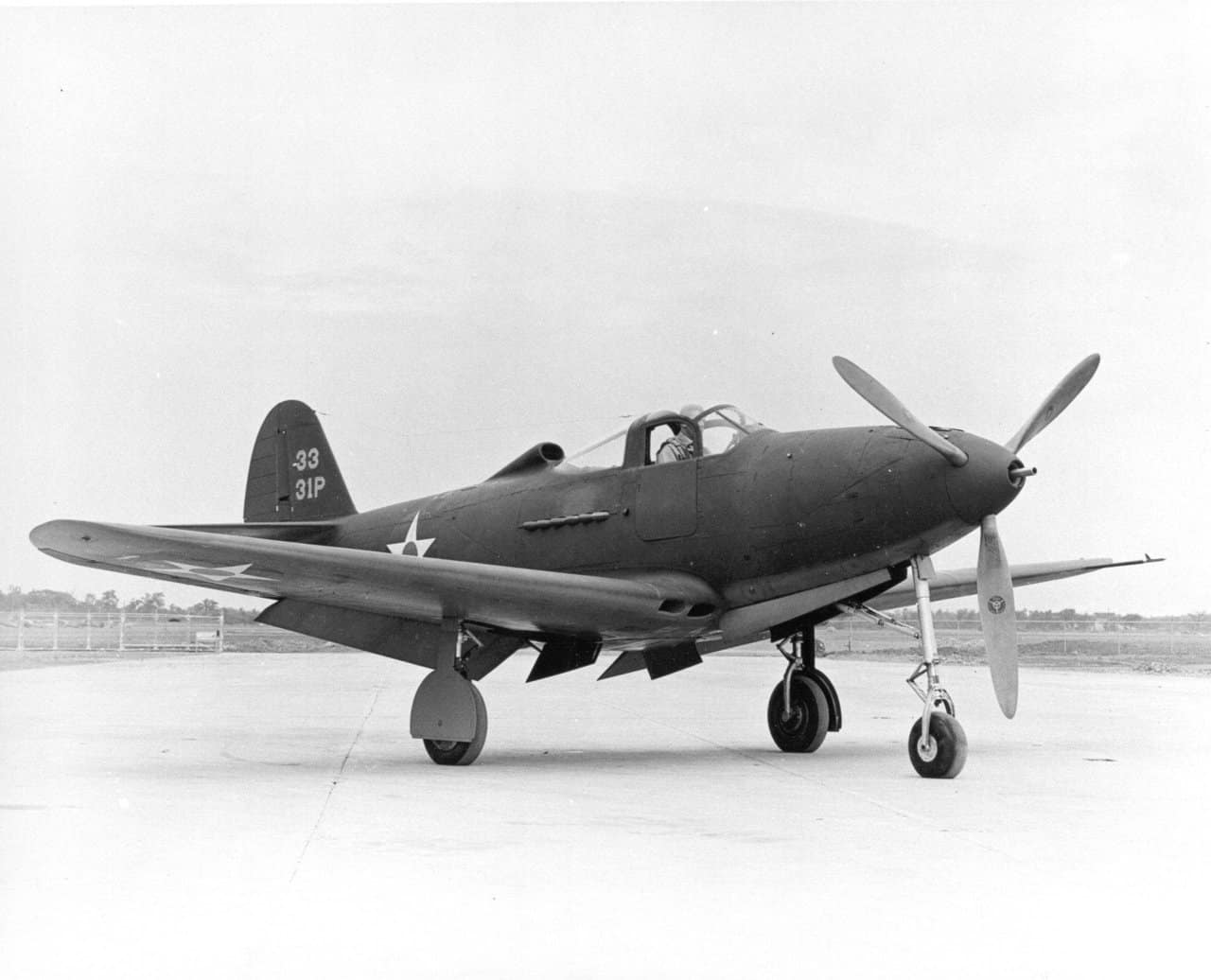
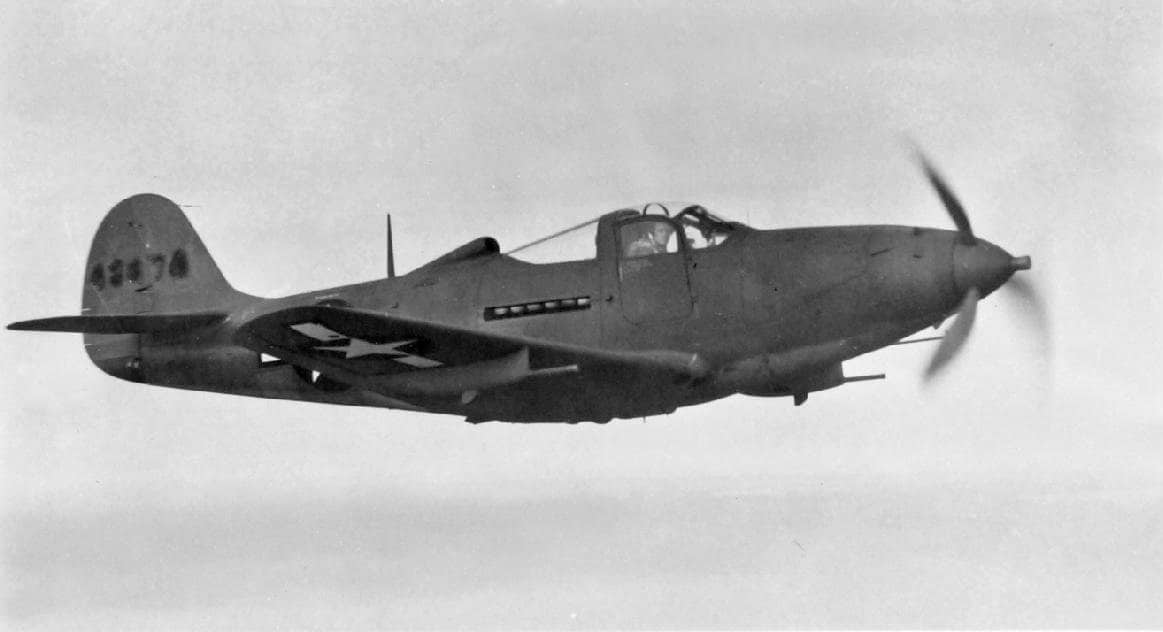
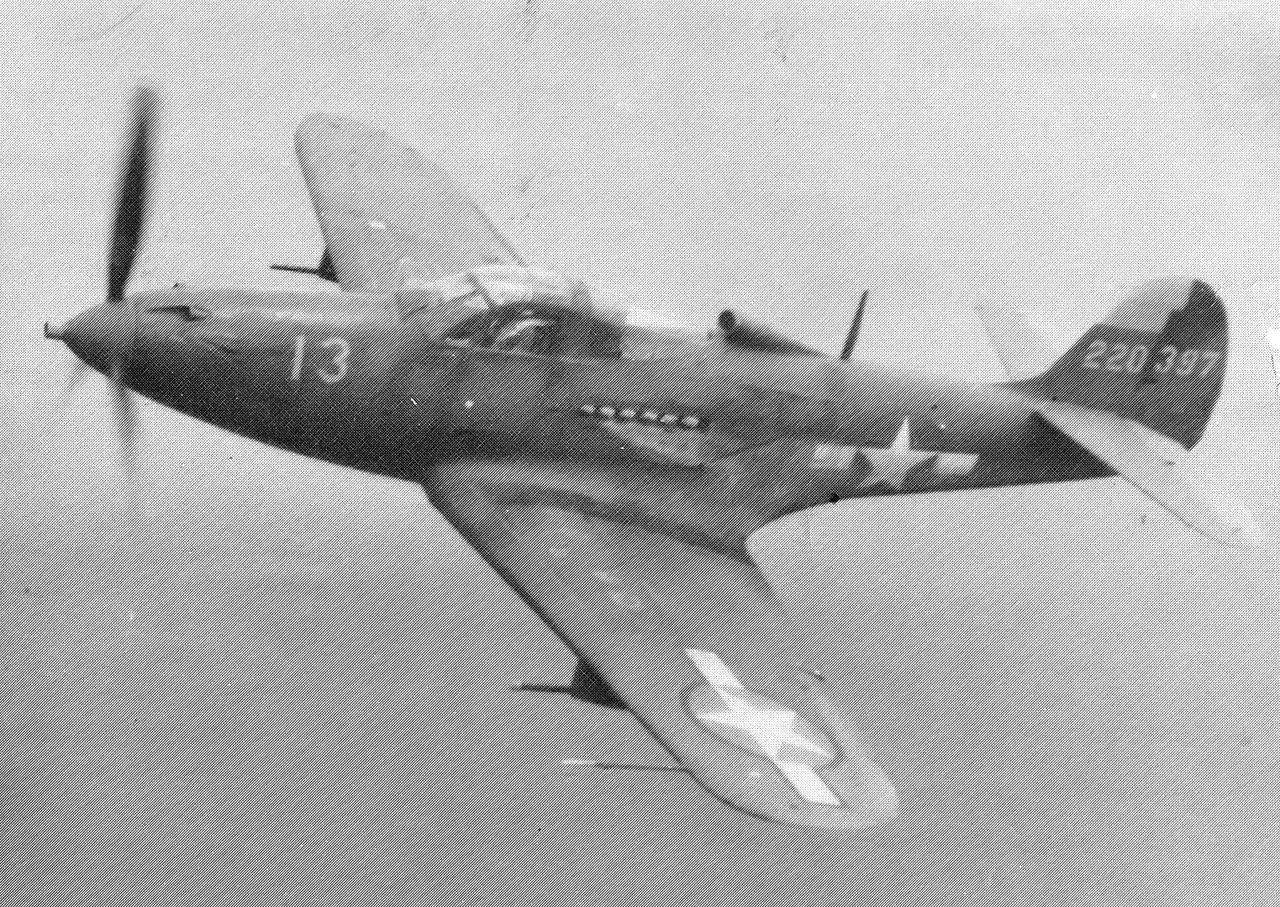
The Bell P-39 Airacobra was a World War II fighter built around a 37 mm cannon, with its Allison V-12 engine mounted behind the pilot and a long drive shaft running to the propeller. It was the first fighter with a tricycle landing gear. The U.S., Britain, Italy and France flew it, and the Soviet Union took about half of all production.
Live Fleet Activity (P39)
Fetching live data…



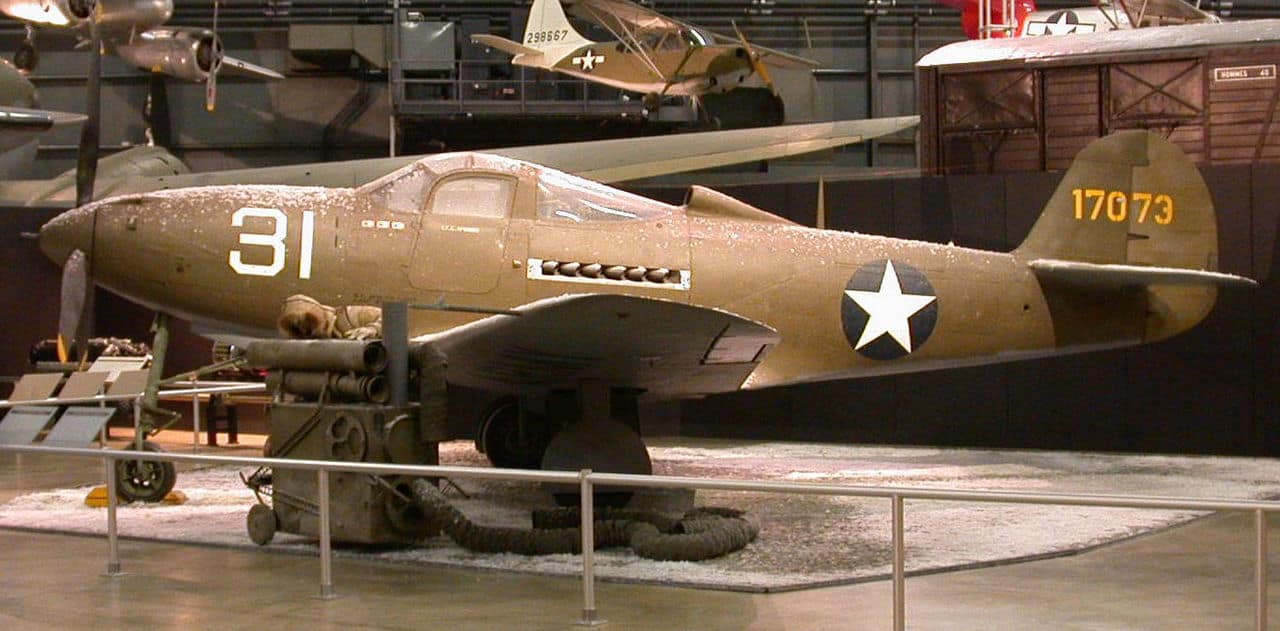
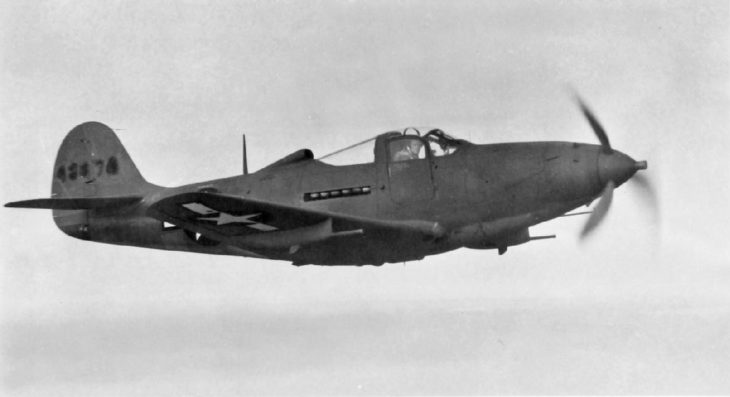
In February 1937, Lt. Benjamin Kelsey and Capt. Gordon Saville of the U.S. Army Air Corps issued Circular Proposal X-609 for a single-engine, high-altitude “interceptor.” It called for a cannon, a turbo-supercharged Allison engine, tricycle landing gear, at least 360 mph at altitude and a climb to 20,000 feet in six minutes.
It was the most demanding fighter specification the Air Corps had written up to that point.
Bell’s answer put the Allison V-12 in the middle of the fuselage, just behind the cockpit. A long drive shaft ran under the pilot’s seat to a gearbox in the nose that turned the propeller.
The reason was the weapon. H.M. Poyer, the designer working for project leader Robert Woods, wanted the 37 mm T9 cannon to fire through the center of the propeller hub, where it would be most accurate and stable. The gun was 90 inches (2.3 m) long and weighed 200 pounds (91 kg), and a nose-mounted engine would have been in its way.
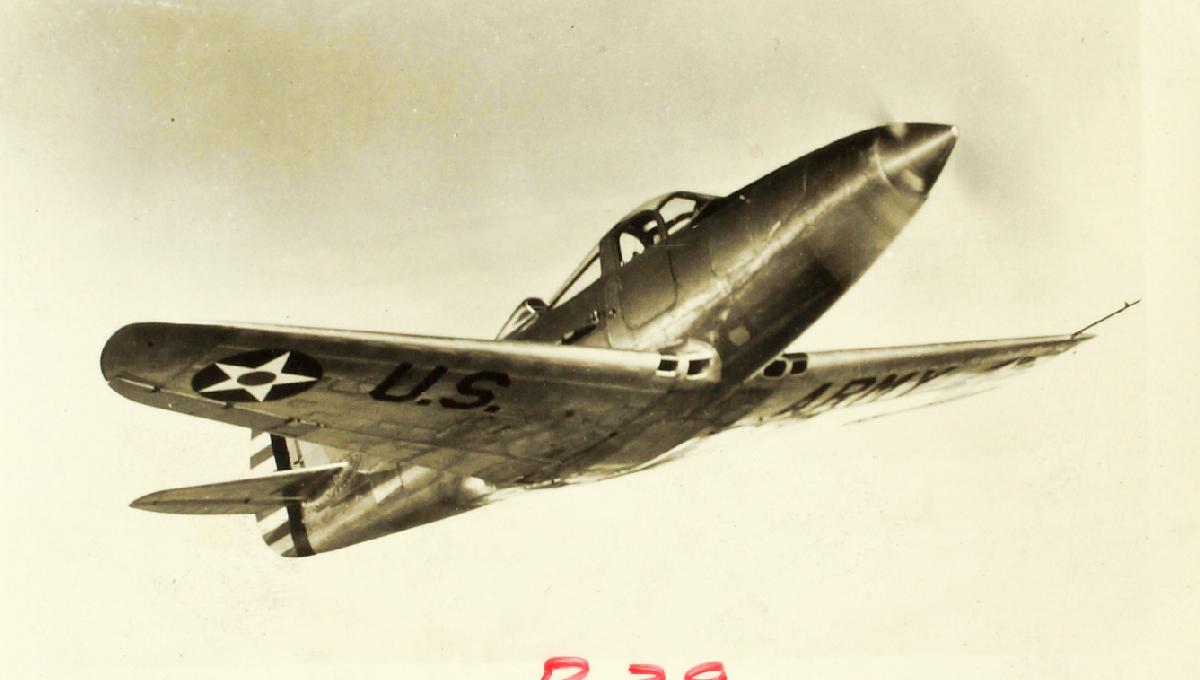
The layout also gave the Airacobra a smooth nose and a high seat with a good view. It was among the first fighters with tricycle landing gear.
The XP-39 prototype first flew on April 6, 1938, at Wright Field, Ohio. It reached 390 mph at 20,000 feet, climbing there in five minutes.
Some references, including the Air Force museum’s fact sheet, give 1939 for the first flight. Wikipedia notes that the evidence favors 1938.
The prototype carried a General Electric turbo-supercharger, as the Army had specified. In 1939, NACA wind-tunnel tests found the installation cluttered and draggy, and no internal space had been left for a tidier one.
At a meeting in August 1939, company founder Larry Bell proposed building the production P-39 without the turbocharger.
Historians disagree on why. One theory is that Bell’s factory had no active production program and he needed cash flow. Another is that the wind-tunnel results convinced the designers the turbocharger cost more in drag than it earned.
The production fighter kept a single-stage, single-speed supercharger with a critical altitude of about 12,000 feet (3,700 m). The Air Force museum says the P-39 performed best below 17,000 feet (5,200 m), and that gap decided most of its career.
Kelsey later said he regretted not being there to override the decision.
The Army placed its first order, for 80 aircraft, on August 10, 1939. The type was briefly designated the P-45 before it went back to P-39C.
Only 20 were built as P-39Cs, because they had no armor or self-sealing fuel tanks. The other 60 became P-39Ds with both, plus shackles for a 500 pound (227 kg) bomb or a drop tank.
The P-39D was the first Airacobra to enter Army service and the first to see action.

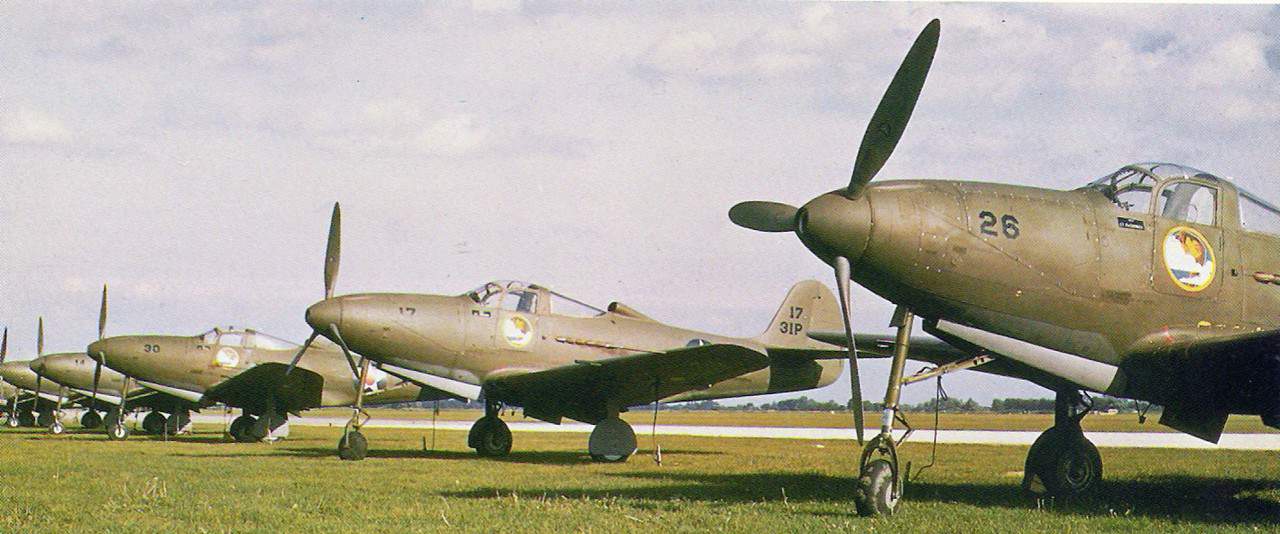
Nearly 600 Airacobras had been built by the time of Pearl Harbor. The considerably improved N and Q models made up about 75 percent of production.
The P-39Q was the last major production variant. NOAA gives its production as 4,905 aircraft between 1943 and 1944.
Early Qs carried 87 US gallons of internal fuel, and the later Q-5 and Q-10 carried 120. Some Qs built for the Soviet Union left the wing guns off entirely.
When production ended in August 1944, the Air Force museum counts 9,584 Airacobras built. Other tallies run a few aircraft higher, since the sources do not agree to the last airframe.
The design lived on in the Bell P-63 Kingcobra, which kept the engine-behind-the-pilot layout. A naval version, the XFL-1 Airabonita, first flew on May 13, 1940, with a tailwheel, and was rejected.
The Air Force museum lists the standard P-39Q armament as one 37 mm cannon firing through the propeller hub and two .50 caliber machine guns in the nose. Two more .50s sat in packets under the wings, and the fighter could carry 500 pounds (227 kg) of bombs externally.
The P-39D had four .30 caliber guns in its wings instead of the two .50 packets.
The British export version, the Airacobra I, swapped the 37 mm gun for a 20 mm Hispano-Suiza cannon and used .303 caliber guns in the wings.
The 37 mm M4 hit hard but had limited ammunition, only 30 rounds. It also had a low rate of fire and was prone to jamming.

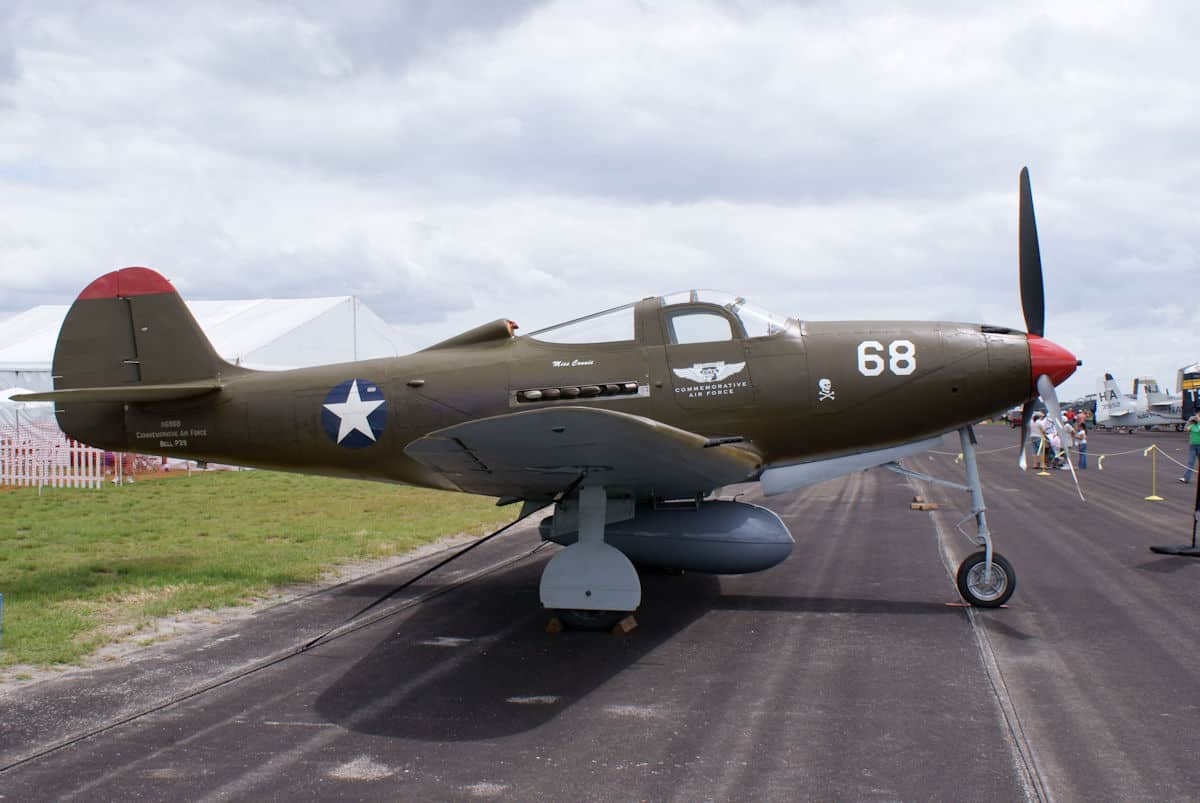
The Airacobra had no sliding canopy. The pilot climbed in through a car-style door on each side, and the roof was fixed.
That made escaping an aircraft in trouble hard. RAF evaluators noted that the cockpit roof could not be jettisoned.
Pilots also worried at first about having an engine right behind them. The Air Force museum says experience showed it was no more of a hazard in a crash landing than a nose-mounted engine.
The bigger reputation was tumbling. Pilots reported that in certain maneuvers the P-39 tumbled end over end, and Bell’s own test pilots made 86 attempts to reproduce it without success.
In the 1970s, NASA tested a model of the P-39 in the Langley Research Center 20 foot Free-Spinning Tunnel. It tumbled only when ballasted as if the nose ammunition had been fired off, which moved the center of gravity aft.
The flight manual told pilots to ballast the front ammunition compartment for that reason. The Air Force museum adds that spins could be a problem if pilots ignored the proper recovery technique. The tumbling stories had more to do with how the aircraft was loaded than with a hidden flaw.
The full specification table for the aircraft is on this page, and it describes the P-39Q. A few of its figures need context.
The panel gives a top speed of 338 kt · 389 mph · 626 km/h. The Air Force museum’s P-39Q sheet says 376 mph, and its cruising speed is 217 kt · 250 mph · 402 km/h. Published speeds differ by source and test conditions, so read 376 to 389 mph as the range.
The range is listed as 565 nm · 650 mi · 1,050 km. Wikipedia gives 525 miles on internal fuel, which is lower, and the gap is mostly drop tanks.
The fuselage had no room for fuel, so the standard load rode in the wings. Drop tanks extended the range, and the P-39D was fitted with shackles for them.
The service ceiling of 35,000 ft · 10,700 m says what the airframe could reach, not where it fought. With the supercharger giving up around 12,000 feet (3,700 m), most P-39 combat took place far below it.
Stall speed, which the panel does not carry, was 95 mph with the power off and the flaps and landing gear down.
Britain ordered 675 aircraft in 1940, first as the Bell Model 14 “Caribou.” The Royal Air Force renamed it the Airacobra in 1941.
British expectations were built on the unarmed, unarmored prototype. The contract guaranteed 394 mph, give or take 4 percent, and production aircraft managed only 371 mph at 14,090 feet in acceptance testing.

No. 601 Squadron received its first two on August 6, 1941. On October 9, four of them attacked enemy barges near Dunkirk, the only operational action the type ever flew with the RAF.
The RAF found its climb and altitude performance inadequate for western Europe. Only 80 aircraft were operated, all by 601 Squadron, which went back to the Supermarine Spitfire in March 1942.
About 200 of the British aircraft went to the Soviet Union.
After Pearl Harbor, the U.S. took over about 200 aircraft from the British contract and designated them P-400. Airacobras first fought Japanese Zeros on April 30, 1942, in a low-level action near Lae, New Guinea.
They also served with the Cactus Air Force at Guadalcanal, where they were deadly in strafing and bombing runs on Japanese troops trying to retake Henderson Field.
By the end of 1942, Fifth Air Force P-39 units had claimed about 80 Japanese aircraft and lost a similar number of their own. Pacific pilots joked that a P-400 was a P-40 with a Zero on its tail, a nod to the Curtiss P-40 Warhawk.
Lt. Bill Fiedler is usually named as the only American pilot to become an ace in the type.
From September to November 1942, the 57th Fighter Squadron flew P-39s and P-38s from a field on Adak Island in the Aleutians. The Air Force museum says the weather killed more of its people than the Japanese did.
In the Mediterranean, the 99th Fighter Squadron, the Tuskegee Airmen, flew P-39s from February 1944 for a few weeks, supporting Operation Shingle at Anzio.
The 81st and 350th Fighter Groups flew maritime patrol with the type from North Africa and Italy. The 350th began changing to the P-47D in August 1944.
The P-39Q was also a training aircraft. NOAA records that on April 11, 1944, Second Lt. Frank Moody’s P-39Q crashed during a gunnery exercise over Lake Huron, about four miles north of Port Huron, Michigan.
NOAA divers have since photographed the wreck and built a photogrammetry model of the wing.
The Soviet Union received 4,773 Airacobras through Lend-Lease, according to the Air Force museum. That is roughly half of everything Bell built, and most were N and Q models flown in over the Alaska-Siberia ferry route.
The Eastern Front was mostly fought at medium and low altitudes, so the P-39’s weak spot hardly mattered. Sturdy construction, good radios and heavy firepower did.
Soviet pilot Nikolai Golodnikov called the lightweight Q-5 “the best fighter I ever flew.”
The Soviets modified their aircraft. Pilots removed the wing machine guns to improve the roll rate, keeping the cannon and two nose guns, and nicknamed the fighter Kobrushka, “little cobra.”
They complained about the cannon’s rate of fire, about three rounds per second, and about the 30-round magazine.
Soviet pilots used group tactics and scored heavily against Junkers bombers and Stukas, and matched early and mid-war Messerschmitt Bf 109s. Aleksandr Pokryshkin scored 47 of his 59 victories in P-39s, and Grigoriy Rechkalov had 44 in the type.
Half of the ten highest-scoring Soviet aces logged most of their kills in Airacobras. The last Soviet air victory of the war came in one, when Capt. Vasily Pshenichikov shot down a Focke-Wulf Fw 189 over Prague on May 9, 1945.
Soviet Airacobra losses totaled 1,030 aircraft: 49 in 1942, 305 in 1943, 486 in 1944 and 190 in 1945. Two regiments were still flying them in 1949.
One claim needs care. The Air Force museum says Russian pilots appreciated the cannon for ground attack, but Wikipedia argues that this is a mistranslation. The Soviet term for the P-39’s job meant covering the airspace over ground forces, and the armored Ilyushin Il-2 did most of the strafing.
The record is mixed. Soviet P-39s did strafe, but it was never their main mission.
For other fighters the Soviets flew, see our guide to the best Russian WWII fighter planes.
Italy retired its P-39s in 1951. For more on the American fighters of the war, see our list of American fighter planes of WWII.
After the war, Bell test pilots Tex Johnston and Jack Woolams raced modified Airacobras. Johnston’s Cobra II won the 1946 Thompson Trophy, beating P-51s. Woolams was lost in Cobra I over Lake Ontario in 1946.
The U.S. Air Force kept a few late P-39Qs for about a year of training and testing and redesignated them ZF-39Q in June 1948.

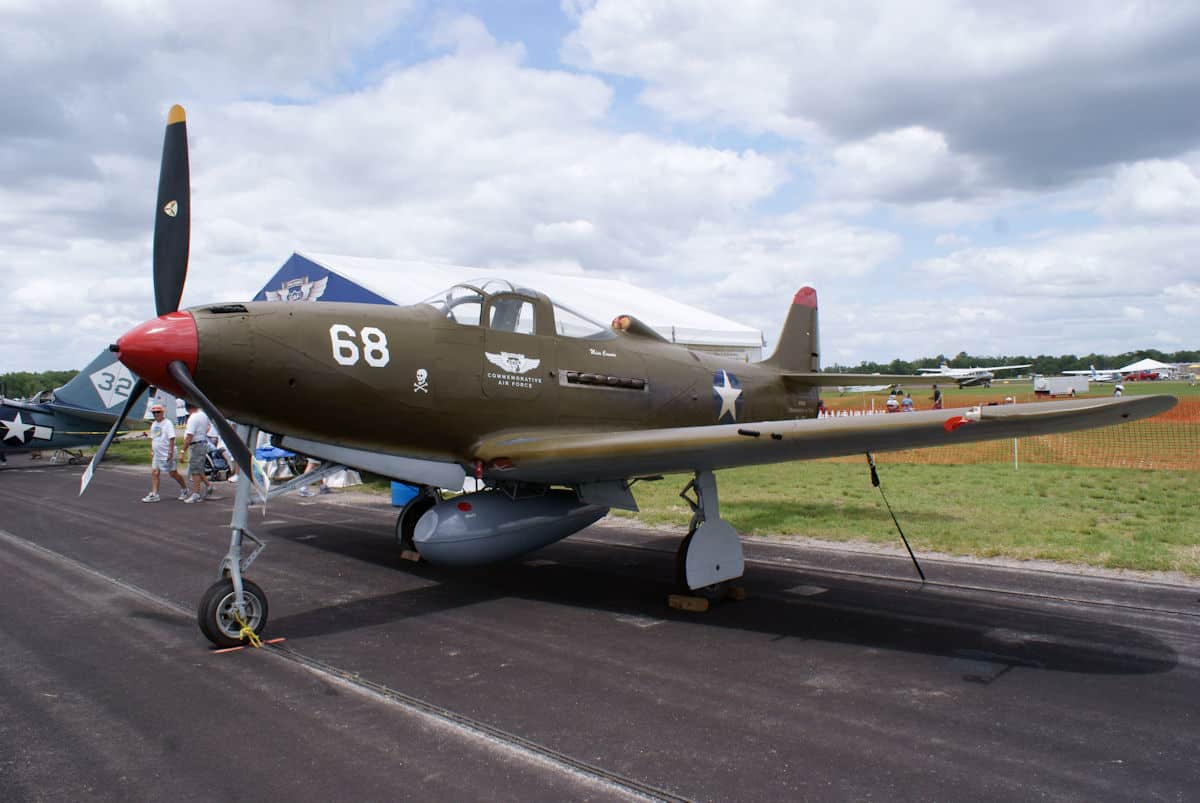
A handful still fly. Wikipedia’s list of survivors names four airworthy examples in the U.S.: a P-39F at the Military Aviation Museum in Virginia Beach, a P-39N at the Yanks Air Museum in Chino, California, and two P-39Qs, “Miss Connie” with the Commemorative Air Force in San Marcos, Texas, and “Brooklyn Bum” with Lewis Air Legends in San Antonio.
The count changes as restorations finish, so check with the owners before planning a trip.
The P-39Q at the National Museum of the U.S. Air Force in Dayton, Ohio, is painted as the P-39D flown by Lt. Leslie Spoonts of the 57th Fighter Squadron on Adak. The museum acquired it from Hardwick Aircraft Co. of El Monte, California, in 1966.
It depended on the altitude. Below about 17,000 feet it was sturdy, heavily armed and well liked by its Soviet pilots. Above that, with no turbocharger, it fell behind its rivals, which is why the RAF rejected it and the USAAF moved it to other roles.
A handful. Wikipedia’s list names four airworthy examples in the United States, and the count changes as restorations finish, so check with the owners.
Most air combat on the Eastern Front took place at medium and low altitudes, where the P-39 was at its best. Soviet pilots also valued its sturdy build, reliable radio, good visibility and the heavy hitting cannon.
No verified total exists. Wikipedia says Soviet pilots racked up the highest number of victories attributed to any U.S.-built fighter type, but these are claims, not confirmed enemy losses. Aleksandr Pokryshkin alone claimed 47 of his 59 victories in P-39s.
To make room for a 37 mm cannon firing through the propeller hub. The engine sat behind the cockpit and drove the propeller through a long drive shaft under the pilot’s seat.
The Airacobra’s rate of climb and altitude performance were inadequate for western Europe, and the cockpit roof could not be jettisoned. Only 80 were operated, all by No. 601 Squadron, and the RAF dropped the type after one operational action in October 1941.
Pilots reported it, but Bell’s test pilots could not reproduce it in 86 attempts. A 1970s NASA tunnel test found a model tumbled only when its nose ammunition was removed, which shifted the center of gravity aft.
The P-400 was the name the USAAF gave to about 200 aircraft built for the British contract and taken over after Pearl Harbor. They fought in the Southwest Pacific, including at Guadalcanal.
Sources and references used for research and fact-checking.


.jpg)