Military Propellor Planes
Bell P-39 Airacobra
ICAO: P39
The mid-engine Bell fighter the U.S. Army passed over and the Soviet Union flew.
Updated: by Tim de Vries
The latest aviation news and stories sent to your inbox.
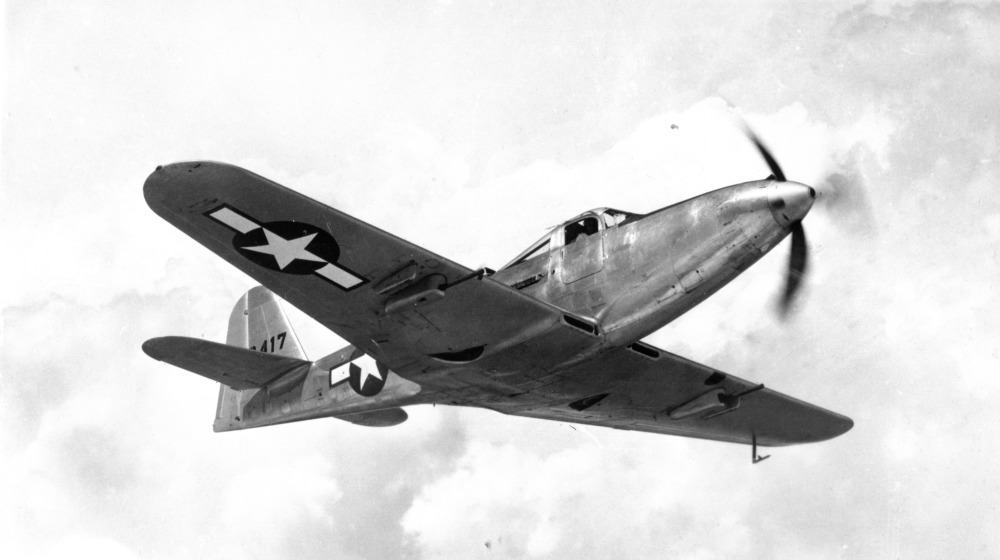
The Bell P-63 Kingcobra was a mid-engine, single-seat fighter developed from the P-39 Airacobra. It first flew on December 7, 1942, and the U.S. Army Air Forces judged it inferior to the P-51 Mustang and never used it in combat. More than 70 percent of the 3,303 built went to the Soviet Union under Lend-Lease, and the Americans used theirs mostly as flying gunnery targets.
Live Fleet Activity (P63)
Fetching live data…


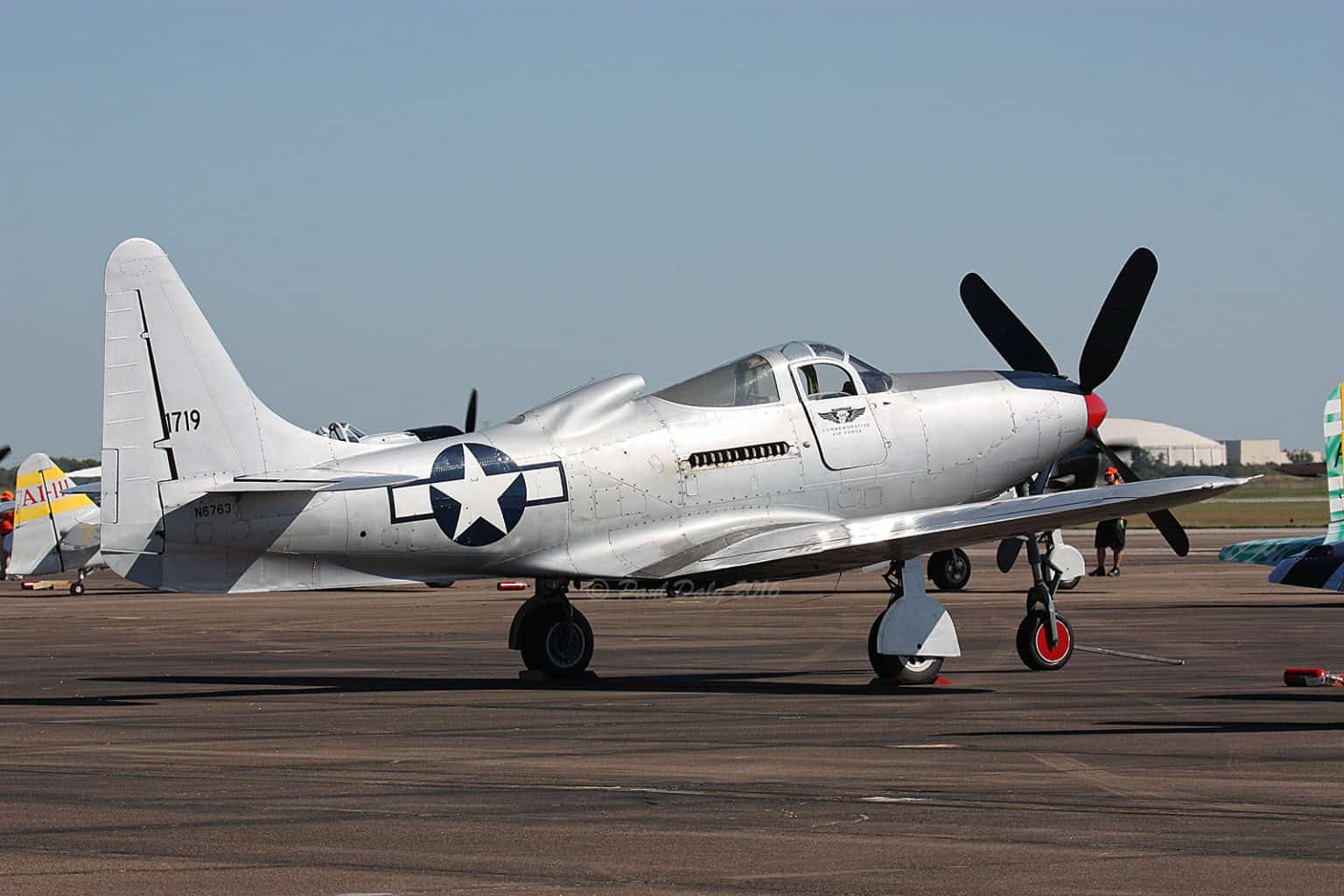


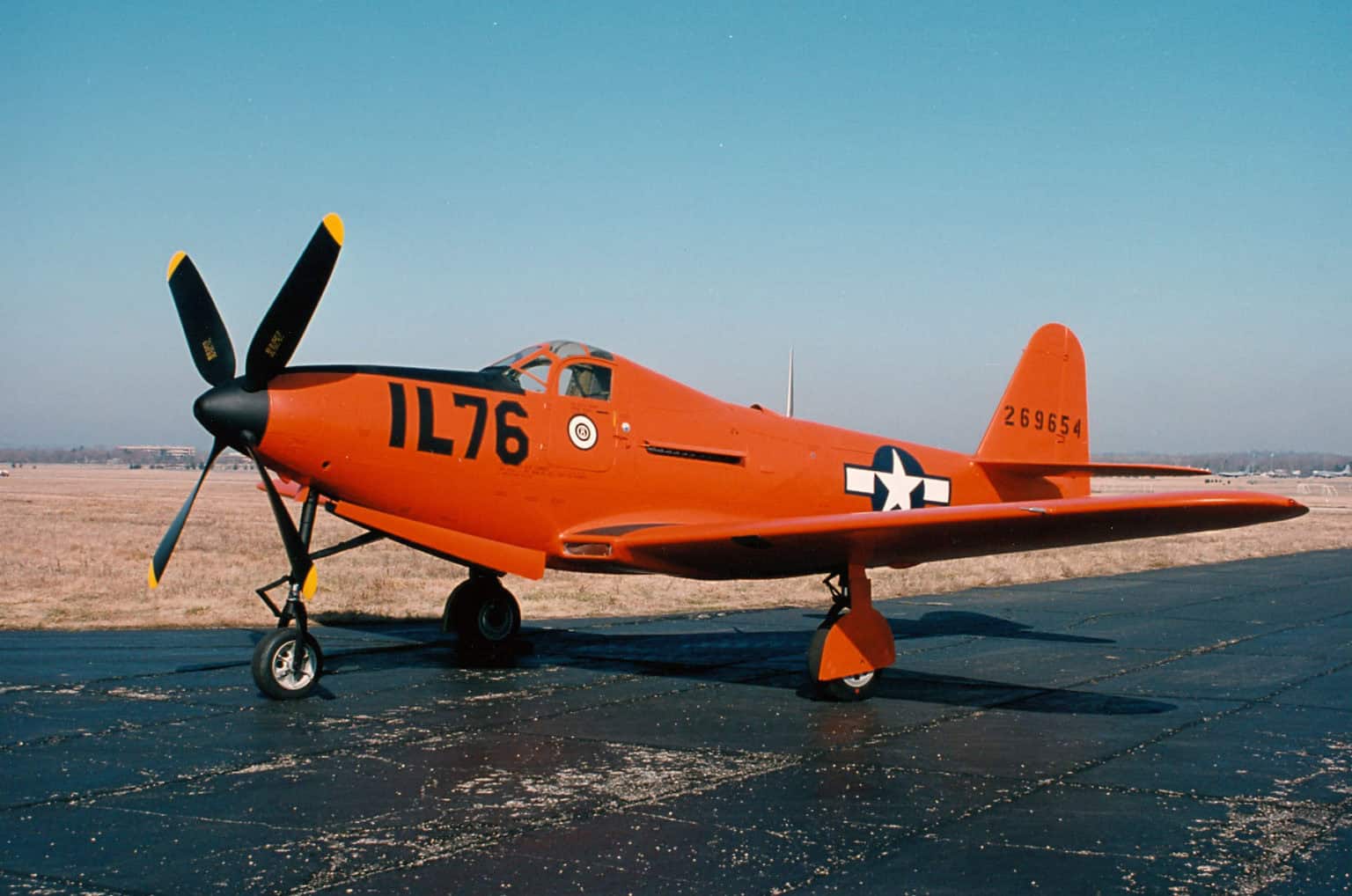


The Bell P-63 Kingcobra was a mid-engine, single-seat fighter that grew out of the P-39 Airacobra. It first flew on December 7, 1942, and was faster and more capable at altitude than the plane it replaced.
It was still not wanted. The U.S. Army Air Forces judged it inferior to the P-51 Mustang and never used it in combat, so more than 70 percent of the 3,303 built went to the Soviet Union under Lend-Lease.
Most of the rest ended up as something stranger: orange-painted flying targets that bomber gunners shot at with bullets designed to disintegrate on impact.
The “P” stands for pursuit. That was the American term for a fighter until the late 1940s, which is why the P-40 Warhawk, P-47 Thunderbolt and P-51 all carry it.
The number identifies the specific type. The aircraft is usually written Kingcobra, and many museums spell it “King Cobra.” Bell’s own company designation for the production design was Model 33, and the ICAO type code is P63.
The two aircraft look nearly identical, but the Pima Air & Space Museum notes they share no parts. The Kingcobra is larger in every dimension and uses a laminar flow wing, the same kind of low-drag wing section found on the P-51.
The layout is the Bell signature. The Allison V-1710 engine sits in the fuselage behind the pilot, with a driveshaft running under the cockpit floor to the propeller. The pilot enters through car-style doors, and the landing gear is a tricycle arrangement.

Bell added a second, remotely mounted supercharger that a hydraulic clutch brought in at higher altitudes. According to Wikipedia’s account of the design, it raised the service ceiling, which was the P-39’s weak point.
Development was not smooth. The first XP-63 flew on December 7, 1942, and was destroyed on January 28, 1943, when its landing gear failed to extend. The second prototype flew on February 5, 1943, and was lost to an engine failure.
A third prototype was meant to take a Packard-built Rolls-Royce Merlin, but Merlins were needed for the Mustang. It flew with an Allison instead and became the XP-63A. The Army ordered the production P-63A in September 1942 and deliveries began in October 1943.
The P-63A used the Allison V-1710-93, a liquid-cooled V-12 rated at 1,325 hp (988 kW) at sea level. It drove a four-blade propeller.
The main weapon was a 37 mm cannon that fired through the propeller hub. Early aircraft used the M4 with a 30-round magazine, and from the P-63A-9 block the improved M10 fed from a belt with 58 rounds.
Two .50 caliber machine guns sat in the upper nose and fired through the propeller arc. Two more were carried in underwing gondolas.
Under the fuselage and wings the aircraft could carry bombs or drop tanks, for a bomb load of up to 1,500 pounds (680 kg). Later blocks added underwing racks and rocket rails.
The Army Air Forces tested the P-63A and concluded it was no match for the Mustang. Pima’s museum notes sum it up as still inferior to the fighters then in production, so very few Kingcobras entered U.S. service. For the fighters that did carry the load, see American fighter planes of WWII.
The numbers explain it. Wikipedia’s P-51D block lists a top speed of 440 mph, a range of 1,650 miles with external tanks and a 41,900 foot service ceiling. The P-63A’s top speed is 410 mph (659 km/h) and its range is 450 miles (720 km).
Range was the real gap. The P-51 could escort bombers deep into Germany, while the Kingcobra was a short-legged fighter built around a heavy cannon.
The P-63 did have strengths. Wikipedia cites a roll rate of 110 degrees per second at 275 mph, better than the P-47, P-40 and P-51 in the comparison it quotes, and the Soviets valued its toughness and radios.
With the U.S. Army Air Forces, no. P-63s flew training missions in the United States, and the Army never sent them overseas.
With the Soviet Air Force, yes. The Soviets flew many Russian fighters alongside their Lend-Lease aircraft, and Wikipedia counts 2,397 delivered to the USSR, 72.6 percent of production, though other sources run as high as 2,672.
American ferry pilots, including members of the Women Airforce Service Pilots, flew new aircraft from the Bell plant at Niagara Falls, New York, toward Alaska. Soviet ferry pilots, many of them women, took delivery there and flew them across the Bering Strait.
The Soviets also shaped the aircraft. In February 1944 test pilot Andrey Kochetkov and engineer Fyodor Suprun visited the Bell factory. Kochetkov’s spin tests showed a flat spin could not be recovered, and he recommended pilots bail out of one.
The result was a more forward center of gravity, and Soviet input also led to more pilot armor and the larger cannon ammunition load of the P-63A-9.
The first official Soviet P-63 air victory came on August 15, 1945, when Lieutenant I. F. Miroshnichenko of the 17th Fighter Aviation Regiment shot down a Nakajima Ki-43 off northern Korea. The Kingcobras flew escort, close support and ground attack in the invasion of Manchuria.
Whether P-63s fought the Luftwaffe is disputed. Some Soviet and German accounts say yes, including the pilot Hans-Ulrich Rudel’s memoir, but official Soviet records do not show P-63s used in Europe.
Older reference sheets, including the U.S. Air Force museum’s, describe the Kingcobra as a Soviet tank buster. Historian James Gebhardt, quoted in Wikipedia’s article, argues that was a mistranslation.
The Russian phrase prikrytiye sukhoputnykh voysk means “coverage of ground forces,” which was fighter cover over the front, not strafing tanks. A Soviet pilot may have hit a tank, Gebhardt wrote, but it was never the main job.
Sufficient aircraft stayed in service after the war to earn the Western reporting name “Fred.” A figure for May 9, 1945 shows 1,148 Kingcobras still on Soviet strength.
France received later production aircraft in 1945, too late for the war. Wikipedia counts 114 delivered, while History of War says 300 were allocated and 150 to 200 taken on charge.
They fought in the First Indochina War, but only 60 were operational in January 1950 because the Americans refused to supply spare parts. From February 1951 French units began receiving the F8F Bearcat, and the last Kingcobra flight in Indochina was on September 6, 1951.
The United Kingdom’s Royal Aircraft Establishment tested two P-63As, using one in 1945 to study laminar flow. Honduras flew the type after the war.
The Soviets also converted several hundred P-63s into two-seat trainers from 1948, designated P-63U, and flew them until the late 1950s.
The U.S. role for the P-63 was unusual. Bomber gunners needed live-fire practice against a fast fighter, so the Army built manned targets that could take hits.

The RP-63 had its guns and standard armor removed and was covered in duralumin plate. Gunners fired special .30 caliber frangible bullets made of lead and plastic that broke up harmlessly on impact.
Sensors under the skin, 110 microphones on the first version according to History of War, detected hits. A light in the propeller hub flashed whenever a bullet struck, which earned the aircraft the nickname Pinball.
Five P-63As were converted in August 1944, and 95 more RP-63A aircraft were then built as production targets. Another 200 RP-63Cs followed, then 32 RP-63Gs, with 420 more cancelled.
Despite the added weight, Skytamer notes the target version still managed over 300 mph at 25,000 feet.
The P-63A was the main production version, with roughly 1,725 built in blocks that added armor, a belt-fed cannon, underwing racks and water injection. The P-63C, with the Allison V-1710-117 and a ventral fin under the rear fuselage, followed with 1,227 built.
The engine ratings differ between them. The P-63C could reach 1,800 hp with water injection, which is why many websites print that figure beside a P-63A.

Other versions were few. The P-63D was a single aircraft with a bubble canopy and a larger wing, and the P-63E was similar with the standard cockpit and only 13 built. The P-63B, which would have used a Merlin, was cancelled.
After the war Bell converted two P-63Cs into the L-39, a test bed with 35 degree swept wings. It first flew on April 23, 1946, and gathered data used on high-speed wing designs such as that of the Bell X-2.
Surplus Kingcobras also went air racing. Charles Tucker bought two, clipped their wings and entered one in the 1946 Thompson Trophy race.
The full specification table for the aircraft is on this page. A few figures need context because published sources disagree.
The page describes the P-63A. Its top speed is 410 mph (659 km/h) at 25,000 feet, and the service ceiling is 43,000 feet (13,100 m). The later P-63C is quoted at 38,600 feet and the P-63E at 39,000 feet, so figures from different variants should not be mixed.
Engine power is quoted three ways. The panel shows the sea-level rating of the Allison V-1710-93, and the war emergency rating is 1,500 hp. The P-63C figure of 1,800 hp applies only to the later engine.
Climb rate also varies. The panel carries 2,500 feet per minute, the figure in Wikipedia’s specification block, while the Military Aviation Museum prints an initial rate of 3,600 feet per minute. History of War lists 7.3 minutes to reach 25,000 feet.
Range depends on the tanks. The panel’s 450 miles (720 km) is the standard figure, and with a belly tank the Jane’s ferry range was 2,200 miles.
Weights vary too. Empty weight is quoted from about 6,375 to 6,800 pounds depending on the source and the production block.
Very few fly. AVweb described the Palm Springs Air Museum’s Pretty Polly in September 2025 as one of only four airworthy P-63s in the world.
The Yanks Air Museum in Chino, California, flew its P-63A Fatal Fang on November 30, 2023, after roughly four decades on the ground. The Commemorative Air Force’s Airbase Georgia in Peachtree City operates another P-63A, and in July 2026 it was announced for display at EAA AirVenture Oshkosh.
Others are static. The National Museum of the U.S. Air Force owns a P-63E that is on loan to the Pima Air & Space Museum. The Military Aviation Museum in Virginia Beach has a P-63A recovered from the Kuril Islands in 1998 that fought the Japanese in August 1945.
The United Kingdom’s Wings Museum, the Smithsonian’s storage facility and museums in Moscow and Honduras also hold P-63s.
On June 3, 2001, a P-63A crashed during the Biggin Hill Air Fair in London, killing its pilot.
On November 12, 2022, a Commemorative Air Force P-63F collided with a B-17G Flying Fortress during an airshow at Dallas Executive Airport. Six people died: the P-63F pilot and five aboard the bomber. The P-63F was the only surviving example of the two built.
The NTSB found on December 9, 2024, that inadequate planning and a lack of oversight contributed to the collision, including no plan for separating dissimilar aircraft. For more on the bomber’s side, see how many B-17s are still flying.
Not with the U.S. Army Air Forces, which used it for training and as a target. The Soviet Air Force flew it in combat, with the first official victory on August 15, 1945, and the French used it in Indochina.
The P stands for pursuit, the American term for fighter at the time, and the number identifies the type. The P-63 is the Bell Kingcobra, developed from the P-39 Airacobra.
Counts differ, but AVweb called one airworthy example “one of only four” in the world in September 2025. A few more are in museums or being restored, including examples in the United States, Russia, Honduras and the United Kingdom.
It was a World War II fighter built by Bell Aircraft with the engine behind the pilot, a 37 mm cannon firing through the propeller hub and four .50 caliber machine guns. It was developed from the P-39 and first flew in December 1942.
No, and the U.S. Army Air Forces said so. The P-51D was faster and had much longer range, and it entered service in far greater numbers.
The Army Air Forces did not want it, and the Soviet Union was the largest user of the earlier P-39 and needed fighters. Kingcobras were built for delivery under Lend-Lease, and the Soviets also influenced the design.
One 37 mm cannon firing through the propeller hub, two .50 caliber machine guns in the nose and two more in underwing pods. Later blocks carried more cannon rounds and could carry bombs, drop tanks or rockets.
Almost none are available. Surplus P-63s were sold off after the war and some went racing, but the few airworthy survivors today are held by museums and nonprofit groups.
Sources and references used for research and fact-checking.