Fighter Jets
Sukhoi Su-27 “Flanker”
ICAO: SU27
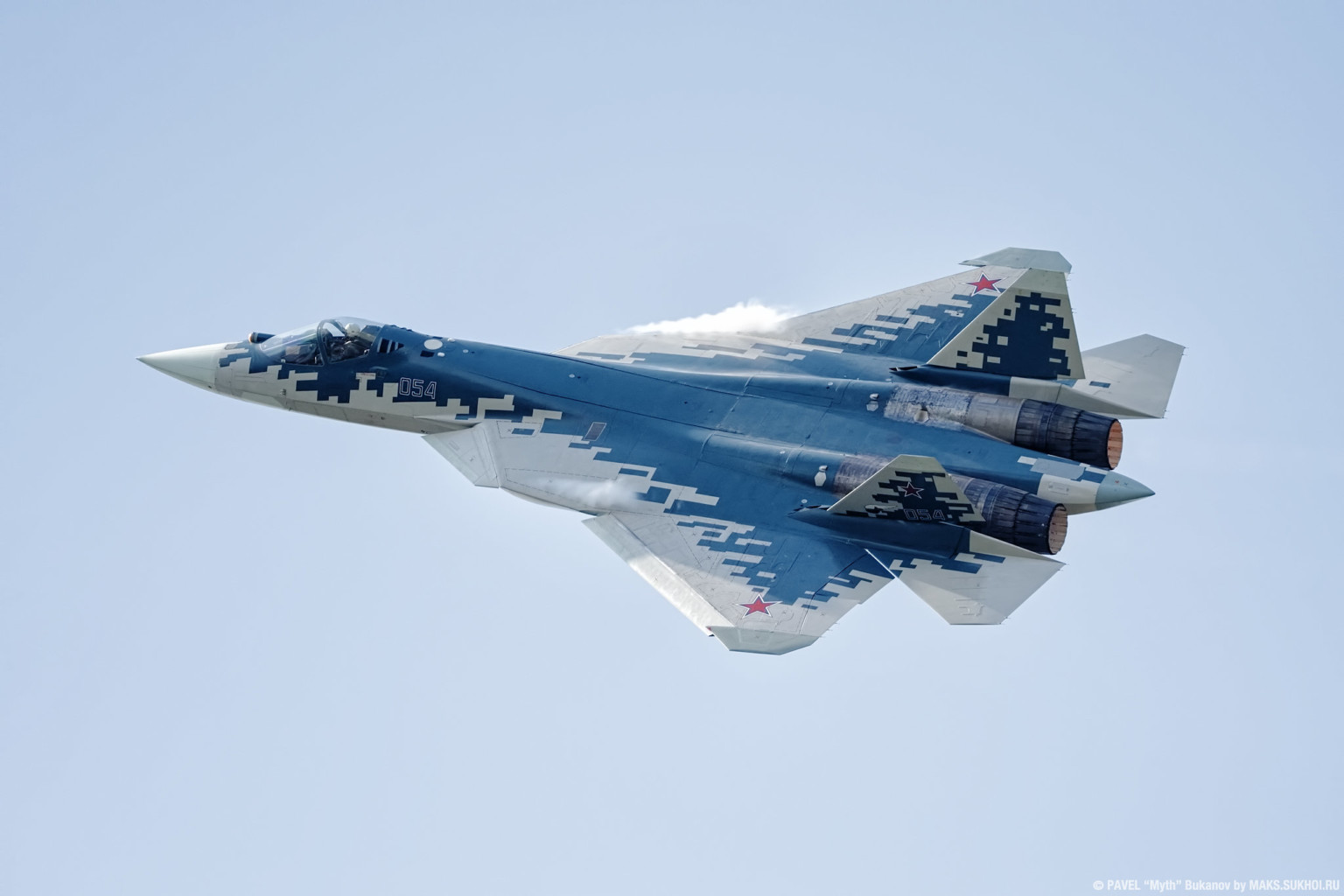
Russia's first stealth fighter, built around supercruise, internal weapons bays, and three-axis thrust vectoring.
Updated: by Tim de Vries
The latest aviation news and stories sent to your inbox.
The Sukhoi Su-57 Felon is Russia’s first combat aircraft designed around stealth from the outset, developed under the PAK FA program and flown as the T-50 prototype in January 2010. It pairs a Mach 2 top speed and Mach 1.3 supercruise with internal weapons bays, an all-aspect sensor suite, and canted thrust-vectoring nozzles. Serial production began in 2019, and at least 44 airframes had been completed by 2026.
Live Fleet Activity (SU57)
Fetching live data…


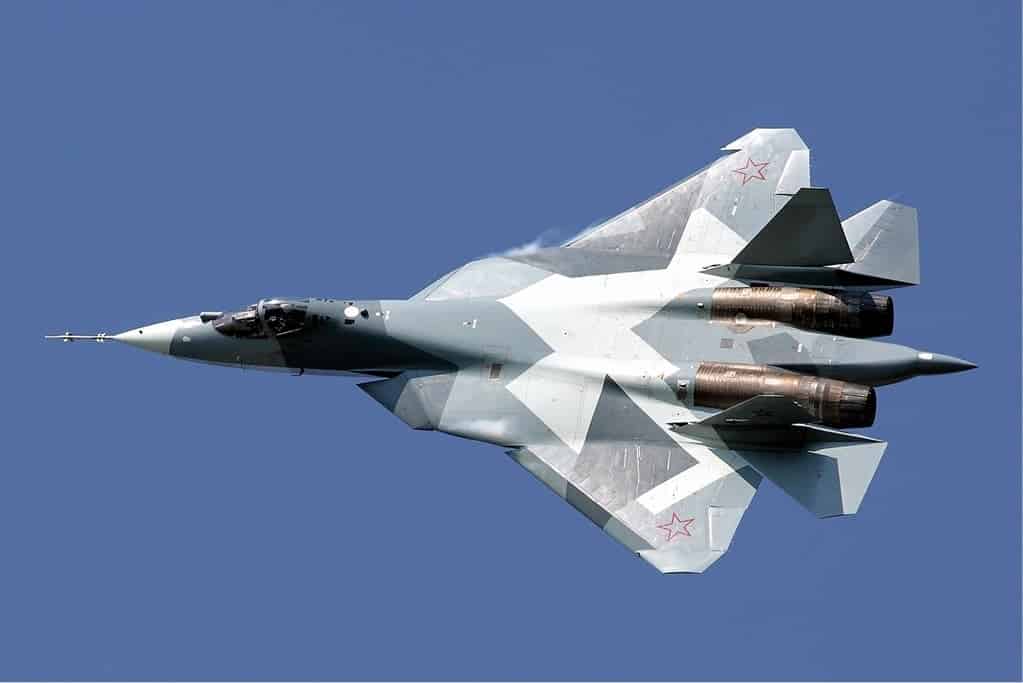


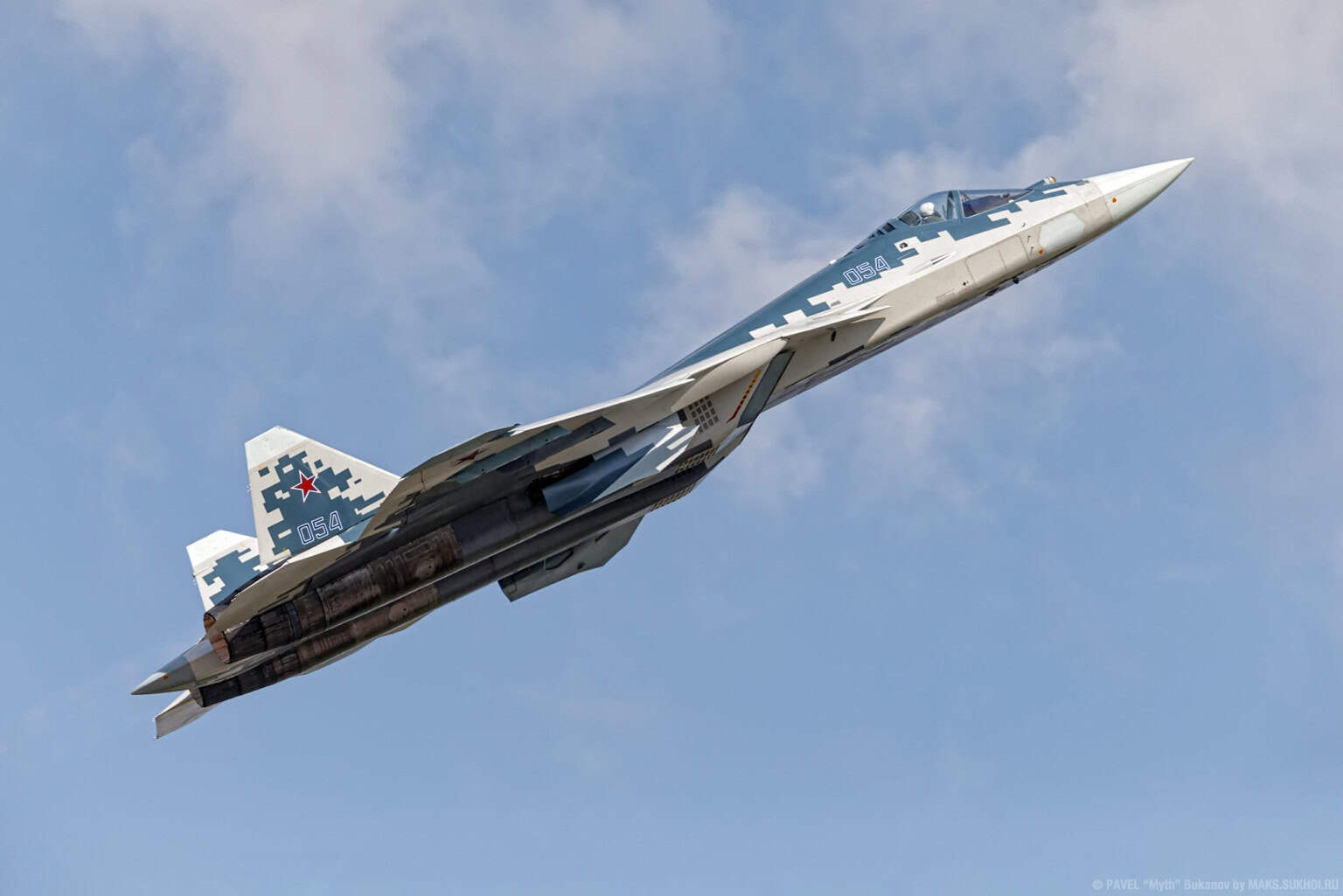
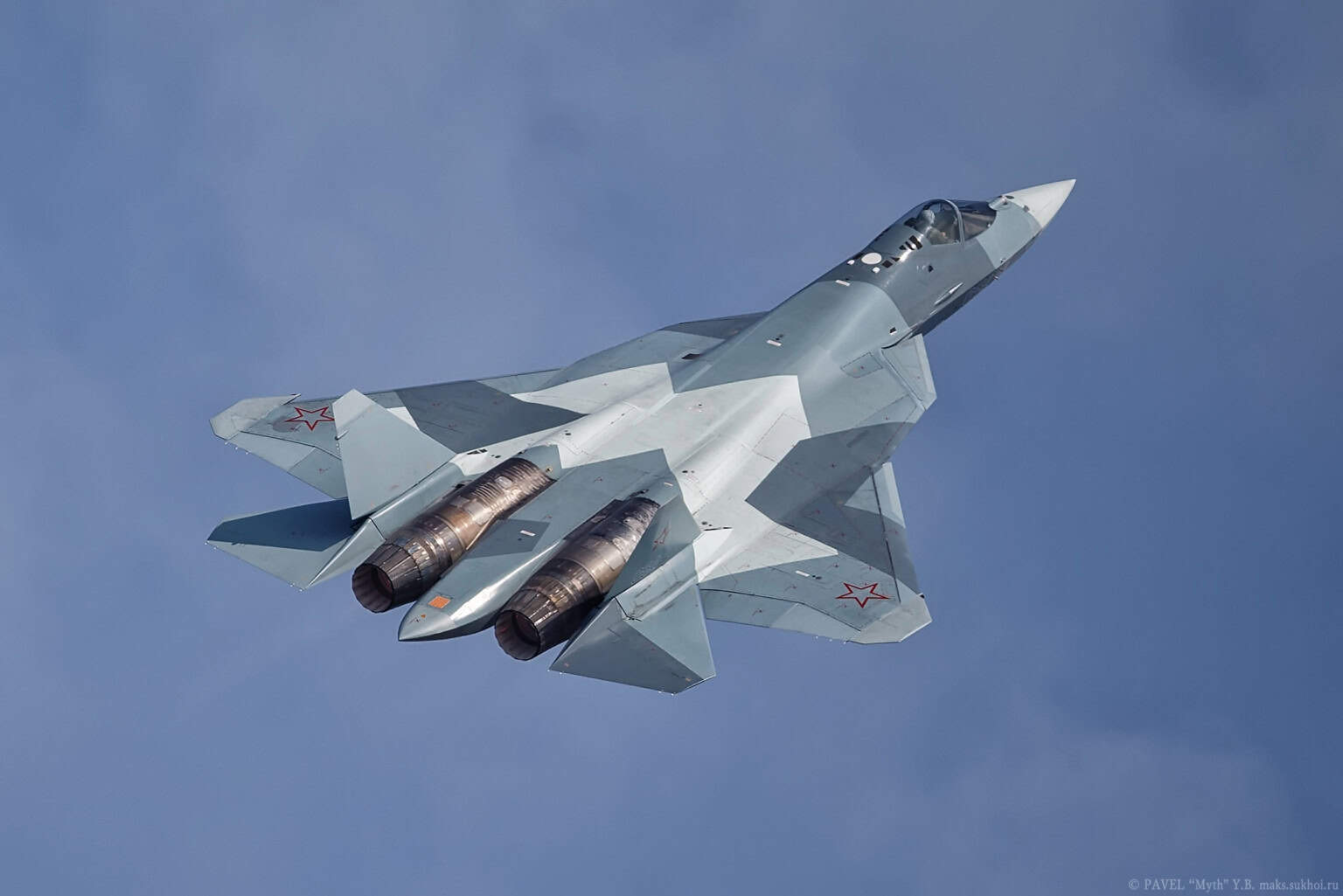

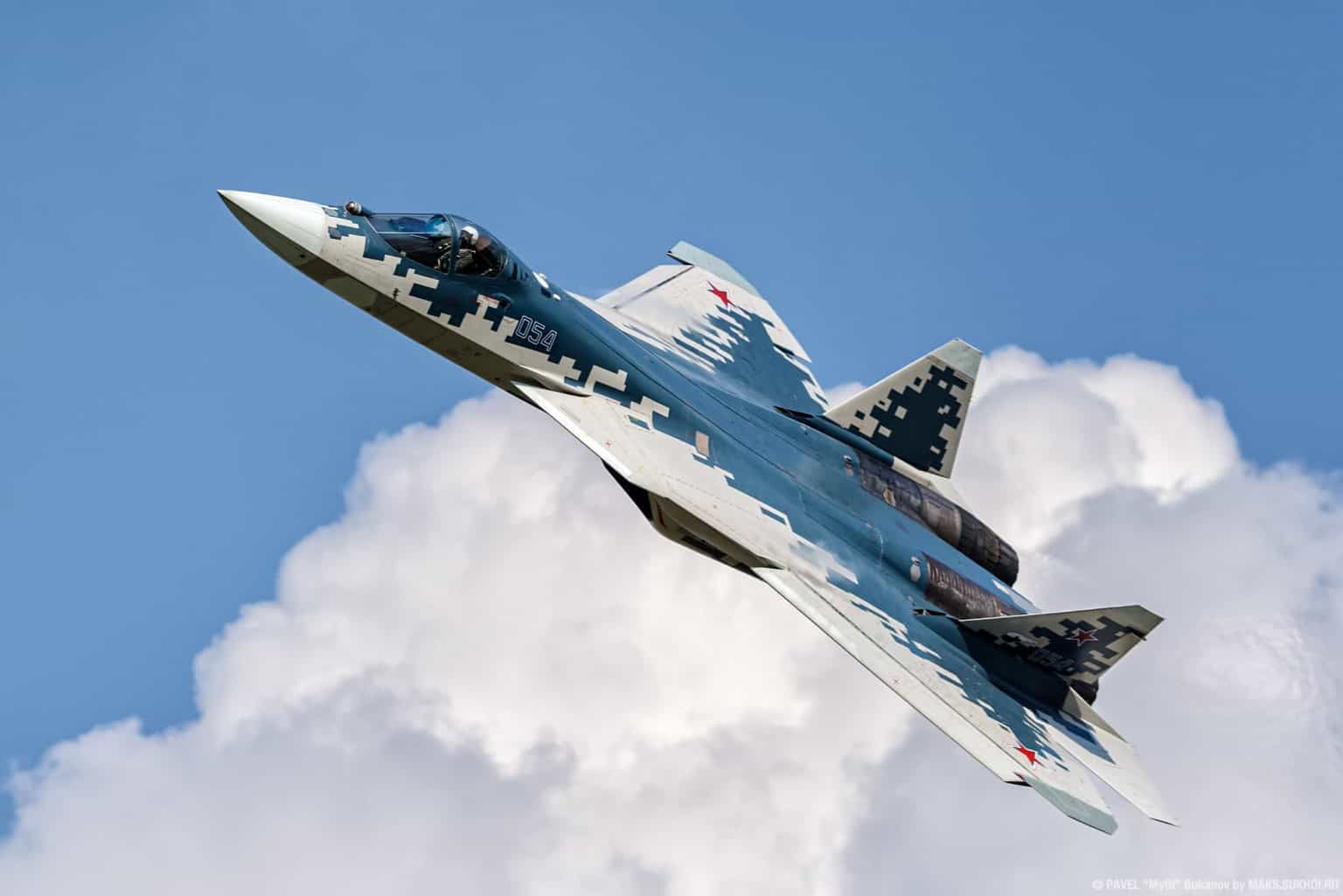
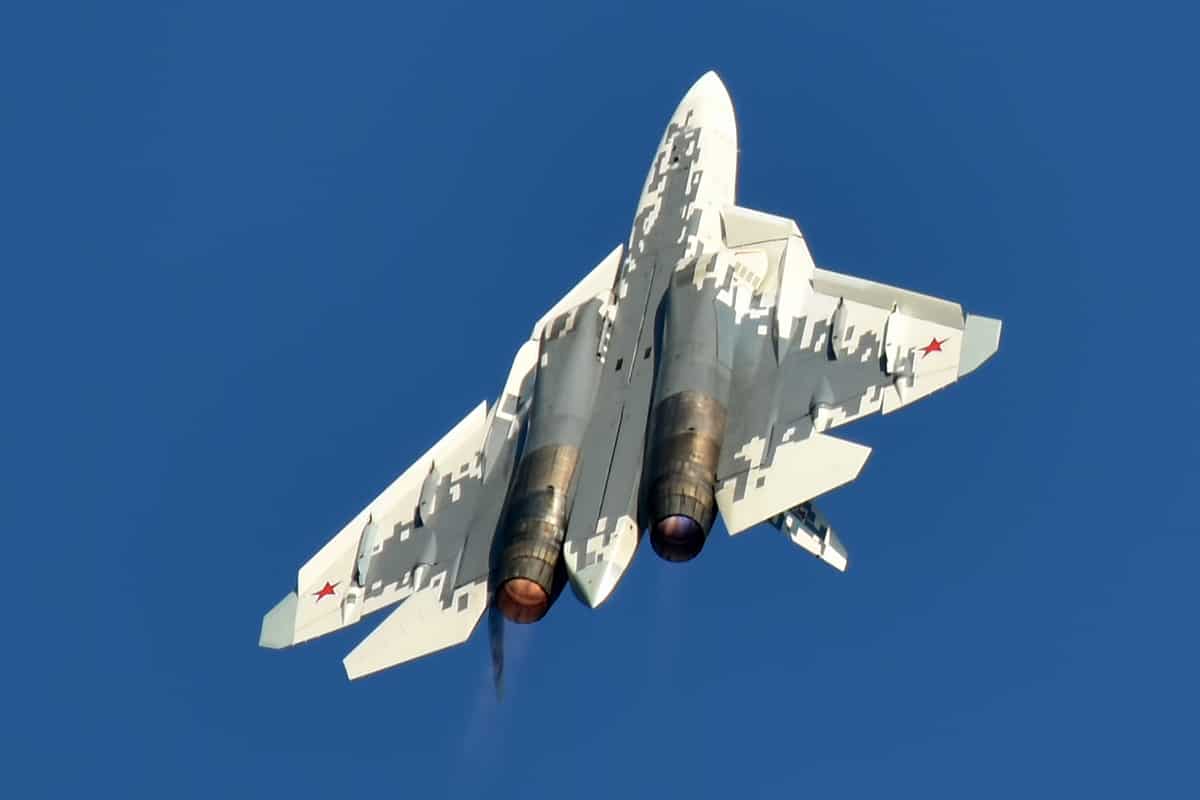

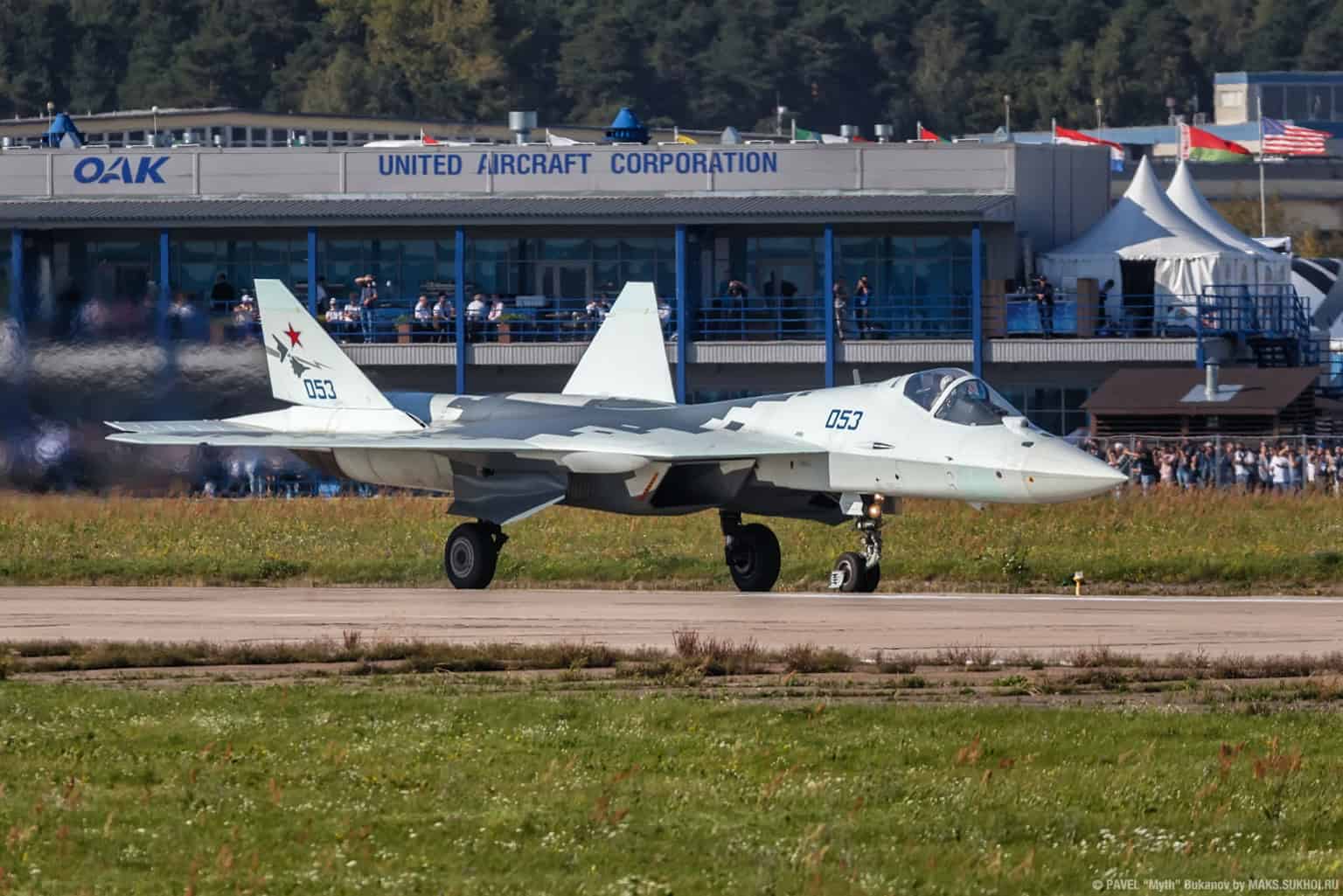

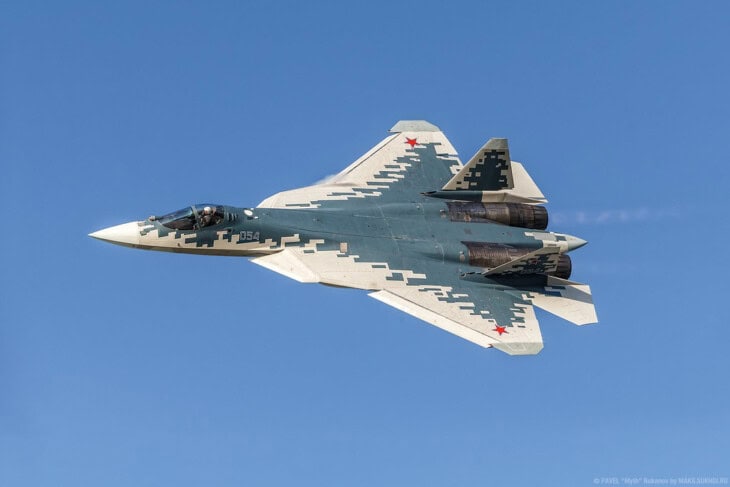
The Sukhoi Su-57 is Russia’s first combat aircraft designed around stealth from the outset. NATO calls it the Felon. Sukhoi’s own designation for the prototype was T-50, and the program that produced it was PAK FA, the Russian acronym for “prospective aviation complex of frontline aviation.”
The first T-50 prototype flew on 29 January 2010 at Komsomolsk-on-Amur. Serial production began in 2019, and the first production aircraft reached a Russian Aerospace Forces regiment in December 2020.
It is a twin-engine, single-seat multirole fighter built to fight other aircraft and to strike targets on the ground and at sea. That puts it in the same broad class as the American F-22 Raptor and F-35 Lightning II, though it reaches those roles by very different engineering choices.
Top speed is Mach 2.0, about 1,327 mph (2,135 km/h) at high altitude. At sea level the limit drops to roughly Mach 1.1, or 839 mph (1,350 km/h).
More significant than the top number is supercruise. The Su-57 can hold Mach 1.3, about 870 mph (1,400 km/h), without lighting its afterburners.
Sustained supersonic flight without afterburner saves fuel and adds energy to any missile launched from the aircraft, extending its effective reach. Only a handful of types can do it, which is why the Su-57 turns up on lists of the fastest fighter jets in service.
The Su-57 is 65 feet 11 inches (20.1 m) long, spans 46 feet 3 inches (14.1 m), and stands 15 feet 1 inch (4.6 m) tall. Wing area is 848 square feet (78.8 square meters).
Empty weight is about 40,800 pounds (18,500 kg), and normal takeoff weight is 58,900 pounds (26,700 kg). Rosoboronexport lists a maximum takeoff weight of 74,960 pounds (34,000 kg) for the export Su-57E, while several reference sources quote 77,160 pounds (35,000 kg) for the baseline aircraft.
Internal fuel is roughly 21,400 pounds (9,700 kg), good for about 2,175 miles (3,500 km) subsonic. Supersonic range falls to around 930 miles (1,500 km), and two external tanks stretch ferry range to roughly 2,800 miles (4,500 km).
Combat radius is about 780 miles (1,250 km). Published service ceilings vary, from roughly 61,700 feet (18,800 m) in export brochure data up to 65,600 feet (20,000 m) in wider reference sources.
The Su-57 aligns its planform edges, recesses its antennas, and carries its primary weapons internally, all standard low-observable practice. Radar-absorbent material coats the inlet ducts, and a slanted blocker grid hides most of the exposed compressor face.
The canopy carries a metal-oxide coating 70 to 90 nanometers thick, which Sukhoi credits with cutting the cockpit’s radar return by about 30 percent. Composites make up 22 to 26 percent of structural weight and roughly 70 percent of the outer surface.
Sukhoi’s patent for the T-50 describes a target average radar cross-section of roughly 0.1 to 1 square meter, against 10 to 15 square meters for the Su-27 it descends from. Western estimates put the F-35 near 0.005 square meters and the F-22 near 0.0005.
The shaping is also deliberately asymmetric. Frontal stealth is prioritized and the aft fuselage is less optimized than on American stealth fighter jets, a choice consistent with Russian doctrine of operating inside friendly integrated air-defense coverage.
Production aircraft use two Saturn AL-41F1 afterburning turbofans, also known as izdeliye 117. Each produces 19,840 pounds of thrust (88.3 kN) dry and 31,970 pounds (142.2 kN) in afterburner, with a 33,070-pound (147.1 kN) emergency rating.
Each nozzle vectors in only one plane, but the nozzles are canted at an angle. Vectoring them differentially therefore produces pitch, yaw, and roll moments, the same arrangement used on the Su-35.
Combined with deliberate relaxed stability and the KSU-50 flight control system, that makes the aircraft very resistant to departure from controlled flight. It can fly the Pugachev Cobra and hold flat rotations with little altitude loss.
A more powerful engine, the AL-51F-1 or izdeliye 30, is meant to replace it on the upgraded Su-57M. It is rated at roughly 24,250 pounds (107.9 kN) dry and 36,380 pounds (162 kN) with afterburner, and has been in slow testing since first flying aboard a Su-57 prototype in December 2017.
The Su-57 carries the Sh-121 multifunctional integrated radio-electronic system. Its core is the N036 Byelka radar set, credited with about 250 miles (400 km) of detection range and the ability to track 60 targets while engaging 16.
Rather than a single nose array, Byelka spreads coverage across a forward X-band array, two cheek arrays for wider angular coverage, and L-band arrays in the wing leading edges used for identification friend or foe.
The 101KS Atoll suite adds infrared search and track, ultraviolet missile-approach warning, a thermal imager for low-altitude flight, and directional infrared countermeasure turrets. The Su-57 was the first fighter to carry DIRCM turrets of that type.
The cockpit is fully digital with no analogue gauges. Two 15-inch (38 cm) displays dominate the panel, backed by a wide-angle head-up display and a ZSh-10B helmet with a pupil-tracking sight.
Two tandem main weapons bays run about 14 feet 5 inches (4.4 m) long and 3 feet (0.9 m) wide, with two smaller triangular side bays near the wing roots.
The air-to-air loadout centers on the R-77M medium-range missile, the R-74M2 for short range, and the izdeliye 810, a very long-range development of the R-37M carried two per main bay.
For strike work the bays take KAB-250 and KAB-500 guided bombs, the Kh-38M air-to-ground missile, the Kh-58UShK anti-radiation missile, and the Kh-69 stealthy cruise missile. Anti-ship options include the Kh-35U and Kh-31.
There are 12 hardpoints in total, six internal and six external, with a maximum payload of 16,500 pounds (7,500 kg). A 30 mm GSh-30-1 cannon with 150 rounds is mounted internally near the right wing root.
At least 44 airframes had been completed as of 2026, a figure that includes 10 test aircraft. Russia’s stated plan is 76 production aircraft spread across three regiments.
Production has been slow by any standard. Defense News reported in 2024 that Russia was trying to accelerate output at the Komsomolsk-on-Amur plant, where the type is built alongside other Sukhoi fighters.
Sanctions and the demands of the war in Ukraine have made that harder rather than easier.
Russia has used the Su-57 in the war in Ukraine, though mostly at a distance. Reported missions have involved standoff cruise missile launches from inside Russian or occupied airspace rather than penetrating strikes.
In February 2024 a Su-57 escorted by a pair of Su-35s launched a Kh-69 cruise missile at Ukrainian targets from above Luhansk Oblast. Further Kh-69 strikes were reported through the spring of that year.
In June 2024 Ukraine’s military intelligence directorate claimed a drone strike had damaged Su-57s parked in the open at Akhtubinsk air base. Russian military channels acknowledged the attack and criticized the lack of protective hangars.
In May 2026 the type returned to action with at least ten cruise missile launches over Kursk Oblast, the Sea of Azov, and Crimea.
The Su-57E is the export version. It differs mainly in its IFF system, English cockpit labeling, flight instruments reading in imperial units, and the option to integrate non-Russian weapons.
The Su-57M, developed under the program name Megapolis, is the planned upgrade. It brings the AL-51F-1 engine, improved mission systems, new flight control actuators, and maintenance changes.
A two-seat variant first flew on 19 May 2026. The single-engine Su-75 Checkmate is a separate, lighter design that borrows Su-57 technology and has not yet flown.
The cancelled Sukhoi/HAL FGFA was the Indian derivative. India withdrew in 2018, citing concerns about stealth performance, cost, and technology sharing.
The comparison turns on what each aircraft was optimized for. The F-22 and F-35 were built with all-aspect stealth and sensor fusion as the first priority, and their radar cross-sections are estimated to be orders of magnitude smaller.
The Su-57 trades some of that for kinematics. It has thrust vectoring about all three axes, a 9-g airframe, supercruise, and far larger internal bays than the F-35.
It also carries sensors the American aircraft do not, including side-looking L-band arrays and podless DIRCM turrets. Where it lags is production quality, fleet size, and the maturity of its intended engine.
For the wider field, see our ranking of the best fighter jets in the world and the rest of the Sukhoi fighter jet family.
Russian domestic procurement figures put the Su-57 near $42 million per aircraft in 2019 terms, well below Western fifth-generation pricing. Export estimates for the Su-57E run far higher, commonly cited in the $80 million to $100 million range per airframe before weapons and support.
Algeria signed for the type in December 2019 and became the first export customer. United Aircraft Corporation said in November 2025 that the first two aircraft had been delivered to a foreign operator, and visual confirmation from Algeria followed in February 2026.
Vietnam, the United Arab Emirates, Turkey, and Iraq have all been discussed as prospects over the years. None has signed a contract.
Not on stealth or sensor fusion, which are the F-35’s defining strengths. The Su-57 is faster, supercruises, carries more internally, and is more maneuverable, so the honest answer depends on the mission. In fleet terms it is not close, with more than 1,100 F-35s built against roughly 44 Su-57s.
Sanctions are the biggest factor, since buying Russian combat aircraft exposes a country to US CAATSA penalties. Slow production, questions about build quality raised at public displays, and the delayed AL-51F-1 engine have not helped. Algeria remains the only confirmed export customer.
The F-22 has a far smaller radar cross-section, estimated near 0.0005 square meters against 0.1 to 1 for the Su-57. The Su-57 answers with three-axis thrust vectoring, longer range on internal fuel, and a broader sensor fit. The F-22 is also the older design, having entered service in 2005.
At least 44 airframes had been built as of 2026, including 10 test aircraft, against a stated plan of 76 production jets. Two more have been exported to Algeria.
Mach 2.0, about 1,327 mph (2,135 km/h) at altitude. It can also supercruise at Mach 1.3, roughly 870 mph (1,400 km/h), without using afterburner.
PAK FA is the Russian acronym for the development program, roughly “prospective aviation complex of frontline aviation.” Sukhoi’s internal prototype designation was T-50, and the production aircraft was named Su-57 in 2017.
Russia and most reference sources classify it as fifth-generation, and it meets the usual criteria for stealth shaping, supercruise, sensor fusion, and high maneuverability. Critics argue its radar cross-section is closer to a 4.5-generation aircraft. Our guide to the five generations of fighter planes explains where those lines are drawn.
Sources and references used for research and fact-checking.