Military Propellor Planes
Grumman F7F Tigercat
ICAO: F7F
Carrier torpedo bomber that flew from 1941 to the 1960s
Updated: by Tim de Vries

The latest aviation news and stories sent to your inbox.
The Grumman TBF Avenger was the US Navy’s main torpedo bomber from late 1942 to the end of World War II. About three quarters of the roughly 9,840 built came from General Motors as the TBM. It made its combat debut at Midway, helped sink the battleships Yamato and Musashi, and was one of the Allies’ most effective submarine killers.
Live Fleet Activity (TBF)
Fetching live data…


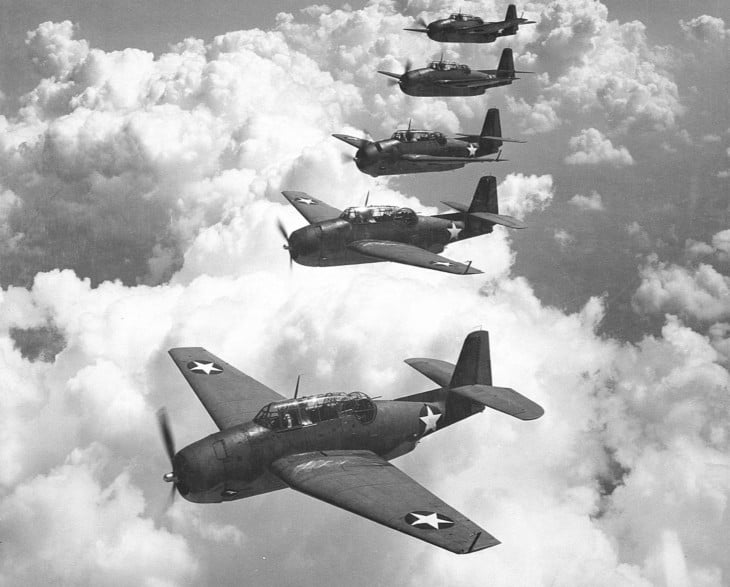
The Grumman TBF Avenger was the US Navy’s main torpedo bomber from late 1942 to the end of World War II. It replaced the obsolete Douglas TBD Devastator and carried a torpedo or bombs inside an internal bay, a first for a carrier aircraft.
The type is also called the TBM when it was built by General Motors. The “M” is the General Motors code, and about three quarters of all Avengers carried it.
In October 1939 the Navy asked industry for a new torpedo bomber with a three-person crew and an internal bay for a torpedo or three 500 lb bombs. Grumman received a contract for two XTBF-1 prototypes on April 8, 1940.
The prototype first flew on August 7, 1941. The National Naval Aviation Museum gives August 1, so the date varies by source.
Flight tests showed instability, which led to a relocated engine and a new dorsal fin ahead of the tail. The first prototype was lost to a bomb-bay fire on November 28, 1941, and the second flew on December 15.
The Avenger looked like a larger F4F Wildcat, and Grumman gave it the same Sto-Wing folding mechanism that its successor fighter, the F6F Hellcat, also used.

Six TBF-1s of Torpedo Squadron 8 flew from Midway Island on June 4, 1942, and only one returned. The pilot, Ensign Albert Earnest, brought back a damaged aircraft with one crewman dead and another wounded.
The loss forced the Navy to rush the Avenger into front-line service. By the end of August 1942 it was the only torpedo bomber in service with the fleet, and it flew in every major US naval action in the Pacific until the war ended.
The battle is covered in more depth in our Battle of Midway article.
Three crew flew the Avenger: the pilot, a turret gunner and a radioman who also served as bombardier. The radioman sat in a compartment in the rear fuselage with a window into the bomb bay for the bomb sight.
Defensive armament was a .50 caliber machine gun in the powered dorsal turret and a hand-fired .30 caliber gun under the tail. Early aircraft had a single .30 caliber gun in the nose, and later ones carried two .50 caliber guns in the wings.
The bay held one 2,000 lb (907 kg) Mark 13 torpedo or up to 2,000 lb of bombs, and the Avenger could also carry up to eight rockets. This is the answer to the common question about what guns the TBF Avenger used.

The full specification table for the aircraft is on this page. The figures describe the early TBF-1, which used a Wright R-2600-8 Twin Cyclone engine rated at 1,700 hp (1,268 kW).
Later TBM-3 aircraft used the 1,900 hp R-2600-20, so their speed, climb and ceiling are higher than the TBF-1 figures in the table. Some websites mix the two and print TBM-3 performance beside TBF-1 power.
The published range is a cruise figure, and an Avenger flying a mission with a torpedo or bombs had less. Extra fuel could be carried in two 58 US gallon droppable tanks under the outer wings, plus a 275 US gallon ferry tank in the bomb bay.
The wingspan of 54 ft 2 in (16.51 m) was a carrier-deck problem. The folding wing cut the width to about 19 ft, which let Avengers share hangar decks with fighters.

Grumman built its first production Avenger on January 30, 1942, and about 2,290 TBF-1 and TBF-1C aircraft by the end of 1943. The Navy wanted far more than Grumman could build while the plant also made Hellcats.
General Motors turned five car factories into its Eastern Aircraft Division, signed the Avenger contract on March 23, 1942, and delivered the first aircraft in November. Eastern was the only builder in 1944 and 1945.
Total production is given as 9,838 by the National Naval Aviation Museum and 9,839 by Wikipedia. More than 7,500 of them were TBMs.
The TBF-1C added two .50 caliber wing guns in place of the nose gun. The TBM-3, with the 1,900 hp engine, became the most numerous version, and the TBM-3E was the last production model, lightened to restore the speed of the original TBF-1.
Specialist conversions covered radar, photo reconnaissance, a searchlight for anti-submarine work, and after the war airborne early warning and carrier delivery. The Royal Navy first called its aircraft Tarpon, then switched to the Avenger name in early 1944.
Most Avenger missions used bombs, depth bombs or rockets rather than torpedoes. Wikipedia credits the type with helping to sink the battleships Yamato and Musashi.
It was also one of the most effective submarine killers of the war. Avengers on escort carriers took part in the sinking of about 30 U-boats, mostly in 1943.
Future president George H. W. Bush was commissioned as the youngest naval aviator at the time in June 1943. On September 2, 1944, his TBM was shot down over Chichi Jima.
Bush released his payload and hit the radio tower target before bailing out over water. Both of his crewmates died, and he was rescued.
The Avenger kept flying after 1945. It became the Navy’s first carrier delivery aircraft in the Korean War, served as an early airborne early warning platform, and flew in the Royal Canadian Navy, which took 125 former Navy TBM-3Es from 1950 to 1952.
Several are still flying as warbirds, and Wikipedia keeps a list of surviving Grumman TBF Avengers.
The TBF was built by Grumman and the TBM by General Motors. The early TBM-1 was identical to the TBF-1 apart from some internal paint and the bureau numbers.
It had three: the pilot, a turret gunner and a radioman who doubled as bombardier. Early aircraft carried an extra seat behind the pilot that was often empty and was removed later.
It had one .50 caliber gun in the dorsal turret and one .30 caliber gun firing from under the tail. Early models also had a .30 caliber nose gun, and later models carried two .50 caliber guns in the wings.
We could not find a reliable wartime unit price, so we do not quote one. Restored flying examples are rare warbirds that trade privately, and any figure depends on the airframe and its history.
The search question mixes up the two presidents. It was George H. W. Bush who flew the TBM Avenger with Torpedo Squadron 51, and he was shot down near Chichi Jima on September 2, 1944.
The cruise range is shown in the specification table on this page, and it was shorter with a full weapons load. Drop tanks and a bomb-bay ferry tank extended it.
Sources give 9,838 or 9,839, and more than 7,500 were General Motors TBMs.
Sources and references used for research and fact-checking.