Military Propellor Planes
The heavy fighter built for long-range strike and night operations.

The latest aviation news and stories sent to your inbox.
The Bristol Beaufighter was a British twin-engine heavy fighter developed during World War II. Designed for long-range interception and strike missions, it became effective in night fighting and maritime attack roles. The aircraft entered service in 1940.


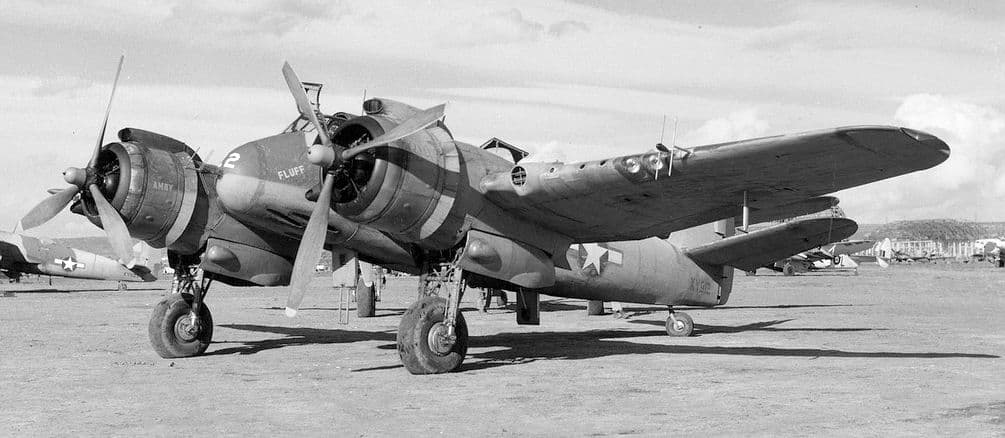


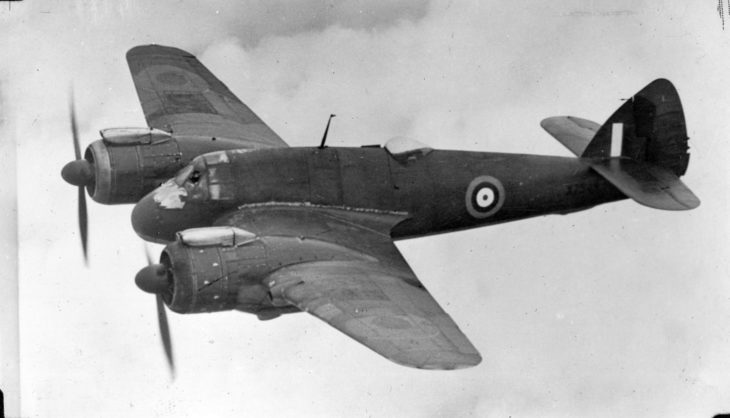
The Beaufighter first flew in 1939 and entered operational service in 1940. It was derived from the Bristol Beaufort torpedo bomber and adapted as a heavy fighter. The aircraft featured a mid-mounted wing and substantial forward armament.
Powered by two Bristol Hercules radial engines producing approximately 1,600 horsepower each, the Beaufighter cruised at around 260 knots (480 km/h). Maximum takeoff weight exceeded 21,000 pounds (9,525 kg). Armament included four 20 mm cannons and machine guns, with additional external stores for strike missions.
The Beaufighter served in Europe and the Pacific, performing night interception and anti-shipping operations. It was eventually replaced by newer fighter designs. The aircraft remains one of the Royal Air Force’s most versatile wartime fighters.
In case you didn’t know yet, the Beaufighter Mk X was utilized as a torpedo bomber in WWII and was considered by the Japanese soldiers as Whispering Death because of its capability to creep up on enemy targets. About six thousand Bristol Beaufighters were constructed. However, today, their surviving members are very slim, along with six remaining across the globe.
In early versions of the Bristol Beaufighter, the radar operator, apart from its regular duties, was in charge of the four 20-millimeter cannon with ammunition. Resupply could be challenging, particularly when an aircraft was maneuvering in pursuit of a target. Further, the ammunition drums weighed at least eighteen kilograms.
The Bristol Beaufighter was created as a long-range heavy fighter, along with different parts in common with the Bristol Beaufort torpedo bomber. By September 1945, a sum of 5,562 had been designed in a wide array of models and continued in front-line service into the 1950s.
Bristol Beaufighters was delivered in time for September 1940, even though most lacked their machine gun wing armament. However, the 4-cannon arrangement was enough to deal with any enemy bomber of the day and could function double-duty in the ground attack strafing role.
The Bristol Beaufighter became one of the best aircraft designs emerging from the Bristol concern during the war, where it’s a field over every major front of the conflict. The first Bristol Beaufighter had twin Hercules III engines that each created 1,400hp.
Those gave the first Bristol Beaufighter a top speed of 309mph. Nonetheless, that wasn’t considered to be impressive when the Hurricane was faster—with a single-engine. The designers had hoped for a top speed of 335mph from the Bristol Beaufighter.
Thus, the original Bristol Beaufighter was not considered to be a fighter aircraft, but was seen as a useful night fighter. They’re fitted with the Bristol Beaufighter A1 Mk IV radar to permit the pilot to see even if they’re in the dark.
The twin-engine of this heavy fighter featured a crew of two. It was initially outfitted with a great armament array of 4 X 20 mm Hispano cannons seen under the nose as well as a 6 X 7.7 mm machine guns installed in the wings.
That armament was a strong installation than other fighters of the way. Further, the simplified fuselage carried the avionics, cockpit, and other mission-critical parts while being set between the radial piston engines.
By the end of the war, Bristol Beaufighter had seen action in the Far East, Mediterranean, and Europe. Different variations were made, and the aircraft obtained a decent reputation among those who flew it.
Sources and references used for research and fact-checking.