

Table of Contents
The Blue Angels are the United States Navy Flight Demonstration Squadron, a team of active-duty Navy and Marine Corps aviators who fly six blue and gold Boeing F/A-18E/F Super Hornets at air shows across North America. They were established on April 24, 1946, which makes 2026 their 80th anniversary season.
One detail catches almost everyone out. The Blue Angels stopped flying the legacy F/A-18 Hornet in November 2020 and now fly the larger Super Hornet, so a lot of what you will read about their aircraft online is five years out of date.
Roughly 11 million people watch them fly each year at more than 60 demonstrations. This guide covers the jets, the formations, the real speeds and altitudes, the safety record, and how the 2026 season works, using the Navy’s own published figures.
| Detail | Current figure |
|---|---|
| Official name | United States Navy Flight Demonstration Squadron |
| Established | April 24, 1946, by Admiral Chester W. Nimitz |
| 2026 season | 80th anniversary year |
| Home base | NAS Pensacola, Florida |
| Winter training | NAF El Centro, California (January to March) |
| Demonstration aircraft | Boeing F/A-18E/F Super Hornet (since November 2020) |
| Jets assigned | About 11 |
| Support aircraft | Lockheed Martin C-130J Super Hercules, “Fat Albert” |
| Squadron size | About 140 sailors and Marines |
| Jets in the demonstration | 6, plus the two-seat No. 7 jet |
| Commanding officer | Capt. Adam Bryan, Blue Angel 1, through November 2026 |
| Shows per year | 60 or more, at about 32 locations |
| Annual audience | Roughly 11 million spectators |
| Closest formation spacing | 18 inches, wingtip to canopy |
| Fastest and slowest | About 700 mph, and about 120 knots |
What Are the Blue Angels?
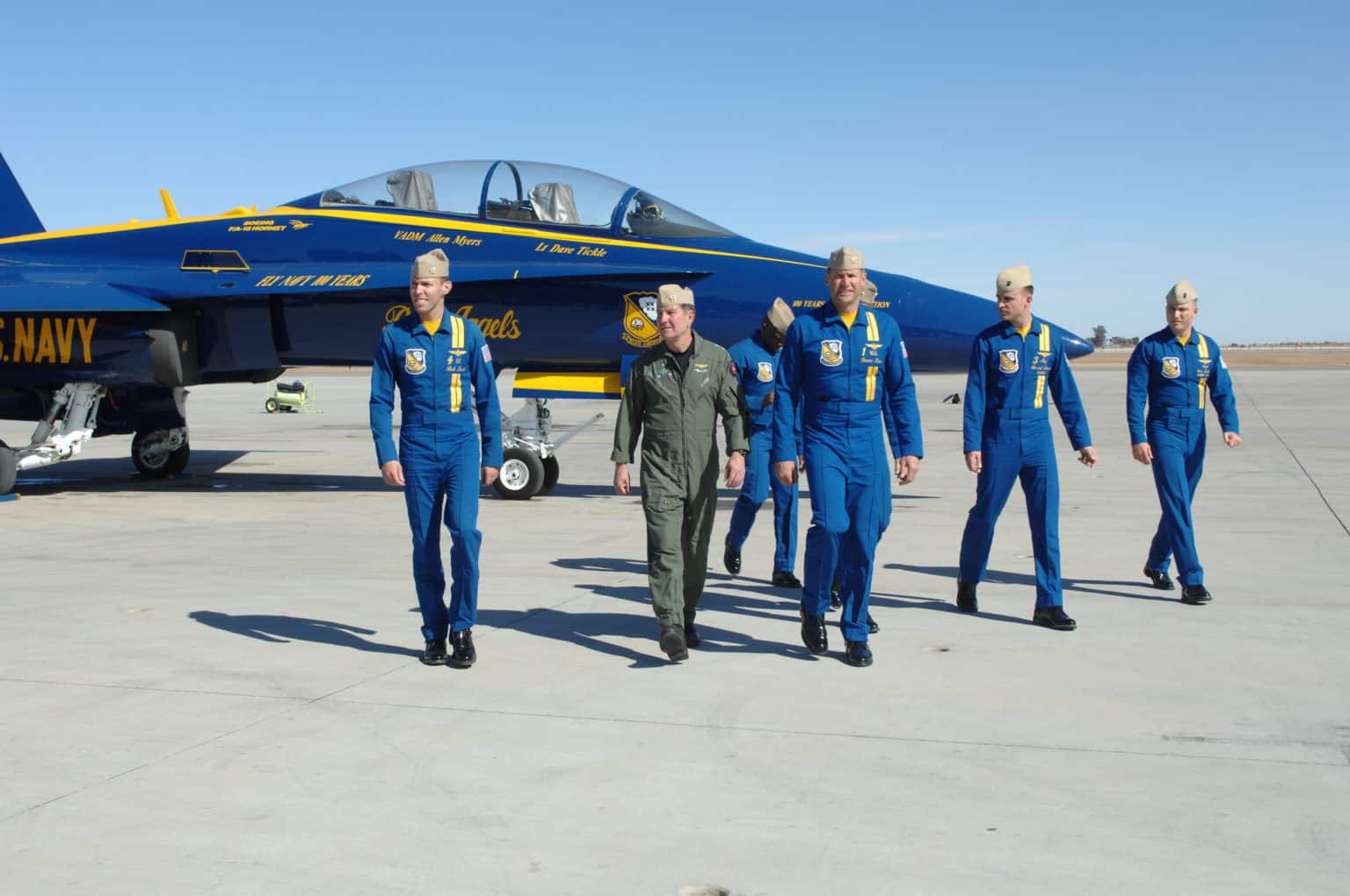
The Blue Angels are a Navy squadron, not a civilian display team or a permanent group of career show pilots. Every member is an active-duty volunteer from the fleet who serves a short tour and then goes back to a regular flying or maintenance job.
The Navy states the mission plainly: to showcase the teamwork and professionalism of the Navy and Marine Corps through flight demonstrations and community outreach, while inspiring a culture of excellence and service to country.
In practice that means recruiting and public engagement. Beyond the air shows, the team reaches more than 50,000 people a season through school and hospital visits.

Where the name came from
The squadron was originally just the Navy Flight Exhibition Team, and the first show was at Craig Field in Jacksonville, Florida, on June 15, 1946. The pilots needed a name before a show in New York later that year.
One of them spotted a listing for the city’s Blue Angel nightclub in the New Yorker. The name stuck, and it has outlasted eight changes of aircraft.
What Planes Do the Blue Angels Fly?
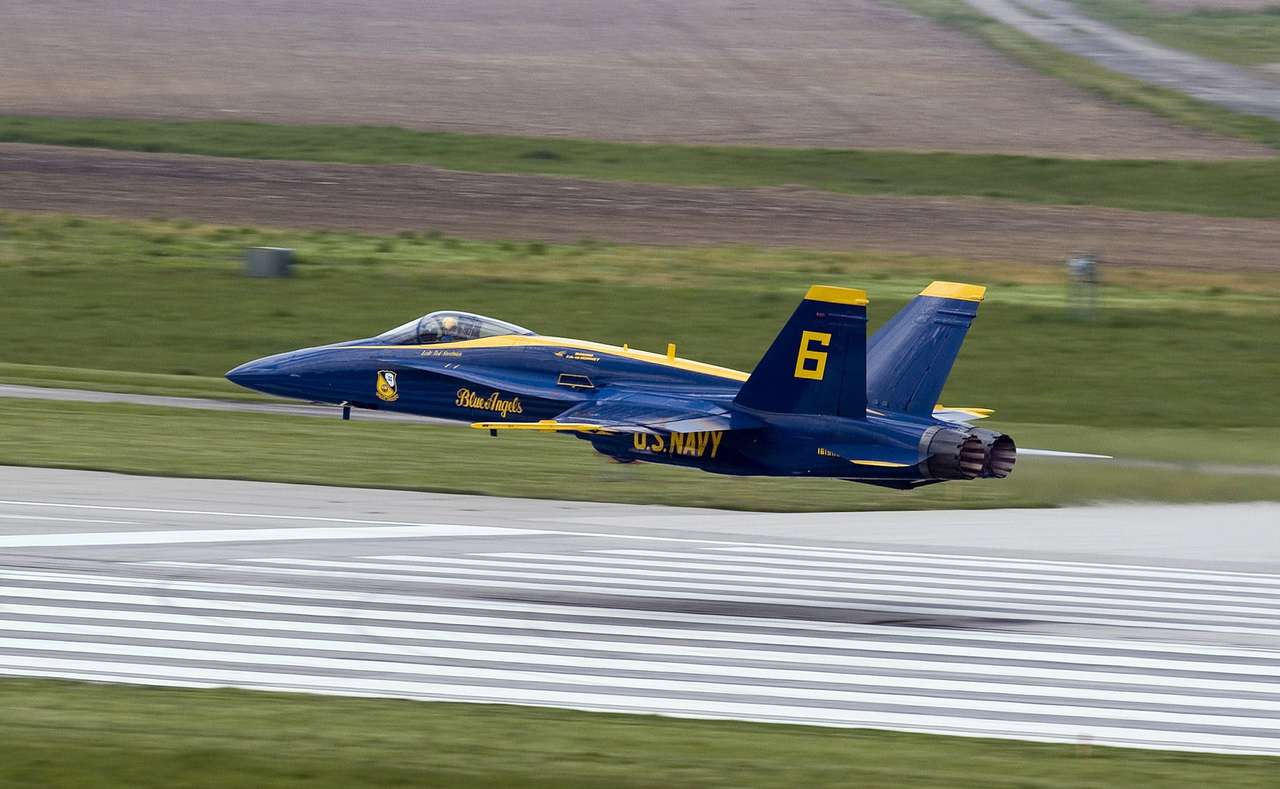
The Blue Angels fly the Boeing F/A-18E/F Super Hornet. The team transitioned in November 2020, retiring the legacy Hornet after 34 seasons, and flew its first full Super Hornet show season in 2021.
The number of jets varies, but the squadron averages about 11. Boeing converted nine single-seat F/A-18Es and two two-seat F/A-18Fs for the team under a 2018 contract.
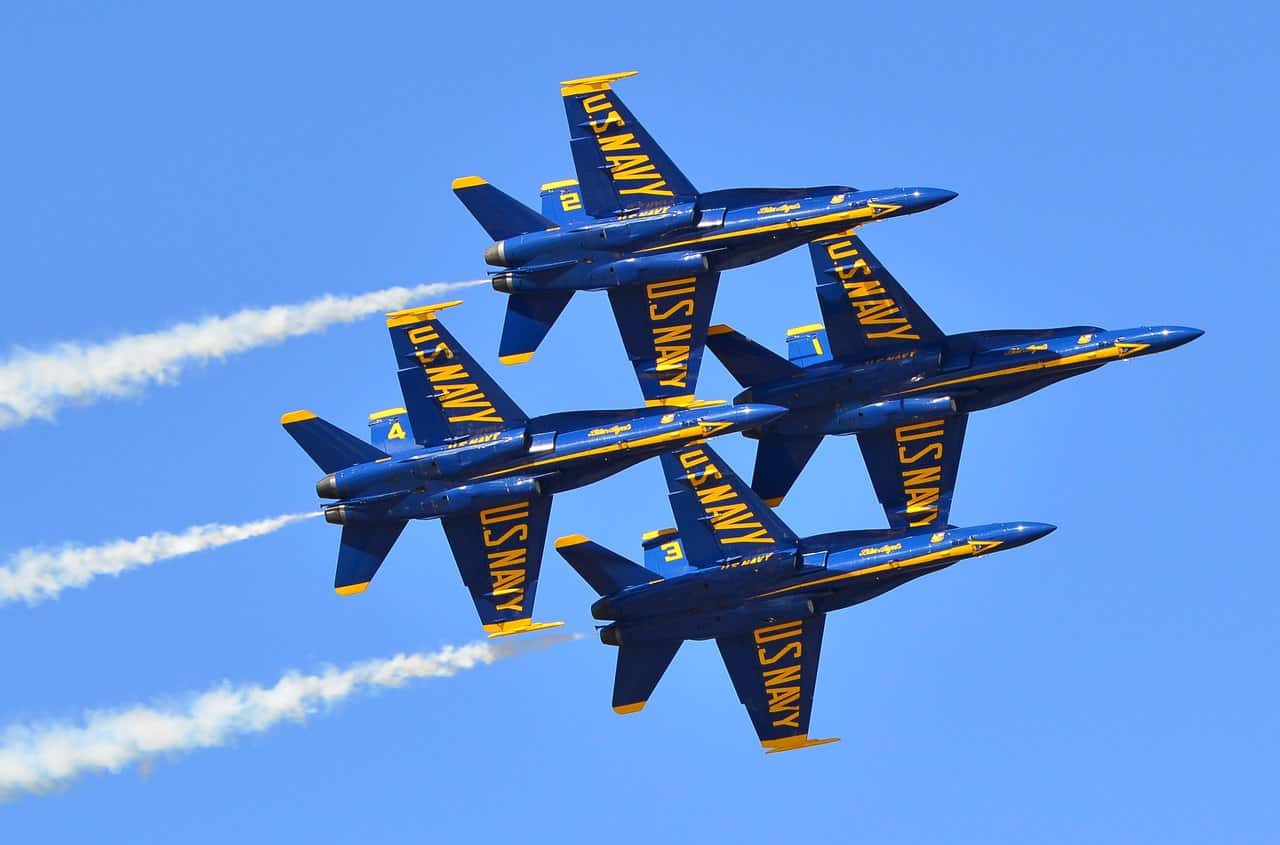
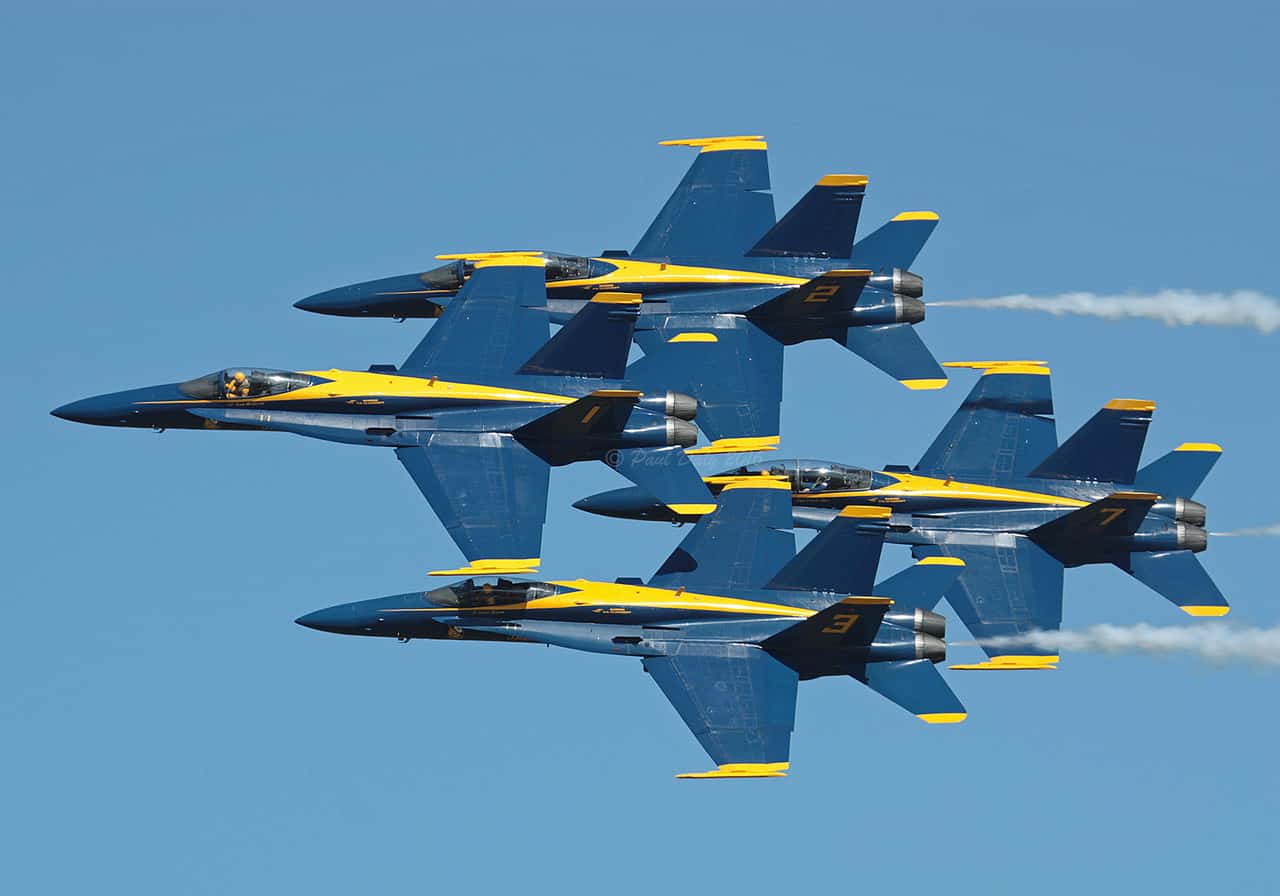
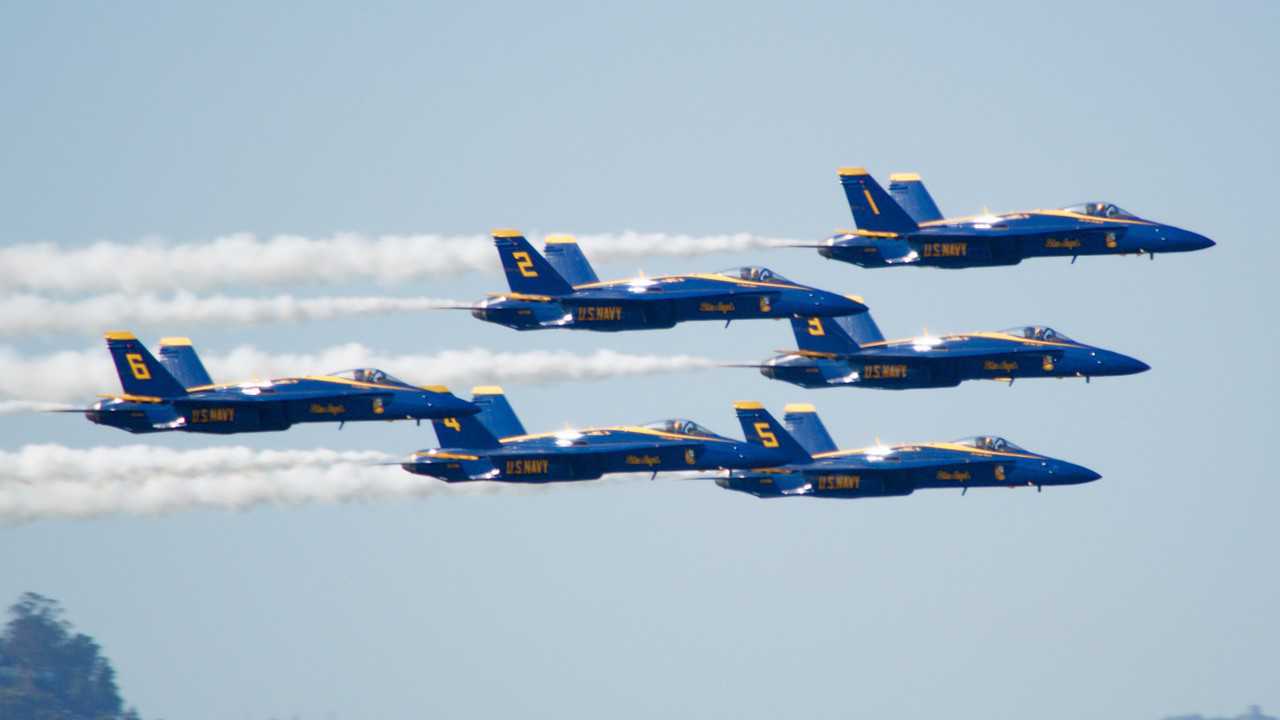
Six jets fly the demonstration. Numbers 1 through 4 form the diamond, and numbers 5 and 6 are the solos.
How a Blue Angels jet differs from a fleet jet
Less than you would think. The nose cannon comes out, a smoke-oil tank goes in, and a spring is fitted to the control stick.
Otherwise these are standard fleet aircraft. Every Blue Angels jet remains carrier-capable and can be returned to combat duty in roughly 72 hours.
The No. 7 jet
Blue Angel 7 is a two-seat F/A-18F flown by the show narrator. It also carries the two backseat riders the team takes up at each show site, and doubles as a spare.
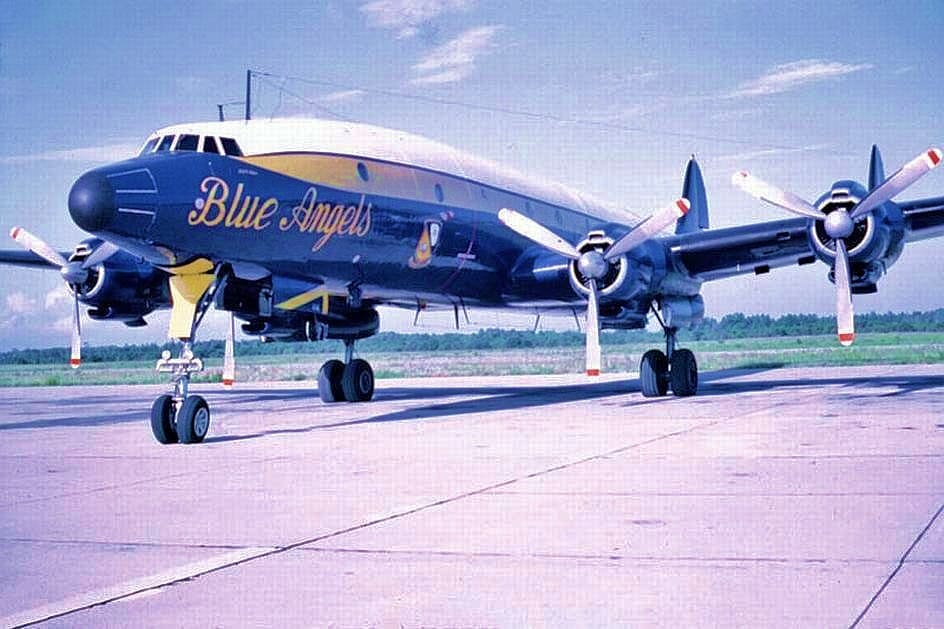
Fat Albert
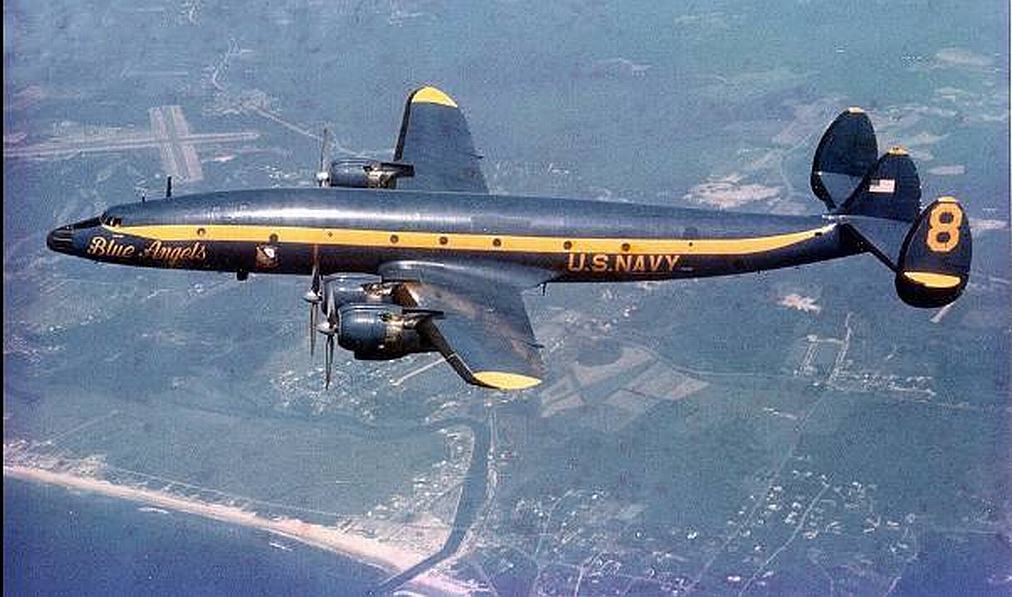
The team’s C-130 transport has been part of the show since 1970, nicknamed by Marine Corps pilots after the cartoon character because of its size and shape. It carries the squadron’s people and spare parts between show sites.
The current aircraft is a C-130J Super Hercules bought secondhand from the Royal Air Force in 2020, replacing a C-130T retired in 2019. It has an all-Marine Corps crew, generally seven: three pilots, two loadmasters and two flight engineers.
Older fans remember the rocket-assisted takeoff, and it is genuinely gone. The last JATO performance was at NAS Pensacola in November 2009, after the final stockpile of Vietnam-era rocket bottles ran out.
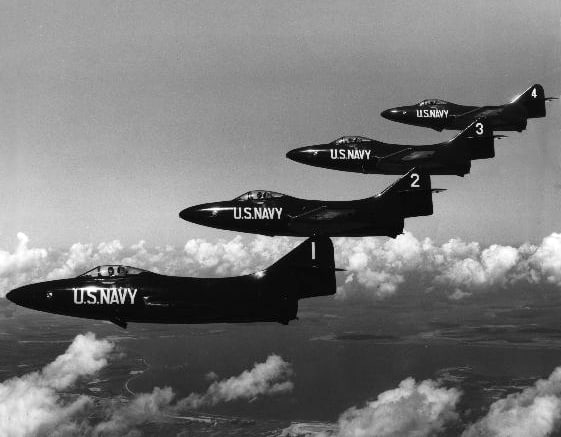
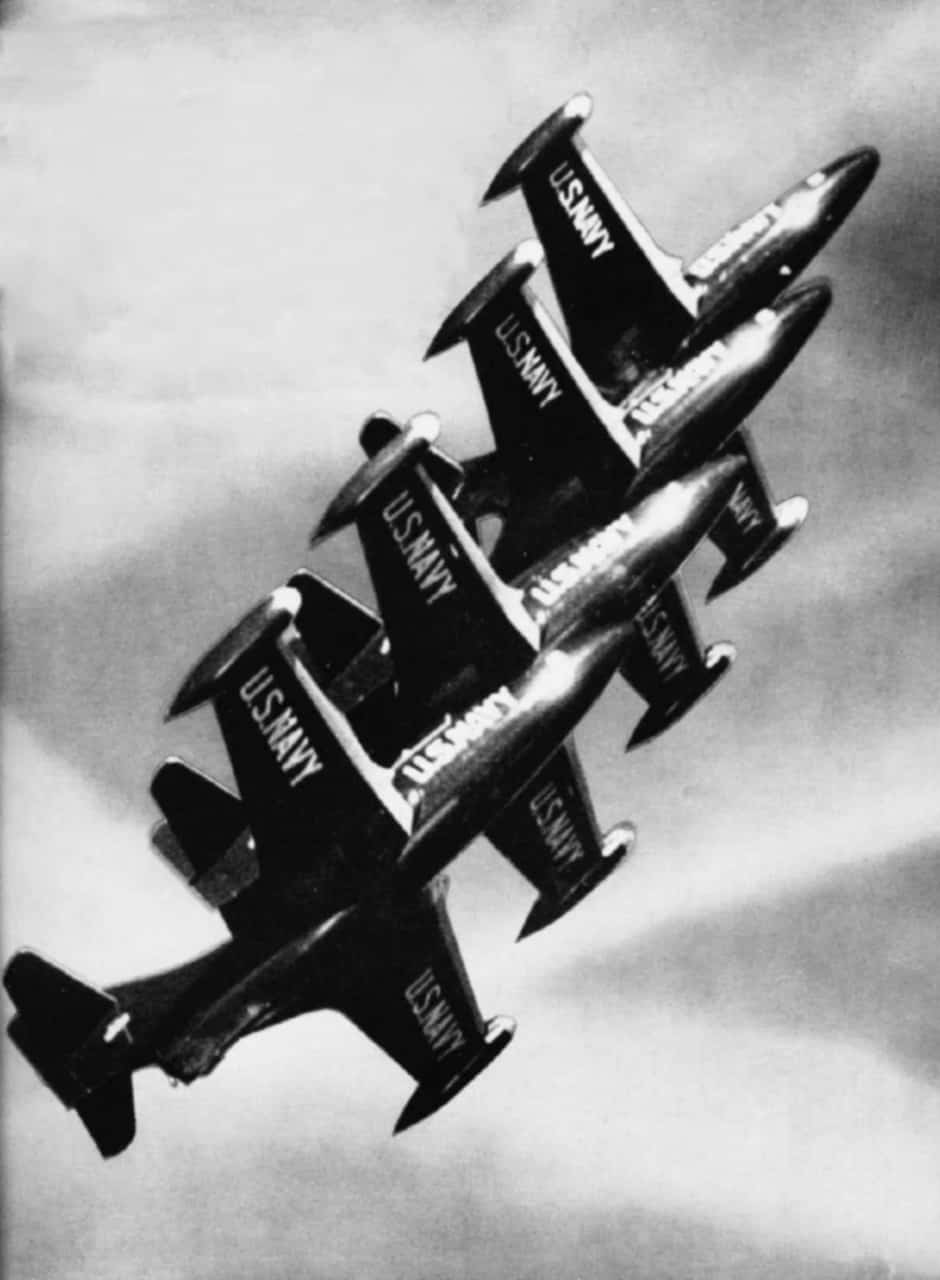
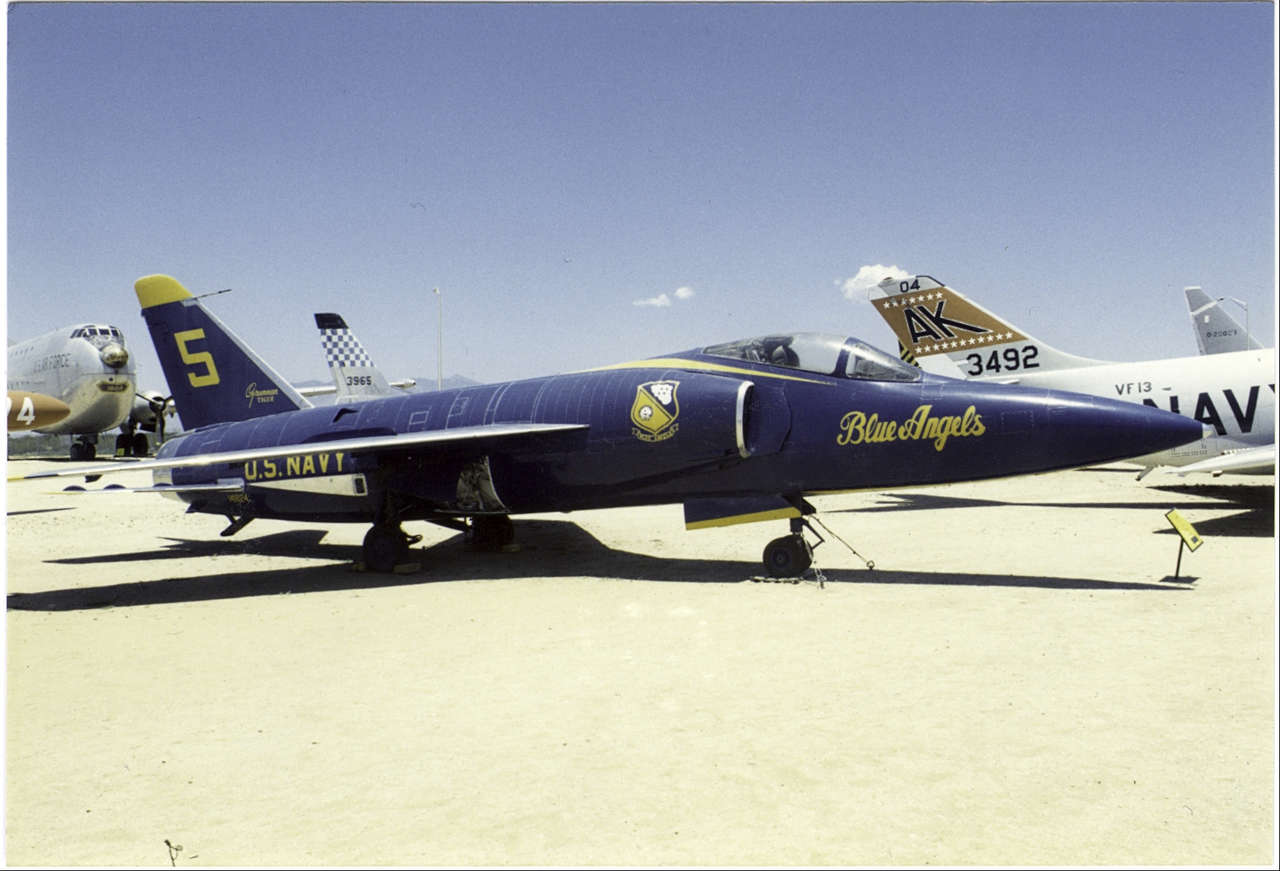
Every aircraft the Blue Angels have flown
| Aircraft | Years flown | Milestone |
|---|---|---|
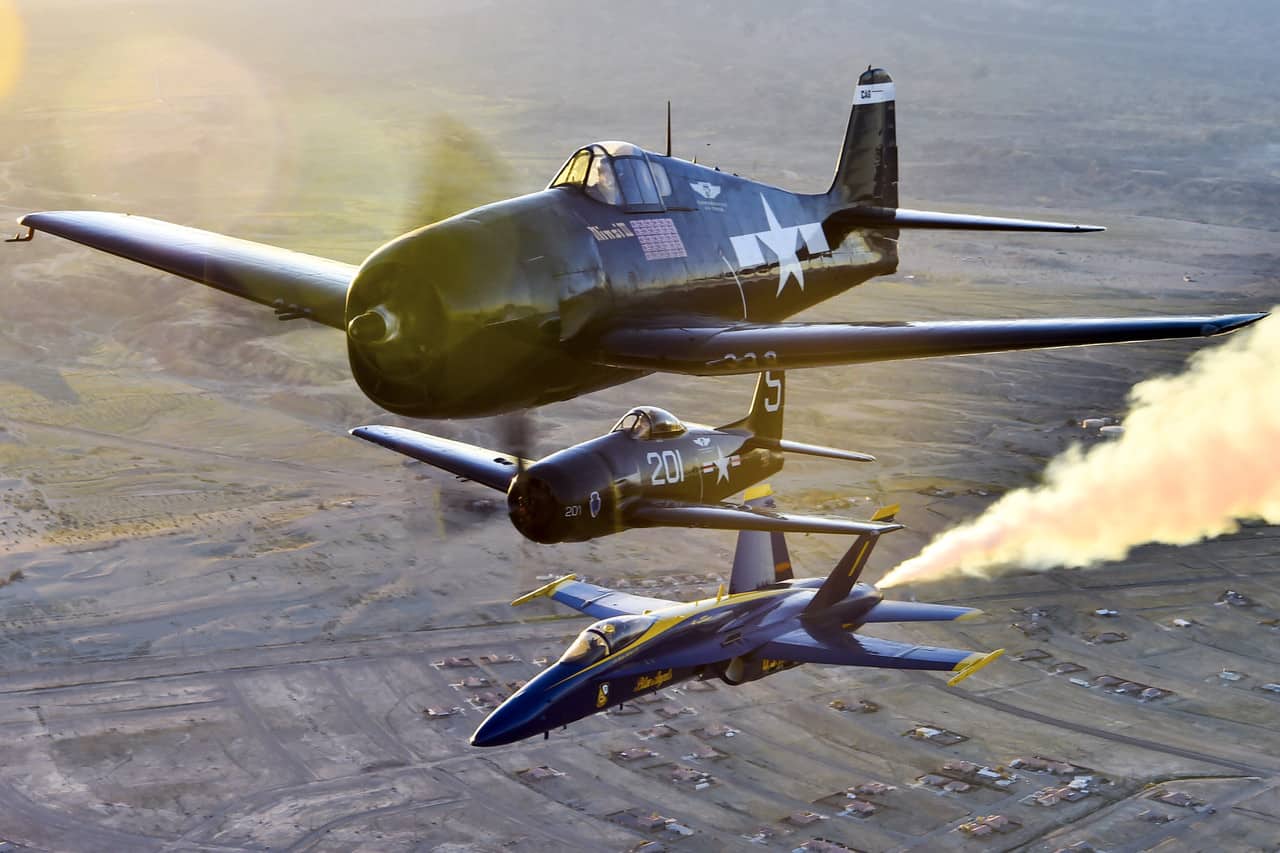
| Grumman F6F Hellcat | June to August 1946 | The original |
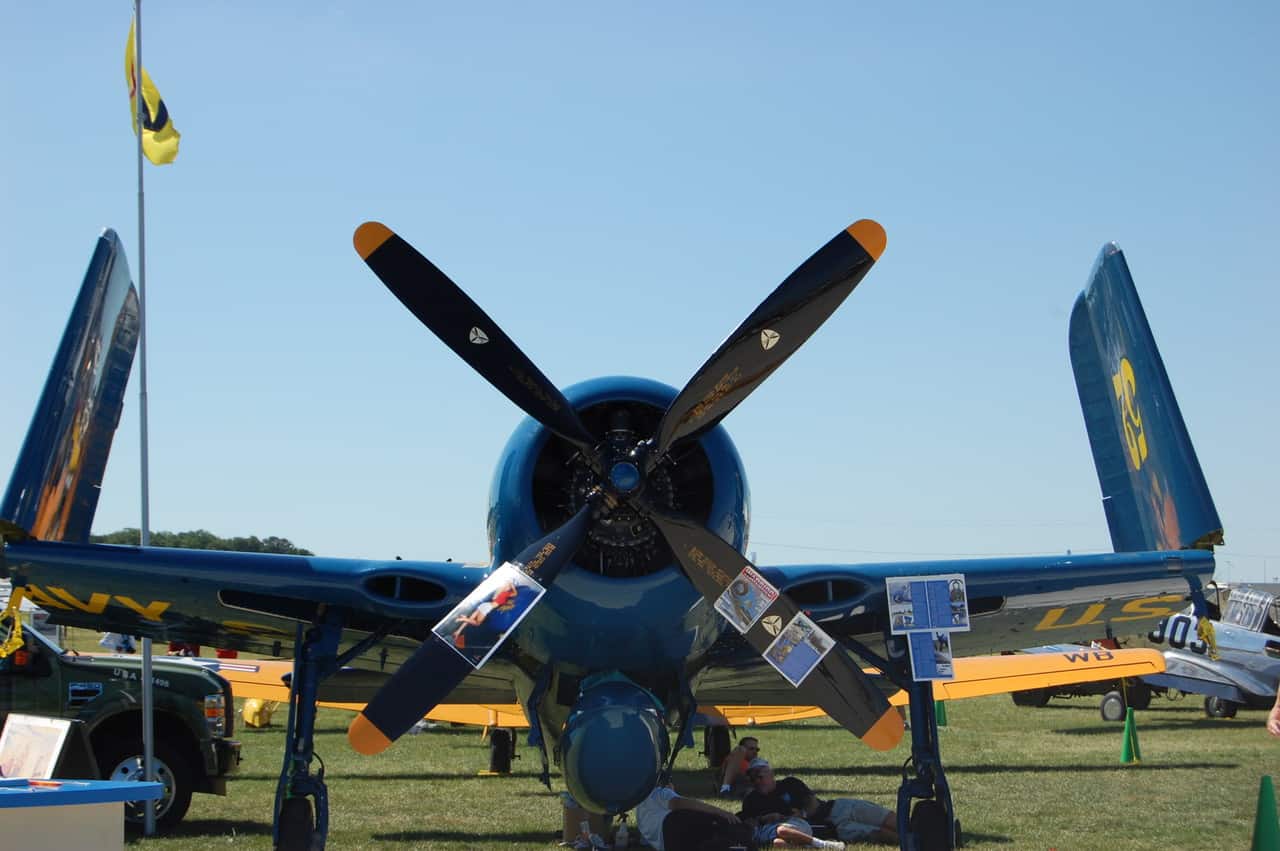
| Grumman F8F Bearcat | August 1946 to 1949 | |
| Grumman F9F-2 and F9F-5 Panther | 1949 to 1950, 1951 to winter 1954/55 | First jet |
| Grumman F9F-8 Cougar | Winter 1954/55 to mid-1957 | |
| Grumman F11F-1 Tiger | Mid-1957 to 1969 | First supersonic type |
| McDonnell Douglas F-4J Phantom II | 1969 to December 1974 | |
| McDonnell Douglas A-4F Skyhawk II | December 1974 to November 1986 | |
| Boeing F/A-18 Hornet | November 1986 to November 2020 | Longest-serving type |
| Boeing F/A-18 Super Hornet | November 2020 to present | Current |



How Fast Do the Blue Angels Fly?
The fastest point of the show is about 700 mph (1,127 km/h), just under the speed of sound, flown by the Lead Solo during the Sneak Pass. The slowest is about 120 knots indicated during the Section High Alpha Pass.
Both extremes belong to the solos. The diamond works in a narrower band, entering most of its signature maneuvers between roughly 290 and 385 knots.
The jets never go supersonic at a show. The team is not authorized to exceed the speed of sound over a crowd, so what spectators sometimes take for a sonic boom is a high-power engine setting.
How low and how high do they actually fly?
The lowest scheduled point in the routine is the Sneak Pass at 50 feet above ground level. The highest is the Opposing Solo’s vertical roll, which can reach 15,000 feet.
A widely repeated claim says the team “flies at 8,000 feet in clear weather.” That is a misreading of the weather rules, which set a minimum cloud ceiling for the airspace, not a flying altitude.
High show, low show, flat show
Weather decides which of three routines you get. The 2026 Maneuvers Manual sets the thresholds, and the difference is dramatic: a flat show has no loops at all.
| Show type | Minimum cloud ceiling | Minimum visibility | What you see |
|---|---|---|---|
| High show | 10,000 feet | 3 nautical miles | The full routine, including loops and vertical rolls |
| Low show | 4,500 feet | 3 nautical miles | Rolling maneuvers, no full loops |
| Flat show | 1,000 feet | 3 nautical miles | Flat passes and turns only |
Every show also needs a sterile aerobatic box. The minimum is a corridor 1,500 feet deep running roughly three nautical miles either side of the center point, and a site that cannot provide it does not get a show.
Blue Angels Formations and Maneuvers
A full high show runs to more than 30 named maneuvers. The Navy publishes every one of them, with minimum altitudes and entry speeds, in an annual maneuvers manual.
The routine alternates between the four-jet diamond and the two solos, so there is almost always something in front of the crowd. It ends with all six joining as the Delta.
| Maneuver | Minimum altitude | Entry speed | What happens |
|---|---|---|---|
| Diamond 360 | 200 feet | 310 knots | The signature pass, and the closest the jets ever get |
| Opposing Knife Edge | 100 feet | 400 knots | Solos cross at 90 degrees of bank |
| Diamond Roll | 200 feet | See note | All four roll together, starting at 1,500 feet |
| Double Farvel | 200 feet | 385 knots | Jets 1 and 4 fly inverted while 2 and 3 stay upright |
| Echelon Parade | 200 feet | 310 knots | Diamond re-forms into a diagonal line |
| Sneak Pass | 50 feet | 600 knots | Blue Angel 5 arrives unannounced from behind the crowd |
| Vertical Rolls | 500 feet | 600 knots | Blue Angel 6 pulls to 85 degrees nose-high, up to 15,000 feet |
| Section High Alpha Pass | 500 feet | 120 knots | The slowest pass of the show, nose high and hanging |
| Fleur de Lis | 200 feet | 420 knots | All six climb and split into a flower shape |
The Sneak Pass is the one that gets people. Blue Angel 5 comes in from behind the spectators at 50 feet while the narrator has the crowd looking the other way, so the jet arrives before the sound does.
How Close Do the Blue Angels Fly Together?
Eighteen inches, wingtip to canopy, during the Diamond 360. That is the official figure and it is the tightest point of the show.
At 310 knots, that spacing leaves no margin for a twitch of the wrist. Which is why the team removes two things most fighter pilots rely on.
Blue Angels pilots fly without G-suits, on purpose
A G-suit inflates bladders around the legs to stop blood pooling under high G. But the Super Hornet’s control stick sits between the pilot’s knees, and the pilots brace their right forearm on their thigh to steady tiny inputs. An inflating bladder would nudge that arm and move the stick. Instead they fit a spring to the stick tensioned to 40 pounds of pressure, giving a deliberately heavy “false feel” that resists un-commanded movement, and they fight G-forces with muscle tensing alone. They can do this because, unlike combat flying, they know exactly which maneuver is coming next.
How Many Blue Angels Are There?
The squadron numbers about 140 sailors and Marines. Only six fly the demonstration, and roughly 45 support personnel travel to each show site.
Officers typically serve two to three years and enlisted members three to four, then return to the fleet. Since 1946 the team has had more than 260 demonstration pilots and 37 flight leaders.
Nobody gets extra pay for it. Every position is a volunteer assignment, and applicants are interviewed and selected by unanimous vote of the current team.
What it takes to become a demonstration pilot
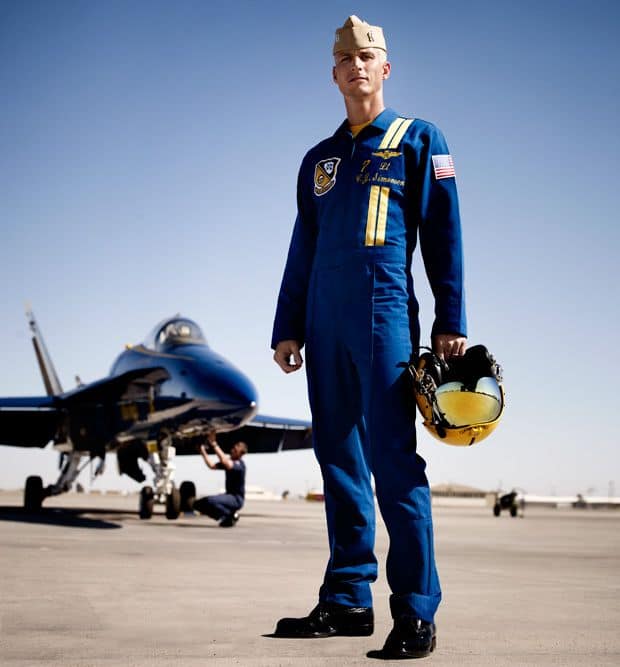
The formal bar is narrower than most people expect: a career-oriented, carrier-qualified, active-duty Navy or Marine Corps pilot. TOPGUN is not a prerequisite, though some team members have been through it.
Applicants visit the squadron at show sites early in the season, finalists are interviewed at Pensacola mid-season, and new pilots are chosen by unanimous vote. The Chief of Naval Air Training picks the flight leader.
The team keeps no spare pilot. Each pilot must fly 120 training flights during winter training before performing publicly, and a substitute could never build enough formation time to be safe.
Lt. Cmdr. Amanda Lee became the team’s first female jet demonstration pilot when she was selected in July 2022, flying the No. 3 left wing position from the 2023 season. Women had served on the team for decades, including as Fat Albert pilots, but never in a demonstration jet.
Are the Blue Angels Navy or Air Force?
Navy and Marine Corps. The Air Force equivalent is the Thunderbirds, who fly F-16 Fighting Falcons out of Nellis Air Force Base in Nevada.
You will almost never see both at the same event, and there is a rule behind it. Department of Defense policy treats demonstration teams as recruiting assets, so they usually do not fly within 150 miles of each other without special permission.
Internationally the closest counterparts are Britain’s RAF Red Arrows and Canada’s RCAF Snowbirds, both of which fly smaller jet trainers rather than frontline fighters.
Do the Blue Angels go into combat?
Not as the Blue Angels. The squadron’s job is demonstration and outreach, and it does not deploy.
The people and the aircraft do go back, though. Pilots return to fleet squadrons at the end of their tours, and the jets can be made combat ready in about 72 hours.
The Navy is also careful about the “best of the best” framing. Its own position is that Blue Angels are representatives of the standard found throughout the fleet, not a separate tier of elite fighter pilots.
Blue Angels Accidents and Fatalities
Twenty Blue Angels pilots and one crew member have died in accidents while assigned to the team since 1946. Four more former Blue Angels were later killed in combat after leaving the squadron.
The first loss came in the team’s first year. Lt. j.g. Ross “Robby” Robinson was killed on September 29, 1946, when he failed to recover from a dive during a Cuban Eight at NAS Jacksonville.
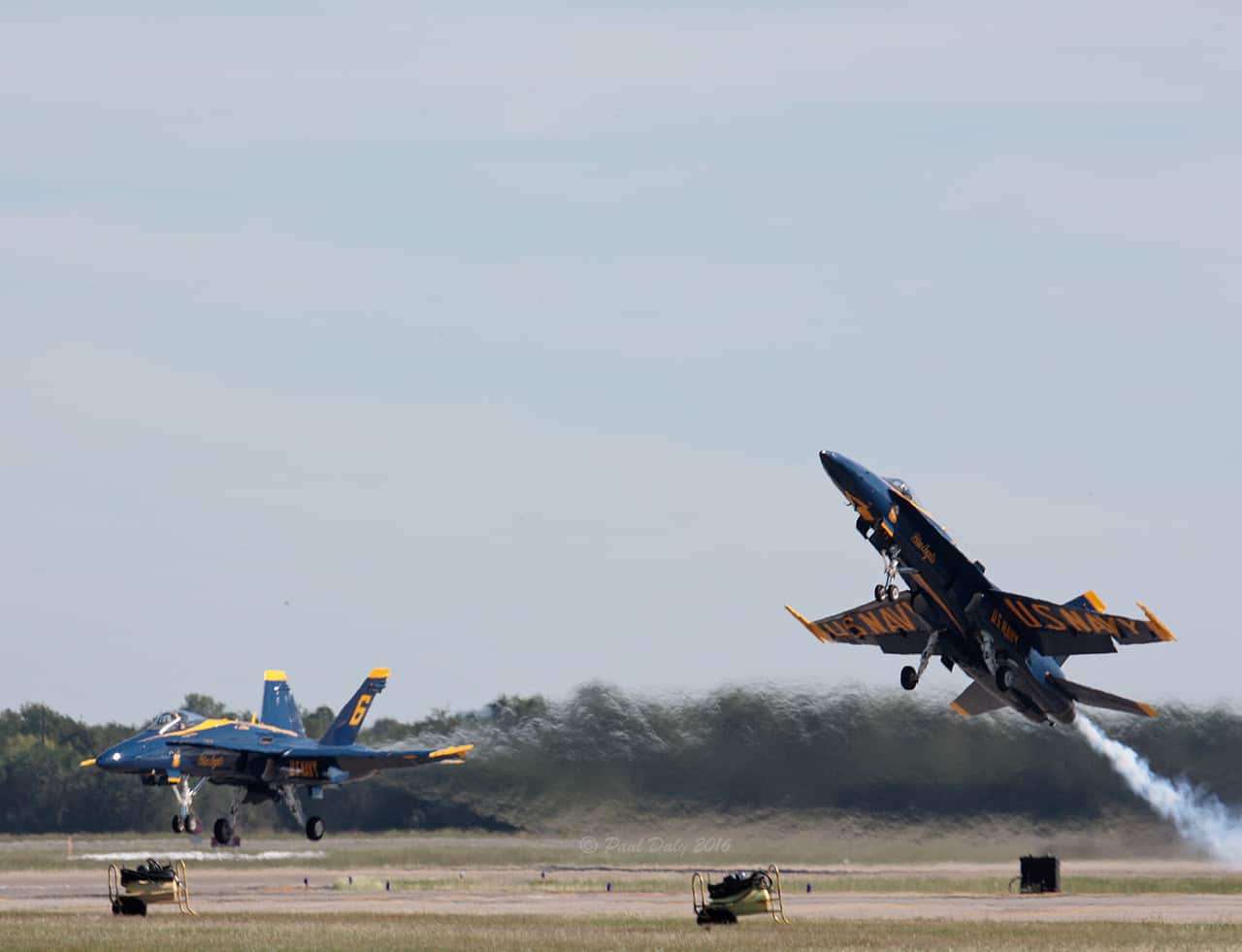
The most recent was Capt. Jeff Kuss on June 2, 2016, during practice for a show at Smyrna, Tennessee. He was flying a Split-S shortly after takeoff with too little altitude to complete it, and stayed with the aircraft to steer it away from housing.
The pattern across the team’s history is consistent. A large share of fatal accidents happened during low-altitude maneuvers, where there is no room to recover from a small error.
Be careful with the numbers you see online
Counts of Blue Angels deaths vary wildly across the web, from about 20 to 27, and a widely copied “8.8% fatality rate” gets quoted as fact. The figures differ because sources count different things: deaths while assigned to the team, all accidents involving squadron aircraft including non-fatal ones, and pilots who died later in combat after their Blue Angels tour. The enumerated record of accidents while assigned to the team gives 20 pilots and one crew member. Percentage “fatality rates” are not published by the Navy and are calculated informally, so treat them as estimates rather than statistics.
Not every crash has been fatal. In 1987 Lead Solo Lt. Dave Anderson ejected safely after a dual engine flameout, one of several accidents pilots have walked away from.
Air show flying carries risk across the discipline, not just for this team. Our roundup of the worst air show disasters covers the accidents that changed display-flying safety rules worldwide.
Where Are the Blue Angels Based?
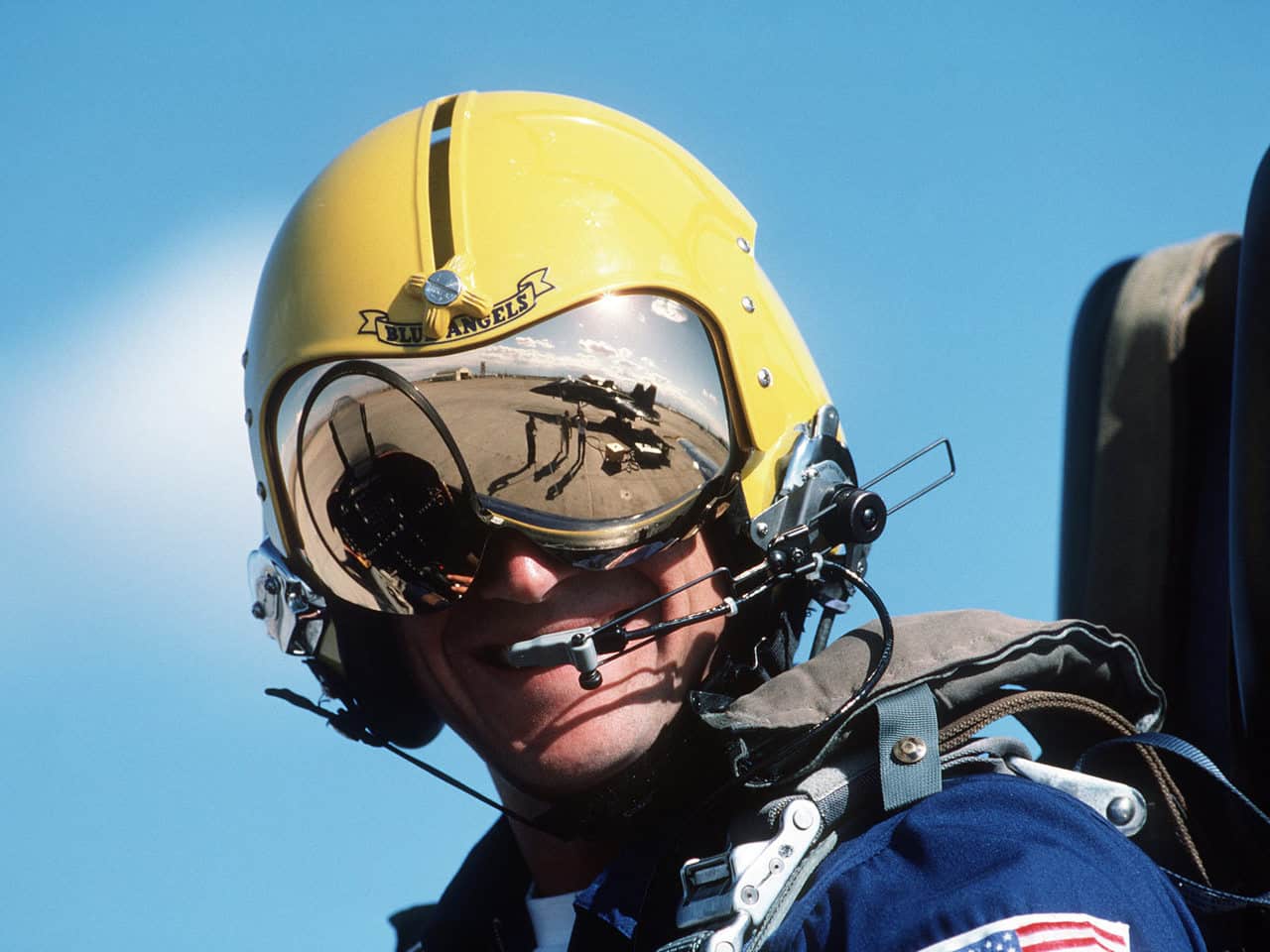
Home is Naval Air Station Pensacola, Florida, where the squadron spends the show season. Winter training runs January through March at Naval Air Facility El Centro, California, where the desert weather is reliable enough to fly twice a day.
Training tightens progressively. The team starts with wide spacing at high altitude and works down to show spacing over roughly two months and 120 flights per pilot.
The 2026 Season and Where to Watch
The 2026 season is the team’s 80th anniversary year, and it coincides with the United States’ 250th. It opened on March 14 at the NAF El Centro Festival of Flight and closes with the Homecoming Air Show at NAS Pensacola on November 6 and 7.
In between the team flies 60 or more demonstrations at about 32 locations, from Florida to Alaska. Anchor stops include Baltimore in June, Pensacola Beach in July, Seattle’s Seafair in early August, and San Francisco Fleet Week in October.
Shows are usually Saturday and Sunday. The team flies to the site on Thursday, practices there Friday, performs the weekend, and returns to Pensacola on Sunday evening.
The cheapest way to see them fly
You do not need an air show ticket. When the team is home in Pensacola it practices most Tuesday and Wednesday mornings, and those practices are free and open to the public at the National Naval Aviation Museum. Schedules shift with weather and the show calendar, so check the official Blue Angels site before travelling.
Air show dates move without much notice, so confirm before you book anything. Our guide to the best air shows in the US covers the events most likely to feature the team.
How to Fly With the Blue Angels
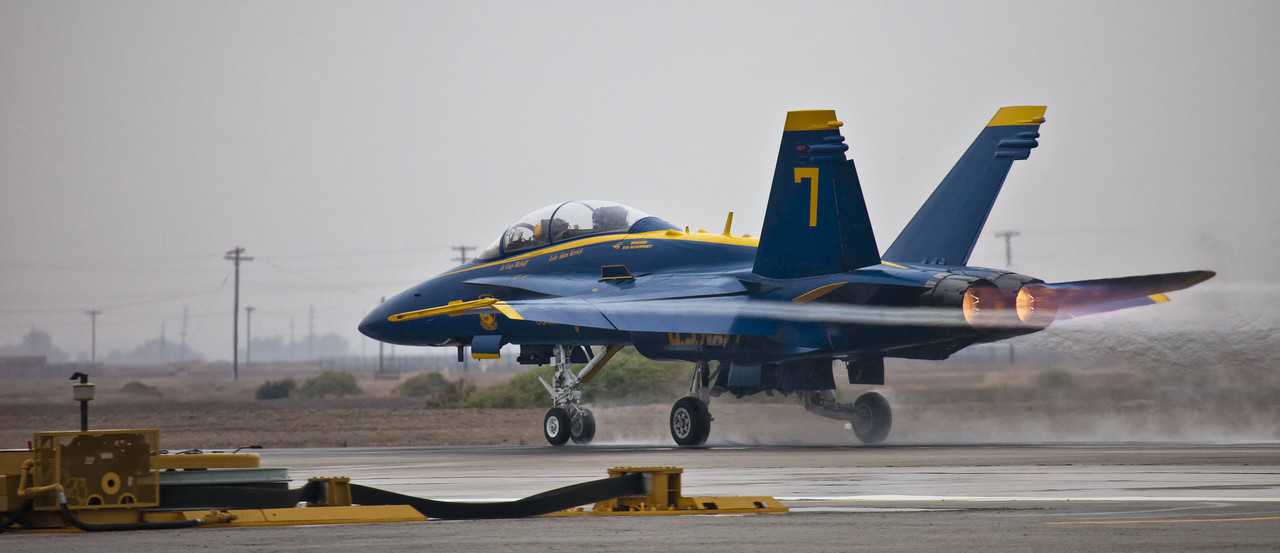
You cannot buy a seat. The team takes two backseat riders at each show site, both in the No. 7 jet, and both slots are allocated rather than sold.
One goes to a credentialed media representative. The other goes to someone in the Key Influencer program, which selects people who shape the attitudes of young people in their community.
Key Influencers are typically teachers, coaches, guidance counselors and youth-organization leaders, and they must be nominated by the commanding officer of a Navy or Marine Corps recruiting district. Contacting a local recruiter is the practical starting point.
What Makes the Smoke?
Biodegradable, paraffin-based oil pumped straight into the exhaust nozzles, where it vaporizes instantly. It poses no environmental hazard.
The smoke is not just for show. It draws a traceable path so spectators can follow the flight profile, and more importantly it lets the solo pilots see each other during opposing passes and in haze.
Will the Blue Angels Switch to the F-35?
There is no plan to. Capt. Adam Bryan, who commands the team through the 2026 season, has described moving to the F-35C as impractical for demonstration flying.
The timeline supports staying put. The Navy expects to operate the Super Hornet into the 2040s, so the team has a supported airframe for years yet.
Leadership is changing, though. Cmdr. Logan R. Peck was named in April 2026 to take command for the 2027 and 2028 seasons, arriving with more than 2,400 flight hours and over 500 carrier arrested landings.
The Blue Angels on Screen
If you want the closest thing to a backseat ride, there is a film. The Blue Angels, a 93-minute documentary shot on IMAX cameras, followed a full season with the team.
It was produced by Glen Powell and J.J. Abrams among others, ran in IMAX theaters from May 17, 2024, and moved to Prime Video on May 23, 2024. It remains the best available look inside the cockpit during a demonstration.
Eighty years in, the formula has barely changed. Six jets, 18 inches apart, flown by people who will be back in a fleet squadron within three years.
FAQ
Sources and references used for research and fact-checking.
- U.S. Navy Blue Angels, Blue Angels Frequently Asked Questions
- U.S. Navy Blue Angels, 2026 Blue Angels Maneuvers Manual
- U.S. Navy, U.S. Navy Blue Angels official site
- Wikipedia, Blue Angels
- Stars and Stripes, Navy Blue Angels announce new commanding officer for 2027-28 air show seasons
- Wikipedia, The Blue Angels (2024 documentary)
Get the Newsletter
The latest aviation news and stories sent to your inbox.
About the Author

Tim is the owner and lead editor of AeroCorner since 2019, overseeing aviation content covering aircraft, airlines, airports, and the broader aviation industry. Through years of researching, writing, editing, and publishing aviation-focused content, he has developed extensive practical knowledge of commercial aviation and air travel. Based in Asia and a frequent traveler himself, Tim also brings firsthand passenger experience to AeroCorner’s coverage. Outside of publishing, he has also explored aviation firsthand through hands-on flight training in New Zealand.