

Table of Contents
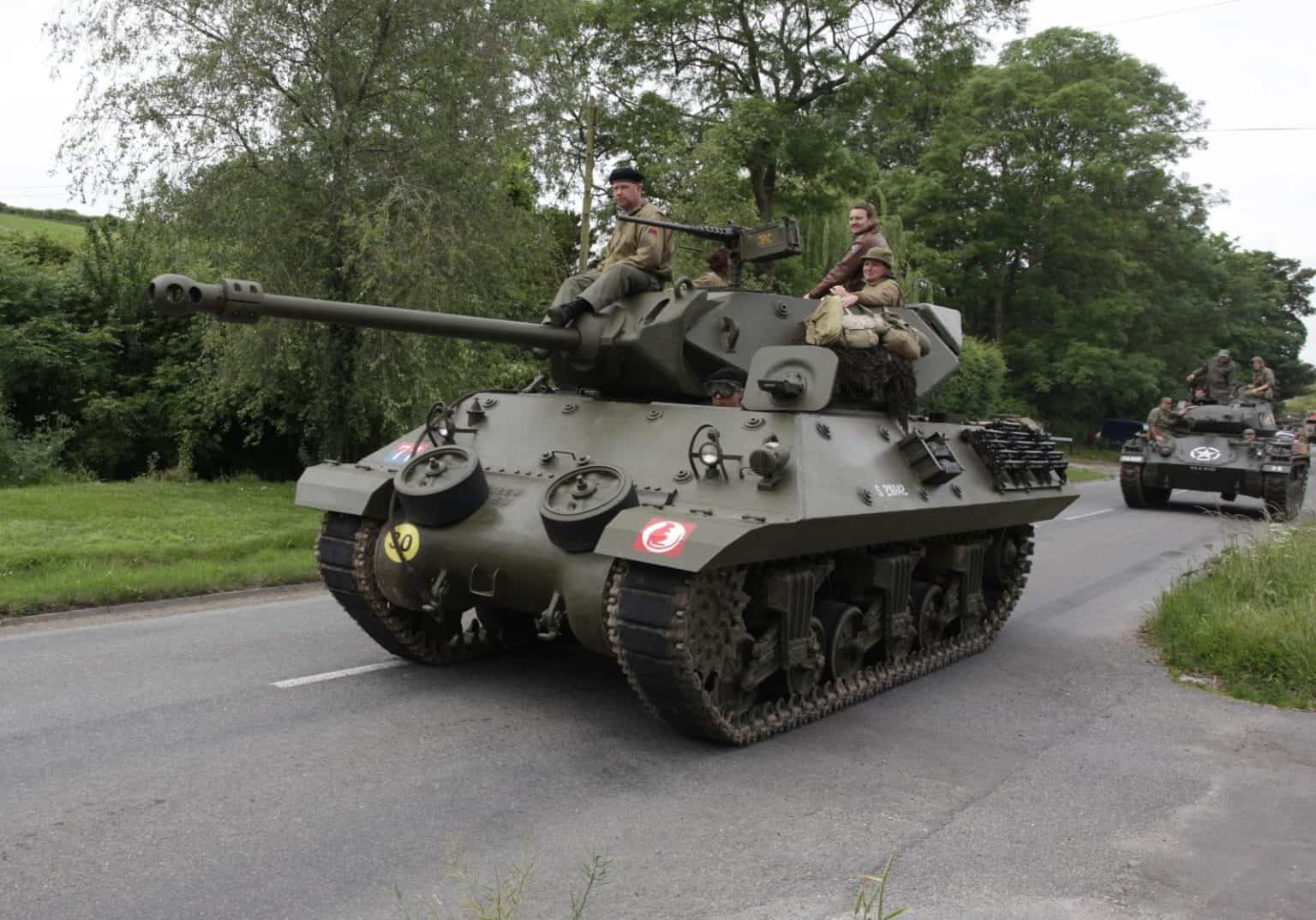
Yes, a private citizen in the United States can legally buy and own a tank. Federal law has no special rule for the vehicle itself: the hull, the armor, the tracks and the engine are yours to own like any other heavy machine.
What the law regulates is the gun. A tank cannon has a bore far wider than half an inch, which makes it a “destructive device” under the National Firearms Act. That is why nearly every tank sold to a collector has a deactivated main gun.
The prices are real, too. At one of the best-documented tank sales of recent years, the 2014 Littlefield Collection auction, tanks sold for between $46,000 and $345,000. Below are the rules, the prices and the catches, from the cannon to the road.
| Part of the tank | Can a civilian own it? | The rule that applies |
|---|---|---|
| Hull, armor, tracks, engine | Yes | No federal rule specific to tanks |
| Deactivated main gun | Yes | Outside the National Firearms Act once the barrel is removed or destroyed to ATF’s standard |
| Working main gun | Yes, with approval | NFA destructive device: ATF registration and a $200 transfer tax, where state law allows |
| High-explosive shells | Yes, with approval | Each explosive projectile is its own destructive device, registered separately |
| Machine guns | Only pre-1986 guns | Only guns lawfully registered before May 19, 1986 can be transferred to a private owner |
| Driving it on public roads | Depends on the state | State vehicle law; some states ban metal tracks on paved highways |
The $2.6 million Panzer that never sold
An earlier version of this page said a WWII Panzer IV sells for $2.4 million to $2.6 million. That figure is the pre-sale estimate for the Panzer IV Ausf. H at the 2014 Littlefield auction. The tank failed to sell, so the number is an asking range, not a price anyone paid.
Is it legal to own a tank?
Yes. No federal law bans a civilian from owning a tracked armored vehicle. Collectors, museums and private owners hold them across the country, and tanks change hands at public auctions.
The federal rules that matter all attach to the weapons. The National Firearms Act (NFA) covers the main gun and any explosive shells, and a separate federal ban covers machine guns. Strip or deactivate those, and what is left is a very heavy vehicle.
State and local law can add limits on top. ATF’s own handbook stresses that a destructive device or machine gun can only be transferred where state and local law do not prohibit possessing one.
Can you own a tank with a working cannon?
Yes, in principle, but it is the hardest version of tank ownership. Federal law defines a destructive device to include any weapon that fires a projectile by explosive or other propellant through a bore more than half an inch (12.7 mm) wide.
Every tank cannon clears that bar many times over. ATF’s National Firearms Act Handbook says most weapons in this category are large military weapons such as rocket launchers, mortars and cannons.
A working cannon has to be registered with ATF in the National Firearms Registration and Transfer Record, and each transfer carries a $200 tax. The tax cut that took effect on January 1, 2026 dropped the tax to $0 for silencers, short-barreled guns and so-called “any other weapons,” not for destructive devices.
That carve-out still holds. When ATF stopped enforcing NFA approval and registration for those $0-tax items on October 9, 2026, it said machine guns and destructive devices remain taxable and subject to every NFA provision.
The shells are destructive devices too
A legal cannon does not come with legal ammunition. Under the same law, a projectile carrying more than a quarter ounce of explosive or incendiary material is its own destructive device, and ATF says high-explosive projectiles larger than 20mm generally qualify. Every live shell is a separate registered item.
That puts a tank shell in the same legal family as a live grenade, which is why civilians generally cannot buy grenades either. A shell with no explosive or incendiary filler falls outside that part of the definition.
The machine guns are a separate problem. Federal law has banned transferring or possessing a machine gun since May 19, 1986, except for guns lawfully possessed before that date. A tank’s machine guns can only change hands if they were registered in time.
What a deactivated gun means
ATF treats a large-caliber weapon as outside the NFA once its barrel is removed, or functionally destroyed. Its handbook describes the standard: a bore-sized hole cut through the chamber, the barrel welded to the receiver and an obstruction welded into the barrel.
Collector tanks are usually sold this way. The British Centurion Mk 5 in the Littlefield sale still carried its 20-pounder barrel and every gunner’s control, but its auction listing noted that cutting the breech had “demilled” the gun.

How much does a tank cost?
A collector tank costs roughly what a high-end classic car does, and sometimes far more. The most transparent price list is the July 11 and 12, 2014 sale of the Littlefield Collection in Portola Valley, California.
The auction house published every result, which is rare in this market. Most tanks change hands privately, at prices nobody publishes.
| Vehicle | Origin | Result |
|---|---|---|
| Panzer IV Ausf. H | Germany, WWII | Not sold (estimate $2.4M to $2.6M) |
| M4A2 (76) HVSS Sherman | USA, WWII | $345,000 |
| M5 Stuart light tank | USA, WWII | $310,500 |
| M4A3 (75) Sherman | USA, WWII | $299,000 |
| M50 Sherman | Israeli-modified Sherman, Six-Day War veteran | $293,000 |
| Leopard 1A1A4 | West Germany, Cold War | $198,950 |
| PT-76B amphibious tank | Soviet design, ex-East German Army | $172,500 |
| Centurion Mk 5 | UK, built 1953 | $66,700 |
| M47 Patton (no engine or transmission) | USA, Cold War | $46,000 |
Rarity, not size, sets the price. The 15.7-ton PT-76B fetched more than two and a half times the Centurion’s price, and every WWII American tank in the table beat every Cold War tank in it.
The most expensive vehicle that day was not a tank at all. A German Sd.Kfz. 7 eight-ton half-track sold for $1,207,500, more than three times the best tank result.
Buying is only the start. The auction listed a transport cost of $4,488 just to move the M50 Sherman to storage, and $5,808 for the Centurion.
What a new tank costs a government
New front-line tanks are bought by governments. When the State Department approved a possible sale to Taiwan of 108 M1A2T Abrams tanks, notified to Congress on July 8, 2019, the package was valued at an estimated $2 billion.
That figure also covered recovery vehicles, heavy transporters, machine guns, ammunition and communications gear, so dividing it by 108 overstates the price of one tank. It still shows the gap between a new Abrams and a $300,000 Sherman.
Where do civilian tanks come from?
Mostly from foreign armies and from long-held private collections. The Littlefield lots show the pattern: an ex-East German PT-76, a West German Leopard 1, a British Centurion and an Israeli Sherman that fought in the 1967 and 1973 wars.
Paperwork is thinner than buyers expect. Several of those lots were sold on a bill of sale only, with no title.
The tank outside the VFW hall is not for sale
Many of the tanks parked outside veterans’ halls and town parks still belong to the US Army. The Army Donations Program issues obsolete combat equipment for static display under 10 U.S.C. 2572, and the VFW’s own instructions to its posts say that equipment remains US Army property.
A post may not sell, loan, move or give away a display tank, and it must send the Army a current photograph of the piece every year. In 2016 the program reported 407,595 items worth $2.6 billion at 33,000 organizations in 14 countries.
That matters to a buyer because forgotten loans resurface. An M1917 tank given to Nitro, West Virginia was stolen, restored, sold and ended up in a Wyoming museum, and the Army’s tank command may still own it, ClearanceJobs reported. Chain of ownership is worth checking before money changes hands.
Are tanks street legal?
Usually not, at least not on paved public roads. The rules that apply are state vehicle laws on weight and tracks.
Weight is the first problem. The federal gross vehicle weight limit on the Interstate is 80,000 pounds (36,300 kg), while the Air Force lists the M1 Abrams at 69 tons, or 138,000 pounds (62,600 kg). Even the Littlefield Leopard 1 weighed 46.7 tons (42,400 kg).
Tracks are the second. Iowa, for example, bans any motor vehicle with a metal track in contact with a paved highway. Moving a tank any distance means a heavy trailer, as the transport charges in the Littlefield listings show.

The rules vary by state, so the state department of transportation is the place to ask before a tank touches a public road.
Tanks and aircraft: the airlift and the Spitfire engine
The military has a faster way to move a tank than a trailer. The rear ramp of the C-17 Globemaster III takes virtually all of the Army’s air-transportable equipment, the Air Force says, including the 69-ton M1 Abrams.
The bigger C-5M Super Galaxy can carry two Abrams tanks at once. An Air Force photo from 2011 shows a pair of them loaded side by side in a C-5M from Dover Air Force Base.
A tank engine built from crashed fighters
The Centurion in the Littlefield sale ran on a Rolls-Royce Meteor, a de-rated, unsupercharged version of the 27-liter Merlin V12 that powered the Spitfire and the Mustang. The first Meteors were assembled from Merlin parts recovered from crashed aircraft, and many early engines still showed crash damage.
Rolls-Royce turned the Merlin’s rotation around for a tank gearbox and stripped out the supercharger and propeller reduction gear. The Meteor is widely credited with giving British tanks ample, reliable power for the first time, from the WWII Cromwell to the Centurion.
So a collector who buys a running Centurion owns a direct descendant of the engine in the Supermarine Spitfire. And for buyers who want their surplus military hardware to fly, the rules are a different story again.
FAQ
Sources and references used for research and fact-checking.
- Cornell Law School, Legal Information Institute, 26 U.S. Code 5845: Definitions (destructive device)
- Cornell Law School, Legal Information Institute, 18 U.S. Code 922: Unlawful acts
- Bureau of Alcohol, Tobacco, Firearms and Explosives, National Firearms Act Handbook, Chapter 2: What Are Firearms Under the NFA?
- Bureau of Alcohol, Tobacco, Firearms and Explosives, Update to NFA Transfer Guidance
- Congressional Research Service, The National Firearms Act and P.L. 119-21: Issues for Congress
- RM Sotheby's, Panzerkampfwagen IV Ausf. H (Sd.Kfz. 161/2), The Littlefield Collection
- RM Sotheby's, Centurion Mk 5 Main Battle Tank, The Littlefield Collection
- RM Sotheby's, PT-76B Light Amphibious Tank, The Littlefield Collection
- RM Sotheby's, Leopard 1A1A4 Main Battle Tank, The Littlefield Collection
- RM Sotheby's, M4A3(75) Sherman Medium Tank, The Littlefield Collection
- RM Sotheby's, M47 Patton Medium Tank, The Littlefield Collection
- Sports Car Digest, Auctions America Littlefield Collection: Auction Results
- J. The Jewish News of Northern California, Israeli tank sells for $293,000 at local auction
- Defense News, State okays possible $2 billion Abrams tank sale to Taiwan
- U.S. Army, TACOM LCMC honors US military through Army Loan and Donations Program
- Veterans of Foreign Wars, Policy and Instructions for Conditional Donation of Military Equipment to Veteran Organizations
- ClearanceJobs, Think You Can Own a Tank? The Rules on Owning Heavy Military Hardware
- Federal Highway Administration, Federal Size and Weight Regulations Overview
- Iowa Legislature, Iowa Code 321.441: Metal tires prohibited
- U.S. Air Force, C-17 Globemaster III fact sheet
- U.S. Air Force, 'Tanks' for the ride
- Wikipedia, Rolls-Royce Meteor
Get the Newsletter
The latest aviation news and stories sent to your inbox.
About the Author

Tim is the owner and lead editor of AeroCorner since 2019, overseeing aviation content covering aircraft, airlines, airports, and the broader aviation industry. Through years of researching, writing, editing, and publishing aviation-focused content, he has developed extensive practical knowledge of commercial aviation and air travel. Based in Asia and a frequent traveler himself, Tim also brings firsthand passenger experience to AeroCorner’s coverage. Outside of publishing, he has also explored aviation firsthand through hands-on flight training in New Zealand.