


Table of Contents
Air Force One is the most closely guarded cockpit in aviation, and the people sitting in it are not named, not volunteers, and not paid a cent extra for the job. Here is who actually flies the president, and what it takes to get there.
Air Force One is flown by active-duty US Air Force officers from the Presidential Airlift Group, a unit of the 89th Airlift Wing at Joint Base Andrews, Maryland. Two pilots are at the controls, backed by a relief pilot and a flight engineer. The senior officer holds the title Presidential Pilot and commands the group, usually as a colonel.
Their names are not released while they are serving. The Air Force treats the identity of a sitting presidential pilot as an operational security matter, which is why no name has been widely confirmed since 2017.
One thing has changed dramatically in 2026: the aircraft. Since July 1, 2026, the president has been flying a converted Boeing 747-8 known as the VC-25B Bridge, replacing the two 35-year-old VC-25A jumbos in the presidential role.
Who is in the Air Force One cockpit
| Role | Typical rank | What they do |
|---|---|---|
| Presidential Pilot | Colonel (O-6) | Commands the Presidential Airlift Group and flies as aircraft commander on the most sensitive missions |
| Deputy Presidential Pilot | Lieutenant colonel or colonel | Second in the rotation, flies as aircraft commander or copilot |
| Relief pilot | Lieutenant colonel or major | Third qualified pilot carried so the flight deck can be crewed continuously on long legs |
| Flight engineer | Senior enlisted | Manages fuel, systems and the aircraft’s engineering panel on the VC-25A flight deck |
| Total crew | Mixed | 26 people on a VC-25A, including cabin, communications, security and maintenance |
Several officers hold the Presidential Pilot and Deputy Presidential Pilot qualifications at any one time. They rotate through the year so leave, training and illness never leave the aircraft without a qualified commander.
Why you cannot look up the current pilot
The Air Force does not identify the serving Presidential Pilot by name. Past pilots become public only after they leave the job, which is why every published list stops with Col. Dave Banholzer, whose tour ended in 2017.
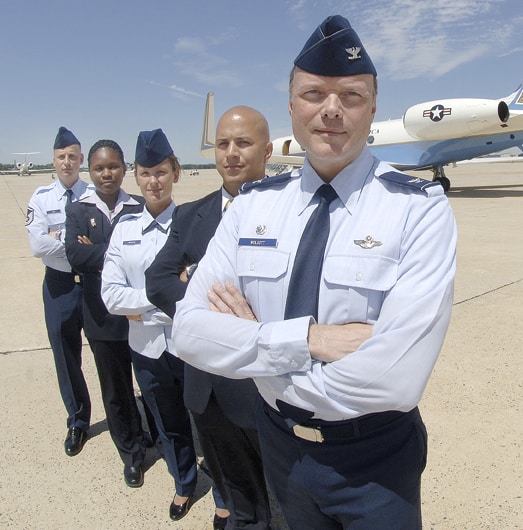
The unit behind the call sign: the Presidential Airlift Group
No aircraft is permanently called Air Force One. The call sign belongs to whatever Air Force aircraft the president is aboard, and in practice that means the jets flown by the Presidential Airlift Group.
The group was formally established in April 2001, but its lineage runs back to the Presidential Pilot Office created in 1944 at Franklin D. Roosevelt’s direction. It contains two squadrons: the Presidential Airlift Squadron, which flies and crews the aircraft, and the Presidential Logistics Squadron, which supports it worldwide.
The group sits inside the 89th Airlift Wing, an Air Mobility Command wing of more than 1,000 personnel at Joint Base Andrews in Maryland. The wing also flies the C-32A, C-37 and C-40B jets that carry the vice president, cabinet secretaries and members of Congress.
Everyone in the wing was recruited from somewhere else in the Air Force. It keeps its own physiologist to screen candidates, and wing leadership has described the vetting as a series of cuts rather than a single interview.
You’ve been vetted, and then you’re going to be double and triple-vetted. At each level, there’s a cut.
Col. Chris Robinson, 89th Airlift Wing commander
How many pilots are on Air Force One?
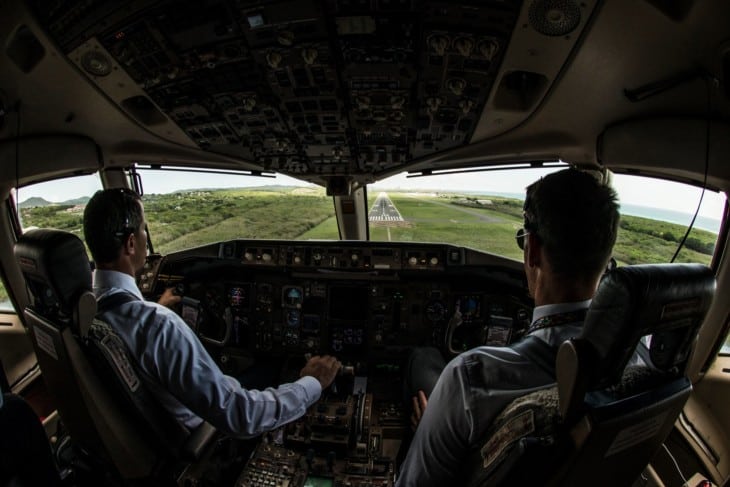
Two pilots fly the aircraft, and a third qualified pilot is carried as relief. That third seat matters on the very long, unrefueled legs the presidential mission routinely demands.
On the VC-25A the flight deck also carried a flight engineer and, historically, a navigator. Total crew on a VC-25A mission is 26, covering the flight deck, cabin service, communications, security and maintenance.
How to become an Air Force One pilot
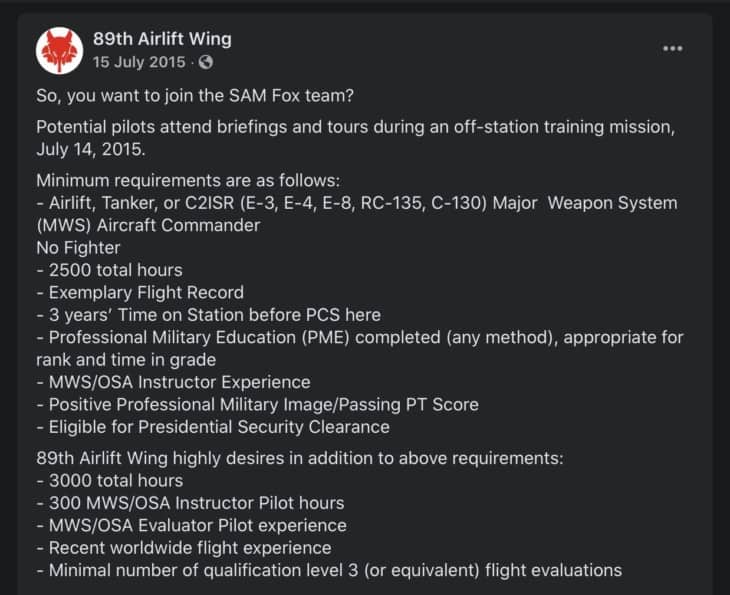
There is no application to fly the president. You apply to the 89th Airlift Wing, spend years flying its other aircraft, and are selected upward from inside the unit.
The path starts the same way every Air Force flying career does. You commission as an officer through the Air Force Academy, ROTC or Officer Training School, then complete Undergraduate Pilot Training.
| Requirement | Detail |
|---|---|
| Commission | US Air Force officer, via the Academy, ROTC or Officer Training School |
| Flight hours | Minimum 2,500 hours, in practice heavily weighted toward large multi-engine transports such as the C-17 or C-5 |
| Qualification | Current instructor pilot in a major weapon system |
| Citizenship | US citizen with unquestioned loyalty and a clean record |
| Clearance | Yankee White, Category One for the Presidential Pilot, on top of a Tier 5 background investigation |
| Selection | Annual 89th Airlift Wing board, plus interviews and psychological screening |
| Typical rank on selection | Lieutenant colonel or colonel, meaning roughly 20 or more years of service |
The 2,500-hour minimum is the gate, not the goal. Candidates who clear the board have usually flown far more than that, and the instructor-pilot requirement means they have already been trusted to teach the aircraft they fly.
If you are weighing which service to fly for, the calculus is different from a fighter career. Our guide to which military branch is best for pilots covers how the heavy-airlift route compares.
The common misconception
People assume the presidential pilot is the best stick in the Air Force, picked for flying skill. Selection is far more about judgment, temperament and trustworthiness. The wing screens for people who will not improvise when 26 crew and a head of state are behind them.
Yankee White clearance
Yankee White is not a clearance level so much as an extra vetting program for people who work in close proximity to the president and vice president. It sits on top of a Tier 5 background investigation.
Category One is the most sensitive tier, covering personnel with direct and regular contact with the president. The Presidential Pilot is explicitly one of those positions, alongside the military aides and the director of the White House Medical Unit.
The investigation reaches beyond the candidate. Finances, foreign contacts, relationships and the backgrounds of close family are all examined, and the vetting is continuous rather than one-time.
Air Force One pilot salary
Flying the president pays nothing extra. Presidential pilots draw the same basic pay as any other Air Force officer of the same rank and time in service, set by the published military pay tables.
Because the job is held by senior officers, that still lands in the six figures. A colonel with more than 22 years of service earns $14,112.90 a month in basic pay under the 2026 tables, or about $169,400 a year.
| Rank | Years of service | 2026 monthly basic pay | Approx. annual basic pay |
|---|---|---|---|
| Lieutenant colonel (O-5) | Over 20 | $12,033 | $144,400 |
| Lieutenant colonel (O-5) | Over 22 | $12,394 | $148,700 |
| Colonel (O-6) | Over 20 | $13,751 | $165,000 |
| Colonel (O-6) | Over 22 | $14,113 | $169,400 |
| Colonel (O-6) | Over 24 | $14,479 | $173,700 |
Basic pay is only the taxable part of the package. Add the housing allowance and subsistence allowance and total compensation for a senior colonel with dependents runs closer to $210,000 a year.
For comparison, a widebody captain at a major US airline can out-earn that comfortably. Presidential pilots are not doing this for the money.
Who is the current Air Force One pilot?
Nobody outside the unit can answer that with confidence, and that is by design. The Air Force does not publicize the identity of the officer currently holding the Presidential Pilot job.
Names surface afterward, usually through unit histories, retirement announcements and interviews the pilots give once they are out of the seat. That is why every public list of presidential pilots ends in the 2010s.
Air Force One pilots list
| Pilot | Years | Aircraft | President served |
|---|---|---|---|
| Lt. Col. Henry T. “Hank” Myers | 1944 to 1948 | Sacred Cow, Independence | Roosevelt, Truman |
| Col. Francis W. Williams | 1948 to 1953 | Independence | Truman |
| Col. William G. Draper | 1953 to 1961 | Columbine | Eisenhower |
| Col. James Swindal | 1961 to 1965 | SAM 26000 | Kennedy, Johnson |
| Col. James U. Cross | 1965 to 1968 | SAM 26000 | Johnson |
| Lt. Col. Paul Thornhill | 1968 to 1969 | SAM 26000 | Johnson |
| Col. Ralph D. Albertazzie | 1969 to 1974 | SAM 27000 | Nixon |
| Col. Lester C. McClelland | 1974 to 1980 | SAM 27000 | Ford, Carter |
| Col. Robert E. Ruddick | 1980 to 1989 | SAM 27000 | Carter, Reagan |
| Col. Robert D. “Danny” Barr | 1989 to 1997 | VC-25A | G. H. W. Bush, Clinton |
| Col. Mark S. Donnelly | 1997 to 2001 | VC-25A | Clinton, G. W. Bush |
| Col. Mark W. Tillman | 2001 to 2009 | VC-25A | G. W. Bush |
| Col. Scott Turner | 2009 to 2013 | VC-25A | Obama |
| Col. Dave Banholzer | 2013 to 2017 | VC-25A | Obama |
Col. Mark Tillman and September 11
Colonel Mark Tillman is the best-known presidential pilot of the modern era, because he was in the left seat on September 11, 2001. President George W. Bush was visiting an elementary school in Sarasota, Florida when the first aircraft struck the World Trade Center.
Tillman was running pre-flight checks for the return to Washington when he was called to the upper deck to watch the live coverage. Reporters were still describing a light aircraft hitting the building by accident. Tillman did not believe it.
What followed was a day of improvised flying with the president aboard and no clear picture of the threat. Tillman kept the aircraft’s position obscured, talked to the FAA command center over secure lines, and effectively had priority over the national airspace as it emptied.
His route that day, Sarasota to Barksdale Air Force Base to Offutt Air Force Base and finally to Washington, was chosen for security rather than convenience. Tillman later described the day simply as a fog of war.
How Tillman got the job
Tillman is a Florida native with a chemical engineering degree who joined the Air Force expecting a short tour before returning to civilian engineering. After a stint designing rocket engines, he applied for pilot training instead.
He flew C-130s, then instructed on the T-37, before being assigned to the 89th Airlift Wing to fly Gulfstreams carrying the first lady, congressional delegations and other dignitaries. That VIP-airlift apprenticeship is the standard route.
He was selected for the Air Force One crew in 1992 but was not authorized to fly with the president aboard for another year. By the time George W. Bush took office, Tillman was chief pilot.
What Air Force One pilots train for that airline pilots do not
Flying a VC-25 is, mechanically, flying a Boeing 747. The difference is everything wrapped around it.
Presidential crews train for aerial refueling, which gives the aircraft effectively unlimited range, and for evasive maneuvering that no airline pilot ever practices. They also operate a flying command post with hardened electronics and secure communications.
The most famous test of that training came in 1974. Flying President Nixon to meet Syria’s Hafez al-Assad, Col. Ralph Albertazzie found two Syrian MiG fighters sliding into formation on either side of the aircraft.
Assuming an attack, Albertazzie banked hard and entered a steep descent that lasted several minutes. Passengers were thrown to the floor. The MiGs, it turned out, were a courtesy escort nobody had told the flight deck about.
No, fighter jets do not normally escort Air Force One
The protection is airspace, not formation flying. The FAA closes a moving bubble of temporary flight restrictions along the route while NORAD watches it. Fighter escorts are the exception, ordered only for a specific threat. On September 11 the F-16s that did join up had trouble keeping pace and asked the crew to slow down.
2026: a new aircraft and a new type rating
The presidential pilot’s job changed this summer. On July 1, 2026, President Trump flew from Joint Base Andrews to North Dakota aboard the VC-25B Bridge, a Boeing 747-8 registered N7478D.
The aircraft was built in 2012 as a private 747-8 for Qatar, donated to the United States in 2025, and converted for the presidential mission by L3Harris in about ten months. It was unveiled at Andrews on June 19, 2026.
It is a stopgap. Boeing’s two purpose-built 747-8 VC-25Bs are years late, with first delivery now projected for mid-2028, and the Bridge aircraft is expected to be handed over to a presidential library before 2029.
The two VC-25As have not been scrapped. They remain available as backup and Special Air Mission aircraft, and one flew as the shadow on that first Bridge flight, though June 18, 2026 is widely reported as their last trip with a president aboard.
The new jet also ended a 64-year-old paint scheme. The pale blue livery designed under John F. Kennedy in 1962 gave way to a navy underside, a red stripe and a large flag on the tail, a change we cover in why Air Force One is blue.
Retraining the crews
Moving from the 747-200 to the 747-8 is a different type rating, and the Air Force does not own a 747 training fleet. It has leaned on Atlas Air, which has provided ground and simulator training for presidential crews since 2007 out of Miami.
By Atlas Air’s own account, the last four presidents have been flown by crews who earned their initial 747 certification through the company. The contract runs through 2027.
Since December 2025 an Atlas Air 747-8 freighter has been flying training sorties for Air Force crews under the call sign VENUS, working out of Andrews, Eglin and Hickam. The Air Force also bought two retired Lufthansa 747-8s in December 2025 so it can eventually train its own crews in-house.
Air Force One pilot uniform
Most Air Force pilots fly in a sage-green flight suit. Presidential crews usually do not.
The familiar look is a navy blue MA-1 bomber jacket over a white shirt and black tie. Without the rank insignia you could easily mistake the crew for airline pilots, which is roughly the intended effect.
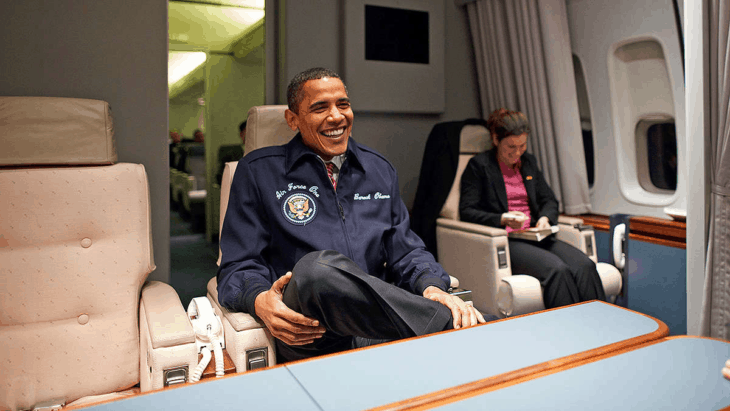
The MA-1 has been Air Force issue since 1950. Presidents have adopted it too, with President Obama wearing a personalized jacket carrying his name and the Air Force One title on the front.
Crews do not always wear a uniform at all. On sensitive overseas trips, where visible foreign military personnel would be a problem, they fly in civilian clothes, as they did on President Bush’s secret 2003 flight into Baghdad.
Do Air Force One pilots have to be American?
Yes. Yankee White eligibility requires US citizenship, so the officer at the controls with the president aboard is always American.
The nuance is that the 89th Airlift Wing does host foreign exchange officers. In 2020 the RAF confirmed that a British wing commander had been posted to the unit, flying other aircraft in the fleet under an exchange program running since 1971.
That posting was widely reported as a British pilot who would one day fly Air Force One. Flying for the wing and flying the president are not the same qualification, and the citizenship rule on the presidential mission has not changed.
The same unit distinction applies to the president’s helicopter. Marine One is flown by Marine Corps pilots from a separate squadron, not by the Air Force at all.
FAQ
Sources and references used for research and fact-checking.
- The White House, Air Force One
- Joint Base Andrews, US Air Force, 89th Airlift Wing Fact Sheet
- Air & Space Forces Magazine, Special Mission, Special Fleet
- Air & Space Forces Magazine, Trump Takes Flight in New 'Bridge' Air Force One
- The Aviationist, U.S. Air Force Training Pilots for Next Generation Air Force One
- Milwaukee Journal Sentinel, Air Force One pilot vividly describes the events of the Sept. 11 terror attacks
- NavyCS, 2026 Military Pay Chart
Get the Newsletter
The latest aviation news and stories sent to your inbox.
About the Author

Tim is the owner and lead editor of AeroCorner since 2019, overseeing aviation content covering aircraft, airlines, airports, and the broader aviation industry. Through years of researching, writing, editing, and publishing aviation-focused content, he has developed extensive practical knowledge of commercial aviation and air travel. Based in Asia and a frequent traveler himself, Tim also brings firsthand passenger experience to AeroCorner’s coverage. Outside of publishing, he has also explored aviation firsthand through hands-on flight training in New Zealand.