Fighter Jets
Yakovlev Yak-28
ICAO: YK28
Russia's lead-in fighter trainer that doubles as a light attack jet
Updated: by Tim de Vries
The latest aviation news and stories sent to your inbox.
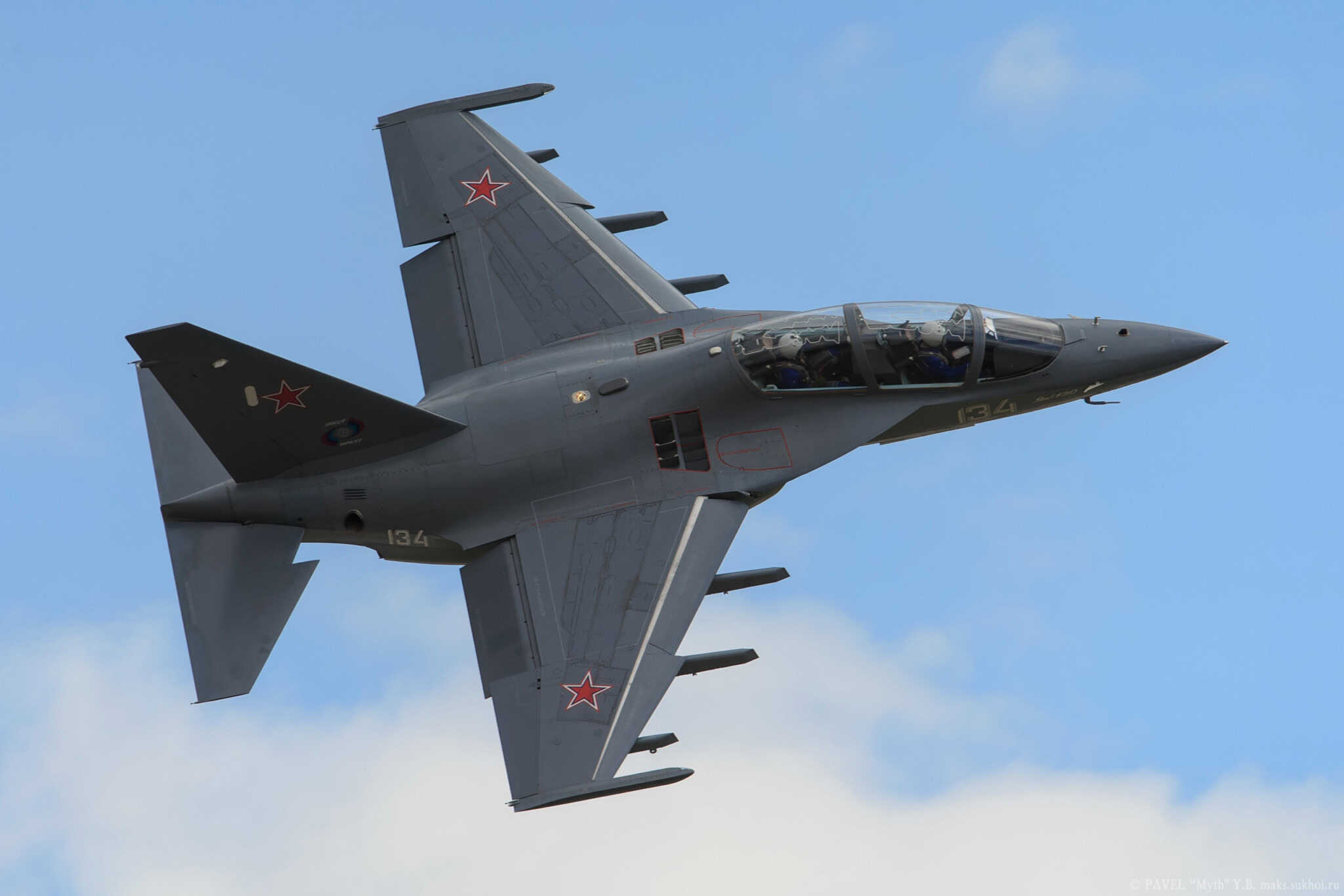
The Yakovlev Yak-130 (NATO reporting name Mitten) is a subsonic, two-seat advanced jet trainer and light combat aircraft, built by Irkut in Irkutsk. It prepares Russian pilots for fighters such as the Su-35 and Su-57, and its programmable fly-by-wire can mimic how different fighters handle. It has also flown combat missions in Myanmar and Iran.
Live Fleet Activity (Y130)
Fetching live data…


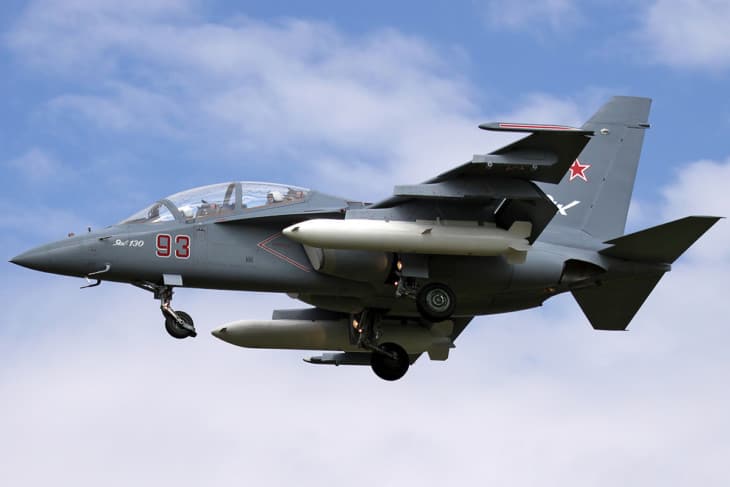
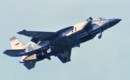
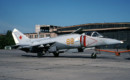
The Yakovlev Yak-130 is a subsonic, two-seat advanced jet trainer that also works as a light attack aircraft. NATO calls it “Mitten.” Russia uses it as the last step before a student pilot moves into a frontline fighter such as the Su-35 or the Su-57.
It has also seen combat. Myanmar’s air force has flown it on strike missions, and in March 2026 an Iranian Yak-130 became, according to the Israeli military, the first crewed aircraft ever shot down by an F-35.
The Yak-130 is a lead-in fighter trainer. It is built to teach the flying, the cockpit displays and the weapons work of fourth- and fifth-generation fighters, so that pilots arrive at their combat jets needing fewer expensive hours in them.
Rosoboronexport, Russia’s state arms exporter, markets it as able to cover every task of the pilot training course, including combat use. It also sells the jet as a light combat aircraft in its own right, for missions against ground and air targets.
Yakovlev designed it. Production moved from the Sokol plant in Nizhny Novgorod to the Irkutsk Aviation Plant, part of Irkut, which is now the sole builder. The Russian Air Force has flown it since February 2010.
In the early 1990s the Soviet government asked industry for a replacement for its Czech-built L-29 and L-39 jet trainers. Yakovlev started the Yak-130 in 1991, and the Russian Ministry of Defense approved the concept in 1993.
Government money was short, so Yakovlev brought in the Italian trainer specialist Aermacchi. The two companies developed the design together from 1993 to 1999, and the demonstrator was known as the Yak/AEM-130.
Yakovlev test pilot Andrey Sinitsyn flew the Yak-130D demonstrator for the first time on April 25, 1996, from the Gromov flight test airfield at Zhukovsky. When the partnership ended, each company kept developing its own version. The Italian one became the Aermacchi M-346 Master.
The Yak-130 won the Russian Defense Ministry’s trainer tender on April 16, 2002, beating the MiG-AT. The first aircraft in full production configuration flew from the Sokol plant on April 30, 2004, and state trials finished in 2009.
The Yak-130 is a mid-wing monoplane with a swept wing and an all-moving horizontal tail. Large wing root extensions run forward almost to the canopy, and the manufacturer says they keep the jet controllable at angles of attack up to 35 degrees.
The key system is its digital fly-by-wire. It is quadruplex, and an instructor can change its handling to behave like a heavy, medium or light fighter. That lets one airframe stand in for several frontline types.
Each cockpit has three 6 by 8 inch color displays. The front cockpit adds a head-up display and a helmet-mounted sight for cueing R-73 missiles. In Flight International’s 2012 flight test, Peter Collins noted that the display area was almost twice that of the BAE Hawk 128.
The instructor sits high behind the student under a separate canopy. Both crew have K-36 zero-zero ejection seats that fire through the canopy.

The Yak-130 was built for rough fields. Doors in the engine intakes close while the jet is on the ground and it breathes through openings on top, which keeps debris out of the engines. A trailing-link landing gear and low-pressure tires complete the package.
An auxiliary power unit lets it start and run at remote airfields without ground equipment.
The full specification table for the Yak-130 is on this page. A few of its figures need context.
The two Ivchenko-Progress AI-222-25 turbofans are rated at 5,510 lbf (25 kN) each. At the normal takeoff weight with full internal fuel, that gives a thrust-to-weight ratio of 0.70, against 0.65 for the Hawk 128. The high ratio is what gives the jet its fighter-like climb and sustained turn.
Top speed is Mach 0.93, or 572 kt (658 mph). The Yak-130 never goes supersonic; the manufacturer describes its flight performance as similar to that of modern combat aircraft within the subsonic range.
Range depends on fuel. The panel lists 1,300 mi (2,100 km), which is with two external tanks. On internal fuel alone the manufacturer quotes about 990 miles (1,600 km).
The airframe is stressed to +8 and -3 g. Collins reported that it can sustain 7 g at low altitude.
The Yak-130 has nine hardpoints: two at the wingtips, six under the wings and one under the fuselage. The maximum combat load is 6,600 lb (3,000 kg).

According to Flight International, the weapons it can carry include bombs of up to 1,100 lb (500 kg), guided bombs, unguided rockets, a twin 23 mm gun pod, R-73 infrared-guided air-to-air missiles, and electronic countermeasures pods. External fuel tanks go on the wing stations.
A double GPS and GLONASS receiver updates the laser-gyro inertial navigation system, which gives precise navigation and weapons aiming. That is what turns a trainer into a usable light attack jet.

A dedicated attack version, the Yak-131, was planned with armor and a built-in 30 mm cannon. Russia dropped it around 2011 and turned to a dedicated replacement for the Su-25 instead.
The modernized Yak-130M was unveiled in August 2024. It adds an AESA radar, an electro-optical and laser targeting system, a podded self-protection suite and a new data link, which pushes the jet further toward a light combat aircraft.
A new engine is also in development. The United Engine Corporation showed the SM-100, a derivative of the AI-222-25, in 2023 and claims 20% more thrust with no increase in weight.
In July 2026, Irkutsk Aviation Plant director Andrei Soynov said Vietnam was close to signing for 18 Yak-130Ms, Aviation Week reported. In September 2026, Rosoboronexport announced its first Yak-130M export contract, for more than 10 aircraft, without naming the customer.
At the end of September 2026, United Aircraft Corporation’s chief executive told TASS that the Yak-130M was in flight testing, that contracts with foreign customers were signed, and that deliveries would begin in 2028.
Myanmar’s military has used the Yak-130 in its internal war. The Centre for Information Resilience documented Yak-130 strike missions between February and June 2022, including one video of a Yak-130 firing its 23 mm cannon and unguided rockets. The strikes drew international criticism after evidence emerged of attacks on civilian areas.
On February 18, 2022, a bomb at Hmawbi air base damaged two of Myanmar’s Yak-130s, according to the same investigation.
Iran received its first Yak-130s in September 2023, and Iran’s deputy defense minister confirmed the deliveries without giving numbers. Images from December 2024 showed an Iranian Yak-130 carrying an R-73 missile, and the jets were reportedly used to intercept drones.
On March 4, 2026, during the 2026 Iran war, the Israel Defense Forces said an F-35I Adir had shot down an Iranian Yak-130 over Tehran. Unconfirmed reports said the Yak-130 was flying a counter-drone mission. The IDF called it the first time an F-35 had shot down a crewed aircraft.
Russia is by far the largest operator. After an initial order for 12, the Defense Ministry ordered 55 more plus 10 options in November 2011, and The Military Balance counted 109 in Russian service at the start of 2023.

Export customers so far:
Two orders never happened. Libya’s new government canceled six jets in 2011, and a Syrian order for 36 had still not been delivered by 2019.
The Yak-130 and the M-346 look like twins because they began as the same design. They split in how they were finished.
Collins, who flew both for Flight International, described the M-346 as taking Western engines and avionics to become a pure advanced trainer. The Yak-130 kept Russian systems and became a combat trainer as well, with weapons integration from the start and clearance for unpaved runways.
Irkut can also supply a Western-style cockpit that reads in feet and knots, and set up the displays and controls to mimic other frontline fighters. Collins saw that as an important export selling point. Comparable jets include the KAI T-50 Golden Eagle and the Hawk.
Unit prices are not published and vary by contract. Defense Express reported in 2023 that the declared export price was $15 million per aircraft, with the Russian Defense Ministry paying about $7 million. Treat both as estimates.
Export deals usually bundle simulators, training and spares, so they run higher per jet. Vietnam’s 2019 order for 12 was reported at about $350 million.
Not in the usual sense. It is an advanced jet trainer and light combat aircraft. It can carry air-to-air missiles and has reportedly flown air defense missions in Iran, but it is subsonic and was designed to train pilots for fighters, not to replace them.
It does not belong to a fighter generation, because it is a trainer. It was built to prepare pilots for fourth- and fifth-generation fighters, and its fly-by-wire can imitate their handling.
The number has not been disclosed. Iran confirmed the first deliveries in September 2023, and reporting since then suggests more followed, but neither Iran nor Russia has published a total.
Yes. Myanmar’s air force has used it for ground attack in the country’s civil war, and Iran reportedly used it against drones. An Israeli F-35I shot one down over Tehran on March 4, 2026.
Vietnam bought 12 in 2019. Two have been lost in training crashes, which leaves about 10. It is also negotiating for 18 upgraded Yak-130Ms.
As a trainer, it is well regarded. Flight International’s test pilot praised its cockpit layout, and Irkut says its life-cycle costs are four to six times lower than training on two-seat MiG-29s or Su-27s. As a combat aircraft it is limited: it is subsonic, and when Iran used it as an interceptor, an F-35 shot one down.
The declared export price reported in 2023 was about $15 million per aircraft. Full export packages with training and support cost more per jet.
Its top speed is Mach 0.93, or 572 kt (658 mph).
Russia. Yakovlev designed it, and Irkut builds it at the Irkutsk Aviation Plant in Siberia. It is one of the Russian combat aircraft sold abroad through Rosoboronexport.
Sources and references used for research and fact-checking.