Fighter Jets
Yakovlev Yak-28
ICAO: YK28
The Yakovlev Yak-141 was the Soviet Union's supersonic vertical-takeoff naval fighter, built to replace the Yak-38. It first flew in 1987 and set 12 world records before the Soviet collapse ended the program.
Updated: by Tim de Vries
The latest aviation news and stories sent to your inbox.
The Yakovlev Yak-141, also known as the Yak-41 and by the NATO name Freestyle, was a Soviet supersonic VTOL fighter designed for the Soviet Navy. Four prototypes were built and two flew. It made the first vertical-to-horizontal transition in 1990 and landed on the carrier Admiral Gorshkov in 1991, but funding ran out before it entered service.
Live Fleet Activity (Y141)
Fetching live data…


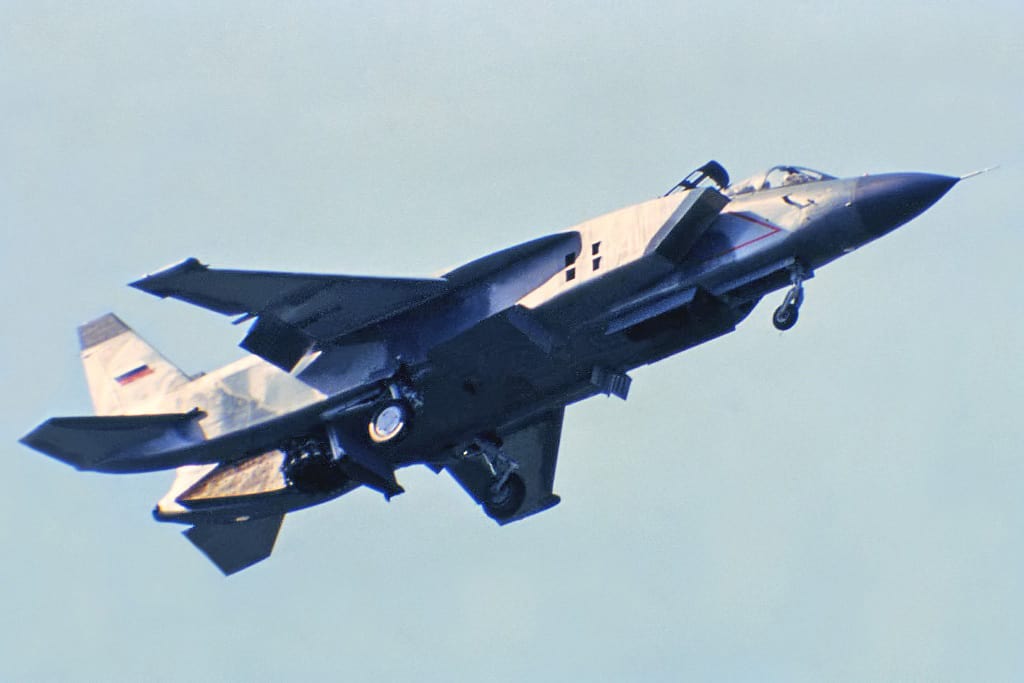
The Yak-141 was a Soviet supersonic fighter that could take off and land vertically. Yakovlev designed it as “Product 48” to replace the Yak-38 on Soviet Navy carriers.
It is also called the Yak-41, and NATO knew it as Freestyle. The specification table for the aircraft is on this page, and the sections below explain what the numbers mean.
The Yak-38 was the Soviet Navy’s only operational VTOL strike aircraft and its first operational carrier-based fixed-wing aircraft. It first flew on January 15, 1971, and entered service on August 11, 1976. It was limited to Mach 0.95 because supersonic performance would have made development too difficult.
The Yak-141 was meant to fix that. It was designed as a supersonic fleet-defense fighter that could operate from Soviet carriers.
Yakovlev studied a twin-engine layout and rejected it, because losing one engine during a landing would create asymmetric thrust. It chose a single main engine with lift jets instead.
The main engine is a Tumansky R-79V-300 afterburning turbofan with a vectoring nozzle, rated at 34,000 lbf (151 kN) in the panel. Two Rybinsk (RKBM) RD-41 lift jets sit behind the cockpit, angled at 85 degrees. For hovering, reaction control jets at the wingtips and under the nose use excess airflow from the engines.

The engines were digitally controlled. The cockpit had an automatic ejection seat, armed when the nozzle rotated past 30 degrees at under 190 mph (300 km/h), so the ejection could fire without the pilot pulling a handle.
The wing sat high on the fuselage and folded so the aircraft could fit in a carrier hangar. The landing gear was a tricycle layout.
The Yak-141 is 60 ft 3 in (18.36 m) long with a wingspan of 33 ft 2 in (10.10 m), and its tail stands 16 ft 5 in (5.00 m) high. That makes it a compact aircraft, sized to share a carrier deck with other aircraft.
The published range is 1,100 nm (1,270 mi, 2,040 km). The ferry range, with external fuel, is 1,600 nmi (3,000 km) in Wikipedia’s data.
The service ceiling is 50,900 ft (15,500 m) and the rate of climb is 49,000 ft/min. Those are listed in the panel beside the speed row, which shows the Yak-141’s published top speed.
The aircraft carried one 30 mm GSh-30-1 cannon with 120 rounds. Four underwing and one fuselage hardpoints took up to 5,750 lb (2,600 kg) of stores, including R-73, R-77 and R-27 air-to-air missiles.
Four prototypes were built. The first was a static-test article and the second a nonflying testbed, so the third and fourth did the flying.
The first flight took place on March 9, 1987, at Zhukovsky. The aircraft first hovered on December 29, 1989, and made its first full transition from vertical to horizontal flight on June 13, 1990.

Combat maneuverability was rated as excellent. Twelve world records were set during flight testing.
The aircraft’s real designation, Yak-41, was classified. The records were therefore registered with the FAI under the name Yak-141, which Yakovlev later used for promotion.
That is why Western sources use both names for the same airframe.
Deck trials on a mock carrier deck at Saky began in April 1991. The first landing on the carrier Admiral Gorshkov came on September 26, 1991, and a second flying prototype landed an hour later.
Eight flights from the ship were completed before October 5, when a hard landing ruptured a fuel tank. The aircraft caught fire and the pilot ejected. The airframe was later repaired for display.
No. The program was suspended in October 1991 for lack of funds, and no production aircraft followed. Yakovlev planned a Yak-41M with large leading-edge root extensions and better avionics, but it stayed on paper.
A further Yak-43 proposal with Kuznetsov NK-321 engines was never built either.

After the Soviet collapse, Lockheed entered a partnership with Yakovlev in 1991. Yakovlev announced it on September 6, 1992, and Lockheed confirmed it in June 1994.
The deal was to produce three more prototypes and a static-test aircraft, with a two-seat trainer among them, but none were built. Wikipedia’s F-35 article says Lockheed considered research from earlier lift-system aircraft, including the Yak-141, when designing its X-35.
The F-35B does not copy the Yak-141 layout, though. Its lift fan is driven by a shaft and clutch from the main engine, rather than by separate lift jets.
Two aircraft survive. Yak-41M number 48-2, call sign 75, is at the Central Air Force Museum at Monino. Number 48-3, call sign 77, is at the Yakovlev OKB Museum.
Both are displayed in their 1992 olive and gray camouflage.

Four prototypes were built, and two of them flew. No production aircraft were built, and the program was suspended in October 1991.
Yes. The Yak-38 first flew on January 15, 1971, and entered Soviet Naval Aviation service on August 11, 1976. Production totaled 143 Yak-38s, 50 Yak-38Ms and 38 two-seat Yak-38U trainers.
The Yak-41 designation was classified, so the 12 world records were declared under the name Yak-141. Yakovlev later used that name for promotion.
Lockheed partnered with Yakovlev in 1991 and considered research from earlier lift-system aircraft, including the Yak-141, for the X-35. The F-35B’s shaft-driven lift fan is a different design from the Yak-141’s lift jets.
One is at the Central Air Force Museum in Monino, Russia, and another is at the Yakovlev OKB Museum.
Sources and references used for research and fact-checking.