

Table of Contents
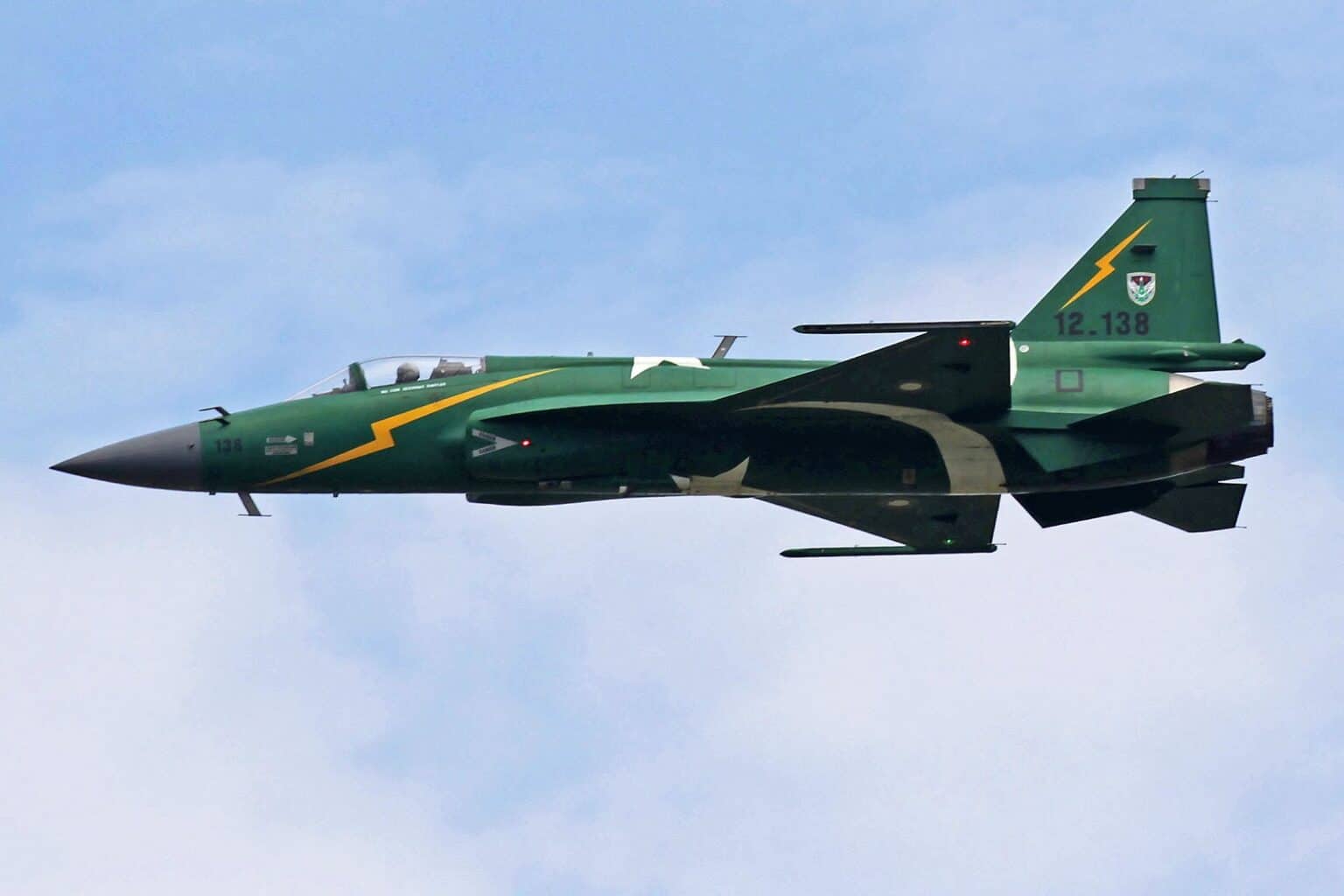
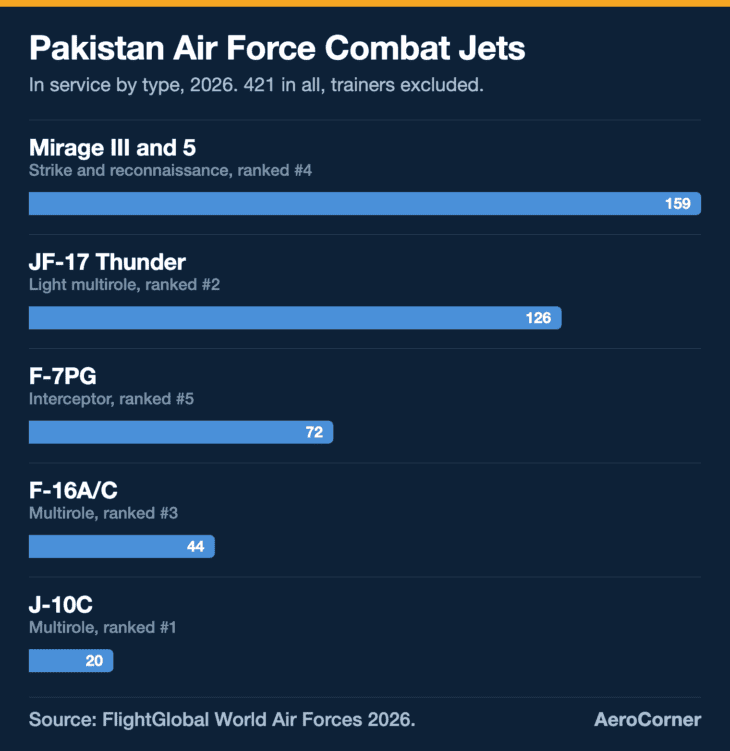
The Pakistan Air Force (PAF) flies 421 combat jets of five types, according to FlightGlobal’s World Air Forces 2026 directory. Its best fighter is the Chinese-built J-10C, and its backbone is a fleet of 126 JF-17 Thunders built in Pakistan.
That gives Pakistan the sixth-largest combat aircraft fleet in the world. More than a third of it is still French Mirage III and Mirage 5 jets of types first bought in the late 1960s and 1970s, and the PAF has signed an initial agreement for China’s J-35 stealth fighter.
This list ranks every combat jet type the PAF flies by one measure: the fighting value it adds as of October 2026, weighing what the aircraft can do against how many Pakistan has. The May 2025 air war with India, the support fleet and the jets on order follow the ranking.
| Rank | Aircraft | Role | In service | On order |
|---|---|---|---|---|
| 1 | J-10C | Multirole fighter | 20 | 5 |
| 2 | JF-17 Thunder | Light multirole fighter | 126, plus 25 two-seaters | 32 |
| 3 | F-16A/C | Multirole fighter | 44, plus 31 two-seaters | None |
| 4 | Mirage III and Mirage 5 | Strike and reconnaissance | 159 (69 and 90), plus 20 trainers | None |
| 5 | F-7PG | Interceptor | 72 | None |
How this ranking works
Each type is ranked by its fighting value in October 2026: its radar, weapons and age, weighed against how many the PAF flies. Counts come from FlightGlobal’s World Air Forces 2026 directory, which lists only aircraft in day-to-day use, with Cirium data drawn in October 2025. Other trackers give lower Mirage and F-7 totals because both fleets are being retired, so treat those two counts as the upper end. Two-seat versions are shown separately, and the J-35 is left out until one is delivered.
1. J-10C: The Smallest Fleet, and the Jet That Made Headlines
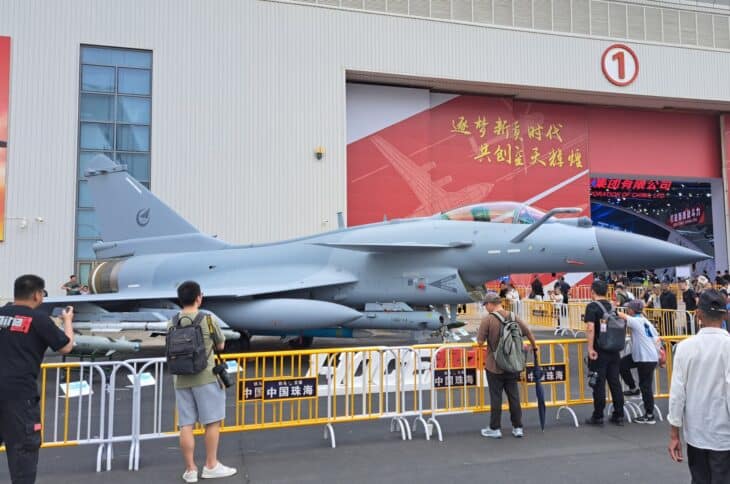

The Chengdu J-10C is a single-engine Chinese multirole fighter armed with the long-range PL-15 air-to-air missile. Pakistan’s first J-10Cs arrived from China on March 4, 2022, and joined No. 15 Squadron, the Cobras, at Minhas air base in Kamra on March 11.
FlightGlobal counts 20 in service and five more on order. In May 2026 the PAF’s deputy chief of air staff, Air Vice Marshal Tariq Ghazi, said Pakistan was seeking more J-10Cs.
It ranks first because of what happened on May 7, 2025. Two US officials told Reuters there was high confidence that a Pakistani J-10 fired air-to-air missiles that brought down at least two Indian aircraft, and that at least one was a French-made Rafale.
Not the F-16
Both US officials who spoke to Reuters said Pakistan’s American-made F-16s were not used in the shootdowns. The jet credited was a Chinese design Pakistan had flown for barely three years, firing a Chinese missile, against one of the most advanced Western fighters in India’s fleet.
2. JF-17 Thunder: Built in Pakistan, and the Backbone of the Fleet
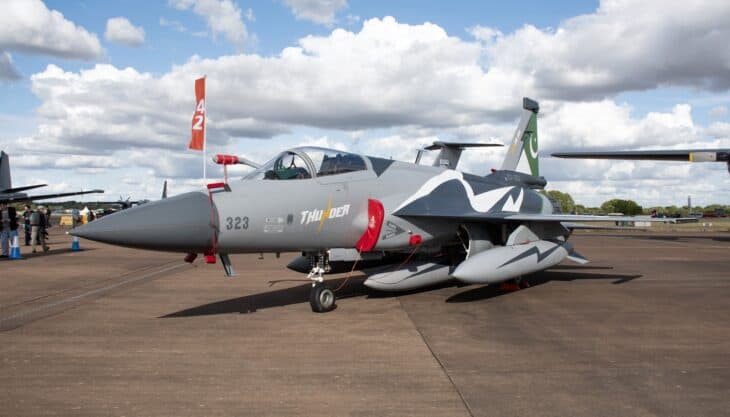

The JF-17 Thunder is a light, single-engine fighter that Pakistan Aeronautical Complex (PAC) at Kamra developed with China’s Chengdu Aircraft Corporation; China calls it the FC-1 Fierce Dragon. It first flew on August 25, 2003, and the first PAF squadron, No. 26, the Black Spiders, was formally inducted on February 18, 2010.
FlightGlobal counts 126 single-seat JF-17s and 25 two-seat JF-17Bs, with 32 more on order. The newest, the Block III, entered service in March 2023 with an AESA radar, a new RD-93MA engine and the ability to carry the PL-15E missile.
It ranks second, ahead of the F-16, because Pakistan builds it, arms it and upgrades it without asking anyone’s permission. JF-17s flew strike missions in February 2019 and again in May 2025, and Pakistan sells it abroad: Azerbaijan signed for Block IIIs in February 2024, and Pakistan announced a $4.6 billion deal for 40 of them in June 2025.
3. F-16: Pakistan’s Most Famous Fighter, on a Short Leash
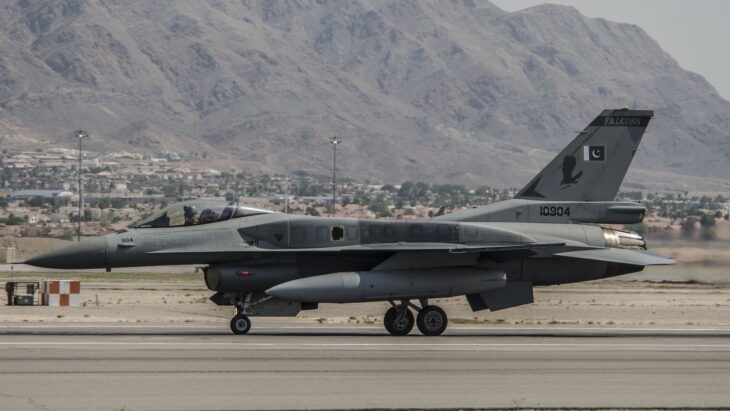

The first Pakistani F-16 landed at Sargodha on January 15, 1983, and 40 were delivered by 1987. Between May 1986 and November 1988, PAF F-16s shot down at least eight intruding aircraft that crossed the border from Afghanistan.
FlightGlobal counts 44 F-16A and F-16C fighters and 31 two-seat B and D models. The best are 18 Block 52 jets delivered in 2010; the older A and B models were upgraded with help from Turkish Aerospace, and 13 more came second-hand from Jordan in 2014.
It ranks third because the US controls its future. In October 1990, a US aid cutoff over Pakistan’s nuclear program stopped delivery of 28 F-16s Pakistan had bought. In October 2025, the US said a new missile contract covered only spares and sustainment for Pakistan’s existing AIM-120C-5 AMRAAMs, not new missiles.
The F-16s India says it hit on the ground
India’s air chief, Air Chief Marshal A.P. Singh, said on August 9, 2025, that Indian strikes in May blew away half of an F-16 hangar at Jacobabad and damaged a few F-16s under maintenance. Pakistan says it lost no aircraft in the conflict. Neither claim has been independently verified.
4. Mirage III and Mirage 5: The Biggest Fleet, and the Oldest
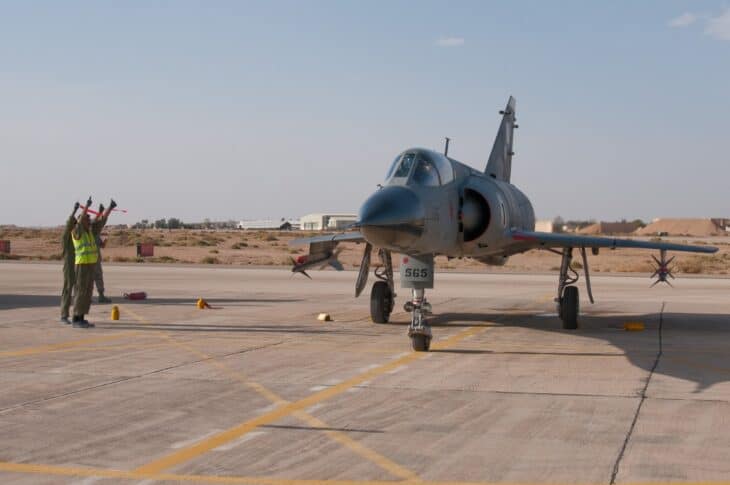

Pakistan has flown the Dassault Mirage III since the late 1960s, and its first Mirage 5s, 28 Mirage 5PAs, were ordered in 1970 and delivered from January 1973. FlightGlobal counts 69 Mirage IIIs and 90 Mirage 5s, plus 20 two-seat trainers.
Many were bought second-hand. Pakistan collected retired Mirages from Australia, France, Lebanon and Libya, and redesigned many of them at Kamra under Project ROSE (Retrofit of Strike Element) with new cockpits, navigation and attack systems, and night-attack sensors.
By numbers alone they would rank first. They rank fourth because they are 1960s and 1970s designs with 1990s upgrades, and the type is being retired: other trackers already count far fewer in day-to-day use than FlightGlobal’s 159.
5. F-7PG: A Chinese MiG-21, Near the End
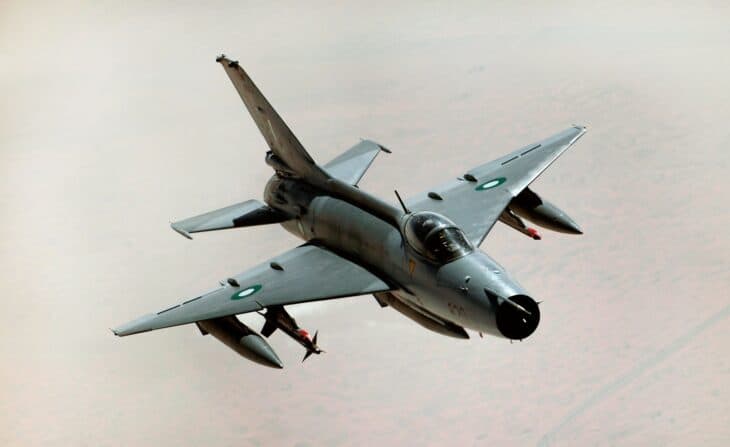

The F-7PG is the export version of the Chengdu J-7, China’s copy of the Soviet MiG-21. Pakistan introduced it in 2002, and FlightGlobal counts 72 F-7s in PAF service.
It is the oldest design in the fleet, a single-engine interceptor descended from a 1950s Soviet fighter. It ranks last, and it is being retired, with the JF-17 taking its place.
The May 2025 Air War With India: What Each Side Claims
India launched Operation Sindoor on May 7, 2025, two weeks after an attack in Pahalgam, in Indian-administered Kashmir, killed 26 civilians. Pakistan answered with Operation Bunyan-um-Marsoos, and the four days of fighting ended in a ceasefire on May 10.
Pakistan’s count has grown over time. It claimed five Indian jets at first, then six. On May 7, 2026, Air Vice Marshal Ghazi said the PAF was at eight-zero: four Rafales, a Su-30, a MiG-29, a Mirage 2000 and an unmanned aircraft, with no Pakistani aircraft lost.
India’s air chief said on August 9, 2025, that India shot down at least five Pakistani fighters and one large ELINT or early-warning aircraft at about 186 miles (300 km), and hit an early-warning aircraft hangar at Bholari. India’s Chief of Defence Staff has acknowledged losses but rejected the claim of six jets.
Who won the air war? Nobody can prove it yet.
Each side says it shot down several of the other’s jets, and Pakistan says it lost none. The only independent statements are from two anonymous US officials, who told Reuters a J-10 brought down at least two Indian aircraft including a Rafale, and FlightGlobal, which classes one Indian Rafale as lost after reviewing images of wreckage. Any exact count beyond that is a claim.
The Support Fleet: Radar Planes, Tankers and Trainers
The PAF’s eyes are seven Saab 2000 Erieye early-warning aircraft and four Chinese Y-8 radar planes, according to FlightGlobal. Four Il-78 tankers refuel the fighter force.
| Aircraft | Role | In service |
|---|---|---|
| Saab 2000 Erieye | Airborne early warning | 7 |
| Y-8 (AEW) | Airborne early warning | 4 |
| Falcon 20 | Electronic warfare | 2 |
| Il-78 | Aerial refueling tanker | 4 |
| C-130 and L-100 Hercules | Tactical transport | 23 |
| Saab 2000 and CN235 | Light transport | 6 and 3 |
| MFI-395 Super Mushshak | Primary trainer | 119 |
| K-8 Karakorum | Jet trainer | 37 |
| T-37 | Jet trainer | 27 |
| AW139, Mi-171 and others | Search and rescue helicopters | 34 |
The world's second-largest training fleet
Pakistan’s armed forces fly 563 training aircraft and helicopters, second only to the United States, FlightGlobal’s 2026 directory says. That includes 214 MFI-17 Mushshak trainers flown by the Army, on top of the Air Force’s own 119 Super Mushshaks.
The attack helicopters belong to the Army, not the Air Force. Pakistan Army Aviation flies 50 AH-1F Cobras and 50 Mi-8/17 family transports, FlightGlobal says.
What Comes Next: The J-35 Stealth Fighter
In June 2025, Islamabad said China had offered it a package of 40 J-35 stealth fighters, KJ-500 early-warning aircraft and HQ-19 air defense systems. In May 2026, Air Vice Marshal Ghazi said the PAF had signed an initial collaborative agreement for the J-35.
No contract has been published, and no J-35 had been confirmed delivered as of October 2026. The jet has not officially entered Chinese service either. For the rest of China’s fighter line, see our guide to the best Chinese fighter jets.
If it arrives, Pakistan would field a stealth fighter, a class of jet India does not yet fly. Until then the J-10C, and more Block III JF-17s, carry the load.
A Short History and Who Leads the PAF
The PAF was founded in August 1947, at partition, as the Royal Pakistan Air Force. Pakistan marks Air Force Day on September 7, for the PAF’s part in the 1965 war with India.
August 1947
Founded. The Royal Pakistan Air Force is formed at partition.
September 1965
War with India. F-86 Sabres, F-104s and B-57s fight the 1965 war; September 7 becomes Air Force Day.
January 15, 1983
First F-16. The first Pakistani F-16 lands at Sargodha.
February 27, 2019
Swift Retort. Pakistani jets shoot down an Indian MiG-21 Bison and its pilot is captured.
March 11, 2022
J-10C. The first J-10Cs enter service at Minhas, Kamra.
May 2025
Operation Bunyan-um-Marsoos. Four days of air and missile fighting with India.
May 2026
J-35. The PAF says it has signed an initial agreement for China’s stealth fighter.
The Chief of the Air Staff is Air Chief Marshal Zaheer Ahmad Babar Sidhu, a fighter pilot commissioned in 1986, who has led the PAF since March 2021. On December 4, 2025, Pakistan approved a two-year extension that keeps him in the post until March 2028.
How Pakistan Compares
Pakistan’s armed forces fly 1,397 military aircraft, seventh in the world, FlightGlobal’s 2026 directory says. By combat aircraft Pakistan is sixth, with 421, all of them in the Air Force.
India, its rival, fields 600 combat aircraft and 2,183 military aircraft in all, fourth in the world on both counts. For the full world table, see our ranking of the largest air forces in the world.
Size is not strength, which is why the 20 J-10Cs, not the 159 Mirages, top this list. Several of the jets above appear in our wider ranking of the best fighter jets in the world.
FAQ
Sources and references used for research and fact-checking.
- FlightGlobal, World Air Forces 2026 directory (PDF)
- Reuters via The Business Standard, Pakistan's Chinese-made jet brought down two Indian fighter aircraft, US officials say
- Arab News Pakistan, Pakistan Air Force says downed eight Indian fighter jets during May 2025 conflict
- Daily Pakistan, '8-0': PAF says 4 Indian Rafales, Su-30, MiG-29, and Mirage 2000 were shot down
- Deccan Herald, India shot down six Pakistani aircraft including five fighter jets during Op Sindoor, says IAF chief
- Arab News Pakistan, On Pakistan Air Force Day, Islamabad warns PAF ready to defend nation's airspace
- The Defense Post, Pakistan Signs Deal for Chinese Stealth Jets, Pressuring India's Fifth-Gen Plans
- The Business Standard, Pakistan Air Force gets 6 China-made J-10C jets
- Wikipedia, PAC JF-17 Thunder
- F-16.net, Pakistan Air Force F-16 users
- Wikipedia, General Dynamics F-16 Fighting Falcon variants
- Congressional Research Service via EveryCRSReport, U.S. Arms Sales to Pakistan
- Janes, Pakistan's AIM-120 stocks to receive sustainment, says US
- Wikipedia, Dassault Mirage 5
- Wikipedia, List of active Pakistan Air Force aircraft
- Wikipedia, Pakistan Air Force
- Dawn, President appoints Field Marshal Munir as country's first chief of defence forces
- Wikipedia, Zaheer Ahmad Babar Sidhu
- Eduvision, Join PAF 2026: Apply now for permanent commission
Get the Newsletter
The latest aviation news and stories sent to your inbox.
About the Author

Tim is the owner and lead editor of AeroCorner since 2019, overseeing aviation content covering aircraft, airlines, airports, and the broader aviation industry. Through years of researching, writing, editing, and publishing aviation-focused content, he has developed extensive practical knowledge of commercial aviation and air travel. Based in Asia and a frequent traveler himself, Tim also brings firsthand passenger experience to AeroCorner’s coverage. Outside of publishing, he has also explored aviation firsthand through hands-on flight training in New Zealand.