


Table of Contents
Yes, but only just. A civilian in the United States can legally own a live grenade only if it is registered with the ATF, the transfer is approved before it happens, a $200 tax is paid, and the buyer holds a federal explosives license or permit.
That makes a live grenade one of the hardest things a private citizen can legally acquire. It is regulated twice: once as a “destructive device” under the National Firearms Act, and again as explosive material under federal explosives law. State law can then add its own permit, or refuse one.
What most people can buy without paperwork is an inert dummy or a toy. Even many of the consumer smoke and flashbang grenades sold for airsoft and paintball lost their federal exemption in 2023. Here is what the law actually says, item by item, and what the Army pays for the real thing.
AeroCorner earns from qualifying purchases as an Amazon Associate.
| Item | Federal status | What it takes |
|---|---|---|
| Live hand grenade (M67 type) | NFA destructive device, plus explosive material | Registered item, approved Form 4, $200 tax, federal explosives license or permit, explosives storage rules |
| 40mm grenade launcher (M79, M203) | NFA destructive device (bore over half an inch) | Registered item, approved Form 4, $200 tax |
| Live 40mm high-explosive round | Explosive grenade, a destructive device in its own right | Same paperwork as a live hand grenade |
| 37mm flare launcher with flares only | Not a destructive device | No NFA paperwork; state law varies |
| 37mm launcher with rubber or bean bag rounds | Destructive device (ATF Ruling 95-3) | Registered as a destructive device before buying the rounds |
| Consumer smoke, paint and flashbang grenades on ATF’s 2023 list | Explosive under 27 CFR Part 555 | Federal explosives license or permit, storage rules |
| Inert dummy or toy grenade | Not a destructive device | Nothing federally, unless sold with parts that readily assemble into a live device |
Are Grenades Legal in the US?
A grenade is not banned outright, but it sits in the most tightly controlled class of weapons in federal law. The National Firearms Act defines a “destructive device” as any explosive, incendiary or poison gas bomb, grenade, mine or similar device. The same definition covers larger rockets and missiles, and most weapons with a bore wider than half an inch.
Destructive devices share the NFA with machine guns, silencers, short-barreled rifles and shotguns, and “any other weapons.” They are often called Title II weapons, because the NFA was re-enacted as Title II of the Gun Control Act of 1968.
Every one of them has to be listed in the National Firearms Registration and Transfer Record. As of June 2026, that registry held 3,480,970 destructive devices out of 12,168,715 NFA items in total.
| NFA category | Registered items (June 2026) |
|---|---|
| Silencers | 6,342,117 |
| Destructive devices | 3,480,970 |
| Short-barreled rifles | 1,162,627 |
| Machine guns | 882,708 |
| Short-barreled shotguns | 204,570 |
| Any other weapons | 95,723 |
| Total | 12,168,715 |
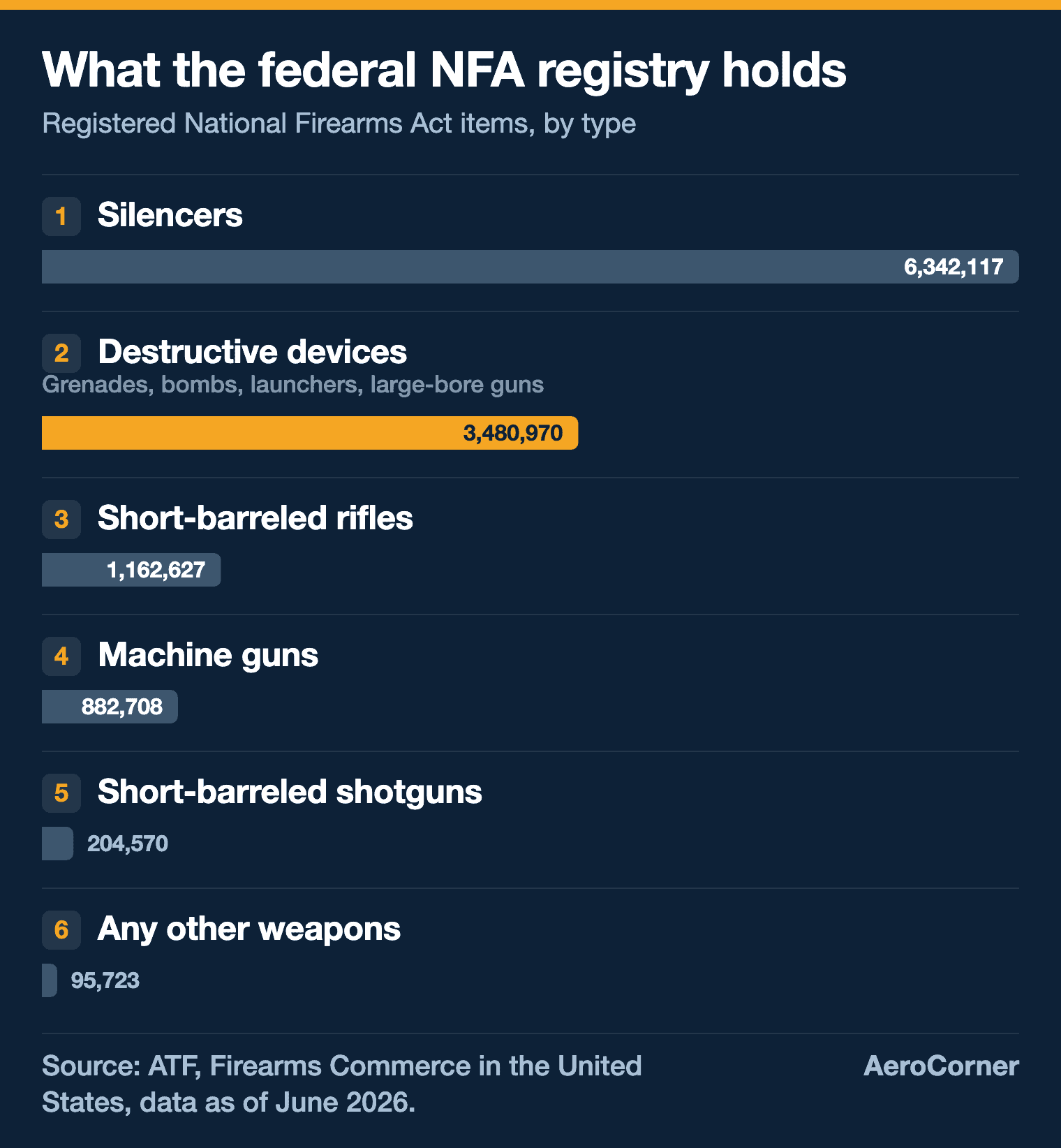
That 3.5 million is not a grenade count. ATF publishes destructive devices as one number, with no breakdown by type, so no public figure says how many registered live hand grenades exist.
How Would a Civilian Legally Buy a Live Grenade?
A live grenade can only change hands as a registered item, and only with the government’s approval first. The process runs through ATF Form 4, the application to transfer and register an NFA firearm.
- File Form 4 before the transfer. Federal regulations say the item cannot change hands until ATF approves the application.
- Identify yourself. An individual buyer’s application must include fingerprints and a photograph.
- Notify local law enforcement. A copy of the form goes to the chief law enforcement officer where the buyer lives before it is sent to ATF.
- Pay the $200 tax. The tax stamp is still $200 for a destructive device.
- Pass the legal test. ATF must deny the application if owning the item would put the buyer in violation of any law.
Older guides say the local police chief or sheriff has to approve the sale. That is out of date: the current regulation requires the buyer to send a copy of the form, not to get a signature. Approval comes from ATF alone.
Businesses that make, import or sell destructive devices need dedicated federal license types. At the end of fiscal 2024, ATF counted 145 licensed dealers, 496 manufacturers and 301 importers of destructive devices in the whole country.
The catch: a live grenade is two regulated things at once
Form 4 covers the grenade as a destructive device. The explosive inside it is a second problem. Federal explosives law makes it illegal to receive, store or transport explosive materials without a federal explosives license or permit, and none of the exemptions in 27 CFR 555.141, such as small arms ammunition or consumer fireworks, fits a privately owned live grenade. The Army describes the M67 as holding about 5.4 ounces of Composition B high explosive.
So a buyer who clears the NFA still has to qualify under the explosives rules, including how and where the item is stored. That second license is the step most “yes, with paperwork” answers leave out.
Did the 2026 Tax Change Make Grenades Cheaper?
No. The 2025 tax law, Public Law 119-21, cut the NFA transfer tax to $0 for silencers, short-barreled rifles and shotguns, and “any other weapons.” The cut applies from January 1, 2026.
The same law kept the tax at $200 for two categories: machine guns and destructive devices. A grenade, a grenade launcher and each explosive round still cost $200 per transfer in tax alone.
State Law Can Add Another Layer
Federal approval does not override state law, and ATF must deny a transfer that would break it. Some states add their own permit for destructive devices.
California is the clearest example. It does not ban destructive devices outright: its Penal Code names “any bomb, grenade, explosive missile, or similar device or any launching device therefor” as a destructive device, then requires a permit from the state Department of Justice to possess one.
The state will not issue that permit to anyone convicted of a felony or barred from owning a firearm. Possessing a destructive device without it can bring up to a year in county jail or a state prison term, a fine of up to $10,000, or both.
Rules differ from state to state, so a federally legal transfer can still be a state crime. Check your own state’s statute, not a forum summary.
How Much Does a Grenade Cost?
The only hard price is the military’s. The Army’s fiscal 2021 budget request priced the standard M67 fragmentation grenade at $44.90 each, for 55,222 grenades.
The same document shows the M67 at $43.16 in fiscal 2019 and $42.51 in fiscal 2020. In the years before that, the Army bought 10,360,693 of them at an average of $31.84 each.
| Grenade | What it is | Unit cost | Quantity requested |
|---|---|---|---|
| XM111 offensive | Blast grenade, no fragments | $299.39 | 14,661 |
| M67 fragmentation | Standard US hand grenade | $44.90 | 55,222 |
| M69 practice body | Reusable training body | $12.43 | 117,767 |
| M228 practice fuze | Smoke-and-bang training fuze | $10.94 | 176,885 |
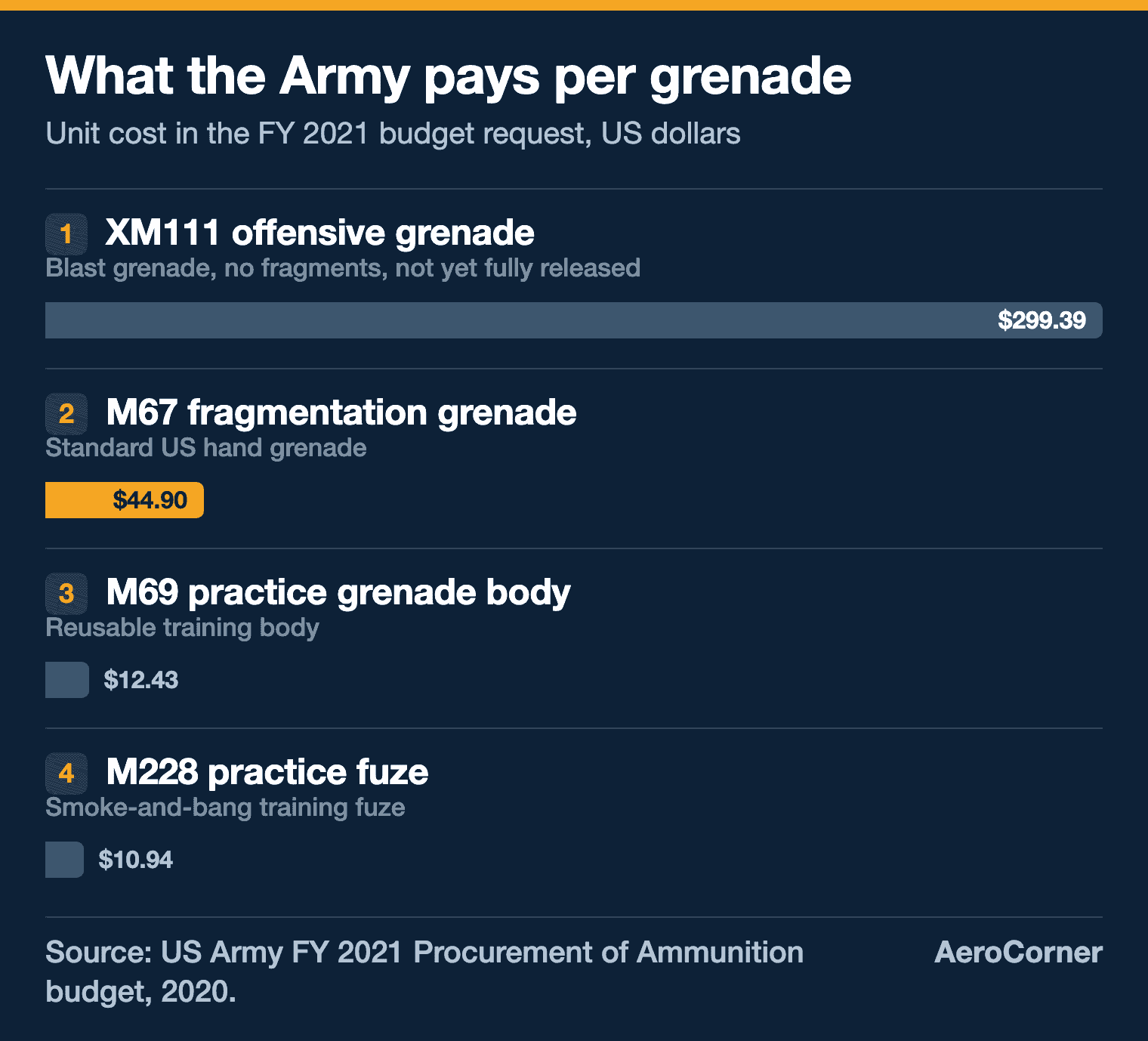
The Army describes the M67 as a 2.5-inch steel sphere that bursts into fragments 4 to 5.5 seconds after the safety lever is released. The XM111, still awaiting full release for service in 2020, is a different tool: a plastic-bodied blast grenade for indoor and close combat, where the Army says fragments are not wanted, to reduce collateral damage.
A civilian price is a different matter. No published market for registered live hand grenades exists, so any figure online is a guess. What is certain is the floor: the item, the $200 tax, and the cost of an explosives license and compliant storage.
Can You Own a Grenade Launcher?
Yes, with the same NFA process as a grenade. A 40mm launcher such as the M79 or M203 is a weapon with a bore far wider than half an inch, which makes it a destructive device. Each live high-explosive 40mm grenade it fires is a destructive device too.
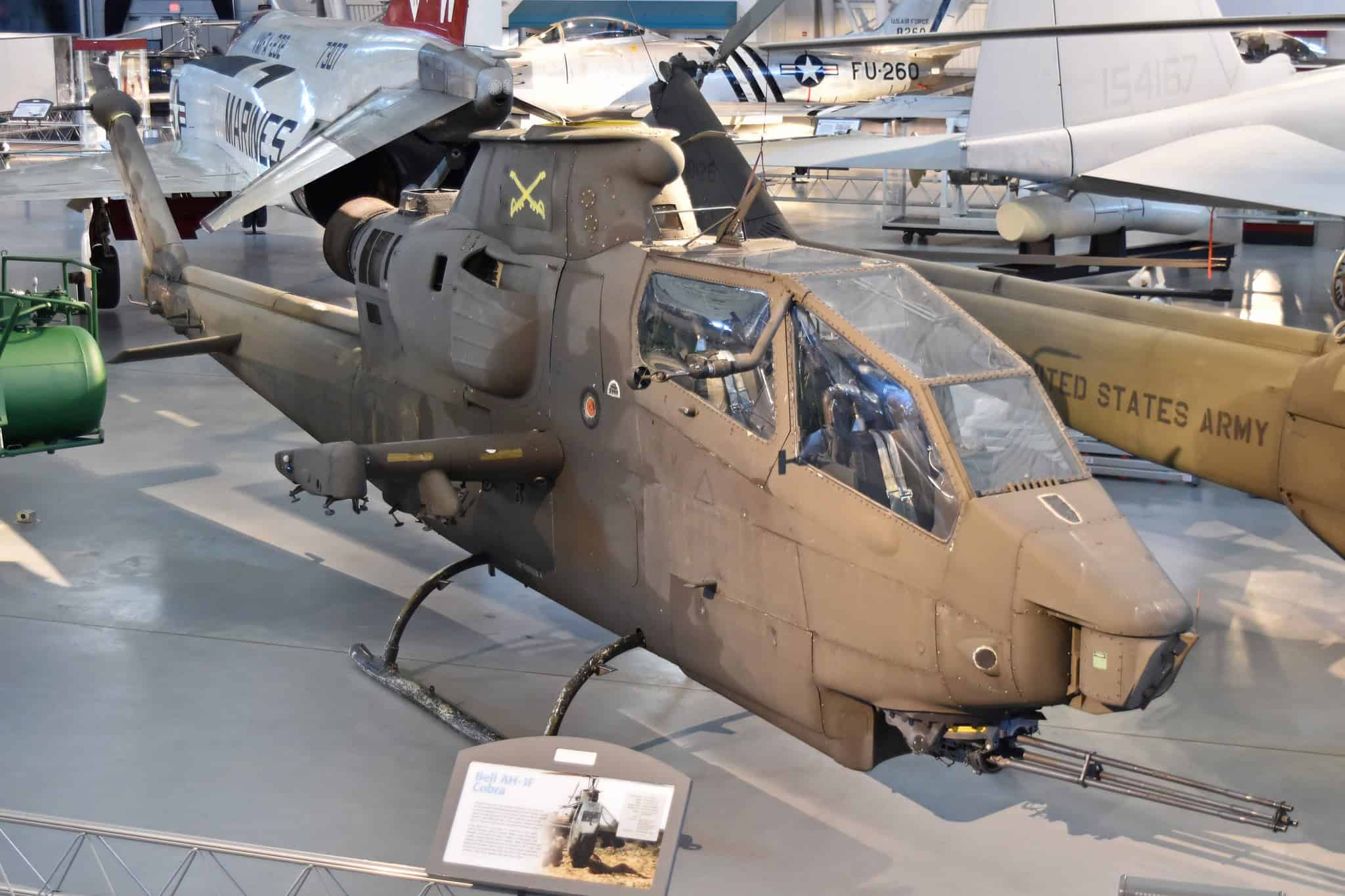
The 40mm grenade also has an aviation history. The M129 grenade launcher, firing up to 400 rounds a minute, rode in the M28 chin turret of the Bell AH-1 Cobra, starting with the AH-1G, and it also flew on the UH-1H Huey.

The 37mm launchers sold as flare guns are the exception. ATF has long held that launchers designed for flares and tear gas are not weapons. Under ATF Ruling 95-3, that changes the moment the launcher is owned with anti-personnel rounds, meaning wood pellets, rubber pellets or balls, or bean bags.
At that point the launcher and the rounds together count as a destructive device. The owner has to register it before acquiring any anti-personnel ammunition.
Smoke Grenades, Flashbangs and Dummy Grenades
Most “grenades” sold to the public are not weapons in the legal sense. The NFA definition excludes devices never designed as weapons, and devices redesigned for signaling, pyrotechnic or safety use.
That did not leave consumer smoke and flashbang grenades unregulated. On November 2, 2023, ATF rescinded the special exemptions it had granted to ten families of consumer-style devices, including MC-18 smoke grenades, EG18X smoke signals, EG67 ball grenades and wire-pull paint grenades.
ATF cited the devices’ use against law enforcement officers and wildfires they had started. Anyone acquiring one of the listed products now needs a federal explosives license or permit, and existing owners must store them under federal explosives storage rules. The fine print for flashbangs is covered in our guide to whether civilians can own flashbangs.
Smoke products sold as consumer fireworks fall under a separate exemption for consumer fireworks. Whether a particular product qualifies depends on its classification, so check the label and the maker’s ATF status, not the word “grenade” on the box.
Inert dummy grenades are the one category that is simple. With no explosive, incendiary or poison gas filler, a dummy is not a destructive device, and replica bodies are sold openly for display, props and military-style training.
[amazon box=”B08D9JMXLB”]
The one trap is parts. The NFA also covers any combination of parts designed to convert a device into a destructive device and from which one can be readily assembled, so a dummy sold with a working fuze and filler is a different item.
Toy grenades with sound effects sit even further from the law. They make noise electronically and contain nothing explosive at all.
[amazon box=”B07D9X8FYR”]
What Happens If You Get It Wrong?
Possessing an unregistered destructive device is a federal felony. The NFA’s penalty section sets a maximum of 10 years in prison and a fine for any violation of its rules.
Explosives violations carry their own federal charges, and state law can add more. For anything with a live charge, the honest answer to “can I buy this?” is that the paperwork comes first, or not at all. Related devices follow similar logic, from flashbangs to tear gas.
FAQ
Sources and references used for research and fact-checking.
- Cornell Law School LII, 26 U.S. Code 5845, Definitions (destructive device)
- Cornell Law School LII, 26 U.S. Code 5811, Transfer tax
- Cornell Law School LII, 26 U.S. Code 5812, Transfers
- Cornell Law School LII, 26 U.S. Code 5871, Penalties
- Cornell Law School LII, 27 CFR 479.84, Application to transfer
- Cornell Law School LII, 27 CFR 555.141, Exemptions (federal explosives regulations)
- ATF, Firearms Commerce in the United States: Annual Statistical Update 2025
- ATF, Illegal Explosives
- ATF, Notification for Previously Exempted Special Explosive Devices (November 2, 2023)
- ATF, ATF Ruling 95-3: 37/38mm gas/flare guns with anti-personnel ammunition
- U.S. Army, FY 2021 Budget Estimates, Procurement of Ammunition, Army (Grenades, All Types)
- California Legislative Information, California Penal Code 18710
- California Legislative Information, California Penal Code 18900
- California Legislative Information, California Penal Code 16460
- Wikipedia, M129 grenade launcher
- Wikipedia, Title II weapons
Get the Newsletter
The latest aviation news and stories sent to your inbox.
About the Author

Tim is the owner and lead editor of AeroCorner since 2019, overseeing aviation content covering aircraft, airlines, airports, and the broader aviation industry. Through years of researching, writing, editing, and publishing aviation-focused content, he has developed extensive practical knowledge of commercial aviation and air travel. Based in Asia and a frequent traveler himself, Tim also brings firsthand passenger experience to AeroCorner’s coverage. Outside of publishing, he has also explored aviation firsthand through hands-on flight training in New Zealand.