

Table of Contents
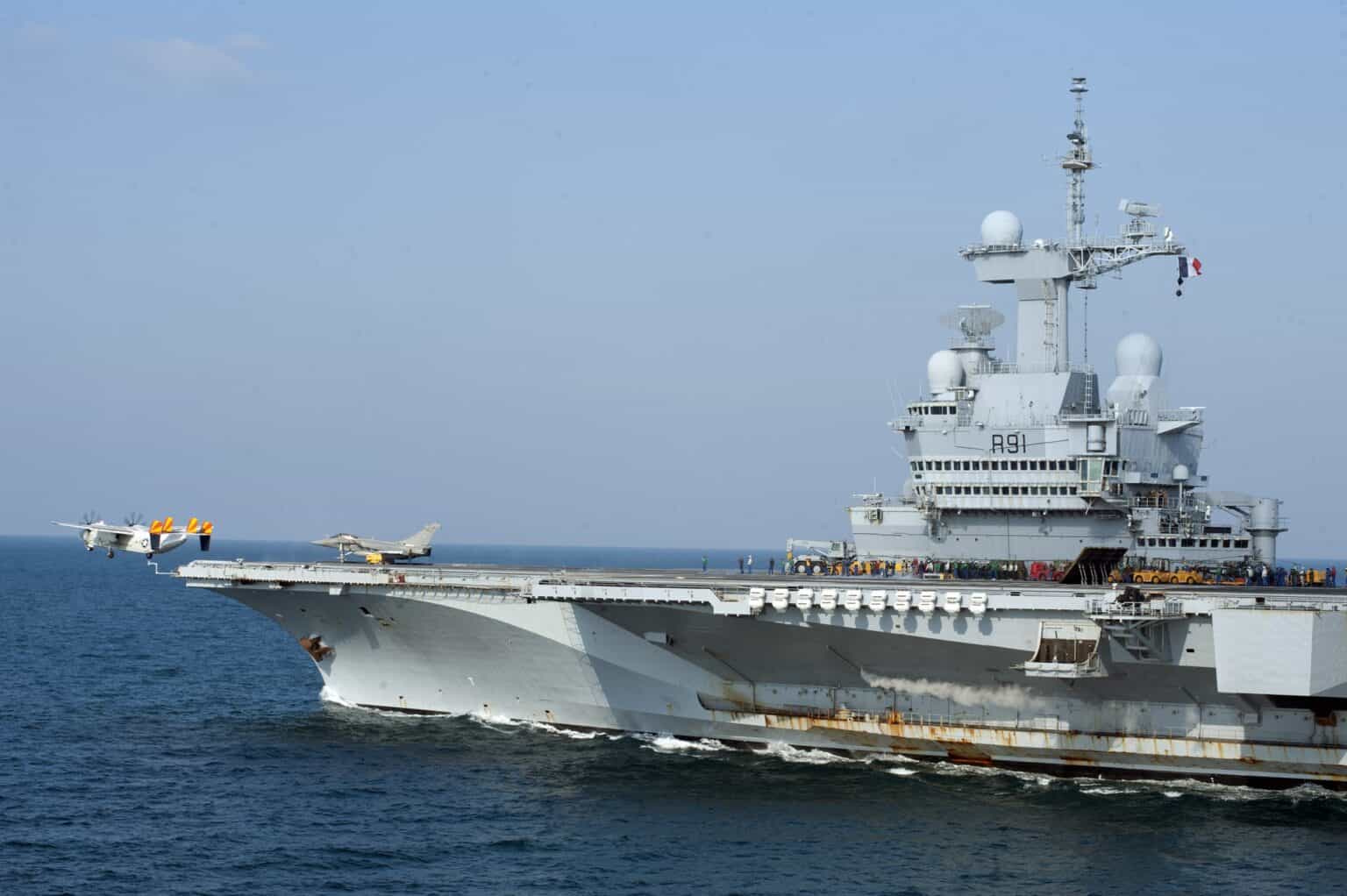
The most powerful ship in the French Navy is the aircraft carrier Charles de Gaulle, the only nuclear-powered carrier ever completed outside the United States Navy. Right behind it sit four Triomphant-class ballistic missile submarines, which carry France’s nuclear deterrent.
The Marine nationale says it has more than 40,000 sailors, and in 2026 it is celebrating 400 years since Cardinal Richelieu founded a royal navy in 1626. Its fighting core is about 29 major warships: 9 nuclear submarines, 1 carrier, 3 amphibious helicopter carriers and 16 destroyers and frigates.
This list ranks every major class by fighting value as of November 2026, then covers the navy’s aircraft, its bases and the new carrier that will replace Charles de Gaulle.
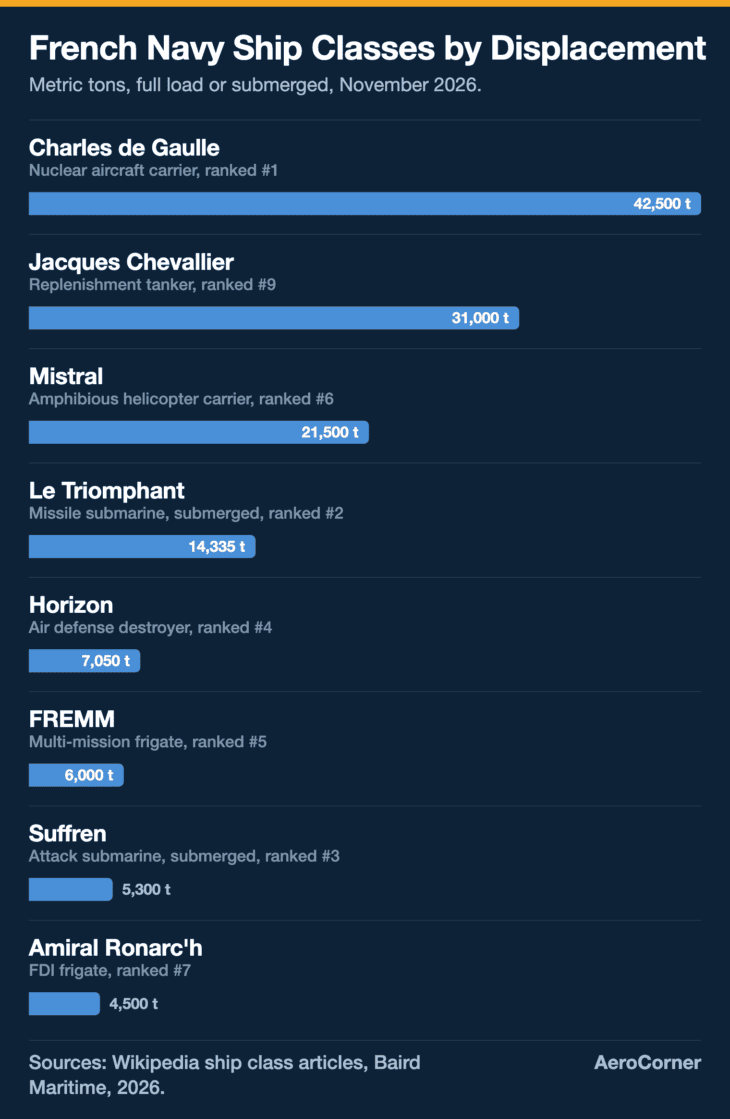
| Rank | Class | Type | Ships | Displacement |
|---|---|---|---|---|
| 1 | Charles de Gaulle | Nuclear aircraft carrier | 1 | 42,500 t |
| 2 | Le Triomphant | Ballistic missile submarine | 4 | 14,335 t submerged |
| 3 | Suffren | Nuclear attack submarine | 4 (1 working up) | 5,300 t submerged |
| 4 | Horizon | Air defense destroyer | 2 | 7,050 t |
| 5 | FREMM (Aquitaine and Alsace) | Multi-mission frigate | 8 | 6,000 t |
| 6 | Mistral | Amphibious helicopter carrier | 3 | 21,500 t |
| 7 | Amiral Ronarc’h (FDI) | Defense and intervention frigate | 1 (working up) | 4,500 t |
| 8 | La Fayette | Light stealth frigate | 5 | 3,800 t |
| 9 | Jacques Chevallier and Durance | Replenishment ship | 3 | 31,000 t (Jacques Chevallier) |
| 10 | Floréal | Surveillance frigate | 6 | 2,950 t |
| 11 | Tripartite (Éridan) | Minehunter | 8 | 595 t |
How this ranking works
Each class is ranked by the fighting value it adds in November 2026: what it can do in a war, how hard it would be to replace, and how many France has. Counts are ships in service or delivered and working up. Patrol boats, survey ships, tugs, training ships and the Maritime Gendarmerie sit outside the ranking. France calls its destroyers frigates, so the Horizon class appears here under the name the rest of NATO uses.
1. Charles de Gaulle: The Only Nuclear Carrier Outside the US
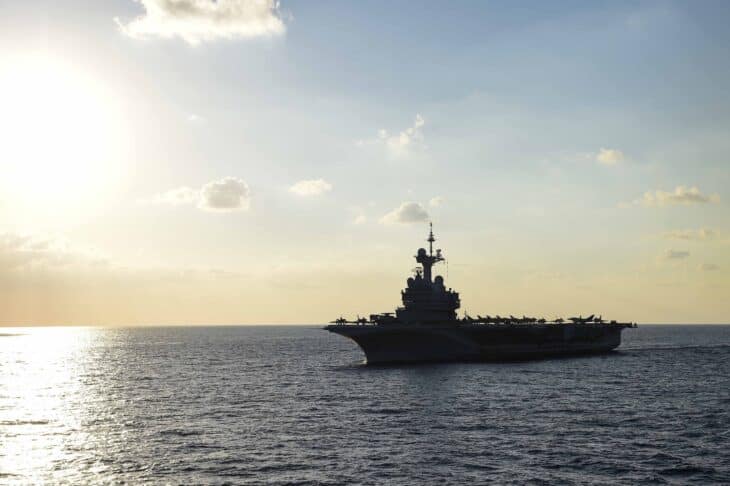

Charles de Gaulle was commissioned on May 18, 2001, five years late, after work stopped four times for lack of money. It is 858 feet (261.5 m) long, displaces 42,500 metric tons fully loaded and makes 27 knots, with a ship’s company of 1,350 plus 600 in the air wing.
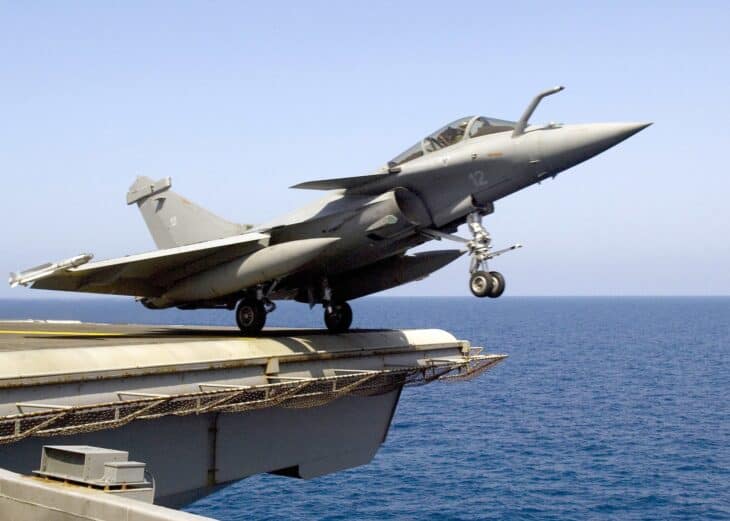
As of March 2026, it and China’s Fujian were the only carriers outside the US Navy with catapults: two 246-foot (75 m) steam catapults, a shorter version of those on the Nimitz class. Three squadrons of Rafale M fighters and a squadron of E-2C Hawkeye radar planes fly from it, and its record load was 35 aircraft in 2019.
It ranks first because nothing else in Europe can project air power like it. In March 2026, President Emmanuel Macron sent its strike group from the Baltic to the Middle East to protect allied bases during the war with Iran, and it returned to Toulon on July 11, 2026, after five and a half months away.
Its weak point is that there is only one. The ship is due to start an 18-month refit in 2027 to refuel its reactors, and France will have no carrier while it is in dock. The full story, broken propeller included, is in our history of the French aircraft carrier Charles de Gaulle.
The carrier a fitness app gave away
During the 2026 deployment, the position of Charles de Gaulle northwest of Cyprus leaked online because an officer logged his runs aboard the ship on the fitness app Strava.
2. Le Triomphant Class: The Nuclear Deterrent
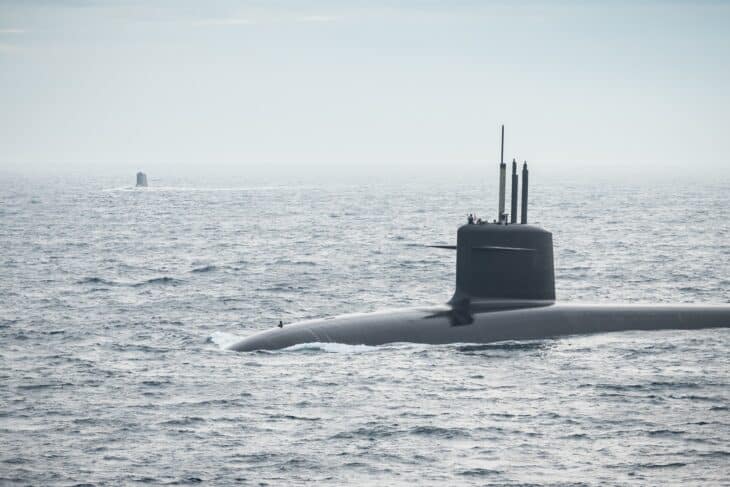

Le Triomphant, Le Téméraire, Le Vigilant and Le Terrible entered service in 1997, 1999, 2004 and 2010. Each is 453 feet (138 m) long, displaces 14,335 metric tons submerged and carries 16 M51 submarine-launched ballistic missiles, with a crew of 111.
They sail from Île Longue, near Brest, and they are the sea-based half of France’s nuclear deterrent. The newest missile version, the M51.3, was reported to have entered operational service in late 2025.
An argument can be made for putting them first, since they are the ships France could least afford to lose. They rank second here only because a deterrent works by never being used, while the carrier fights in real operations every few years.
The night two nuclear deterrents collided
In February 2009, Le Triomphant collided underwater with the British missile submarine HMS Vanguard in the Atlantic. Le Triomphant returned to Brest with a damaged sonar dome, and Vanguard came home with dents in the casing over its missile compartment.
Their replacements, the third-generation SNLE 3G boats, began construction in 2024 and are due to start arriving in the 2030s.
3. Suffren Class: The New Attack Submarines
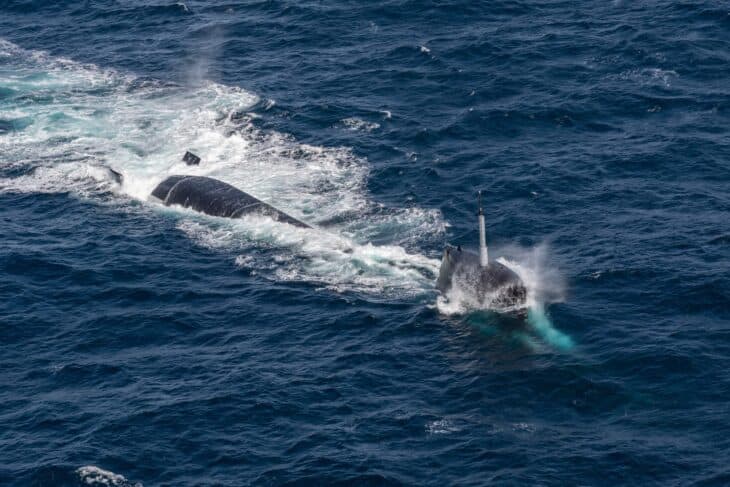

Suffren entered active service in June 2022, followed by Duguay-Trouin, declared operational in April 2024, and Tourville, delivered in November 2024. The fourth boat, De Grasse, was delivered in June 2026 and is working up to active service.
Each is 326 feet (99.5 m) long and displaces 5,300 metric tons submerged, with a crew of about 60. They can fire MdCN cruise missiles from their torpedo tubes at land targets more than 620 miles (1,000 km) away.
The last two of six, Rubis and Casabianca, are due by 2031. One boat of the class they replace is left: Améthyste, the final Rubis-class submarine, after Perle was retired in 2026. How they compare with bigger boats is in our ranking of the largest submarines in the world.
The small submarine that sank a US carrier, twice
In the 1998 Péan exercise, the Rubis-class boat Casabianca simulated sinking USS Dwight D. Eisenhower and its escorting cruiser. In COMPTUEX 2015, a US Navy-led exercise, Saphir did the same to USS Theodore Roosevelt. The French Navy publicized it; the US Navy did not mention it.
4. Horizon Class: The Air Defense Destroyers
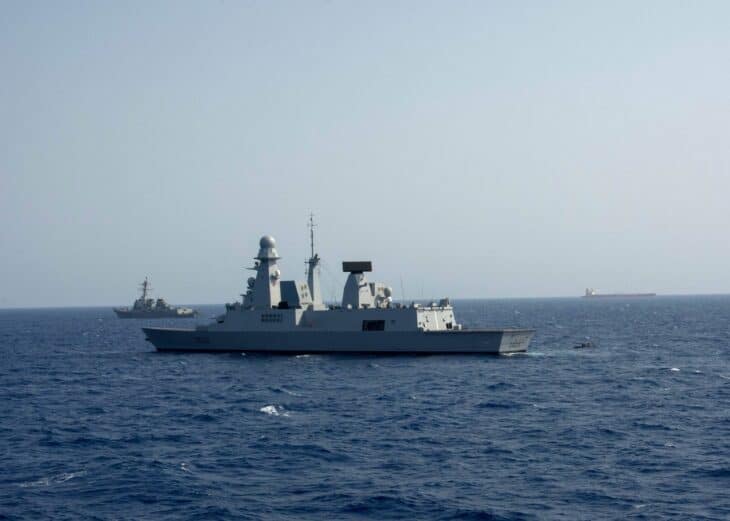

Forbin and Chevalier Paul are the largest French escort ships: 502 feet (152.87 m) long, 7,050 metric tons fully loaded and faster than 29 knots. France calls them frigates, but the rest of NATO counts them as destroyers.
Their job is to shield Charles de Gaulle from aircraft and missiles. A 48-cell Sylver launcher holds Aster 15 and Aster 30 missiles, the same PAAMS air defense system as Italy’s two Horizons and, in a different form, Britain’s Type 45 destroyers.
They rank fourth because there are only two of them, after two more were cancelled. Chevalier Paul sailed with the carrier on its 2026 deployment, which shows how central they are.
5. FREMM Frigates: The Backbone of the Fleet
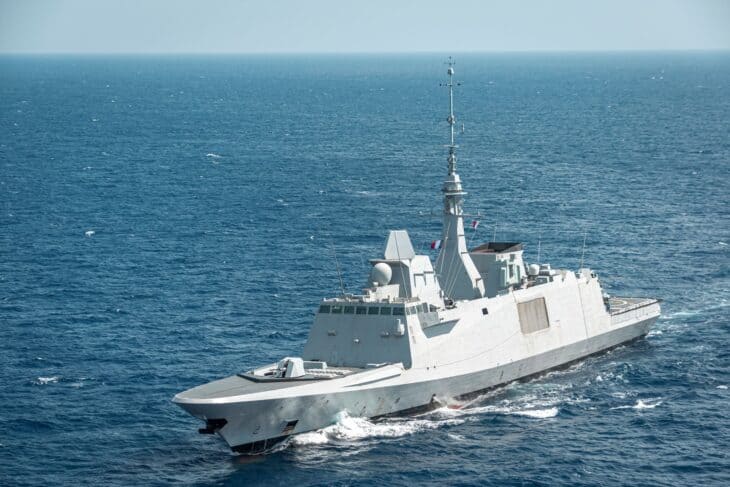

France has eight FREMM frigates, the largest group of major warships it operates. Six are anti-submarine ships, Aquitaine, Provence, Languedoc, Auvergne, Bretagne and Normandie, and two, Alsace and Lorraine, are air defense versions delivered from 2021.
Each is 466 feet (142 m) long, displaces about 6,000 metric tons and makes more than 27 knots with a crew of 145. The anti-submarine ships carry a 16-cell launcher for MdCN cruise missiles with a range of up to 870 miles (1,400 km), giving France a land-attack weapon on its frigates.
The fleet was meant to be far bigger. Plans for as many as 17 FREMMs were cut to 11 and then to 8, which is why each one is in constant demand.
6. Mistral Class: The Helicopter Carriers
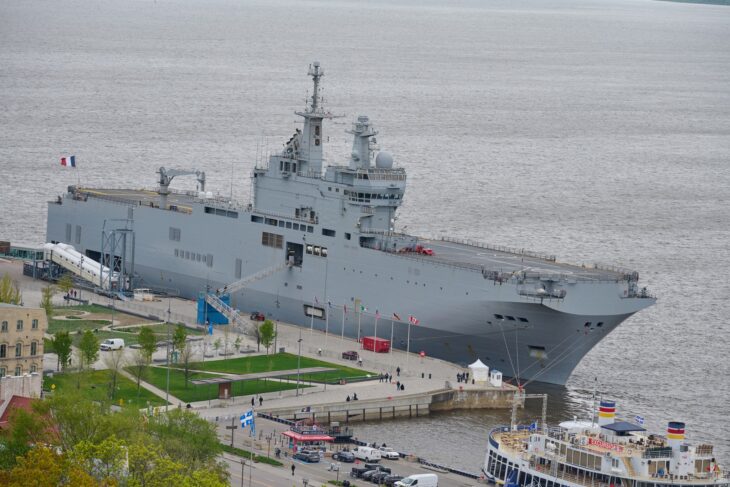

Mistral, commissioned on December 15, 2006, Tonnerre, on August 1, 2007, and Dixmude are amphibious assault ships. Each is 653 feet (199 m) long and displaces 21,500 metric tons fully loaded.
One ship can carry 16 NH90 or Tiger helicopters, four landing craft, up to 70 vehicles including 13 Leclerc tanks, and 450 soldiers, with a 69-bed hospital aboard. Its first captain said the decks could handle up to 30 helicopters, at roughly 40 percent of the cost and crew of an American Wasp-class ship.
Two more were built for Russia, but France cancelled that deal in 2014, and both ships were sold to Egypt instead. The French trio rank sixth because they are how France puts troops and helicopters ashore far from home.
7. Amiral Ronarc’h Class: The Newest Frigates
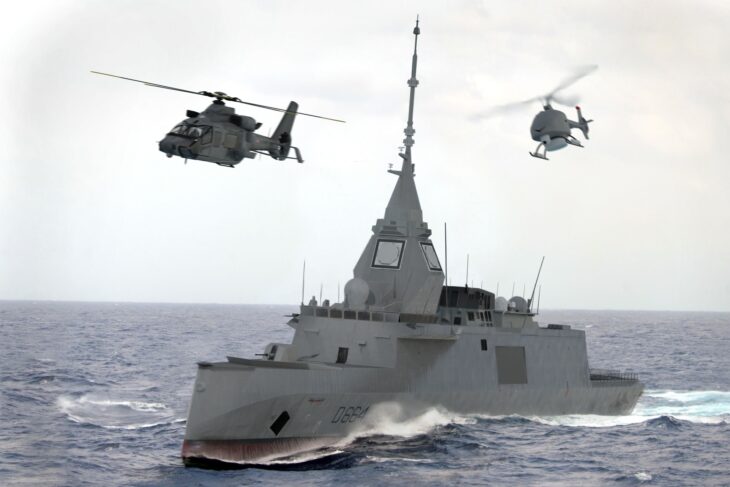

Amiral Ronarc’h, the first of five defense and intervention frigates (FDI), was delivered on October 17, 2025. From January 14 to May 16, 2026, it sailed 24,850 nautical miles on a 123-day trial deployment, from the Arctic Circle to Brazil, the Caribbean and New York.
It is 400 feet (122 m) long and displaces 4,500 metric tons, with 16 Aster missiles, eight Exocet MM40 Block 3c anti-ship missiles and the Thales Sea Fire radar with four fixed antennas. Formal entry into active service is expected in spring 2027.
The second ship, Amiral Louzeau, was launched at Lorient in May 2026 and is due in service in 2027, with the rest following through 2032. Later ships are to carry 32 Aster missiles instead of 16, and the first two are to be brought up to that standard.
8. La Fayette Class: The First Stealth Frigates
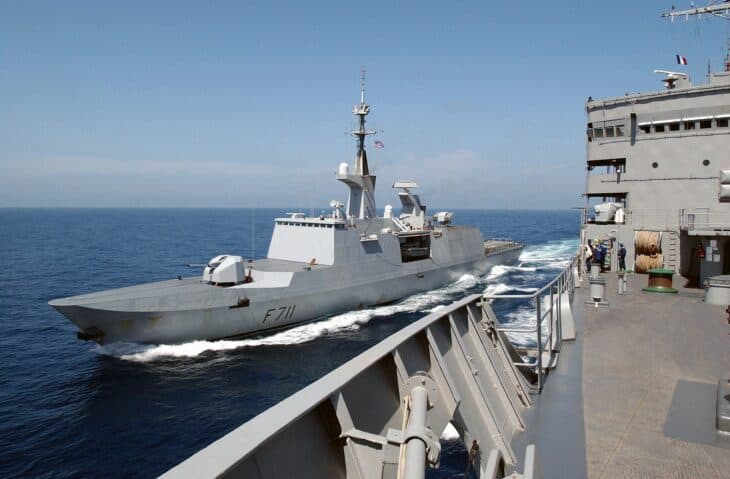

When they appeared in the 1990s, the La Fayette class was called the “stealth frigates”: angled sides, a clean superstructure and radar-absorbent composite cut their radar signature. Five remain, each 410 feet (125 m) long and 3,800 metric tons fully loaded.
La Fayette, Courbet and Aconit have been rebuilt with a hull sonar for submarine hunting and the latest Exocet, to serve until 2031 to 2034. Surcouf and Guépratte got lighter upgrades and are covering patrol work, with withdrawals scheduled for 2027 and 2031.
The design sold widely abroad, and derivatives serve with Saudi Arabia, Singapore and Taiwan. The FDI frigates ranked above them are their replacement.
9. Jacques Chevallier Class: The New Tankers
A carrier group cannot stay at sea without fuel, and these ships carry it. Jacques Chevallier was delivered in July 2023 and Jacques Stosskopf on November 27, 2025, each 636 feet (194 m) long and 31,000 metric tons fully loaded.
Each holds 13,000 cubic meters (about 3.4 million US gallons) of fuel. Four are planned in all, and one older Durance-class tanker remains in service.
10. Floréal Class: The Overseas Patrol Frigates
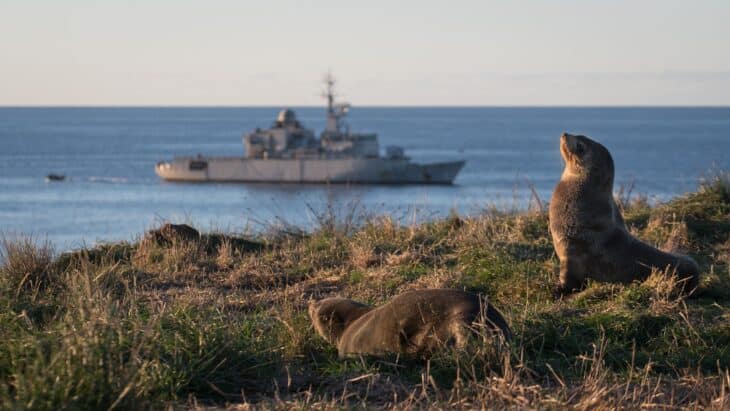

The six Floréal-class surveillance frigates are 307 feet (93.5 m) long, displace 2,950 metric tons and make 20 knots with a crew of 90. Their Exocet missiles have been removed, leaving a 100 mm gun and short-range Mistral missiles.
They are based in France’s overseas territories, where they patrol the waters around French islands far from Europe. Four Auguste Bénébig-class offshore patrol vessels and other patrol ships work alongside them.
11. Tripartite Class: The Minehunters
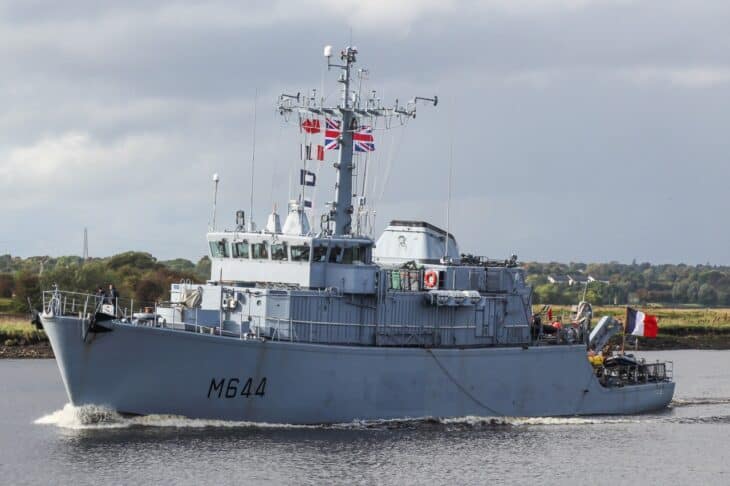

Eight Tripartite-class minehunters remain in French service, a design shared with Belgium and the Netherlands. Each is 169 feet (51.6 m) long and displaces 595 metric tons, with a crew of 55.
They are being replaced by uncrewed systems, and three Thales drone mine warfare boats are already in service. The Dutch and Belgian navies are taking the same route, as covered in our ranking of the Royal Netherlands Navy.
French Naval Aviation
The Aéronautique navale flies about 41 Rafale M fighters, 3 E-2 Hawkeyes, 22 Atlantique 2 maritime patrol aircraft and Falcon surveillance jets, according to the ministry’s 2025 list. Its helicopters include 27 NH90 Caïman submarine hunters and 16 Panthers.
The Rafale M is the carrier version of the jet the French Air and Space Force flies from land. How the two services share it is in our guide to the French Air Force.
France Libre: The Next Carrier
On March 18, 2026, Macron named Charles de Gaulle’s successor France Libre, the program previously known as PANG. At about 78,000 tons and 1,020 feet (310 m), with two nuclear reactors and three electromagnetic catapults, it will be nearly twice the size of the ship it replaces.
It is to be assembled at Saint-Nazaire from 2031 and enter service in 2038. It will be France’s second nuclear carrier, and its predecessor is ranked against the carriers already at sea in our list of the best aircraft carriers in the world.
A Navy Older Than the United States
Richelieu created the royal navy in 1626, and Jean-Baptiste Colbert built its dockyards at Brest and Toulon. It was renamed the Marine nationale during the Revolution, but sailors still call it “la Royale.”
Americans owe it a debt. At the Battle of the Chesapeake on September 5, 1781, Admiral de Grasse’s fleet kept the Royal Navy from reinforcing or evacuating Cornwallis at Yorktown. The surrender that followed led Britain to accept American independence, and the newest French submarine carries de Grasse’s name.
It was also an inventor’s navy. Napoléon became the first steam-powered ship of the line in 1850, Gloire the first seagoing ironclad in 1859, and Plongeur, launched in 1863, the first submarine driven by mechanical power.
Where the French Navy Is Based
Toulon, on the Mediterranean, is the largest base and the carrier’s home port. Brest is the main Atlantic base, the missile submarines sail from Île Longue across the roadstead, and Cherbourg covers the English Channel.
Overseas, the navy has bases at Fort-de-France in Martinique, Degrad des Cannes in French Guiana, Port des Galets on Réunion, Dzaoudzi on Mayotte, Nouméa and Papeete. It also shares bases in Abu Dhabi, Dakar and Djibouti.
That global spread, plus a nuclear carrier and nuclear submarines, is why France ranks well above its ship count among the largest navies in the world. Its closest European peer is Britain’s Royal Navy, whose Vanguard-class missile submarines are the closest match to the Triomphant class.
FAQ
Sources and references used for research and fact-checking.
- French Ministry of the Armed Forces, Marine nationale
- Wikipedia, French Navy
- Wikipedia, List of active French Navy ships
- Wikipedia, French aircraft carrier Charles de Gaulle
- The Aviationist, France names next aircraft carrier
- Wikipedia, Triomphant-class submarine
- Wikipedia, Suffren-class submarine
- Baird Maritime, French Navy takes delivery of fourth Suffren-class nuclear-powered submarine
- Wikipedia, Rubis-class submarine
- Wikipedia, Horizon-class frigate
- Wikipedia, FREMM multipurpose frigate
- Wikipedia, Mistral-class landing helicopter dock
- Wikipedia, French frigate Amiral Ronarc'h
- French Ministry of the Armed Forces, Retour de déploiement de longue durée de l'Amiral Ronarc'h
- Wikipedia, Amiral Ronarc'h-class frigate
- The Defense Post, France launches second FDI frigate
- Wikipedia, La Fayette-class frigate
- Baird Maritime, French Navy takes delivery of second BRF supply vessel
- Wikipedia, Floréal-class frigate
- Wikipedia, Tripartite-class minehunter
Get the Newsletter
The latest aviation news and stories sent to your inbox.
About the Author

Tim is the owner and lead editor of AeroCorner since 2019, overseeing aviation content covering aircraft, airlines, airports, and the broader aviation industry. Through years of researching, writing, editing, and publishing aviation-focused content, he has developed extensive practical knowledge of commercial aviation and air travel. Based in Asia and a frequent traveler himself, Tim also brings firsthand passenger experience to AeroCorner’s coverage. Outside of publishing, he has also explored aviation firsthand through hands-on flight training in New Zealand.