Fighter Jets
Dassault Mirage 2000 5Mk2
ICAO: MIR2
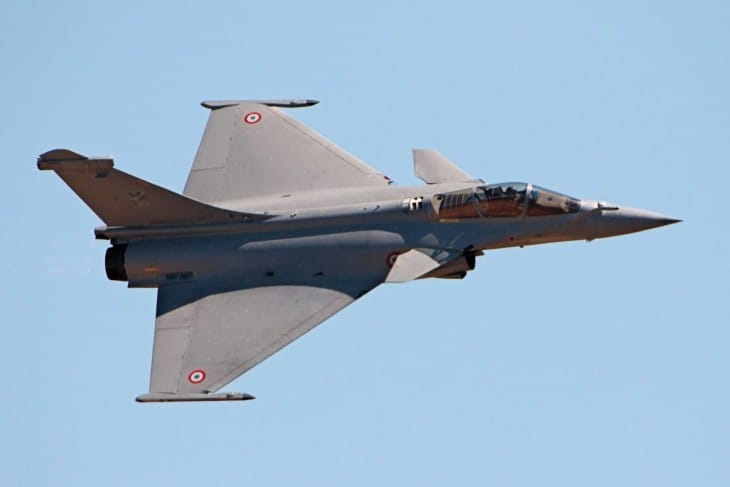
The Dassault Rafale is France's twin-engine delta-wing multirole fighter, flown from both land bases and aircraft carriers, and the only fighter in its class built almost entirely by one country.
Updated: by Tim de Vries

The latest aviation news and stories sent to your inbox.
The Dassault Rafale is a French twin-engine, canard delta-wing fighter that Dassault Aviation markets as an omnirole aircraft, meaning one jet can fly air defense, strike, reconnaissance, anti-ship and nuclear deterrence missions in a single sortie. It serves in the French Air and Space Force and French Navy, and has been exported to Egypt, India, Qatar, Greece, Croatia, Indonesia, the United Arab Emirates and Serbia.
Live Fleet Activity (RFAL)
Fetching live data…


The Dassault Rafale is a French twin-engine fighter with a delta wing and close-coupled canards. Dassault Aviation builds it for the French Air and Space Force and the French Navy.
Dassault calls it an “omnirole” fighter. One aircraft can fly air defense, strike, reconnaissance, anti-ship and nuclear deterrence missions, sometimes within a single sortie.
The name is French for “gust of wind”. The Rafale answers the question “what is the name of France’s fighter jet?” and replaces the Jaguar, Mirage F1 and Mirage 2000 in air force service, plus the F-8 Crusader and Super Etendard in naval service.
The page’s specification panel lists the full numbers. This article explains the history, the variants and what the figures actually mean.
In the late 1970s, the French Air Force and Navy wanted one common replacement for their aging fighters. France then joined a five-nation European fighter effort with the UK, Germany, Italy and Spain.
The partners disagreed on workshare and requirements, and France withdrew in July 1985. The other nations went on to build the Eurofighter Typhoon, while France went ahead alone.
That decision shaped the jet. The Rafale is almost entirely French, with Dassault building the airframe, Thales the radar and electronic warfare system, and Safran the engines.
Dassault first flew a technology demonstrator, the Rafale A, on 4 July 1986. It used American General Electric F404 engines because the French M88 engine was not ready.
The first production-standard prototype, the single-seat Rafale C, flew on 19 May 1991. The first aircraft series formally started in December 1992, was suspended in November 1995 and resumed in January 1997.
The Rafale was meant to enter service in 1996 and slipped by years because of post-Cold War budget cuts. The French Navy received its first two Rafale M fighters in December 2000, and the carrier squadron Flottille 12F was reactivated with the type on 18 May 2001.
There are three main French variants. The Rafale C is the single-seat air force fighter, and the Rafale B is the two-seat version of it.
The Rafale M is the single-seat carrier version. It has a strengthened airframe, a longer nose gear leg, a larger tailhook and a built-in boarding ladder, and it weighs about 1,100 pounds (500 kg) more than the C.
The Rafale M is the only non-U.S. fighter type cleared to operate from the decks of U.S. carriers, using their catapults and arresting gear. Export customers use their own letter codes, such as the Rafale EH and DH for India and the EQ and DQ for Qatar.
Two Safran M88 turbofans power the Rafale, which answers the common question about whether it has a single or double engine. Each produces about 11,000 pounds-force dry and 16,860 lbf (75 kN) with afterburner.
The delta wing and canards make the jet very agile but aerodynamically unstable. Digital fly-by-wire controls hold it stable, and the airframe is rated for +9 g and -3.6 g, with up to 11 g available in an emergency.
The sensor suite is largely home-grown. It includes the Thales RBE2 AA active electronically scanned array radar, the SPECTRA self-defense system and an infrared search-and-track sensor built into the front of the aircraft.
Dassault has upgraded the jet in steps. The F3R standard added the Meteor long-range missile, and the F4 standard, whose first aircraft was delivered in 2023, improves radar, sensors and communications. A planned F5 standard would add more powerful engines and a new nuclear missile.
The full specification table for the aircraft is on this page. A few figures need context to read correctly.
The listed range of 2,000 nm (2,300 mi, 3,700 km) is a ferry range with three drop tanks. It is not the distance the jet can fly and fight, because a combat mission with heavy weapons loads and high-speed dashes burns far more fuel.
The top speed is Mach 1.8 at high altitude. At low altitude the Rafale is limited to roughly Mach 1.1, and it can sustain supersonic flight without afterburner, known as supercruise, with a light load of four missiles and one belly tank.
The payload figure covers external fuel and ordnance. The Rafale has 14 external hardpoints on the air force versions and 13 on the navy version, plus a 30 mm cannon with 125 rounds.
Fuel capacity depends on the configuration. The panel figure includes external and conformal tanks, while the internal fuel load is smaller and differs between the single-seat and two-seat versions.
For air-to-air combat the Rafale carries MICA short- and medium-range missiles, the Meteor long-range missile and the Magic II. For ground and maritime strikes it uses the AASM Hammer precision bomb, the SCALP-EG (Storm Shadow) cruise missile and the Exocet anti-ship missile.
French Rafale squadrons also hold the air-launched nuclear deterrence mission. Two squadrons based at Saint-Dizier fly it.

The Rafale first deployed to a combat zone in 2002, flying from the carrier Charles de Gaulle during the Afghanistan campaign, but its early software standard barred it from attacking ground targets and it saw no action.
Its first real combat came over Libya in March 2011, where it flew strike and reconnaissance missions and used SPECTRA to operate without dedicated defense-suppression aircraft. In January 2013 four Rafales flew from France to strike targets in Gao, Mali, in Operation Serval.
French Rafales began flying over Iraq in September 2014 and took part in the April 2018 missile strikes on Syria. In March 2026, during the Iran war, French Rafales based in the United Arab Emirates reportedly intercepted at least 60 Iranian drones.
India reportedly used its Rafales, armed with SCALP missiles and Hammer bombs, in strikes inside Pakistan on the night of 6 to 7 May 2025. Pakistan claimed it shot down several Indian aircraft, including Rafales.
India’s Chief of Defence Staff acknowledged on 31 May 2025 that India had lost jets without giving types or numbers. The French Air Force chief said he had seen evidence confirming the loss of one Rafale, and BBC Verify authenticated video of Rafale wreckage near Bathinda. The wider claims remain disputed.
France is the main operator, with both the Air and Space Force and the Navy. The French fleet is roughly 165 aircraft by recent counts, and France plans to reach 225 in service by 2035. Our guide to the French Air Force covers that fleet in detail.
Egypt became the first export customer in February 2015 and has ordered 54. Qatar ordered 36, India has received 36 Rafale F3Rs and has 26 naval Rafale Ms on order, and Greece operates 24.
Croatia bought 12 used French aircraft, and Indonesia has ordered 42 Rafale F4s. Serbia ordered 12, and the United Arab Emirates has 80 on order, as covered in our UAE Air Force guide.

Two figures get quoted, and they measure different things. The unit flyaway price, the cost of the aircraft itself, was about 101.1 million euros in 2010 for the F3+ standard.
The unit program cost, which spreads 40 years of development over the aircraft built, was about 160.5 million euros as of fiscal 2013. Export deals cost more per aircraft because they bundle weapons, spares and training.
By most measures it is among the most capable fighters in service. It has flown combat in Libya, Mali, Iraq, Syria and elsewhere, and it has won export orders from eight countries.
It is a fourth-generation design, not a stealth fighter, though it uses radar-absorbent materials and a reduced-signature layout. Its strengths are agility, sensor fusion, carrier capability and the ability to swap roles within a single mission.
The unit flyaway price was about 101.1 million euros in 2010 for the F3+ version. Counting 40 years of development, the unit program cost was about 160.5 million euros as of fiscal 2013.
France’s main fighter is the Dassault Rafale, which serves in both the Air and Space Force and the Navy. It replaced older types such as the Mirage 2000 and the Jaguar.
It is widely regarded as one of the most advanced fighters in service, with combat experience over Libya, Mali, Iraq and Syria. It is a fourth-generation fighter rather than a stealth jet, and its May 2025 combat record in the India-Pakistan clash remains disputed.
The Rafale has two Safran M88 turbofan engines, each producing 16,860 lbf (75 kN) with afterburner.
The French Navy received its first Rafale M in December 2000, and the first operational squadron stood up on 18 May 2001.
Yes, the Rafale M flies from the French carrier Charles de Gaulle, and it has also operated from U.S. carriers using catapults and arresting gear.
Sources and references used for research and fact-checking.