Fighter Jets
The stealthier, faster ATF prototype that lost to the F-22
Updated: by Tim de Vries
The latest aviation news and stories sent to your inbox.
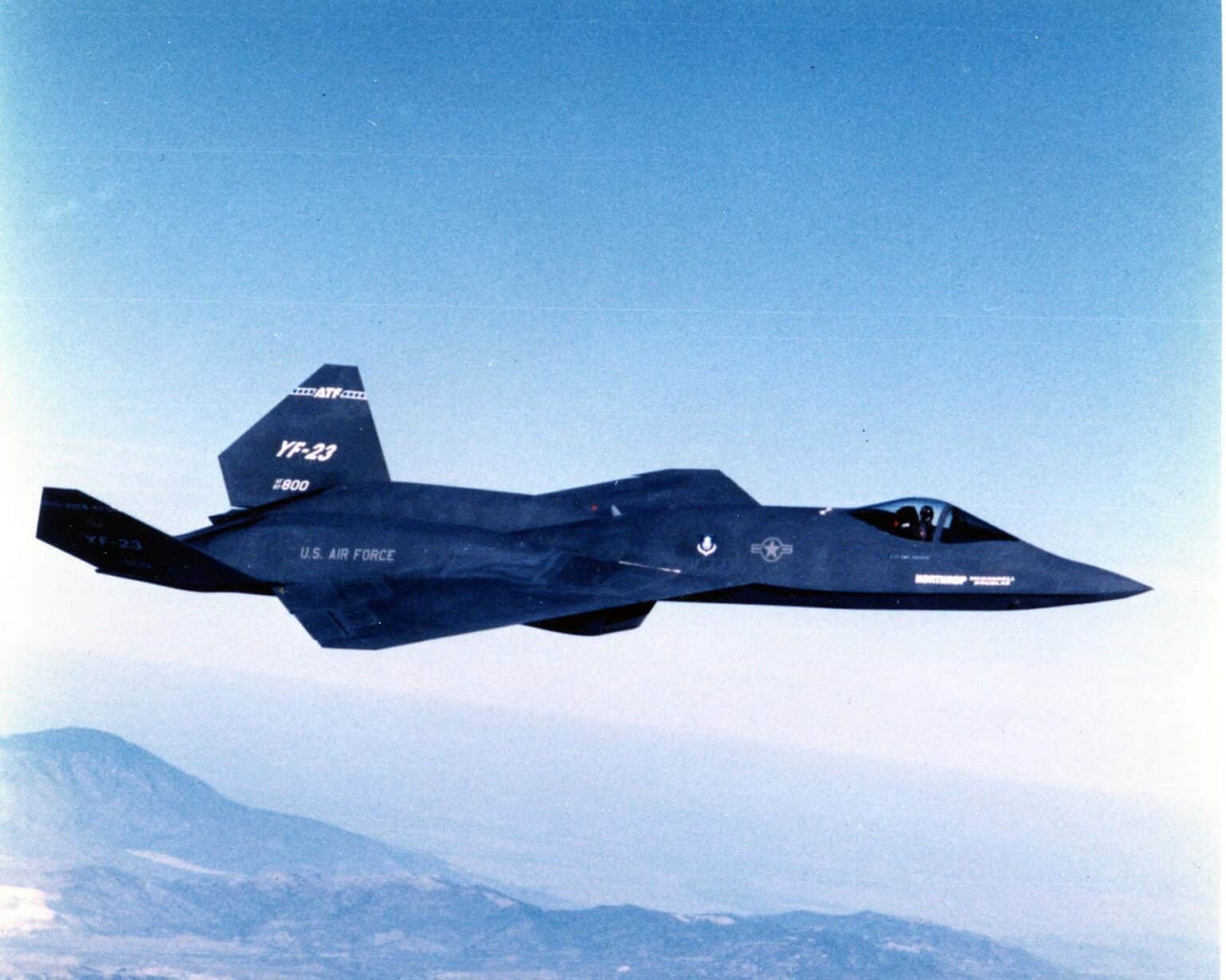
The Northrop YF-23 Black Widow II was the Northrop and McDonnell Douglas entry in the U.S. Air Force’s Advanced Tactical Fighter competition, the contest to replace the F-15 Eagle. Two were built, and the first flew on August 27, 1990. Evaluators considered it stealthier and faster than Lockheed’s YF-22, but the Air Force chose the YF-22 in April 1991, and it became the F-22 Raptor. Both YF-23s survive in museums in Ohio and California.


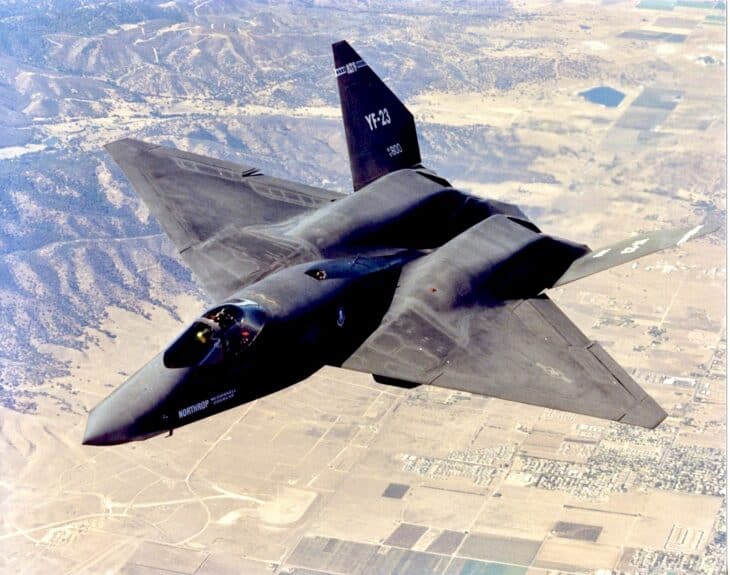
The Northrop YF-23 Black Widow II was one of the two finalists to become America’s next air superiority fighter. Built by Northrop with McDonnell Douglas, it went head to head with Lockheed’s YF-22 in the Air Force’s Advanced Tactical Fighter (ATF) competition of the late 1980s.
Evaluators considered the YF-23 stealthier and faster than its rival, and the YF-22 more agile. On April 23, 1991, the Air Force picked Lockheed’s design, which became the F-22 Raptor. Only two YF-23s were ever built, and both are now museum pieces.
The story starts with Soviet fighters. American reconnaissance satellites spotted the prototypes of the Sukhoi Su-27 and MiG-29 between 1977 and 1979, and both threatened to erode the edge of the new F-15 Eagle.
The Air Force sent a request for information on an Advanced Tactical Fighter to nine companies in 1981. Seven responded, with 19 concepts between them. By 1984 the requirement had settled on a stealthy fighter that could cruise at supersonic speed without afterburner, a trick known as supercruise.
On October 31, 1986, Lockheed and Northrop were named the two finalists. Each team received $691 million in fiscal 1985 dollars and 50 months to prove its concept, ending in flying prototypes. Lockheed’s design was designated YF-22 and Northrop’s YF-23.
Northrop teamed with McDonnell Douglas, and Lockheed with Boeing and General Dynamics. The Northrop team put another $650 million of its own money into the effort.
Northrop and Lockheed were the two industry leaders in stealth. A small team inside its B-2 division had been sketching stealth fighters since 1981, drawing on the curved-surface shaping of the Tacit Blue demonstrator and the B-2 Spirit.
The result looked like nothing else in the sky. The wings were diamond-shaped, with the leading and trailing edges both swept 40 degrees, and the fuselage was pinched along its length to cut drag at transonic and supersonic speeds.
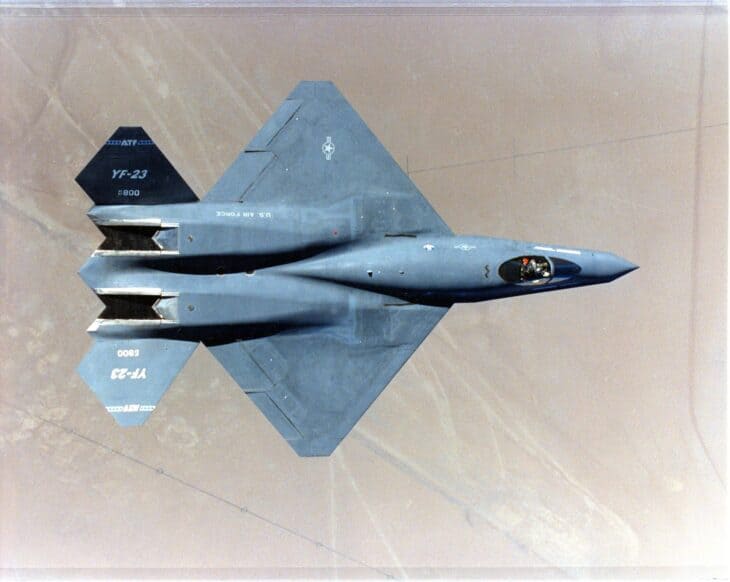
There was no conventional tail. Two large all-moving fins, canted 50 degrees from vertical, handled both pitch and yaw, and a fly-by-wire system kept the statically unstable airframe flying straight.
The engines breathed through S-shaped ducts that hid the compressor faces from radar. At the back, the exhaust ran through troughs lined with heat-abating tiles, the same idea used on the B-2, to shield the hot gas from infrared sensors below.
Northrop left out thrust vectoring, which the YF-22 used for control. The Air Force Museum says the choice was made to save weight and improve stealth.
To keep costs down, the prototypes borrowed parts from existing jets: an F-15 nose wheel, F/A-18 main landing gear parts, and the forward cockpit of the F-15E Strike Eagle. Northrop built the aft fuselage in Hawthorne, California, McDonnell Douglas built the wings and forward fuselage in St. Louis, and final assembly took place at Edwards Air Force Base.
The name was never official. It came from a “Name the Plane” contest among the team, and it nodded to Northrop’s P-61 Black Widow night fighter of World War II.
The YF-23’s radar cross-section plot also had a spider-like shape, and for its first flight someone painted a red hourglass, the black widow’s marking, on the first prototype. When Northrop management found out, they had it removed.
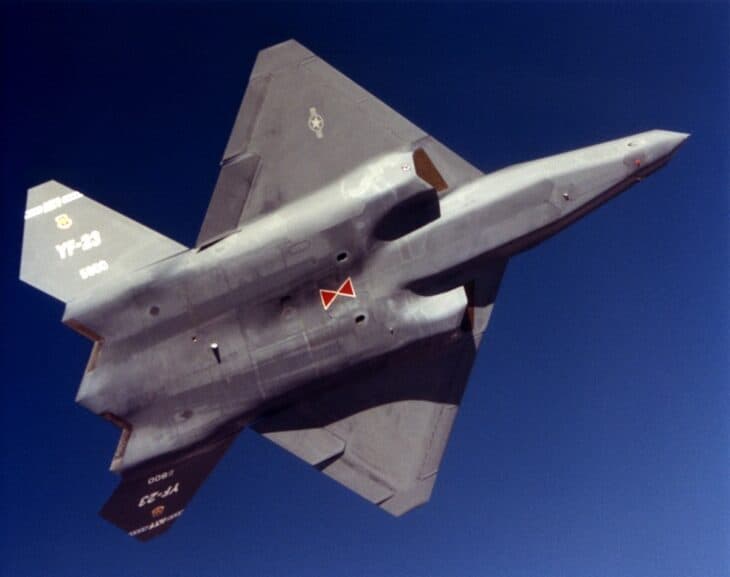
The two jets had nicknames of their own. The first prototype, PAV-1 (serial 87-0800), was painted charcoal gray and flew as “Gray Ghost.” The second, PAV-2 (87-0801), wore two shades of gray and flew as “Spider.”
Northrop rolled out the first YF-23 at Edwards on June 22, 1990. On August 27, test pilot Paul Metz took it up for the first time, and the F-16 chase plane had to use afterburner to keep up with the YF-23 in military power.
The program moved fast. The YF-23 qualified for air refueling on its fourth flight, went supersonic on its fifth, and supercruised at Mach 1.43 on September 18, 1990.
PAV-2, powered by General Electric engines, first flew on October 26 with Jim Sandberg at the controls. Its early flights were rough: one ended on a single engine, and on another a blocked sensing line overpressurized the fuel tanks up to their structural limits.
PAV-1 cracked the outer layer of its windscreen at Mach 1.5 on October 30, and PAV-2 did the same about a month later; the inner layer held both times. Once those problems were behind it, PAV-2 became a reliable test aircraft and pushed the supercruise envelope further than PAV-1.
The two YF-23s flew together only once, over the Mojave Desert on November 29, 1990. The next day, PAV-1 ended its career with six flights in about 10 hours, reaching Mach 1.8, the highest speed it flew. The last YF-23 flight was on December 18, 1990.
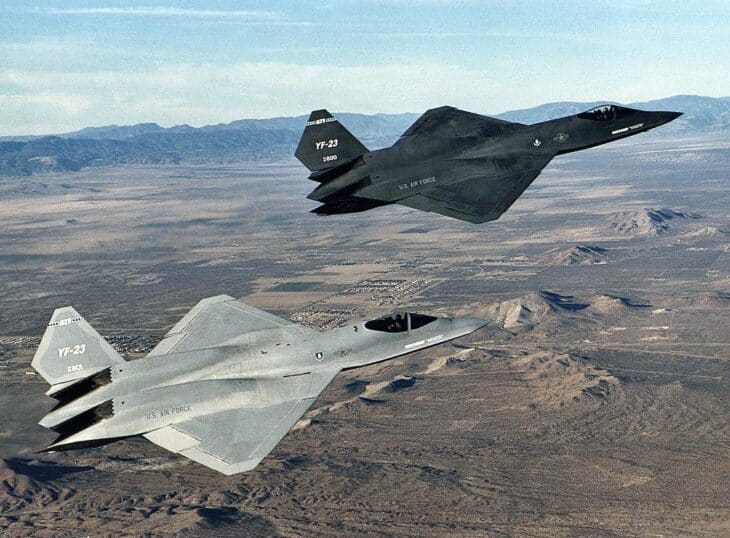
In all, the two prototypes made 50 flights totaling 65.2 hours. The weapons bay was used to test bay acoustics, but no missile was ever fired from it.
The full specification table for the YF-23 is on this page. A few of its figures need context, because the YF-23 was a prototype and some of its performance was never released.
Top speed. The Air Force Museum lists the top speed as approximately Mach 2, and the exact figure is still classified. Some published estimates go as high as Mach 2.2. The fastest a YF-23 actually flew in testing was Mach 1.8.
Supercruise. This was the headline trick, and the reason the cruise speed row is blank. PAV-1 managed Mach 1.43, PAV-2 officially went beyond Mach 1.6, and one history puts its best at Mach 1.72.
The Edwards test center says the true maximum has never been released. The YF-22, by comparison, supercruised at Mach 1.58.
Range. The range in the table is a published ferry-range estimate. The number that mattered to the Air Force was mission radius: the 1984 requirement asked for 700 to 800 nautical miles on a subsonic mission. A radius is out and back, so it is always far shorter than a ferry range.
Weight. The table leaves weights blank on purpose. The one published empty weight, 29,000 pounds, is a contractor figure that excludes the engines, and the roughly 64,000-pound takeoff weight is an estimate rather than a certified maximum.
Those numbers overshot the original plan. The ATF was meant to weigh 50,000 pounds at takeoff, and when neither team could get there, the target was raised to 60,000 pounds and the engine class to 35,000 pounds of thrust.
Secretary of the Air Force Donald Rice announced the winner on April 23, 1991: Lockheed’s YF-22 and Pratt & Whitney’s F119 engine. He said both designs met the requirements, but the Air Force had more confidence that the Lockheed team could deliver on time and on cost.
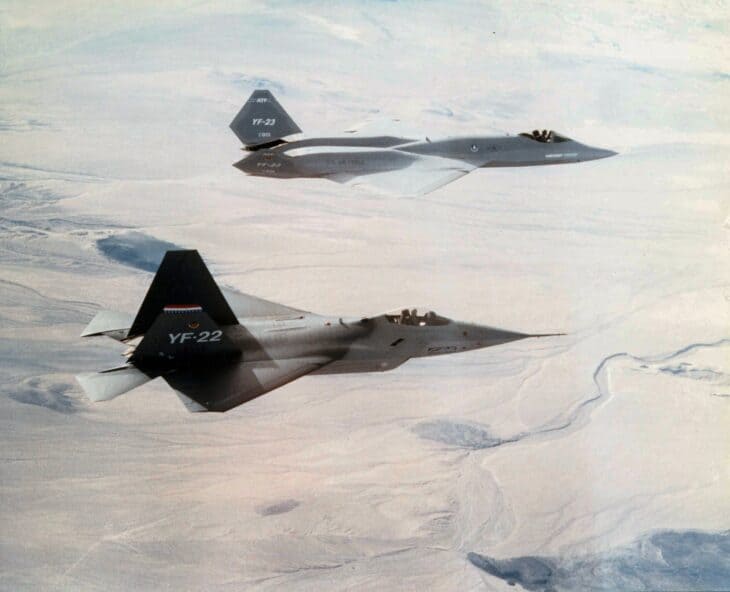
The Lockheed and Pratt & Whitney proposals were also rated higher on technical grounds and judged lower risk. Part of that came down to flying: the YF-22 logged 74 flights and 91.6 hours against the YF-23’s 50 flights and 65.2 hours.
The YF-22 team also fired AIM-9 and AIM-120 missiles and flew at angles of attack up to 60 degrees. The YF-23 fired nothing and was tested to 25 degrees, so on agility and weapons it had less to show.
The YF-23’s own design carried risk too. The tile-lined exhaust troughs were a known problem area, and their performance and cost later became the subject of lawsuits between Northrop and the supplier.
Aviation writers have long speculated that Northrop’s cost overruns and delays on the B-2 and the AGM-137 missile program counted against it. That was never part of the official explanation, which rested on program management and risk.
So was the YF-23 the better aircraft? On stealth and speed, evaluators thought so. On agility, proven weapons, flight hours, and confidence in the team, the YF-22 won, and those were the things the Air Force decided to buy.
The YF-23 was a demonstrator for the airframe and engines only. Its mission avionics, including the radar, were tested separately on a modified BAC One-Eleven airliner and a ground rig.
The production F-23 would have been slightly longer and taller, with two weapons bays in tandem instead of one, an M61 cannon, and a bigger nose for the radar. Northrop offered both a single-seat F-23A and a two-seat F-23B.
A naval version, sometimes called the NATF-23, was drawn up to replace the F-14 Tomcat, with canards, folding wings and thrust-vectoring nozzles. The Navy walked away from the program over cost, abandoning it by fiscal 1992.
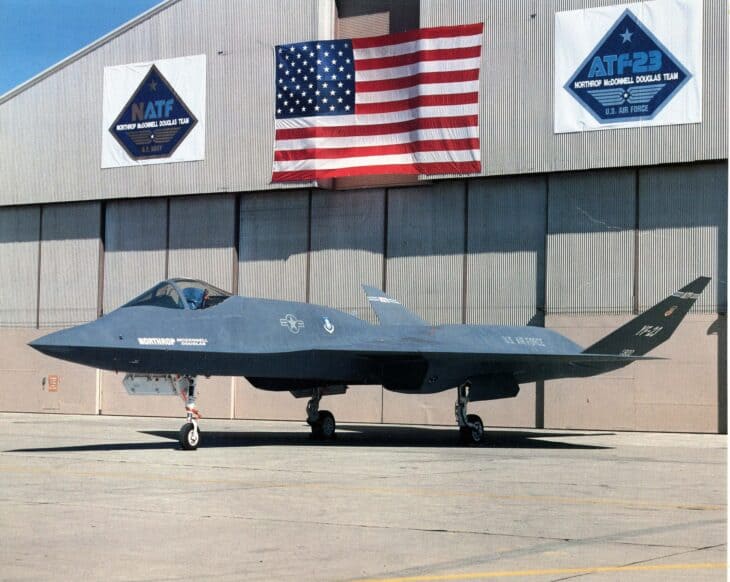
The design came back twice. In 2004, Northrop Grumman pitched a much larger two-seat FB-23 regional bomber and used PAV-2 as a display model, but the 2006 Quadrennial Defense Review chose a longer-range bomber instead, the line that led to the B-21 Raider.
In 2018, Northrop Grumman answered Japan’s call for partners on its next fighter, prompting speculation about a modernized F-23. Japan did not take up that proposal.
After the decision, both prototypes were stripped of their engines and government equipment and parked outdoors next to the B-2 test facility at Edwards. Ownership passed to NASA on December 1, 1993.
NASA’s Dryden Flight Research Center planned to use one airframe for loads-calibration research, but the money never came, and NASA never planned to fly them. In the mid-1990s it offered both to museums.
PAV-1 “Gray Ghost” first went on temporary display at the Air Force Flight Test Center Museum at Edwards. In 2000 it was flown in pieces aboard a C-5 Galaxy to the National Museum of the U.S. Air Force near Dayton, Ohio, where it sits in the research and development gallery.
PAV-2 “Spider” went to the Western Museum of Flight in California. Northrop Grumman reclaimed it in 2004 for the FB-23 display, then returned it in 2010, and it is now on show at the museum’s home at Zamperini Field in Torrance.
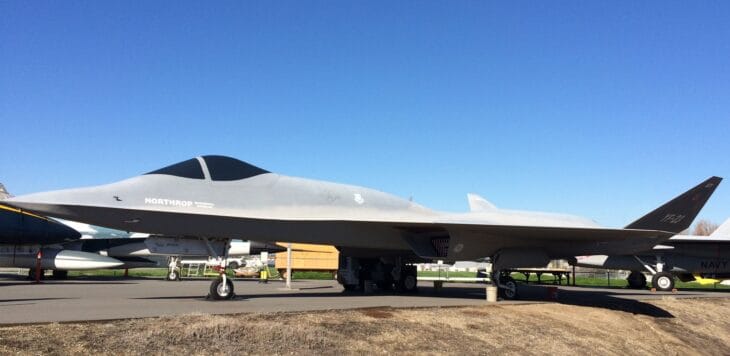
Neither is airworthy: both were stripped of their engines after the competition, and the two airframes are the only YF-23s that exist.
It depends on the measure. Evaluators rated the YF-23 stealthier and faster, but the YF-22 was more agile, flew more test hours, fired live missiles, and was judged lower risk.
When he announced the result on April 23, 1991, Air Force Secretary Donald Rice said both designs met the requirements but the Air Force had more confidence in the Lockheed team to deliver on time and on cost. The Lockheed proposal was also rated higher on technical grounds and considered lower risk.
Mostly on risk and program management rather than raw performance. The YF-23 flew 50 test flights to the YF-22’s 74, fired no missiles, and was tested to a much lower angle of attack. Its tile-lined exhaust troughs were also seen as a technical risk.
Yes, both survive. PAV-1 is at the National Museum of the U.S. Air Force near Dayton, Ohio, and PAV-2 is at the Western Museum of Flight in Torrance, California, both without engines.
The Air Force Museum gives approximately Mach 2, and the exact figure remains classified. The highest speed actually flown in testing was Mach 1.8, and without afterburner the YF-23 supercruised beyond Mach 1.6.
It was a prototype from the competition that produced the F-22, which is classed as a fifth-generation fighter and entered service in December 2005. The YF-23 carried the same core traits, stealth and supercruise, but never reached production.
The name came from a team naming contest and honored Northrop’s World War II P-61 Black Widow. It was never official, and a red hourglass painted on the first prototype was removed on management’s orders.
Two. PAV-1 flew with Pratt & Whitney YF119 engines and PAV-2 with General Electric YF120 engines, so each competing engine was flown in the YF-23 airframe.
Sources and references used for research and fact-checking.