Military Aircraft
Northrop Grumman B-2 Spirit
ICAO: B2
America's next stealth bomber, and the first designed to be affordable in quantity
Updated: by Tim de Vries
The latest aviation news and stories sent to your inbox.
The Northrop Grumman B-21 Raider is the U.S. Air Force’s sixth-generation stealth bomber, built to penetrate the world’s toughest air defenses and strike with conventional or nuclear weapons. It first flew on November 10, 2023, and two test aircraft are flying today at Edwards Air Force Base. The Air Force plans to buy at least 100 at roughly $692 million each, replacing the B-1B Lancer and the B-2 Spirit, with the first aircraft due at Ellsworth Air Force Base in 2027. Almost every physical specification remains classified.


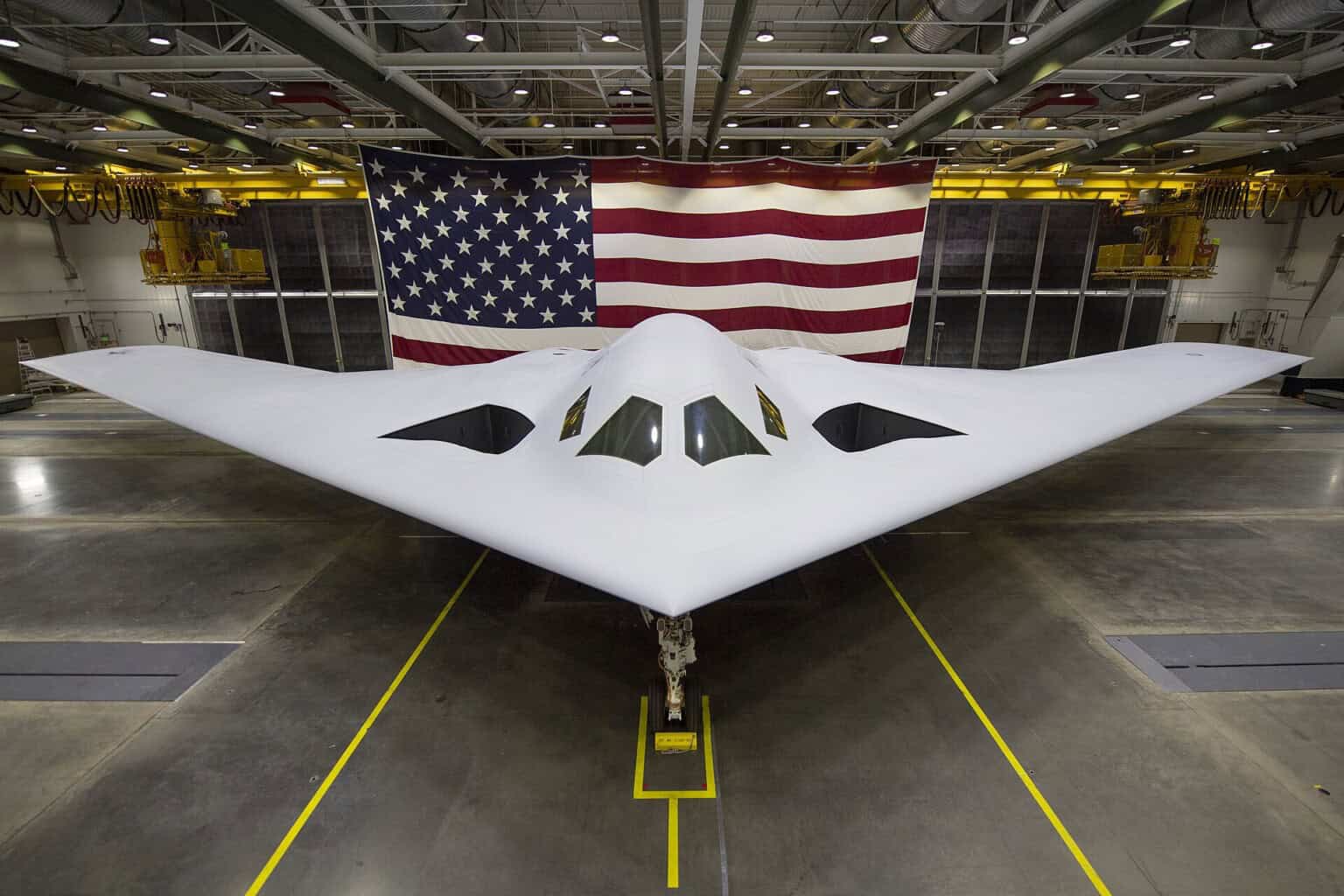
The Northrop Grumman B-21 Raider is the United States Air Force’s next stealth bomber, built to fly into the most heavily defended airspace on Earth and strike with either conventional or nuclear weapons. Northrop Grumman calls it the world’s first sixth-generation aircraft.
It first flew on November 10, 2023, and two test aircraft are flying today. The Air Force plans to buy at least 100 of them at roughly $692 million each, replacing both the B-1B Lancer and the B-2 Spirit.
The Raider began as the Long Range Strike Bomber program, a classified effort to field a survivable bomber that could still reach targets defended by modern Russian and Chinese air defenses. The Air Force issued its request for proposals in July 2014.
Northrop Grumman won the contract in October 2015, beating a Boeing and Lockheed Martin team. The Air Force assigned the designation B-21 in February 2016, marking it as the first bomber of the 21st century.
The name came in September 2016. It honors the Doolittle Raiders, the 80 airmen who launched 16 B-25 Mitchell bombers off a carrier deck to strike Japan in April 1942.
The first aircraft was rolled out in public on December 2, 2022, at Air Force Plant 42 in Palmdale, California. Almost a year later, on November 10, 2023, it made its maiden flight from Palmdale to Edwards Air Force Base.
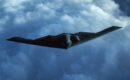
The B-21 is a flying wing, the same basic shape as the B-2, but a generation of stealth technology later. Northrop Grumman has said little about the specifics beyond describing it as “next-generation stealth” designed against defenses that did not exist when the B-2 was drawn.
The bigger change is not the skin, it is the software. The Raider is built around an open systems architecture, so new sensors, weapons, and mission software can be added without redesigning the aircraft or rewriting the whole system.
Northrop Grumman says it invested more than $5 billion in the program’s digital and manufacturing infrastructure, including a digital twin of the aircraft that cut software certification time roughly in half.
That approach is a large part of why the company and the Air Force describe the Raider as a generation beyond the stealth aircraft that came before it. It is the same generational language used for the five generations of fighter planes.
The aircraft is also designed to work as a sensor and a node in a wider network, not just a bomb truck. Northrop Grumman describes it as “more than a bomber,” combining range, access, and payload with integrated data and sensors.
Pratt & Whitney is the confirmed propulsion supplier for the B-21. Beyond that, almost everything about the powerplant is classified.
The Air Force has not stated how many engines the aircraft has, what they are called, or how much thrust they produce. Two exhausts are visible on the airframe, and the engines are widely reported to be two non-afterburning turbofans from Pratt & Whitney’s PW9000 family, sharing technology with the F135 that powers the F-35.
The B-21 is a high-subsonic aircraft. Like the B-2, it trades outright speed for stealth and range, and published estimates put its top speed somewhere above Mach 0.8.
Range is not disclosed either. Northrop Grumman says the Raider’s fuel-efficient engines give it extended range and reduce how much tanker support it needs compared with earlier bombers, which suggests an unrefueled reach in the same intercontinental class as the B-2’s roughly 6,000 nautical miles.
The Air Force has never published a spec sheet for the B-21. Every dimension and weight figure in circulation is an outside estimate, usually derived from photograph analysis of the rollout and flight-test aircraft.
Those estimates consistently show an aircraft noticeably smaller than the B-2. Air & Space Forces Magazine estimates a wingspan near 140 feet (43 m), a length around 55 feet (17 m), and a height around 18 feet (5.5 m), against the B-2’s confirmed 172-foot (52.4 m) span.
Other published estimates run higher on span, in the 145 to 155 foot (44 to 47 m) range, which is a fair measure of how much guesswork is involved. Empty weight is commonly estimated near 70,000 pounds (31,800 kg) and maximum takeoff weight near 180,000 pounds (81,600 kg), both unconfirmed.
What the Air Force has confirmed is the crew: two. The B-21 was also designed from the start with the option of flying uncrewed at some point in its life, though it is being fielded as a crewed aircraft.
The B-21 carries everything internally, in a weapons bay sized to keep the aircraft’s stealth shape intact. It is designed as a dual-capable bomber, cleared to deliver both conventional precision weapons and nuclear gravity bombs.
Payload capacity is classified. Estimates generally put it in the 20,000 to 30,000 pound (9,100 to 13,600 kg) class, roughly half the B-2’s 40,000-pound load, a deliberate trade for a smaller and far cheaper airframe.
Weapons integration work is already underway in flight test rather than being deferred until after the aircraft is delivered. That is a break from how the Air Force normally sequences a new combat aircraft.
The comparison people reach for first is payload, and on that measure the B-2 wins. The Raider is the smaller aircraft and carries less.
Almost every other measure favors the B-21. It has newer low-observable technology, modern sensors, an open architecture that can absorb upgrades for decades, and a cost per aircraft roughly a third of what the B-2 works out to.
The decisive difference is fleet size. Only 21 B-2s were ever built and 20 remain, which made each mission a strategic decision about a scarce national asset. A fleet of 100 or more Raiders changes what the Air Force can actually risk sending.
The B-2 also holds a record the B-21 was designed to avoid. Counting development costs across just 21 airframes, each Spirit works out near $2.1 billion, which keeps it near the top of any list of the most expensive military aircraft ever built.
Flight testing runs out of Edwards Air Force Base in California. The first aircraft, nicknamed Cerberus, has been flying there since November 2023, and a second test aircraft arrived on September 11, 2025.
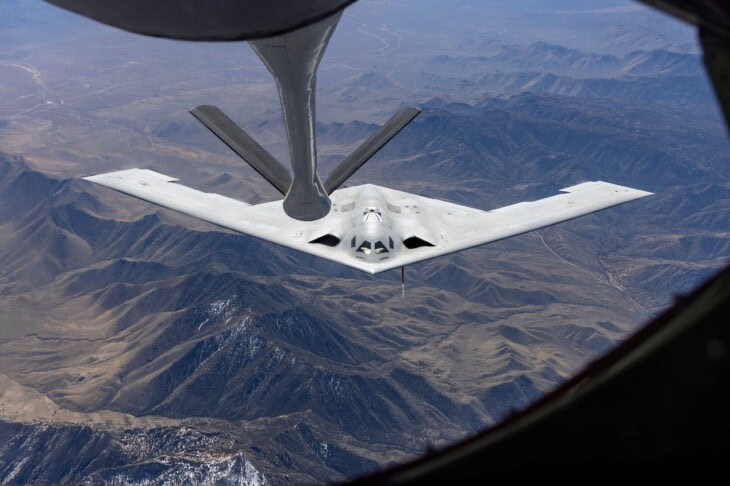
Having two aircraft let the test force run mission systems and weapons work in parallel with basic flight performance testing. In March 2026 the first aircraft completed a five-and-a-half-hour aerial refueling mission with a KC-135.
In May 2026 the Air Force announced that a test campaign planned for 180 days had been finished in 73. The service attributed the pace to testing multiple objectives on the same sorties rather than to skipped work.
On June 11, 2026, an operational test pilot flew the B-21 alongside a Test Pilot School graduate, the earliest an operational pilot has flown a new Air Force aircraft in modern history. The point was to judge combat usefulness years before the bomber reaches a combat wing, not just how it handles.
The program of record is at least 100 aircraft. Senior officers have argued publicly for more, with figures between 145 and 200 raised as what the mission actually requires.
The Air Force’s published average procurement unit cost is $550 million in base year 2010 dollars, which restates to about $692 million in 2022 dollars. Total program cost over 30 years is estimated at roughly $203 billion.
The contract is fixed-price, which has been expensive for the manufacturer. Northrop Grumman has absorbed more than $2 billion in losses on the early production lots, including a $1.56 billion charge taken in January 2024.
Production is now speeding up. On February 23, 2026, the Air Force and Northrop Grumman agreed to apply $4.5 billion in already appropriated funding to raise annual production capacity by 25 percent, and the fiscal 2027 budget request includes $6.1 billion for the program.
Ellsworth Air Force Base in South Dakota is the first operating base and the home of the formal training unit. Construction to prepare the base is already underway.
Air Force Secretary Troy Meink confirmed in 2026 that Raiders will be on the ramp at Ellsworth in 2027, starting with a test aircraft moved from Edwards to help the base prepare. Whiteman Air Force Base in Missouri and Dyess Air Force Base in Texas follow.
The B-21 is built by a team of more than 8,000 industry and Air Force personnel drawing on over 400 suppliers across 40 states.
Yes. Two B-21 test aircraft are flying at Edwards Air Force Base, the first since November 2023 and the second since September 2025, with several more airframes in assembly at Palmdale. No aircraft has been delivered to an operational unit yet.
Two are flying, both of them test aircraft. The Air Force plans to buy at least 100, with the first aircraft due on the ramp at Ellsworth Air Force Base in 2027.
The B-2 carries a heavier bomb load, roughly double the B-21’s estimated payload. The B-21 is more capable in almost every other respect, with newer stealth, modern sensors, upgradeable open-architecture software, and a cost low enough to field five times as many aircraft.
It combines next-generation stealth with an open systems architecture that lets the Air Force add new weapons and software without redesigning the aircraft. It is also the first bomber designed from the start to be affordable in quantity, which is what makes a fleet of 100 or more possible.
The Air Force has not released a speed figure. The B-21 is a high-subsonic aircraft, with published estimates above Mach 0.8, roughly 600 mph (965 km/h) at altitude.
The first Raiders are scheduled to arrive at Ellsworth Air Force Base in 2027. Operational capability follows once enough aircraft and trained crews are in place, with the fleet building through the late 2020s and 2030s.
The Air Force’s average procurement unit cost is $550 million in 2010 dollars, about $692 million in 2022 dollars. The full program is estimated at roughly $203 billion over 30 years.
Pratt & Whitney supplies the engines, but the model, count, and thrust are classified. They are widely reported to be two non-afterburning turbofans from the PW9000 family, related to the F135 engine in the F-35.
Sources and references used for research and fact-checking.