Military Aircraft
The four-seat jammer that escorted US strikes for nearly five decades.
Updated: by Tim de Vries

The latest aviation news and stories sent to your inbox.
The Northrop Grumman EA-6B Prowler was a four-seat, carrier-based electronic warfare aircraft developed from the A-6 Intruder. It jammed enemy radar and communications for the US Navy and Marine Corps from 1971 until 2019, from Vietnam to the campaign against ISIS. Grumman built 170, and none was ever shot down.
Live Fleet Activity (A6)
Fetching live data…


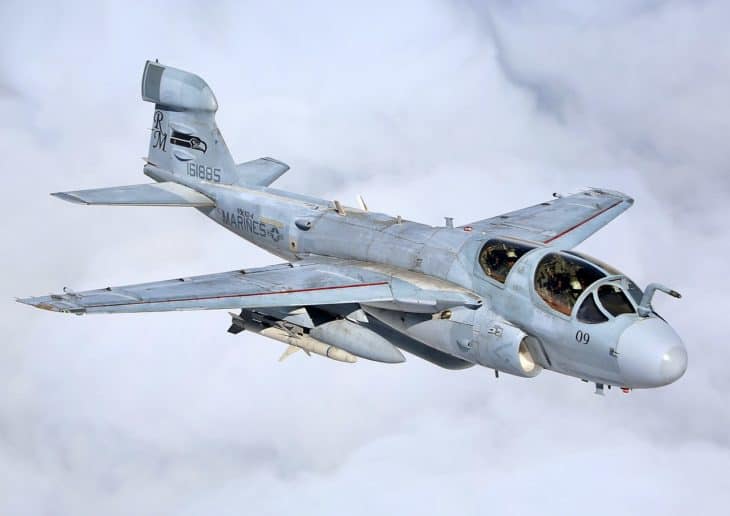
The Grumman EA-6B Prowler was an electronic warfare aircraft built to jam enemy radar and communications so that strike aircraft could reach their targets and come home. It flew with the US Navy and Marine Corps from 1971 until 2019.
Grumman built 170 of them at its Calverton, New York, plant between 1966 and 1991. The company later became part of Northrop Grumman, which is why the aircraft appears under both names.
The Smithsonian describes the Prowler as the first US military aircraft designed specifically for tactical electronic warfare. It also notes that no major US combat operation since Vietnam went ahead without electronic warfare support, and for much of that period the support was Prowlers.
That record makes the type central to any history of electronic warfare aircraft.
No EA-6B is in service today. The Navy retired its last one in June 2015, and the Marine Corps followed in March 2019.
The Prowler was developed from the Grumman A-6 Intruder, a carrier-based attack bomber, and the family resemblance is obvious. That shared ancestry is why the two names often get blended into an “A-6 Prowler”, which was never an official designation.
The first step was the EA-6A “Electric Intruder”, a jamming version of the A-6 that entered Marine Corps service in December 1965 for the air war over North Vietnam. It kept the Intruder’s two-seat cockpit, with an electronic countermeasures officer in the second seat.
The Navy wanted a far more capable jammer, and work on the EA-6B began in 1966. Grumman stretched the forward fuselage to fit a four-seat cockpit, which made the EA-6B nearly 5 feet (1.5 m) longer than the A-6, and added an antenna pod to the top of the tail.
Beyond the general shape, the new aircraft shared little with the A-6 or the EA-6A, so the Navy gave it its own name. The first EA-6B flew on May 25, 1968.
The EA-6B carried a pilot and three electronic countermeasures officers, known as ECMOs, in two side-by-side rows. The ECMO beside the pilot handled navigation, communications and defensive countermeasures, while the two officers in the back ran the main jamming equipment.
Four was the design crew, but flying an operational mission with only two ECMOs was not unusual.
Two cockpit details stand out in photographs. The canopy has a gold tint that shields the crew from the radio energy the aircraft’s own jammers put out, and the refueling probe bends to the right so it does not block the pilot’s view.
Crews had less flattering names for its shape, calling it the “flying drumstick” and the “family truckster.”
The Prowler community also broke a barrier. When the Navy opened combat aircraft to women, a Prowler squadron was the first to have women assigned, with VAQ-130 receiving three women naval aviators in the summer of 1993.
The Navy defined its primary mission as suppression of enemy air defenses: interrupting enemy electronic activity in support of strike aircraft and ground troops. Its secondary job was gathering tactical electronic intelligence inside the combat area.
More than 30 antennas around the airframe listened for radar and radio signals. Once a threat was found, the crew could jam it with the AN/ALQ-99 tactical jamming system, carried in up to five pods, two under each wing and one under the fuselage.
A separate system, the AN/USQ-113, jammed enemy communications. The Prowler carried no gun.
From 1985 it could also fire the AGM-88 HARM, a missile that homes on a radar’s own transmissions. Jamming hid a strike package from a radar, and a HARM could destroy the radar outright.
In Iraq and Afghanistan the mission changed shape. Prowlers jammed the cell phones and garage door openers insurgents used to set off roadside bombs, protecting convoys on the ground.
The Prowler was upgraded throughout its life because the threats it faced kept changing. Expanded Capability (EXCAP) arrived in 1973, Improved Capability (ICAP) in 1976, and ICAP II in 1980, which gave it the ability to carry Shrike and HARM anti-radiation missiles.
A more ambitious Advanced Capability (ADVCAP) program flew in the late 1980s with more powerful engines, extra wing stations and a new cockpit. The plan was to bring every EA-6B up to that standard, but the program was cut from the fiscal 1995 budget.
Its three test aircraft were later rebuilt into a single airframe the Navy nicknamed the “FrankenProwler”, which returned to service on March 23, 2005. It is now on display at the Pima Air & Space Museum in Tucson, Arizona.
The final standard was ICAP III, approved for low-rate initial production in June 2003. It added the AN/ALQ-218 receiver, more precise selective jamming and a Link 16 data link, and it is the configuration the last Prowlers flew in.
Much of that upgrade work happened at Point Mugu, California, which became the EA-6B’s designated software support activity in 1973.
The Prowler went to war almost as soon as it arrived. VAQ-132 took the first EA-6Bs on a combat deployment in June 1972 aboard the USS America, and Prowlers flew over North Vietnam during Operation Linebacker II later that year, in the closing phase of the air war over Vietnam.
Two squadrons flew 720 sorties in that war, jamming defenses ahead of Navy attack aircraft and Air Force B-52 bombers.
Through the 1980s, Prowlers supported the 1983 invasion of Grenada, the 1985 interception of the airliner carrying the Achille Lauro hijackers, the 1986 strikes on Libya, and Operation Praying Mantis against Iran in 1988.
Desert Storm in 1991 was the biggest test. EA-6Bs flew more than 1,600 combat sorties and fired more than 150 HARMs against Iraq’s air defense network.
A summary of Desert Storm air operations, quoted by the Naval History and Heritage Command, put the Prowler’s value plainly: “If Navy defense suppression wasn’t available, the missions didn’t fly.”
When the Air Force retired the EF-111A Raven in 1998, the Prowler became the US military’s only tactical jammer. Four land-based “expeditionary” squadrons covered Air Force needs, and Air Force electronic warfare officers flew in Navy Prowler units from 2004 to 2014.
Later deployments took it over Bosnia and Yugoslavia, Afghanistan and Iraq. In 2014, Marine Prowlers were the first Marine Corps aircraft to operate over Syria, supporting the campaign against ISIS.
Across nearly five decades of service, no EA-6B was ever shot down.
The Prowler was not retired because it could no longer do the job. By the 21st century its airframes needed increasingly intensive maintenance, and the Navy had a newer platform in the EA-18G Growler.
The Navy began moving its squadrons to the Growler in 2009. Its last Prowler deployment was VAQ-134’s cruise aboard the USS George H.W. Bush in 2014, and the Navy’s last operational Prowler flight took place on May 27, 2015.
NAS Whidbey Island marked the end with a retirement commemoration from June 25 to 27, 2015. On the final day, Prowler 163890 of VAQ-134 made the ceremonial last takeoff and flew to Point Mugu, where it now stands on display in the base’s Missile Park.
The Marine Corps kept flying Prowlers for almost four more years. VMAQ-2 made the type’s last operational deployment, to Al Udeid Air Base in Qatar, and came home in November 2018.
The squadron was deactivated on March 8, 2019. On March 14, four of its officers flew Prowler 162230 from MCAS Cherry Point to Washington Dulles for delivery to the Smithsonian, the last EA-6B flight ever made.
The Marines did not buy a direct replacement. They rely on Navy Growler squadrons for tactical jamming, with Marine aviators flying in them, and adopted a Marine Air-Ground Task Force electronic warfare concept that shifts part of the mission to drones.
The Navy’s replacement is the Boeing EA-18G Growler, a jamming version of the two-seat F/A-18F Super Hornet that entered service in 2009.
The Growler does the same job with half the crew. Its jamming system is more automated than the Prowler’s and can share information and jamming tasks across several aircraft, so a pilot and one electronic warfare officer replace a pilot and three ECMOs.
It also inherited decades of Prowler work. “The EA-18G Growler was effective on day one because of the legacy that was carried over from the Prowler,” said Harlan Kooima, director of research and development at the Naval Air Warfare Center Weapons Division.
The Air Force’s electronic attack fleet has gone through a handover of its own. Its EC-130H Compass Call fleet flew its last mission in September 2026, with the job passing to the Gulfstream-based EA-37B.
The full specification table for the EA-6B is on this page. A few of its figures are quoted in very different forms elsewhere, so they need context.
Range causes the most confusion. The 2,083 nm in the table is the Navy’s combat range with maximum external fuel, and it is the same distance some references print as 2,400 miles.
On internal fuel alone the range is about 1,000 nm, roughly 1,150 miles (1,850 km), which matches the “1,000 nautical miles+” in the Navy’s own fact file. The fuel capacity in the table is internal fuel only, and up to five 300-gallon drop tanks could be added, each one taking a station that could otherwise carry a jamming pod.
The 566-knot top speed, about 651 mph (1,048 km/h), is a sea-level figure for a subsonic jet with two non-afterburning turbojets. The published cruise speed is 418 knots (481 mph).
Weight figures vary by source. The table uses the Navy fact file’s 61,500 lb (27,900 kg) maximum takeoff weight, while the Naval History and Heritage Command’s characteristics sheet gives 65,000 lb (29,500 kg). The 18,000 lb (8,150 kg) payload is the combined limit of the five stations that carried pods, tanks and missiles.
No Prowler was lost to enemy fire, but peacetime flying was costly. In 1998 a memorial at NAS Whidbey Island was dedicated to 44 crew members killed in EA-6B accidents.
On May 26, 1981, a Marine Corps EA-6B low on fuel crashed onto the flight deck of the USS Nimitz, killing 14 crewmen and injuring 45. The fire and explosions that followed destroyed or damaged 19 other aircraft.
On February 3, 1998, a VMAQ-2 Prowler flying low and fast in breach of its rules cut the cable of a ski cable car near Cavalese in the Italian Dolomites. Twenty people in the car were killed, and the damaged jet landed at Aviano Air Base.
The pilot and navigator were tried in the United States and found not guilty of involuntary manslaughter and negligent homicide. Both were later convicted of obstruction of justice and conduct unbecoming an officer for destroying a videotape recorded on the flight, and both were dismissed from the service.
On March 11, 2013, a VAQ-129 Prowler crashed during a training flight in Washington state, killing its three crew. An investigation a year later attributed the crash to controlled flight into terrain caused by pilot error.
Retired Prowlers went to museums and bases. The last one ever to fly, 162230, is displayed at the Smithsonian’s Steven F. Udvar-Hazy Center in Chantilly, Virginia, and its squadron partner 162228 went to the Frontiers of Flight Museum in Dallas.
The National Naval Aviation Museum in Pensacola, Florida, shows 156481, the first Prowler built from new rather than converted from an A-6A. Others are on display aboard the USS Midway Museum in San Diego, at Wings Over the Rockies in Denver, and at the Museum of Flight in Seattle.
At least two of them are still Navy property. The Denver aircraft, a former VAQ-134 jet, and the Seattle aircraft are both on loan from the National Naval Aviation Museum.
You cannot buy one. The FAA’s aircraft reference file, in the release dated September 11, 2026, contains no Grumman A-6 or EA-6 model at all, so no Prowler is on the US civil register.
No. The US Navy retired its last EA-6B in June 2015, and the Marine Corps deactivated its last Prowler squadron, VMAQ-2, on March 8, 2019.
The final Prowler flight took place on March 14, 2019, when aircraft 162230 was delivered to the Smithsonian. The US Navy and Marine Corps were its only operators.
The Prowler jammed enemy radar and communications so that strike aircraft could operate in defended airspace. Its crew located threats with receivers around the airframe, jammed them with up to five AN/ALQ-99 pods, and from 1985 could destroy radars with the AGM-88 HARM missile.
It also gathered electronic intelligence, and in Iraq and Afghanistan it jammed the signals used to detonate roadside bombs.
The Boeing EA-18G Growler, a two-seat jamming version of the F/A-18F Super Hornet, replaced the Prowler in the Navy starting in 2009. The Marine Corps did not buy a direct replacement; it relies on Navy Growler squadrons and a Marine Air-Ground Task Force electronic warfare concept that shifts part of the mission to drones.
Grumman built 170 production EA-6Bs at Calverton, New York, between 1966 and 1991, and the last one was delivered in November 1991. Three A-6As were also converted as prototypes during development.
Four: a pilot and three electronic countermeasures officers (ECMOs). The ECMO in the right front seat handled navigation, communications and defensive countermeasures, and the two in the rear seats ran the main jamming system. Some operational missions flew with only two ECMOs.
Its top speed was 566 knots, about 651 mph (1,048 km/h), at sea level, and its published cruise speed was 418 knots (481 mph). It was a subsonic aircraft powered by two non-afterburning Pratt & Whitney J52 turbojets.
No. No EA-6B was ever lost to enemy fire in nearly five decades of service. The type did suffer many accidents, and a memorial dedicated at NAS Whidbey Island in 1998 honors 44 crew members killed in them.
The EA-6B Prowler was a subsonic, four-seat jammer based on the A-6 Intruder. The EA-18G Growler is a supersonic, two-seat jammer based on the F/A-18F Super Hornet, and its more automated systems let one electronic warfare officer do work that took three ECMOs in the Prowler. The Growler replaced the Prowler in Navy service between 2009 and 2015.
The Associated Press reported in 2003 that the aircraft cost an estimated $52 million each. That figure did not state whether it covered the bare airframe or included support costs, so treat it as a broad estimate rather than a contract price.
No. Retired Prowlers went to museums and military bases, and several are still Navy property on loan. The FAA’s aircraft reference file (release dated September 11, 2026) contains no Grumman A-6 or EA-6 model, so no Prowler is registered to a private owner in the United States.
Sources and references used for research and fact-checking.