

Military Aircraft
NASA's single-seat quiet supersonic X-plane, built by Lockheed Martin Skunk Works
Updated: by Tim de Vries
The latest aviation news and stories sent to your inbox.
The Lockheed Martin X-59 QueSST is NASA’s one-of-a-kind quiet supersonic research aircraft, built to prove that a sonic boom can be softened into a barely audible thump. It first flew on October 28, 2025, and NASA reports it has reached its Mach 1.4 design speed. Data from its flights over U.S. communities is meant to help regulators revisit the ban on supersonic flight over land.


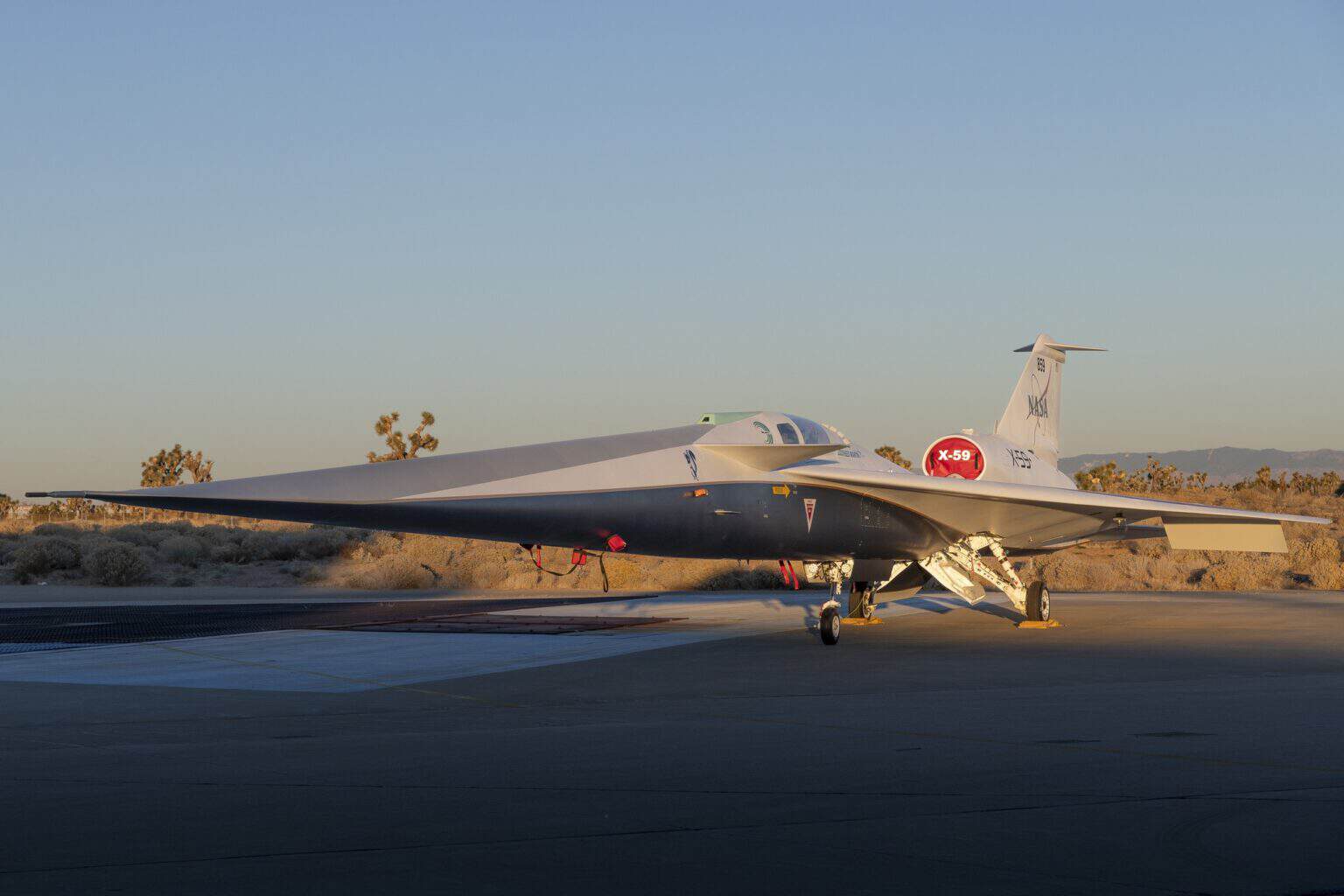
The Lockheed Martin X-59 QueSST is a single-seat experimental aircraft that NASA built to test one idea: a supersonic jet does not have to produce a loud sonic boom. QueSST stands for Quiet SuperSonic Technology.
NASA calls the program Quesst, and its goal is to fly the X-59 over real communities and ask people how it sounds. The results go to the FAA and international regulators.
The aircraft is an X-plane, not a prototype of an airliner. Nobody plans to sell it, and only one has been built.
Faster than sound, an aircraft drags shock waves behind it, and on the ground they arrive as a double bang. The FAA has banned civil supersonic flight over the United States since 1973 because of that noise.
That ban is a big reason Concorde flew its fast routes over the ocean. For the full story, see our Concorde explainer.
The X-59 attacks the problem at the source. NASA’s aim is to stop the shock waves from merging into one sharp boom, so they reach the ground as what the agency calls a barely audible thump.
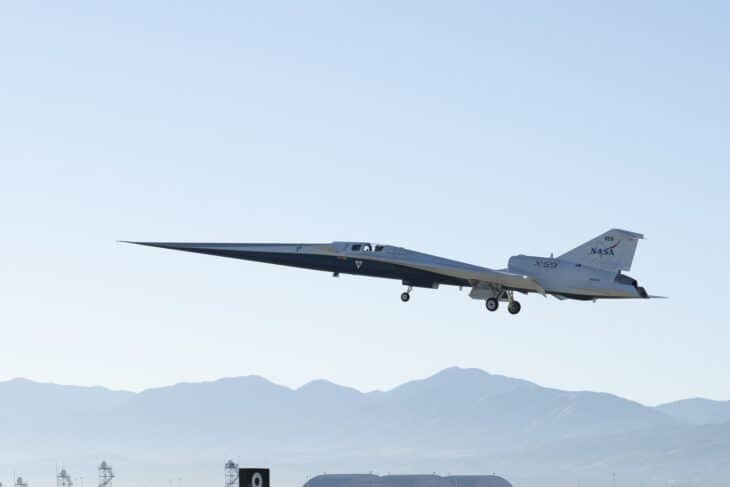
Almost every odd feature on the aircraft serves that goal. The nose is about one-third of the airplane’s length, which spreads the shock waves out instead of letting them stack up.
The wings are swept back and the engine sits on top of the fuselage near the tail. That keeps the underside smooth, so shock waves from the engine do not join the ones from the body.
The result looks like a spear with a tail. It is also why the cockpit has no forward window.
The long nose blocks any windshield-style view ahead. Instead, the X-59 uses the eXternal Vision System, a series of high-resolution cameras feeding a 4K monitor in the cockpit.
The pilot sits about halfway down the fuselage. NASA test pilot Nils Larson described the early flights as “exciting but uneventful,” which is what a test program wants.
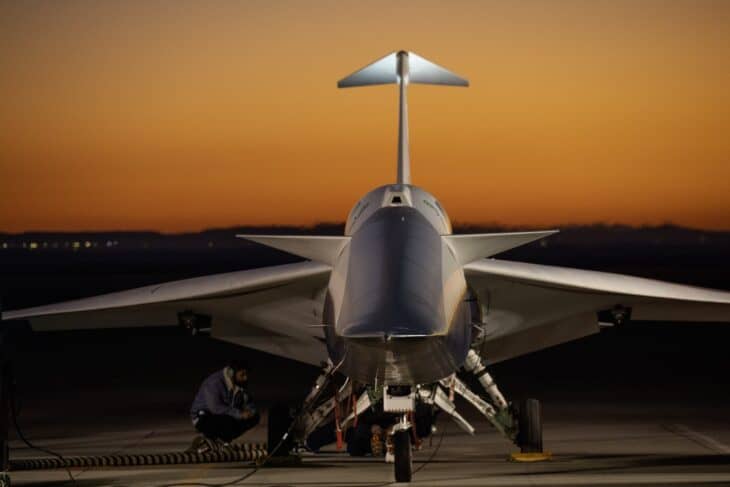
A single General Electric F414 turbofan powers the X-59. It is a version of the engine that flies on the F/A-18E/F Super Hornet.
Using a proven engine kept the risk in the airframe shape, which is the part the experiment is actually about.
The full specification table for the aircraft is on this page. A few figures need context.
The speed and altitude shown are NASA’s design point, Mach 1.4 at 55,000 feet. They are targets the aircraft has flown, not a record attempt. The X-59 is built to be quiet, not fast.
The weight comes from a secondary source, because NASA has not published a takeoff weight on its public pages. Height, range and climb rate are blank for the same reason.
NASA awarded Lockheed Martin Skunk Works $247.5 million on April 2, 2018, to design, build and deliver the aircraft. Lockheed released video of the assembled aircraft rolling out of its hangar in August 2023.
NASA and Lockheed unveiled the X-59 publicly on January 12, 2024. Engine runs and taxi tests followed before flight.
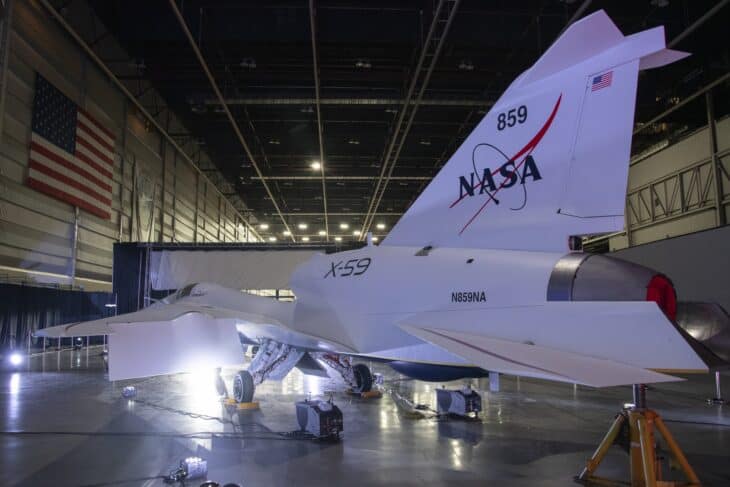
The X-59 made its first flight on October 28, 2025, from Lockheed Martin’s Palmdale, California, site. It stayed subsonic and landed at NASA’s Armstrong Flight Research Center in Edwards, California.
The second flight, on March 20, 2026, was cut short by a technical issue and landed after about nine minutes. NASA flew it again within days.
The first supersonic flight came on June 5, 2026, when NASA reported Mach 1.1 at 43,400 feet. By the 25th flight on August 21, 2026, the aircraft had flown 72 minutes to Mach 1.2 at about 49,000 feet.
NASA says the X-59 has already reached its Mach 1.4 and 55,000 feet target, “relatively early” in the schedule. Flight data closely matches simulations for controllability, stability margin and flight loads.
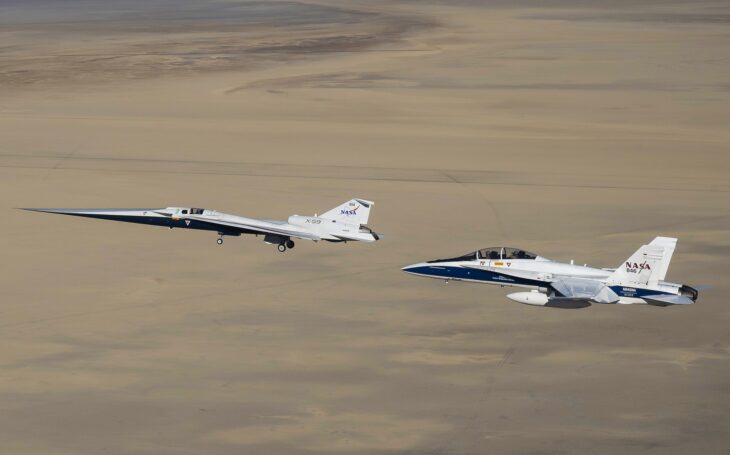
The next phase is acoustic validation. NASA will measure the X-59’s sonic thump from the ground and the air, with more focus on supersonic cruise in the coming months.
After that, NASA plans community flights over selected U.S. cities and will survey how people react. NASA lists the mission as running through 2029, and the regulatory decision is up to the FAA and its international counterparts.
The X-59 is not the only company chasing quiet supersonic flight. Boom’s XB-1 is a privately built supersonic demonstrator aimed at a commercial airliner.
It is NASA’s experimental quiet supersonic research aircraft, built by Lockheed Martin Skunk Works. It is designed to produce a soft thump instead of a loud sonic boom.
Strictly, the FAA bans civil supersonic flight over the United States, not booms as such. The rule dates to 1973 and exists because the boom is a loud noise on the ground.
It made its first flight on October 28, 2025, at subsonic speed. It first flew supersonic on June 5, 2026.
NASA’s design speed is Mach 1.4, or about 925 mph at 55,000 feet. NASA reports the aircraft has reached that target.
No. It has one seat, for the pilot, and it exists to gather noise data rather than to carry anyone.
No. We found no crash in NASA’s reporting. The second flight was cut short by a technical issue and landed safely, and NASA flew it again days later.
Sources and references used for research and fact-checking.

.jpg)
.jpg)
.jpg)
.jpg)