Fighter Jets
Boeing F-15EX Eagle II
ICAO: F15
The two-seat F-15 built to strike deep and fight its way back out.
Updated: by Tim de Vries

The latest aviation news and stories sent to your inbox.
The F-15E Strike Eagle is a two-seat, all-weather strike fighter derived from the F-15 Eagle, flown by a pilot and a weapon systems officer. Built to reach targets deep behind enemy lines and fight its way back out, it has flown combat from the 1991 Gulf War to the 2026 Iran war. The U.S. Air Force now plans to keep 99 upgraded jets while the F-15EX begins replacing the rest.
Live Fleet Activity (F15)
Fetching live data…


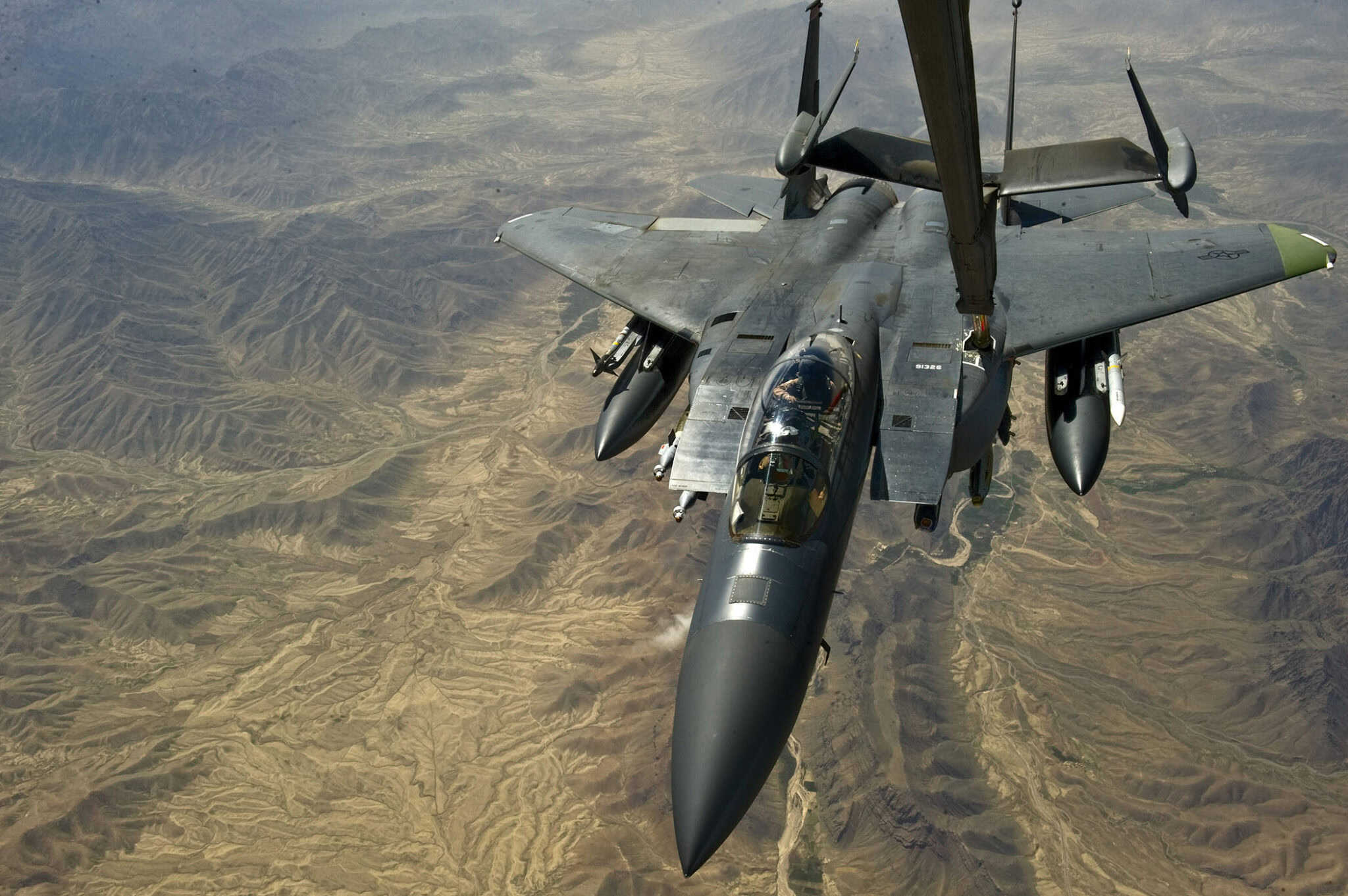


The F-15E Strike Eagle is a two-seat, all-weather strike fighter developed from the F-15 Eagle air superiority fighter. McDonnell Douglas designed it in the 1980s to fly long-range, high-speed interdiction missions without needing escort fighters or jamming aircraft.
A pilot sits in front and a weapon systems officer, or WSO, sits behind, running the radar, targeting pods and weapons. The jet still carries Sidewinder and AMRAAM missiles for air combat, which is why the Air Force calls it a dual-role fighter.
The first F-15E flew on 11 December 1986, and the type reached initial operational capability in September 1989. It has flown combat over Iraq, the Balkans, Afghanistan, Libya and Syria, and in 2026 it flew strike missions in the war with Iran.
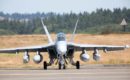
An Air Force Strike Eagle is easy to tell from other Eagles. It wears darker camouflage, carries conformal fuel tanks along its fuselage sides, and has targeting and navigation pods mounted beneath its engine intakes.
The original F-15 was built purely for air combat. Its program office resisted any ground-attack role, and the phrase “not a pound for air to ground” summed up the attitude.
McDonnell Douglas quietly kept a basic ground-attack capability in the design anyway. It pitched an F-15 interdictor to replace the F-111 Aardvark and the remaining F-4 Phantom IIs, and converted the second two-seat TF-15A prototype into a demonstrator that first flew on 8 July 1980.
In March 1981 the Air Force launched the Enhanced Tactical Fighter program, later renamed the Dual-Role Fighter competition. McDonnell Douglas entered the F-15E against General Dynamics’ F-16XL, a cranked-delta version of the F-16 that would have entered service as the F-16E and F-16F.
The F-15E won on 24 February 1984. Its development costs were lower, 270 million dollars against 470 million for the F-16XL, and the Air Force also valued its twin-engine redundancy and room for growth.
The Panavia Tornado was also a candidate but was never seriously considered. It lacked a credible air superiority capability and was not American-made.
The first F-15E, serial 86-0183, flew on 11 December 1986 with Gary Jennings at the controls, reaching Mach 0.9 and 40,000 feet on a 75-minute flight. The first production jet was delivered to Luke Air Force Base, Arizona, in April 1988.
The 336th Tactical Fighter Squadron at Seymour Johnson Air Force Base, North Carolina, reached initial operational capability on 30 September 1989. About 236 F-15Es were built for the Air Force between 1985 and 2001.
Jet 86-0183 later had a second career. Boeing modified it into the demonstrator for the F-15SE Silent Eagle, which flew in July 2010 with a conformal weapons bay.
From the outside the two look alike, but the Strike Eagle is a different aircraft underneath. It began as a modification of the two-seat F-15B and kept the same aerodynamic shape, but added significant structural changes and a redesigned engine bay that could take more powerful engines.
The obvious change is the second crew member. The combat version of the air superiority Eagle, the F-15C, is a single-seater, while every F-15E carries a pilot and a WSO.
The Strike Eagle’s airframe is rated for 8,000 flight hours, or up to 16,000 with depot maintenance. That is twice the service life of earlier F-15 variants.
Its conformal fuel tanks hug the fuselage and produce less drag than conventional drop tanks. They carry weapons on short pylons rather than conventional racks, but they cannot be jettisoned, so the extra range costs some drag and weight compared with a clean jet.
The radar changed too. The F-15E’s original APG-70 could map the ground as well as search the sky: the crew could sweep a target area, freeze the ground map, then switch back to air-to-air mode to check for threats.
For the air superiority Eagle against its best-known stablemate, see our F-16 vs F-15 comparison.
The pilot gets three screens and a head-up display at eye level, so flight and weapon information is visible without looking down. At night, the head-up display can show a video picture of the ground ahead from the forward-looking infrared sensor, close to a daylight view.
The WSO in the rear cockpit works four screens showing radar, electronic warfare and infrared sensor pictures, weapon status, threats, targets and a moving map. Two hand controllers select displays and refine targeting information.
Unlike the back seats of the F-14 Tomcat and Navy F-4s, the F-15E’s rear cockpit has its own stick and throttle. The WSO can take over flying, albeit with reduced visibility.
The cockpit already includes helmet-mounted cueing for aiming weapons off the nose. The current upgrade program adds color large-area digital displays.
The Strike Eagle can carry most of the air-to-ground weapons in the Air Force inventory, conventional and nuclear. That includes laser- and GPS-guided bombs, the GBU-28 bunker buster, the GBU-39 Small Diameter Bomb, the GBU-53 StormBreaker and the AGM-158 JASSM cruise missile.
For air combat it carries four AIM-9 Sidewinders and four AIM-120 AMRAAMs, or eight AMRAAMs. An internal 20 mm M61A1 cannon carries up to 500 rounds.
The F-15E is also a nuclear aircraft. A 2026 survey of U.S. nuclear forces in the Bulletin of the Atomic Scientists describes it as the Air Force’s most capable tactical nuclear delivery aircraft, able to carry up to five B61-12 bombs.
Night and bad-weather strike is where it made its name. The LANTIRN navigation pod under the right intake holds a terrain-following radar that can be coupled to the autopilot for hands-off low-level flight, while a targeting pod under the left intake holds a laser designator.
Sniper and Litening pods now also fill the targeting role, and once a target is being tracked, the pod hands its information straight to laser- or GPS-guided bombs.
Under the Radar Modernization Program, the APG-70 was replaced by the Raytheon AN/APG-82(V)1 active electronically scanned array radar. It pairs the antenna of the F-15C’s APG-63(V)3 with the processor from the Super Hornet’s APG-79, and reached initial operational capability in 2014.
The old Tactical Electronic Warfare System is being replaced by the BAE Systems AN/ALQ-250 EPAWSS, a digital suite that swaps every TEWS component for lighter, more capable ones. The first F-15E fitted with EPAWSS was delivered in 2022.
F-15Es have also begun moving to jam-resistant MUOS satellite communications. Planned work covers GPS hardening, updated electronic warfare protection and warning, and a Legion Pod infrared search and track sensor, starting in fiscal 2026, to engage aircraft more discreetly.
Not every jet will get all of this. The Air Force plans to keep and upgrade only its newest F-15Es, as the retirement section below explains.
The full specification table for the F-15E is on this page. Several of its figures need context, because the numbers quoted for this jet change with configuration and with who is quoting them.
The top speed is Mach 2.5, which the flight-manual figures put at about 1,650 mph (2,656 km/h) at high altitude, or 1,434 knots. The Air Force fact sheet quotes 1,875 mph (“Mach 2.5 plus”), which is higher than the flight-manual number, so we use the flight-manual figure. For how that compares, see our list of the fastest fighter jets.
Those speeds are for a jet without conformal tanks. With the tanks fitted, the limit falls to about Mach 2.0, or 1,320 mph (2,124 km/h), and even a clean jet is limited to Mach 1.2, about 800 knots, at low altitude.
The 2,100 nautical mile range is a ferry figure, flown with conformal tanks and three 600-gallon drop tanks, and works out to about 2,420 miles. The combat range published for an air interdiction mission is 687 nautical miles, about 790 miles (1,272 km).
The fact sheet puts ferry range at 2,400 miles (3,840 km), and Air and Space Forces Magazine at 2,762 miles, both with the same tank fit. Air refueling extends all of these, which is how F-15E crews over Afghanistan flew a 15.5-hour mission with 12 refuelings.
The fuel capacity in the table is internal fuel only, 12,915 pounds (5,858 kg), converted to US gallons at 6.7 pounds per gallon. Each conformal tank adds 750 US gallons (2,800 L), and with three drop tanks as well the jet carries 34,162 pounds (15,496 kg) of fuel.
The maximum payload figure is external capacity, about 23,000 lb (10,400 kg), and it counts external fuel as well as weapons. The fact sheet simply says payload “depends upon mission.”
Engine thrust depends on which jets you mean. Early F-15Es use Pratt and Whitney F100-PW-220 engines, rated at between 23,450 and 25,000 pounds of thrust each depending on the source, while later jets have the F100-PW-229 at 29,000 pounds (129 kN), the figure shown in the table.
The F-15E went to war within two years of entering service. When Operation Desert Storm began on 17 January 1991, 24 F-15Es struck five fixed Scud missile sites in western Iraq, and at night crews hunted mobile Scud launchers.
Two F-15Es were shot down by Iraqi defenses early in the war. The first, on 18 January during a strike near Basra, killed both crew members, and the crew of the second was captured.
The Strike Eagle’s only air-to-air kill of that war came on 14 February 1991, with a bomb. A crew dropped a 2,000-pound (907 kg) GBU-10 laser-guided bomb on an Iraqi Mi-24 helicopter, which was about 800 feet (240 m) above the ground when the bomb hit.
In March 1999, 26 F-15Es flew the opening strikes of Operation Allied Force against Serbian air defenses. Over Afghanistan from 2001 they flew close air support, including during the Battle of Roberts’ Ridge in March 2002.
In Iraq in 2003, F-15Es were credited with destroying 60 percent of the Medina Republican Guard division’s forces and striking 65 MiGs on the ground. One F-15E crashed near Tikrit on 7 April 2003, killing Captain Eric Das and Major William Watkins.
Over Libya in March 2011, an F-15E crashed after equipment problems caused a weight imbalance, and both crew members were rescued. Against Islamic State, F-15Es flew 37 percent of all Air Force sorties between August 2014 and January 2015.
The type has also become a drone hunter. On 13 April 2024, Air Force F-15Es helped blunt an Iranian attack on Israel by shooting down more than 70 one-way attack drones.
U.S. and Israeli strikes on Iran began on 28 February 2026, in what the U.S. calls Operation Epic Fury. According to open-source tracking reported by Air and Space Forces Magazine, F-15Es from Seymour Johnson, RAF Lakenheath in England and Mountain Home Air Force Base in Idaho were among the fighters massed in the region.
The first reported U.S. aircraft losses of the war were three F-15Es, shot down on 2 March 2026 by Kuwaiti air defenses in what U.S. Central Command called an apparent friendly-fire incident. All six aviators, three pilots and three WSOs, were recovered, and later reporting suspected Kuwaiti F/A-18 fighters.
On 3 April 2026, an F-15E of the 494th Fighter Squadron was shot down over Iran, reportedly by a shoulder-fired missile. The pilot was rescued within hours, while the WSO, a colonel, evaded capture in the Zagros Mountains until a special operations mission recovered him early on 5 April.
The rescue was costly in equipment. U.S. forces blew up two MC-130J special operations transports that became stuck at a makeshift landing site in Iran, and called in backup aircraft to finish the mission.
On the night of 8 to 9 September 2026, after U.S. forces destroyed five Iranian oil tankers, Iran fired ballistic missiles at Muwaffaq Salti Air Base in Jordan. About eight F-15Es were lightly damaged but considered serviceable, according to people familiar with the matter, while an A-10 suffered a severely damaged wing.
The war was still under way when this page was updated in September 2026, so the F-15E’s record in it is not final.
Four air forces besides the U.S. Air Force bought Strike Eagle derivatives. Counting them, about 435 F-15E-family jets were built between 1985 and 2017.
Israel’s F-15I Ra’am, meaning “Thunder,” flies with No. 69 Squadron. Israel announced a buy of 21 in January 1994 and added four in November 1995, and all 25 were built between 1996 and 1998 with an Israeli electronic warfare suite and helmet-mounted sights.
Saudi Arabia received 72 F-15S jets between 1996 and 1998, nearly identical to the U.S. version apart from their radar’s performance in synthetic aperture mapping mode. It planned to upgrade 66 of them to the F-15SR standard by 2026, broadly comparable to its newer F-15SA.
South Korea chose the F-15K Slam Eagle in 2002 over the Rafale, Typhoon and Su-35, and bought 61 in two batches. In December 2022 it approved upgrading all 59 remaining jets with the APG-82(V)1 radar and EPAWSS, and it expects to fly them until 2060.
Singapore picked the F-15SG in 2005 over the Rafale and built up a fleet of 40 by 2018. Its crews train in Idaho with the 428th Fighter Squadron, a joint U.S. and Singaporean unit at Mountain Home Air Force Base.
The design also led to the F-15 Advanced Eagle family, starting with Saudi Arabia’s fly-by-wire F-15SA, which first flew in 2013. It continued with Qatar’s F-15QA and the U.S. Air Force’s own F-15EX Eagle II, which the Air Force now plans to use to replace F-15Es.
The Air Force fact sheet gives a unit cost of 31.1 million dollars in fiscal 1998 constant dollars. That figure is expressed in 1998 money, so it understates what the same jet would cost in today’s dollars.
The Air Force’s F-15Es were built between 1985 and 2001, so there is no current new-build price for one. The service is buying the newer F-15EX instead.
For how that compares with other front-line jets, see our guide to the most expensive fighter planes.
Partly. As of September 2026 the F-15E is still in front-line service and flying combat, but the Air Force wants to shrink the fleet and replace much of it with the F-15EX.
Air and Space Forces Magazine lists an inventory of 217 F-15Es. The service plans to retire roughly half of them through 2029 and keep only 99 late-model jets with F100-PW-229 engines, which it would continue to upgrade.
Congress blocked the retirement of 21 F-15Es in fiscal 2026 but signaled it could accept about 50 retirements through 2028. The Air Force’s fiscal 2027 budget request, released in April 2026, proposes divesting 20.
In the same budget the Air Force more than doubled its planned F-15EX buy, from 129 to 267 jets, saying the larger fleet would “begin to recapitalize the aging F-15E fleet.” That fits a wider problem with an aging Air Force fleet.
The first base to swap is Seymour Johnson, home of the 4th Fighter Wing and the primary training ground for Air Force F-15 pilots. In a letter made public in August 2026, Air Force Secretary Troy Meink confirmed it will get F-15EXs and pledged that its F-15Es will not leave until the replacements are in place.
About two dozen of Seymour Johnson’s Strike Eagles are due to move to Whiteman Air Force Base, Missouri, where the 442nd Fighter Wing, a reserve unit, would fly them in place of its A-10s. A final basing decision is expected in fall 2028.
The Air Force expects the new F-15E mission at Whiteman to reach initial operational capability in 2032, as covered in our Whiteman F-15E report.
Meink summed up the jet’s position at his 2025 confirmation hearing: “Is it going to be able to operate in the highest environments? No. Does it have value? Yes.”
That is the trade of a fourth-generation fighter in a stealth era. For the Eagle family against the jets that followed it, see our F-22 vs F-15 and F-35 vs F-15 comparisons, and our ranking of the best fighter jets in the world.
The F-15 Eagle, in its F-15C form, is a single-seat air superiority fighter built to shoot down other aircraft. The F-15E Strike Eagle is a two-seat derivative with a weapon systems officer, a strengthened structure, an engine bay for more powerful engines, conformal fuel tanks and ground-attack sensors, built for long-range strike while keeping its air-to-air missiles.
Yes. Air and Space Forces Magazine lists 217 in the U.S. Air Force inventory, and in 2026 they flew combat missions against Iran, while Israel, Saudi Arabia, South Korea and Singapore fly export versions. The Air Force plans to retire roughly half its fleet through 2029 and keep 99 upgraded jets.
It has flown combat from the 1991 Gulf War to the 2026 Iran war and can carry most Air Force air-to-ground weapons, including nuclear bombs. Its limit is survivability: it is not stealthy, and Air Force Secretary Troy Meink said in 2025 that it could not operate in the highest-threat environments, though it “definitely has value today.”
Yes, but only as an informal name. When the Air Force retired part of its F-15C/D fleet, officials called the jets being kept and upgraded “Golden Eagles” and those being shelved “Silver Eagles,” and later “Golden” meant jets fitted with the APG-63(V)3 radar. Air Force Materiel Command said the terms were never formal program names.
The F-15E’s top speed is Mach 2.5, about 1,650 mph (2,656 km/h) at high altitude, according to its flight-manual figures. With conformal fuel tanks fitted the limit drops to about Mach 2.0, and the Air Force fact sheet’s 1,875 mph figure is higher than the flight-manual number.
The Air Force fact sheet puts the unit cost at 31.1 million dollars in fiscal 1998 constant dollars. The Air Force’s jets were built between 1985 and 2001, so there is no current new-build price, and the service is buying the newer F-15EX instead.
About 236 F-15Es were built for the U.S. Air Force between 1985 and 2001. Counting the export F-15I, F-15S, F-15K and F-15SG, about 435 F-15E-family jets were built through 2017.
Yes. Iraqi defenses shot down two in January 1991, and in 2026 three were downed by Kuwaiti friendly fire on 2 March and one by Iranian forces on 3 April. All eight crew members from the 2026 losses were recovered.
The second seat is for the weapon systems officer, who runs the radar, targeting pods, sensor displays and navigation. During an attack the pilot can detect and engage air targets while the WSO designates the ground target, and the rear cockpit has its own stick and throttle.
The F-15E is a fourth-generation fighter. It has been upgraded with an AESA radar and digital electronic warfare, but it carries its weapons externally and was not designed for stealth.
Sources and references used for research and fact-checking.