Fighter Jets
Boeing F-15EX Eagle II
ICAO: F15
The carrier strike fighter the US Navy built its air wings around.
Updated: by Tim de Vries

The latest aviation news and stories sent to your inbox.
The Boeing F/A-18E/F Super Hornet is the US Navy’s main carrier strike fighter, flown by up to three squadrons in every carrier air wing. It is a roughly 20 percent larger redesign of the original F/A-18 Hornet, first flown in 1995 and in fleet service since 1999, and it replaced the F-14 Tomcat, A-6 Intruder and S-3 Viking. The US Navy, Australia and Kuwait fly it, and the last new-build jets are due off the St. Louis line by 2027.
Live Fleet Activity (F18S)
Fetching live data…

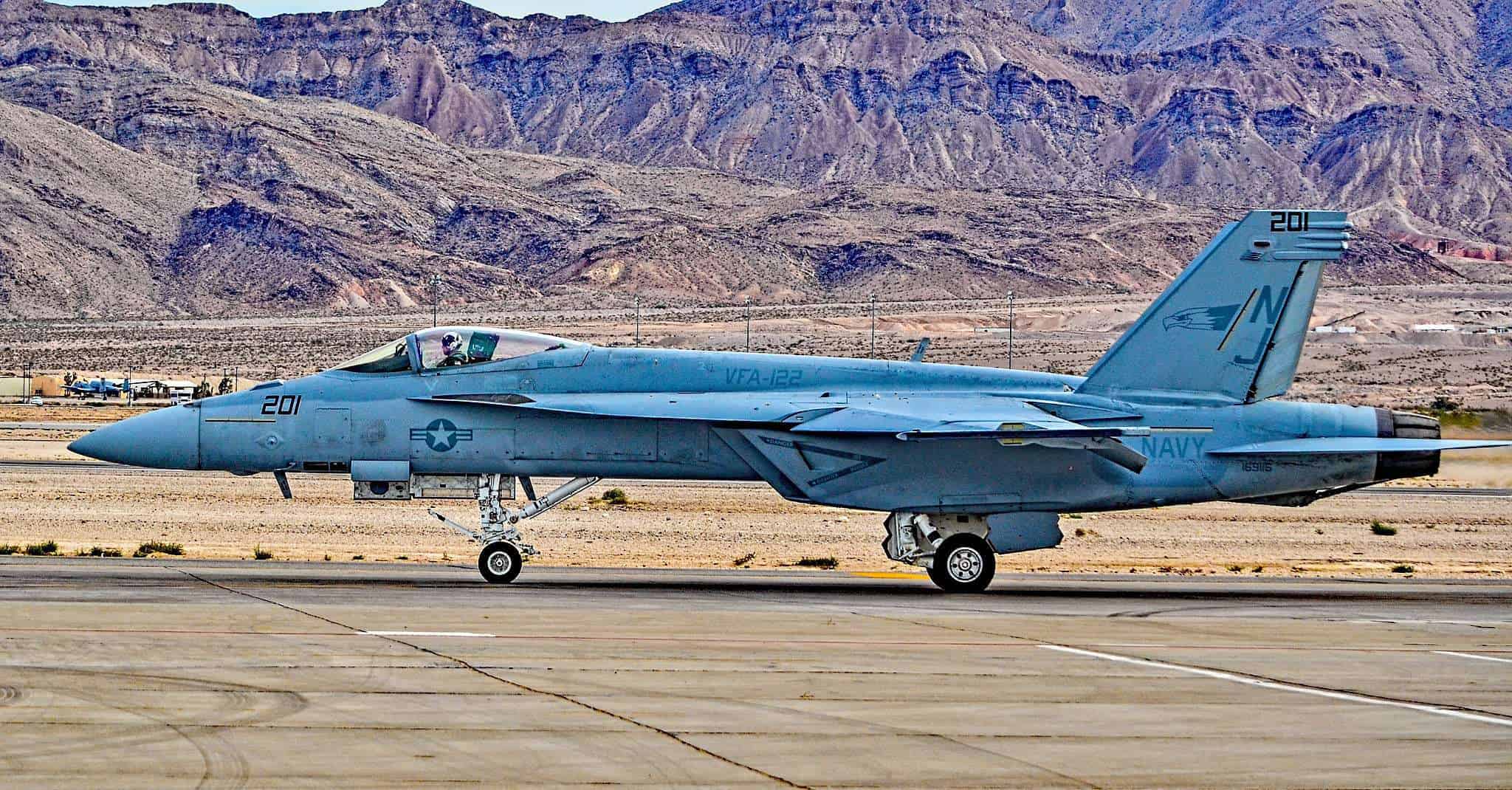
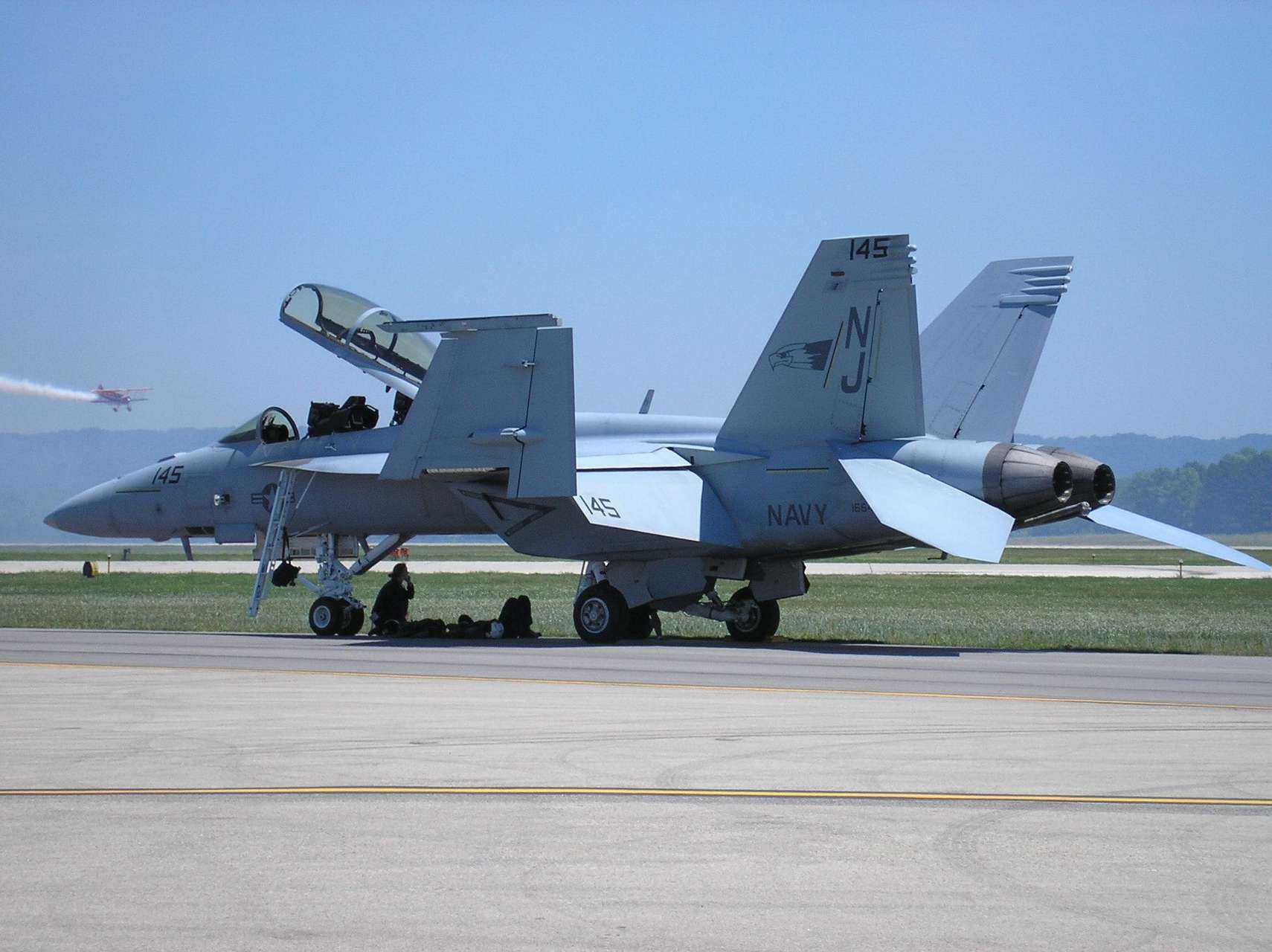


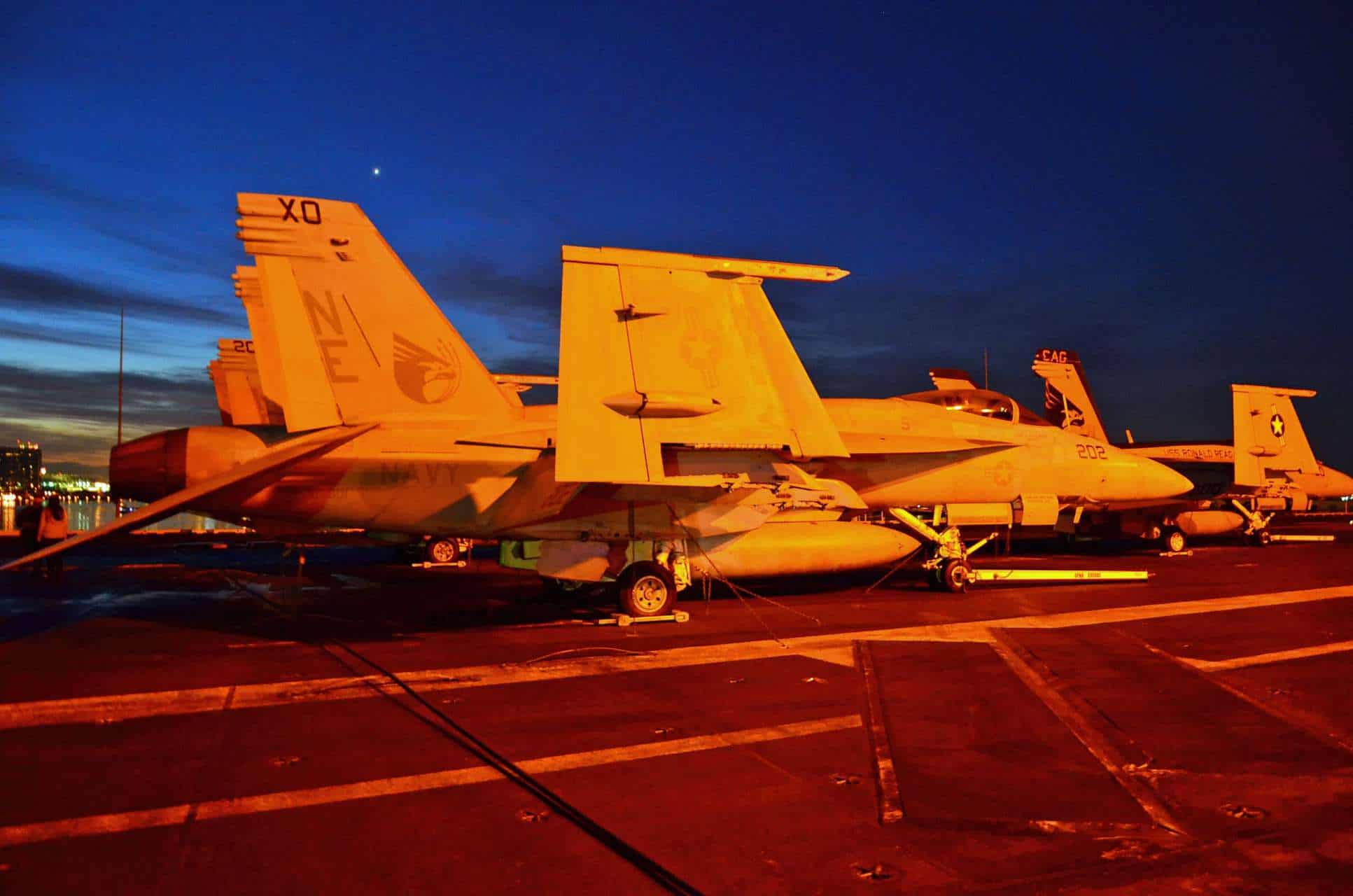


The Boeing F/A-18E/F Super Hornet is a twin-engine, carrier-based multirole strike fighter. It is the main combat jet of the US Navy, and it does both halves of the job the “F/A” designation describes: fighter and attack aircraft in one airframe.
It comes in two versions. The F/A-18E is a single-seater, and the F/A-18F puts a weapon systems officer in a second seat behind the pilot.
The Super Hornet took over the work of four earlier Navy types: the F-14 Tomcat fighter, the A-6 Intruder bomber, the S-3 Viking and the KA-6D tanker. The Navy calls that consolidation a “neck-down,” and it made one airframe the core of every carrier air wing. It features in our ranking of the best carrier-based fighter jets for that reason.
Inside the Navy it is commonly called the “Rhino,” a nickname that keeps radio calls from confusing it with the older Hornets it served alongside.
The Super Hornet kept the F/A-18 name, but it is largely a new aircraft. The Navy kept the designation partly to sell the program to Congress as a low-risk derivative of a jet already in service.
The forward fuselage carried over unchanged, but the rest of the airframe shares little with the F/A-18C/D. The Super Hornet is about 20 percent larger than the original F/A-18 Hornet, about 4 ft (1.2 m) longer overall, with a wing 25 percent larger in area, and the Navy puts it at roughly 7,000 lb (3,200 kg) heavier.
The payoff was reach. It carries 33 percent more internal fuel, which buys 41 percent more mission range and 50 percent more endurance than the legacy Hornet.
It also has two extra weapon stations, for 11 in total, and its General Electric F414 engines give 35 percent more thrust across most of the flight envelope than the Hornet’s F404s. Despite the bigger airframe, it has 42 percent fewer structural parts.
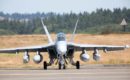
The quickest way to tell them apart in a photograph is the air intakes. The Hornet’s are oval; the Super Hornet’s are larger and rectangular, a shape that also cuts the jet’s frontal radar signature.
The legacy Hornet is not fully retired. The Navy withdrew its last F/A-18C/D Hornets from active service in February 2019, but the Marine Corps still flies them, with plans to replace them fully with the F-35 by 2030.
The two versions share the same airframe, engines and mission systems. The difference is the second seat.
In the F/A-18F, the weapon systems officer handles sensors and weapons while the pilot flies, which splits the workload on long or complex missions. The two-seater also serves as a trainer.
The single-seat E carries slightly more internal fuel, 14,700 lb (6,668 kg) against the F’s 13,760 lb (6,241 kg). Most Navy strike fighter squadrons fly one version or the other.
The full specification table for the aircraft is on this page. Four of its figures are worth explaining, because the Super Hornet’s published numbers get quoted against each other in ways that do not compare.
The first is range. The 1,275 nm figure is the Navy’s number for a jet flying clean with two AIM-9 Sidewinders, and a combat mission looks nothing like that.
Flying a fighter escort on internal fuel, its combat radius is about 404 nm. Loaded with four bombs and two drop tanks for interdiction it is about 388 nm, and flown as a ferry with nothing but fuel, its range stretches to about 1,800 nm.
The second is speed. Published top speeds disagree: the Navy fact file gives Mach 1.8+, while Boeing’s product page and the Royal Australian Air Force both quote Mach 1.6.
Configuration matters here. Mach 1.8 is about 1,030 knots (1,185 mph) for a clean jet at 40,000 ft, while the Navy’s standard characteristics give Mach 1.62 at 36,000 ft for a jet carrying two AMRAAMs and two Sidewinders.
The third is payload. The panel’s figure is the most the 11 stations can lift, but the number carrier crews care about is “bringback”: the weight of unused fuel and weapons a jet can still land with on a carrier.
For the Super Hornet, bringback is 9,900 lb (4,491 kg) for the E and 9,000 lb (4,082 kg) for the F. Fixing the legacy Hornet’s poor bringback was one of the reasons the new jet was built.
The fourth is fuel. On top of its internal tanks, a Super Hornet can carry up to four 480-gallon external tanks, spending weapon stations on reach.
The Super Hornet’s family tree starts with the Northrop YF-17, which lost the Air Force’s Lightweight Fighter competition to the YF-16 in the 1970s. The Navy picked the twin-engine YF-17 anyway, because two engines suited carrier flying, and developed it into the F/A-18 Hornet.
The Hornet was effective but short-legged. McDonnell Douglas pitched an enlarged “Hornet 2000” in the 1980s, with a bigger wing, a longer fuselage and more fuel.
The end of the Cold War turned that pitch into a program. The Navy’s A-12 Avenger II attack jet was canceled in 1991, the follow-on A/F-X was canceled in the 1993 Bottom-Up Review, and F-14 production had already been stopped in favor of the updated Hornet.
The Navy ordered the Super Hornet in 1992, with development costs capped at $4.88 billion in 1990 dollars. The first aircraft flew on November 29, 1995, and low-rate production began in March 1997, months before McDonnell Douglas merged into Boeing.
Testing ran through 1999 and covered 3,100 flights. The Super Hornet entered fleet service that year and reached initial operational capability in September 2001 with Strike Fighter Squadron 115 (VFA-115) at Naval Air Station Lemoore, California.
The decision to replace the Tomcat with an all-Hornet air wing was controversial at the time. After the last F-14 retired in 2006, every Navy combat jet was a Hornet variant until the F-35C arrived.
The Super Hornet has been upgraded in blocks. Block II, fitted to new-build jets from 2005, added the Raytheon AN/APG-79 active electronically scanned array (AESA) radar, a helmet-mounted cueing system and the ALQ-214 defensive countermeasures suite.
Block III is the current standard, and it is the reason the Navy expects to fly the type for decades. It raises airframe life from the original 6,000 flight hours to 10,000, replaces the cockpit displays with one large touchscreen, and adds new networking and a faster targeting processor.
Boeing delivered two Block III test jets to the Navy in June 2020, and production Block III deliveries began in 2021. Block II aircraft are going through Boeing’s Service Life Modification line, which returns them with Block III capability and extra flight hours, and the Navy plans to convert its Block II fleet through 2033.
One planned Block III feature did not make it. The Navy dropped conformal fuel tanks from the standard configuration in 2021, citing cost, schedule and performance issues.
Another arrived late. The AN/ASG-34 IRST21 infrared search and track sensor, which rides in the nose of a modified centerline fuel tank and can track aircraft without using radar, became operational in January 2025.
The Super Hornet carries an internal M61A2 Vulcan 20 mm rotary cannon with 412 rounds. Everything else hangs from its 11 stations: two wingtip rails, six under the wings and three under the fuselage.
For air combat it carries the AIM-9X Sidewinder and the AIM-120 AMRAAM. It has also been photographed carrying four AIM-174B missiles, a configuration that has been tested but is not confirmed as operational.
For strike missions the menu is long: JDAM and Paveway guided bombs, the AGM-154 JSOW glide weapon, the AGM-158 JASSM cruise missile, the AGM-84 Harpoon and LRASM anti-ship missiles, and the AGM-88 HARM anti-radiation missile.
The Super Hornet’s combat debut came on November 6, 2002, when two F/A-18Es struck surface-to-air missile launchers and an air defense bunker in Iraq during Operation Southern Watch. It went on to fly strike, close air support and tanker missions over Iraq and Afghanistan.
In August 2014 Super Hornets flew some of the first American strikes against Islamic State forces in northern Iraq. They dropped laser-guided bombs on artillery shelling Kurdish troops near Irbil.
Its first air-to-air kill came on June 18, 2017. An F/A-18E from VFA-87, flying from the USS George H.W. Bush, shot down a Syrian Su-22 near Tabqa after an AIM-9X missed and an AMRAAM hit, the first air-to-air kill of a crewed aircraft by an American fighter since 1999.
The Red Sea brought a different kind of fight. On December 26, 2023, Super Hornets from the USS Dwight D. Eisenhower and an accompanying destroyer destroyed 12 attack drones, three anti-ship missiles and two land-attack cruise missiles fired by Houthi forces.
In 2026 Super Hornets were among the main strike aircraft of Operation Epic Fury, the US air campaign against Iran. They flew from the carrier strike groups in the region against nuclear sites, missile infrastructure and naval forces.
The Pentagon says the operation officially ended on May 5, 2026, though CBS News reported in September 2026 that US forces were still conducting missions tied to the conflict.
On March 25, 2026, Iran claimed it had shot down an F/A-18 over Chabahar. US Central Command denied that any US aircraft had been downed by Iranian missiles, and it is unclear whether the aircraft in question was a Hornet or a Super Hornet.
The Super Hornet has a job no Hornet before it could do: refueling other jets. Fitted with a centerline “buddy store” hose-and-reel pod and external tanks, it becomes an aerial tanker.
That filled a gap the Navy created when it retired its KA-6D and S-3B Viking tankers. The cost is real: on typical missions about a fifth of the air wing is tied up in the tanker role, which uses up airframe fatigue life faster than other missions.
The Super Hornet’s most unusual loss came from its own side. On December 22, 2024, an F/A-18F from VFA-11 was shot down over the Red Sea by the cruiser USS Gettysburg in a friendly fire incident; both crew ejected and survived.
Two more were lost from the USS Harry S. Truman eight days apart. On April 28, 2025, an F/A-18E from VFA-136 fell overboard while being towed in the hangar as the carrier turned hard to evade Houthi fire, and on May 6, 2025, an F/A-18F went over the side after the arresting gear failed to stop it.
On August 20, 2025, an F/A-18E from VFA-83 crashed off the coast of Virginia on a training flight; the pilot ejected. On October 26, 2025, an F/A-18F from VFA-22 went down in the South China Sea while flying from the USS Nimitz, and both crew were recovered.
The Navy raised both the Nimitz jet and an MH-60R helicopter lost the same afternoon from about 400 ft (122 m) of water on December 5, 2025. At the time of the recovery, the causes of both crashes were still under investigation.
The type has also had fatal accidents. A VFA-122 demonstration jet crashed in April 2011, killing both crew; a VFA-151 pilot was killed in California’s “Star Wars Canyon” in July 2019; and a VFA-113 pilot died near China Lake in June 2022.
The US Navy is by far the largest operator. FlightGlobal’s World Air Forces 2025 directory, as cited on Wikipedia, counted 416 F/A-18E/Fs in Navy service, spread across more than 30 fleet, training and test squadrons.
Each deployable fleet squadron carries the VFA prefix and has a standard strength of 12 aircraft, and a carrier air wing brings several of them to sea. Our guide to how many planes an aircraft carrier holds shows where they fit in the wider air wing.
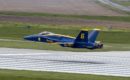
The Navy’s flight demonstration team flies them too. The Blue Angels began moving from the legacy Hornet to the Super Hornet in 2020, using nine single-seat and two two-seat jets converted by Boeing.
Australia bought 24 F/A-18Fs in 2007 to replace its F-111 strike aircraft, and the first squadron was declared operational in December 2010. They fly with No. 1 Squadron at RAAF Base Amberley in Queensland.
Kuwait is the third operator, with 22 F/A-18Es and six F/A-18Fs ordered in 2018. Boeing completed all 28 in September 2021, built largely to the Navy’s Block III standard, and handed them to the US Navy for transfer to Kuwait.
Boeing pitched the jet to many other air forces, including Canada, Finland, Switzerland, Germany and India, without a sale. The Marine Corps also passed, preferring to put its money into the F-35.
The Navy’s published unit cost is $67.4 million in fiscal 2021 dollars. Boeing markets the jet on lower near-term acquisition costs than many fifth-generation alternatives.
Export deals quote much bigger numbers because they include weapons, training and support. Australia’s 2007 contract for 24 jets was $2.9 billion, with the full package over 10 years expected to reach A$6 billion (US$4.6 billion), and Kuwait’s 28-jet deal was reported at $2.7 billion including weapons and radar warning receivers.
Program and unit costs are not comparable, and mixing them is a frequent source of confusion in fighter price comparisons. For how the Super Hornet sits against other types, see our ranking of the best fighter jets in the world.
The Super Hornet is not a stealth aircraft. It has a frontal radar cross-section an order of magnitude smaller than earlier fighters, but the Navy took a “balanced approach” to survivability rather than designing for low observability the way the F-35 was.
The F-35C ended the Super Hornet family’s monopoly on Navy combat jets, and the two now serve side by side. Our F-35 vs F/A-18 comparison lays out the differences in detail.
Against the F-14 it replaced, the Super Hornet gave up some of the Tomcat’s raw performance in exchange for far better handling, reliability and running costs. Its empty weight is lower than the Tomcat’s while approaching, but not matching, its payload and range, a trade covered in our Super Hornet vs F-14 Tomcat comparison.
The F-16 is a different kind of aircraft altogether: a single-engine, land-based Air Force fighter descended from the YF-16 that beat the Hornet’s ancestor in 1970s competition. The F-16 vs F-18 comparison puts the two side by side.
Super Hornet production is almost over. Northrop Grumman, which builds the center and aft fuselage and the tails, confirmed on January 27, 2026 that it had delivered its final set of new-build parts, and Boeing is due to hand over the last new aircraft by 2027.
More than 600 Super Hornets have been built for the United States, Australia and Kuwait. The EA-18G Growler electronic attack version, built on the two-seat F airframe, has already finished production.
The long-term replacement is the F/A-XX, a sixth-generation carrier fighter meant to take over from both the Super Hornet and the Growler. Boeing and Northrop Grumman are competing for it.
The Navy’s top officer said in April 2026 that the winner would be picked in August, but as of September 1, 2026 no award had been announced. Until F/A-XX arrives, the Block III upgrade is what keeps the Super Hornet in the air wing.
The Super Hornet is about 20 percent larger than the original F/A-18 Hornet, with a 25 percent bigger wing, 33 percent more internal fuel, more powerful F414 engines and two extra weapon stations.
It keeps the Hornet’s name and forward fuselage, but the rest is largely a new aircraft. The easiest visual tell is the intakes: oval on the Hornet, rectangular on the Super Hornet.
Yes, though not with the US Navy. The Navy retired its last legacy F/A-18C/D Hornets from active service in February 2019.
The Marine Corps still flies them and plans to replace them fully with the F-35 by 2030, and air forces including Finland, Spain and Switzerland still operate the type. The newer F/A-18E/F Super Hornet is the Navy’s main carrier fighter and remains in front-line service.
FlightGlobal’s World Air Forces 2025 directory, as cited on Wikipedia, counted 416 F/A-18E/Fs in US Navy service. More than 600 Super Hornets have been built in total, including 24 for Australia and 28 for Kuwait, and the last new-build jets are due by 2027.
The Navy’s published unit cost is $67.4 million in fiscal 2021 dollars. Export deals are much larger per jet because they bundle weapons, training and support: Australia’s full 24-jet package was expected to reach A$6 billion (US$4.6 billion) over 10 years.
Its top speed is about Mach 1.8, roughly 1,185 mph (1,908 km/h) for a clean jet at 40,000 ft. Boeing and the Royal Australian Air Force quote Mach 1.6, and a jet carrying air-to-air missiles is slower, about Mach 1.62 at 36,000 ft in the Navy’s standard characteristics.
Only just. Northrop Grumman confirmed on January 27, 2026 that it had delivered its final set of new-build fuselage and tail parts, and Boeing’s last new Super Hornets are due by 2027. Existing jets will keep flying for years through the Block III upgrade.
Navy crews call it the “Rhino” to tell it apart from the older Hornets on the radio and on the flight deck, since the catapult and arresting gear need different settings for the heavier jet. The name had earlier belonged to the F-4 Phantom II.
The F/A-18E is a single-seater and the F/A-18F has two seats, a pilot and a weapon systems officer. Otherwise they share the same airframe, engines and systems, though the E carries slightly more internal fuel, 14,700 lb (6,668 kg) against 13,760 lb (6,241 kg). The EA-18G Growler jammer is built on the F.
No. It is usually classed as a 4.5-generation fighter: a fourth-generation design with later additions such as an AESA radar and a reduced frontal radar signature, but it is not a stealth fighter. Our guide to the five generations of fighter planes explains the categories.
Neither is simply better, because they were built for different jobs. The F-16 is a single-engine, land-based Air Force fighter, while the F-18 descends from the twin-engine YF-17, which lost to the YF-16 in the Air Force’s competition but was chosen by the Navy because two engines suited carrier flying.
Not realistically. The Super Hornet is a front-line fighter still in production for the US Navy, not a surplus type on the civilian market. Retired examples have gone to museums, including the first F/A-18E ever built, at the National Museum of Transportation in Kirkwood, Missouri.
The Navy’s planned replacement is the F/A-XX, a sixth-generation carrier fighter that will also replace the EA-18G Growler. Boeing and Northrop Grumman are competing for it, and as of September 1, 2026 the Navy had not announced a winner despite promising a decision in August.
Sources and references used for research and fact-checking.