

Table of Contents
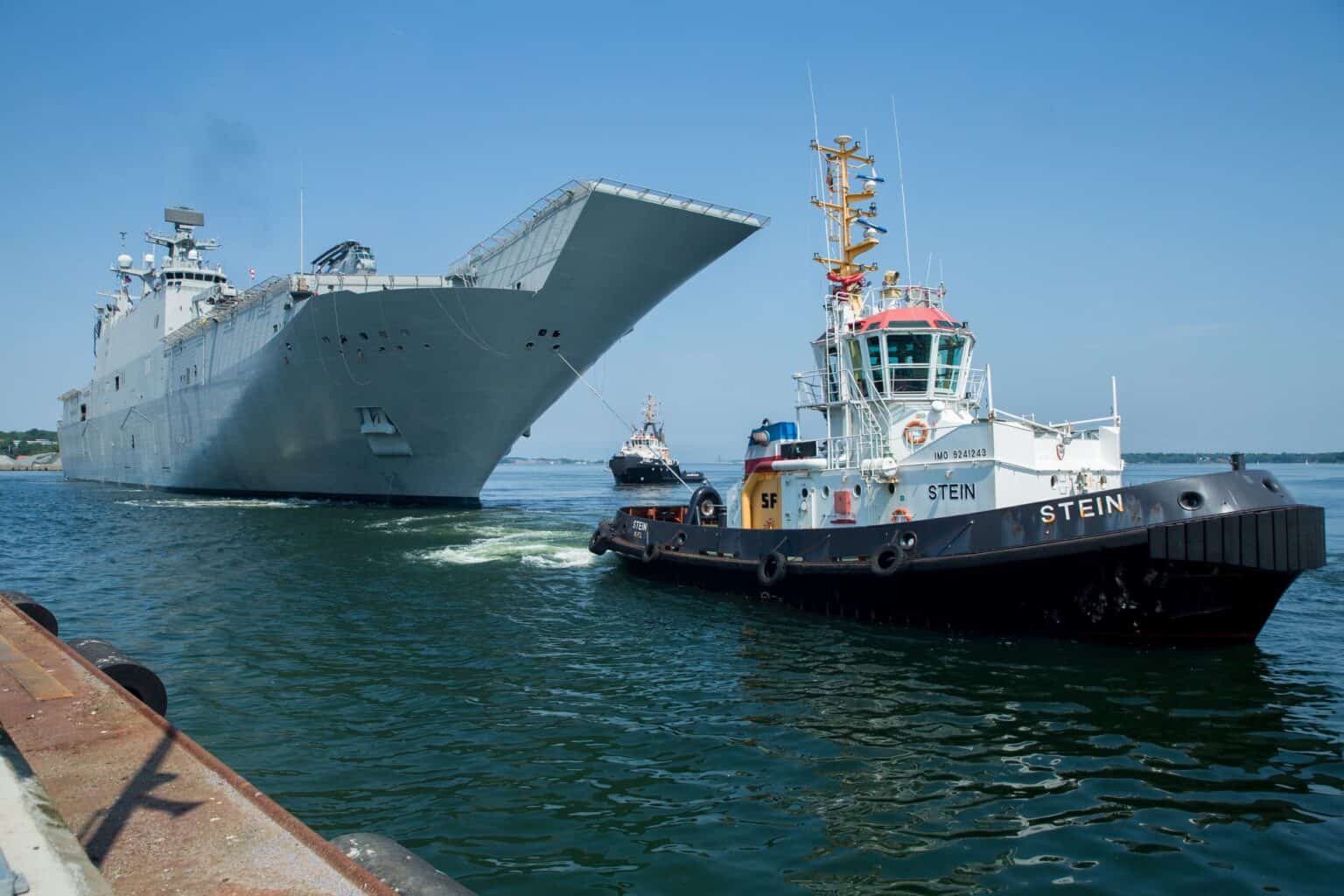
The most powerful ship in the Spanish Navy is Juan Carlos I, a 26,000-ton amphibious assault ship that doubles as Spain’s only aircraft carrier. It flies AV-8B Harrier II jump jets, and Spain has shelved the F-35B that was meant to replace them.
Behind it, the Armada Española has 5 Aegis air defense frigates, 6 older Santa María-class frigates, 2 amphibious transport docks and 2 submarines in service, with a second new S-80 boat on sea trials. It counted about 25,400 people in 2025.
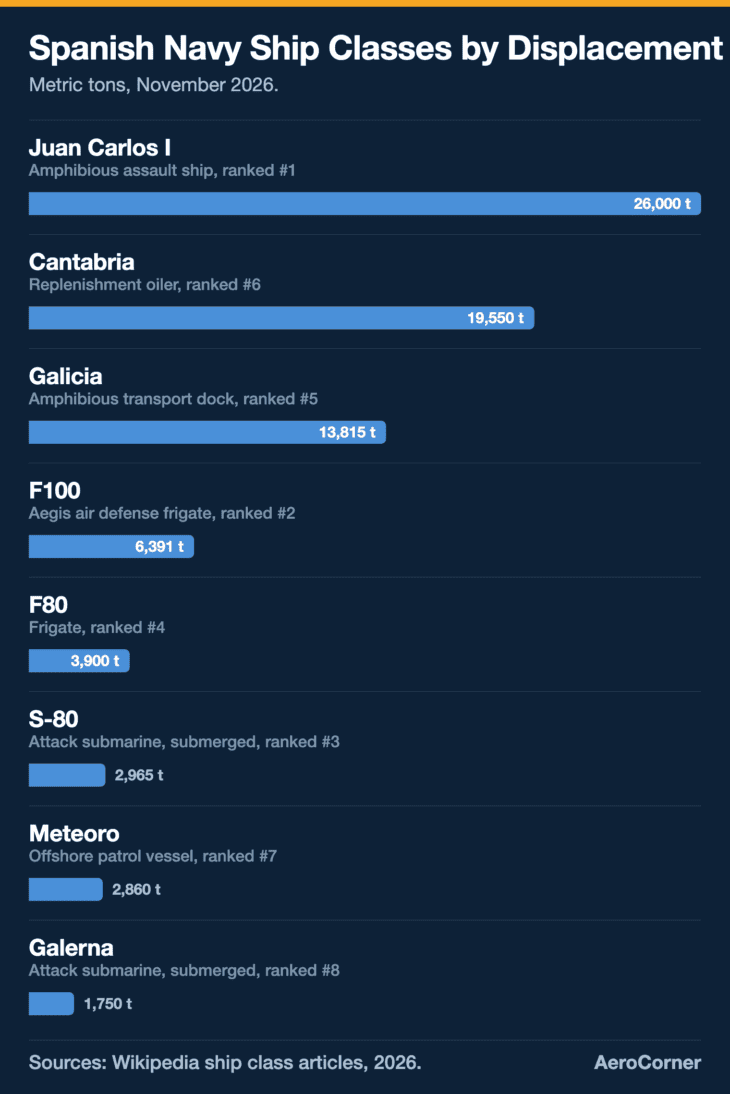
This list ranks every major ship class by fighting value as of November 2026, then covers the Navy’s aircraft, the ships Spain designed for other navies, its history and the warships on order.
| Rank | Class | Type | Ships | Displacement |
|---|---|---|---|---|
| 1 | Juan Carlos I | Amphibious assault ship and carrier | 1 | 26,000 t |
| 2 | Álvaro de Bazán (F100) | Aegis air defense frigate | 5 | 6,391 t |
| 3 | Isaac Peral (S-80) | Attack submarine | 1 (1 on trials) | 2,965 t submerged |
| 4 | Santa María (F80) | Frigate | 6 | 3,900 t |
| 5 | Galicia | Amphibious transport dock | 2 | 13,815 t |
| 6 | Patiño and Cantabria | Replenishment oiler | 2 | 19,550 t (Cantabria) |
| 7 | Meteoro (BAM) | Offshore patrol vessel | 6 | 2,860 t |
| 8 | Galerna (S-70) | Attack submarine | 1 | 1,750 t submerged |
| 9 | Segura | Minehunter | 6 | 583 t |
How this ranking works
Each class is ranked by the fighting value it adds in November 2026: what it can do in a war, how hard it would be to replace, and how many Spain has. Counts are ships in commission. Smaller patrol boats, survey ships, tugs, the intelligence ship Alerta and the sail training ship Juan Sebastián de Elcano sit outside the ranking, as do ships still under construction.
1. Juan Carlos I: The Flagship and Spain’s Only Carrier
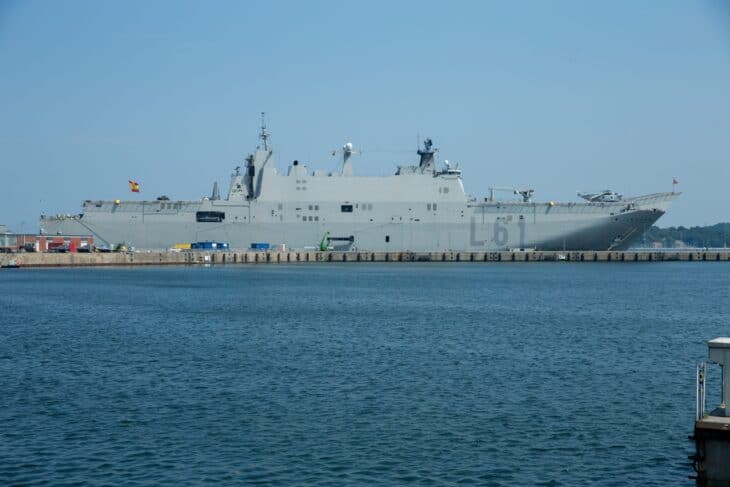

Juan Carlos I was commissioned on September 30, 2010, and is based at Rota near Cádiz. It is 757 feet (231 m) long, displaces about 26,000 metric tons and makes 21 knots.
The Navy built it to do two jobs. A stern well deck holds four LCM-1E landing craft, and the ship can carry 913 soldiers and up to 46 Leopard 2E tanks. A 663-foot (202 m) flight deck with a ski jump lets it launch 10 to 12 jump jets plus 10 to 12 helicopters, or up to 30 helicopters.
It ranks first because it is the only Spanish ship that can strike with fixed-wing jets. That job has an end date: the AV-8B Harrier II fleet aboard is being kept flying until 2032, and no replacement has been chosen.
Ships like it are covered in our guide to amphibious assault ships, the carriers nobody calls carriers.
Spain's flagship sails under two other flags
Australia built two copies of Juan Carlos I, HMAS Canberra and HMAS Adelaide, commissioned in 2014 and 2015, with hulls built by Navantia in Spain. Turkey built a modified version, TCG Anadolu, commissioned in 2023. Spain’s F100 frigate design became Australia’s three Hobart-class destroyers and Norway’s Fridtjof Nansen frigates, and its supply ship Cantabria became Australia’s Supply class.
2. Álvaro de Bazán Class (F100): The Aegis Frigates
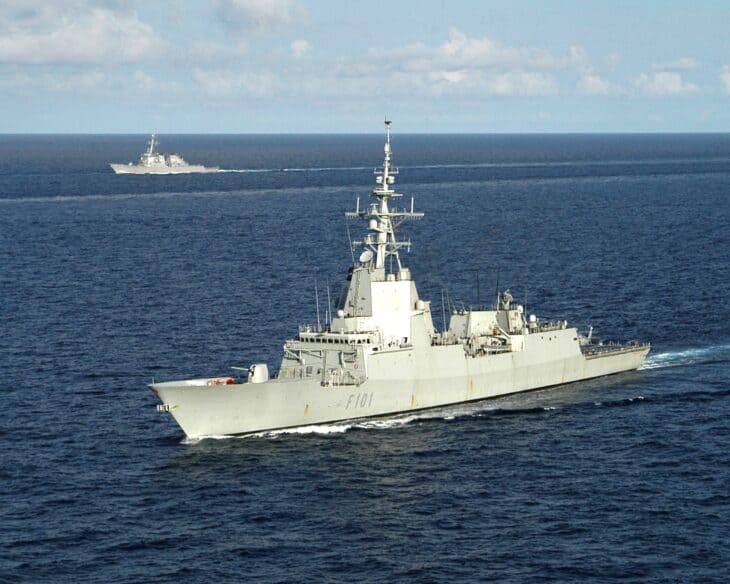

Spain has five F100 frigates, commissioned from 2002 to 2012: Álvaro de Bazán, Almirante Juan de Borbón, Blas de Lezo, Méndez Núñez and Cristóbal Colón. All are based at Ferrol in Galicia.
Each is 481 feet (146.7 m) long, displaces 6,391 tons fully loaded and makes 28 knots with a crew of 201. They carry the US Aegis combat system and its SPY-1D radar, which makes them the fleet’s air defense shield.
A 48-cell Mk 41 vertical launcher holds 32 SM-2 and 64 ESSM air defense missiles. Eight Harpoon anti-ship missiles are being replaced by the Naval Strike Missile, and each ship carries one SH-60 Seahawk helicopter.
3. Isaac Peral Class (S-80): The Submarine That Grew 33 Feet
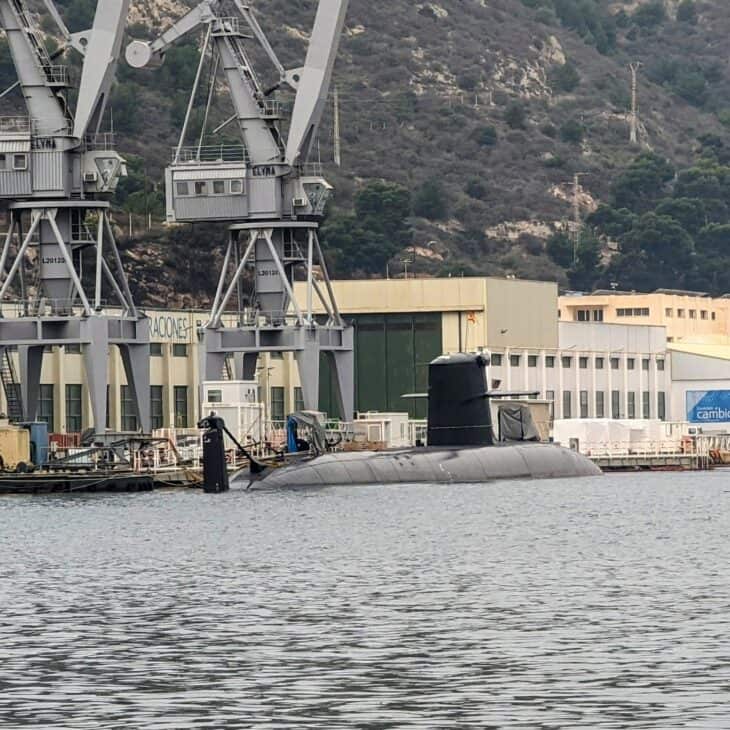

Isaac Peral (S-81) was commissioned on November 30, 2023, after a contract approved in 2003 and a first delivery once expected in 2011. It is 266 feet (81.05 m) long and displaces 2,965 metric tons submerged, with a crew of 32 plus 8 special forces.
The delay came from a design error: Navantia miscalculated the boat’s weight by about 100 tons. With help from General Dynamics Electric Boat, the hull was lengthened by 33 feet (10 m) to fix it.
Its sister Narciso Monturiol (S-82) was launched in October 2025, began sea trials in June 2026 and is due to be handed over at the end of 2026. Two more boats follow, and they will be the first fitted with the class’s air-independent propulsion, which turns bioethanol into hydrogen for fuel cells. S-81 and S-82 are to get it later.
It ranks third because a modern submarine is the hardest Spanish asset for an enemy to find. How it compares in size with the nuclear boats is in our ranking of the largest submarines in the world.
One torpedo, one ship
On November 4, 2026, the Spanish Navy announced that Isaac Peral had sunk the decommissioned patrol vessel Infanta Elena with a single DM2A4 heavyweight torpedo during a live-fire exercise off the Canary Islands. The torpedo hit the stern and the ship went down stern first.
4. Santa María Class (F80): The Spanish Perrys
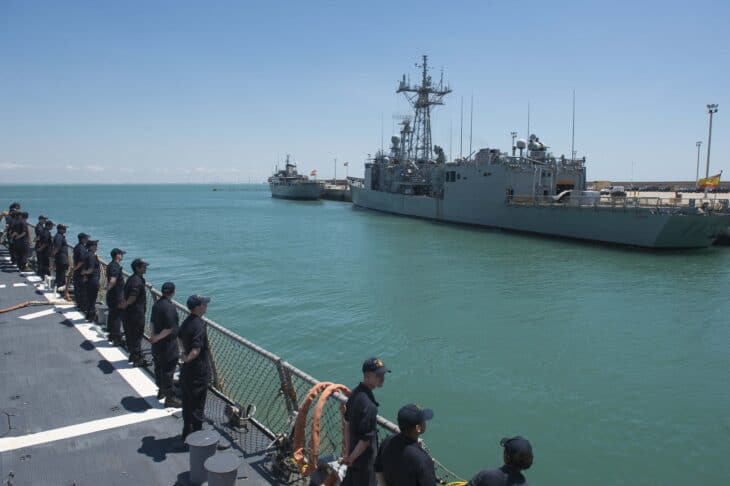

Six Santa María-class frigates, commissioned from 1986 to 1994, are still in service from Rota. They are a Spanish version of the US Oliver Hazard Perry class, built with a slightly wider hull and more weight margin for upgrades.
Each is 455 feet (138.8 m) long, makes 29 knots and has a crew of 223. A single-arm Mk 13 launcher fires SM-1MR and Harpoon missiles, backed by a 76 mm gun, a Meroka close-in gun and up to two SH-60B helicopters.
They rank above the amphibious ships because they are front-line escorts, armed against aircraft, ships and submarines. They are due to be replaced by the new F110 frigates from about 2028.
5. Galicia Class: The Amphibious Transport Docks
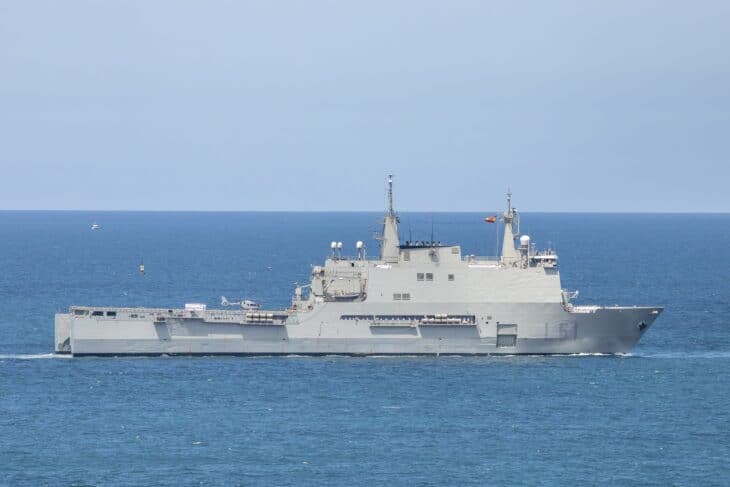

Galicia and Castilla were commissioned in 1998 and 2000 and are based at Rota. Each is 525 feet (160 m) long, displaces 13,815 metric tons fully loaded and makes 20 knots.
A well deck holds four LCM-1E landing craft, and the ships can carry up to 33 main battle tanks or 130 armored personnel carriers. Galicia carries 543 troops and Castilla 404, and the hangar takes four heavy or six medium helicopters.
The design came from a joint project with the Netherlands, which built its own Rotterdam class from it.
6. Patiño and Cantabria: The Fleet Oilers
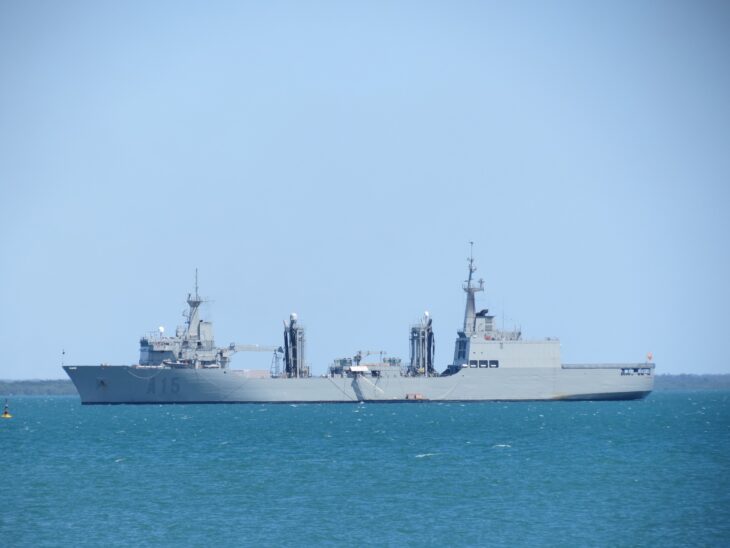

Cantabria, commissioned on September 29, 2010, is the second-largest ship in the Navy at 19,550 metric tons. It carries 8,920 cubic meters of ship fuel and 1,585 cubic meters of jet fuel, and its older partner Patiño entered service in 1995.
From February to November 2013, Cantabria served with the Royal Australian Navy while an Australian tanker was in maintenance, completing 63 replenishments. Australia then chose its design for its own new tankers.
7. Meteoro Class (BAM): The Ocean Patrol Ships
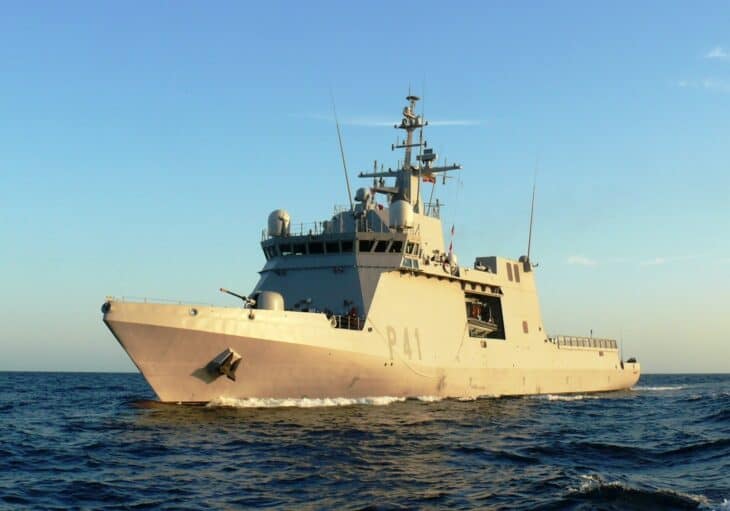

Six Meteoro-class offshore patrol vessels entered service from 2011 to 2019, four of them based at Las Palmas in the Canary Islands. Each is 308 feet (93.9 m) long, displaces 2,860 metric tons fully loaded and carries a 76 mm gun.
They handle anti-piracy, smuggling and search-and-rescue work, freeing the frigates for combat duty. Two more BAM ships were approved in 2023 for €550 million, and a submarine rescue version, Poseidón, was due for delivery in 2026.
8. Galerna Class (S-70): The Last of the Old Submarines
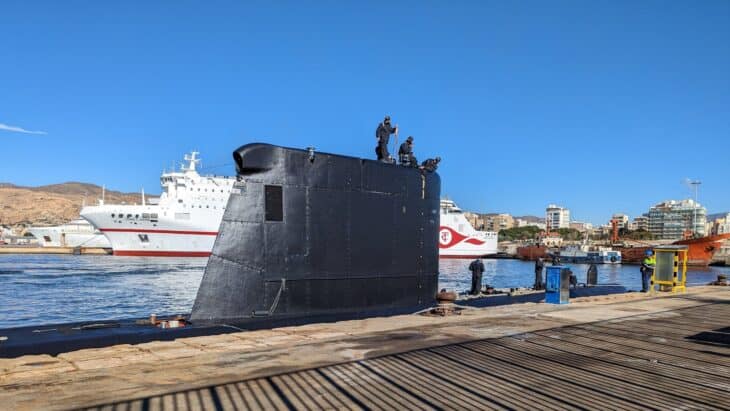

Galerna (S-71), commissioned on January 21, 1983, is the last of four French-designed Agosta-type boats. It displaces 1,750 metric tons submerged.
Its three sisters have been retired, the last of them, Tramontana, on February 16, 2024. Galerna stays in service until the S-80 boats can take over, which is why it ranks low despite being one of only two Spanish submarines.
9. Segura Class: The Minehunters
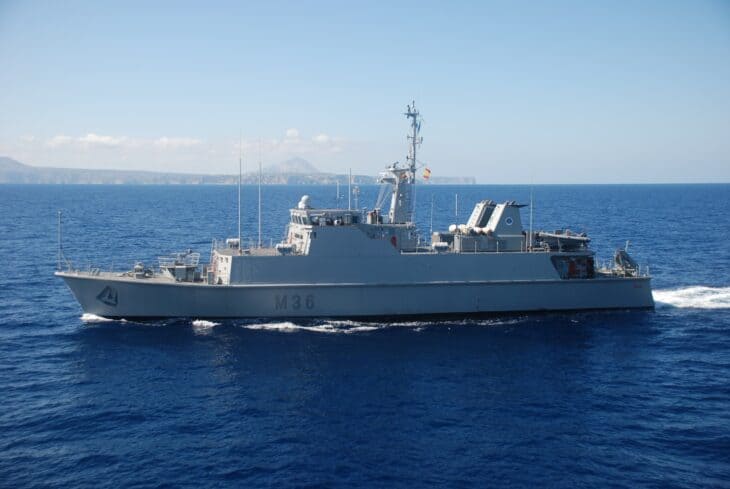

Six Segura-class minehunters, commissioned from 1999 to 2005, are based at Cartagena. Each displaces about 570 to 583 metric tons.
Their hulls are built to hunt mines, not to fight other warships, which is why they rank last.
Spanish Naval Aviation
The Navy’s 9th Squadron flies 12 EAV-8B Harrier II Plus jets and one two-seat TAV-8B trainer. In August 2025, the government indefinitely suspended talks with the United States on the F-35B, and Defense Minister Margarita Robles said the jet was not a priority for the Navy.
Instead, Spain is stretching the Harriers. Five airframes retired by the US Marine Corps were bought in pieces as a source of spare parts, due in Spain before the end of 2026, and that purchase moved the planned retirement from 2030 to 2032.
The helicopter fleet is built around 10 SH-60B and 8 SH-60F Seahawks, with 8 MH-60R Seahawks on order. Four NH90 transports are in service with 9 more ordered, alongside 7 H135 trainers, 3 Cessna Citations and 8 ScanEagle drones.
The land-based side of the F-35 decision is covered in our guide to the Spanish Air Force, which also said no to the jet.
Doesn't Spain have a real aircraft carrier?
Not since 2013. Príncipe de Asturias, the flagship from 1989, was decommissioned in February 2013 because of budget cuts. Juan Carlos I is an amphibious ship that can fly jump jets, and once the Harriers retire around 2032 it will fly helicopters only unless Spain finds a new jet. Navantia has studied a conventional carrier of about 40,000 to 42,000 tons with catapults, but nothing has been ordered.
From the Armada of 1588 to Santiago de Cuba
Spain’s navy traces its roots to the fleets of Castile and Aragon in the late Middle Ages. In 1571, Spain was part of the Holy League fleet that defeated the Ottoman Navy at Lepanto.
In 1588, the Spanish Armada left Lisbon with 141 ships, 10,138 sailors and 19,315 soldiers to invade England. It lost about 44 ships, many wrecked on the way home, and the English counter-armada of 1589 failed in turn.
Spain lost eleven ships of the line fighting under French command at Trafalgar in 1805. The end of its global naval power came in 1898, in the war with the United States.
On May 1, 1898, Commodore George Dewey’s squadron destroyed the Spanish Pacific Squadron in Manila Bay. On July 3, Admiral Pascual Cervera’s squadron tried to break the US blockade of Santiago de Cuba and lost all six ships, with 343 Spaniards killed against one American.
What Comes Next for the Spanish Navy
The biggest program is five F110 Bonifaz-class frigates from Navantia’s Ferrol yard, each 476 feet (145 m) long with a 127 mm gun and a crew of up to 150. Bonifaz is due to start sea trials in 2027, and the second ship, Roger de Lauria, was launched on October 27, 2026, four months early, for delivery in 2029.
Four S-80 submarines are on contract, and a second batch of two would give the Navy six. Spain still sits well behind the nuclear-armed fleets, as our ranking of the largest navies in the world shows, and next to its neighbor in our guide to the Italian Navy.
FAQ
Sources and references used for research and fact-checking.
- Wikipedia, Spanish Navy
- Wikipedia, List of active Spanish Navy ships
- Wikipedia, Spanish amphibious assault ship Juan Carlos I
- Wikipedia, Álvaro de Bazán-class frigate
- Wikipedia, S-80 Plus-class submarine
- The Maritime Executive, Spain's Long-Awaited New Sub Torpedoes a Target Ship in Live-Fire Test
- Wikipedia, Santa María-class frigate
- Wikipedia, Galicia-class landing platform dock
- Wikipedia, Spanish replenishment oiler Cantabria
- Wikipedia, Meteoro-class offshore patrol vessel
- Wikipedia, Spanish submarine Tramontana
- El Español, La Armada recibirá el despiece de los Harrier comprados a EEUU antes de finalizar el año
- Defense Magazine, Rearming Without Stealth: Why Spain Rejected the F-35B and What Comes Next for Its Carrier Fleet
- The Defense Post, Spain launches second Bonifaz-class frigate
- Wikipedia, Battle of Santiago de Cuba
- Wikipedia, Spanish Armada
Get the Newsletter
The latest aviation news and stories sent to your inbox.
About the Author

Tim is the owner and lead editor of AeroCorner since 2019, overseeing aviation content covering aircraft, airlines, airports, and the broader aviation industry. Through years of researching, writing, editing, and publishing aviation-focused content, he has developed extensive practical knowledge of commercial aviation and air travel. Based in Asia and a frequent traveler himself, Tim also brings firsthand passenger experience to AeroCorner’s coverage. Outside of publishing, he has also explored aviation firsthand through hands-on flight training in New Zealand.