

Table of Contents
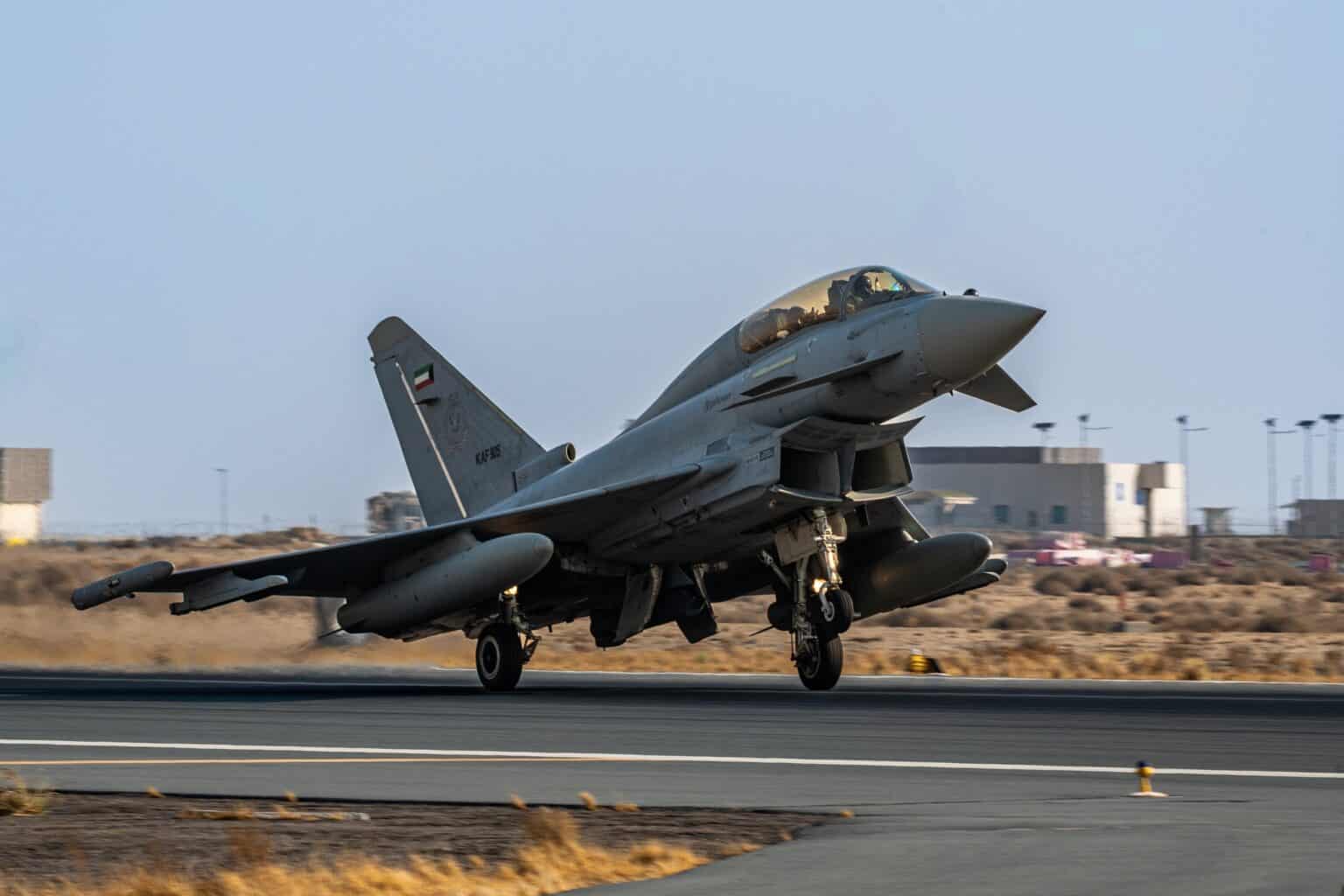
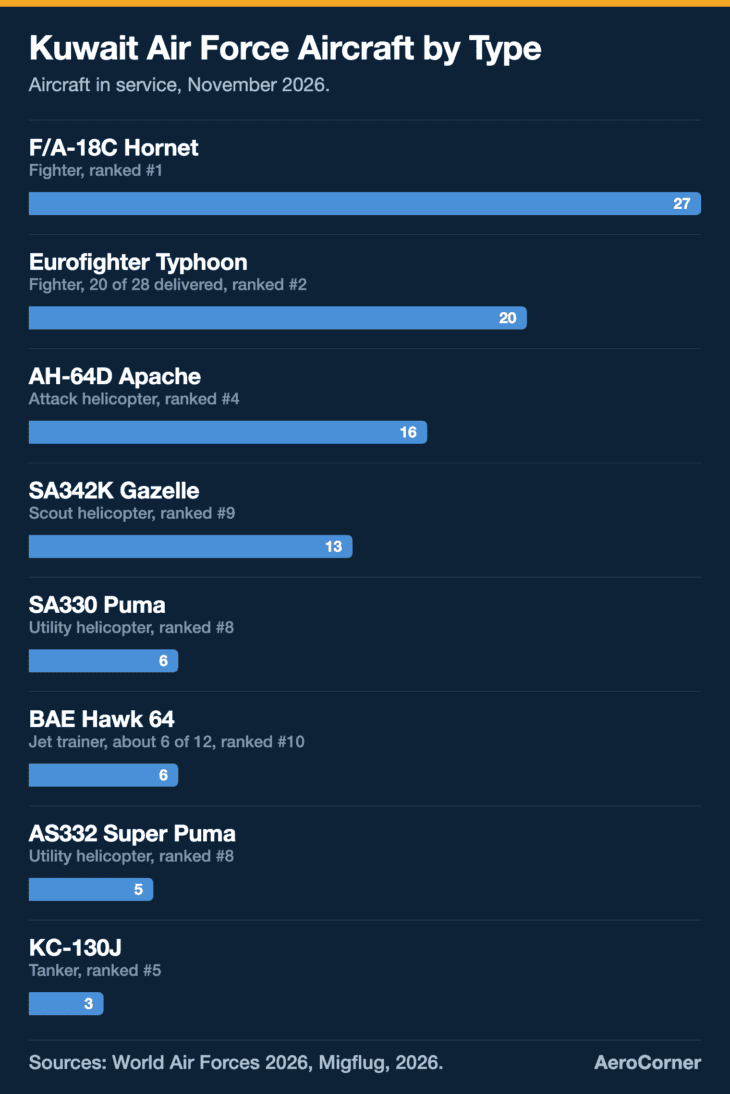
Kuwait’s front line in 2026 is still the F/A-18 Hornet it bought in 1988. Flight Global’s World Air Forces 2026 directory counts 27 single-seat F/A-18Cs, flying alongside 20 Eurofighter Typhoons from an order of 28.
The jet meant to replace the Hornet has not taken its place. Kuwait ordered 28 F/A-18E/F Super Hornets in 2018, and the same directory still lists none in service.
This guide ranks every type the Kuwait Air Force flies by its weight in Kuwaiti defense as of November 2026. It also covers the bases, the 1990 invasion, and the March 2026 night a Kuwaiti fighter was reported to have shot down three American jets.
| Rank | Aircraft | Role | Fleet | Status |
|---|---|---|---|---|
| 1 | F/A-18C/D Hornet | Multirole fighter | 27 F/A-18C, plus two-seat F/A-18Ds | In service at Ahmad al-Jaber since 1991 |
| 2 | Eurofighter Typhoon | Multirole fighter | 20 of 28 delivered | In service at Ali Al Salem since 2021 |
| 3 | F/A-18E/F Super Hornet | Multirole fighter | 28 ordered (22 E, 6 F) | Ordered 2018; none listed in service |
| 4 | AH-64D Apache Longbow | Attack helicopter | 16 | In service; AH-64E upgrade approved |
| 5 | KC-130J Super Hercules | Tanker, tactical airlift | 3 | In service |
| 6 | C-17A Globemaster III | Strategic airlift | 2 | In service since 2014 |
| 7 | H225M Caracal | Transport, rescue, anti-ship | 30 ordered for the armed forces | In service |
| 8 | SA330 Puma and AS332 Super Puma | Utility helicopter | 6 Puma, 5 Super Puma | In service at Ali Al Salem |
| 9 | SA342K Gazelle | Scout, anti-armor, training | 13 | In service since the 1970s |
| 10 | BAE Hawk 64 | Jet trainer | About 6 of 12 bought | In service at Ali Al Salem |
How this ranking works
Aircraft are ranked by their weight in Kuwaiti defense in November 2026: fighters first, then attack helicopters, the tanker and airlift fleet, utility helicopters and trainers. Kuwait does not publish fleet numbers, so counts come from Flight Global’s annual World Air Forces directory and open inventories, and where sources disagree we say so. Air defense batteries, drones and aircraft flown by the navy and National Guard are left out.
1. F/A-18C/D Hornet: Still Kuwait’s Main Fighter
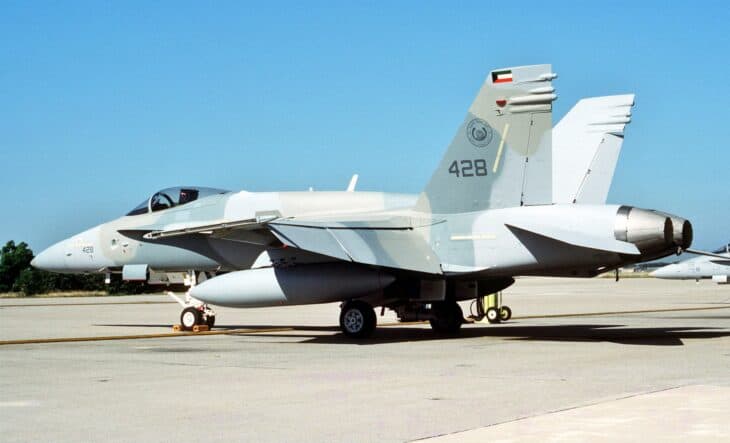

Kuwait ordered 40 F/A-18 Hornets in 1988, 32 single-seat F/A-18Cs and eight two-seat F/A-18Ds. The invasion came before they did, and the jets were delivered between October 1991 and August 1993.
They fly with 9 Squadron, 25 Squadron and 61 Training Squadron at Ahmad al-Jaber Air Base, south of Kuwait City. World Air Forces 2026 counts 27 F/A-18Cs; Migflug, reading the same sources, adds seven F/A-18Ds.
The Hornets were supposed to be gone by now. Instead, the US approved a $1.8 billion support package in June 2023 so Kuwait could keep flying them, and a plan for Malaysia to buy the surplus jets collapsed: by June 2026 Malaysia’s cabinet had cancelled it.
Three American jets, one Kuwaiti fighter
On March 2, 2026, the third day of the US war against Iran, three US Air Force F-15E Strike Eagles were shot down over Kuwait. CENTCOM said Kuwaiti air defenses downed them by mistake, and all six crew ejected and were recovered. The Wall Street Journal later reported that a single Kuwaiti F/A-18 fired three missiles, one for each jet, while it was hunting Iranian drones. The investigation had not been published by November 2026.
2. Eurofighter Typhoon: The Newest Jets in the Fleet
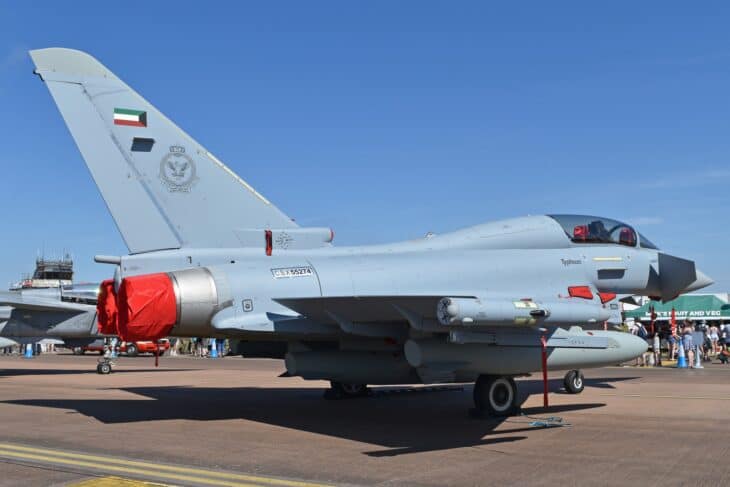

Kuwait signed for 28 Eurofighter Typhoons in April 2016, 22 single-seaters and six two-seaters, built by Leonardo in Italy. They are Tranche 3A jets, and Kuwait was the launch customer for the Captor-E electronically scanned radar.
The first two reached Kuwait on December 14, 2021, after a delay blamed on the pandemic. Thirteen had arrived by October 2023, and World Air Forces 2026 counts 20, leaving eight still to come.
The jets fly with 7 Squadron at Ali Al Salem Air Base, where new hangars were built for them. Italy trains the Kuwaiti pilots and technicians and has provided tanker support with its KC-767A.
3. F/A-18E/F Super Hornet: Ordered in 2018, Still Not in Service
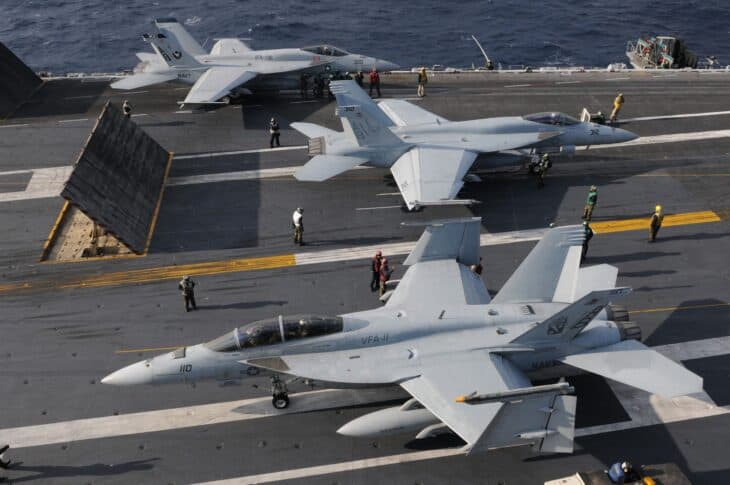

Kuwait ordered 22 F/A-18Es and six F/A-18Fs in 2018, with Boeing awarded about $1.5 billion for the aircraft. The US had approved a much larger package of up to 40 jets, worth $10.1 billion, in November 2016.
Kuwaiti Super Hornets were photographed at St. Louis in their low-visibility gray paint in September 2020, and delivery was expected in 2021 or 2022. In August 2025 Defence Blog reported that deliveries had slipped to 2026, with service expected in 2027 or 2028.
The delays were put down to the pandemic and to US Navy orders taking priority. Until the new jets are flying from Ahmad al-Jaber, the old Hornets stay.
4. AH-64D Apache Longbow: The Attack Helicopters
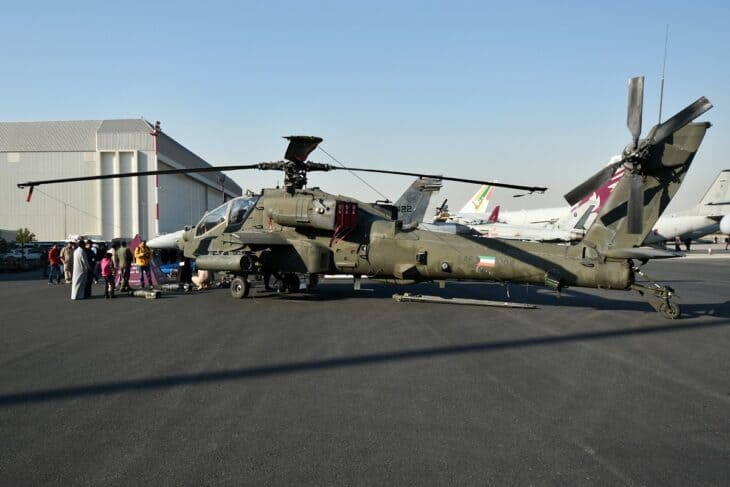

Kuwait bought 16 AH-64D Apache Longbows, and the first six were handed over on February 3, 2006. They fly with 17 Squadron “Night Wolf” and 20 Squadron “The Dark Knights” at Ali Al Salem.
In December 2020 the US approved a $4 billion sale of eight new AH-64Es and the remanufacture of 16 more to the same standard. World Air Forces 2026 still lists the eight new AH-64Es as on order.
5. KC-130J Super Hercules: The Tanker
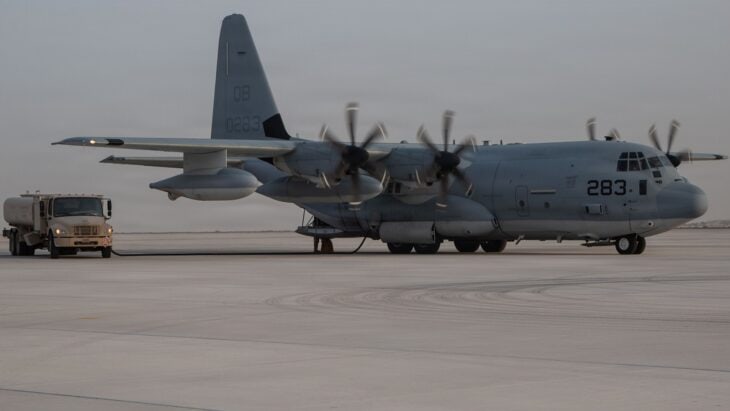

Three KC-130Js, ordered from Lockheed Martin in 2010 for $245 million, refuel the Hornet fleet and carry cargo. They are tanker versions of the C-130J Super Hercules.
They replaced Kuwait’s L-100 Hercules, civil versions of the C-130 flown since 1971. The transports fly from Abdullah Al-Mubarak Air Base, the military side of Kuwait International Airport.
6. C-17A Globemaster III: Two Strategic Airlifters
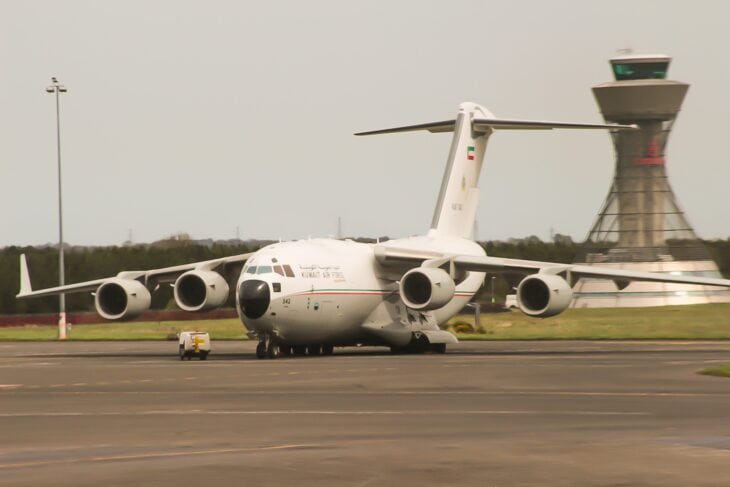

Kuwait asked for one C-17 in 2010 and then a second. The first was handed over at Long Beach on February 13, 2014.
Both fly with 42 Squadron from Abdullah Al-Mubarak, alongside the KC-130Js. They give Kuwait its own long-range heavy lift, rather than relying on allies to move outsized cargo.
7. H225M Caracal: Rescue and Anti-Ship Helicopters
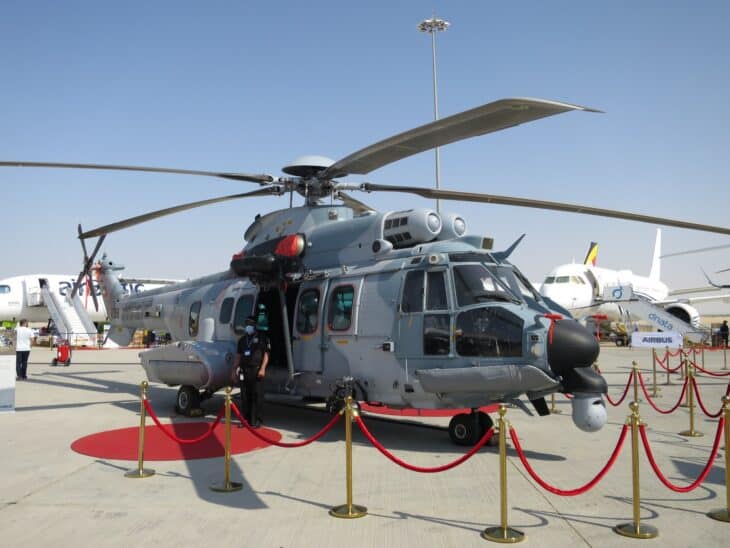

Kuwait ordered 30 H225M Caracals from Airbus Helicopters in August 2016, 24 for the air force and six for the National Guard. They fly transport, search and rescue and medical evacuation.
In February 2023 Kuwait showed a Caracal armed to launch anti-ship missiles, a rare role for the type. Open sources split the fleet differently between the air force, navy and National Guard, so we do not give an in-service count.
8. Puma and Super Puma: The Utility Helicopters
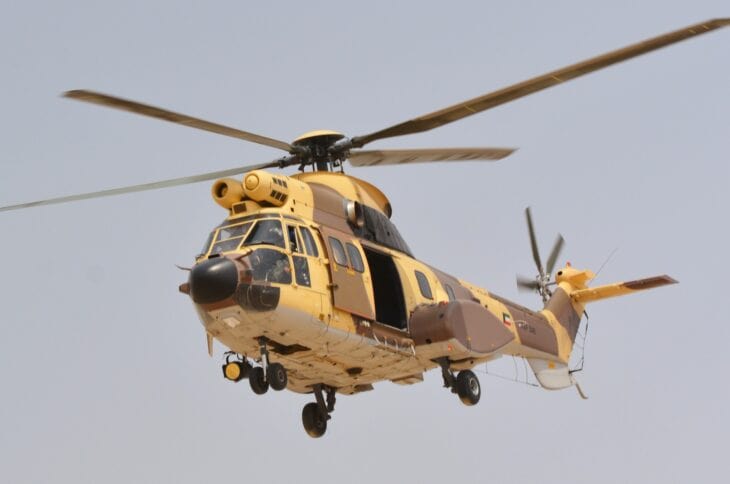

Six SA330 Pumas fly with 62 Squadron and five AS332 Super Pumas with 32 Squadron, both at Ali Al Salem. They move troops and cargo and fly rescue missions.
Four Sikorsky S-92s are also listed with the air force, flown as VIP helicopters for the State of Kuwait.
9. SA342K Gazelle: Half a Century in Service
Kuwait took 24 Gazelles in the mid-1970s, and 13 remain. They serve as scouts, anti-armor helicopters and trainers with 33 Squadron and 88 Training Squadron.
10. BAE Hawk 64: Where Kuwaiti Fighter Pilots Train
Kuwait ordered 12 Hawk 64s on October 31, 1983, and about six remain with 12 Training Squadron at Ali Al Salem. The Hawk is the air force’s advanced jet trainer.
The Shorts Tucano that came before the Hawk in the syllabus was retired in 2025, after 30 years. No replacement trainer had been announced by November 2026.
Didn't Kuwait already replace the Hornet?
Not yet. The 2016 plan was to swap the Hornets for Super Hornets and Typhoons, and a 2023 report described the Super Hornets as recently received. But the US approved a $1.8 billion deal in June 2023 to keep the old Hornets flying, the World Air Forces 2026 directory still lists the Super Hornets as on order, and a Kuwaiti F/A-18 was the jet named in the March 2026 shootdown.
Where the Kuwait Air Force Is Based
Kuwait flies from three bases. Ahmad al-Jaber, in the south, is home to the Hornets; Ali Al Salem, west of Kuwait City, hosts the Typhoons, the helicopters and the flying school.
Abdullah Al-Mubarak Air Base, at Kuwait International Airport, is the air force headquarters and home of the transports. Both combat bases also host US Air Force units, which is why Ali Al Salem was targeted by Iranian ballistic missiles on February 28, 2026; Kuwait said it intercepted them.
A Short History of the Kuwait Air Force
The air force began in 1953 as the air wing of the Public Security Force, with a few Austers and two de Havilland Doves. After independence in 1961 it went British, with Jet Provosts, Hunters from 1964 and 14 English Electric Lightnings in the late 1960s.
In the 1970s Kuwait bought Mirage F1s from France and 36 A-4KU Skyhawks from the US. When Iraq invaded on August 2, 1990, Kuwaiti A-4s attacked Republican Guard columns heading for Kuwait City, landing on a perimeter road at al-Jaber after its runways were hit.
Ali Al Salem was overrun by nightfall on August 3. About 80 percent of the air force escaped to Saudi Arabia and Bahrain, flew in the 1991 war as the Free Kuwait Air Force, and came home to wrecked bases.
Today the air force has about 2,500 personnel, which puts it far down the list of the largest air forces in the world. Its bigger neighbors are covered in our guides to the Royal Saudi Air Force and the Iraqi Air Force.
FAQ
Sources and references used for research and fact-checking.
- Wikipedia, Kuwait Air Force
- Migflug, Kuwait Air Force
- Defense News, Kuwait receives four Eurofighter Typhoons
- Leonardo, Leonardo: delivered to Kuwait the first two Eurofighter Typhoons
- Air & Space Forces Magazine, Kuwaiti F/A-18 Aircraft Suspected of Shooting Down US F-15s
- The War Zone, Kuwaiti F/A-18 Hornet Responsible For Shooting Down Three USAF F-15E Strike Eagles: Report
- Stars and Stripes, Three US fighter jets downed over Kuwait in friendly fire incident
- Janes, Kuwait set to continue flying classic Hornets with new support agreed with US
- Federal Register, Arms Sales Notification: Kuwait AH-64E Apache
- UPI, Kuwait orders 30 Caracal helicopters from Airbus Helicopters
- Janes, Kuwait shows Caracal helicopter equipped to launch anti-ship missiles
Get the Newsletter
The latest aviation news and stories sent to your inbox.
About the Author

Tim is the owner and lead editor of AeroCorner since 2019, overseeing aviation content covering aircraft, airlines, airports, and the broader aviation industry. Through years of researching, writing, editing, and publishing aviation-focused content, he has developed extensive practical knowledge of commercial aviation and air travel. Based in Asia and a frequent traveler himself, Tim also brings firsthand passenger experience to AeroCorner’s coverage. Outside of publishing, he has also explored aviation firsthand through hands-on flight training in New Zealand.