

Table of Contents
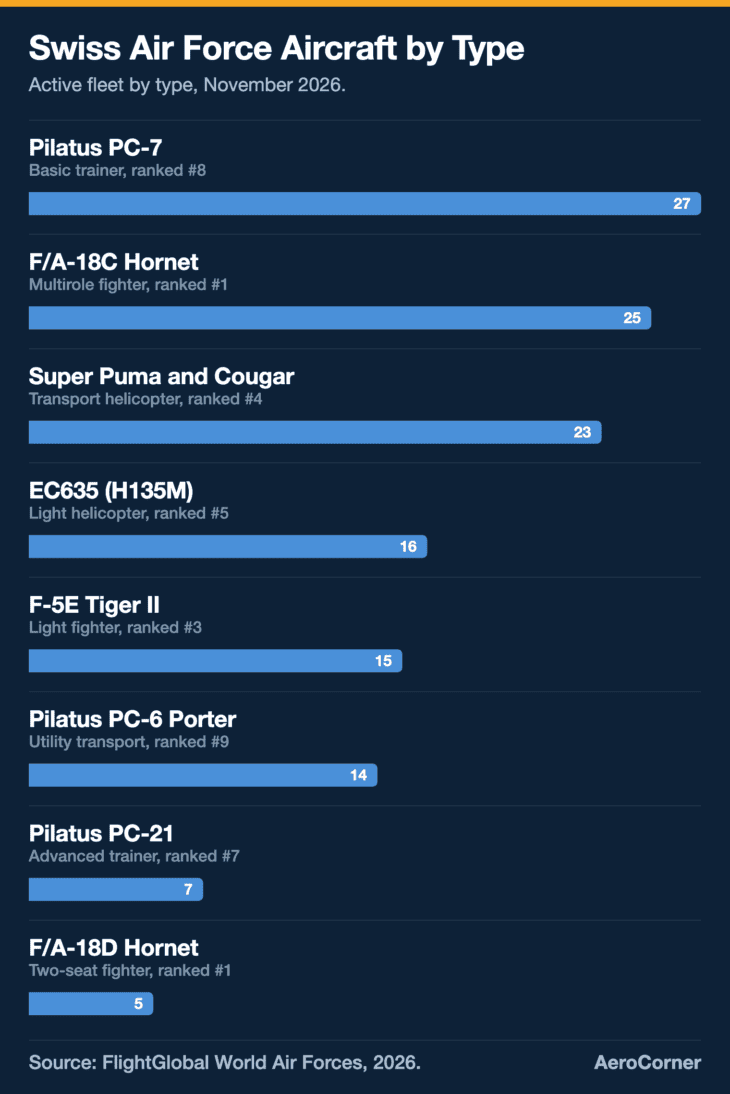
The Swiss Air Force defends one of Europe’s most crowded skies with just 30 fighter jets that can do the full job: 25 single-seat F/A-18C Hornets and 5 two-seat F/A-18Ds, according to FlightGlobal’s World Air Forces 2026 directory. Behind them sit 19 aging F-5 Tigers due to retire at the end of 2027.
The replacement is the F-35A, and it has become the most argued-over purchase in Swiss politics. Switzerland ordered 36, but in March 2026 the government said rising US prices mean it now expects about 30, with the first Swiss jets arriving in 2028.
This guide ranks every type the Swiss Air Force flies by its weight in Swiss air defense as of November 2026. It also covers how a neutral country polices its airspace around the clock, where the jets are based and what the fleet will look like when the Hornets leave.
| Rank | Aircraft | Role | Fleet | Status |
|---|---|---|---|---|
| 1 | F/A-18C/D Hornet | Multirole fighter, two-seat trainer | 25 C, 5 D | In service; to retire as the F-35A arrives |
| 2 | F-35A Lightning II | Stealth multirole fighter | 0 (about 30 expected) | 36 ordered; first jets to Switzerland in 2028 |
| 3 | F-5E/F Tiger II | Light fighter, Patrouille Suisse | 15 E, 4 F | Retiring at the end of 2027 |
| 4 | Super Puma and Cougar (AS332, AS532) | Transport, search and rescue | 23 | In service |
| 5 | EC635 (H135M) | Light utility helicopter | 16 | In service |
| 6 | ADS 15 (Hermes 900) | Reconnaissance drone | 3 of 6 delivered | Full capability 2029 at the earliest |
| 7 | Pilatus PC-21 | Advanced jet-pilot trainer | 7 | In service |
| 8 | Pilatus PC-7 | Basic trainer, PC-7 Team | 27 | Service life being extended |
| 9 | Pilatus PC-6 Porter | Utility transport, paratroops | 14 | In service |
| 10 | Global 7500, Challenger 604, Falcon 900EX and survey aircraft | Government transport, mapping, test | Global 7500, 2 Challenger 604, Falcon 900EX, King Air 350, DHC-6, DA42 | Global 7500 in service since February 2025 |
How this ranking works
Aircraft are ranked by their weight in Swiss air defense in November 2026: fighters first, then the helicopters and drones that support the army, then trainers and transport. Active counts come from FlightGlobal’s World Air Forces 2026 directory, built on Cirium fleet data. Orders, retirement dates and costs come from the Swiss defense department (DDPS), armasuisse and the Federal Council. Ground-based air defense such as Patriot is left out.
1. F/A-18C/D Hornet: 30 Jets Holding the Line
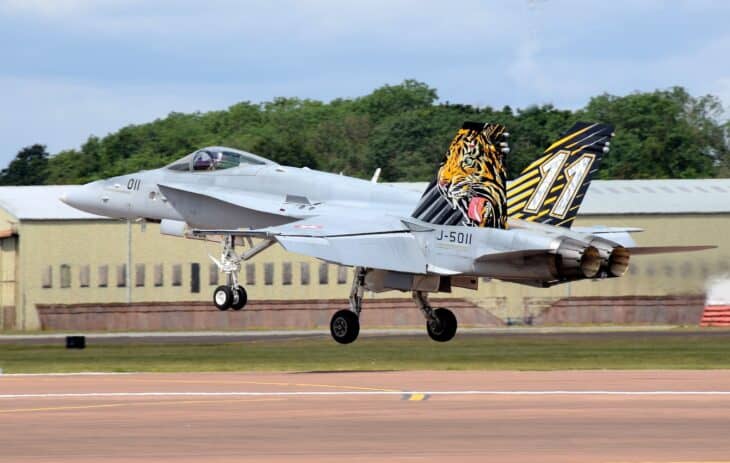

Every serious Swiss air-defense mission in 2026 is flown by the F/A-18 Hornet. FlightGlobal counts 25 single-seat F/A-18Cs and 5 two-seat F/A-18Ds, the survivors of 34 jets assembled at Emmen between 1996 and 1999.
Keeping them flying has taken a long fight against age. Switzerland’s defense department announced on June 1, 2026, that the CHF 450 million service-life extension was complete, with the main structural work finished at the end of April, so the fleet can fly into the early 2030s.
The Hornets are also moving house. In February 2025 the government decided to gather all three F/A-18 squadrons at Emmen from 2027, freeing Payerne and Meiringen to prepare for the F-35A.
Doesn't the Swiss Air Force only fly office hours?
It used to. Until 2020, Swiss air defense was on duty roughly from 6 a.m. to 10 p.m., so when Ethiopian Airlines Flight 702 was hijacked to Geneva in February 2014, outside those hours, Swiss fighters could not respond. Switzerland reached round-the-clock readiness on December 31, 2020, with two armed F/A-18s on alert at all times.
2. F-35A Lightning II: The Fighter That Got Smaller
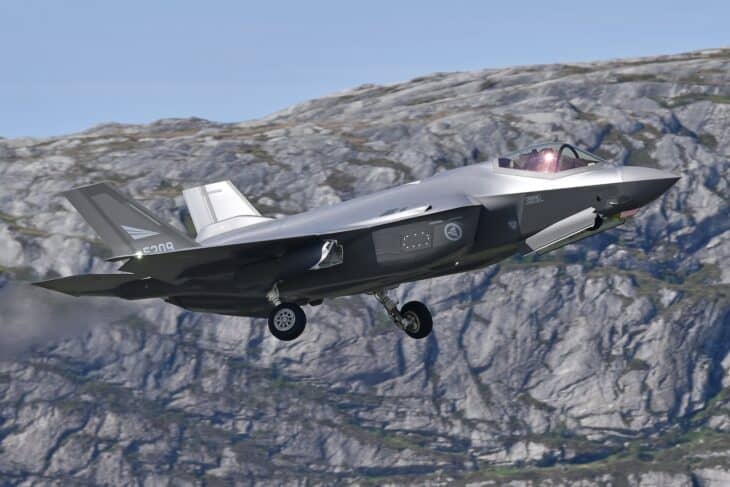
The F-35A is the future of the Swiss Air Force, even though not one is in Switzerland yet. It won the Air2030 competition in June 2021, and Switzerland signed for 36 in 2022 under a budget of about CHF 6 billion.
Then the price moved. A US defense official said in December 2025 that airframe and engine costs were trending about $610 million above the original estimates, and Switzerland had believed its price was fixed.
On March 6, 2026, the Federal Council declined to ask for the extra CHF 1.1 billion that all 36 jets would need. It is keeping the CHF 6 billion budget plus CHF 394 million for inflation, which the defense department expects to buy about 30, and it rejected cancelling the deal on security grounds.
Production is under way. Switzerland’s first F-35A entered main assembly in May 2026, the first eight are due at Ebbing Air National Guard Base in Arkansas in mid-2027 to train Swiss crews, and jets start arriving in Switzerland in 2028. Many of the rest will be assembled at Cameri in Italy.
Won by 8,670 votes
Swiss voters approved the money for new fighters on September 27, 2020, by 1,605,700 votes to 1,597,030, or 50.1% to 49.9%. Six years earlier, in May 2014, they had rejected a plan to buy 22 Saab Gripens, which is why Switzerland still flies the F-5 today.
3. F-5E/F Tiger II: The Last Red Tigers
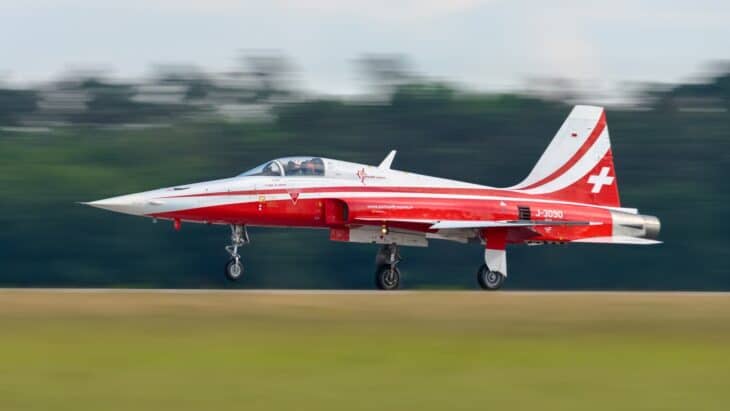

Switzerland has flown the Northrop F-5 Tiger II since 1978. FlightGlobal counts 15 single-seat F-5Es and 4 two-seat F-5Fs active, from a fleet that once numbered 53.
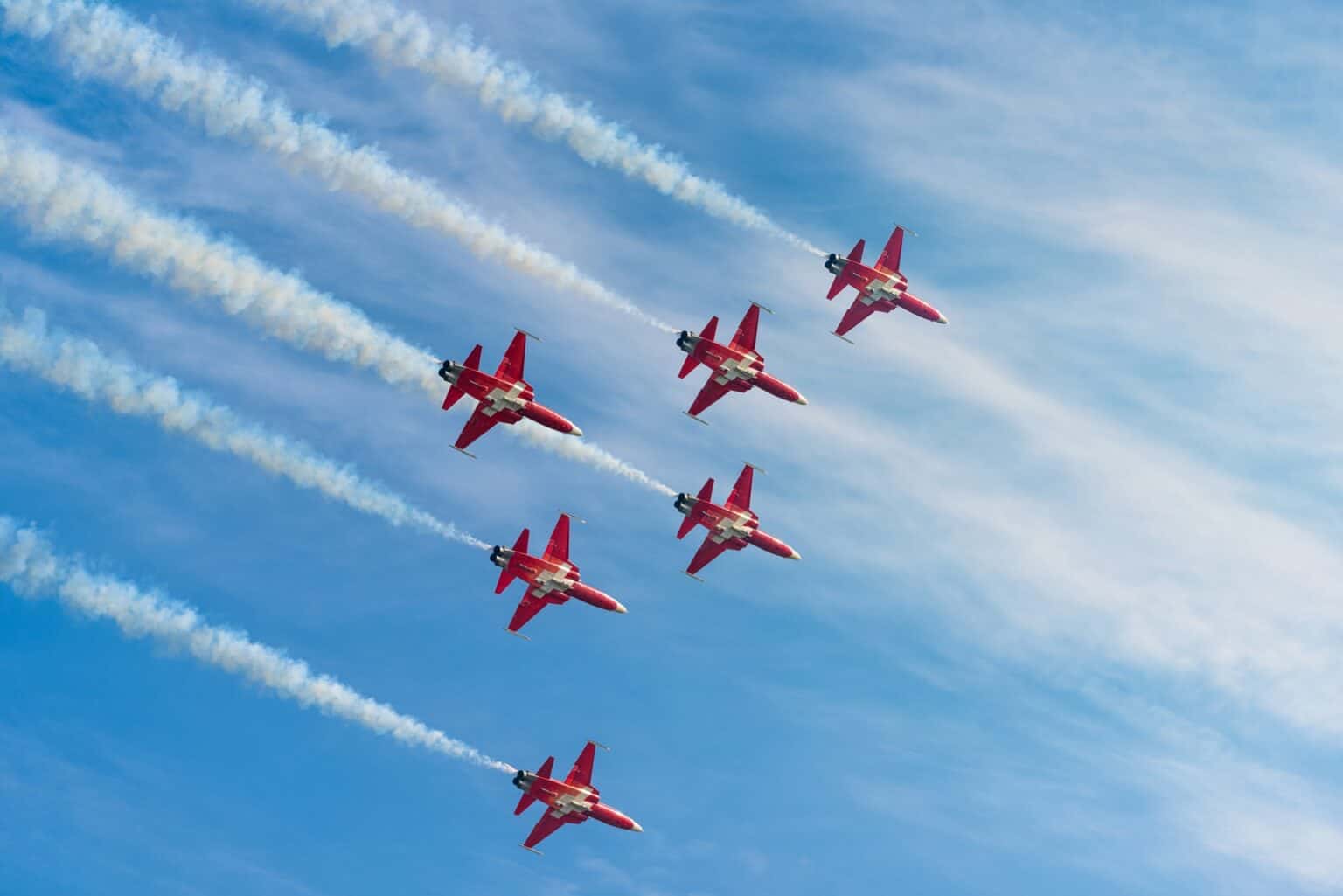
The Tigers no longer fight. They fly secondary jobs such as target towing and training, which saves hours on the Hornets, and they carry the Patrouille Suisse, the national jet display team.
That ends soon. The Senate approved the decree to retire them on September 17, 2025, by 22 votes to 20, after the House had backed it in June, and the Air Force plans to stop flying the F-5 at the end of 2027.
Keeping them longer would mean paying for new ejection seats, avionics and navigation systems. The government has said it wants to keep a display team, most likely on PC-7 turboprops.
4. Super Puma and Cougar: The Alpine Workhorses
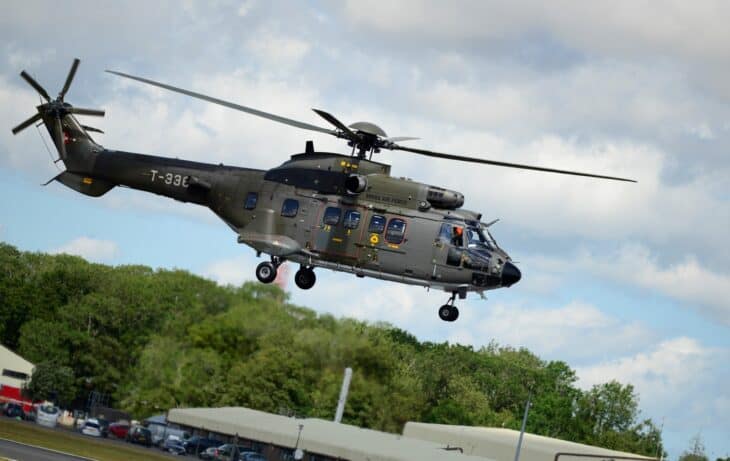

FlightGlobal counts 23 AS332 Super Pumas and AS532 Cougars, the Swiss Air Force’s medium transport helicopters. They move troops and cargo, fly search and rescue and support the civil authorities when disasters strike.
Mountain flying has a cost. Switzerland bought 12 Cougars and lost one in 2011 and another in 2016.
5. EC635: The Light Helicopter That Replaced the Alouette
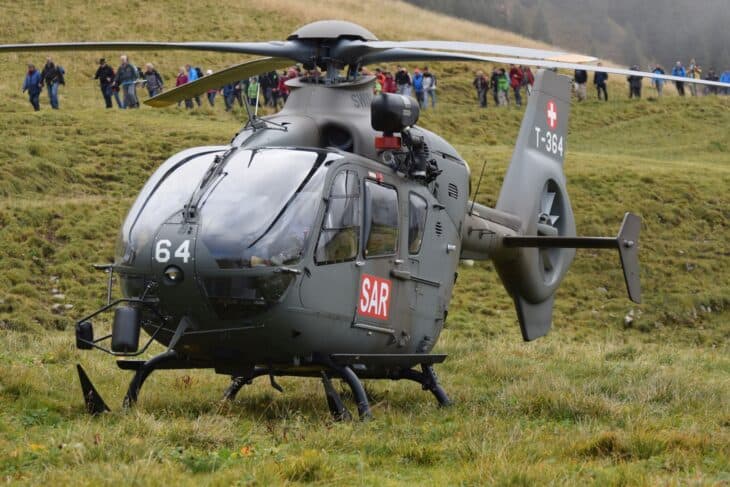

Switzerland ordered 18 EC635s and two VIP EC135s in 2006 to replace the last of its Alouette IIIs, and the 20th was delivered in December 2009. FlightGlobal counts 16 EC635s, now known as the H135M, in active service.
They fly utility and VIP missions, and the EC135 family’s fleet passed 100,000 flight hours in Swiss service in 2023.
6. ADS 15: The Drone Switzerland Is Still Waiting For
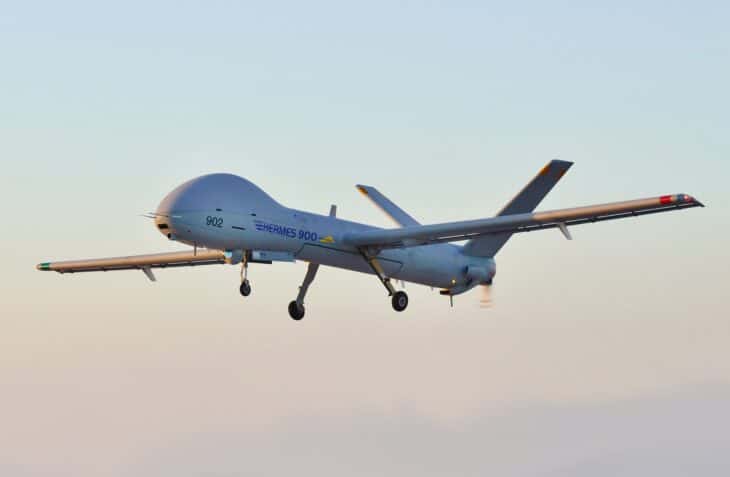

The ADS 15 is a Swiss version of Elbit’s Hermes 900 reconnaissance drone, and it has become a byword for delay. Six systems were meant to be in service by 2019, and armasuisse handed over only the third in September 2025.
Flights were suspended in January 2025 after a Hermes 900 accident in India. Rather than cancel, Switzerland dropped three features it can no longer get, including automatic obstacle avoidance and anti-icing, and the Federal Audit Office says the system will meet its requirements in 2029 at the earliest.
7. Pilatus PC-21: Where Fighter Pilots Learn
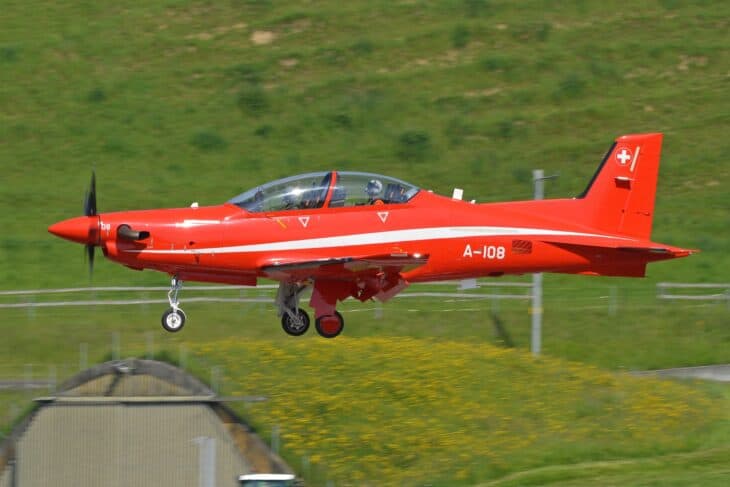
Swiss fighter pilots move on to the Pilatus PC-21, a Swiss-built turboprop used as an advanced and lead-in fighter trainer. FlightGlobal counts 7 in service, upgraded in a 2020 mid-life update.
Its role grows as the F-35A arrives, because the two-seat F-5Fs Switzerland uses as conversion trainers retire at the end of 2027 along with the rest of the Tigers.
8. Pilatus PC-7: The Biggest Fleet in the Air Force
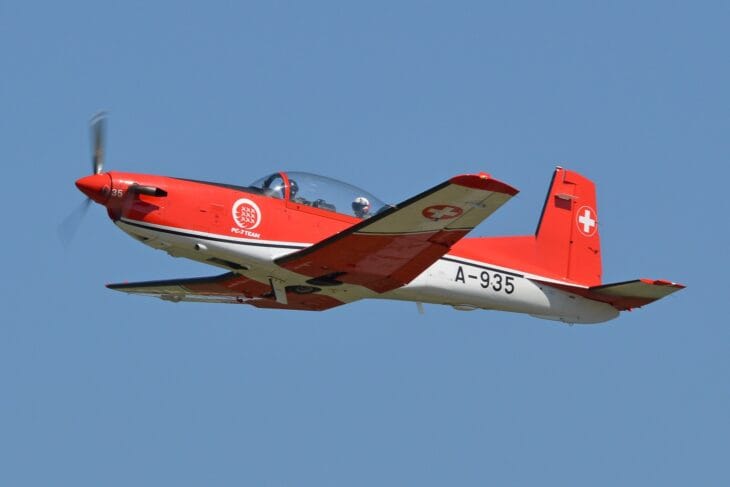
The most numerous aircraft in Swiss service is a trainer. FlightGlobal counts 27 Pilatus PC-7s, more than the single-seat Hornet fleet.
It is the basic trainer for Swiss military pilots, and it also flies with the PC-7 Team, the Air Force’s turboprop display team. In November 2024 RUAG and Pilatus announced work to extend the fleet’s service life.
9. Pilatus PC-6 Porter: The Mountain Taxi
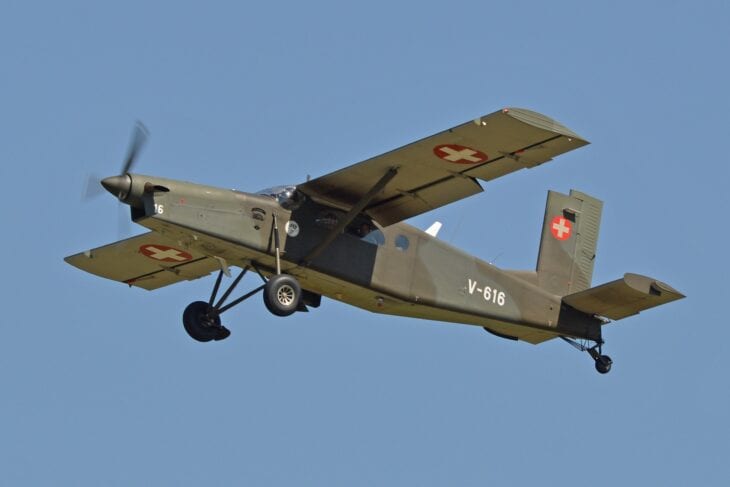
The PC-6 Porter is a short-takeoff utility plane designed for exactly the strips Switzerland has. FlightGlobal counts 14 in Swiss Air Force service.
They carry people and light cargo into short strips in the mountains, a job the Porter has done for the Swiss military for decades.
10. Government Jets and Survey Aircraft
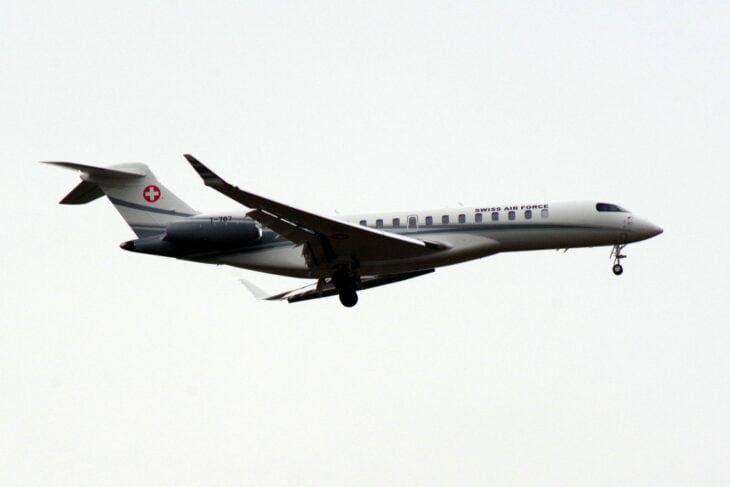

The Federal Air Transport Service, part of the Air Force, flies Switzerland’s ministers. Its newest jet is a Bombardier Global 7500, approved in August 2023 for CHF 103 million, landed in Switzerland on December 19, 2024, and in service since February 2025.
Its start was rough: after a takeoff problem in Ankara in April 2025 it was grounded until the end of October for modifications. It flies alongside two Challenger 604s and a Falcon 900EX bought secondhand from Prince Albert of Monaco in 2012, whose replacement has been put off for budget reasons.
A King Air 350 and a DHC-6 Twin Otter fly aerial mapping, and a Diamond DA42 serves as a test aircraft.
How a Neutral Country Polices Its Airspace
Switzerland is not in NATO, so it cannot borrow allied fighters to cover gaps the way Sweden or Finland can. Air policing is the Air Force’s main peacetime job, and every intercept over Swiss territory is flown by Swiss jets.
Since December 31, 2020, two armed F/A-18s have been ready at all hours, able to take off within 15 minutes of an alarm. Radar stations on mountain peaks such as Pilatus, Scopi, Weisshorn and Weissfluh watch the skies.
The ground layer is late. The five Patriot systems Switzerland ordered alongside the F-35 face a delay of four to five years because the US redirected supplies to Ukraine, and the Federal Council has asked for a second long-range system to be assessed.
Where the Swiss Air Force Is Based
Fighters fly from Payerne in western Switzerland, Meiringen in the Bernese Oberland and Emmen near Lucerne. Meiringen is famous for hangars dug into the mountain, which can shelter Hornets inside the rock.
Dübendorf near Zurich is the operational headquarters, and helicopters fly from Alpnach and Locarno as well as the jet bases. Squadron 11 sits at Meiringen and Squadrons 17 and 18 at Payerne until the Hornets consolidate at Emmen.
A Short History of the Swiss Air Force
The Swiss Air Force was founded on July 31, 1914, three days after World War I broke out, as part of the army. It became an independent service in 1936.
The Patrouille Suisse display team formed in 1964 on Hawker Hunters before moving to red-and-white F-5Es, which it will fly until the type retires. Major General Christian Oppliger has commanded the Air Force since October 1, 2025.
With about 30 fighters, Switzerland sits far down the list of the largest air forces in the world, and it is never near the top of the best air forces in the world. Its neighbors’ choices are covered in our guides to the German Air Force and the French Air Force.
FAQ
Sources and references used for research and fact-checking.
- FlightGlobal, World Air Forces 2026
- Breaking Defense, Swiss cutting F-35 order by six, facing up to five year Patriot delay
- Migflug, Swiss F-35A: First Jet in Assembly as Order Shrinks
- Swissinfo, Tiger fighter aircraft will definitely be decommissioned
- European Airshows, Patrouille Suisse to fly until 2027
- Militär Aktuell, Swiss F/A-18C/D Hornet service life extension
- The Aviationist, Swiss F/A-18s to be Moved to Emmen in First Step Towards Retirement
- Defense News, Switzerland's $6.5 billion fighter jet plan narrowly passes referendum
- Swissinfo, Christian Oppliger named new head of the Swiss Air Force
- AviationPros, Swiss Air Force Receives 20th Eurocopter EC635 Helicopter
- Helis.com, Swiss EC635
- Militarnyi, Switzerland Decides to Ease Requirements for Israeli Drones Instead of Abandoning Them
- Shephard, Switzerland's Hermes 900 procurement faces further delays and headwinds
- ch-aviation, Switzerland takes delivery of new government Global 7500
- blue News, New Federal Council jet to remain on the ground until fall
- Wikipedia, Swiss Air Force
Get the Newsletter
The latest aviation news and stories sent to your inbox.
About the Author

Tim is the owner and lead editor of AeroCorner since 2019, overseeing aviation content covering aircraft, airlines, airports, and the broader aviation industry. Through years of researching, writing, editing, and publishing aviation-focused content, he has developed extensive practical knowledge of commercial aviation and air travel. Based in Asia and a frequent traveler himself, Tim also brings firsthand passenger experience to AeroCorner’s coverage. Outside of publishing, he has also explored aviation firsthand through hands-on flight training in New Zealand.