

Table of Contents
Midget submarines, carrier strikes and two earlier bomber raids had failed to finish her. A Barnes Wallis bomb and a stripped-down four-engine bomber did it in one morning.
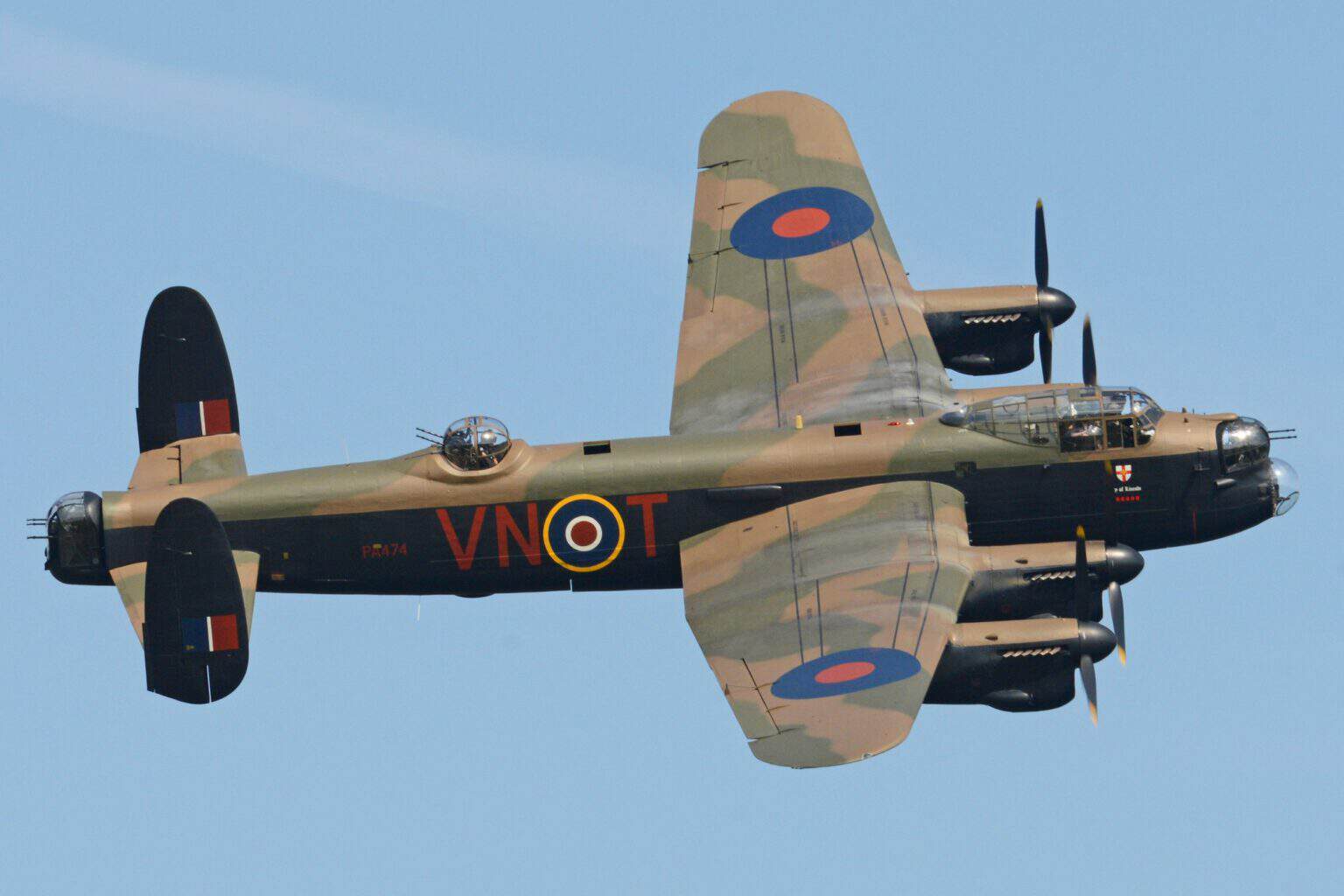
On the morning of Nov. 12, 1944, about 30 Avro Lancasters from the RAF’s No. 9 and No. 617 “Dambusters” Squadrons attacked the German battleship Tirpitz at her anchorage off Håkøya island, near Tromsø, Norway. Each bomber carried a single 12,000-pound (5,400 kg) Tallboy.
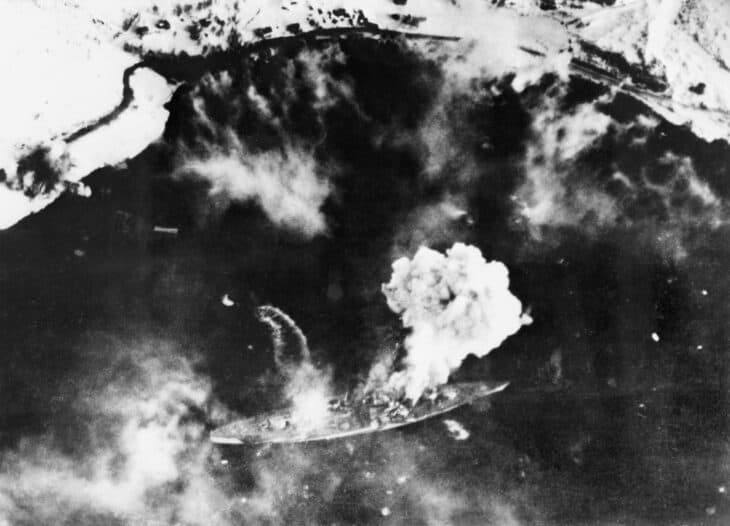
The first bomb fell at 9:41 a.m. British time. At least two Tallboys hit, a magazine exploded, and by 9:52 a.m. the 823-foot (251 m) ship had rolled over. The raid was called Operation Catechism, and no bomber crewman was killed.
Why the Tirpitz Needed a 12,000-lb Bomb
The Tirpitz was commissioned in February 1941 as the second Bismarck-class battleship. After wartime changes she was about 2,000 metric tons heavier than the Bismarck itself, at 52,600 metric tons fully loaded, with eight 15-inch (38 cm) guns.
She rarely fought, and she did not need to. In July 1942 the threat of her sortie led the Admiralty to scatter Arctic convoy PQ 17. U-boats and Luftwaffe bombers then sank 21 of the 34 isolated transports.
Sinking her was the problem. British midget submarines damaged her badly in September 1943, and Fleet Air Arm carrier aircraft scored 15 direct hits in Operation Tungsten on April 3, 1944. None of those bombs got through her main armor.

That was the job Barnes Wallis designed the Tallboy for. The engineer behind the bouncing bomb of the 1943 Dams Raid drew a streamlined, 21-foot (6.4 m) casing packed with 5,200 pounds (2,400 kg) of Torpex explosive.
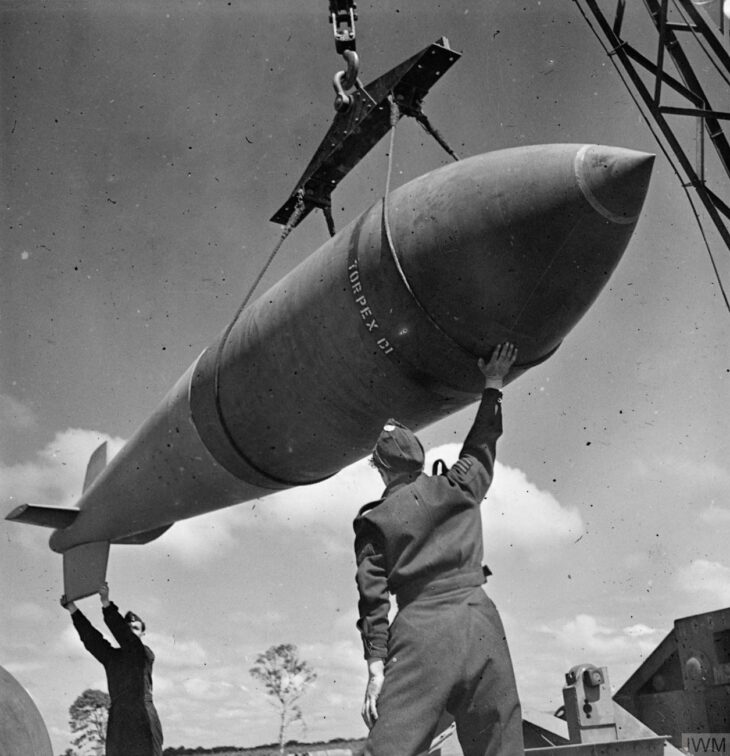

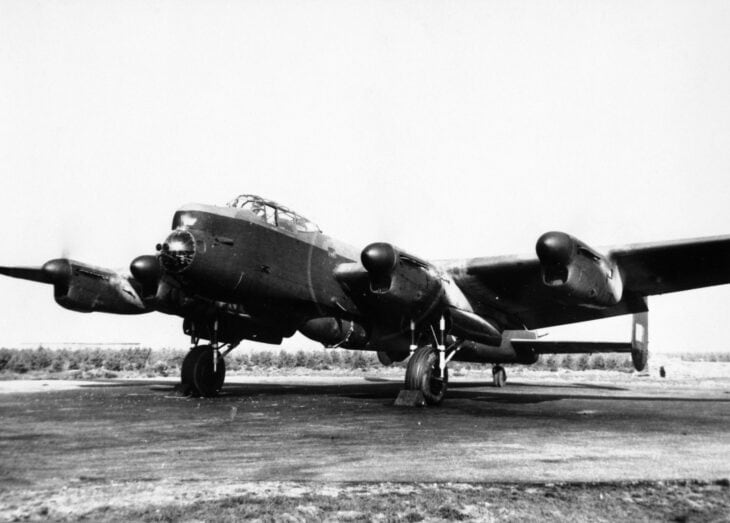
Dropped from about 18,000 feet (5,500 m), it was meant to strike at roughly 750 mph (1,210 km/h) and penetrate before exploding. Only a modified Lancaster could lift it, with armor and defensive guns removed and the bomb-bay doors reworked to fit.
Three Tallboy Raids, 2,252 Miles and One Clear Sky
It took the Lancasters three tries. The first, Operation Paravane on Sept. 15, 1944, was flown from Yagodnik in the Soviet Union against the ship at Kaafjord. One Tallboy wrecked her bow, and Germany’s navy chief, Karl Dönitz, was told repairs would take nine months.
Instead of repairing her, the Germans moved her south to Tromsø as a floating gun battery. That move put her within reach of Lancasters flying from northern Scotland, if the bombers could carry enough fuel.
So 9 and 617 Squadrons rebuilt their aircraft. They fitted Rolls-Royce Merlin 24 engines and two extra internal fuel tanks, one borrowed from the Vickers Wellington, and pulled out the front and mid-upper turrets and the pilot’s armor plate. Loaded, the bombers sat well above their authorized maximum takeoff weight.

The second raid, Operation Obviate on Oct. 29, flew a round trip of about 2,252 miles (3,624 km). Cloud covered the ship at the last minute, and no Tallboy hit her directly, although a near miss damaged a propeller shaft and her rudder.
Catechism used the same plan. The Lancasters left Scotland from about 3 a.m., and 32 were dispatched: 18 from 617 Squadron, 13 from 9 Squadron and an unarmed No. 463 Squadron RAAF aircraft to film the attack. Two of the 9 Squadron bombers turned back.
This time the sky was clear and there was no smoke screen. The ship opened fire at 13.5 miles (22 km), and the bombers released from between 12,000 and 16,000 feet (3,700 to 4,900 m).
Two Tallboys broke through the armored deck, one of which failed to explode, and a third probably hit. Near misses tore at her hull. She listed to port, the magazine under her rear “Caesar” turret blew up at 9:50 a.m., and two minutes later she capsized.
The Fighters That Never Found the Lancasters
The bombers should have been easy prey. Without their front and mid-upper turrets they flew unescorted, and about 38 fighters of the Luftwaffe’s JG 5 had been moved to Bardufoss, an airfield in the same part of northern Norway.
German observers reported the Lancasters from 7:39 a.m. British time, and the ship’s crew spotted them just after 8 a.m. Yet the fighters were not ordered up until 9:18 a.m., and their takeoff was held up when a Ju 52 transport landed on the runway.
Historians blame late orders and the wall between the navy and the Luftwaffe, whose warnings ran through separate channels. The acting fighter commander, Major Heinrich Ehrler, was sentenced to three years in prison, then released after a month and demoted.
For airmen it settled an argument that went back to Billy Mitchell sinking a battleship from the air: a battleship with no air cover was a target. The cost on the German side was heavy. Estimates of the dead run from about 950 to 1,204, and the RAF Museum puts it at about a thousand sailors.
Within two hours, 596 men swam ashore or were pulled from the water. Rescuers cut another 87 out of the upturned hull over the next 24 hours. The ship’s captain, Robert Weber, died with all of his senior officers.
One question was never settled: whose bomb did it. 617’s commander, Wing Commander James “Willie” Tait, is credited with a hit that exploded over a boiler room, but 9 Squadron claimed the decisive Tallboy too, and the credit has stayed split between them.
A Tirpitz Raider Is About to Fly Again
The ship never came back. A German-Norwegian salvage company broke up the wreck between 1948 and 1957.
The bombers have a longer story. PA474, the Royal Air Force’s Battle of Britain Memorial Flight Lancaster and one of only two Lancasters still flying anywhere, is grounded through 2026 for an 18-month major overhaul. The other is FM213, flown by the Canadian Warplane Heritage Museum in Ontario.
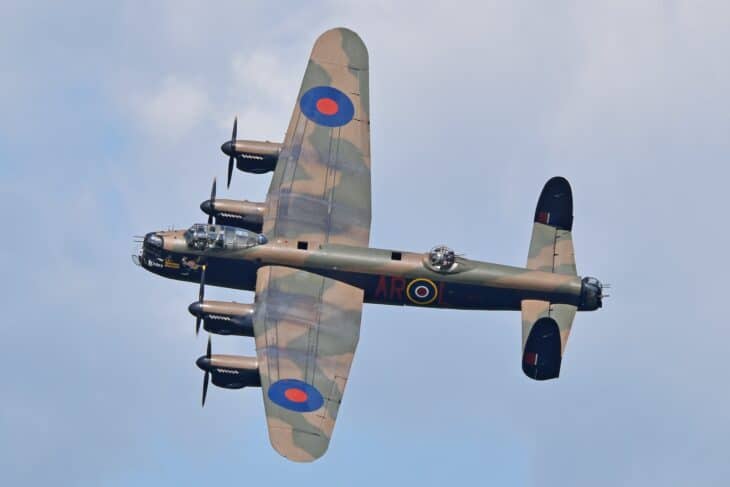
When PA474 returns in 2027, it will wear the markings of LM220, a 9 Squadron Lancaster coded WS-Y and named “Getting Younger Every Day.” LM220 flew 63 operations from Bardney, Lincolnshire, in 1944 and 1945, including two raids against the Tirpitz.
Both squadrons are still in service. 617 Squadron, re-formed in 2018, now flies the F-35B from RAF Marham and from the Royal Navy’s Queen Elizabeth-class carriers, part of the Royal Air Force’s 2026 fleet.
The Tallboy went on, too. Wallis scaled it up into the even bigger Grand Slam, which 617 Squadron first dropped in March 1945. Of the 854 Tallboys built, the handful that fell on Tromsø in eight minutes on Nov. 12, 1944, are the ones that ended a battleship.
Sources and references used for research and fact-checking.
- Wikipedia, Operation Catechism
- Wikipedia, Operation Obviate
- Wikipedia, Tallboy (bomb)
- Wikipedia, German battleship Tirpitz
- RAF Museum, Target the Tirpitz
- Bomber Command Museum of Canada, The Tirpitz
- Wikipedia, No. 617 Squadron RAF
- Wikipedia, Avro Lancaster PA474
- Aviation News EU, UK's Last Lancaster Bomber to Miss 2026 Airshows During Major Overhaul
- Vintage Aviation News, New Markings for the Battle of Britain Memorial Flight's Lancaster in 2027
Get the Newsletter
The latest aviation news and stories sent to your inbox.
About the Author

Tim is the owner and lead editor of AeroCorner since 2019, overseeing aviation content covering aircraft, airlines, airports, and the broader aviation industry. Through years of researching, writing, editing, and publishing aviation-focused content, he has developed extensive practical knowledge of commercial aviation and air travel. Based in Asia and a frequent traveler himself, Tim also brings firsthand passenger experience to AeroCorner’s coverage. Outside of publishing, he has also explored aviation firsthand through hands-on flight training in New Zealand.