

Table of Contents
At about 10:26 a.m. on June 4, 1942, three American dive bombers tipped over above the flagship of Japan’s carrier fleet. Almost every other bomber in their squadron had just dived on a different ship.
Only one of the three bombs hit. It was enough. The carrier was Akagi, the ship that had led the attack on Pearl Harbor six months earlier, and by the next morning it was gone.
Akagi’s story starts long before that morning, with a battlecruiser hull that a treaty turned into a carrier and a stack of flight decks no carrier since has copied. Here is what the ship was, what it did, and why one bomb was enough to finish it.
What Was the Japanese Aircraft Carrier Akagi?
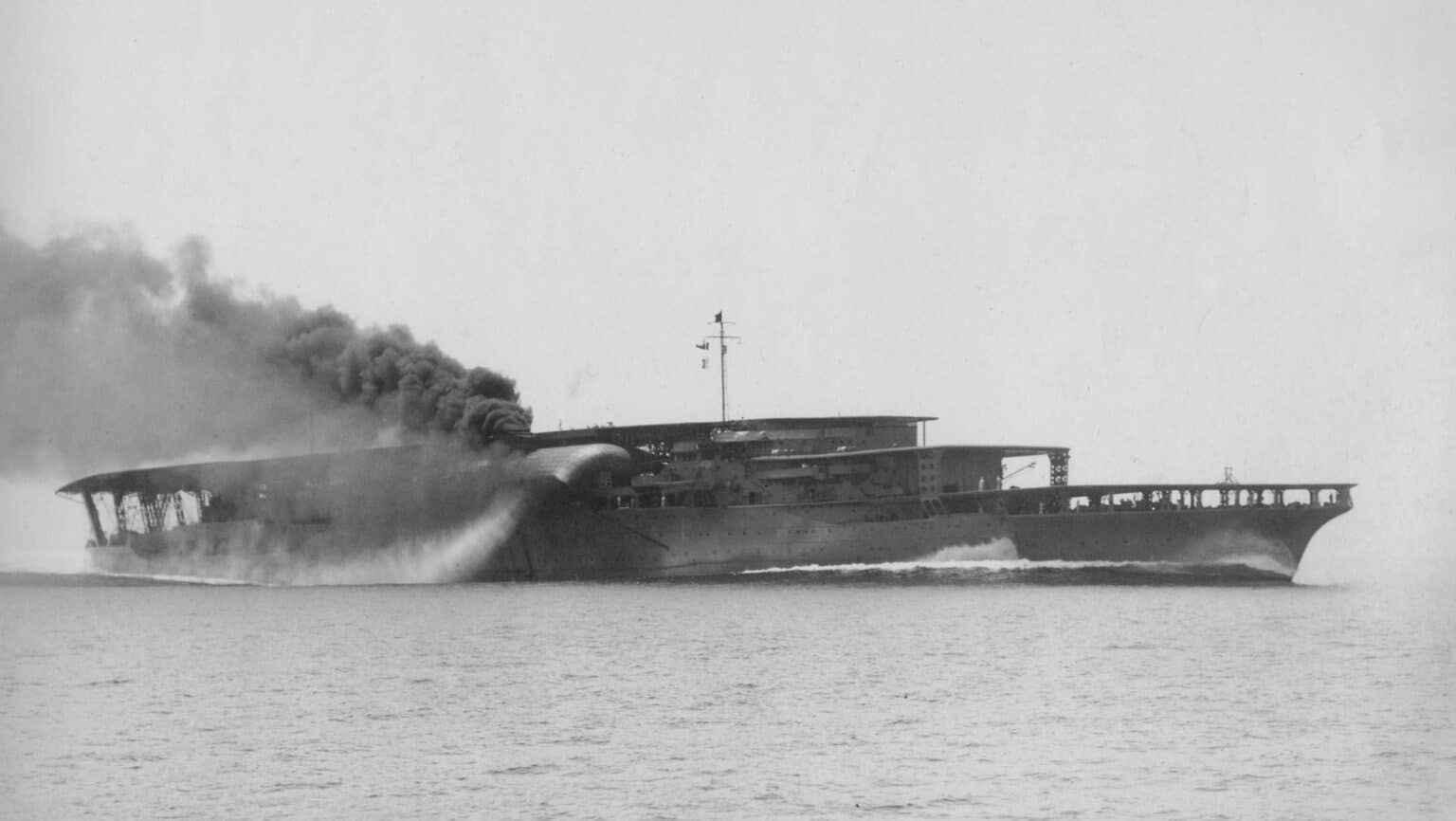
Akagi was a fleet aircraft carrier of the Imperial Japanese Navy, in service from 1927 to 1942. It was laid down in 1920 as a battlecruiser, converted to a carrier while still on the slipway, and rebuilt in the late 1930s into the ship that fought World War II.
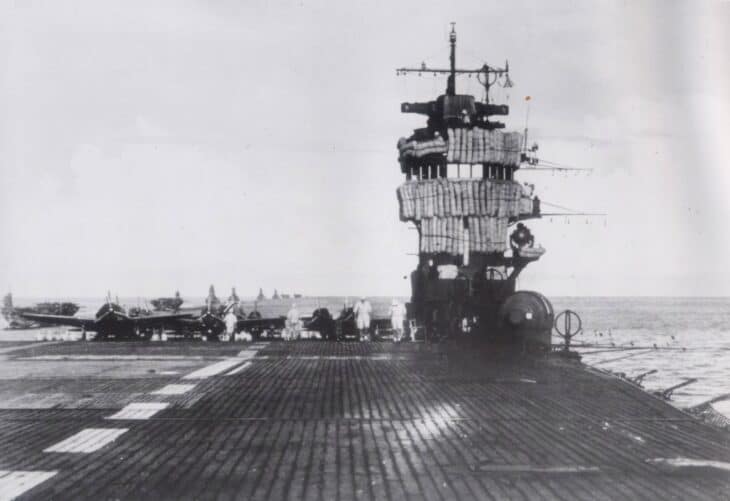

It was the flagship of Vice Adm. Chuichi Nagumo’s carrier striking force, the Kido Butai, for the attack on Pearl Harbor and again at Midway. The name comes from Mount Akagi, a dormant volcano in Japan’s Kanto region, and means “red castle.”
Akagi at a glance
Laid down as a battlecruiser at Kure on Dec. 6, 1920. Commissioned as a carrier on March 25, 1927. Rebuilt with a single flight deck from 1935 to 1938. Flagship at Pearl Harbor on Dec. 7, 1941. Hit by one bomb at Midway on June 4, 1942, and scuttled by Japanese destroyers the next morning. Wreck found in 2019.
Its war was short. In six months Akagi’s aircraft struck Pearl Harbor, Rabaul, Darwin and Colombo, and then the ship was lost in a single morning.
A Battlecruiser That a Treaty Turned Into a Carrier
Akagi was meant to be an Amagi-class battlecruiser, a big-gun ship built for speed. Construction stopped when Japan signed the Washington Naval Treaty on Feb. 6, 1922, which capped how many battleships and battlecruisers each navy could build.
The treaty had a loophole. It let Japan convert two unfinished battleship or battlecruiser hulls into carriers of up to 33,000 long tons. Japan picked Akagi and its sister Amagi.
The United States used the same clause the same way. Its first big carriers, USS Lexington and USS Saratoga, were also battlecruiser hulls, and the first USS Lexington was laid down as battlecruiser CC-1 in January 1921, a month after Akagi.
The earthquake that changed the fleet
The Great Kanto earthquake of Sept. 1, 1923, damaged Amagi’s hull beyond economical repair, and it was scrapped. Japan swapped in the unfinished battleship Kaga instead. That is why Akagi and Kaga, the two carriers that fought side by side from Pearl Harbor to Midway, were never sister ships.
Akagi, building far to the west at Kure, carried on. It was launched as a carrier on April 22, 1925, and commissioned at Kure Naval Arsenal on March 25, 1927.
Three Flight Decks, Then One
The Akagi of 1927 looked nothing like the ship that went to war. It had three flight decks stacked like steps at the bow, and no island at all. Akagi and Kaga were the only carriers ever designed that way.
The idea was to launch and land at the same time. Aircraft would take off straight out of the hangars onto the lower decks while others landed on the main deck above, which was about 624 feet (190 m) long.
In practice the extra decks were of little use. The middle deck was only about 49 feet (15 m) long, so short that only a few lightly loaded aircraft could use it, and the lower one was about 180 feet (55 m).
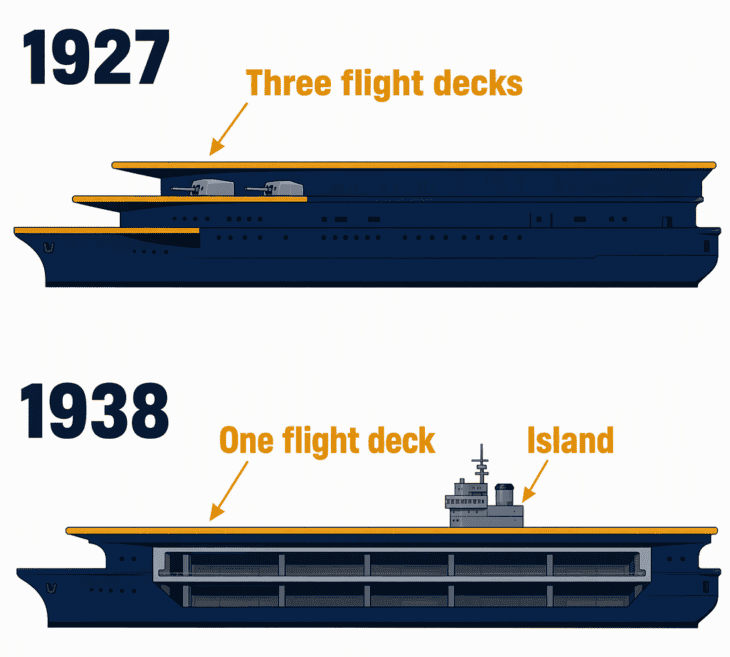
By the 1930s, new aircraft were too big and heavy for the short decks. From 1935 to 1938 Akagi was rebuilt at Sasebo with one flight deck about 817 feet (249 m) long and two enclosed hangars beneath it.
The rebuild raised its capacity from about 60 aircraft to 86, of which 61 were ready to fly and 25 were stored. It also added a small island on the port side, an experiment to move the bridge away from the funnel exhaust on the starboard side. The only other carrier built that way was Hiryu.
| Akagi after the 1938 rebuild | |
|---|---|
| Builder | Kure Naval Arsenal |
| Laid down | Dec. 6, 1920 (as a battlecruiser) |
| Launched | April 22, 1925 |
| Commissioned | March 25, 1927 |
| Length | 855 feet (261 m) |
| Flight deck | About 817 feet (249 m) |
| Displacement | 36,500 long tons standard, 41,300 at deep load |
| Speed | 31.2 knots on trials |
| Aircraft | 86 (61 operational, 25 stored) |
| Crew | About 2,000 |
The Flagship at Pearl Harbor
On the morning of Dec. 7, 1941, Akagi and five other carriers launched two waves of aircraft from about 230 nautical miles north of Oahu. Akagi’s air group commander, Cmdr. Mitsuo Fuchida, led the whole attack.
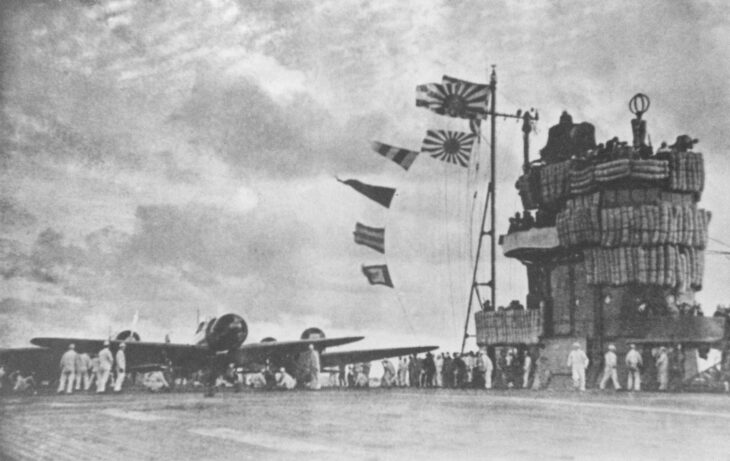

In the first wave, 27 of Akagi’s Nakajima B5N torpedo bombers went after battleship row and hit USS Oklahoma, USS West Virginia and USS California. Nine Mitsubishi A6M Zero fighters from the ship attacked Hickam Field.
The second wave added 18 Aichi D3A dive bombers and nine more Zeros. Akagi lost four dive bombers and one fighter that day. Our guide to the aircraft that fought at Pearl Harbor covers every type on both sides.
The winning streak kept going. Akagi’s aircraft hit Rabaul in January 1942, Darwin, Australia, on Feb. 19, and Colombo, Ceylon, on April 5, and on April 9 they helped sink the British carrier HMS Hermes.
Midway: Three Dive Bombers, One Bomb
At Midway, Akagi was again Nagumo’s flagship, carrying 24 Zeros, 18 D3A dive bombers and 18 B5N torpedo bombers. By mid-morning on June 4, its fighters had helped beat off every American attack from Midway and from the U.S. carriers’ torpedo squadrons.
Then the dive bombers from USS Enterprise arrived. Through a mix-up over targets, about 28 of them dived on Kaga, and only three, led by Lt. Richard Best of Bombing Squadron 6, pulled out and went for Akagi.
They were too low for a textbook attack, so Best’s section came in on a shallower dive in their SBD Dauntless bombers. Two bombs were near misses, one off the port side by the island and one by the stern.
The third, a 1,000-pound bomb, hit the aft edge of the middle elevator and exploded in the upper hangar. Most accounts credit Best with the hit, though the Navy’s history office notes that some give it to his wingman.
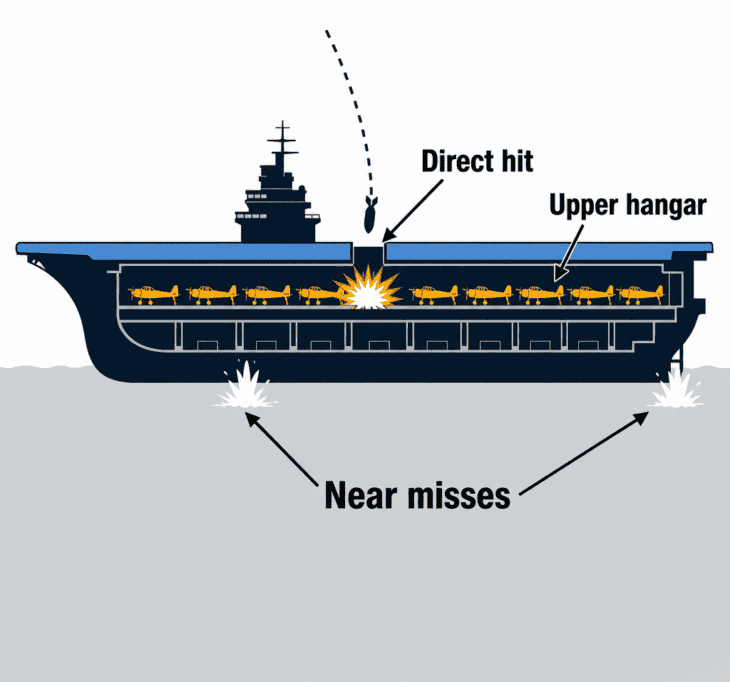
One hit should not have sunk an 855-foot ship. What made it fatal was what sat in that hangar: B5N torpedo bombers, fully fueled and armed, being readied for a strike on the American carriers.
They went up one after another, and burning aviation fuel spread the fire deeper into the ship. At 10:40, damage from the near miss aft jammed the rudder 30 degrees to starboard, and at 10:46 Nagumo and his staff escaped the bridge by rope through the forward windows and moved to the light cruiser Nagara.
Could Akagi Have Been Saved?
Possibly, and its crew believed so for most of the day. The Navy’s history office says that unlike Kaga and Soryu, which were hopeless from the first bombs, Akagi had a chance, and its crew fought the fires for about nine hours.
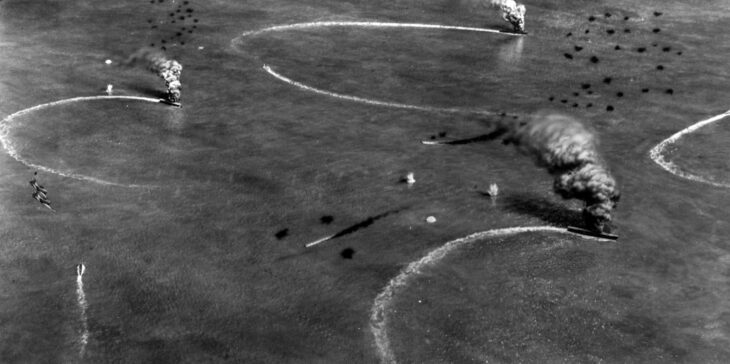

The odds kept getting worse. The aft magazines could not be flooded at first because of valve damage, the main water pump appears to have been damaged, and the ship went dead in the water at 1:50 p.m.
Capt. Taijiro Aoki stayed aboard with the damage-control teams into the night and had to be talked off his own ship. He was the only captain of the four Japanese fleet carriers lost at Midway to survive the battle.
Myth: American bombs sank Akagi
American dive bombers wrecked Akagi, but Japan sank it. At 4:50 a.m. on June 5, Adm. Isoroku Yamamoto, who had once commanded the ship, ordered it scuttled. Four Japanese destroyers, Arashi, Hagikaze, Maikaze and Nowaki, each fired one torpedo into it, and Akagi sank bow first at 5:20 a.m.
Yamamoto took the decision hard. “I was once the captain of Akagi,” he told his staff, “and it is with heartfelt regret that I must now order that she be sunk.”
Akagi lost 267 men, the fewest of the four Japanese carriers sunk in the Battle of Midway. To hide the defeat, the navy kept it on the register as “unmanned” until Sept. 25, 1942.
Dec. 1920
Laid down as a battlecruiser. Construction begins at Kure Naval Arsenal.
Feb. 1922
Washington Naval Treaty. Work stops, and the hull is chosen for conversion to a carrier.
March 1927
Commissioned. Akagi enters service with three stepped flight decks and no island.
1935 to 1938
Rebuilt. One full-length flight deck, a port-side island and room for 86 aircraft.
Dec. 7, 1941
Pearl Harbor. Flagship of the striking force.
June 4, 1942
Midway. One bomb from an Enterprise dive bomber sets the hangar on fire.
June 5, 1942
Scuttled. Four Japanese destroyers torpedo the burning carrier.
Oct. 2019
Wreck found. Sonar from the research vessel Petrel locates Akagi.
Sept. 2023
First images. Remotely operated vehicles from E/V Nautilus film the wreck.
The Akagi Wreck Today
Akagi lay undiscovered for 77 years. In October 2019, a Vulcan Inc. expedition aboard the research vessel Petrel, working with the Navy’s history office, found the wreck by sonar inside Papahanaumokuakea Marine National Monument, northwest of Hawaii.
Nobody actually saw it until September 2023. The Ocean Exploration Trust’s ship Nautilus spent 14 hours surveying Akagi with remotely operated vehicles, on dives below 16,600 feet (5,100 m), the deepest of the more than 1,000 the ship had made.
NOAA describes the wreck as intact but badly broken up and sunk into the sediment, with heavy damage aft of amidships, likely from the bomb and the explosions that followed. The port-side island is still there.
Akagi’s American opponent at Midway lies in the same waters. The first USS Yorktown, sunk in the same battle, rests nearby, and the Nautilus team filmed it on the same 2023 expedition.
So the next time you see a photo of Akagi with its stepped bow decks, you are looking at the battlecruiser a treaty made into a carrier. It led the attack that brought America into the war, and it was finished by one bomb in the wrong place, from three planes that almost went somewhere else.
Sources and references used for research and fact-checking.
- Wikipedia, Japanese aircraft carrier Akagi
- Wikipedia, Japanese aircraft carrier Kaga
- Naval History and Heritage Command, H-Gram 006, Attachment 4: The Battle of Midway
- Naval History and Heritage Command, Dictionary of American Naval Fighting Ships, Lexington IV (CV-2)
- NOAA Ocean Exploration, Akagi
- Ocean Exploration Trust, Exploring Iconic Shipwrecks from the Battle of Midway Provide Never-Before-Seen Details
- The Maritime Executive, Second Japanese Aircraft Carrier Wreck Discovered
Get the Newsletter
The latest aviation news and stories sent to your inbox.
About the Author

Tim is the owner and lead editor of AeroCorner since 2019, overseeing aviation content covering aircraft, airlines, airports, and the broader aviation industry. Through years of researching, writing, editing, and publishing aviation-focused content, he has developed extensive practical knowledge of commercial aviation and air travel. Based in Asia and a frequent traveler himself, Tim also brings firsthand passenger experience to AeroCorner’s coverage. Outside of publishing, he has also explored aviation firsthand through hands-on flight training in New Zealand.