

Table of Contents
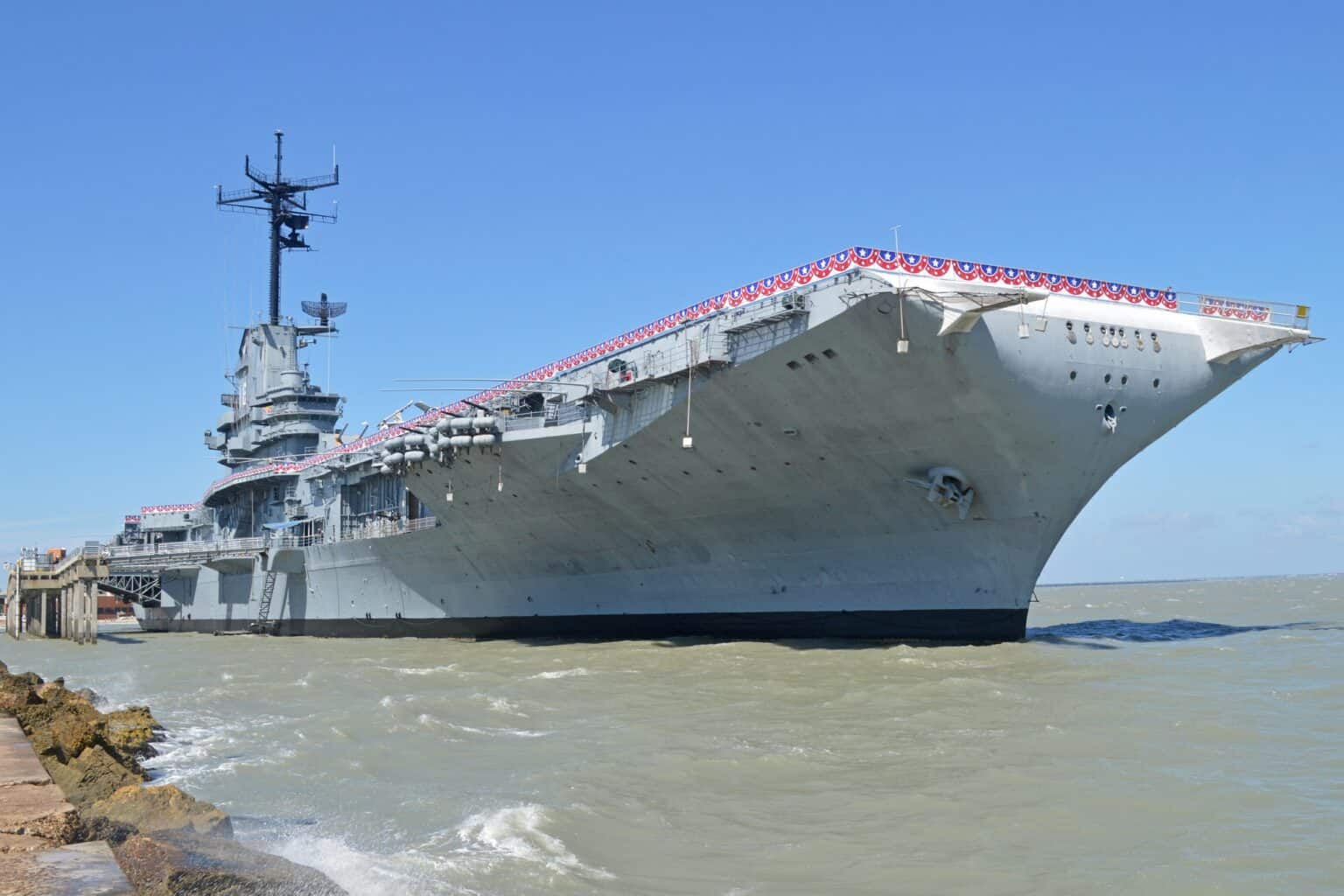
On North Beach in Corpus Christi, an aircraft carrier with a 910-foot (277 m) flight deck sits alongside a jetty in the bay. The sign says USS Lexington, and the museum’s phone number spells out 1-800-LADY LEX.
That nickname first belonged to a different ship. The first carrier called Lexington lies about two miles down on the floor of the Coral Sea, where it went down burning in May 1942.
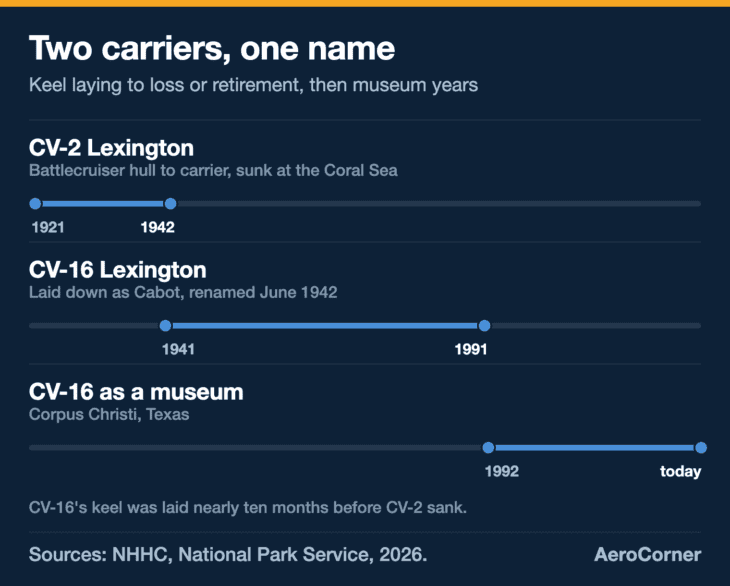
The two ships were built in the same Massachusetts shipyard and christened by the same woman, and their lives overlapped by nearly ten months. Here is which Lexington is which, where each one is today, and how the second got its name.
Where Is the USS Lexington Now?
The USS Lexington you can visit is CV-16, an Essex-class carrier commissioned in 1943. It has been the USS Lexington Museum on the Bay at 2914 North Shoreline Boulevard in Corpus Christi, Texas, since 1992, and it was named a National Historic Landmark in 2003.
The original USS Lexington, CV-2, is a wreck. An expedition funded by Microsoft co-founder Paul Allen found it on March 4, 2018, about 3,000 meters (roughly two miles) deep and more than 500 miles off Australia’s east coast.
| USS Lexington (CV-2) | USS Lexington (CV-16) | |
|---|---|---|
| Nickname | Lady Lex | The Blue Ghost |
| Started life as | A battlecruiser, laid down 1921 | A carrier named Cabot, laid down 1941 |
| Shipyard | Fore River, Quincy, Mass. | Fore River, Quincy, Mass. |
| Commissioned | Dec. 14, 1927 | Feb. 17, 1943 |
| Length | 888 feet (271 m) | 910-foot (277 m) flight deck after modernization |
| WWII battle stars | 2 | 11, plus the Presidential Unit Citation |
| Fate | Scuttled at the Battle of the Coral Sea, May 8, 1942 | Decommissioned November 1991 |
| Where it is now | About 2 miles (3,000 m) down in the Coral Sea | Museum ship in Corpus Christi, Texas |
The First Lexington Was Built to Be a Battlecruiser
CV-2 was laid down on January 8, 1921, at Fore River Shipbuilding in Quincy, Massachusetts, as battlecruiser CC-1. The Washington Naval Treaty of 1922 all but ended new battleship and battlecruiser building, so the Navy finished the hull, only about a quarter complete when work stopped in 1922, as an aircraft carrier instead.
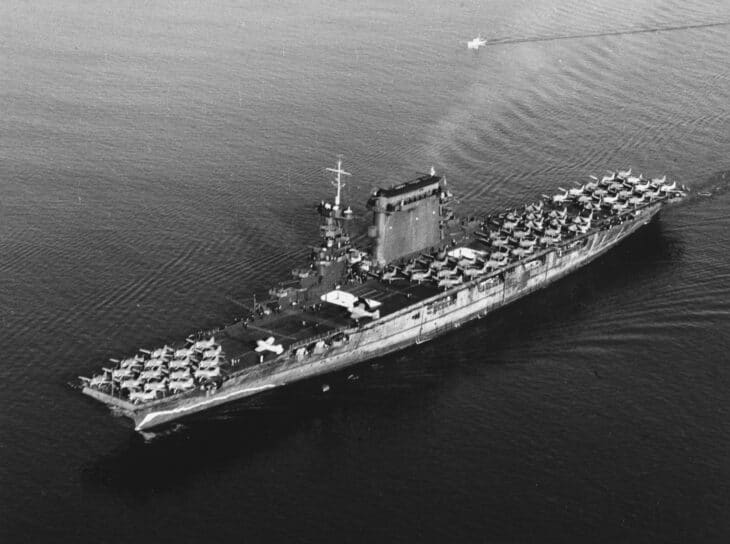
The result was enormous for its day. At 888 feet (271 m) long, Lexington had a hangar described as the largest single enclosed space afloat on any ship when it was built.
It was commissioned on December 14, 1927, and spent the next 14 years teaching the Navy how to fight with carriers. In July 1937, the ship joined the unsuccessful search for Amelia Earhart.
_leaving_San_Diego_on_14_October_1941_(80-G-416362).jpg)
The carrier that helped power a city
In the drought winter of 1929, Tacoma, Washington, ran short of hydroelectric power. The Navy sent Lexington, and from about December 17, 1929, the ship’s generators supplied roughly a quarter of the city’s electricity for about 30 days, more than 4 million kilowatt-hours in all.
On December 7, 1941, Lexington was at sea ferrying Marine aircraft from Pearl Harbor to Midway, so it was not in port when the attack came. On February 20, 1942, Lt. Edward “Butch” O’Hare flew his F4F Wildcat into a formation of bombers heading for the carrier and shot down five of them in a single sortie, earning the Medal of Honor.
How the Lady Lex Was Lost at the Coral Sea
In early May 1942, Lexington and USS Yorktown moved into the Coral Sea to block a Japanese push toward Port Moresby. On May 7, Lexington’s air group helped sink the light carrier Shoho.
The next day became the first naval battle in history in which the opposing ships never sighted or fired directly at each other. Every blow came from aircraft, and Lexington was the ship that did not survive them.
11:20 a.m.
Two torpedoes. Japanese torpedo planes hit Lexington twice on the port side, and dive bombers add three bomb hits. The ship lists 7 degrees with several fires burning.
Midday
Damage control wins, briefly. The fires are under control, the ship is back on an even keel, and it is making 25 knots, ready to recover aircraft.
Soon after
The fuel explodes. Gasoline vapor leaking from cracked aviation fuel tanks ignites below decks. The fires rage out of control again.
5:07 p.m.
Abandon ship. Capt. Frederick Sherman orders the crew over the side. Nearby cruisers and destroyers pick them out of the warm water almost at once.
7:56 p.m.
Scuttled. Torpedoes from the destroyer USS Phelps finish the burning carrier, and Lexington sinks.
The Navy counts more than 200 of Lexington’s crew killed and 35 of its aircraft lost in the battle and the sinking. The battle still halted Japan’s advance for the first time since Pearl Harbor, and the Navy’s own history calls Lexington part of the price paid to safeguard Australia and New Zealand.
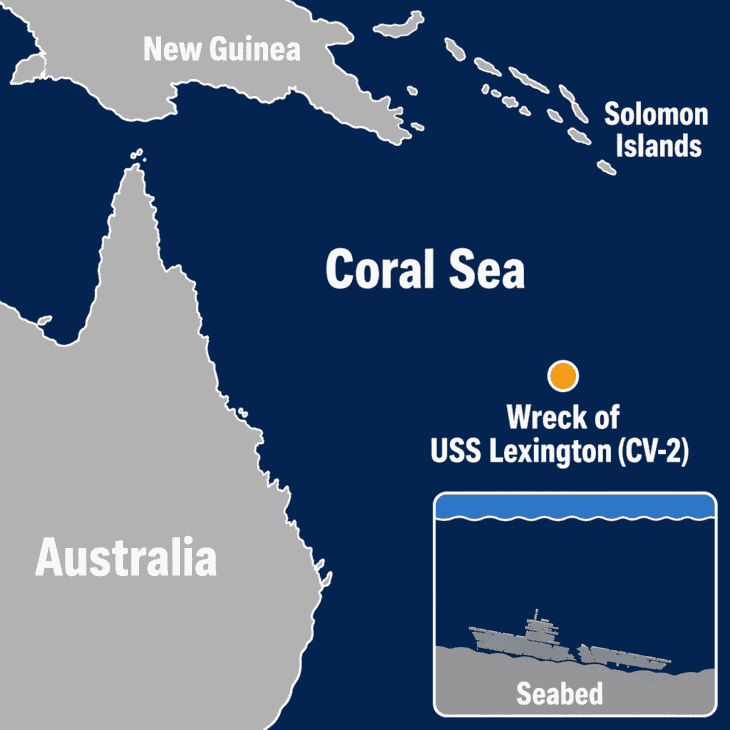
When Paul Allen’s research vessel Petrel found the wreck in 2018, its remote vehicle confirmed the ship by the nameplate on the stern. Nearby lay seven TBD Devastators, three SBD Dauntlesses and a single Wildcat, several with their markings still visible.
In February 2025, Australia added Lexington’s wreck to its National Heritage List as part of the Battle of the Coral Sea site, alongside the oiler Neosho and the destroyer Sims.
Shipyard Workers Gave the Name to the Next Carrier
At the same Quincy yard, an Essex-class carrier had been under construction since July 15, 1941. Its planned name was Cabot.
In June, workers at the shipyard asked Navy Secretary Frank Knox to give the lost carrier’s name to the one they were building. He agreed, and Cabot became Lexington on June 16, 1942, a little over five weeks after the original sank.
Same yard, same sponsor
Both Lexingtons were sponsored by the same woman, Mrs. Theodore Douglas Robinson, whose husband was Assistant Secretary of the Navy when she christened CV-2 in 1925. Seventeen years later she sponsored CV-16 as well.
The new Lexington was commissioned on February 17, 1943, under Capt. Felix Stump, and was in the Pacific by August.
Why Japan Kept Announcing the Blue Ghost Sunk
On the night of December 4, 1943, off Kwajalein, Japanese flares lit up Lexington and a torpedo hit its starboard side aft. Nine men were killed and the steering gear was knocked out, so the crew rigged a hand-operated steering unit and limped back to Pearl Harbor.
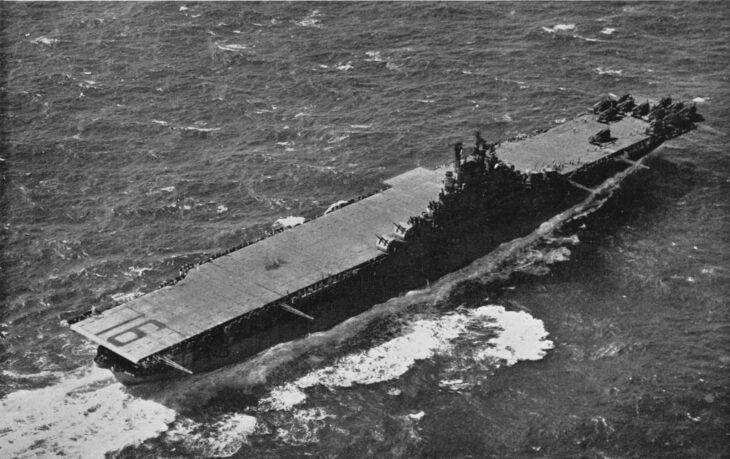
Tokyo Rose broadcasts announced the carrier sunk. It was the first of several false reports, and the ship’s own 1965 cruise book credits the same propaganda voice with giving it a nickname: the Blue Ghost.
_underway_at_sea_c1944.jpg)
The repaired Lexington became Marc Mitscher’s flagship for the fast carrier force in March 1944. After the Truk raid in April, Japanese propaganda declared it sunk a second time, and after an air attack off Guam in June, a third.
In the Battle of Leyte Gulf in October 1944, its aircraft helped sink the battleship Musashi and the carrier Zuikaku, one of the two Japanese carriers whose aircraft had sunk the first Lexington. On November 5, a kamikaze crashed near the island and wrecked most of it, and four days later the crew learned Tokyo had claimed the ship destroyed once more.
Myth: the Blue Ghost wore no camouflage
A popular story says Lexington was the only carrier in the fleet without camouflage, which made it look blue. The ship did look blue, but it was camouflaged: Navy photo records describe its solid Navy Blue paint as camouflage Measure 21. What made Lexington unusual, according to the National Park Service, is that it was the only Essex-class carrier to serve through the war without a dazzle pattern, until a two-tone repaint in 1945.
Lexington ended the war with 11 battle stars and the Presidential Unit Citation. Its last strike of the war was ordered to jettison its bombs and turn back on August 15, 1945, when word of Japan’s surrender arrived.
Nearly 30 Years as the Navy’s Training Carrier
Lexington went into reserve in 1947, then came back on August 15, 1955, rebuilt with an angled flight deck and steam catapults for jets. It was the first carrier to deploy aircraft armed with the Bullpup air-to-surface missile.
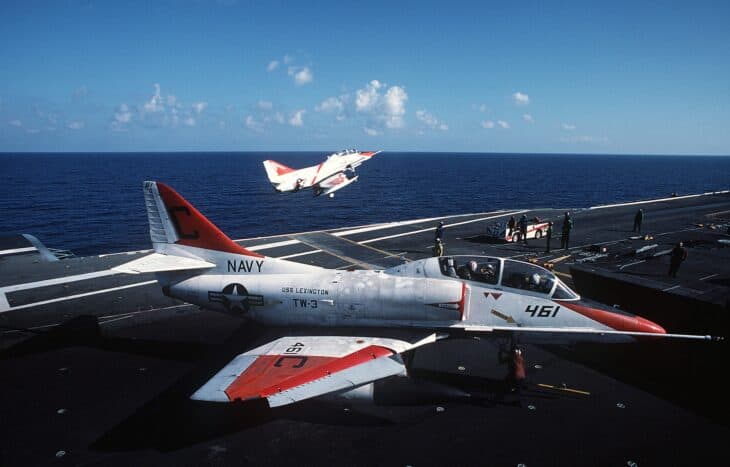
On December 29, 1963, it took over as the Navy’s training carrier at Pensacola, Florida. For most of the next three decades, student pilots flying jets like the A-4 Skyhawk made their first carrier landings on its deck in the Gulf of Mexico.
,_1_April_1989_(6445251).jpg)
The landings added up. Lexington logged its 200,000th arrested landing in October 1967, and the National Park Service puts its lifetime total at more than 493,000 deck landings.
In 1980 it became the first US aircraft carrier with women assigned to its crew. By the end of its career, 273 of its roughly 1,200 crew members were women.
Hollywood used it too. Lexington stood in for USS Yorktown in the 1976 film Midway and played other carriers in the 1988 miniseries War and Remembrance.
The final arrested landing came in March 1991, and the Navy decommissioned Lexington that November. It was the last Essex-class carrier in commission, and its career from 1943 to 1991 was the longest of the class.
Can the USS Lexington Still Sail?
No. By its final year of service, Lexington could no longer operate under its own power.
The carrier arrived at Naval Station Ingleside on January 29, 1992. On June 17, 1992, it was towed to its permanent berth on North Beach in Corpus Christi, and it opened to visitors that October.
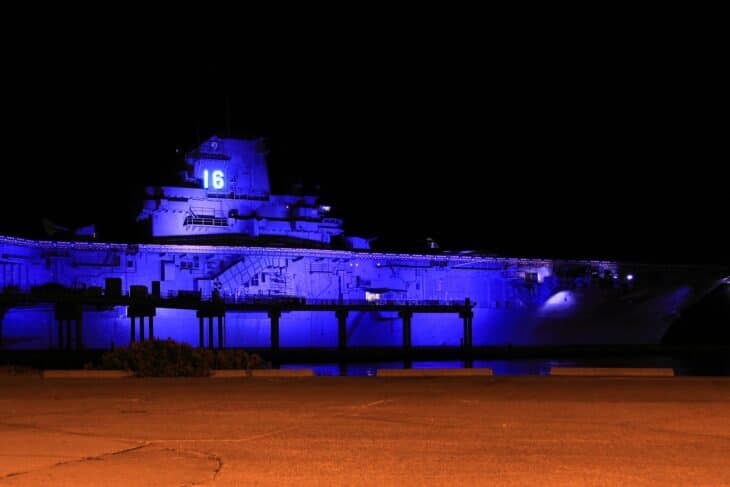

Inside, about 90 percent of the crew and machinery spaces were unchanged from the World War II original, according to its 2001 landmark nomination. Visitors walk the flight deck and the hangar bays, and the ship is one of the anchors of the aviation museums in Texas.
It is also one of only four Essex-class carriers still in existence, alongside Yorktown in South Carolina, Intrepid in New York and Hornet in California. Lexington was laid down and commissioned before the other three, even though its hull number is higher.
None of the Navy’s current carriers carries the Lexington name, and you can see how today’s fleet is used in how many aircraft carriers the US has.
So if you stand on that flight deck in Corpus Christi, you are on the Blue Ghost, the ship Japan kept announcing sunk. The Lady Lex, the one Japan really did sink, is far out in the Coral Sea, two miles straight down.
Sources and references used for research and fact-checking.
- Naval History and Heritage Command, Dictionary of American Naval Fighting Ships, Lexington IV (CV-2) 1927-1942
- Naval History and Heritage Command, USS Lexington (CV-2)
- Naval History and Heritage Command, Dictionary of American Naval Fighting Ships, Lexington V (CV-16)
- National Park Service, National Historic Landmark Nomination: U.S.S. Lexington
- U.S. Navy, via e-yearbook.com, Lexington (CV 16) Naval Cruise Book, 1965
- Pacific Wrecks, USS Lexington (CV-16) Pacific Wrecks profile
- USS Lexington Museum on the Bay, The Museum
- USS Lexington Museum on the Bay, LEX Trivia
- HistoryLink.org, U.S.S. Lexington provides electricity to Tacoma beginning about on December 17, 1929
- Naval Historical Center Online Library, via ibiblio HyperWar, USS Lexington (CV-16), photo 80-G-K-102
- Vintage Aviation News, Paul G. Allen Expedition Discovers the Sunken USS Lexington and Her Aircraft
- Wikipedia, USS Lexington (CV-2)
- Wikipedia, USS Lexington (CV-16)
Get the Newsletter
The latest aviation news and stories sent to your inbox.
About the Author

Tim is the owner and lead editor of AeroCorner since 2019, overseeing aviation content covering aircraft, airlines, airports, and the broader aviation industry. Through years of researching, writing, editing, and publishing aviation-focused content, he has developed extensive practical knowledge of commercial aviation and air travel. Based in Asia and a frequent traveler himself, Tim also brings firsthand passenger experience to AeroCorner’s coverage. Outside of publishing, he has also explored aviation firsthand through hands-on flight training in New Zealand.