

Table of Contents
At 08:43 on the morning of July 2, 1937, a voice came over the radio aboard the Coast Guard cutter Itasca, anchored off a speck of coral in the middle of the Pacific. The operator logged it as received “at maximum strength.”
“We are on the line 157 337,” Amelia Earhart said. “We will repeat message. We will repeat this on 6210 kilocycles. Wait.” Nobody aboard the Itasca ever heard from her again.
Almost 90 years later, she is still among the most famous pilots in history, and her Lockheed Electra has still not been found. The reason has a lot to do with that last sentence. Here is what actually happened on the flight, what the radio calls mean, and what the evidence says about each theory.
What Happened to Amelia Earhart?
Earhart and her navigator, Fred Noonan, disappeared on the most difficult leg of a round-the-world flight: 2,556 miles (4,113 km) of open ocean from Lae, New Guinea, to Howland Island. They never arrived, and no confirmed piece of the aircraft has ever been found.
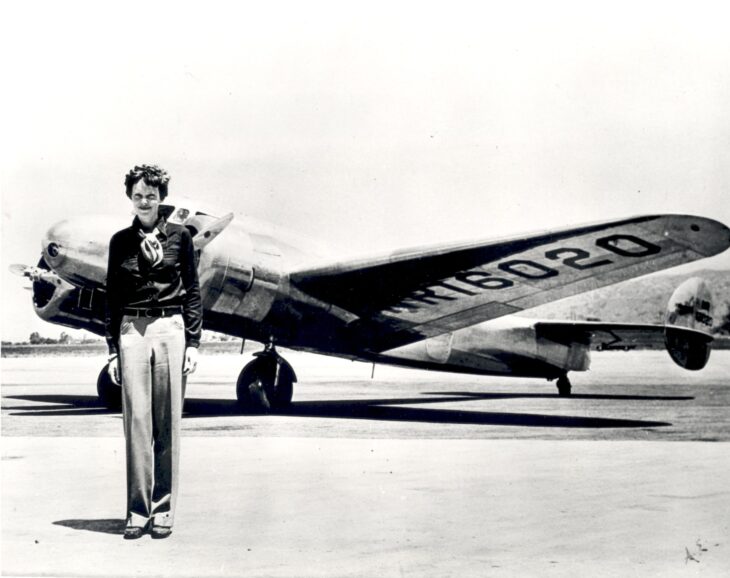

The U.S. government concluded that the Electra ran out of fuel and went into the sea somewhere near Howland. That “crash and sink” explanation is still the most widely accepted. The main rival holds that they landed on an uninhabited atoll to the southeast and died there as castaways. A third, much weaker theory has them captured by the Japanese.
The disappearance at a glance
Date: July 2, 1937. Crew: Amelia Earhart, 39, and navigator Fred Noonan. Aircraft: Lockheed Model 10E Electra, registration NR16020. Leg: Lae, New Guinea, to Howland Island, 2,556 miles. Last message: 08:43 ship’s time, about 20 hours 13 minutes after takeoff. Search: called off July 19, 1937. Declared dead: January 5, 1939. Plane found: no.
The Hardest Leg of the Whole Trip
Earhart was already a household name. In 1932 she had become the first woman to fly solo nonstop across the Atlantic, one of the famous firsts in aviation that made her the best-known flyer of the decade. The world flight was meant to be her last big record.
The aircraft was a twin-engine Lockheed 10E Electra, bought through the Purdue Research Foundation’s Amelia Earhart Fund and nicknamed the “Flying Laboratory.” Its two Pratt and Whitney Wasp engines made 550 horsepower each in normal cruise and 600 horsepower for takeoff, and its tanks held 1,151 US gallons (4,357 liters) of fuel.
The first attempt, flying west, ended on March 20, 1937, when Earhart ground-looped the Electra on takeoff at Luke Field in Hawaii and collapsed its landing gear. After repairs she started again in the opposite direction, leaving Miami on June 1 and reaching Lae on June 29.
By then about 22,000 miles (35,000 km) were behind them and roughly 7,000 miles (11,000 km) were left, all of it over the Pacific. They took off from Lae at 10:00 local time on July 2 with about 1,100 gallons aboard, for a flight planned at 18 to 20 hours.
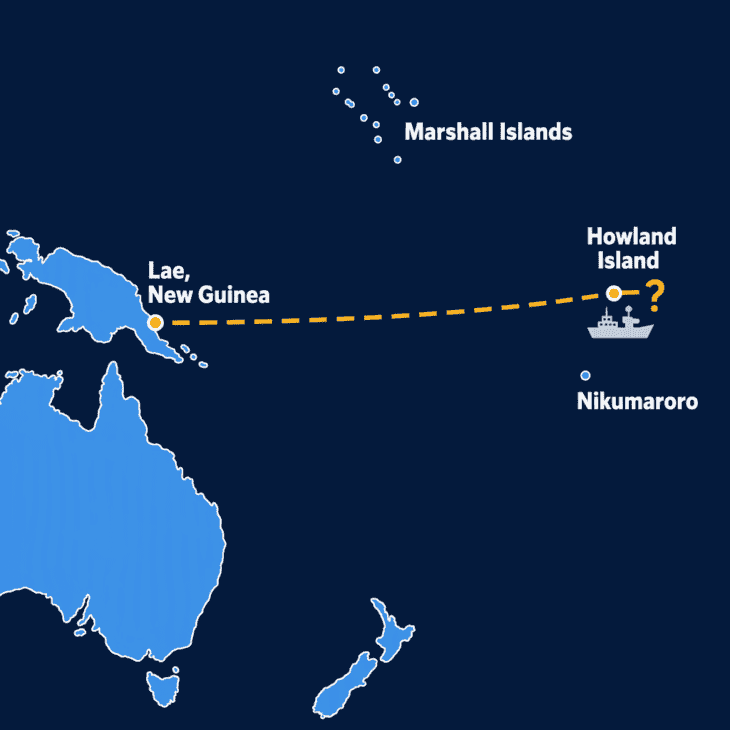
The target was tiny. Howland Island is under 2 miles (3 km) long and about 10 feet (3 m) high, a low strip of coral that is easy to miss from the air. The Itasca waited offshore to talk them in by radio.
Why the Radio Plan Failed
Finding Howland depended on radio direction finding: one side transmits, the other swings an antenna until the signal fades, and that “minimum” gives a bearing. The system broke down at almost every link.
In Miami in late May, Earhart had the Electra’s 250-foot trailing wire antenna removed. That antenna was what let the plane work 500 kilocycles, the standard marine frequency of the day. Without it, she was left with voice on 3105 and 6210 kilocycles.
The Itasca sent its homing signal in Morse code on 7500 kilocycles. Earhart heard it. At 08:00 she radioed, as logged, “we received your signals but unable to get a minimum, please take bearing on us and answer 3105 with voice.” Her direction finder could not take a bearing on a frequency that high.
Neither side ever got a usable bearing on the other, and Morse was no fallback: researchers at TIGHAR say Earhart could not read it well enough to follow the messages.
TIGHAR’s analysis of film of the Lae takeoff also suggests the antenna masts under the belly were missing by the end of the takeoff roll, a loss that, if real, would have handicapped her radio before the flight even began.
At 07:42 the Itasca logged her saying, with the abbreviations spelled out, “we must be on you but cannot see you but gas is running low, been unable to reach you by radio, we are flying at 1000 feet.” A second operator noted “only 1/2 hour left.” Then came the line 157 337.
What “the Line 157 337” Actually Means
Noonan was a celestial navigator, and near dawn the only body he could shoot was the rising sun. A single sun sight does not give a position. It gives a line of position, always at right angles to the direction of the sun.
That morning the sun rose at a bearing of 67 degrees. A line at right angles to it runs 157 degrees one way and 337 degrees the other, which is exactly what Earhart reported. The classic technique was to slide that line so it passed through Howland, then fly along it until the island appeared.
The catch is that the line tells you nothing about where along it you are. “We are on the line 157 337” meant they believed Howland was somewhere ahead on that line, but not whether it lay to the northwest or the southeast. Radio bearings were supposed to answer that, and they never came.
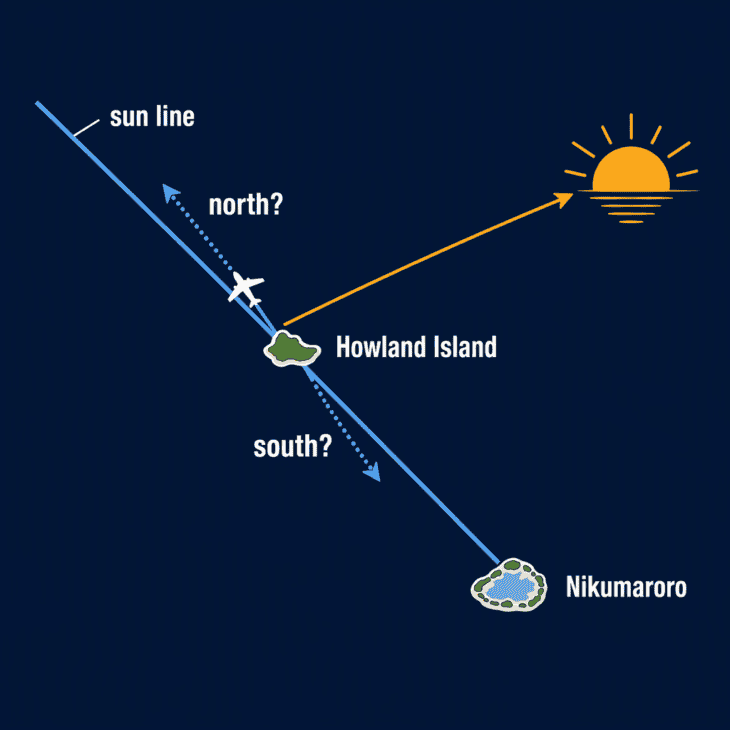
Every serious theory starts from that line. Crash and sink assumes they flew up and down it near Howland until the fuel ran out. The castaway theory assumes they flew southeast along it, toward an island the line passes within sight of.
Theory One: Out of Fuel and Into the Sea Near Howland
This was the government’s conclusion in 1937, and it remains the default. The search ran until July 19, using the Itasca, the battleship USS Colorado with its three floatplanes, and the aircraft carrier USS Lexington with 63 aircraft. Colorado’s floatplanes alone covered 25,490 square miles between July 7 and 12. They found nothing.
.jpg)
The modern champion of the theory was the aviator Elgen Long, whose 1999 book argued that the Electra ditched close to Howland when its fuel ran out. The company Nauticos took up the search, sweeping the deep seabed near the island with sonar on expeditions in 2002, 2006 and 2017.
Nauticos puts the total surveyed there at 3,610 square nautical miles (about 4,800 square miles, or 12,400 km²), including a 2009 search by the Waitt Institute. The bottom lies at depths of nearly 18,000 feet (5,500 m), and the wreck, if it is there, would be a small target in a very large dark place.
The Electra-shaped sonar image was a rock
In January 2024, the company Deep Sea Vision released a sonar image from about 100 miles from Howland that looked like a plane on the seabed. Nauticos pointed out that it seemed to have swept wings and no engine nacelles, unlike an Electra. In November 2024 the team went back and confirmed it was a natural rock formation more than 16,000 feet down.
The weakness of the theory is the one it cannot fix: after more than two decades of sonar work, there is still no wreck. Supporters answer that the search box is huge and the sea floor is rough, which is true, but it is still an argument from absence.
Theory Two: A Landing on Nikumaroro
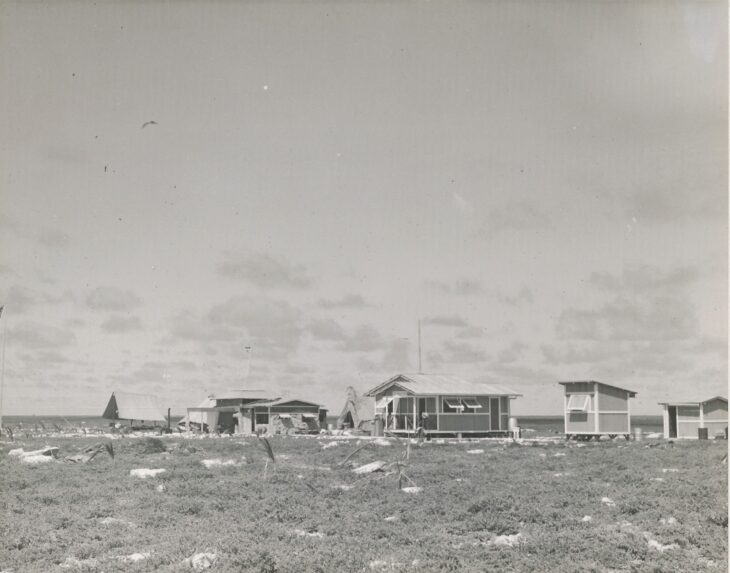
Nikumaroro, then called Gardner Island, is an uninhabited atoll about 350 nautical miles (400 miles, or 650 km) southeast of Howland. The 157-degree end of Earhart’s line passes within sight of it. The International Group for Historic Aircraft Recovery, known as TIGHAR, has argued for more than three decades that the Electra landed on its reef flat.


The case rests on three kinds of evidence, and the first is radio.
TIGHAR examined 120 reported signals heard in the days after the disappearance and in 2012 judged 57 of them credible. If they were genuine, the Electra was sitting somewhere on land, not under the sea. The Navy at the time dismissed them all as hoaxes or mistakes.
The second is bones. In 1940 a work party on the island found a human skull, and a search ordered by the colonial official Gerald Gallagher turned up more bones, part of a shoe judged to be a woman’s, and a sextant box.
In 1941 a doctor in Fiji, D. W. Hoodless, measured the bones and concluded they belonged to a stocky man. The bones were later lost.
In 2018 the anthropologist Richard Jantz reanalyzed Hoodless’s measurements against Earhart’s estimated dimensions and concluded she was more similar to the bones than 99 percent of individuals in a large reference sample. Critics point out the obvious limit, which Jantz acknowledges: without the bones themselves there can be no positive identification.
The third is artifacts, including a piece of aluminum found in 1991 that TIGHAR believes matches a patch fitted to the Electra in Miami. That match is disputed. In 2019 Robert Ballard, who found the Titanic, searched the waters around the whole island down to 750 meters (2,460 feet) and saw no sign of the plane.
The next search sails October 7, 2026
A 16-person team from the Archaeological Legacy Institute and Purdue University, the school that helped pay for the Electra, plans to sail from Tarawa to Nikumaroro on October 7, 2026. Its target is the Taraia Object, an unidentified shape in the lagoon spotted in 2020 satellite imagery and visible in aerial photos as far back as 1938. As of October 2, 2026 the team had not yet sailed, and nothing has been identified.
Theory Three: Captured by the Japanese
This theory holds that Earhart and Noonan came down in the Japanese-held Marshall Islands, far to the northwest, and died in custody. It rests mostly on witness accounts collected decades later, and most researchers regard it as implausible.
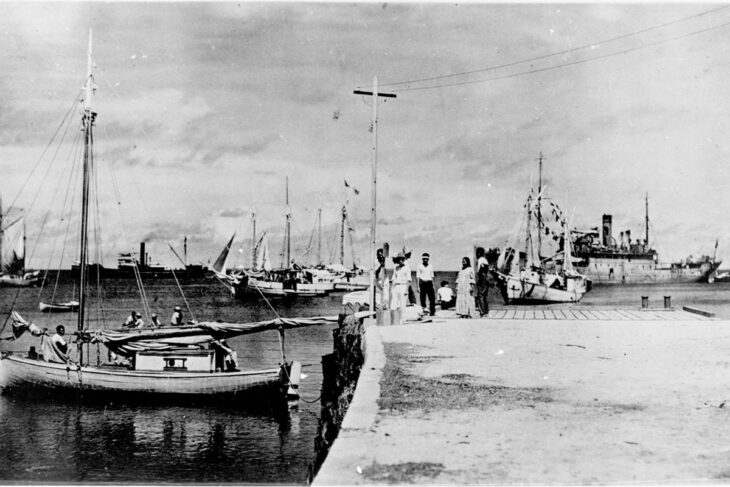
Its biggest moment was a 2017 History channel documentary built around a photo of a dock on Jaluit Atoll that supposedly showed the two fliers. Within days, the Japanese researcher Kota Yamano found the same photograph in a travelogue published in 1935, two years before they vanished. He said the search took him about 30 minutes.

In November 2025 the National Archives released 4,624 pages of government records on the disappearance. Among them were telegrams and memos discounting rumors that Earhart had been taken captive and executed. No smoking gun for capture turned up.
Myth: Earhart survived and lived under another name
A 1970 book, Amelia Earhart Lives, claimed she had returned to the US and was living as a woman named Irene Bolam. Bolam sued for $1.5 million. The publisher, McGraw-Hill, withdrew the book and settled with her out of court.
How the Three Theories Compare
Put side by side, the theories are less a three-way contest than one strong default, one serious challenger, and one theory that keeps losing its best evidence.
| Theory | Main evidence for | Main problem | Searched by |
|---|---|---|---|
| Crash and sink near Howland | Fuel running low at 07:42, strong final signal suggesting she was close | No wreck after decades of deep-sea sonar | Nauticos, Waitt Institute, Deep Sea Vision |
| Castaway on Nikumaroro | The 157-degree line passes the atoll; post-loss radio calls; the 1940 bones | The bones are lost; no artifact proven to come from the Electra | TIGHAR, Ballard (2019), Purdue and ALI (2026) |
| Captured by the Japanese | Later witness accounts in the Marshall Islands and Saipan | Its key photo dates from 1935; released records discount it | Documentary makers and private researchers |
Earhart’s Electra is the best-known entry on the list of planes that disappeared and were never found, and the reason is the same as for most of the others. Over deep ocean, with no wreckage on the surface, there was nothing to anchor a search, and every theory since has been an argument about which way to read one line.
So when someone says the mystery has been solved, ask what was actually found. Until a piece of NR16020 comes up with a part number on it, the honest answer is the one in the Itasca’s log: they were on the line 157 337, somewhere.
Sources and references used for research and fact-checking.
- Smithsonian National Air and Space Museum, Answering Your Questions About Earhart's Disappearance (Except the Big One)
- Smithsonian National Air and Space Museum, Amelia Earhart
- Wikipedia, Amelia Earhart
- U.S. Naval Institute, Naval History, Amelia Didn't Know Radio
- TIGHAR, The Final Flight, Parts 1, 3 and 4
- TIGHAR, Navigation FAQ
- TIGHAR, The Lost Antenna (Bulletin 20)
- This Day in Aviation, Lockheed 10E Electra NR16020 (tag 1055)
- Purdue University, Amelia Earhart: Aviator. Legend. Boilermaker.
- National Naval Aviation Museum, Naval Aviation and the Search for Amelia Earhart
- Nauticos, Response to Deep Sea Vision's Sonar Target
- NBC News, Sonar image believed to show Amelia Earhart's plane was a rock formation
- Purdue University, ALI-Purdue expedition to search for Amelia Earhart's plane will depart in October
- NPR, Amelia Earhart's lost plane may have been found
- Forensic Anthropology (Richard Jantz, 2018), TIGHAR copy, Amelia Earhart and the Nikumaroro Bones
- NBC News, Credible Amelia Earhart radio signals were ignored as bogus
- Wikipedia, Nikumaroro
- National Geographic, Tantalizing clue marks end of Amelia Earhart expedition
- National Geographic, Amelia Earhart photo discredited
- Purdue University, 1 week out: Countdown to the search for Amelia Earhart's plane begins
- Cyprus Mail (Reuters), US National Archives releases Amelia Earhart records
- Wikipedia, The International Group for Historic Aircraft Recovery
Get the Newsletter
The latest aviation news and stories sent to your inbox.
About the Author

Tim is the owner and lead editor of AeroCorner since 2019, overseeing aviation content covering aircraft, airlines, airports, and the broader aviation industry. Through years of researching, writing, editing, and publishing aviation-focused content, he has developed extensive practical knowledge of commercial aviation and air travel. Based in Asia and a frequent traveler himself, Tim also brings firsthand passenger experience to AeroCorner’s coverage. Outside of publishing, he has also explored aviation firsthand through hands-on flight training in New Zealand.