

Table of Contents
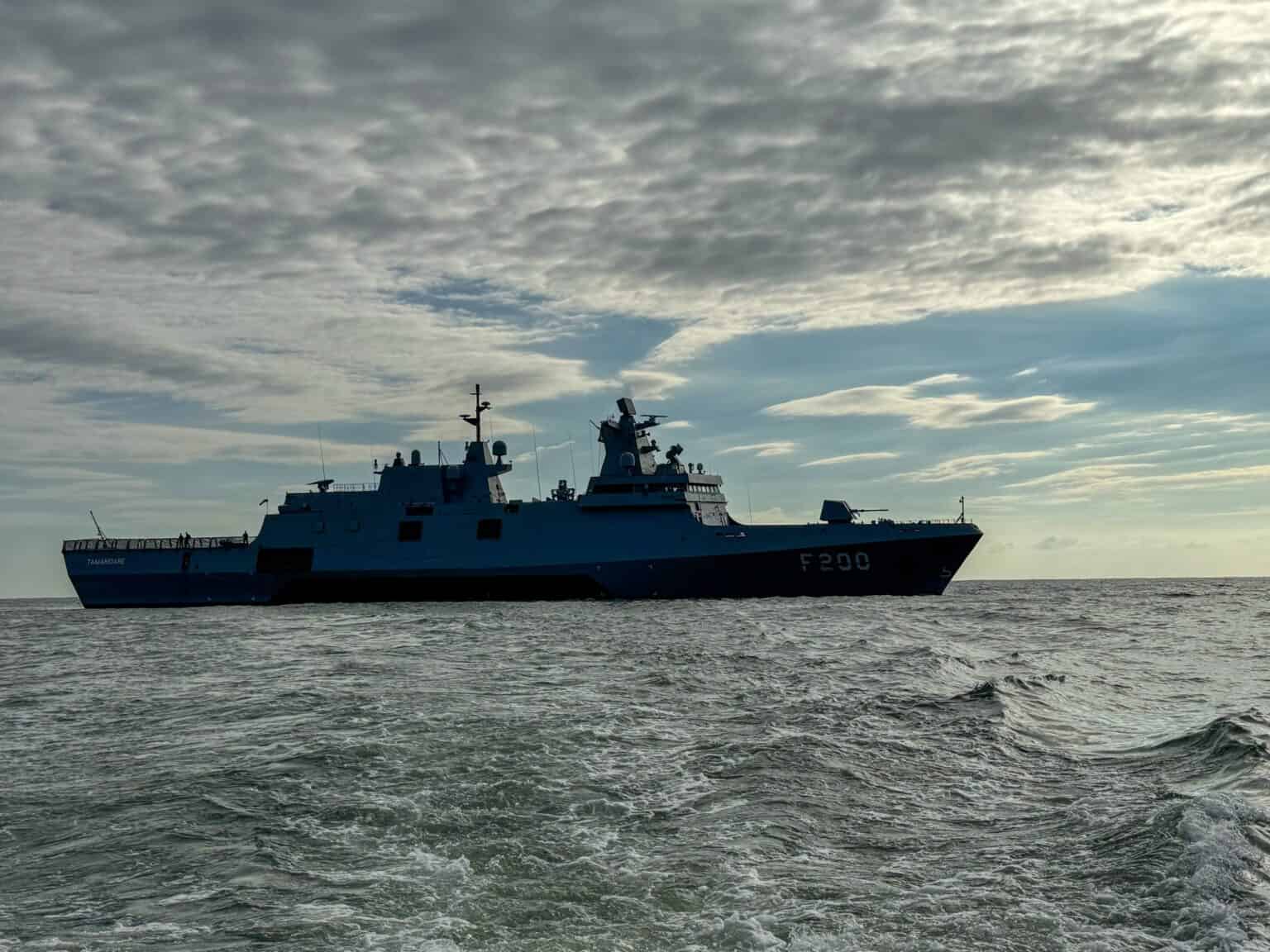
The most powerful ships in the Brazilian Navy are its three Riachuelo-class submarines, French Scorpène designs built in Brazil and commissioned between 2022 and 2025. Right behind them is Tamandaré, the first of a new class of stealth frigates, commissioned on April 24, 2026.
The biggest ship is the flagship Atlântico, the former HMS Ocean, which Brazil calls a multipurpose aircraft carrier. It operates helicopters only, and the navy’s only fixed-wing jets, a handful of modernized A-4 Skyhawks, fly from a base on land.
The Marinha do Brasil had 77,216 personnel in 2026, about 16,000 of them marines. This list ranks every major ship class by fighting value as of November 2026, then covers the amphibious ship, frigates and nuclear submarine on the way.
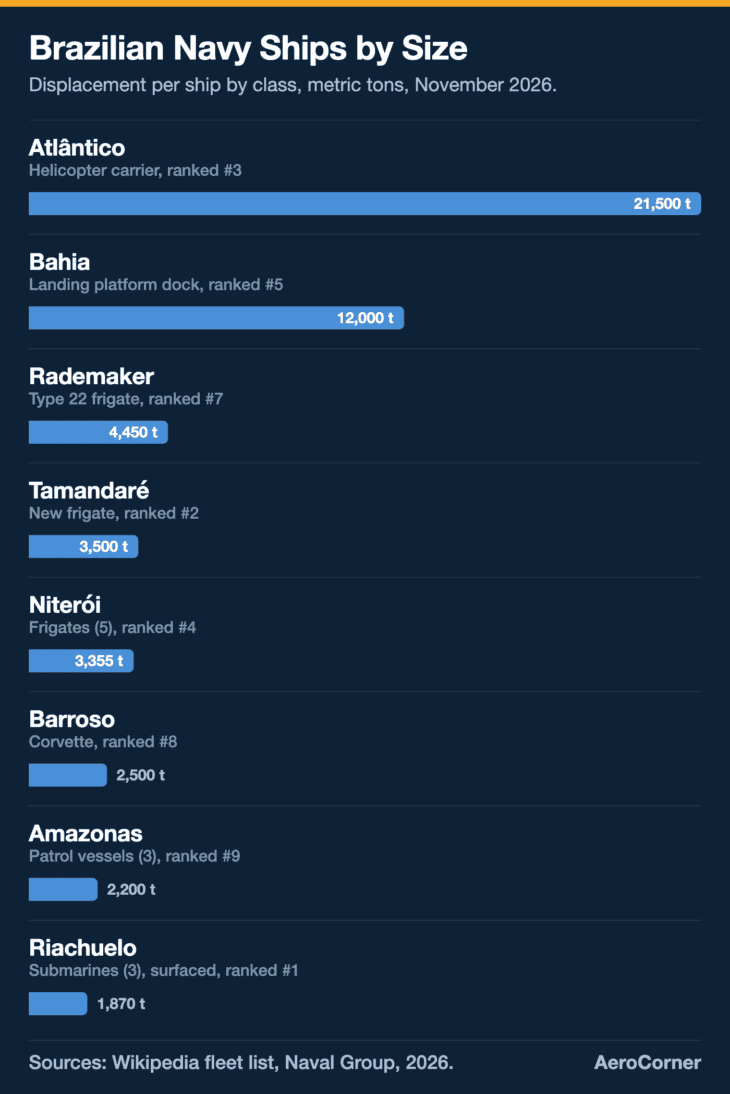
| Rank | Class | Type | Ships | Displacement (metric tons) |
|---|---|---|---|---|
| 1 | Riachuelo | Attack submarine | 3, plus 1 on trials | 1,870 |
| 2 | Tamandaré | Frigate | 1, plus 3 building | 3,500 |
| 3 | Atlântico | Helicopter carrier | 1 | 21,500 |
| 4 | Niterói | Frigate | 5 | 3,355 |
| 5 | Bahia | Landing platform dock | 1 | 12,000 |
| 6 | Tupi and Tikuna | Attack submarine | 2 | 1,440 to 1,580 |
| 7 | Rademaker | Frigate | 1 | 4,450 |
| 8 | Barroso | Corvette | 1 | 2,500 |
| 9 | Amazonas | Offshore patrol vessel | 3 | 2,200 |
How this ranking works
Each class is ranked by the fighting value it adds in November 2026: its weapons and sensors, its age, whether it works today, and how many Brazil has. Counts are ships in commission. Ships still being built, river and coastal patrol boats, minesweepers, survey ships, tankers and training ships sit outside the ranking.
1. Riachuelo Class: The Scorpène Submarines
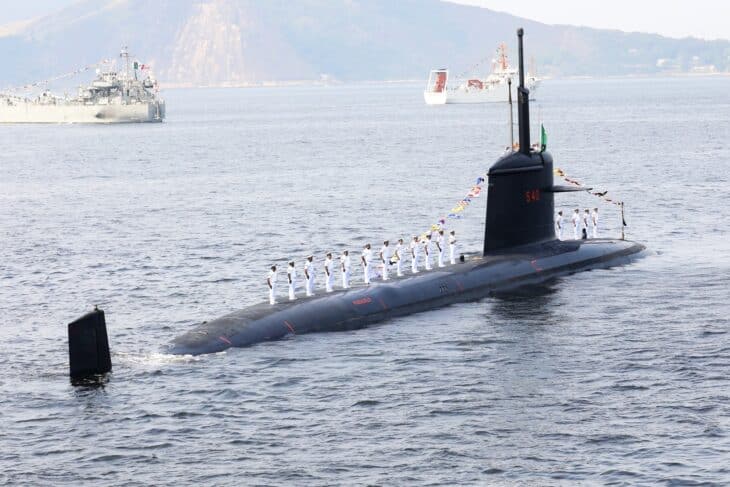

Riachuelo was commissioned in September 2022 and Humaitá in January 2024. The third boat, Tonelero, was accepted at the Itaguaí naval base on November 26, 2025, the same day the fourth, Almirante Karam, was launched.
Each is 236 feet (72 m) long, displaces 1,870 metric tons surfaced and can dive to 984 feet (300 m). Six tubes carry up to 18 weapons, including SM39 Exocet anti-ship missiles, which only this class of Brazilian submarine carries.
They rank first because a quiet modern submarine is the hardest thing in the South Atlantic for an enemy to find. They also carry the program that matters most to Brazil: the 2008 deal with France transferred the know-how to build submarine hulls at home.
How these diesel-electric boats compare with the nuclear giants is in our ranking of the largest submarines in the world.
2. Tamandaré Class: The New Stealth Frigates
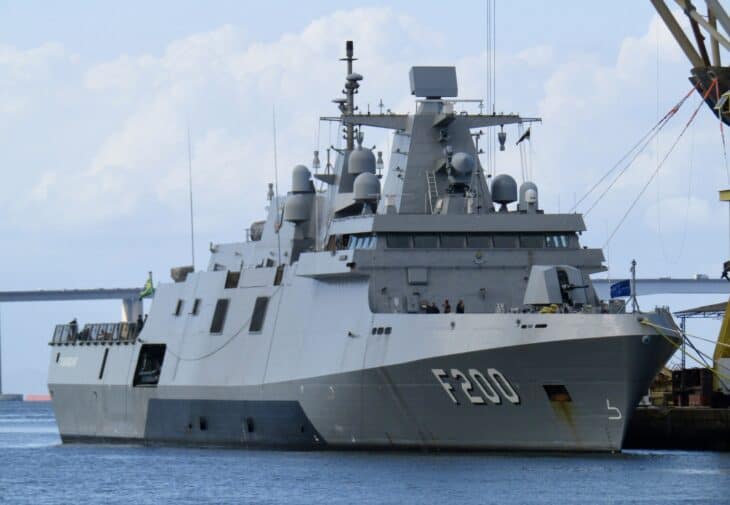

Tamandaré was commissioned on April 24, 2026, at the lead of a four-ship class built in Itajaí by the Águas Azuis consortium of TKMS, Embraer and Atech. The design is the German MEKO A-100, adapted for Brazil.
It is 352 feet (107.2 m) long, displaces about 3,500 metric tons and has a crew of about 130. Its weapons are a 76 mm gun, a 30 mm close-in gun, 12 Sea Ceptor air defense missiles in vertical launchers, 12 anti-ship missiles and two triple torpedo launchers.
It has the most modern air defense in the fleet, which is why one new ship outranks five older frigates.
Its sisters are coming: Jerônimo de Albuquerque, launched on August 26, 2025, is due in the first half of 2027, Cunha Moreira was launched on June 26, 2026, for 2028, and Mariz e Barros is due in 2029.
Four frigates, then maybe four more
On the day Tamandaré was commissioned, Brazil’s Ministry of Defense, TKMS and Embraer signed a memorandum of understanding for a second batch of four more ships of the same class. It is an intent, not a contract, but it would give Brazil eight modern frigates in place of today’s 1970s fleet.
3. Atlântico: The Flagship
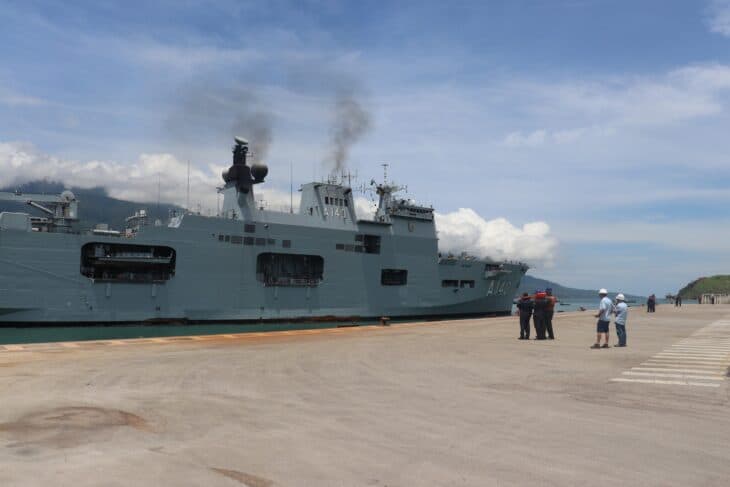

Atlântico served the Royal Navy as HMS Ocean from 1998 until March 27, 2018. Brazil bought it for £84.6 million and commissioned it on June 29, 2018.
At 667 feet (203.4 m) and about 21,500 metric tons, it is by far the largest ship in the fleet. It can carry up to 18 helicopters, and on November 12, 2020, the navy reclassified it from multipurpose helicopter carrier to multipurpose aircraft carrier, to cover drones and future tiltrotors.
It ranks third, not first, because it fights through what it carries. Its own armament is four 30 mm guns, and the Phalanx close-in weapons it had in British service were removed before the handover.
4. Niterói Class: Five 1970s Frigates
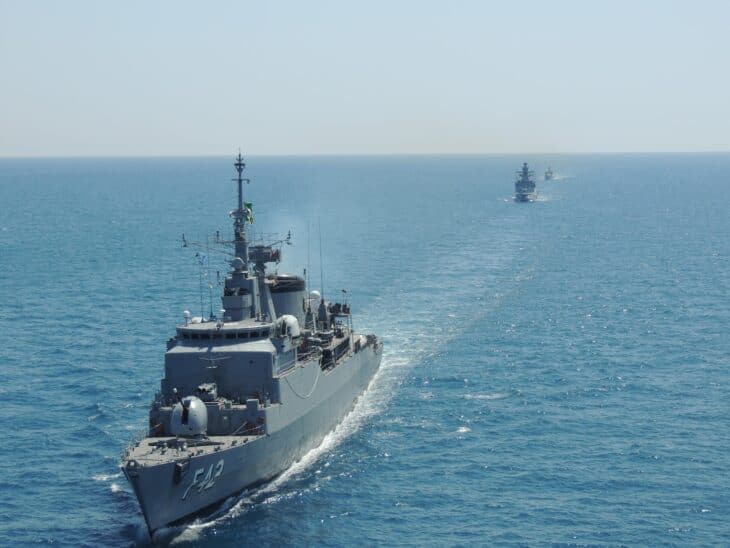

Defensora, Constituição, Liberal, Independência and União were launched between 1974 and 1977, three by Vosper Thornycroft in Britain and two at the Rio de Janeiro Navy Arsenal. Each is 424 feet (129.2 m) long, displaces 3,355 metric tons and carries a crew of 217 and a Super Lynx helicopter.
They are still the backbone of the escort force, with MM40 Exocet Block 2 anti-ship missiles, Sea Wolf or Aspide air defense missiles, torpedoes and anti-submarine rockets. But they are about 50 years old, and the plan is to move the survivors to patrol duties as the Tamandaré frigates take over.
5. Bahia: The Landing Dock Ship
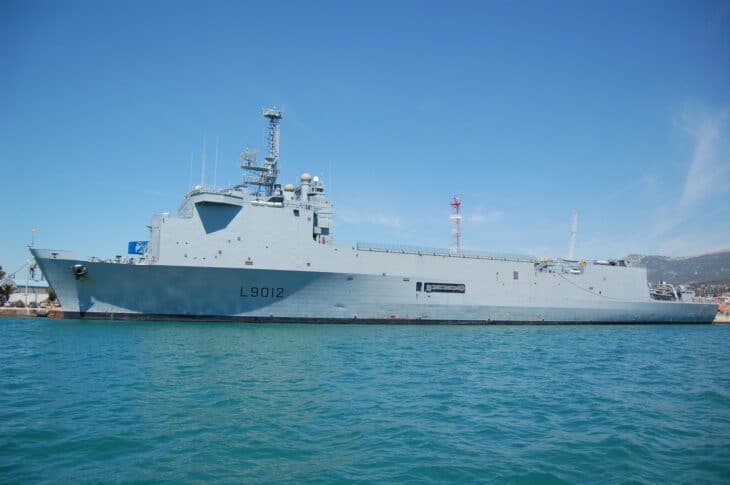

Bahia is the former French Navy Siroco, a Foudre-class landing platform dock commissioned in France in 1998. Brazil acquired it on August 7, 2015, and commissioned it that December 17.
It is 551 feet (168 m) long, makes 21 knots and can operate four helicopters, Super Cougars or Seahawks, from its deck.
With Atlântico, it carries the marines’ landing force. The navy’s one remaining tank landing ship, Almirante Sabóia, was launched in 1966.
6. Tupi and Tikuna: The Last Type 209 Submarines
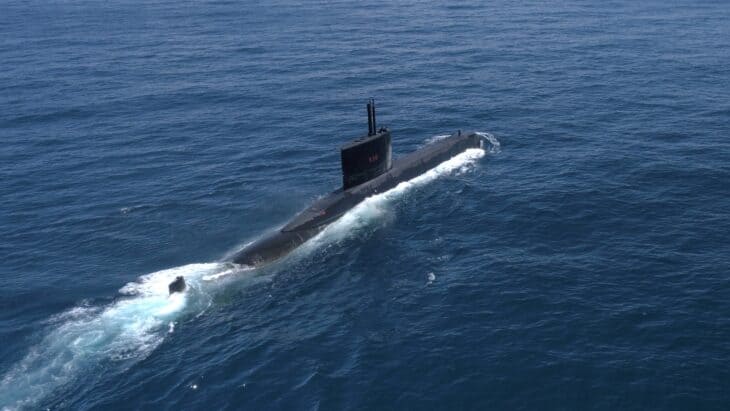

Tupi was built in Germany by HDW and launched in 1987. Tikuna, a modified version built at the Rio de Janeiro Navy Arsenal, was launched in 2005.
Both are German Type 209 designs of about 1,440 to 1,580 metric tons, armed with eight torpedo tubes for Mk 48 and Tigerfish torpedoes but no missiles. The rest of their class has already been retired, which leaves these two as the oldest boats in the submarine force.
7. Rademaker: The Last Ex-British Type 22
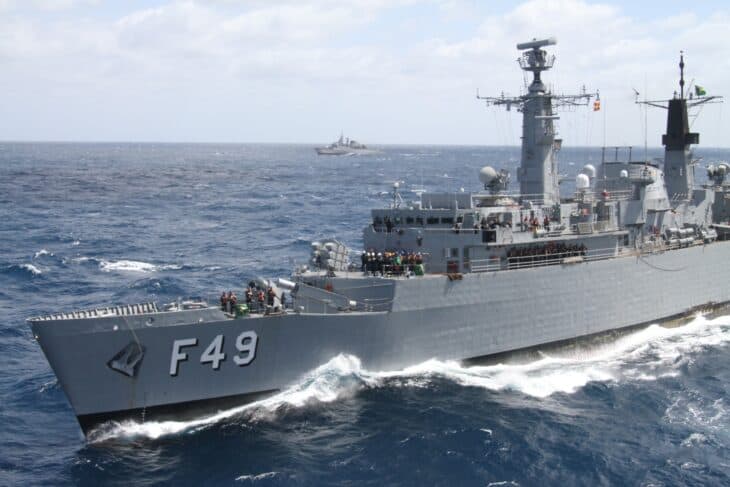

Rademaker is the former HMS Battleaxe, launched in 1977 and in Royal Navy service until August 30, 1996. It is the last of the Greenhalgh class, the ex-British Type 22 frigates Brazil bought after their Royal Navy service.
At 430 feet (131.2 m) and about 4,450 metric tons, it is the largest escort Brazil has. It carries Exocet missiles and two triple torpedo tubes, but its age and a single hull of its kind put it below the Niterói class.
8. Barroso: The Only Corvette Left
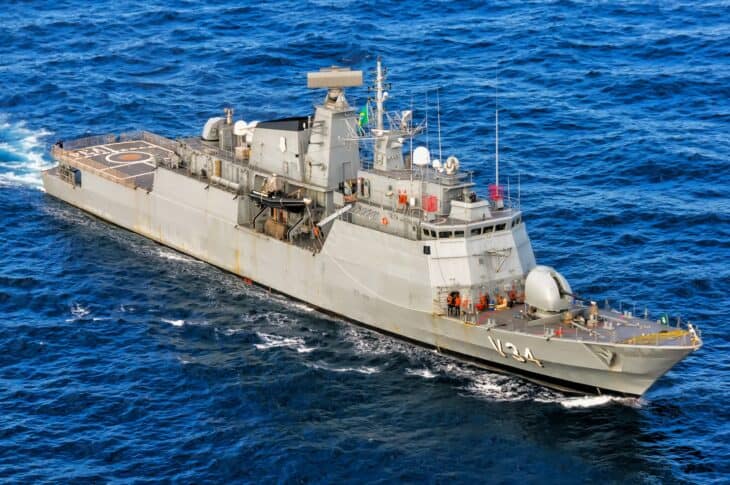

Barroso was launched on December 20, 2002, and commissioned on August 19, 2008, an improved development of the Brazilian-designed Inhaúma class. It is 339 feet (103.4 m) long, makes more than 27 knots and carries a Super Lynx.
It became the navy’s only corvette in June 2026, when Júlio de Noronha, the last of the four Inhaúmas, was taken out of service. Those ships were the first warships Brazil set out to design and build largely by itself, from a contract signed in 1981.
9. Amazonas Class: The Offshore Patrol Vessels
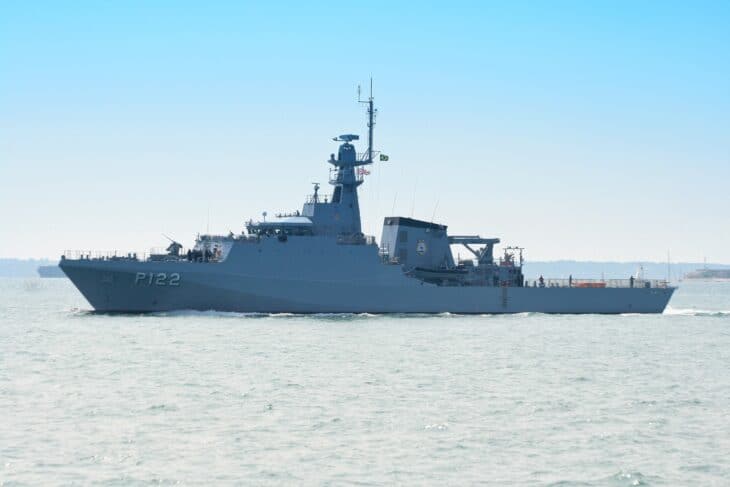

Amazonas, Apa and Araguari were built by BAE Systems in Britain and launched in 2009 and 2010. Each is 297 feet (90.5 m) long, makes 25 knots with a crew of 80 and is armed with a 30 mm cannon.
They are not warships in the full sense, but they do the job the navy does most days: patrolling the waters Brazil calls the Blue Amazon, its exclusive economic zone and continental shelf. They lead a patrol force of 23 offshore vessels, most of them much smaller.
Does Brazil still have an aircraft carrier?
Not one that launches jets. The last was São Paulo, the former French Foch, withdrawn in 2017 and scuttled in the Atlantic on February 3, 2023, about 220 miles (350 km) off the coast, after Turkey refused to let it dock for scrapping. Atlântico carries the aircraft carrier label, but it flies helicopters.
What Brazil Is Building
The next big ship is already Brazilian. HMS Bulwark, a 577-foot (176 m), 19,560-ton Albion-class landing platform dock, was acquired on September 10, 2025, and will become NDM Oiapoque.
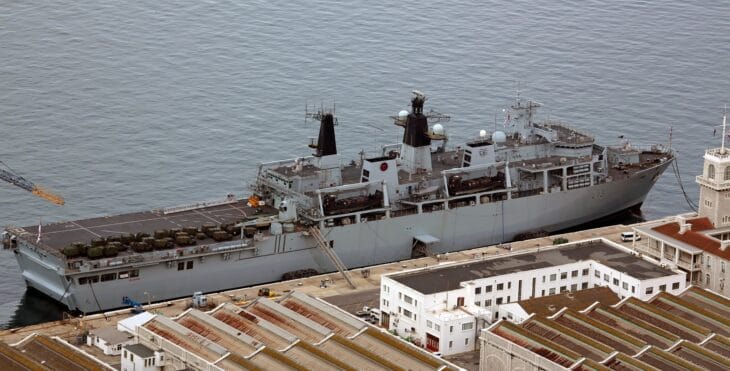

The UK Ministry of Defence announced the transfer on August 28, 2026, and Brazil planned to commission the ship in 2026. Its sister, HMS Albion, stays at Devonport pending disposal.
The long-term prize is Álvaro Alberto, Brazil’s first nuclear-powered submarine, about 328 feet (100 m) long and 6,000 metric tons.
In March 2026 the navy moved its keel laying to 2027 and its launch to about 2037, blaming the budget, reactor prototype testing and talks with the IAEA. In a June 22 letter to Congress, the Defense Ministry put the launch at 2038.
Where all this leaves Brazil among the world’s fleets is in our list of the largest navies in the world.
Bigger country, smaller fleet
By total displacement, Brazil had the world’s 22nd largest navy in 2025, at 135,737 metric tons. That put it ahead of Argentina but behind both Peru and Chile, countries with a fraction of Brazil’s coastline and population.
Brazilian Naval Aviation
The navy’s air arm is based at São Pedro da Aldeia, in Rio de Janeiro state, and had 76 aircraft in 2022. Almost all of them are helicopters: S-70B Seahawks for submarine hunting, Super Lynx upgraded to the AH-11B standard, Super Cougar transports, Esquilo utility helicopters and ScanEagle drones.
The exception is the AF-1, Brazil’s modernized A-4 Skyhawk, with about six still in service. Argentina retired its A-4AR Fightinghawks in May 2026, which left the Brazilian Navy as the last military operator of the Skyhawk.
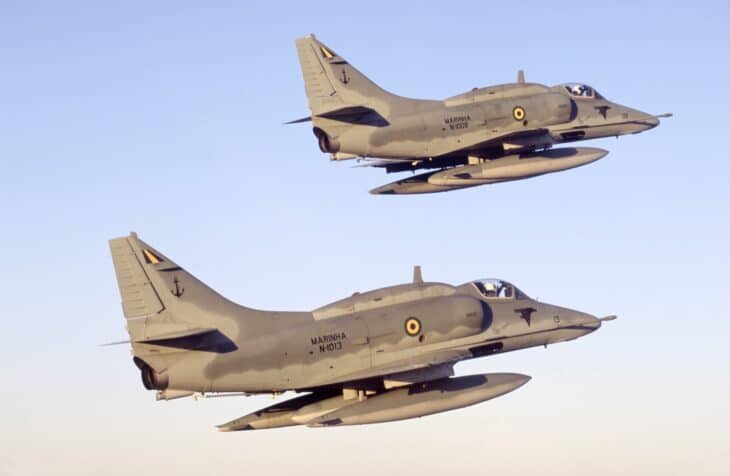

With no carrier left to fly from, the Skyhawks now operate only from land. Maritime patrol planes belong to the Air Force, covered in our guide to the Brazilian Air Force.
A Navy Built Around One Coast
The Brazilian Navy dates from 1822, the year Brazil became independent, and it fought to expel the last Portuguese forces from South America. Its anniversary is June 11, the date of the Battle of Riachuelo.
Today it is also Brazil’s coast guard and maritime authority. The fleet is based on Mocanguê Island in Niterói, the submarines at Itaguaí and naval aviation at São Pedro da Aldeia, all in Rio de Janeiro state.
Most of that fleet dates from programs of the 1970s and 1980s. The submarines, frigates and landing ship now arriving are the first wholesale renewal in two generations.
FAQ
Sources and references used for research and fact-checking.
- Wikipedia, Brazilian Navy
- Wikipedia, List of active Brazilian Navy ships
- Naval Technology, Brazilian Navy accepts third Scorpène-class submarine Tonelero
- Baird Maritime, Brazilian Navy commissions locally built stealth frigate
- Navy Leaders, Brazilian Navy Commissions New Frigate And Plans Four More
- Janes, Third Brazilian Tamandaré-class frigate is launched
- Wikipedia, Brazilian frigate Tamandaré
- Wikipedia, NAM Atlântico
- Wikipedia, Niterói-class frigate
- Wikipedia, French ship Siroco (L9012)
- Wikipedia, HMS Battleaxe (F89)
- Wikipedia, Brazilian corvette Barroso
- The Rio Times, Brazil Inhauma Corvette: Last of a Class Bows Out
- Wikipedia, Amazonas-class offshore patrol vessel
- Wikipedia, Brazilian aircraft carrier São Paulo
- UK Ministry of Defence, HMS Bulwark to transfer to Brazilian Navy as UK turns to future of amphibious ships
- Wikipedia, NDM Oiapoque (ex-HMS Bulwark)
- Wikipedia, Brazilian submarine Álvaro Alberto
- The Rio Times, Brazil Nuclear Submarine Delayed to 2038 as Funding Falls Short
- Wikipedia, Brazilian Naval Aviation
- iProfesional, Sólo quedan los F-16: tras baja de un emblema aéreo, ¿qué harán con los A-4AR desactivados?
Get the Newsletter
The latest aviation news and stories sent to your inbox.
About the Author

Tim is the owner and lead editor of AeroCorner since 2019, overseeing aviation content covering aircraft, airlines, airports, and the broader aviation industry. Through years of researching, writing, editing, and publishing aviation-focused content, he has developed extensive practical knowledge of commercial aviation and air travel. Based in Asia and a frequent traveler himself, Tim also brings firsthand passenger experience to AeroCorner’s coverage. Outside of publishing, he has also explored aviation firsthand through hands-on flight training in New Zealand.