

Table of Contents
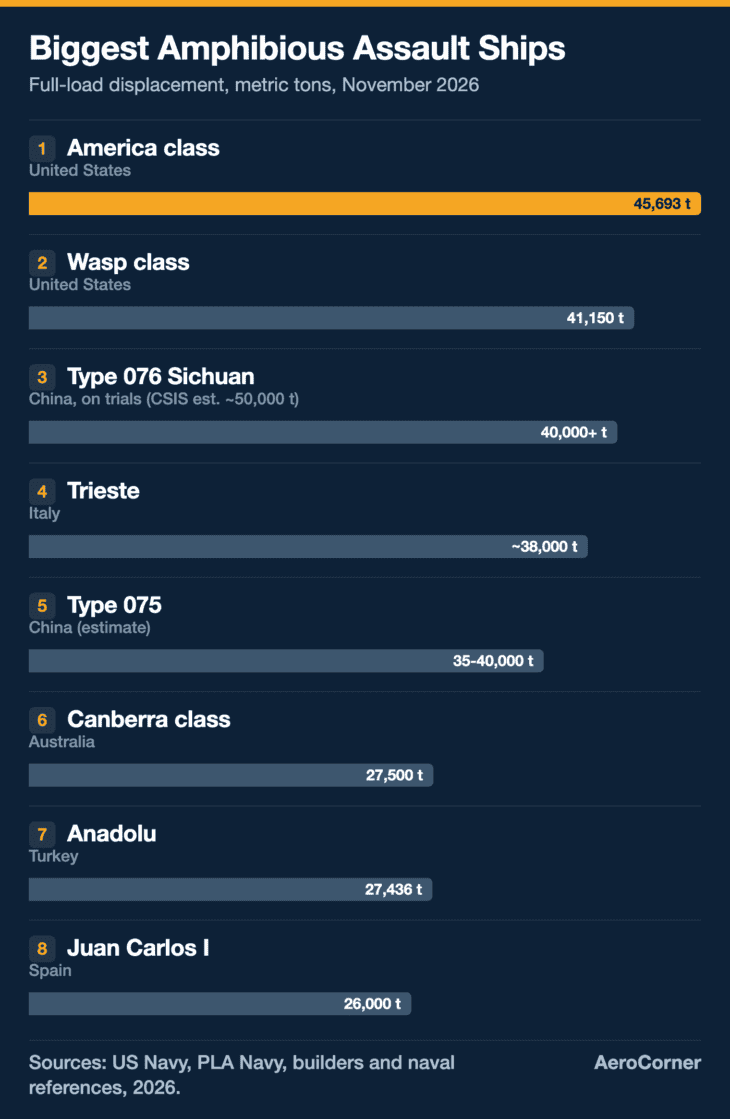
The biggest amphibious assault ship in the world is the US Navy’s America class, at 45,693 metric tons (44,971 long tons) fully loaded. That makes it heavier than France’s Charles de Gaulle, the only nuclear-powered aircraft carrier outside the US Navy.
An amphibious assault ship is a flat-topped warship built to put Marines ashore by helicopter, tiltrotor and landing craft. Several of them also fly F-35B jump jets, which is why navies call them everything except what they look like.
This list ranks every class with a full-length flight deck that is in service or on sea trials as of November 2026, by full-load displacement. That is the one size measure every navy publishes in some form.
| Rank | Class (navy) | Full-load displacement | In service | Fixed-wing aircraft |
|---|---|---|---|---|
| 1 | America class (US) | 45,693 t | 2 (3 more building or funded) | F-35B |
| 2 | Wasp class (US) | 41,150 t | 7 | F-35B, AV-8B |
| 3 | Type 076 Sichuan (China) | 40,000+ t (official), ~50,000 t (CSIS est.) | 0 (1 on trials) | Catapult-launched drones |
| 4 | Trieste (Italy) | ~38,000 t | 1 | F-35B |
| 5 | Type 075 (China) | 35,000 to 40,000 t (est.) | 4 | None, helicopters only |
| 6 | Canberra class (Australia) | 27,500 t | 2 | None, helicopters only |
| 7 | Anadolu (Turkey) | 27,436 t | 1 | Bayraktar TB3 drones |
| 8 | Juan Carlos I (Spain) | 26,000 t | 1 | AV-8B Harrier II |
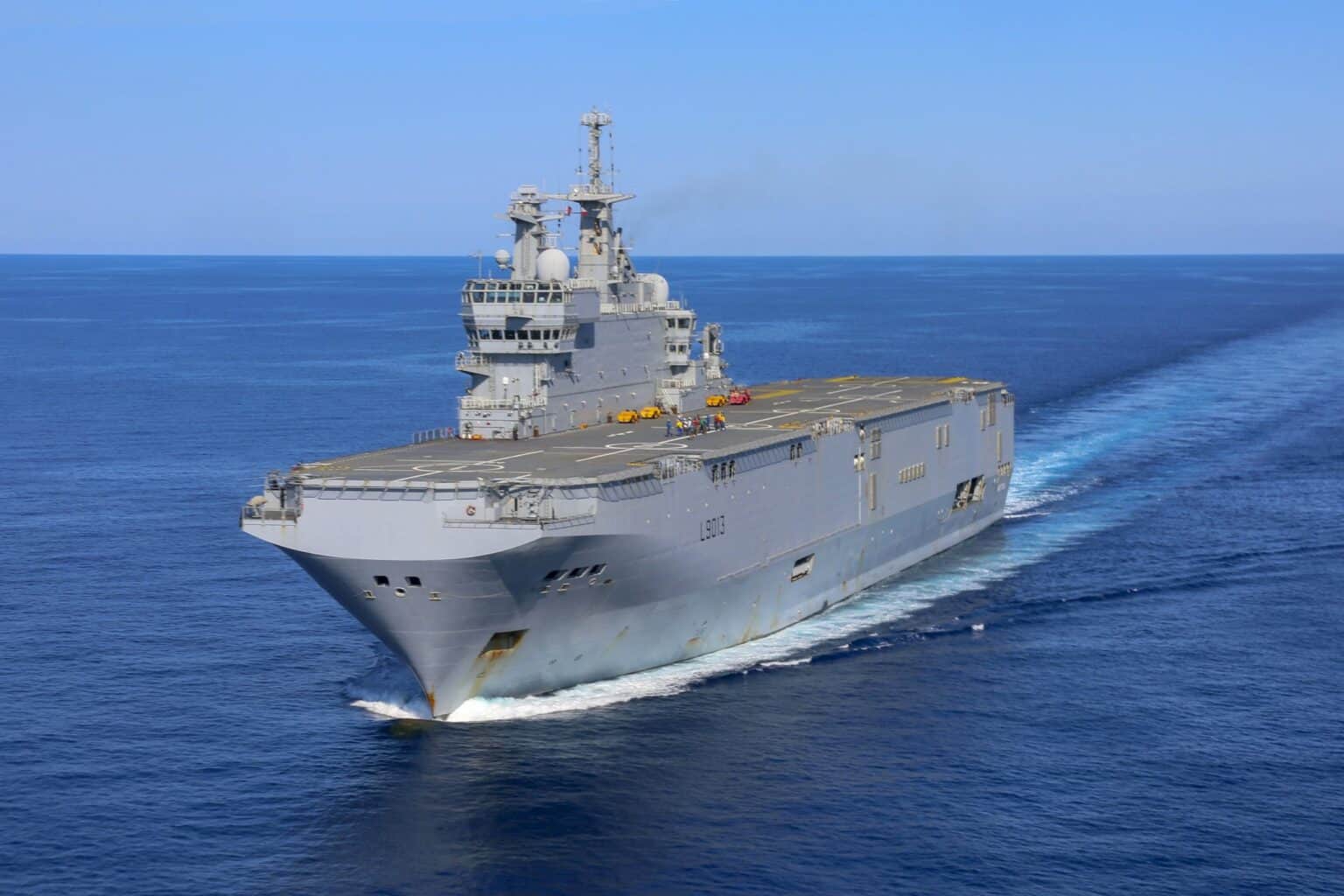
| 9 | Mistral class (France, Egypt) | 21,500 t | 5 (3 French, 2 Egyptian) | None, helicopters only |
| 10 | Atlântico (Brazil) | ~21,500 t | 1 | None, helicopter carrier design |
| 11 | Dokdo class (South Korea) | 18,000 to 19,500 t | 2 | None, helicopters only |
How this ranking works
Ships are ranked by full-load displacement, the weight of the water a ship pushes aside when fully fueled, armed and loaded. Only flat-deck ships whose main job is landing troops are included: amphibious assault ships (LHA, LHD) and helicopter assault ships (LPH). Dock ships without a full flight deck, such as the US San Antonio class, are left out. Where a navy publishes only a floor or analysts disagree, the range is shown and the class sits where its official figure puts it.
1. America Class (United States)
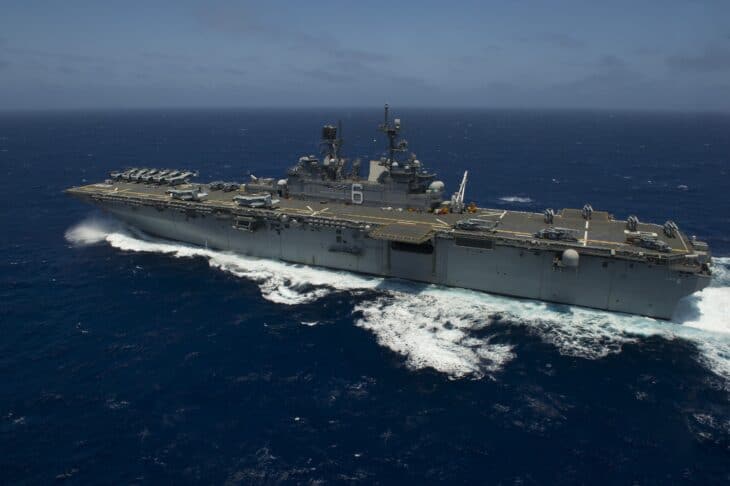

USS America (LHA-6) was commissioned on Oct. 11, 2014, and USS Tripoli (LHA-7) followed on July 15, 2020. Each is 844 feet (257 m) long, displaces 45,693 metric tons fully loaded and carries 1,687 Marines.
The first two ships dropped the well deck, the floodable stern dock that launches landing craft, to make room for aviation fuel, spares and maintenance space. A typical air group in the first two ships is 12 MV-22B Ospreys, six F-35Bs, four CH-53Ks, seven AH-1Z and UH-1Y helicopters and two MH-60S.
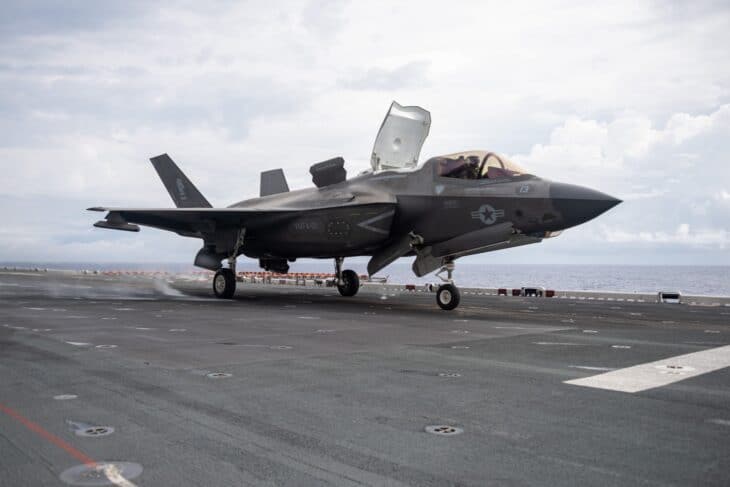

Loaded for sea control instead, an America can carry about 20 F-35B or AV-8B jets. Day to day, though, the V-22 Osprey is the backbone of the air group, because moving Marines ashore is the ship’s real job.
From Bougainville (LHA-8) onward, the Flight I ships restore the well deck. Bougainville was launched on Sept. 30, 2023, and its delivery has slipped to July 2027; Fallujah (LHA-9) is under construction and Helmand Province (LHA-10) is authorized.
Bigger than France's carrier
At 45,693 metric tons fully loaded, an America-class ship outweighs the Charles de Gaulle, France’s nuclear-powered aircraft carrier, at 42,500 tons. The US Navy still counts it as an amphibious ship, not a carrier.
2. Wasp Class (United States)
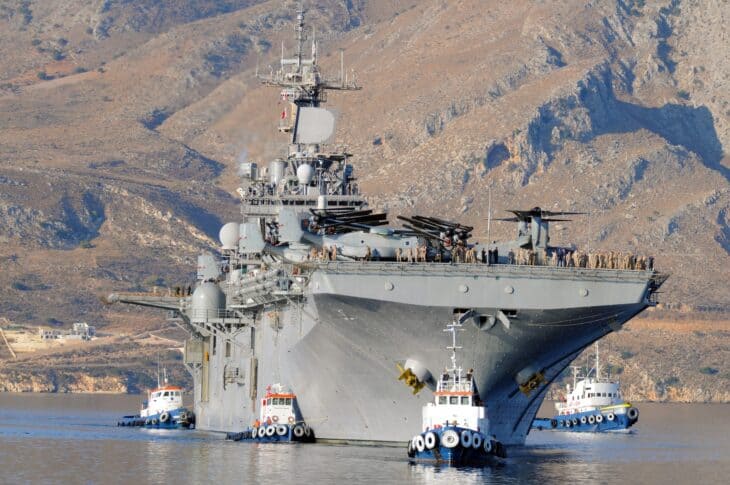

The Wasp class is the workhorse of the US amphibious fleet: eight were built, and seven are active. They displace 41,150 metric tons (40,500 long tons) fully loaded and make 22 knots.
Unlike the first two Americas, every Wasp has a well deck, 266 feet long, that holds three hovercraft landing craft or 40 amphibious assault vehicles. A standard air group mixes six Harriers or F-35Bs with 12 Ospreys and about a dozen helicopters, and a sea-control load swaps in 20 jets.
The lead ship, USS Wasp, was commissioned on July 29, 1989, and the newest, Makin Island, on Oct. 24, 2009. The Marine Corps aircraft that fly from them are the same types as on the America class.
The one the US lost without a war
USS Bonhomme Richard (LHD-6) was badly damaged by a fire pierside on July 12, 2020. Rather than repair her, the Navy decommissioned the ship on April 15, 2021, and she was scrapped, which is why the class counts eight built and seven active.
3. Type 076 Sichuan (China)
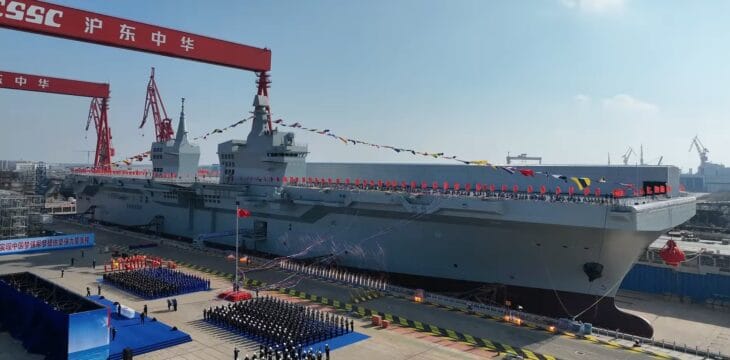

Sichuan, hull number 51, was launched at Hudong-Zhonghua in Shanghai on Dec. 27, 2024. China’s state media put its full-load displacement at more than 40,000 tons, while CSIS estimates about 50,000 tons, which would make it the largest amphibious assault ship afloat.
What sets it apart is an electromagnetic catapult and arresting gear, which Chinese media describe as a world first for an amphibious assault ship. In October 2026 the PLA announced the ship’s first catapult launches and recoveries, using the GJ-21 drone.
Sea trials began in November 2025, and the ship exercised in the South China Sea in April 2026. As of early November 2026 the PLA Navy had not announced a commissioning date, so Sichuan ranks here on its official floor and stays out of the in-service count.
4. Trieste (Italy)
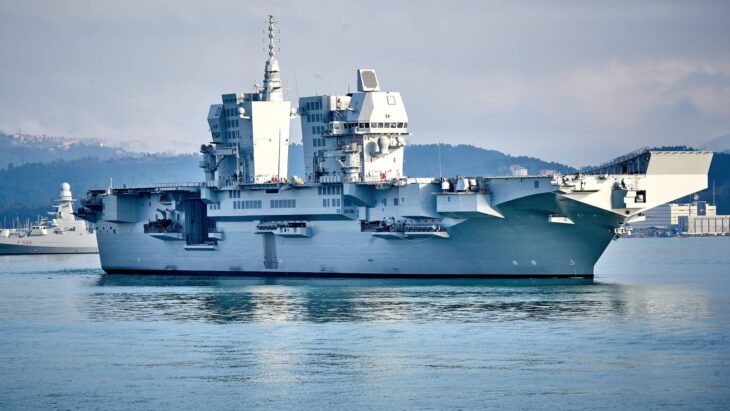

Trieste (L 9890) was commissioned at Livorno on Dec. 7, 2024, and displaces about 38,000 metric tons fully loaded. It is 804 feet (245 m) long, with a ski-jump and nine deck spots for heavy helicopters or F-35Bs.
That makes Italy’s amphibious ship heavier than its designated aircraft carrier, Cavour, at about 30,000 tons. Trieste can make 25 knots on gas turbines, fast for a ship of this type.
5. Type 075 (China)
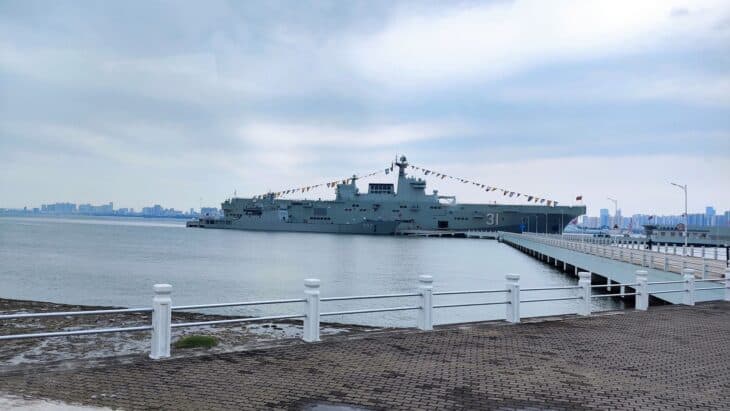

China has commissioned four Type 075 ships: Hainan was commissioned in April 2021, Guangxi in April 2022, Anhui in October 2022 and Hubei on Aug. 1, 2025. Displacement is estimated at 35,000 to 40,000 metric tons, and the ships are 761 feet (232 m) long.
The Type 075 flies helicopters only, about 28 in a typical load, and carries 800 troops and three hovercraft landing craft. Eight are reported planned, which would give the Chinese Navy the largest amphibious flat-deck fleet after the US.
6. Canberra Class (Australia)
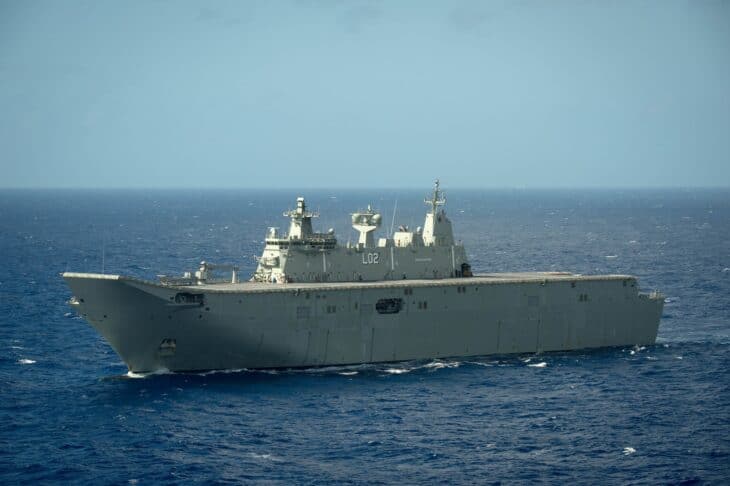

HMAS Canberra (commissioned Nov. 28, 2014) and HMAS Adelaide (Dec. 4, 2015) are licensed copies of Spain’s Juan Carlos I. They displace 27,500 metric tons fully loaded and carry 1,046 troops, or 1,600 in overload conditions.
Both kept the Spanish ski-jump, but Australia has no jets to fly from it. An F-35B option was studied in 2014 and 2015 and rejected, so the ramp serves no aircraft today.
7. TCG Anadolu (Turkey)
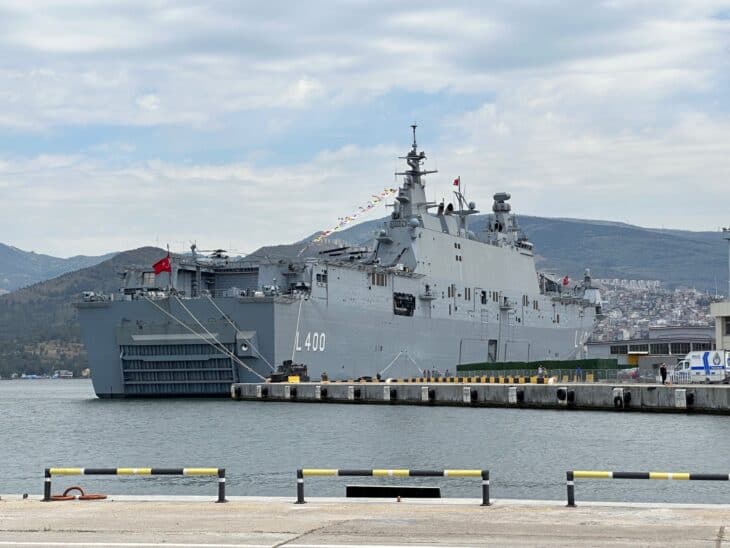

Anadolu is another Juan Carlos I derivative, commissioned on April 10, 2023, at 27,436 metric tons fully loaded in its amphibious configuration. Turkey planned to fly F-35Bs from it until that purchase was blocked, so it went another way.
Anadolu is now described as the first ship built to fly armed drones from a flight deck. A Bayraktar TB3 took off from and landed on it in November 2024, and another flew a demonstration from the ship during a NATO exercise in February 2026.
8. Juan Carlos I (Spain)
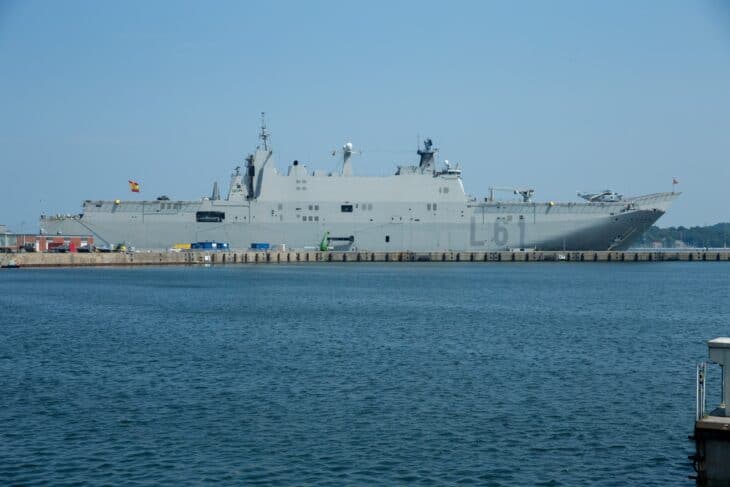

Juan Carlos I, commissioned on Sept. 30, 2010, is the design behind ships in two other navies, Australia and Turkey. It displaces 26,000 metric tons fully loaded and can carry up to 46 Leopard 2E tanks.
It still flies AV-8B Harrier IIs, but Spain has ruled out buying the F-35B, so Harrier operations are expected to end around 2030. After that, the ship that started the ski-jump LHD family may be left without jets of its own.
9. Mistral Class (France and Egypt)
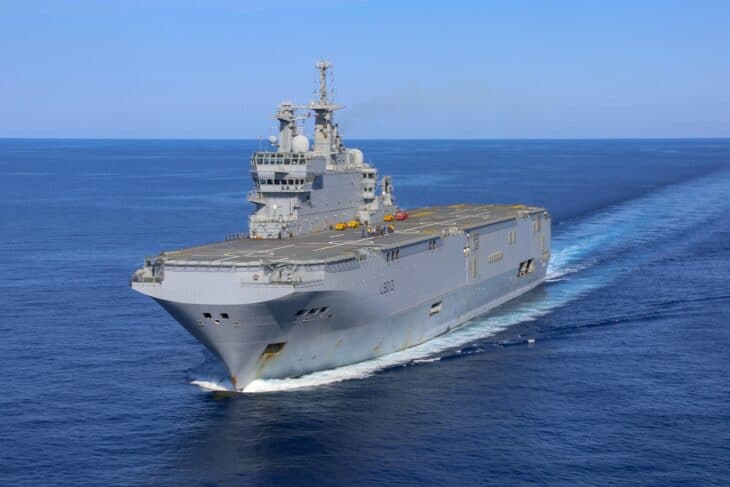

France operates three Mistrals: Mistral, Tonnerre and Dixmude, the last commissioned in December 2012. Each displaces 21,500 metric tons fully loaded and carries 16 heavy helicopters such as the NH90 and Tiger.
Two more were built for Russia. France held them back in 2014 after the annexation of Crimea, refunded Moscow in August 2015 and sold both to Egypt for roughly 950 million euros, where they serve as Gamal Abdel Nasser and Anwar El Sadat.
10. Atlântico (Brazil)
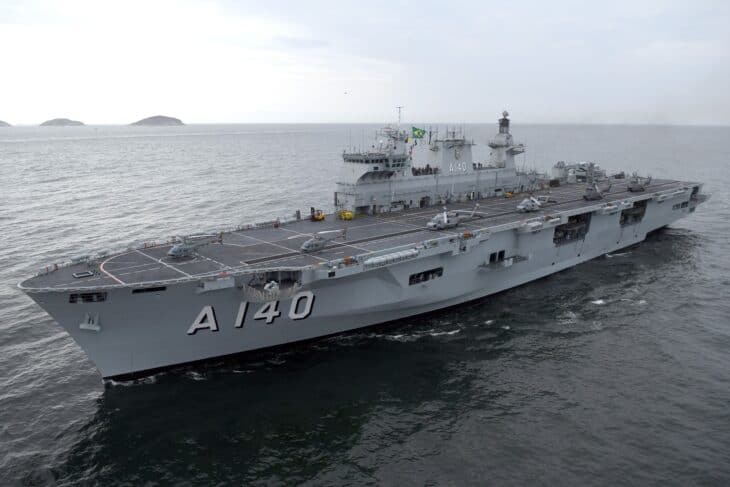

Atlântico began life as the Royal Navy’s HMS Ocean, commissioned in 1998 and retired in March 2018. Brazil bought her for 84.6 million pounds, about $113 million, and commissioned her on June 29, 2018.
She displaces about 21,500 metric tons and was designed as a helicopter carrier. On Nov. 12, 2020, Brazil reclassified her from multipurpose helicopter carrier to multipurpose aircraft carrier, the one navy on this list that went the other way on the label.
11. Dokdo Class (South Korea)
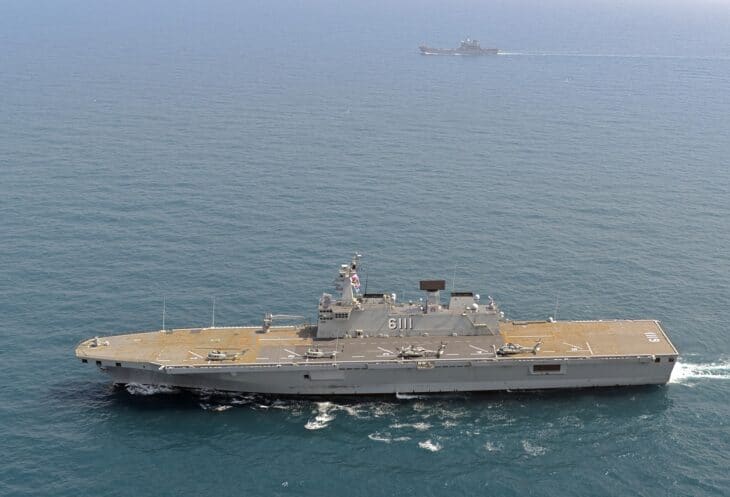

ROKS Dokdo was commissioned in July 2007 and her sister Marado in June 2021. Published full-load figures run from 18,000 to 19,500 metric tons, and each ship carries 720 Marines and up to 15 helicopters.
South Korea has studied flying F-35Bs from the class since at least 2017, but no plan has been officially declared. For now, the Dokdos are helicopter ships with a flat top.
Amphibious Assault Ship vs Aircraft Carrier
The difference is the job, not the size. An aircraft carrier exists to launch and recover a strike air wing; an amphibious assault ship exists to land a fighting force of Marines, and its aircraft serve that landing.
That is why most of these ships have a well deck in the stern and berths for over 1,000 troops, which carriers do not. It is also why the line blurs once a ship carries 20 F-35Bs, as the America class can. Our ranking of the best aircraft carriers in the world covers the ships navies do call carriers.
What about Japan's Izumo and Russia's Ivan Rogov?
Japan’s Izumo class is officially a destroyer, not an amphibious ship, even though two US Marine F-35Bs landed on Izumo in October 2021. At 26,000 tons it is being modified for jets and reclassified as an aircraft-carrying escort ship, so it belongs with carriers, not here. Russia’s Project 23900 ships, Ivan Rogov and Mitrofan Moskalenko, were laid down in Crimea in July 2020 at a planned 40,000 tons, but neither is in service, and Ivan Rogov was last reported due for delivery in 2028.
The Russian ships are covered in our guide to the Russian Navy, and the US amphibious fleet beyond its big decks is in types of Navy ships.
FAQ
Sources and references used for research and fact-checking.
- Wikipedia, America-class amphibious assault ship
- Wikipedia, Wasp-class amphibious assault ship
- Wikipedia, Type 076 landing helicopter dock
- Global Times, China's first electromagnetic catapult-equipped Type 076 amphibious assault ship Sichuan starts maiden sea trial
- Naval Technology, Analysis: what we know about the Sichuan, China's drone carrier hybrid
- Wikipedia, Trieste (L 9890)
- Wikipedia, Italian aircraft carrier Cavour
- Wikipedia, Type 075 landing helicopter dock
- Wikipedia, Canberra-class landing helicopter dock
- Wikipedia, TCG Anadolu
- Wikipedia, Spanish ship Juan Carlos I
- Wikipedia, Mistral-class amphibious assault ship
- Wikipedia, Brazilian aircraft carrier Atlântico
- Wikipedia, Dokdo-class amphibious assault ship
- Wikipedia, French aircraft carrier Charles de Gaulle
- Wikipedia, Izumo-class multi-purpose operation destroyer
- Wikipedia, Project 23900 amphibious assault ship
Get the Newsletter
The latest aviation news and stories sent to your inbox.
About the Author

Tim is the owner and lead editor of AeroCorner since 2019, overseeing aviation content covering aircraft, airlines, airports, and the broader aviation industry. Through years of researching, writing, editing, and publishing aviation-focused content, he has developed extensive practical knowledge of commercial aviation and air travel. Based in Asia and a frequent traveler himself, Tim also brings firsthand passenger experience to AeroCorner’s coverage. Outside of publishing, he has also explored aviation firsthand through hands-on flight training in New Zealand.