

Table of Contents
At 2:44 p.m. on September 15, 1942, a lookout on the aircraft carrier USS Wasp called out “three torpedoes.” The carrier was escorting Marines to Guadalcanal, and her planes were being fueled on deck for the afternoon patrol.
Little more than six hours later she sank. Today a different USS Wasp, an 844-foot (257 m) warship that has flown F-35B stealth jets, is homeported in Norfolk, Virginia.
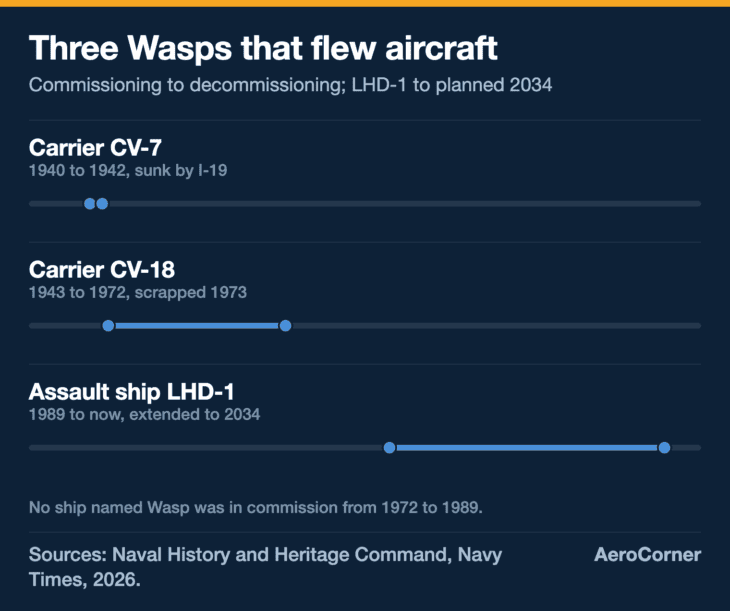
Three ships answer the search for USS Wasp, and their stories are connected on purpose. Here is which is which, what each one did, and how the name passed from one to the next.
Which USS Wasp Sank, and Which Is Still in Service?
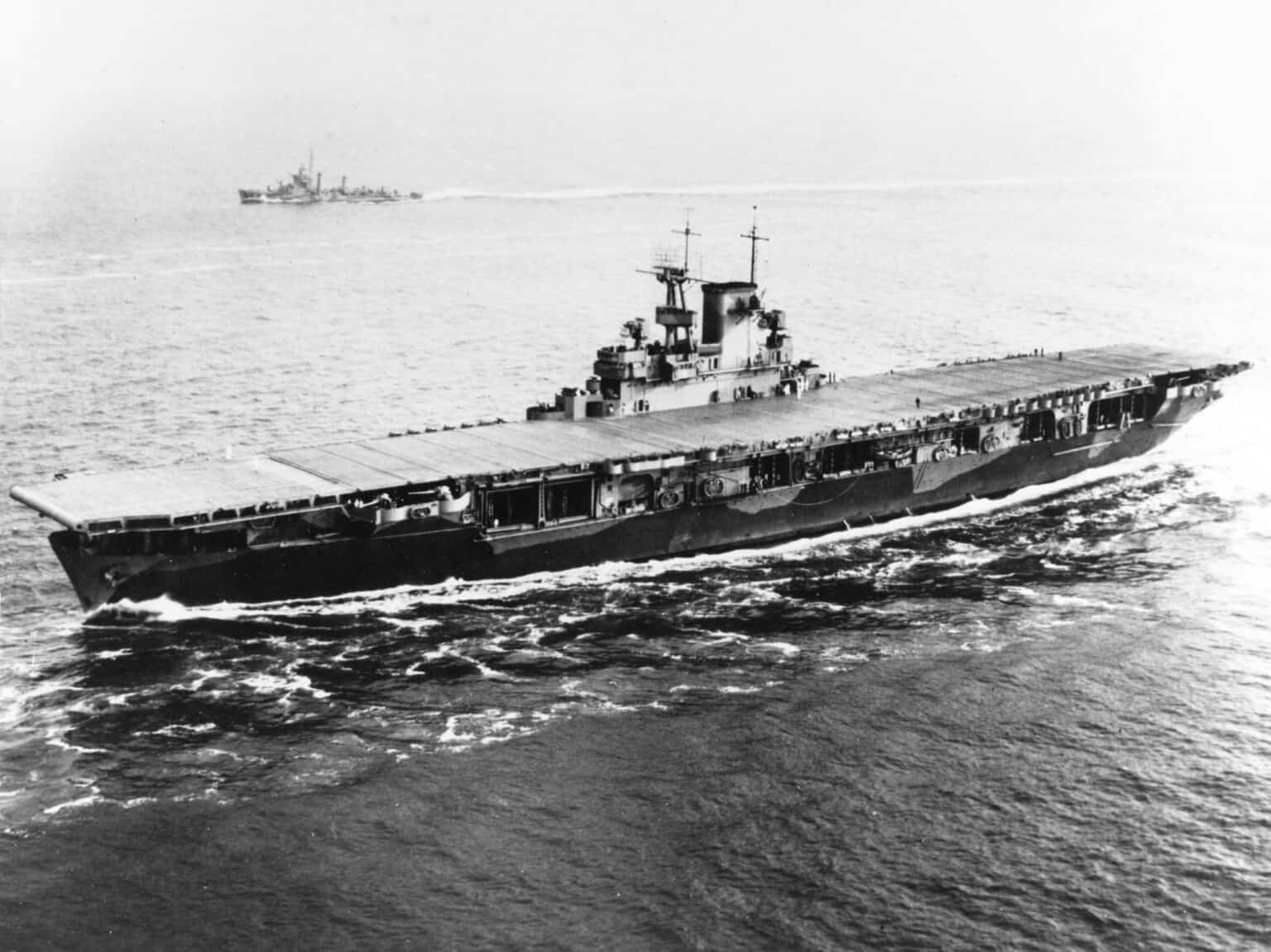
USS Wasp (CV-7) is the one that sank. She was commissioned in 1940, ferried fighters across the Atlantic and the Mediterranean, and was torpedoed by the Japanese submarine I-19 off the Solomon Islands on September 15, 1942.
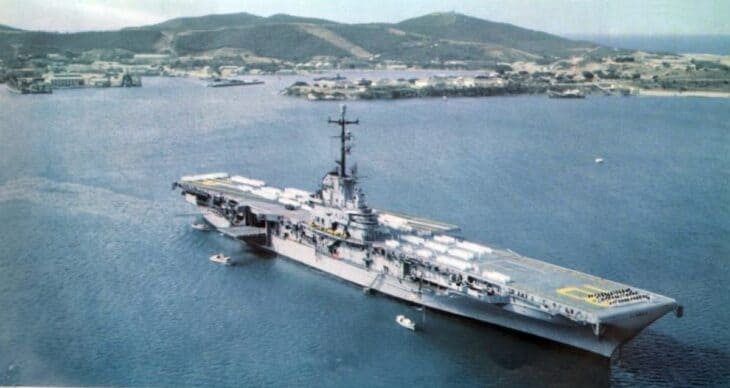
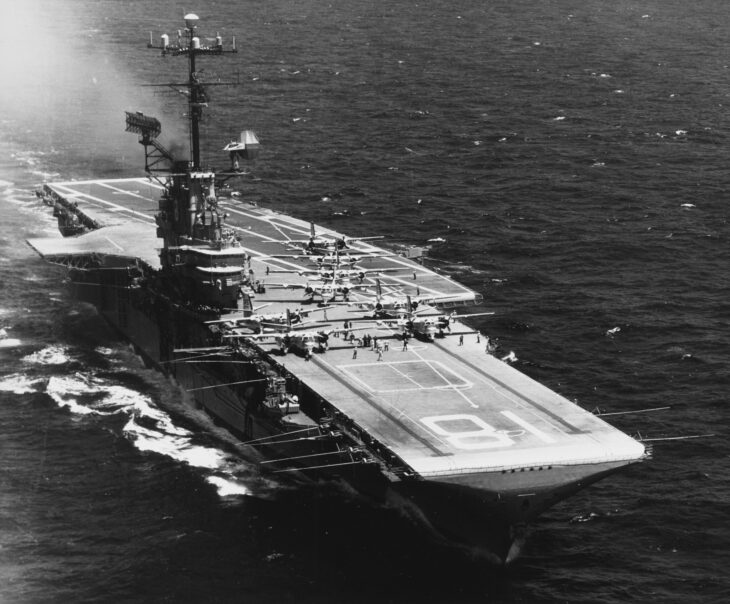
USS Wasp (CV-18) was laid down as Oriskany and renamed in CV-7’s honor in November 1942. She fought across the Pacific through 1945, recovered the crews of five Gemini missions in the 1960s, and was scrapped in 1973.
USS Wasp (LHD-1) is the one in service now. She is an amphibious assault ship rather than a fleet carrier, commissioned in 1989, and in April 2026 the Navy extended her service life to 2034.
The three Wasps at a glance
CV-7: one-of-a-kind carrier, commissioned 1940, sunk September 15, 1942. CV-18: Essex-class carrier renamed Wasp in 1942, decommissioned 1972, scrapped 1973. LHD-1: amphibious assault ship, commissioned 1989, homeported in Norfolk, service life extended to 2034.
| Wasp (CV-7) | Wasp (CV-18) | Wasp (LHD-1) | |
|---|---|---|---|
| Type | Aircraft carrier (only ship of her class) | Essex-class aircraft carrier | Wasp-class amphibious assault ship |
| Builder | Bethlehem, Quincy, Mass. | Bethlehem, Quincy, Mass. | Ingalls, Pascagoula, Miss. |
| Commissioned | April 25, 1940 | November 24, 1943 | 1989 |
| Length | 741 ft 4 in (226 m) | 872 ft (265.8 m) | 844 ft (257 m) |
| Displacement | 14,700 tons | 27,100 tons | 41,000 tons |
| Aircraft | 80 | 80 to 100 | Up to 31 |
| Fate | Sunk September 15, 1942 | Decommissioned 1972, scrapped 1973 | In service, extended to 2034 |
The First Carrier Wasp Was Built Small on Purpose
CV-7 was the product of an arms-control treaty. In the mid-1930s, after the Yorktown and Enterprise were ordered, the Navy had only enough carrier tonnage left under the naval treaties for one more small ship.
The result displaced 14,700 tons, against 19,800 for a Yorktown-class carrier, but still carried an air group of about 80 planes. Something had to give, and the Navy’s own history names it: modest speed and no torpedo protection.
The designers knew it when they drew her. The Naval History and Heritage Command describes Wasp as “strictly a result of the limitations imposed by international agreement,” and says her missing side protection “doomed her to a blazing demise.”
“Who Said a Wasp Couldn’t Sting Twice?”
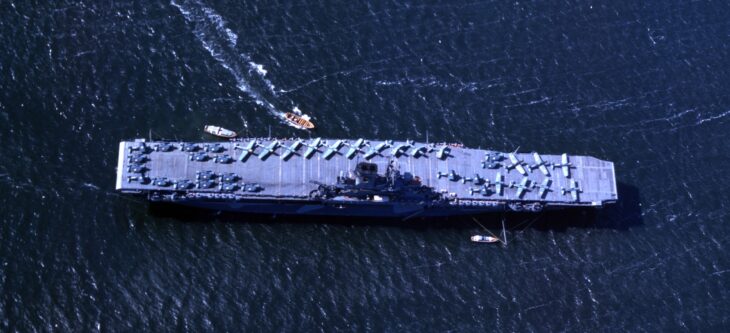
Wasp spent her first two years in the Atlantic, and her most famous work was delivering other people’s airplanes. In October 1940 she flew off Army Air Corps P-40s in a test, the first time U.S. Army planes had flown from a Navy carrier.
In August 1941 she launched 30 Curtiss P-40 fighters and three trainers to cover the American occupation of Iceland. The following spring she was sent to help Malta, which German and Italian bombers were pounding every day.
On April 20, 1942, Wasp launched her 47 Spitfire fighters toward the island from the western Mediterranean. Axis intelligence tracked their arrival, and air raids destroyed many of them on the ground.
_in_at_anchor_in_Casco_Bay,_Maine_(USA),_on_25_March_1942_(80-G-K-447).jpg)
Winston Churchill asked President Roosevelt to let Wasp have “another good sting.” On May 9 she and the British carrier HMS Eagle flew off another load, 47 Spitfires from Wasp and 17 from Eagle.
A Spitfire landed back on Wasp
On May 9, Pilot Officer Jerrold Smith found his long-range fuel tank was faulty. Rather than ditch, he landed his Spitfire back aboard Wasp, and it stopped 15 feet (4.6 m) from the forward edge of the flight deck.
German radio announced that Wasp had been sunk. On May 11, Churchill signaled her crew instead: “Many thanks to you all for the timely help. Who said a Wasp couldn’t sting twice?”
What Happened to the USS Wasp?
By June 1942 the Navy had lost Lexington at Coral Sea and Yorktown at the Battle of Midway, so Wasp was rushed to the Pacific. On August 7 her planes supported the Marine landings on Guadalcanal and Tulagi.
By mid-September, Wasp and Hornet were the only two American carriers left in the southwest Pacific. On September 15 they were covering transports carrying the 7th Marine Regiment to Guadalcanal, southeast of San Cristobal Island.
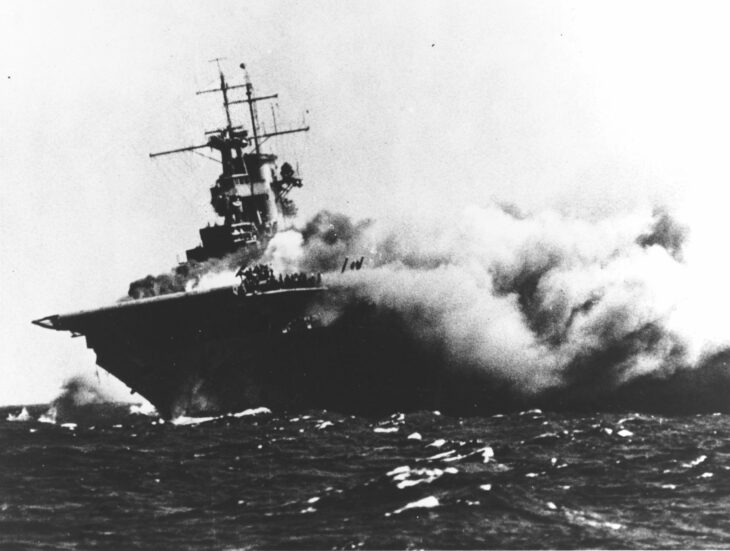
The submarine I-19 fired a spread of six torpedoes. Wasp turned hard to starboard, but two or three hit her forward, near her aviation gasoline tanks and magazines.
_burning_on_15_September_1942_(80-G-16331).jpg)
The rest kept running. One hit the destroyer O’Brien, and another hit the battleship North Carolina, which went to Pearl Harbor for repairs. O’Brien’s damage proved worse than it looked, and she sank on October 19, 1942, while trying to reach a shipyard.
One salvo, three ships
The Navy calls it arguably the most effective spread of torpedoes in history: six torpedoes from I-19 sank an aircraft carrier, sank a destroyer a month later, and put a new battleship in the repair yard.
On Wasp, the explosions broke the water mains in the forward part of the ship, so there was no water to fight the gasoline fires. Planes in the hangar fell from the overhead, ready ammunition cooked off, and burning fuel spread across the sea around her.
Capt. Forrest Sherman ordered the crew off at 3:20 p.m. The abandonment took nearly 40 minutes, with many men refusing to leave until the wounded were off. Sherman left only once he was satisfied no one remained, at 4 p.m.
Of the 2,162 people aboard, 176 were killed. The destroyer Lansdowne was ordered to sink the burning hulk, and Wasp went down by the bow at 9 p.m.
Three torpedoes? Probably two
Many accounts say three hit Wasp, and the Navy’s own ship history even calls the spread four torpedoes. Capt. Sherman’s first report counted three hits, but a Bureau of Ships report four months later concluded the third blast was a secondary explosion. When the Navy announced the wreck in 2019, it said two, possibly three.
The wreck stayed lost for 76 years. On January 14, 2019, the crew of the late Paul Allen’s research vessel Petrel found her in the Coral Sea, nearly 14,000 feet (4,200 m) below the surface.
Two of her survivors went on to Navy records. Sherman became the youngest Chief of Naval Operations, and David McCampbell, an officer aboard Wasp, became the Navy’s top-scoring ace of the war.
The Navy Gave Her Name to a Carrier Already on the Slipway
At the same Quincy, Massachusetts, shipyard that built CV-7, an Essex-class carrier named Oriskany had been under construction since March 18, 1942. On November 13, 1942, two months after Wasp sank, the Navy renamed her Wasp.
It was the same thing the Navy did for Yorktown, whose name went to a carrier being built as Bon Homme Richard. The new Wasp was nearly twice the size of the old one: 27,100 tons, 872 feet (265.8 m) long, with room for up to 100 aircraft.
CV-18 was commissioned on November 24, 1943, and earned eight battle stars. Between March 17 and 23, 1945, damaged by a bomb hit and under almost continuous air attack, she logged what the Navy’s history says was often called “the busiest week in flattop history.”
In those seven days her planes shot down 14 aircraft, destroyed six more on the ground, and hit two Japanese carriers, two battleships and a heavy cruiser. Her gunners fired more than 10,000 rounds.
The Second Wasp Fished Astronauts Out of the Atlantic
After the war, CV-18 was modernized for jets and later became an antisubmarine carrier. Her worst day came on April 26, 1952, when she collided with the destroyer minesweeper Hobson during night flying in the Atlantic and Hobson lost 176 of her crew.
_at_anchor_1958.jpg)
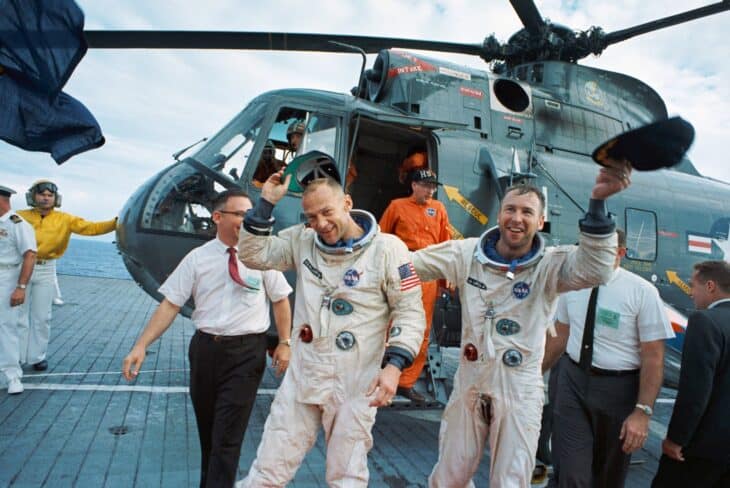
Her best-known job came in the space race. Wasp recovered the crews of Gemini IV in June 1965, Gemini VI and VII that December, Gemini IX in June 1966, and Gemini XII in November 1966.
Gemini XII came down within three miles (5 km) of the ship, and Jim Lovell and Buzz Aldrin were hoisted aboard by helicopter. Less than three years later, Aldrin walked on the moon.
_underway_at_sea,_circa_in_early_1967_(NH_97509).jpg)

Wasp was decommissioned on July 1, 1972, and sold for scrap on May 21, 1973. Unlike Yorktown, Intrepid and Lexington, no Wasp survives as a museum ship.
Is the USS Wasp Still in Service?
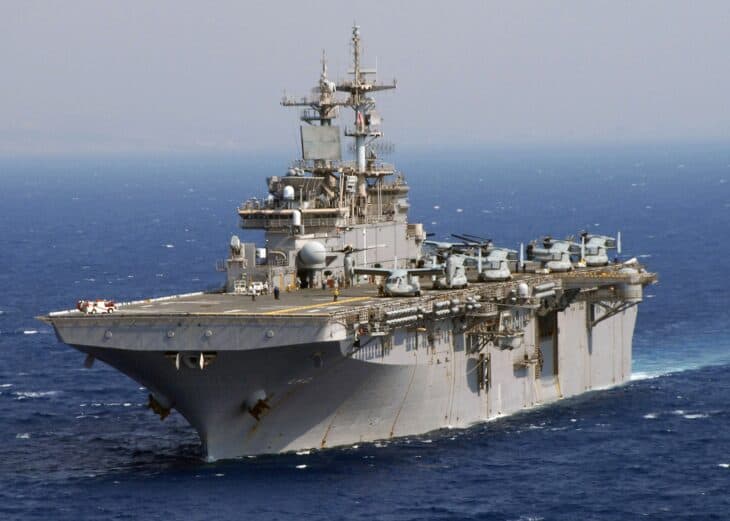
Yes. USS Wasp (LHD-1), built by Ingalls in Pascagoula, Mississippi, and commissioned in 1989, is the lead ship of the Wasp class of amphibious assault ships. The Navy counts her as the tenth ship named Wasp since 1775.
She is not a fleet carrier, though she looks like one. Her job is to put Marines ashore by helicopter, tiltrotor and hovercraft, and she carries about 1,200 sailors and Marines plus roughly 1,000 more embarked troops.
Her class was the first designed from the start for Air Cushion landing craft and the AV-8B Harrier. In October 2007 Wasp became the first ship to deploy the MV-22 Osprey, carrying 10 of them to Iraq.
_Osprey_2.jpg)
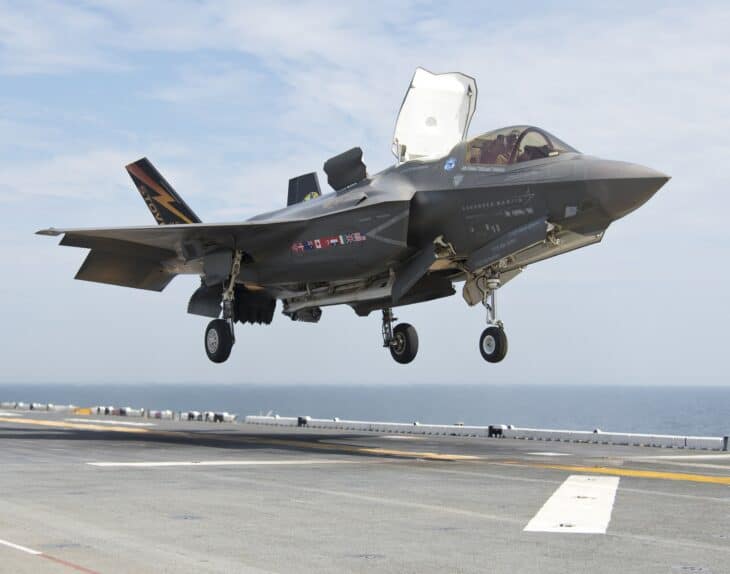
On October 3, 2011, an F-35B made the first vertical landing at sea on her deck. In March 2018, sailing from Sasebo, Japan, she took six F-35Bs of squadron VMFA-121 on the jet’s first operational deployment.
.jpg)
Where is USS Wasp now?
LHD-1 is homeported in Norfolk, Virginia, under Naval Surface Force Atlantic. Before that she spent a forward-deployed tour in Sasebo, Japan, which included the 2018 F-35B patrol.
She was due to retire around the end of the decade. In April 2026, Brig. Gen. Lee Meyer told reporters that the Chief of Naval Operations had extended Wasp’s service life by five years, to 2034, while the Navy studies whether her sisters can last longer too.
The reason is a shortage. The Marine Corps commandant says the amphibious fleet is not big enough to meet commanders’ requirements, a 2024 GAO report found half of it in poor condition, and Wasp’s own deployment was delayed by mechanical failures.
And no, WASP does not stand for anything. The Navy’s ship history defines the name by the insect: winged, slender, and known for a painful sting, which is why her crew still call themselves Stingers.
So when the name turns up, check the hull number. CV-7 is on the floor of the Coral Sea, CV-18 was cut up for scrap half a century ago, and LHD-1 is the one still flying jets, a ship that has already served longer than the other two combined.
Sources and references used for research and fact-checking.
- Naval History and Heritage Command, Dictionary of American Naval Fighting Ships, Wasp VIII (CV-7)
- Naval History and Heritage Command, Dictionary of American Naval Fighting Ships, Wasp IX (CV-18)
- Naval Historical Center, Online Library of Selected Images, Ranger, Yorktown and Wasp class aircraft carriers (CV 4-8)
- U.S. Pacific Fleet, Wreckage of USS Wasp (CV 7) discovered in Coral Sea
- Wikipedia, USS Wasp (CV-7)
- Wikipedia, USS O'Brien (DD-415)
- Naval Surface Force Atlantic, USS Wasp (LHD-1) welcome page
- Wikipedia, USS Wasp (LHD-1)
- Commander, Amphibious Force U.S. 7th Fleet, Wasp completes historic patrol in Indo-Pacific
- Navy Times, US Navy to extend service life of amphibious assault ship USS Wasp by 5 years
- Wikipedia, USS Wasp (ship index)
Get the Newsletter
The latest aviation news and stories sent to your inbox.
About the Author

Tim is the owner and lead editor of AeroCorner since 2019, overseeing aviation content covering aircraft, airlines, airports, and the broader aviation industry. Through years of researching, writing, editing, and publishing aviation-focused content, he has developed extensive practical knowledge of commercial aviation and air travel. Based in Asia and a frequent traveler himself, Tim also brings firsthand passenger experience to AeroCorner’s coverage. Outside of publishing, he has also explored aviation firsthand through hands-on flight training in New Zealand.