

Table of Contents
On the morning of May 7, 1942, a Japanese scout plane over the Coral Sea reported the target its fleet had been hunting for days: an American aircraft carrier. Two Japanese carriers launched 78 aircraft at it.
The “carrier” was the fleet oiler USS Neosho, escorted by one destroyer. A few hours later, 93 American aircraft were flying toward two Japanese carriers that existed only because a scout had used the wrong code word.
This was the first battle between aircraft carriers, fought by ships that never once saw each other. Here is what happened in the Coral Sea, who actually won, and the popular story about it that historians reject.
What Happened at the Battle of the Coral Sea?
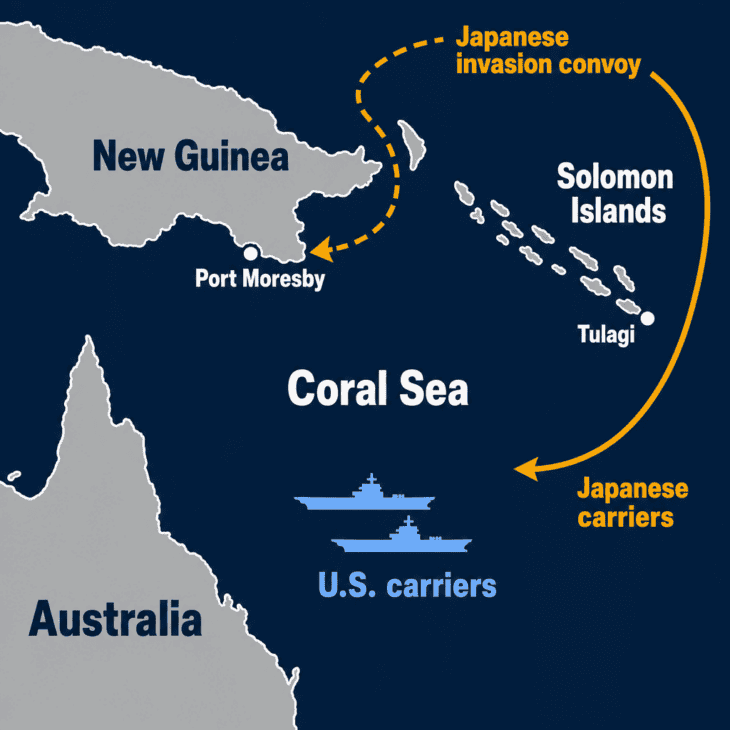
The Battle of the Coral Sea was fought in the waters between northeast Australia, New Guinea and the Solomon Islands. The carrier battle itself took place on May 7 and 8, 1942, after a first American air raid on May 4.
Japan was sending an invasion force to capture Port Moresby, on the south coast of New Guinea. It was covered by two big fleet carriers, Shokaku and Zuikaku, and a new light carrier, Shoho.
Waiting for them were two U.S. carriers, USS Lexington and USS Yorktown, under Rear Adm. Frank Jack Fletcher. American codebreakers had given Adm. Chester Nimitz a good picture of the Japanese plan, its forces and its timing by mid-April.
The Navy’s history office calls it the first naval battle in which the ships involved never sighted or fired directly at each other. Every blow was struck by aircraft.
Coral Sea at a glance
Japan sank more ships, so the U.S. Navy’s own history office calls Coral Sea a Japanese tactical victory. But Japan called off the invasion of Port Moresby, and two of its fleet carriers missed the Battle of Midway a month later because of the battle.
| Japan | United States | |
|---|---|---|
| Carriers sunk | 1 (Shoho, a light carrier) | 1 (Lexington) |
| Carriers damaged | Shokaku | Yorktown |
| Other ships sunk | 3 small minesweepers at Tulagi | Destroyer Sims, oiler Neosho |
| Aircraft lost | About 69 from Shokaku and Zuikaku, plus all 18 of Shoho’s | 81, including 35 that went down with Lexington |
| Killed | More than 1,000, most aboard Shoho | 543 aboard Lexington, Neosho and Sims |
Two Fleets Hunting Each Other Blind
The fighting began on May 4, when Yorktown’s planes raided a Japanese landing force at Tulagi, in the Solomon Islands. The pilots claimed several cruisers sunk. No cruisers were there.
What the raid actually did was sink three small minesweepers and four landing barges, damage a destroyer, and destroy all five of the big flying boats at Tulagi. That last part mattered most: those flying boats were Japan’s long-range eyes.
On May 5 and 6, neither carrier force found the other. The Americans searched to the northwest, expecting the Japanese carriers to be close to the invasion convoy.
Instead, Shokaku and Zuikaku had swung around the eastern side of the Solomons and entered the Coral Sea from the east. Fletcher was also fed reports from Gen. Douglas MacArthur’s aircraft in Australia that put several carriers with the convoy.
By dawn on May 7, according to the Navy’s history office, neither side knew where the other’s carriers were, and both were searching in the wrong direction.
May 7: Both Navies Strike the Wrong Target
Rear Adm. Chuichi Hara, the aviator running the Japanese carriers in action, launched a full strike at the “carrier” his scout had found: 18 fighters, 24 torpedo bombers and 36 dive bombers.
Over the target, the strike leader realized it was an oiler and a destroyer, and sent his torpedo planes off to keep searching.
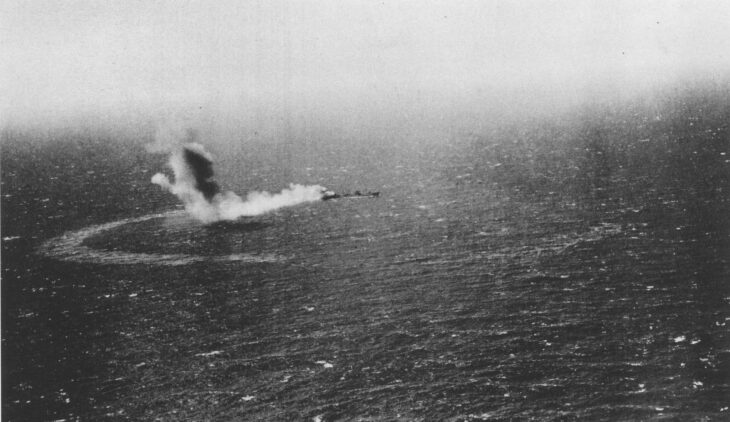
The dive bombers attacked anyway. The destroyer USS Sims took three bombs and sank quickly, with heavy loss of life, and Neosho took seven hits. Neither ship got off a distress call, so Fletcher still had no idea where the Japanese carriers were.
Neosho refused to sink. Half its crew got back aboard and fought to save the ship, and it was finally scuttled on May 11.

The American mistake was a coding error. A Yorktown scout reported two carriers near the invasion convoy when he meant two cruisers.
The U.S. carriers launched 93 aircraft at them by the Navy history office’s count, 50 from Lexington and 43 from Yorktown. Fletcher learned of the error after launch and let the strike go on.
It got lucky. At about 10:40 a.m., Lexington’s air group found Shoho close to the convoy, a brand-new light carrier with just 18 working aircraft.
Lexington’s SBD Dauntless dive bombers came in just ahead of its torpedo planes, which attacked from both sides of the bow at once. The Navy’s history office calls it perhaps the best-coordinated U.S. carrier attack of the entire war.
Yorktown’s air group arrived next and kept hitting the burning ship. Only 203 of Shoho’s 834 crew survived. Lt. Cmdr. Robert Dixon of Lexington’s scouting squadron radioed back the line that became Navy slang: “Scratch one flat top.”
Meanwhile, a cruiser force Fletcher had sent toward New Guinea under Rear Adm. Crace of the Royal Navy dodged more than a hundred bombs from Japanese land-based bombers, which then claimed a battleship sunk that was not even there.
Three U.S. Army B-26 Marauders from Australia bombed Crace’s ships too, and also missed. Crace called their accuracy “disgraceful.”
Trying to land on the enemy's carrier
That evening Japan sent 27 of its best crews, all volunteers, on a risky dusk strike that flew right over the U.S. carriers, hidden by cloud, without seeing them. Coming home in the dark, some mistook the American carriers for their own and tried to land on Yorktown. One was shot down on approach. The two fleets were only about 40 to 60 miles (65 to 95 km) apart.
That dusk strike cost Japan more than it seemed. F4F Wildcat fighters ambushed one group on the way home and shot down six torpedo bombers and a dive bomber, and only 18 of the 27 planes made it back. The missing torpedo planes would matter the next morning.
May 8: The Battle Both Navies Had Rehearsed
The Navy’s history office says May 8 played out like numerous prewar fleet exercises in both navies. The scouts found each other at about the same time, both sides struck at about the same time, and each knocked out the other’s carriers.
The Americans had more aircraft, 117 operational planes against 96. But a weather front hid the Japanese carriers under cloud, while the U.S. carriers sat under mostly clear skies.
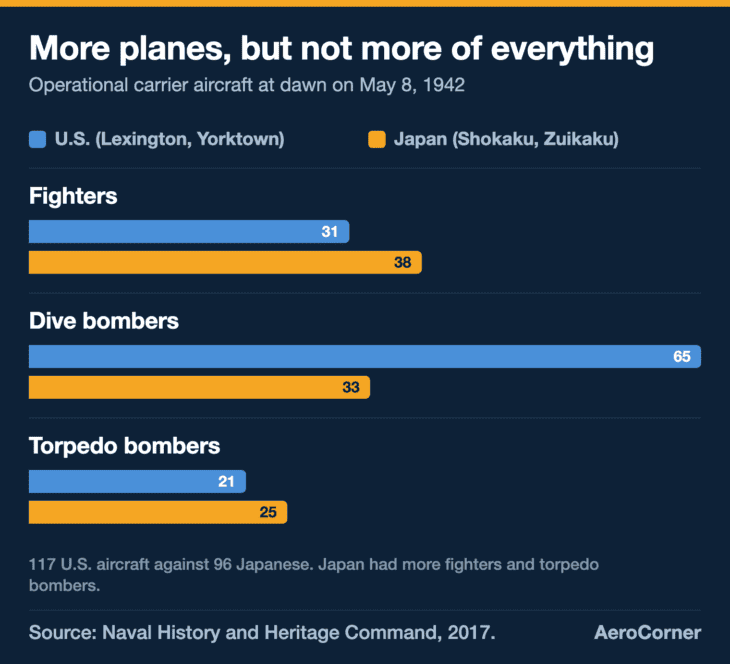
The breakdown is the surprise. Japan actually had more fighters and more torpedo bombers than the Americans did. The U.S. lead came almost entirely from dive bombers.
8:20 a.m.
Both sides find each other. A U.S. Dauntless scout reports the Japanese carriers. Two minutes later, a Japanese scout reports the two American carriers.
9:00 a.m.
The Americans launch first. Yorktown sends 39 aircraft, and Lexington starts launching 36 at 9:07. Japan’s carriers follow with a 69-plane strike.
11:00 a.m.
Shokaku is hit. Yorktown’s dive bombers attack. Zuikaku ducks under the clouds and is never seen by the Americans.
About 11:15 a.m.
Both U.S. carriers are hit. The Japanese strike attacks Lexington and Yorktown at the same time.
12:47 p.m.
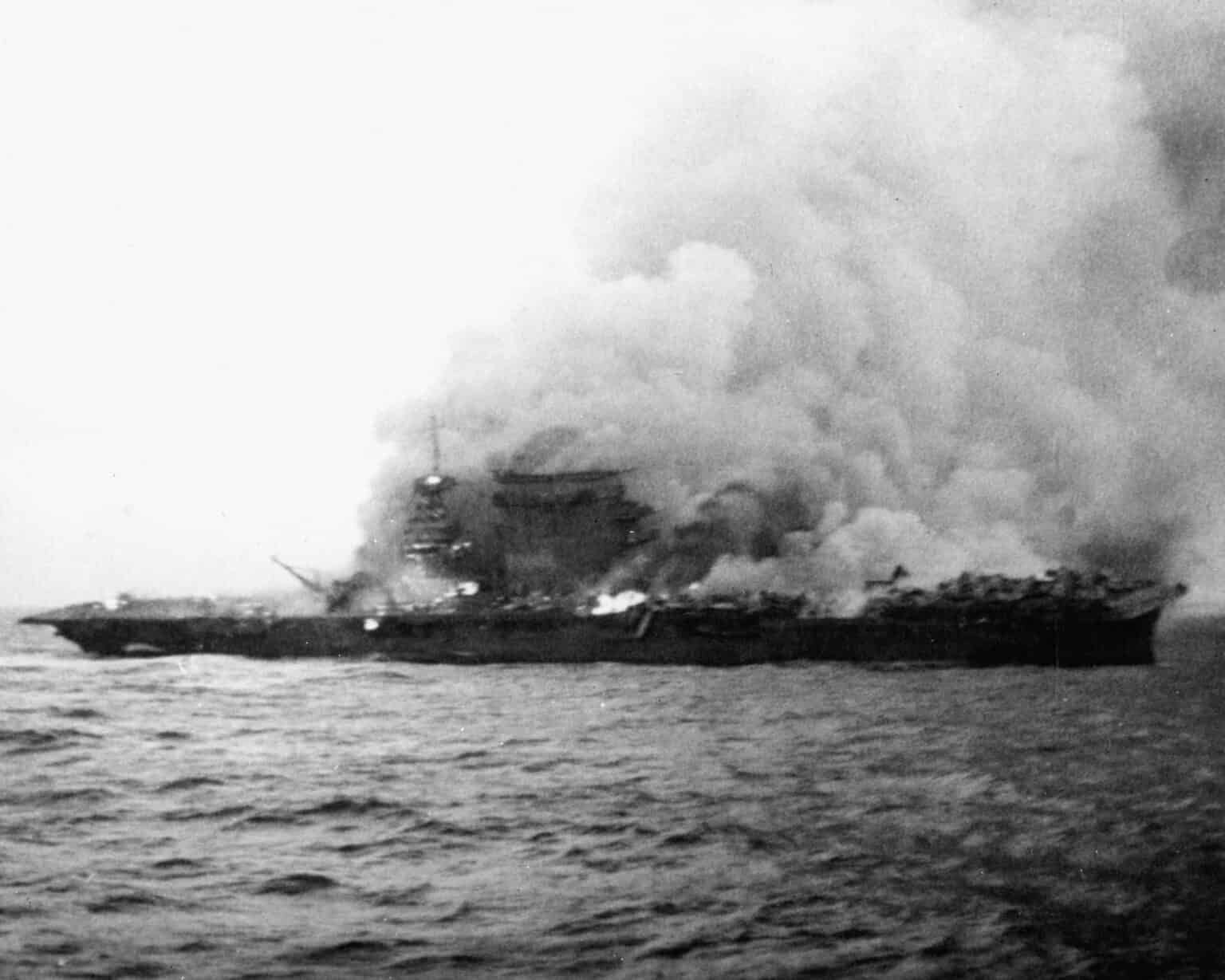
Lexington explodes. Gasoline vapor from a cracked fuel tank reaches the motor generators and ignites.
5:07 p.m.
Abandon ship. Capt. Frederick Sherman orders Lexington’s crew over the side.
Yorktown’s dive bombers reached Shokaku first, and their windshields and bombsights fogged over in the dive from 18,000 feet (5,500 m). Pilots had to release their bombs, in the Navy’s words, “by memory.”
Lt. John Powers pressed his dive far below the normal pull-up height, put a bomb into Shokaku and crashed alongside it. He and his radioman-gunner, Everett Hill, were killed, and Powers received the Medal of Honor after his death.
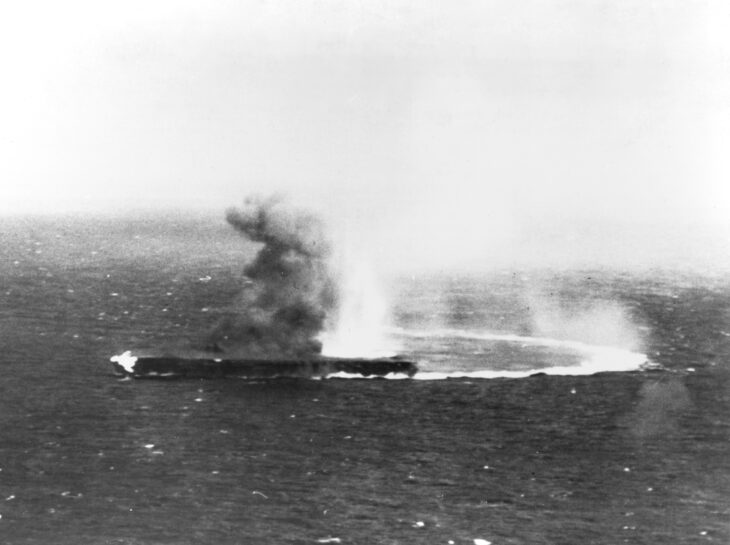

Shokaku took three bomb hits in all and could not launch or land aircraft for the rest of the battle. Lexington’s torpedo planes attacked it too, and not one torpedo hit.
The Japanese strike did better. Its Zero fighters kept the defenders off the dive bombers, and nine torpedo bombers attacked Lexington from two directions.
Two of those torpedoes hit. Yorktown dodged the four aimed at it, but took a bomb that went deep into the ship.
At first Lexington seemed to have gotten off lightly. But a torpedo had cracked an aviation fuel tank, and gasoline vapor was spreading through the ship. The explosion at 12:47 p.m. started fires that could not be stopped.
The Navy counts 216 of Lexington’s crew lost and 2,735 rescued. Its history office calls the evacuation arguably the most orderly abandon-ship in the history of the U.S. Navy.
Who Won the Battle of the Coral Sea?
Counted in ships, Japan won. It sank a big fleet carrier, a destroyer and an oiler, and lost one light carrier, so the Navy’s history office calls Coral Sea a Japanese tactical victory.
But the battle was about Port Moresby, and Japan did not get it. The invasion was “postponed,” as the Navy’s history office puts it, and never attempted again by sea.
46 planes back, 9 that could fly
By the evening of May 8, Zuikaku had taken aboard 46 aircraft from both Japanese air groups. Only nine of them were still operational.
The bigger cost came a month later. Shokaku was too badly damaged to join the attack on Midway.
Zuikaku had lost so many planes and pilots that it stayed out too. By the Navy’s count, Coral Sea cut the Japanese carriers available for the Battle of Midway by a third.
Yorktown’s bomb damage, by contrast, was repaired in time for it to fight at Midway. The Navy’s history office says that would not have been possible had it been hit by a torpedo instead of a bomb.
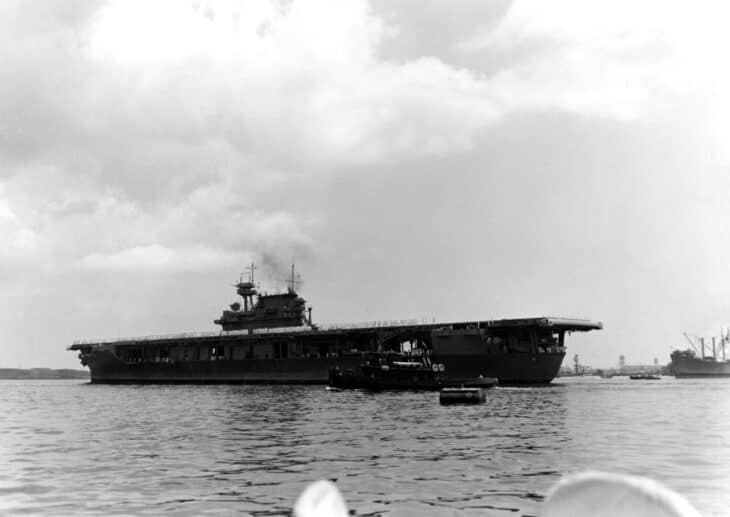
_entering_Pearl_Harbor_May_1942.jpg)
The Navy historian Samuel Eliot Morison summed it up: “So many mistakes were made by both sides in this new mode of fighting that it might be called the Battle of Errors; but more were made by the enemy, and he failed to profit by them.”
The Myth: Coral Sea Saved Australia From Invasion
Myth: the Coral Sea stopped a Japanese invasion of Australia
In Australia the battle is often remembered as the moment the country was saved from invasion. Japan’s invasion convoy was bound for Port Moresby in New Guinea, and by March 1942 Japan had already put aside the idea of landing on the Australian mainland.
The idea of invading Australia did come up. In February and March 1942, some middle-ranking naval staff officers in Tokyo proposed it, to stop the Allies using Australia as a base for a counteroffensive.
According to Peter Stanley, then principal historian of the Australian War Memorial, the Japanese army dismissed the plan as “gibberish.” The Navy General Staff could not spare the million tons of shipping it would have needed either, and by mid-March the proposal had lapsed.
Japan chose to isolate Australia instead, by taking Port Moresby and then islands to the east such as New Caledonia, Fiji and Samoa, to cut Australia off from the United States. Coral Sea and Midway stopped that plan.
Stanley’s reading is contested. The Battle for Australia commemoration group argues that Japan’s navy deferred its invasion plan in March 1942 rather than dropping it, in favor of the army’s plan to force Australia’s surrender.
But the battle’s own target is not in question. The Navy’s history office says a Japanese Port Moresby would have been a serious threat to the northeast coast of Australia.
A threat to Australia and a landing in Australia are not the same thing, and the convoy that turned back in May 1942 was not carrying an invasion of the mainland.
That does not shrink what the battle did. In the Navy’s words, it was the first time since the attack on Pearl Harbor that Japan’s seemingly relentless advance into the Pacific was checked.
So the Battle of the Coral Sea was not the day Australia was saved, and it was not a clean American win. It was the first sea battle in which the ships never saw each other, fought by two navies still working out how to do it.
Both sides struck the wrong ships, tried to land on each other’s carriers and overcounted what they had hit. What decided it was that Japan, the side that sank more, went home without the port it came for.
Sources and references used for research and fact-checking.
- Naval History and Heritage Command, Battle of the Coral Sea
- Naval History and Heritage Command, H-Gram 005: The Battle of the Coral Sea
- Naval History and Heritage Command, H-005-3: The Battle of the Coral Sea
- Office of Naval Intelligence, via Naval History and Heritage Command, Battle of the Coral Sea Combat Narrative
- Wikipedia, Robert E. Dixon
- Naval History and Heritage Command, Battle of Midway
- Australian War Memorial (Peter Stanley, 2002), He's (not) Coming South: the invasion that wasn't
- Battle for Australia Commemoration, Proving that Dr Peter Stanley is promoting a false history of 1942
Get the Newsletter
The latest aviation news and stories sent to your inbox.
About the Author

Tim is the owner and lead editor of AeroCorner since 2019, overseeing aviation content covering aircraft, airlines, airports, and the broader aviation industry. Through years of researching, writing, editing, and publishing aviation-focused content, he has developed extensive practical knowledge of commercial aviation and air travel. Based in Asia and a frequent traveler himself, Tim also brings firsthand passenger experience to AeroCorner’s coverage. Outside of publishing, he has also explored aviation firsthand through hands-on flight training in New Zealand.