


Table of Contents
The best British fighter of World War II was the Supermarine Spitfire: 20,351 were built, it was upgraded through the whole war, and it was the only British fighter able to meet the Messerschmitt Bf 109E on equal terms. But it was not the plane that won the Battle of Britain on its own. The Hawker Hurricane shot down more.
This ranking covers the 10 best British WW2 fighter planes, flown by the Royal Air Force and the Fleet Air Arm. Bombers such as the Lancaster have their own list of British bombers of WW2.
The measure is combat impact: what each fighter did to the outcome of the air war, weighed by its record and by how many were built. It is not top speed. For that, see the fastest planes of WW2.
| Rank | Fighter | Role | Top speed | Built | Claim to fame |
|---|---|---|---|---|---|
| 1 | Supermarine Spitfire | Day fighter | 362 mph (Mk I) to 446 mph (Mk XIV) | 20,351 | Matched the Bf 109 from 1940 to 1945 |
| 2 | Hawker Hurricane | Day fighter, fighter-bomber | 340 mph (Mk IIC) | About 14,500 | Most kills in the Battle of Britain |
| 3 | de Havilland Mosquito | Night fighter, fighter-bomber | 378 mph (FB.VI) | 7,781 | Wooden twin that did every job |
| 4 | Hawker Tempest V | Fighter, V-1 hunter | 435 mph | 801 | 638 V-1 flying bombs destroyed |
| 5 | Bristol Beaufighter | Night fighter, anti-shipping | 335 mph (Mk I) | 5,928 | First radar night-fighter kills |
| 6 | Hawker Typhoon | Fighter-bomber | 422 mph (Mk Ib) | 3,317 | Rocket attacks over Normandy |
| 7 | Gloster Meteor | Jet interceptor | 417 mph (early Meteor) | 20 F.1, 210 F.3 | Only Allied jet in combat operations |
| 8 | Gloster Gladiator | Biplane fighter | 257 mph | 747 | Held the line in Norway and Malta |
| 9 | Fairey Fulmar | Carrier fighter | 272 mph | 600 | Fleet Air Arm’s top scorer, 112 kills |
| 10 | Supermarine Seafire | Carrier fighter | About 360 mph | 2,646 | The Spitfire at sea |
How this list was ranked
Each fighter is ranked by its combat impact on the air war: the battles it decided, its record against enemy aircraft, and how many served. A fast fighter that arrived too late, or a capable one built in tiny numbers, ranks below a slower type that carried the fight for years.
1. Supermarine Spitfire

The Supermarine Spitfire is the best British fighter of the war because it stayed competitive for all of it. The prototype flew on March 5, 1936, and production Spitfires reached the RAF in August 1938.
R.J. Mitchell designed it around a thin elliptical wing, with Joseph Smith leading the design from June 1937. The RAF Museum calls the Mk I the only British fighter capable of meeting the Messerschmitt Bf 109E on equal terms.

The airframe kept absorbing more power. The Mk I flew on a 1,030 hp Merlin II and reached 362 mph (583 km/h). The Griffon-engined Mk XIV had a 2,050 hp Griffon 65 and a top speed of 446 mph (718 km/h).
Early Spitfires carried eight .303 Browning machine guns. The B wing swapped four of them for two 20 mm cannon.

BAE Systems puts total production at 20,351, from 1938 until the last Mk 24 was delivered in February 1948. That figure includes postwar aircraft, so it is not a wartime-only count, and it excludes the 2,646 Seafires built for the Royal Navy.

2. Hawker Hurricane

The Hawker Hurricane was the RAF’s first eight-gun monoplane. Sydney Camm’s prototype flew on November 6, 1935, and the type entered service in 1937, about 100 mph faster than the fighters it replaced.
It was the RAF’s numerical backbone in 1940. In July of that year, Fighter Command had 29 Hurricane squadrons against 19 Spitfire squadrons.
The Hurricane, not the Spitfire, shot down the most
In the Battle of Britain, Hurricane pilots were credited with 55% of RAF claims against 42% for Spitfires, according to BAE Systems Heritage. The RAF Museum puts the Hurricane’s share above 60% and says Hurricanes destroyed more enemy aircraft than all the other air and ground defenses combined.
The Hurricane was slower than the Spitfire. A Mk IIC reached 340 mph (547 km/h) at 21,000 feet (6,400 m).


Later marks traded the original eight guns for heavier loads. The Mk IIB carried twelve .303 Brownings, and the Mk IIC carried four 20 mm Hispano cannon.
Its war went far beyond 1940. Hurricanes fought over Malta, in the desert war in North Africa and against Japan, and Flight Lieutenant James Nicholson won Fighter Command’s only Victoria Cross in one. BAE Systems counts 14,483 built, while other sources give up to 14,583, and the last one left Langley in July 1944.
3. de Havilland Mosquito

The de Havilland Mosquito was conceived as a fast, unarmed bomber built largely of wood, which earned it the name the Wooden Wonder. The first one flew on November 25, 1940, and a dedicated fighter version followed on May 15, 1941.

The fighter Mosquito carried four .303 Browning machine guns in the nose and four 20 mm Hispano cannon under the chin. The FB.VI fighter-bomber reached 378 mph (608 km/h) and had a range of 1,120 miles (1,800 km).

Its biggest fighter role came at night. Radar-equipped NF.II night fighters entered service with No. 157 Squadron in January 1942, and by 1944 the IWM describes it as the dominant night fighter over the UK.

Mosquito night fighters shot down 471 V-1 flying bombs, according to the Imperial War Museums. One variant, the FB.XVIII Tsetse, even carried a 57 mm Molins gun.

The IWM counts 7,781 Mosquitoes built between 1940 and 1950, and 6,710 of them during the war. Its fighter and fighter-bomber versions are what put it on this list.
4. Hawker Tempest V
The Tempest V arrived late, entering service in January 1944, but it did more in that time than most fighters managed in five years. It reached 435 mph (700 km/h) at 17,000 feet (5,200 m) and 390 mph (628 km/h) at sea level.
The IWM calls it Fighter Command’s fastest piston-engined aircraft at low and medium altitudes. That made it the weapon of choice against the V-1 flying bomb, which flew fast and low toward London.
Tempests claimed 638 V-1s, the highest total of any type, out of 1,771 shot down by fighters. Over Germany in 1945, Tempest pilots also caught Messerschmitt Me 262 jets as they slowed to land.
Only 801 Tempest Vs were built, and 1,702 Tempests of all marks. In air combat they were credited with 239 confirmed victories for 31 losses.
5. Bristol Beaufighter
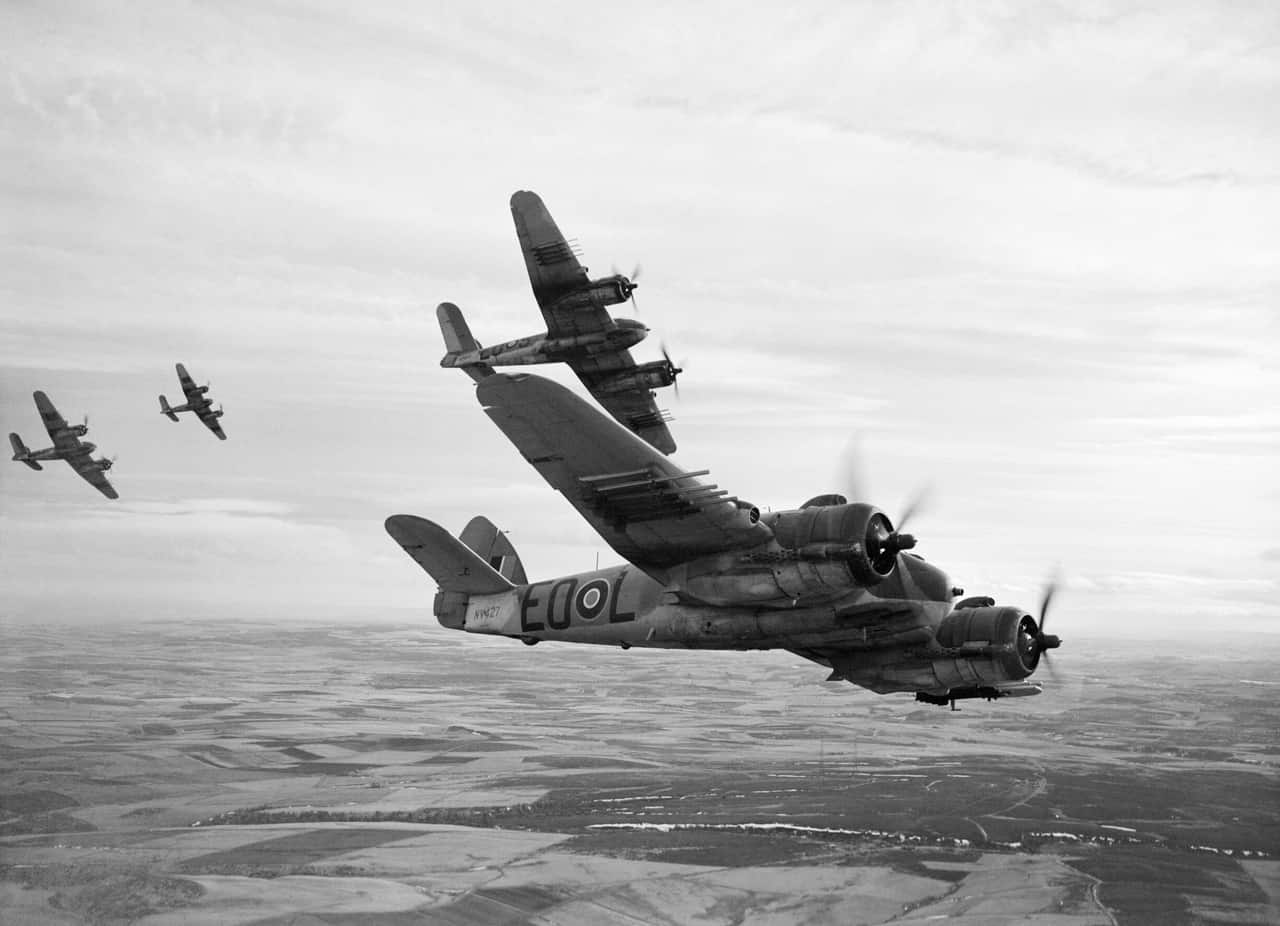

The Bristol Beaufighter carried ten guns: four 20 mm cannon in the nose and six .303 machine guns in the wings.
It flew in July 1939 and entered service in July 1940, just in time for the Blitz. On the night of November 19 to 20, 1940, a radar-equipped Beaufighter scored the first kill of its kind, a Junkers Ju 88.
Once the AI Mk IV radar worked, the night war turned. Fighter Command’s night fighters shot down 22 German bombers in March 1941, 48 in April and almost 100 in May, according to the IWM.
Later, Coastal Command’s strike wings flew rocket- and torpedo-armed Beaufighters against German shipping. The North Coates wing sank 29,762 tons of it in ten months. In all, 5,928 Beaufighters were built.
It is often said that Japanese troops called it Whispering Death. The nickname is real, but its Japanese origin comes from a British journalist and is not supported by Japanese sources.
6. Hawker Typhoon
The Hawker Typhoon nearly failed as a fighter. Its 2,180 hp Napier Sabre engine was hard to start and burned oil, and early aircraft suffered structural failures that tore off whole tail sections.
It was still fast. The RAF Museum calls it the RAF’s first 400 mph fighter, and the Mk Ib reached 422 mph (679 km/h). Between October 1942 and June 1943, Typhoons shot down 57 Focke-Wulf Fw 190 fighter-bombers flying tip-and-run raids on Britain.
Its real career was ground attack. Armed with four 20 mm cannon plus two 1,000-pound (450 kg) bombs or eight 60-pound rockets, it became the RAF’s tank-buster over Normandy and the Falaise Gap.
The tank-buster legend has a footnote
At Mortain in August 1944, British and American fighter-bombers claimed 252 German tanks. Historian Niklas Zetterling found that the Germans lost 46 tanks there, and only nine were verified as destroyed by Typhoons. The rocket attacks were real; the claims were inflated.
Gloster built all but 15 of the 3,317 Typhoons produced.
7. Gloster Meteor

The Gloster Meteor was Britain’s first jet fighter and the only Allied jet to fly combat operations in World War II. It first flew on March 5, 1943, and No. 616 Squadron flew its first operational sorties on July 27, 1944.
Its first target was the V-1. On August 4, 1944, Flying Officer Dixie Dean’s guns jammed, so he flew alongside a flying bomb, slid his wingtip under it and tipped it over. Flying Officer J.K. Rodger shot down another later that day.
By the end of the war, Meteors had accounted for 14 flying bombs. They never met the German jets in combat, and no Meteor is recorded as lost to enemy action. The first losses were two aircraft that collided in poor visibility in late April 1945.


The Meteor’s Rolls-Royce Welland engines needed an overhaul every 180 hours. Estimates for the Me 262’s Jumo 004 run from about 10 to 50 hours, depending on the source.
It ranks seventh because so few fought: 20 F.1s were built, then 210 F.3s, a run that continued into 1945. The Meteor matters more for what came next, and it led straight to the British fighter jets of the postwar RAF.
8. Gloster Gladiator
The Gloster Gladiator was the RAF’s last biplane fighter, accepted into service in February 1937. With a top speed of 257 mph (414 km/h) and four .303 Brownings, it was obsolete by 1939, yet it fought hard.
In Norway in 1940, No. 263 Squadron flew Gladiators off the frozen Lake Lesjaskog. Pat Pattle, the top Gladiator ace, scored 15 victories in the type.
Faith, Hope and Charity: what really happened
The legend says three Gladiators named Faith, Hope and Charity defended Malta alone in June 1940. In fact, six Sea Gladiators were assembled from crates a carrier had left behind, and only three could fly at a time. The famous names were attached after the battle.
In all, 747 Gladiators were built, including the Sea Gladiator naval version.
9. Fairey Fulmar
The Fairey Fulmar looks like an odd pick next to the Spitfire. It topped out at 272 mph (438 km/h), more than 170 mph slower than a Spitfire Mk XIV.
Yet the Fulmar was the Fleet Air Arm’s highest-scoring fighter of the war, with 112 kills. Armed with eight .303 machine guns, it was the main fighter on the Malta convoys of 1941 and 1942. Only 600 were built.
10. Supermarine Seafire

The Supermarine Seafire was the Spitfire adapted for carriers. It first flew on January 7, 1942, reached No. 807 Squadron that June and first saw combat during Operation Torch in November 1942.
It brought Spitfire performance to the fleet, with a top speed of about 360 mph (580 km/h). But its narrow undercarriage was badly suited to deck landings, and many Seafires were damaged by heavy landings. The Royal Navy received 2,646 of them.
British WW2 fighters that did not make the list
Three famous names miss the top 10, each for a different reason. Some of them also appear among the worst fighter planes of WW2.
Boulton Paul Defiant
The Defiant put all four of its guns in a turret behind the pilot, with no forward-firing guns. Over Dunkirk on May 29, 1940, No. 264 Squadron claimed 37 kills in two sorties. But the turret could not fire within 16 degrees of straight ahead.
On July 19, 1940, No. 141 Squadron lost seven of nine Defiants to Bf 109s. After No. 264 lost five more on August 28, the type was pulled out of day fighting and became a night fighter. In all, 1,064 were built.
Westland Whirlwind
The twin-engine Whirlwind carried four 20 mm cannon in its nose, which made it the most heavily armed fighter in the world when it first flew in 1938. It reached 385 mph (620 km/h).
Only 114 were built. Rolls-Royce dropped its Peregrine engine to focus on the Merlin, and Whirlwind production ended.
Westland Welkin

The Welkin was built to catch the Junkers Ju 86P, a German high-altitude bomber, with a service ceiling of 44,000 feet (13,400 m). Its pressurized cockpit held the pilot at the equivalent of 24,000 feet (7,300 m).

The high-altitude bomber threat never materialized. Only 77 complete Welkins were built, plus 26 airframes without engines, and the type was never used operationally by the RAF.

The best “American” fighter was built for Britain
One of the war’s great fighters started as a British order. In 1940, British purchasing agents asked North American Aviation to build Curtiss P-40s; North American proposed its own design instead.
The Mustang flew for the RAF first
The prototype of the North American Mustang flew in October 1940 to a British order, and the RAF was its first user, with the first Mustang I squadron in January 1942. Rolls-Royce then fitted it with a Merlin, and that Mustang X flew at Hucknall in October 1942.
The P-51 Mustang went on to lead our list of American fighter planes of WW2. Its enemies are ranked in the best German fighter planes of WW2.
British WW2 planes beyond the fighters
Fighters were only part of Britain’s air war. Bomber Command flew heavy bombers such as the Avro Lancaster against Germany,.
For production totals across every nation, from the Spitfire to the Il-2, see the most-produced aircraft of WW2.
FAQ
Sources and references used for research and fact-checking.
- RAF Museum, Supermarine Spitfire I
- BAE Systems Heritage, Vickers Supermarine Spitfire
- Wikipedia, Supermarine Spitfire (Griffon-powered variants)
- BAE Systems Heritage, Hawker Hurricane
- RAF Museum, Hawker Hurricane I
- RAF Museum, Hawker Hurricane collection object
- Wikipedia, Battle of Britain
- Air & Space Forces Magazine, The Battle of Britain
- Imperial War Museums, De Havilland Mosquito: the Wooden Wonder
- Wikipedia, de Havilland Mosquito
- Imperial War Museums, What did Fighter Command do after the Battle of Britain?
- RAF Museum, Hawker Tempest V
- Wikipedia, Hawker Tempest
- Wikipedia, Bristol Beaufighter
- RAF Museum, Hawker Typhoon IB MN235
- Wikipedia, Hawker Typhoon
- Wikipedia, Gloster Meteor
- HistoryNet, Meatboxes Versus Doodlebugs
- Wikipedia, Rolls-Royce Welland
- Wikipedia, Junkers Jumo 004
- BAE Systems Heritage, Gloster Gladiator
- Wikipedia, Gloster Gladiator
- The National WWII Museum, British Biplanes: Faith, Hope and Charity, 1940
- Hush-Kit, Fairey Fulmar: Britain's top-scoring naval fighter
- Wikipedia, Fairey Fulmar
- Wikipedia, Supermarine Seafire
- Wikipedia, Boulton Paul Defiant
- Wikipedia, Westland Whirlwind
- Wikipedia, Westland Welkin
- Smithsonian National Air and Space Museum, North American P-51D-30-NA Mustang
- Wikipedia, North American P-51 Mustang
Get the Newsletter
The latest aviation news and stories sent to your inbox.
About the Author

Tim is the owner and lead editor of AeroCorner since 2019, overseeing aviation content covering aircraft, airlines, airports, and the broader aviation industry. Through years of researching, writing, editing, and publishing aviation-focused content, he has developed extensive practical knowledge of commercial aviation and air travel. Based in Asia and a frequent traveler himself, Tim also brings firsthand passenger experience to AeroCorner’s coverage. Outside of publishing, he has also explored aviation firsthand through hands-on flight training in New Zealand.