


Table of Contents
The best German fighter plane of World War II was the Messerschmitt Bf 109. It was not the most advanced or even the best-flying German fighter, but it fought from the first day of the war to the last, and Germany built more of them than any nation has built of any fighter, before or since.
That is the measure used here: combat record and production scale. A fighter earns its place by what it did, how many were built, and whether the air war would have looked different without it.
By that measure the Focke-Wulf Fw 190 is a close second, and many pilots thought it the better aircraft. The Messerschmitt Me 262 jet is third: the world’s first operational jet fighter, and far too late and too few to change the war.
This list covers fighters only, including the twin-engine heavy fighters and night fighters the Luftwaffe relied on. Germany’s bombers are ranked separately in our guide to German bombers of WW2.
The Best German Fighter Planes of WW2, Ranked
| Rank | Aircraft | Built | Top speed | Main role |
|---|---|---|---|---|
| 1 | Messerschmitt Bf 109 | 34,248 | 426 mph (686 km/h), G-10 | Day fighter |
| 2 | Focke-Wulf Fw 190 | 20,000+ | 426 mph (686 km/h), D-9 | Day fighter and fighter-bomber |
| 3 | Messerschmitt Me 262 | 1,443 | 540 mph (870 km/h) | Jet fighter |
| 4 | Messerschmitt Bf 110 | 6,170 | 336 mph (541 km/h), C series | Heavy fighter and night fighter |
| 5 | Heinkel He 219 Uhu | 294 | 404 mph (650 km/h), A-6 | Radar night fighter |
| 6 | Messerschmitt Me 410 Hornisse | 1,189 | 388 mph (625 km/h) | Heavy fighter and bomber destroyer |
| 7 | Focke-Wulf Ta 152 | 67 | 472 mph (759 km/h) at 41,000 ft | High-altitude fighter |
| 8 | Messerschmitt Me 163 Komet | 279 delivered | 596 mph (959 km/h) | Rocket interceptor |
| 9 | Heinkel He 162 Volksjäger | About 120 delivered | 520 mph (840 km/h) | Emergency jet fighter |
How this ranking was made
Fighters are ranked on combat record and production scale: what the type achieved in action, how long it stayed relevant, and how many were built. Speed and technology count only where they changed an outcome. Ranked on top speed alone, the order would almost invert, with the rocket-powered Me 163 first and the Bf 110 last.
1. Messerschmitt Bf 109
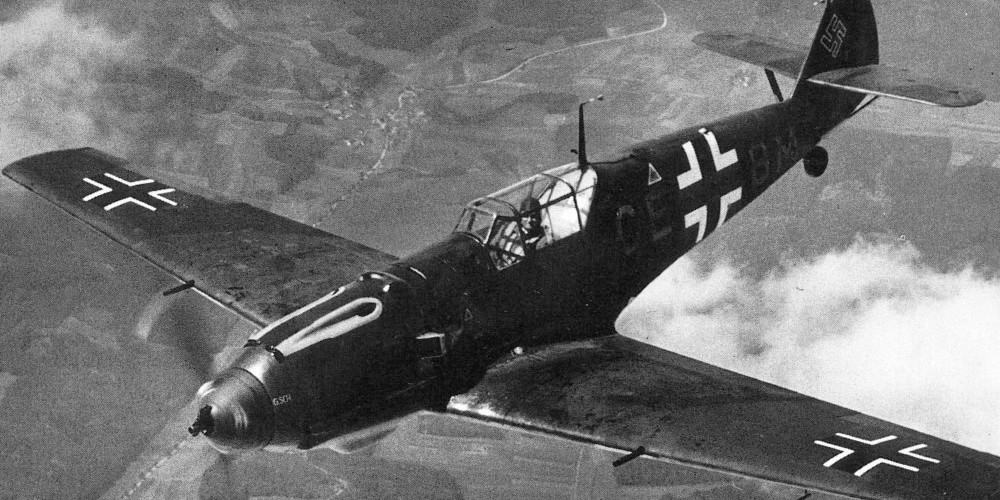

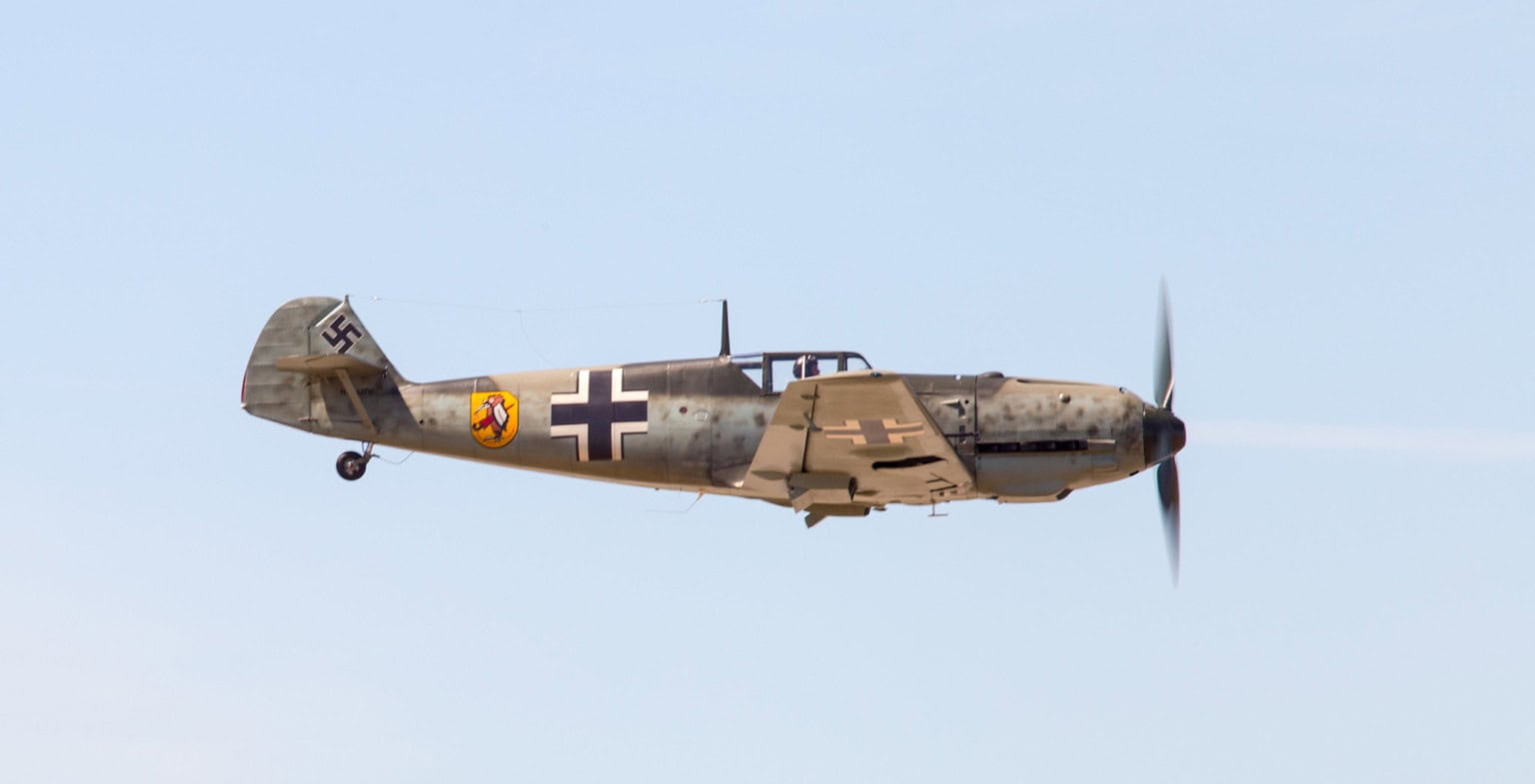
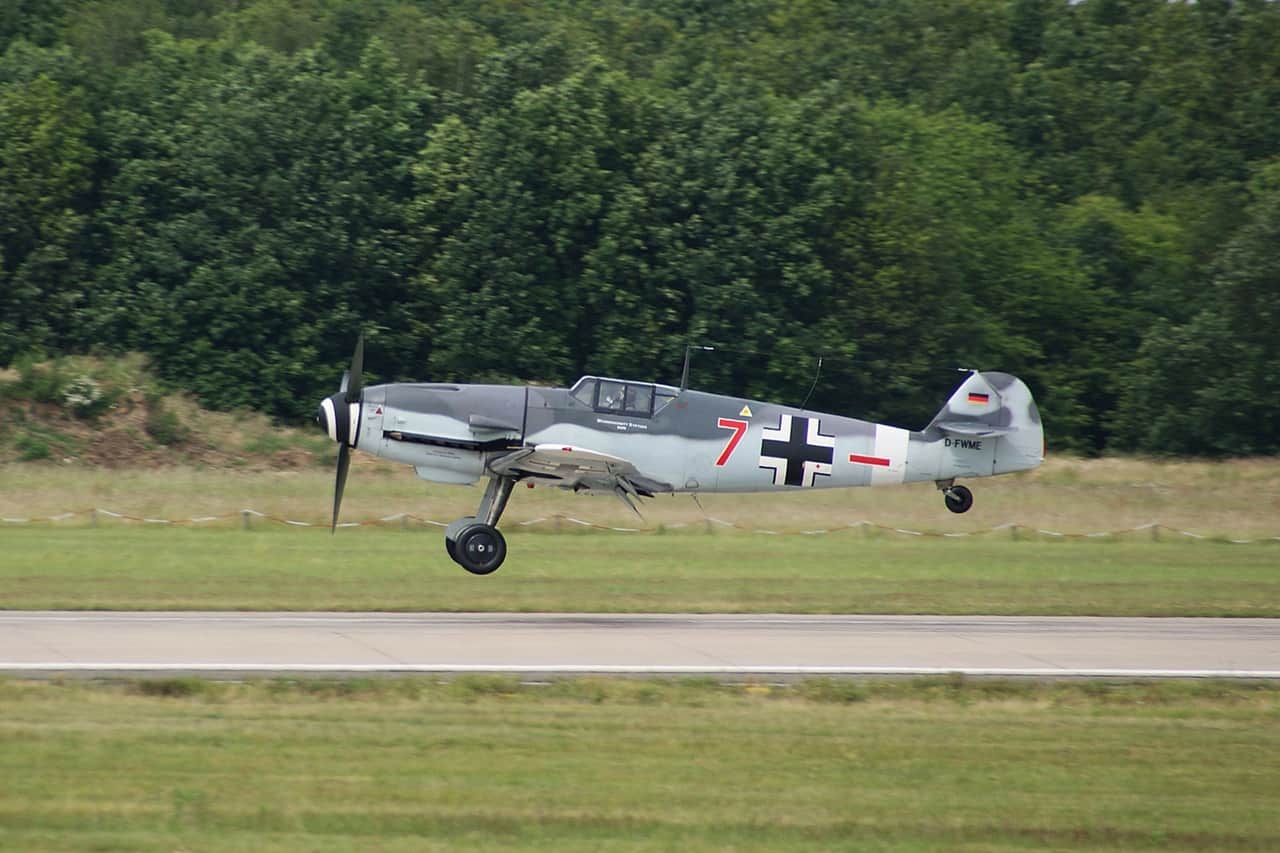


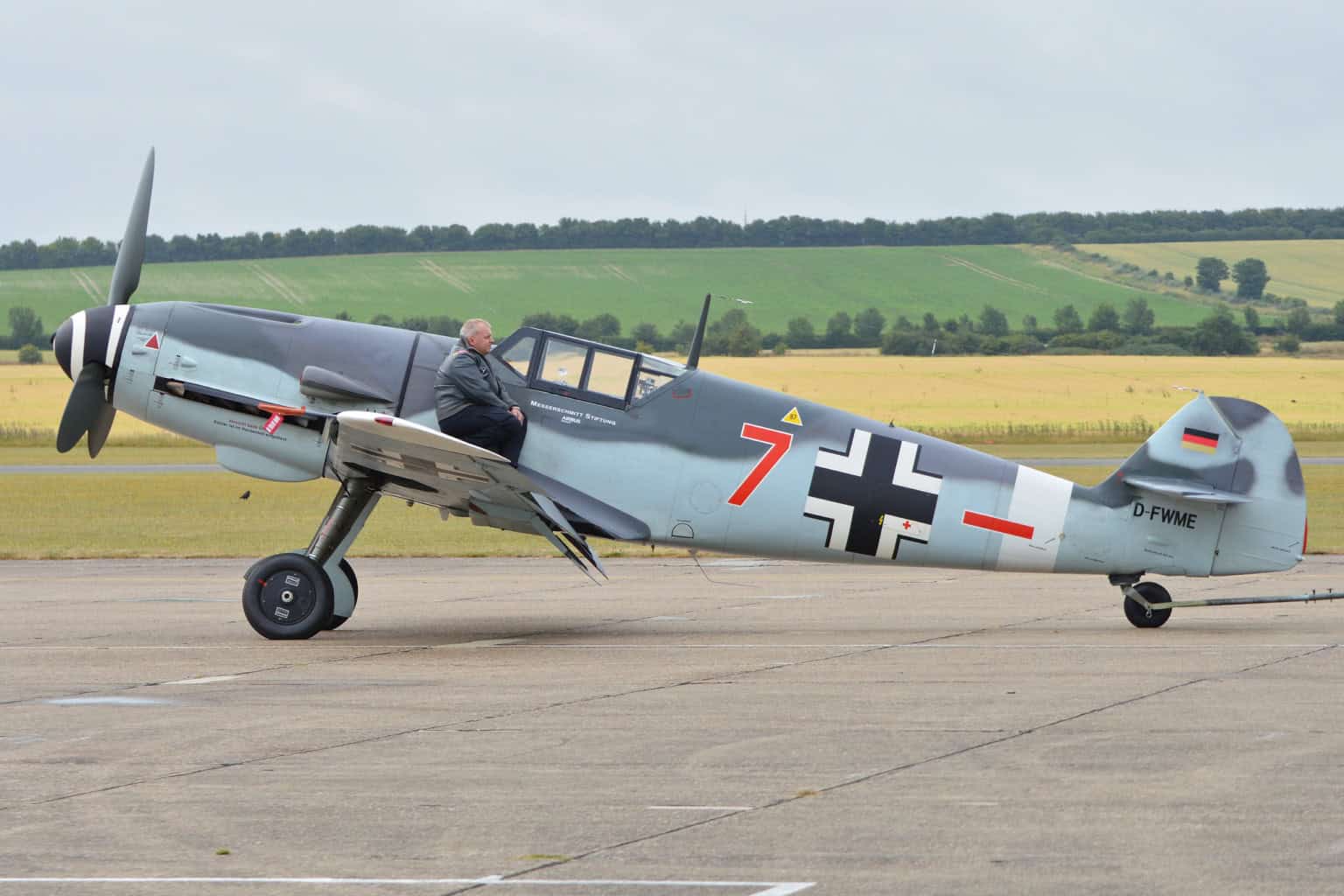

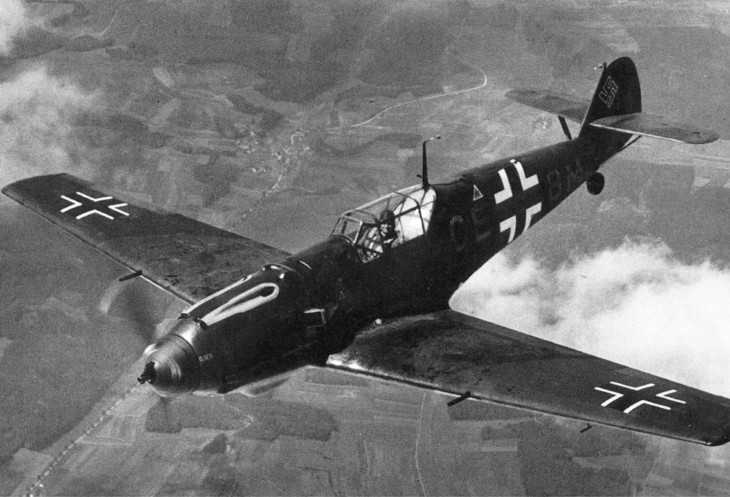
The Messerschmitt Bf 109 was the backbone of the Luftwaffe fighter force for the entire war. It first flew on 29 May 1935, fought in the Spanish Civil War, and was still in front-line service when Germany surrendered in May 1945.
At its introduction it was one of the most advanced aerodynamic designs of its time, with retractable landing gear, an enclosed cockpit, automatic leading-edge slats and stressed-skin construction. In Spain it replaced the Heinkel He 51, a biplane.
Early in the war the Bf 109E dominated Polish fighters, then outfought French Morane-Saulnier MS.406s and British Hurricanes over France in 1940. Then it met the Spitfire over the English Channel, and its real weakness showed.
That weakness was range. The Bf 109E could not escort bombers past London, which left most of Britain’s airfields and factories out of reach. The National Museum of the US Air Force counts this as a significant cause of the Luftwaffe’s defeat in the Battle of Britain.
Messerschmitt kept improving it. The F series flew with more than half of the single-engine fighter units that invaded the Soviet Union in June 1941. The G series, in production from early 1942, was faster but less maneuverable, and its pilots found it increasingly hard to fight aircraft such as the P-51D Mustang.
Production still rose until the final months of the war. A total of 34,248 were built between 1936 and April 1945, making the Bf 109 the most produced fighter aircraft in history, a record that is the subject of our look at the most produced aircraft of WW2.
The three highest-scoring aces in history all flew the Bf 109
Between them they claimed 928 victories, flying Bf 109s with Jagdgeschwader 52, mostly on the Eastern Front. Erich Hartmann, the top scorer, was credited with 352, and Günther Rall, third on the list, with 275. Like all wartime victory claims, these are credited totals rather than audited ones.
The Bf 109 was also flown by Hans-Joachim Marseille, the top-scoring ace of the North African campaign with 158 claims, and our ranking of the best fighter pilots in history covers where they all stand.
Some Bf 109 production relied on concentration camp slave labor, a part of the aircraft’s history that belongs alongside its record. After the war it kept flying: Czechoslovakia built it until 1949, Spain until 1958, and 25 Czech-built Avia S-199s served with the new Israeli Air Force in 1948.
2. Focke-Wulf Fw 190
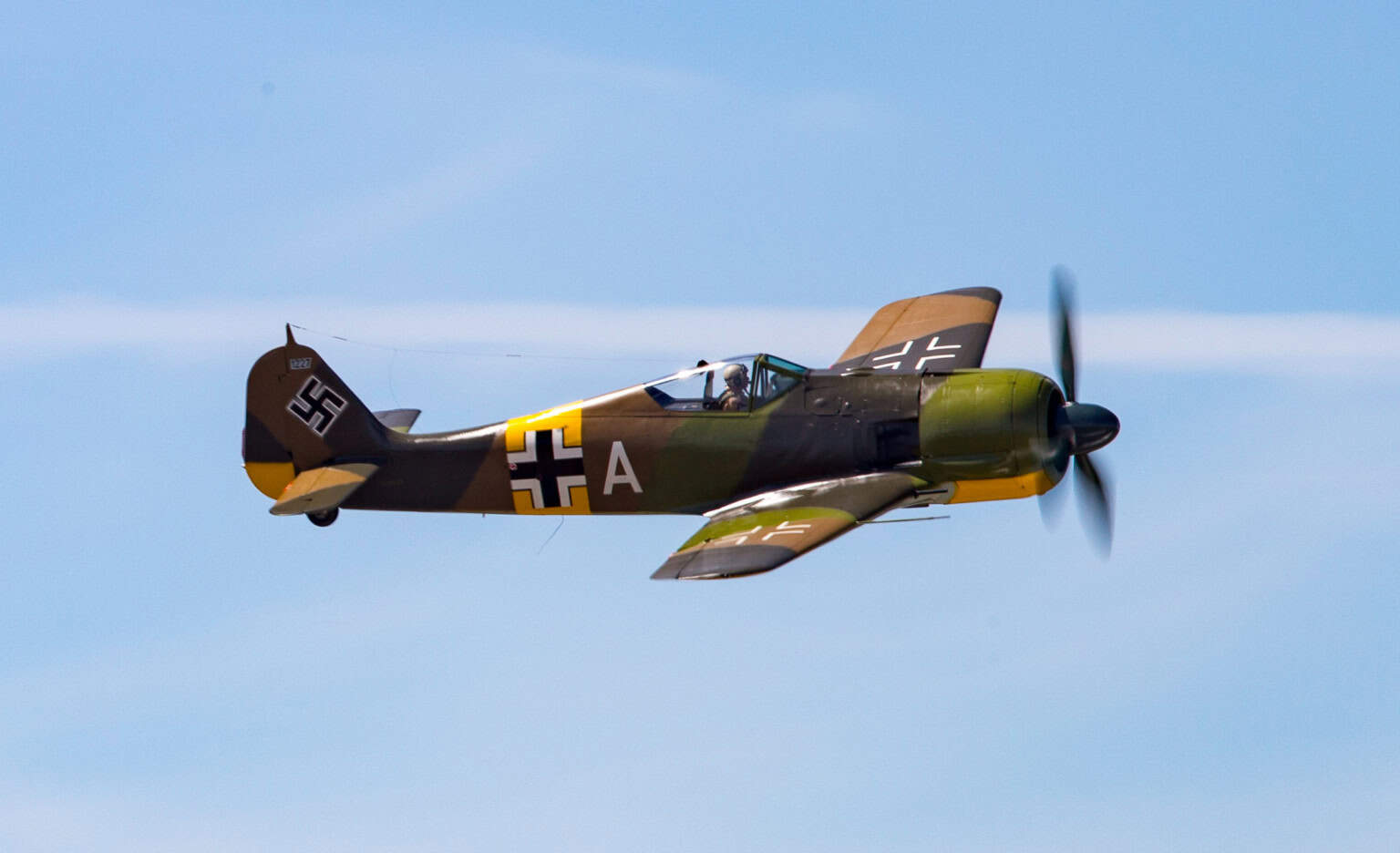


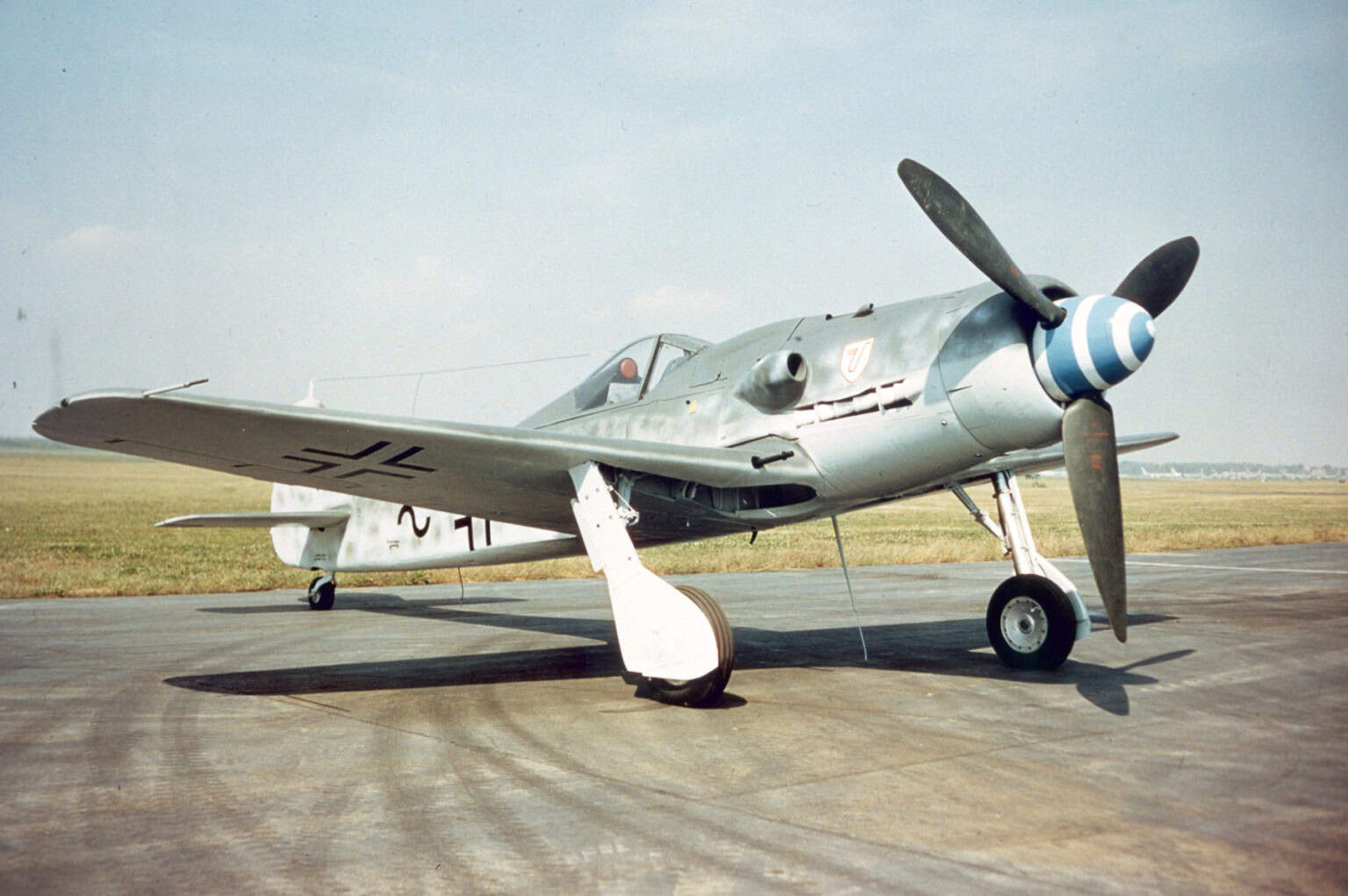
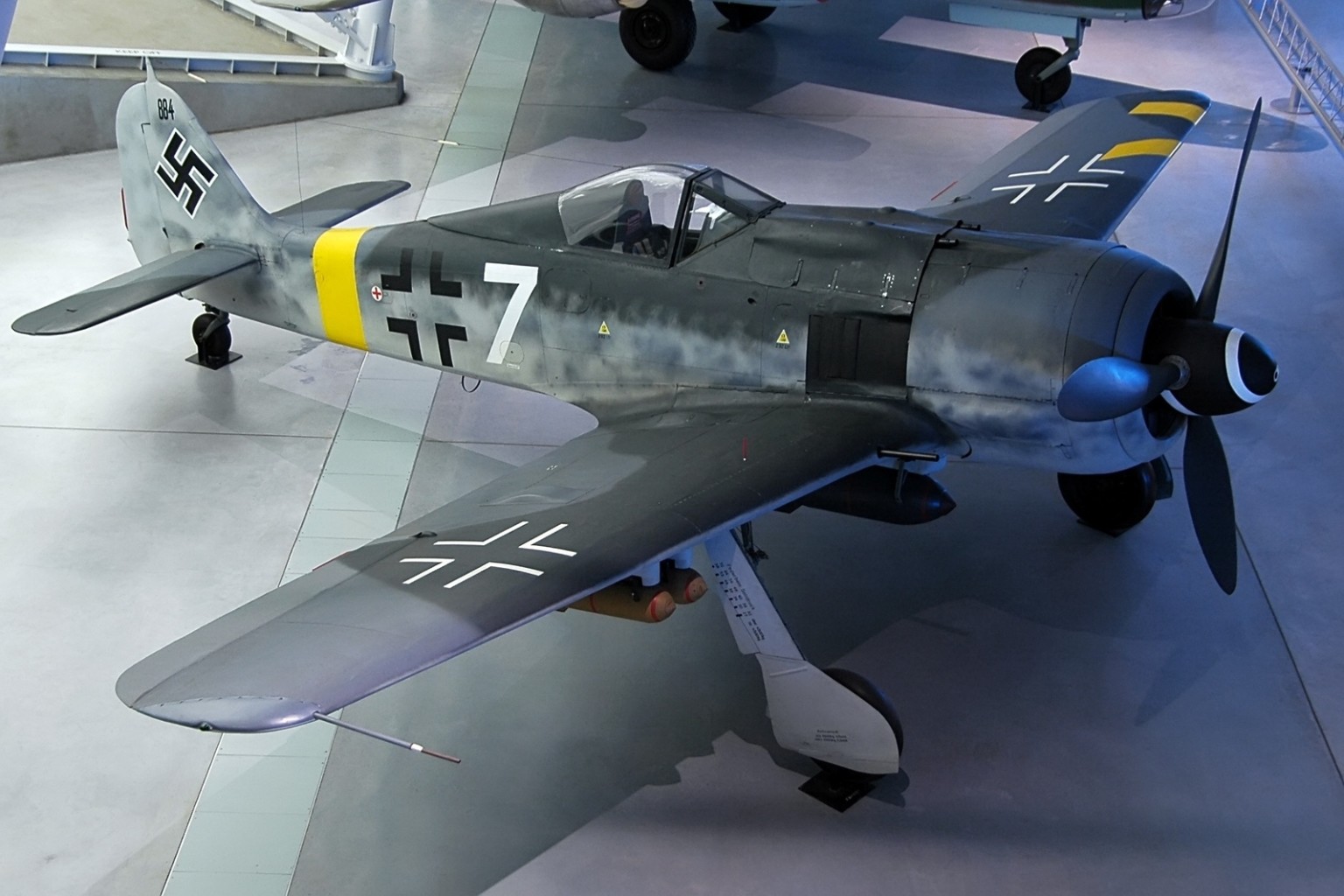
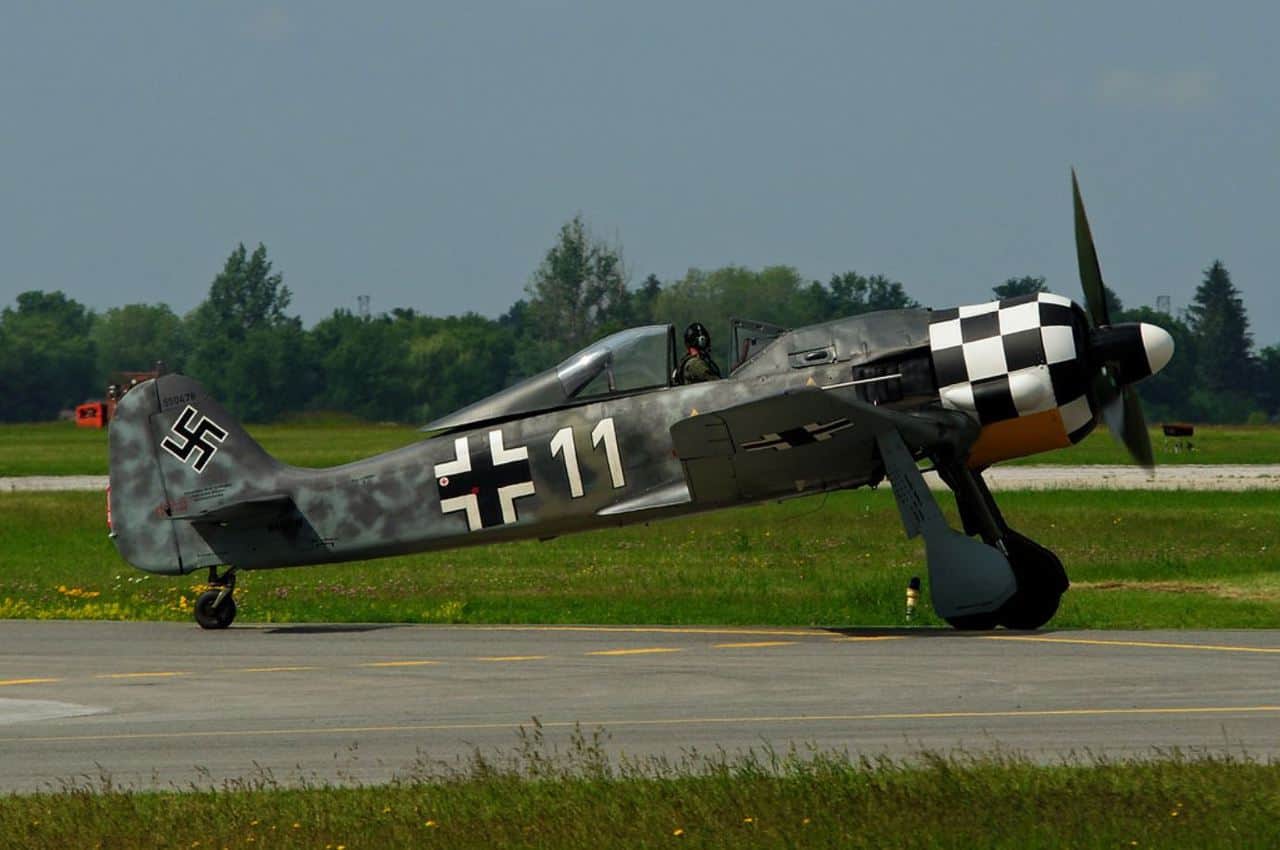

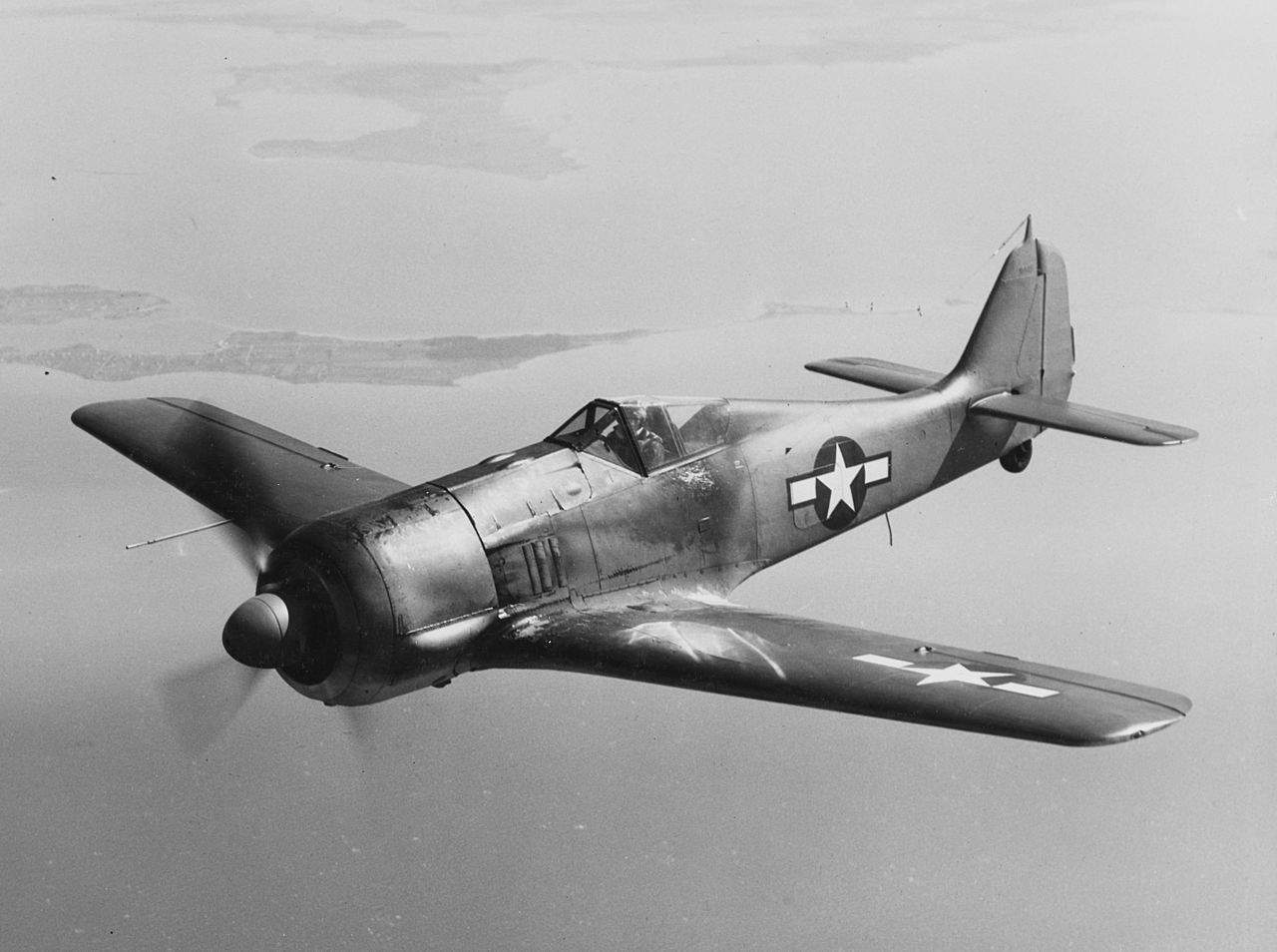
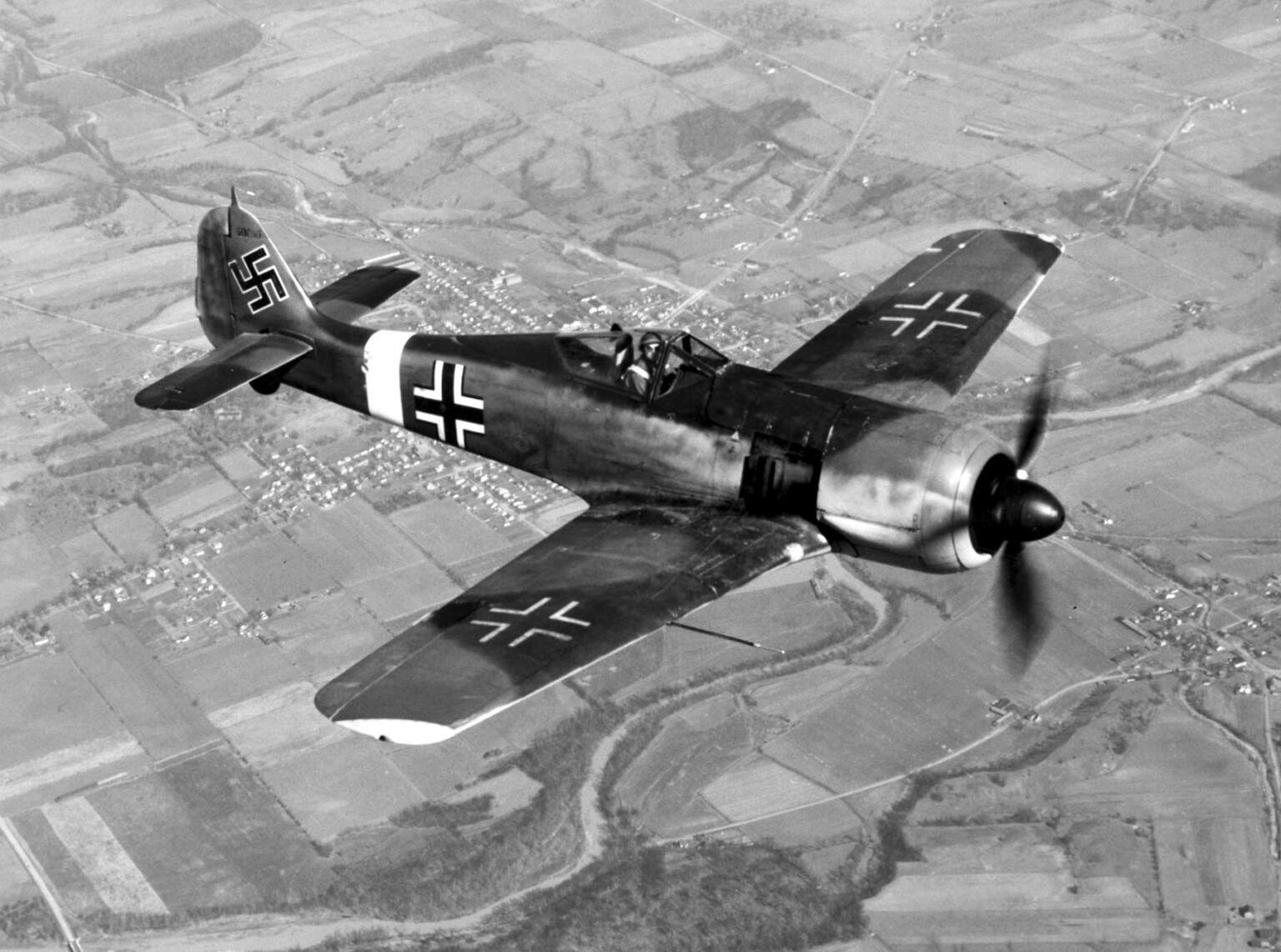

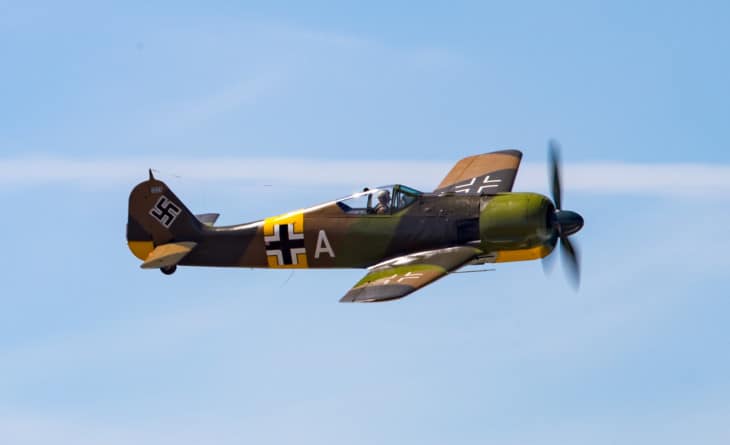
If the Bf 109 was Germany’s workhorse, the Focke-Wulf Fw 190 was its thoroughbred. It first flew on 1 June 1939, and when it met the RAF over northern France in September 1941 it outclassed everything the British had.
According to the Smithsonian’s National Air and Space Museum, the Spitfire V proved inferior to it by almost every measure except turning radius. Until the improved Spitfire Mk IX arrived late in 1942, the Allies had no fighter to equal it.
It was designed as a supplement to the Bf 109, not a replacement. Designer Kurt Tank’s team used a BMW radial engine because every available Daimler-Benz inline engine was already allocated to Messerschmitt, which made the Fw 190 the only German single-seat fighter of the war with a radial engine.
The RAF got its first Fw 190 because a German pilot landed at the wrong airfield
On 23 June 1942, Oberleutnant Armin Faber of JG 2 landed his Fw 190 A-3 by mistake at RAF Pembrey, a British airfield. The RAF now had an intact example of the fighter that had been beating its Spitfires, and used it to test the new Spitfire Mk IX and work out tactics against it.
The Fw 190A-5 played a principal role in the heavy losses inflicted on unescorted American bombers in 1943. Later versions carried heavier guns that were devastating against bombers, but the extra weight left them more exposed to escorting P-47s and P-51s.
Its rugged radial engine and wide-track landing gear suited the rough airfields of the Eastern Front, where the armored Fw 190F became a ground-attack aircraft. The long-nosed Fw 190D-9, powered by a Jumo 213 inline engine, entered service in autumn 1944 and could reach 426 mph (686 km/h).
More than 20,000 were built. That is fewer than the Bf 109, and the Fw 190 only reached combat two years into the war, which is why it ranks second on this measure despite being the better fighter for much of the war.
3. Messerschmitt Me 262 Schwalbe

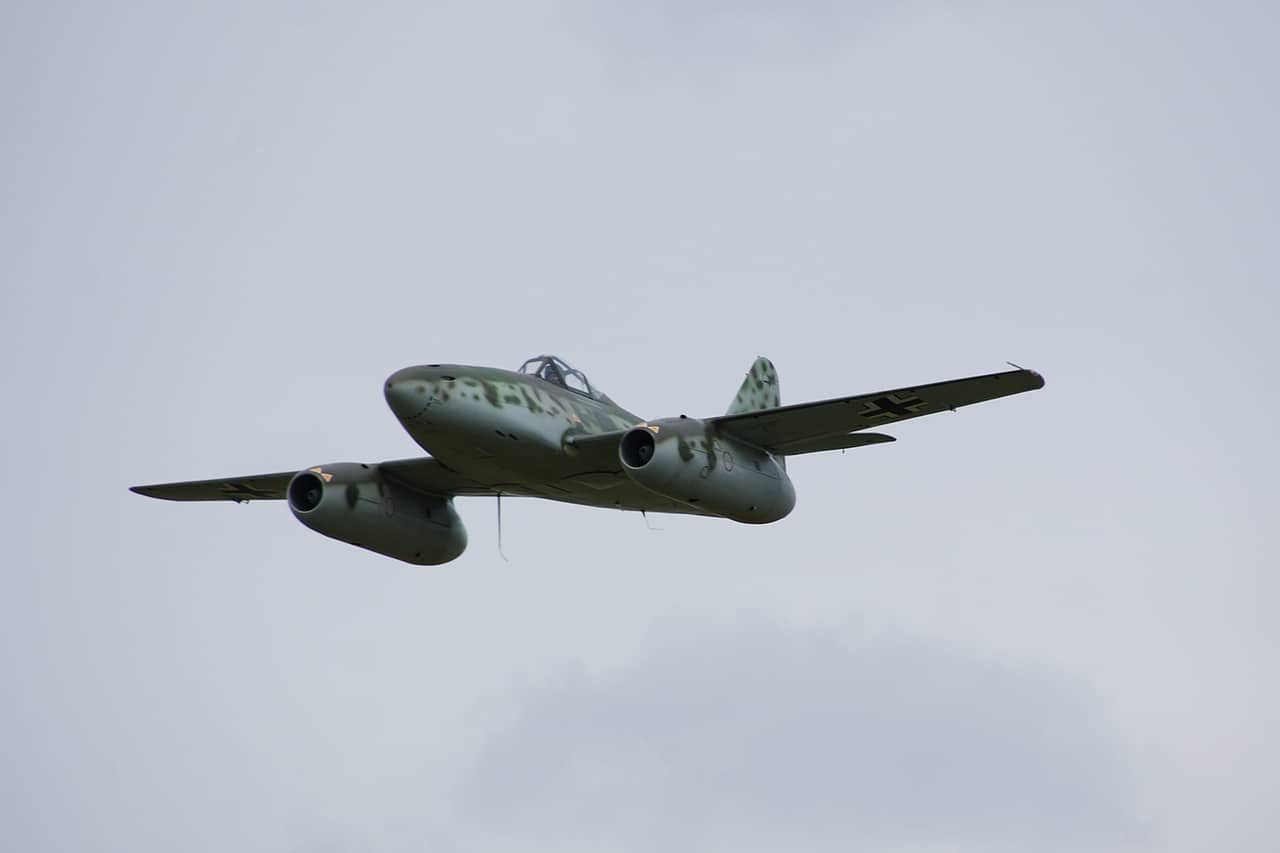
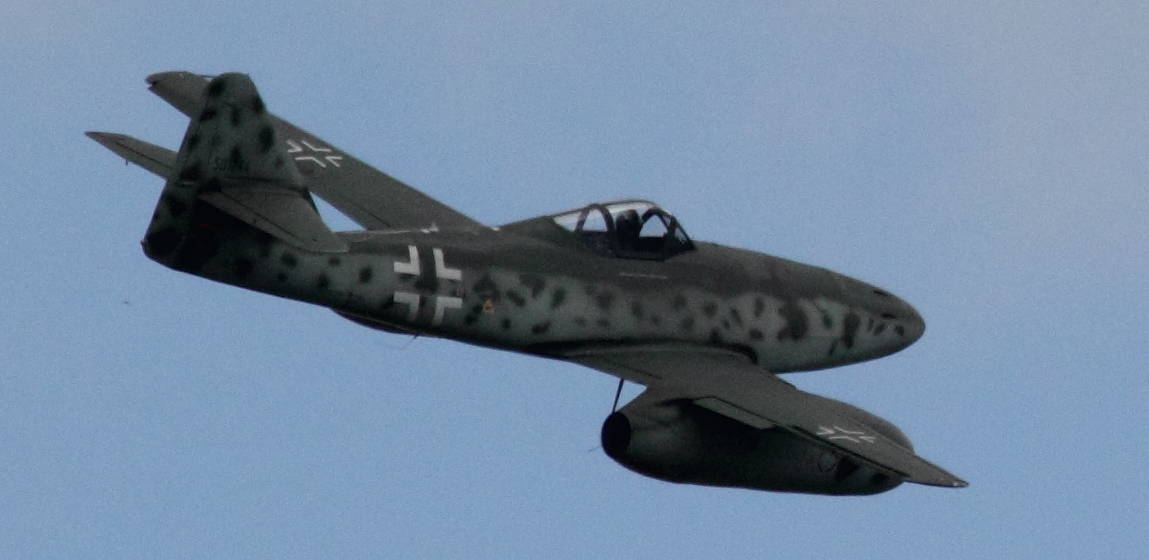
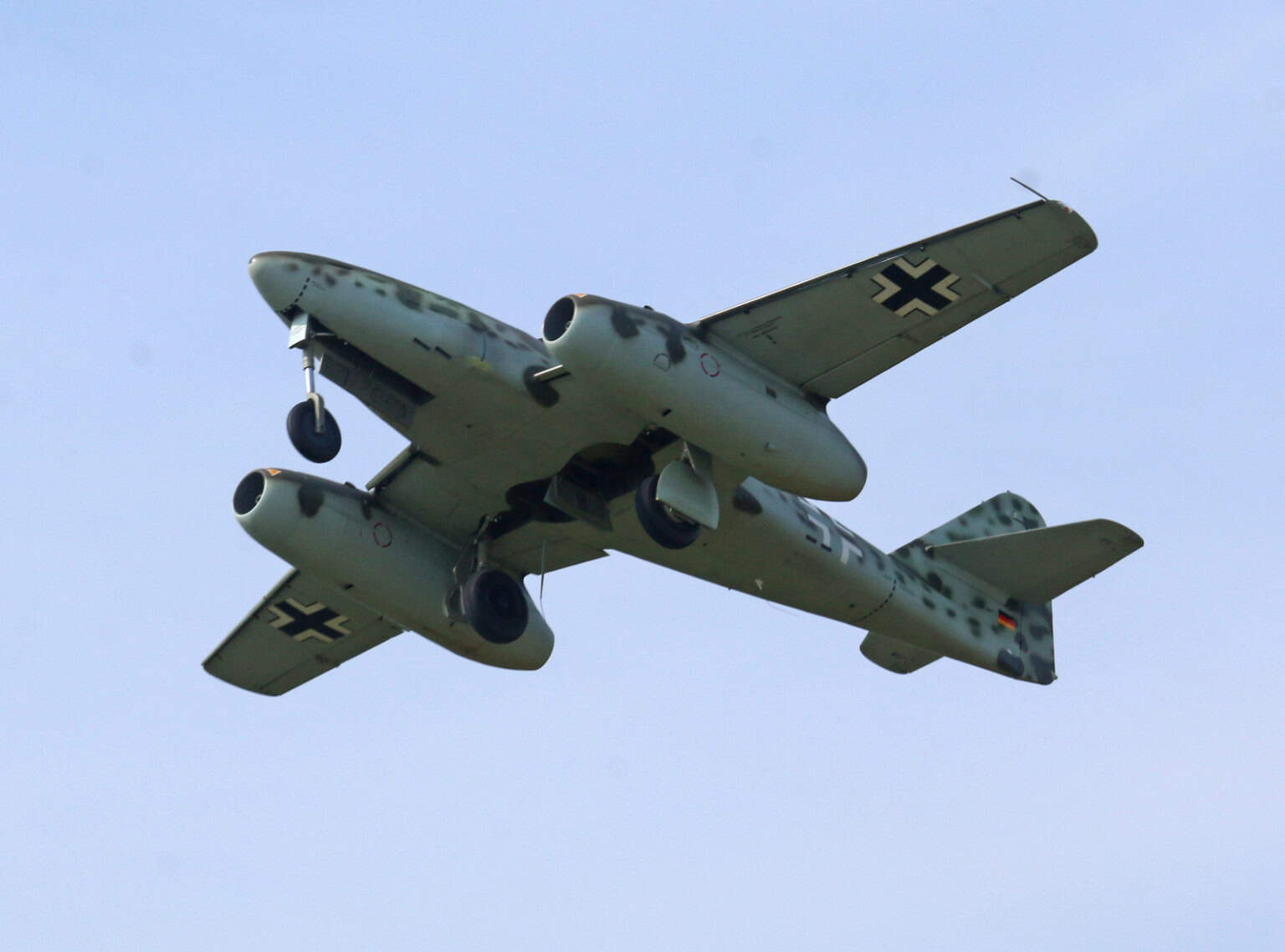
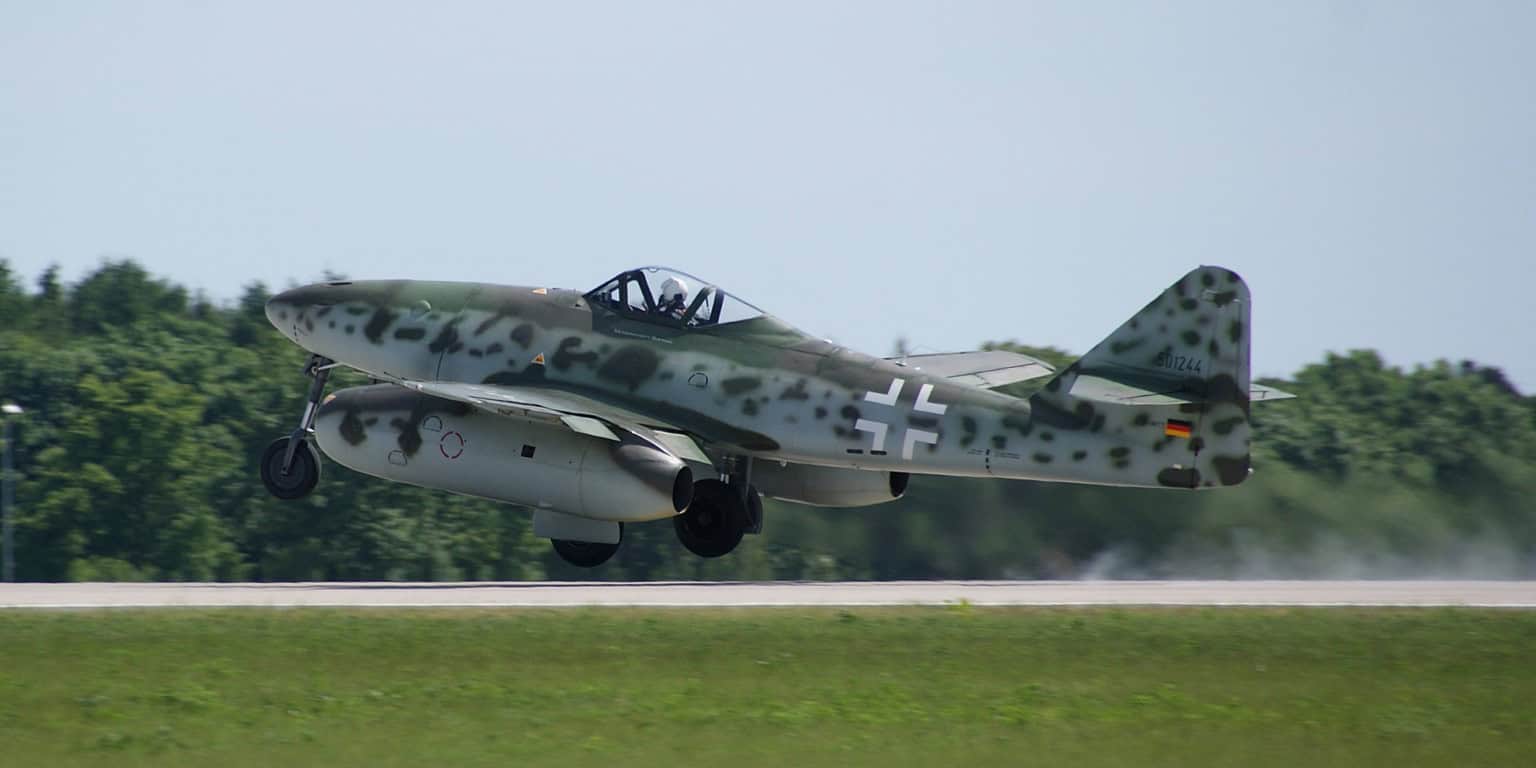


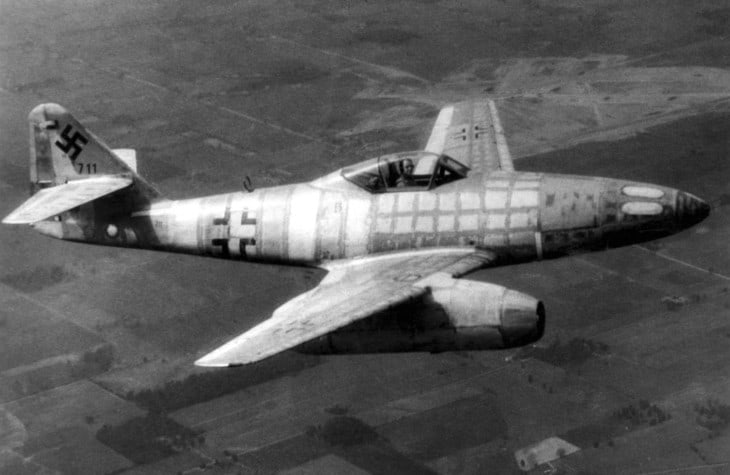
The Messerschmitt Me 262 was the world’s first operational jet fighter. With two Junkers Jumo 004 turbojets, swept wings and four 30 mm cannon, it reached about 540 mph (870 km/h).
That made it roughly 120 mph (193 km/h) faster than a P-51 Mustang at the same altitude. It was less maneuverable, but it could join a fight or leave one whenever its pilot chose.
The design dates to 1938, but the engines were not ready for years. The first Me 262 flew on 18 April 1941 with a piston engine in its nose, and test pilot Fritz Wendel made the first takeoff on jet power on 19 July 1942.
Hitler did not keep the Me 262 out of the war
The popular story is that Hitler’s order to build the Me 262 as a bomber delayed it as a fighter until it was too late. The Smithsonian’s National Air and Space Museum says this is not the case. The real delay was the long, difficult development of the jet engines. Hitler’s order did divert about 30 percent of production airframes to the Me 262A-2a bomber version.
Messerschmitt factories completed 1,443 Me 262s, but only about 300 saw combat. The rest were lost in training accidents or destroyed by Allied bombing.
The Allies answered with fighter sweeps that offset its speed and with constant attacks on its airfields. By the last days of the war, surviving Me 262 units were flying from makeshift bases along Germany’s autobahns.
It ranks third because it arrived too late and in too few numbers to change the air war. The full story of it and the jets that followed is in our guide to German jet aircraft of WW2.
4. Messerschmitt Bf 110
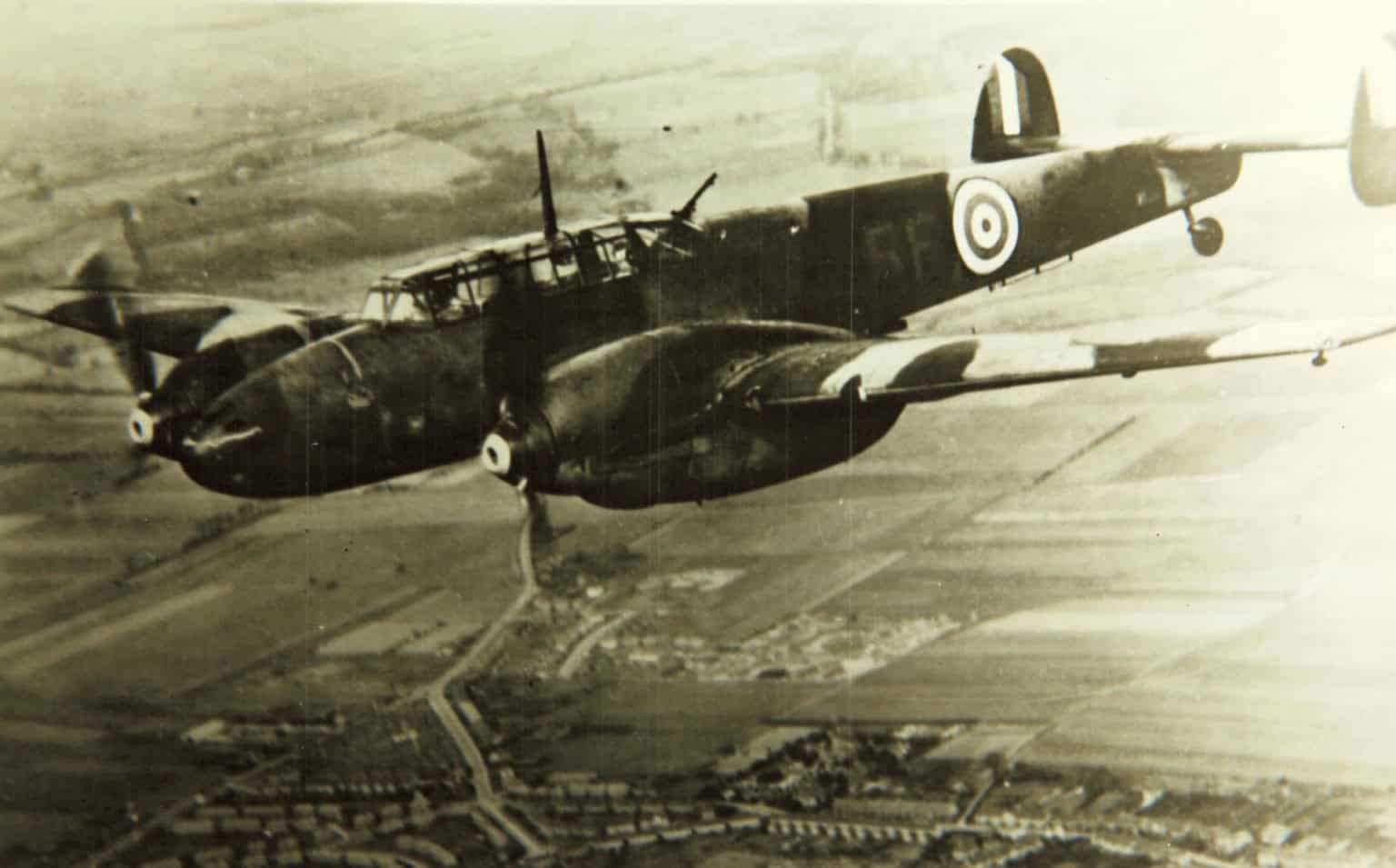
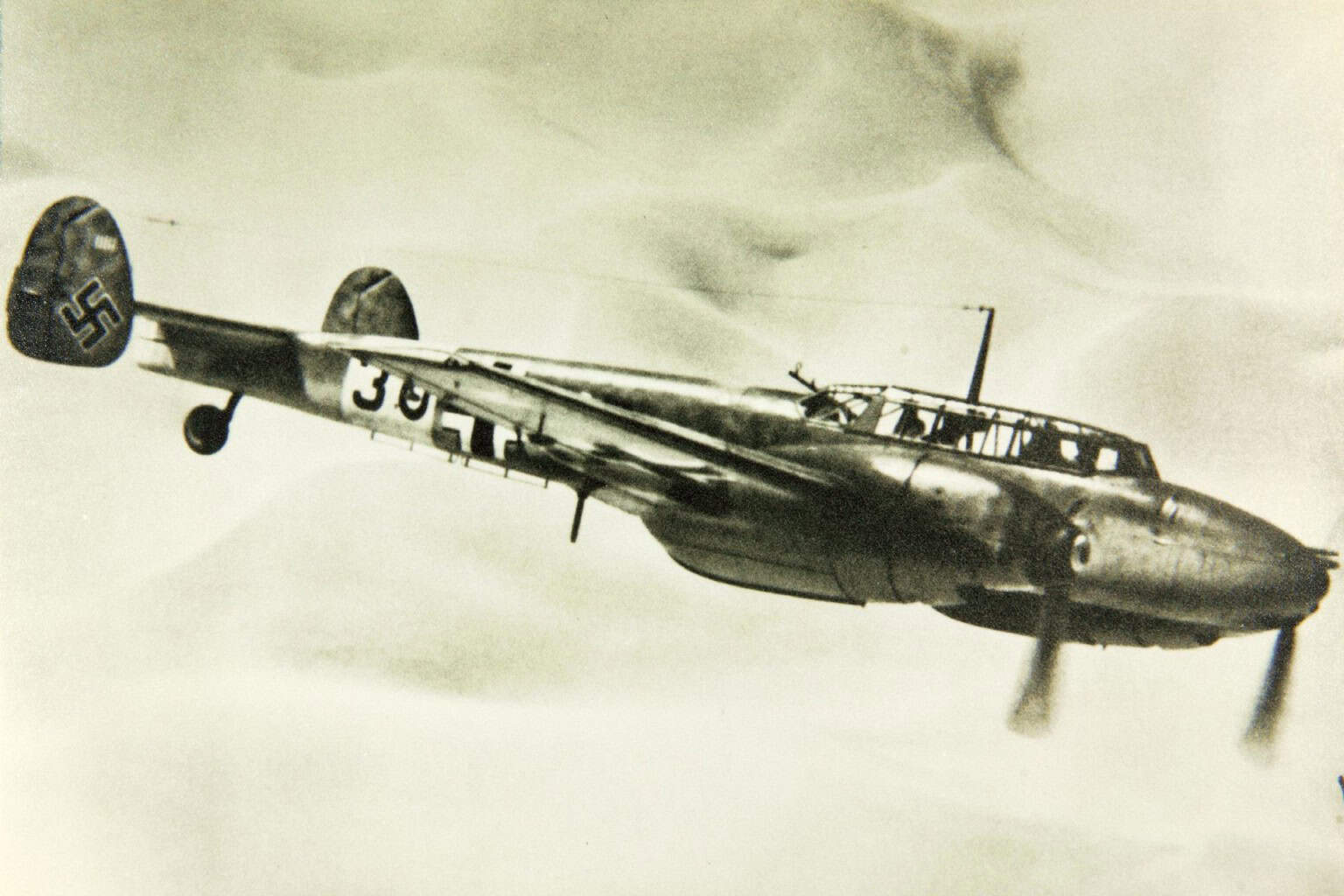

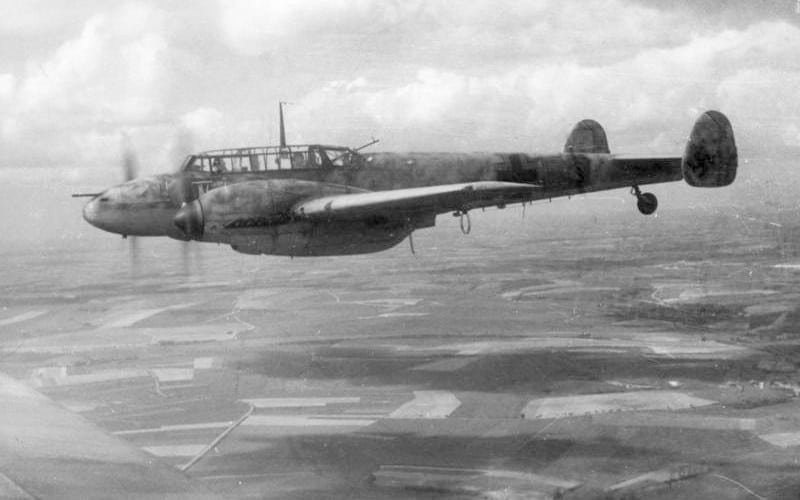
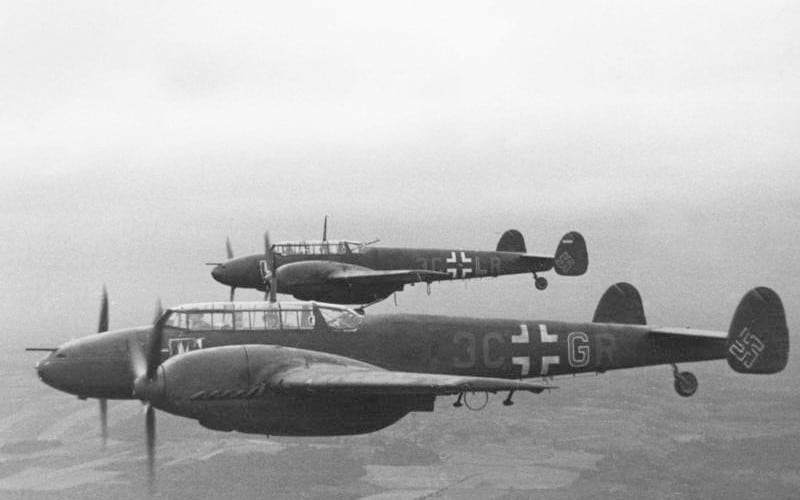


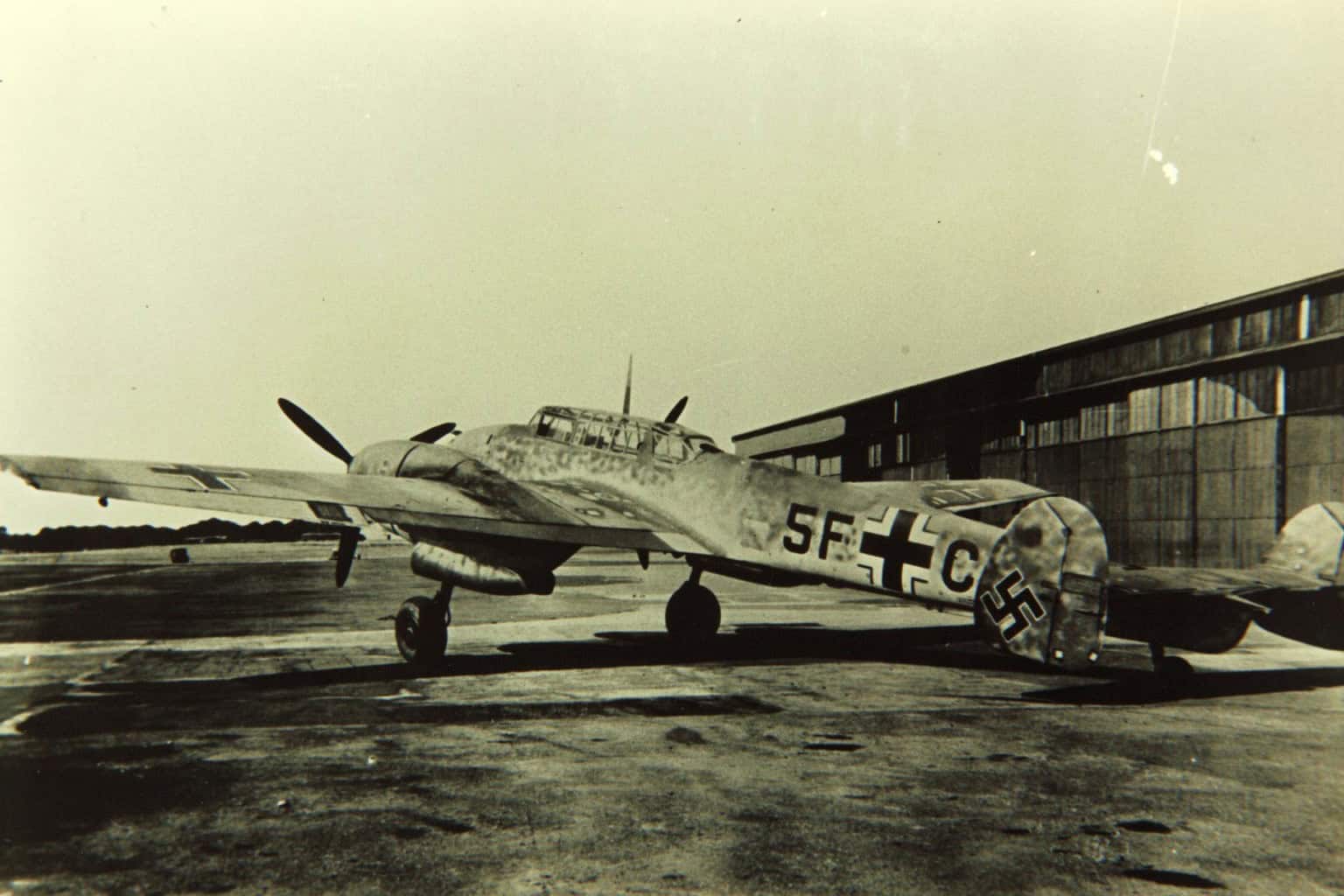


The Messerschmitt Bf 110 is the fighter that failed at its original job and then became the Luftwaffe’s principal night fighter.
It first flew on 12 May 1936 as a Zerstörer (“destroyer”), a twin-engine heavy fighter meant to escort bombers deep into enemy territory. Its weakness was maneuverability, and in the Battle of Britain RAF pilots exploited it whenever the Bf 110 was tied to the bombers as close escort.
Then it found its role. When the RAF began bombing Germany at night, Bf 110 units were converted to night fighting, a job the aircraft suited well, and it became the backbone of the night defense.
Most German night fighter aces flew it at some point. The highest-scoring night fighter pilot in history, Heinz-Wolfgang Schnaufer, flew only the Bf 110 and claimed 121 victories in 164 sorties.
By day it had a second career in other theaters and against American bombers over Germany. A total of 6,170 were built, and its long service in a role it was never designed for is what puts it ahead of the more capable twin-engine fighters below it.
5. Heinkel He 219 Uhu
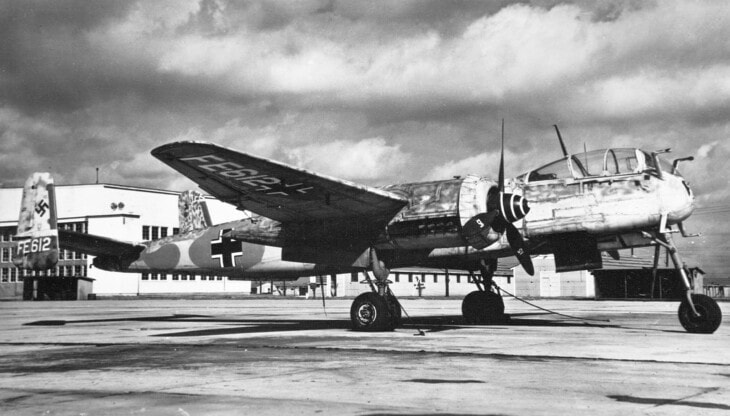
The Heinkel He 219 Uhu (“Eagle Owl”) was the best night fighter Germany built, and the Smithsonian suggests it may have been the best night fighter of the war.
It was one of only two fighters of the war designed from the start for night operations, the other being America’s P-61 Black Widow. The Bf 110 and Junkers Ju 88 were conversions, and by late 1941 they were struggling to stop RAF night raids.
The prototype flew on 15 November 1942. Its debut was spectacular: on its first operational mission, on the night of 11/12 June 1943, Major Werner Streib and his radio operator shot down five British bombers, four Halifaxes and a Lancaster.
The He 219 carried the world's first operational ejection seats
Ejection seats are often associated with the He 162 jet, but the Smithsonian lists the He 219 as the first operational aircraft with ejection seats. It was also the first operational German aircraft with a steerable nosewheel, and later versions carried Schräge Musik, a pair of 30 mm cannon firing upward at the unprotected underside of a bomber.
A stripped-down A-6 version reached 404 mph (650 km/h), fast enough to hunt the British Mosquito. It was the only piston-engine Luftwaffe night fighter that could meet the Mosquito on equal terms.
Politics limited it. Air Ministry procurement chief Erhard Milch had the program cancelled in May 1944, yet Heinkel kept building it in small numbers, and some 2,000 prisoners from the Mauthausen concentration camp worked its assembly line at Vienna-Schwechat.
Only 294 were built. It ranks fifth, below the Bf 110, because there were never enough of them to matter as much as a better aircraft should have.
6. Messerschmitt Me 410 Hornisse

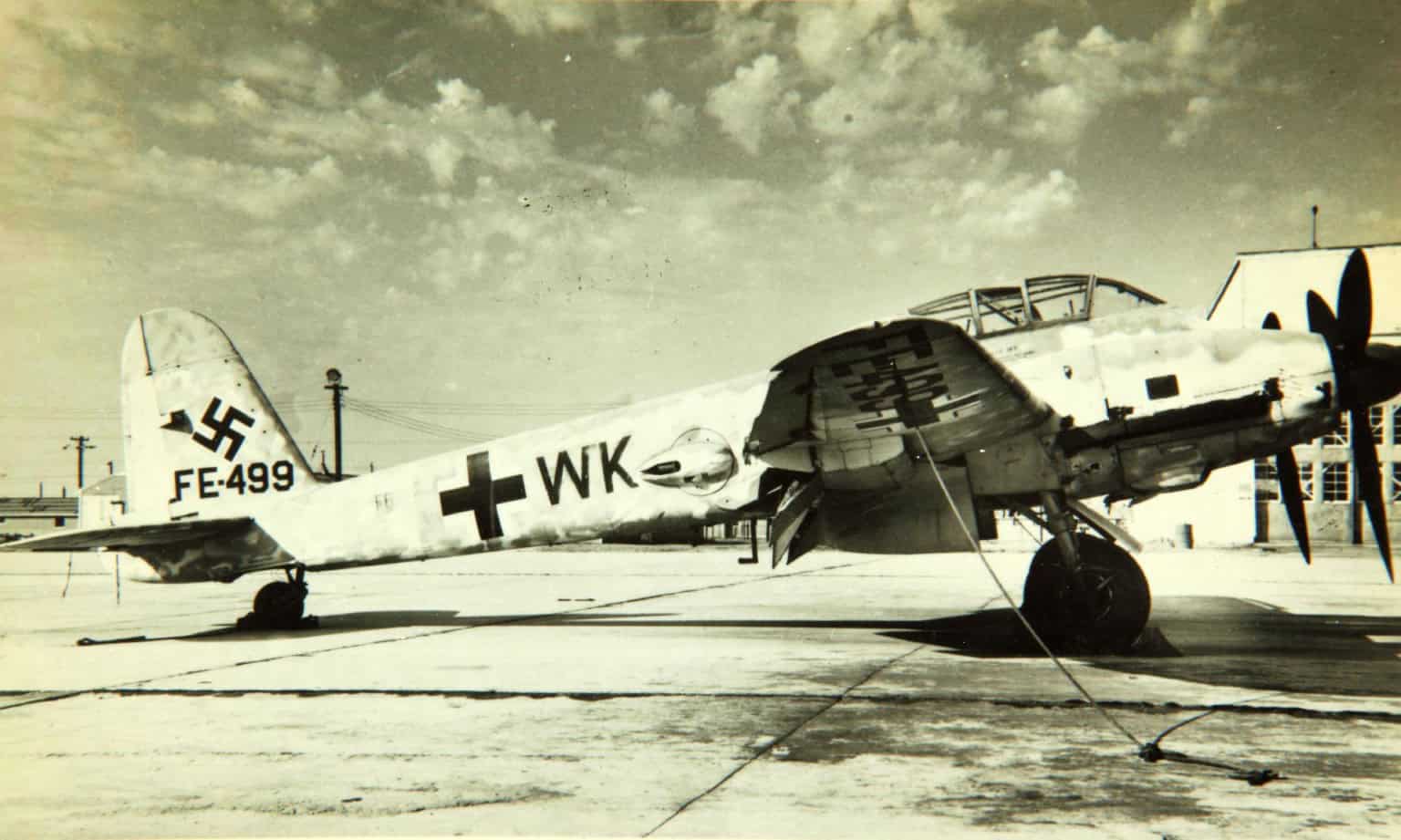


The Messerschmitt Me 410 Hornisse (“Hornet”) was the Bf 110’s intended successor, developed from the troubled Me 210. It first flew on 14 March 1942, and 1,189 were built between May 1943 and August 1944.
One of its main jobs was breaking up American bomber formations, and some versions carried a weapon unlike any other fighter’s. The A-1/U4 mounted a 50 mm BK 5 cannon, derived from the gun of the Panzer III tank.
The BK 5 could fire from more than 1,000 yards (914 m), beyond the reach of a bomber’s defensive machine guns. Other Me 410s carried underwing launch tubes for 8-inch (21 cm) rockets fired into the formations.
Against unescorted bombers through 1943, the Me 410 was moderately successful. Once long-range Allied escorts arrived, its improved performance was not enough to protect it from them.
7. Focke-Wulf Ta 152
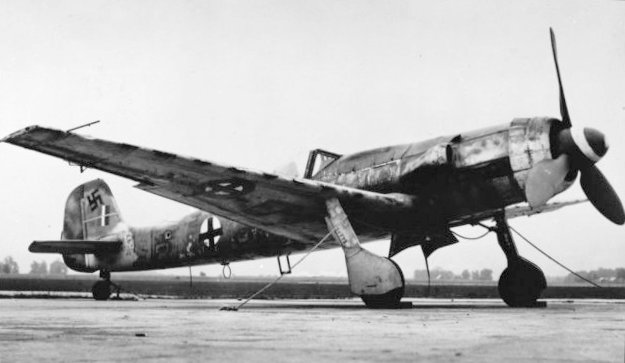

The Focke-Wulf Ta 152 was probably the fastest and most capable propeller-driven fighter Germany put into service. It carries the initials of its designer, Kurt Tank, because the Air Ministry decreed in 1944 that new fighter designations include the chief designer’s name.
It was a high-altitude development of the Fw 190D, built to fight at about 40,000 feet (12,500 m), roughly a third higher than the Bf 109 or Fw 190. With nitrous-oxide boost it could reach 472 mph (759 km/h) at 41,000 feet (12,500 m).
According to the Smithsonian, it was faster and more maneuverable than both the P-51 Mustang and the P-47 Thunderbolt. Kurt Tank was flight-testing one when he met a flight of Mustangs, engaged the engine’s methanol-water boost, and simply outran them.
Potential was all it had. Only 67 were completed before production ended in February 1945, some were lost to engine fires, engine trouble and spares shortages grounded most of the rest, and by 30 April 1945 the Luftwaffe had grounded every H model. The only surviving example is at the Smithsonian.
8. Messerschmitt Me 163 Komet
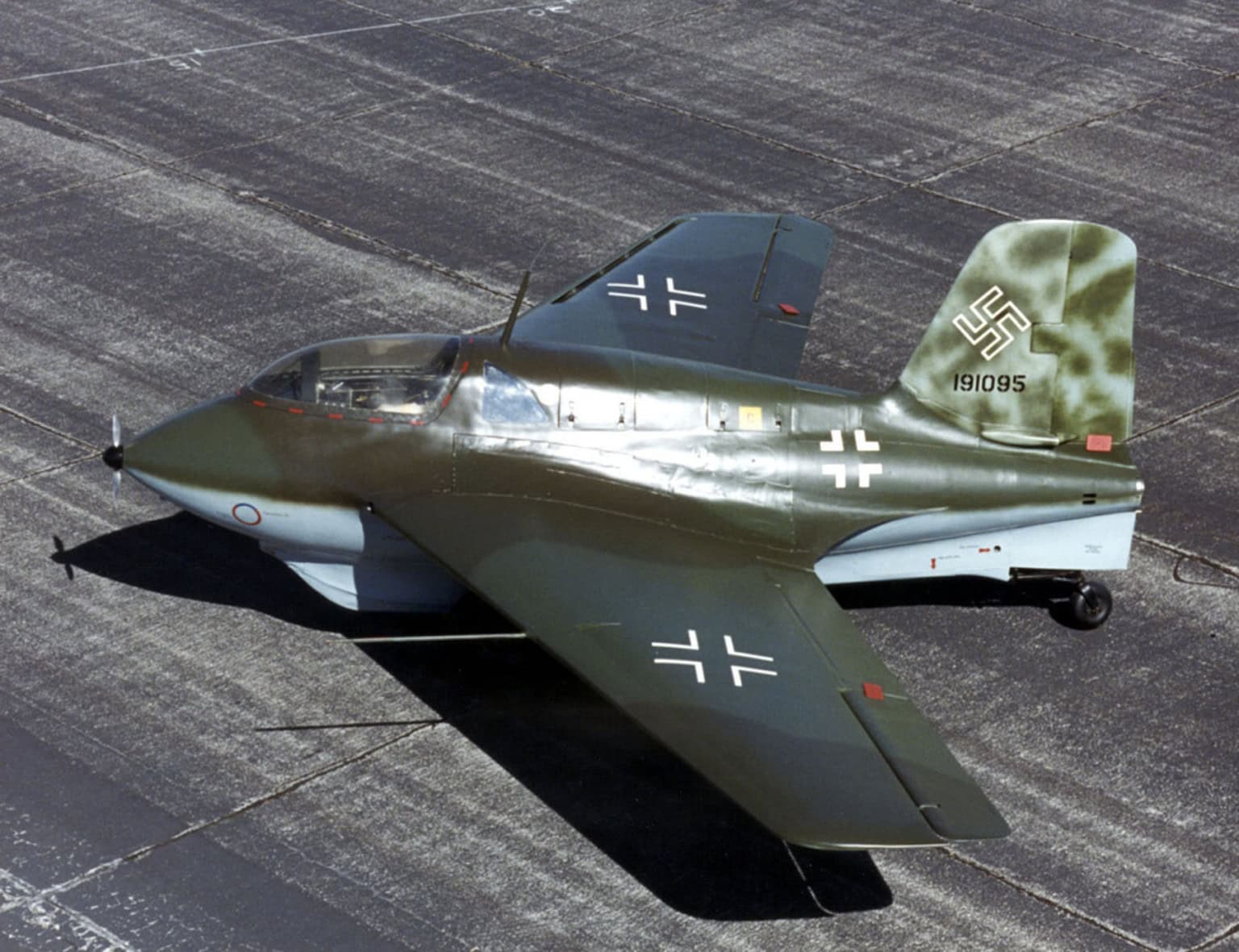


The Messerschmitt Me 163 Komet is the first and only tailless rocket-powered interceptor to see operational service. A prototype set a world speed record of 623.8 mph (1,004.5 km/h) on 2 October 1941, and the production Me 163B could reach 596 mph (959 km/h).
Its climb was astonishing. It could reach 39,690 feet (12,100 m) in just under three and a half minutes, but it carried only enough fuel for about eight minutes of powered flight.
After one or two firing passes, the pilot glided home with no power and no way to escape Allied escort fighters. It landed on a skid, and its volatile rocket fuels sometimes exploded without warning, killing a number of pilots.
Its speed was also a problem in combat. Closing on slow bombers far too quickly, with slow-firing, short-range cannon, pilots had almost no time to aim.
The results show it. Only 279 Me 163Bs were delivered, and the sole operational unit, JG 400, scored nine kills while losing 14 of its own aircraft.
The Komet in Dayton may have been sabotaged by the people who built it
The National Museum of the US Air Force’s Me 163B was found with a small stone wedged between the fuselage fuel tank and its strap, which could have caused a dangerous fuel leak, and contaminated glue in the wing that could have made it fail in flight. Inside its skin is a French inscription, perhaps left by a forced laborer: Mon coeur est en chomage, or “my heart is not occupied”.
9. Heinkel He 162 Volksjäger

The Heinkel He 162 Volksjäger (“People’s Fighter”) was built in desperation. The Air Ministry issued its specification on 10 September 1944 for a jet fighter that used as little steel and aluminum as possible and could be mass-produced by semi-skilled and unskilled labor.
Heinkel received the contract on 23 September, and the prototype flew on 6 December 1944, just 74 days later. It crashed four days after that.
The Nazi plan was for Hitler Youth pilots to fly it into combat after minimal training. The Smithsonian notes that the He 162 was difficult and even dangerous for experienced pilots, and that takeoffs and landings alone would have killed as many teenagers as combat.
It could reach 520 mph (840 km/h) at 20,000 feet (6,100 m), but its tiny fuel load gave it an endurance of around 20 minutes. With its jet engine mounted directly above the cockpit, it was the first single-engine aircraft with an ejection seat in operational service.
Nearly 1,000 were on the assembly lines at the end, but only about 120 reached the airfields. It first saw combat in mid-April 1945 and was never certified combat-ready, so it is on this list for what it represented rather than what it achieved.
Bf 109 vs Fw 190: Which Was Better?
As an aircraft, the Fw 190 was better for most of the war. Even the US Air Force museum’s history of the Bf 109 calls it the superior fighter, and it was more heavily armed and far better suited to rough front-line airfields.
The Bf 109 kept one advantage: altitude. The radial-engine Fw 190A lost performance above about 20,000 feet (6,000 m), and in the defense of Germany Bf 109s often flew top cover while Fw 190s attacked the bomber formations below them.
So the Bf 109 is first here on its record, not its handling. It fought for six years on every front, it produced the war’s top aces, and there were far more of them, which is what the ranking measures.
German Fighters That Did Not Make the List
Junkers Ju 88 night fighters

The Ju 88 was a bomber first, and one of the most versatile aircraft of the war, with about 15,000 built. Its C and G versions flew as night fighters alongside the Bf 110.
It is left off because it was a converted bomber rather than a fighter design. Its most famous night fighter moment was an accident: in July 1944 a Ju 88G-1 crew landed by mistake at RAF Woodbridge in England, handing the RAF its first look at the Lichtenstein SN-2 radar.
Dornier Do 17

The Do 17 “Flying Pencil” often turns up on German fighter lists, but it was a light bomber, with 2,139 built. Some were converted into night fighters, such as the Do 17Z-10 Kauz II with an infrared searchlight in its nose.
Those were conversions of a bomber, not a fighter design. The Do 17 belongs with the other types in our German bombers guide, not here.
Dornier Do 335 Pfeil

The Do 335 Pfeil (“Arrow”) had one engine in the nose and another in the tail, a push-pull layout that gave it the power of a twin with less drag. German sources claimed one reached 474 mph (763 km/h) in level flight, faster than the official world speed record of the time.
It also had an ejection seat and a tail fin and rear propeller that could be blown off with explosive bolts before bailing out. Dornier finished as many as 48, but no pilot flew one in combat, so it cannot rank on this measure.
How German Fighters Compared to the Rest of the War
Germany began the war with fighters that beat everything they met over Poland and France, and ended it flying the first operational jet fighter. What it never had was enough aircraft, fuel and experienced pilots at the same time.
The contrast with its enemies is sharp. The American fighter planes of WW2 won on range and industrial scale, while the British fighter planes of WW2 were built to defend home airspace. That defense, and the Bf 109’s short range, decided the Battle of Britain in 1940.
On the Eastern Front, where the top German aces scored most of their victories, the opponents were the Russian WW2 fighter planes, built for low-altitude combat over the battlefield.
Germany’s jet and rocket fighters outpaced every piston fighter of the war, as our list of the fastest planes of WW2 shows. Arriving in 1944 and 1945, they were a preview of the next era rather than a way to win the current one.
FAQ
Sources and references used for research and fact-checking.
- National Museum of the US Air Force, Messerschmitt Bf 109G-10
- Wikipedia, Messerschmitt Bf 109
- National Museum of the US Air Force, Focke-Wulf Fw 190D-9
- Smithsonian National Air and Space Museum, Focke-Wulf Fw 190 F-8/R1
- Wikipedia, Focke-Wulf Fw 190
- Smithsonian National Air and Space Museum, Messerschmitt Me 262 A-1a Schwalbe (Swallow)
- Wikipedia, Messerschmitt Bf 110
- Wikipedia, Heinz-Wolfgang Schnaufer
- Smithsonian National Air and Space Museum, Heinkel He 219 A-2/R4 Uhu (Eagle Owl)
- Wikipedia, Messerschmitt Me 410 Hornisse
- Smithsonian National Air and Space Museum, Focke-Wulf Ta 152 H-0/R11
- Wikipedia, Focke-Wulf Ta 152
- Smithsonian National Air and Space Museum, Messerschmitt Me 163B-1a Komet
- National Museum of the US Air Force, Messerschmitt Me 163B Komet
- Smithsonian National Air and Space Museum, Heinkel He 162 A-2 Spatz (Sparrow)
- Wikipedia, Heinkel He 162
- Wikipedia, Junkers Ju 88
- National Museum of the US Air Force, Junkers Ju 88D-1/Trop
- Wikipedia, Dornier Do 17
- Smithsonian National Air and Space Museum, Dornier Do 335 A-0 Pfeil (Arrow)
Get the Newsletter
The latest aviation news and stories sent to your inbox.
About the Author

Tim is the owner and lead editor of AeroCorner since 2019, overseeing aviation content covering aircraft, airlines, airports, and the broader aviation industry. Through years of researching, writing, editing, and publishing aviation-focused content, he has developed extensive practical knowledge of commercial aviation and air travel. Based in Asia and a frequent traveler himself, Tim also brings firsthand passenger experience to AeroCorner’s coverage. Outside of publishing, he has also explored aviation firsthand through hands-on flight training in New Zealand.