

Table of Contents
“Types of aircraft wings” is really three questions wearing one coat. Wings are classified by how many there are, by where they sit on the fuselage, and by their shape seen from above, which designers call the planform.
Most articles answer only the third one. This guide covers all three, because an airliner wing and a trainer wing differ on every axis at once, not just in outline.
If you want the short answer: the most common wing on a modern airplane is a swept, tapered, low-mounted monoplane wing. The table below covers the planforms, which is where the real variety lives.
| Planform | What it is good at | Where the stall starts | Example aircraft |
|---|---|---|---|
| Rectangular | Cheap to build, docile handling | Root | Piper PA-38 Tomahawk |
| Tapered | Balance of efficiency and cost | Tip | P-51 Mustang |
| Elliptical | Lowest induced drag | Whole span at once | Supermarine Spitfire |
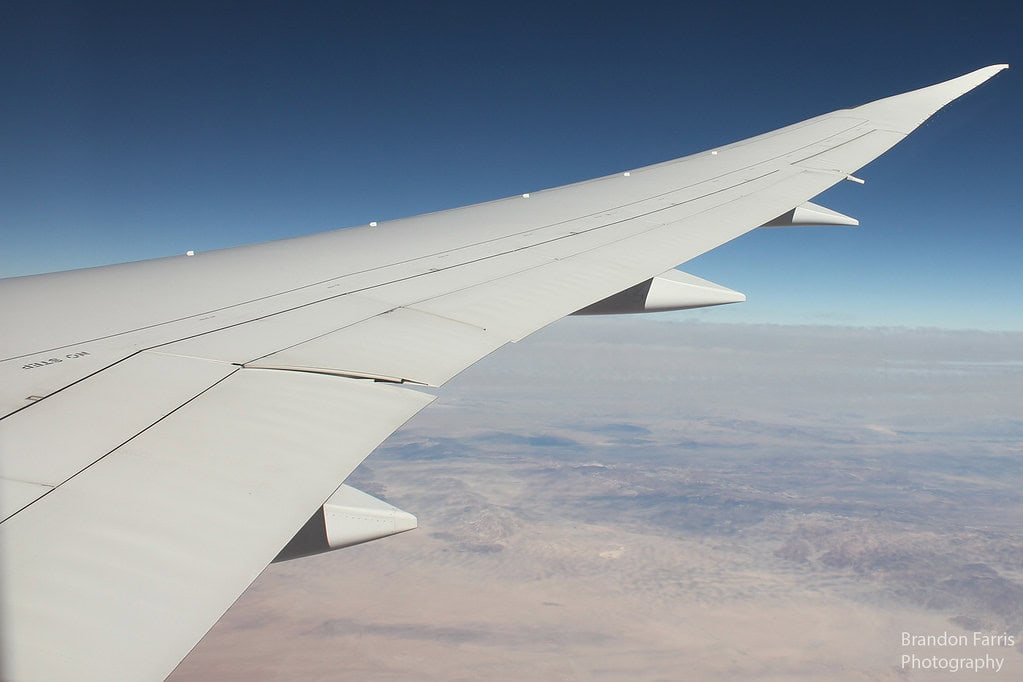
| Swept back | Delaying drag rise near the speed of sound | Tip | Boeing 787 Dreamliner |
| Forward swept | Low-speed handling, agility | Root | Sukhoi Su-47 Berkut |
| Delta | Supersonic flight, internal volume | No clean stall, vortex lift | Dassault Mirage 2000 |
| Ogival delta | Sustained supersonic cruise | No clean stall, vortex lift | Concorde |
| Trapezoidal | Supersonic speed plus stealth | Tip | F-22 Raptor |
| Variable sweep | Slow and fast in one airframe | Varies with sweep | F-111 Aardvark |
| Gull and inverted gull | Propeller or engine clearance | Root | F4U Corsair |
| Flying wing | Lowest drag, lowest radar return | Tip | B-2 Spirit |
| Blended wing body | Fuel burn on future airliners | Not yet established | JetZero demonstrator |
How this guide is organized
Wings are grouped here the way aerodynamicists group them: by number, by vertical position, and by planform. The planform section is ordered from the simplest shape to the most specialized, not by how good the wing is. There is no official count of wing types, so any article promising exactly nine or exactly ten has drawn its own line.
Classification 1: How many wings
A monoplane has one wing crossing the fuselage. It is what almost everything flying today uses, and it has been the default since the 1930s.
A biplane stacks two wings, which was the norm before the 1930s. Two smaller wings gave the lift of one large one while the bracing wires and struts between them carried the loads, which mattered when wings were built of wood and fabric.
Triplanes such as the Fokker Dr.I stacked three. The variations go further, including the sesquiplane, where the lower wing is much smaller than the upper, as on the Nieuport 17.
Once metal construction allowed a single wing to carry its own loads without external bracing, the drag penalty of all that rigging stopped being worth paying. The monoplane won on drag, not on lift.
Classification 2: Where the wing sits on the fuselage
Vertical position is the axis most guides skip, and it changes how an airplane behaves more than its outline does. There are five standard positions: low, mid, shoulder, high, and parasol, the last raised clear above the fuselage on struts.
A high wing hangs the fuselage below the lift, which is naturally stable and keeps the wing clear of rough ground, so it suits cargo aircraft and bush planes. A low wing puts the wing spar under the cabin floor and shortens the landing gear, which suits airliners and fast light aircraft. We cover the trade-off in detail in our guide to high wing versus low wing aircraft.
Wings are also angled in the vertical plane. Tips raised above the root is dihedral, which adds roll stability; tips below the root is anhedral. Our explainer on the dihedral angle covers why that works.
Bend the angle partway along the span and you get a gull wing, with sharp dihedral at the root, or an inverted gull, with anhedral at the root and dihedral outboard.
Classification 3: The planform, or the shape from above
Planform is the wing’s outline viewed from directly above, and it is what people usually mean by a type of wing. Two numbers describe most of it.
The first is aspect ratio. NASA defines it as span squared divided by wing area, which for a rectangular wing is simply span divided by chord, the distance from leading edge to trailing edge. A higher aspect ratio gives lower drag, a higher lift-to-drag ratio, and a better glide angle, which is why gliders have long thin wings and the Space Shuttle had short stubby ones.
The second is sweep, the angle the wing is raked back or forward from the fuselage. Everything below is a different answer to the same question: how do you get the lift you need without paying too much drag for it?
Rectangular wing

The rectangular or constant-chord wing has the same chord from root to tip, so every rib is identical. That makes it the cheapest wing to build and repair, which is why it turns up on trainers and light aircraft such as the Piper PA-38 Tomahawk and the Piper J-3 Cub.
It is also the best-behaved. A rectangular wing stalls from the root first, so the airflow over the ailerons at the tips stays attached and the pilot keeps roll control into the stall, with buffet as a warning. That is exactly what you want in an airplane someone is learning to fly.
The cost is efficiency. The lift distribution is a poor match for the ideal, so a rectangular wing produces more induced drag at the tips than a tapered or elliptical wing of the same span.
Tapered wing
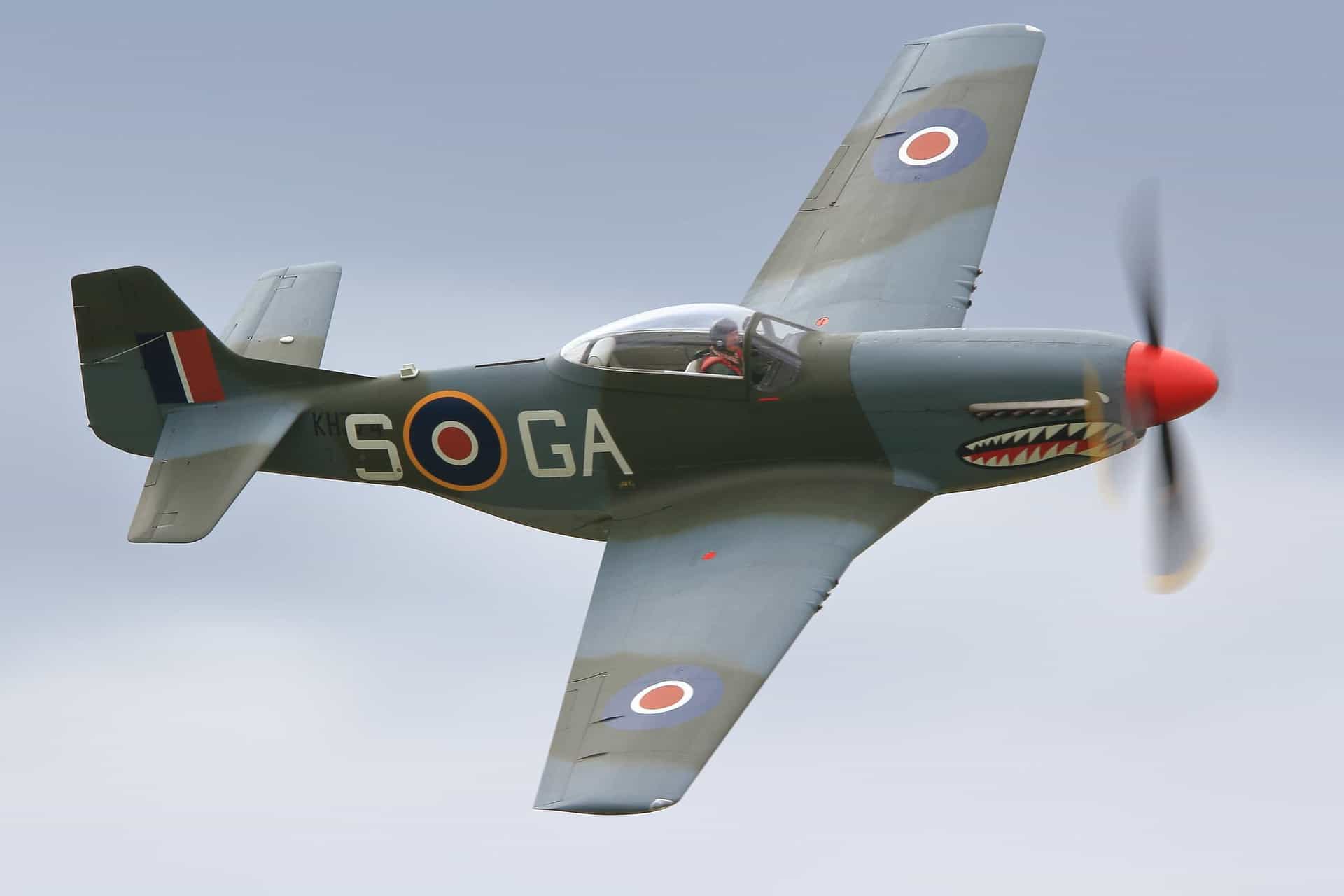
A tapered wing narrows from root to tip, which brings the lift distribution much closer to the ideal without the curved ribs an elliptical wing demands. It is the compromise that won, and it underlies most wings flying today.
The P-51 Mustang is the classic example, and the Messerschmitt Bf 109 is another. The catch is that a tapered wing tends to stall at the tip first, which costs aileron authority at the worst possible moment.
Designers fix that with washout, a built-in twist that lowers the tip’s angle of incidence relative to the root so the root stalls first anyway. Stall strips at the root and fences that block spanwise flow do similar work.
Elliptical wing

An elliptical planform produces an elliptical spanwise lift distribution, which is the theoretical minimum for induced drag. On paper it is the most efficient wing there is.
In practice it has two problems. It is expensive to build, because the ribs change shape continuously along the span, and it stalls across the whole span at once, which can mean losing control with very little warning.
The Supermarine Spitfire is the shape’s monument. The Heinkel He 111 started elliptical and abandoned it for straight-edged wings that were cheaper to manufacture.
The Spitfire's wing was not chosen for its drag
The elliptical planform is famous for minimizing induced drag, but that is not why it was picked. Supermarine’s aerodynamicist Beverley Shenstone said the ellipse “was simply the shape that allowed us the thinnest possible wing with room inside to carry the necessary structure and the things we wanted to cram in.” The wing had to be thin for speed and fat enough to swallow the guns and the retracted landing gear. The low drag was a bonus.
Swept back wing

Sweeping a wing back is not about looking fast. It is about delaying the drag rise that hits as an airplane approaches the speed of sound.
Only the component of the airflow perpendicular to the leading edge drives lift and shock formation. Angle the wing and that component is slower than the airplane itself, so shock waves and wave drag arrive at a higher flight speed. A 45-degree sweep raises the critical Mach number by roughly 30 percent.
Adolf Busemann presented the idea at the Volta Conference in 1935. The MiG-15 was the first operational swept-wing jet, and it outclassed the straight-winged American fighters it met over Korea.
The penalty is low-speed behavior. Sweep drives air outward along the span, thickening the boundary layer at the tips so they stall first, and because those tips sit behind the center of gravity, a tip stall pitches the nose up rather than down. The F-100 Super Sabre’s “Sabre dance” landing accidents were this failure mode.
That is also why swept wings need so much hardware on their edges. The flaps and leading edge slats on an airliner exist to buy back the low-speed lift that sweep gave away.
Forward swept wing

Sweep the wing forward and the spanwise flow runs inward instead of outward. The root stalls before the tips, so the ailerons keep working at high angles of attack, which is excellent for agility and low-speed control.
So why is almost nothing built this way? Because of aeroelastic divergence. Lift on a forward swept wing twists the leading edge upward, which raises the angle of attack, which increases the lift, which twists it further. The loop feeds itself until the wing fails.
A metal wing stiff enough to resist that is too heavy to be worth it. The Grumman X-29 beat it with carbon fiber laid up so that bending and twisting are coupled: as the tips bend up, the composite rotates the leading edge down and cancels the divergence.
Two X-29s flew 242 flights from December 1984, and Russia’s Sukhoi Su-47 Berkut followed the same route. Neither led to a production aircraft.
Delta wing
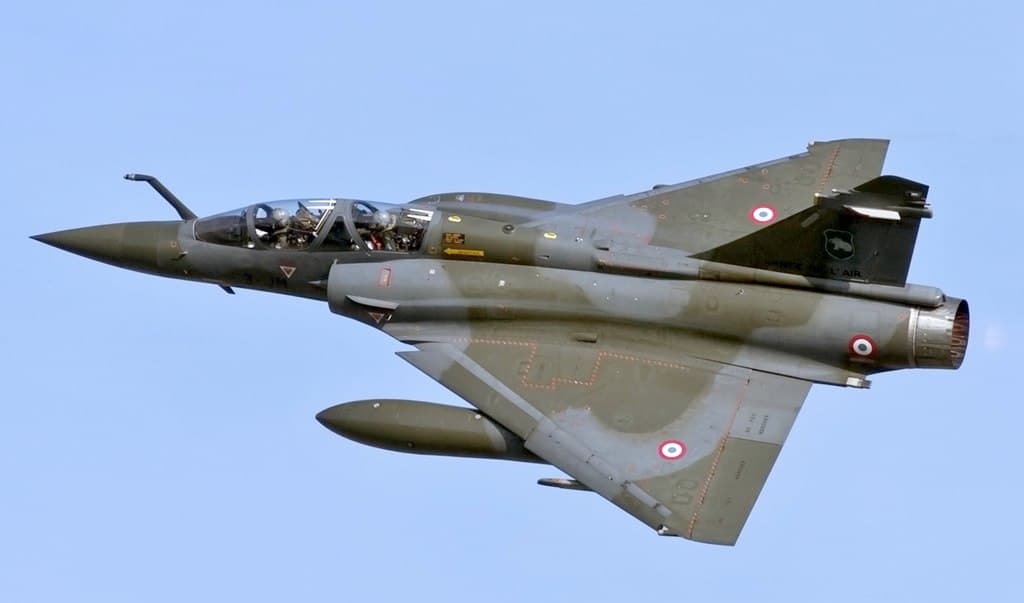
A delta is a triangular wing with heavy leading-edge sweep and a long root chord. It is structurally simple, light, low in drag at speed, and roomy enough inside to hold a great deal of fuel.
Deltas do not stall the way a straight wing does. At a high angle of attack the air spills over the leading edge and rolls into vortices that sit on the upper surface, accelerating the flow and holding lift well past the point a conventional wing would quit. That is vortex lift.
The trade is that a delta needs that high angle of attack to make lift slowly, which is why deltas land fast and nose-high, dragging a lot of induced drag behind them.
There are four main variants. A tailless delta has no horizontal tail, as on the Dassault Mirage 2000 and the Mirage III. A tailed delta keeps one, as on the MiG-21.
A cropped delta has the tips cut off to keep lift outboard and soften tip stalling, and most deltas are cropped to some degree. A compound or double delta uses a steeper sweep on the inner section to generate a controlled vortex without a foreplane, as on the Saab Draken.
The Eurofighter Typhoon and the HAL Tejas add canards ahead of the wing, a small foreplane that trims the aircraft and feeds vortices over the main wing.
Ogival delta wing
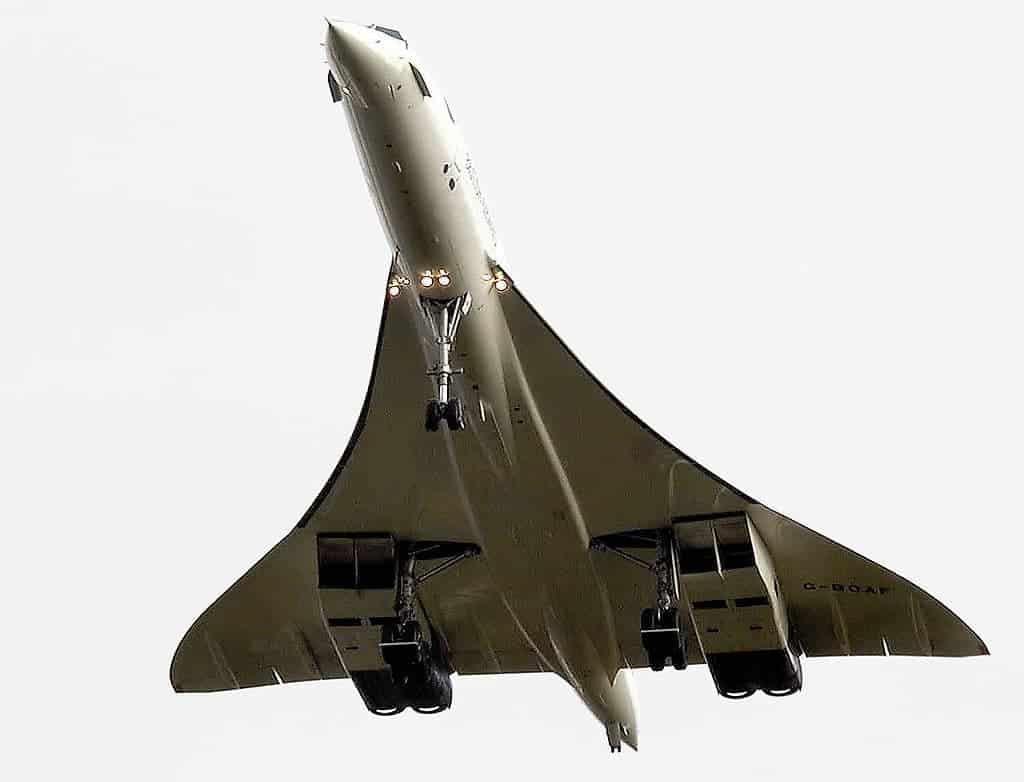
The ogival delta replaces the delta’s straight leading edge with a smooth double curve, the shape draughtsmen call an ogee. It is often listed separately as the ogive wing.
That curve was worked out to hold a stable, predictable vortex across a very wide speed range, which is what an airliner cruising above Mach 2 needs. Concorde is the aircraft that used it.
The shape is difficult and expensive to build, and its subsonic performance is mediocre. No airliner has used it since Concorde retired.
Trapezoidal wing
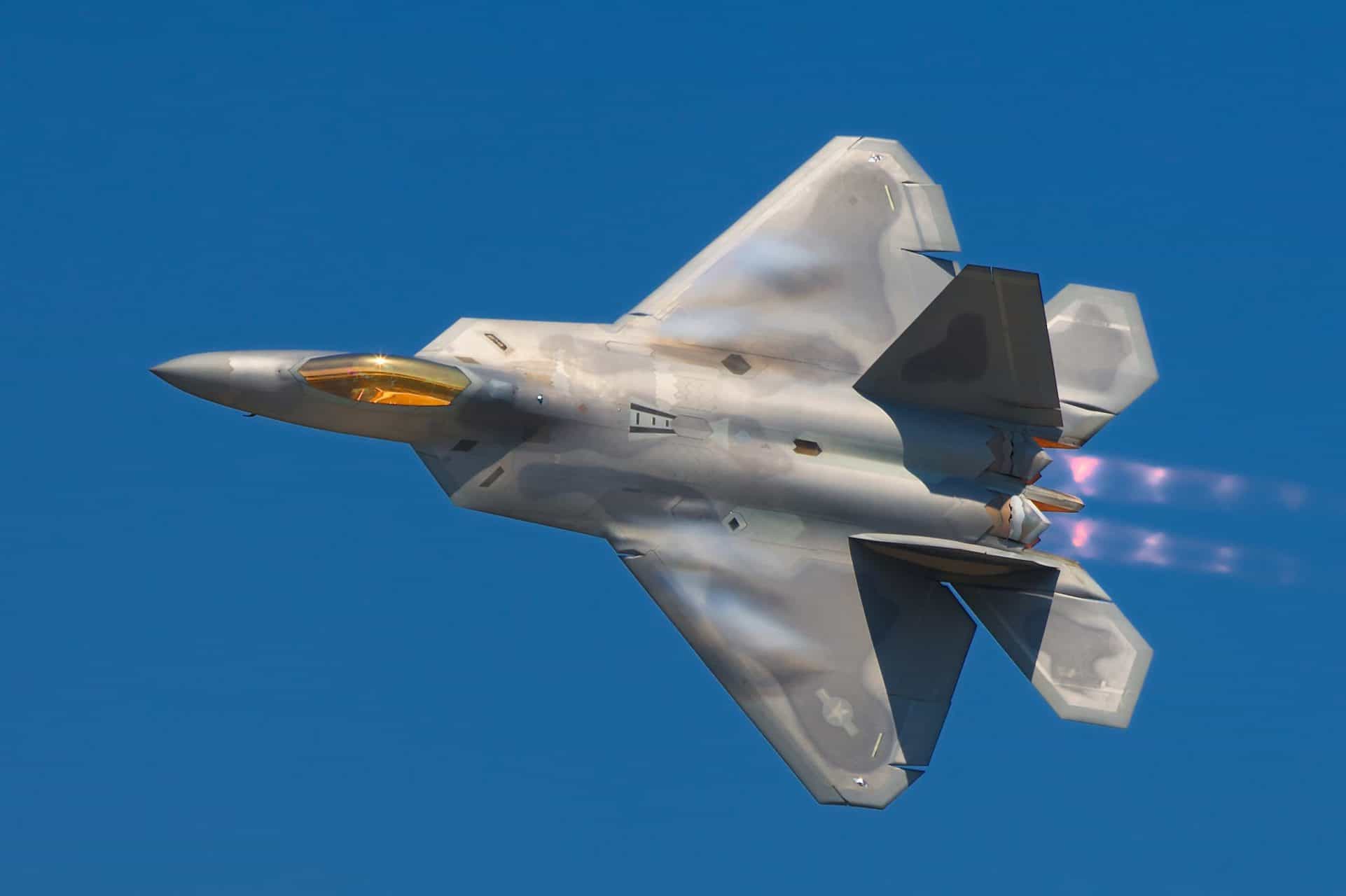
The trapezoidal wing sweeps the leading edge back and the trailing edge forward, giving a short, stiff, low aspect ratio wing. Strictly it is a heavily tapered planform rather than a family of its own, but modern American fighters have made it a recognizable type.
Its real advantage is stealth. Aligning the leading and trailing edges with a small number of angles concentrates radar returns into a few narrow spikes rather than scattering them everywhere, and the same alignment is repeated on the tail surfaces and doors.
The F-22 Raptor and the F-35 both use it. The cost is high wing loading, since a small wing carrying a heavy aircraft gives up some turning performance and some range.
Variable sweep wing

Straight wings are good at low speed and swept wings are good at high speed, so the swing wing tried to have both by pivoting in flight.
The Bell X-5 was the first aircraft to change its sweep in flight, on 20 June 1951, moving between 20, 40 and 60 degrees. It was built on the untested wartime Messerschmitt P.1101 design, and two were made.
The General Dynamics F-111 Aardvark was the first production variable-geometry aircraft, not the first ever. It first flew on 21 December 1964, entered service in July 1967, swept between 16 and 72.5 degrees, and 563 were built. The last ones, Australia’s F-111Cs, retired on 3 December 2010.
The F-14 Tomcat, Tornado, MiG-23, Su-24 and B-1B followed. Then the idea died, because a pivot carrying the entire wing load is heavy, complicated and expensive to maintain, and better engines and flight controls delivered the same breadth without moving parts.
Gull wing and inverted gull wing
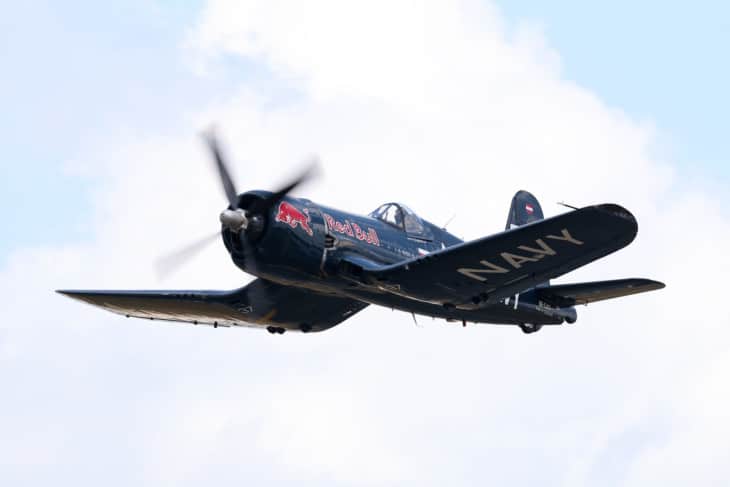
These are bends in the vertical plane rather than planform shapes, but they are distinctive enough to be treated as wing types in their own right.
A gull wing angles sharply up at the root then flattens outboard, as on the PZL P.11. It lifts the wing clear of the pilot’s sightline and raises the outer wing away from the ground.
An inverted gull does the opposite, dropping at the root and rising outboard. The F4U Corsair used one to swing a propeller 13 feet 4 inches (4.06 m) across without absurdly long landing gear, and the bend let the wing meet the fuselage at the angle that minimized drag without fairings. The Junkers Ju 87 Stuka is the other well-known example.
Flying wing
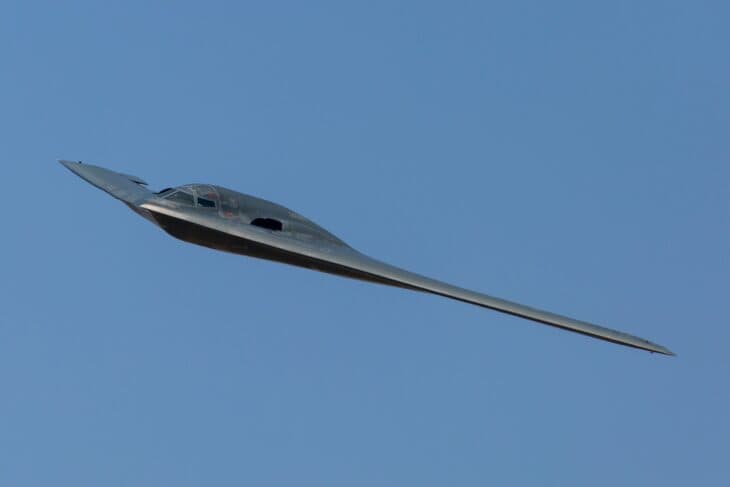

A flying wing has no distinct fuselage and no horizontal tail. Crew, fuel and payload all live inside the wing.
In theory it is the lowest-drag configuration a fixed-wing aircraft can have, because there is no fuselage or tail generating drag without generating lift. It is also very hard to see on radar, which is why the shape defines the modern stealth bomber.
The problem is yaw. With no vertical fin there is nothing to keep the nose pointed forward, so flying wings steer with split ailerons that open like clamshells to make drag on one side, or with spoilers in the upper surface.
Northrop’s YB-35 and YB-49 proved the idea was flyable and that 1940s pilots could not manage it without help. Computer flight control solved that, and the B-2 Spirit followed. Its successor, the B-21 Raider, had two aircraft in flight test as of mid-2026.
Blended wing body and the truss-braced wing
A blended wing body is not quite a flying wing. It keeps a recognizable body, but the body is shaped to make lift and flows into the wing with no clear join.
JetZero is building a full-scale demonstrator called Jet1 at Mojave under a US Air Force program, assembled by Scaled Composites and powered by PW2000 engines from the Boeing 757. First flight is targeted for 2027, and the company expects a large reduction in fuel burn against a conventional airliner of similar size.
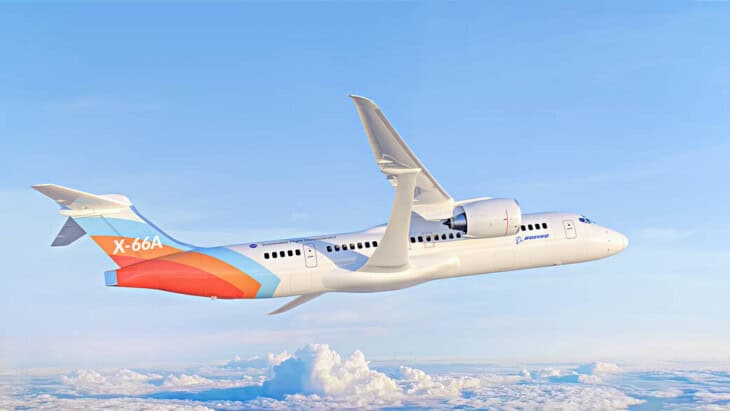
The other candidate is the transonic truss-braced wing, a very long, very thin wing held by a diagonal strut, which raises aspect ratio far beyond what a cantilever wing can carry. Long thin wings are efficient, and the strut is what makes that span structurally possible.
NASA and Boeing paused the X-66 flight demonstrator on 24 April 2025 in favor of a ground-based thin-wing testbed. The hardware and the design were retained rather than scrapped, so the concept is shelved rather than dead.
Ground-effect wing
A ground-effect wing is defined less by its shape than by where it flies. Within about one wingspan of the surface, the water or ground pushes back against the wing’s downwash and stops the wingtip vortices from fully forming, which cuts induced drag.
Pilots feel the same physics for a few seconds on every landing, as our guide to ground effect explains. A ground-effect craft is built to live in it for the whole trip.
The Soviet ekranoplans used short, constant-chord wings with a high tail for stability. The KM, known in the West as the Caspian Sea Monster, first flew on October 16, 1966, with a wing just 123 feet (37.6 m) across on a hull 302 feet (92 m) long.
The newest example is REGENT’s all-electric Viceroy Seaglider, which made its first crewed flight over Narragansett Bay on September 2, 2026, at about 33 feet (10 m). Seen from above, its wing is an ordinary one: straight, unswept, high-mounted and tapered toward the tips, which suits a craft with a top speed of around 180 mph (290 km/h).
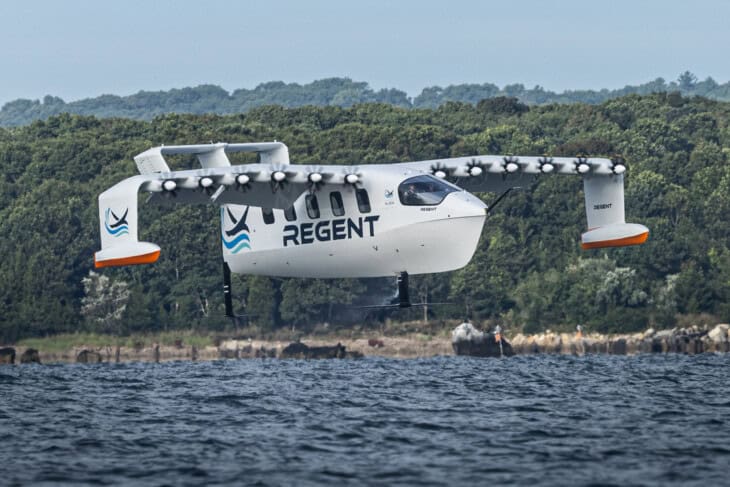
The rest of it is anything but ordinary. Twelve electric motors along the leading edge blow air over the wing for extra lift, and the tips turn sharply down into floats. It is not a blended wing body either, because the wing sits on a distinct boat hull.
Legally, it may not be an aircraft at all. The International Maritime Organization classes ground-effect craft as ships, and the Seaglider is regulated by the U.S. Coast Guard and captained by licensed mariners, as we reported when it first flew with a crew aboard.
So how many types of aircraft wings are there?
There is no official number, and any article that promises exactly nine or exactly ten has quietly chosen where to stop. Delta wings alone split into tailless, tailed, cropped, compound and ogival, and each of those is a defensible entry on its own. Counting also depends on which axis you count: by number of wings there are about four types, by fuselage position five, and by planform as many as you care to name. The useful question is not how many there are, but what each shape is trying to buy.
How wing design got here
Every shape above was an answer to a constraint of its era, and the constraints kept moving.
1935
Sweep is proposed. Adolf Busemann presents swept wings at the Volta Conference, years before any aircraft flies fast enough to need them.
1940
The elliptical wing peaks. The Spitfire fights the Battle of Britain on the most aerodynamically efficient planform ever put into mass production, and the most expensive to build.
1951
The first swing wing flies. The Bell X-5 changes its sweep in flight between 20 and 60 degrees, proving the concept that the F-111 and F-14 would later carry into service.
1964
Variable sweep reaches production. The F-111 Aardvark flies, and for two decades the swing wing looks like the future of combat aircraft.
1984
Composites beat divergence. The Grumman X-29 flies a forward swept wing that metal could never have made stiff enough, using carbon fiber to twist against its own lift.
2026
The tail disappears. Flying wings and blended wing bodies dominate what comes next, with the B-21 Raider in flight test and JetZero building a full-scale demonstrator for a 2027 first flight.
The wing is also no longer just a lifting surface. It carries the fuel, as our explainer on wet wings describes, and it carries the control surfaces, including the ailerons whose survival in a stall drives so much of the design above.
Even the tips are working parts now. Winglets exist to recover some of the induced drag that every finite wing pays at its tips, which is the same penalty the elliptical planform was chasing ninety years ago.
FAQ
Sources and references used for research and fact-checking.
- NASA Glenn Research Center, Wing Geometry
- Embry-Riddle Aeronautical University, Wing Shapes and Nomenclature, Introduction to Aerospace Flight Vehicles
- Boldmethod, 6 Wing Designs That Every Pilot Should Recognize
- Wikipedia, Wing configuration
- Wikipedia, Swept wing
- Wikipedia, Elliptical wing
- Wikipedia, Delta wing
- Wikipedia, Grumman X-29
- Wikipedia, Bell X-5
- Wikipedia, General Dynamics F-111 Aardvark
- Wikipedia, Flying wing
- Wikipedia, Vought F4U Corsair
- Wikipedia, Stall (fluid dynamics)
- NASA, NASA, Boeing Consider New Thin-Wing Aircraft Research Focus
- Wikipedia, Ground-effect vehicle
- Wikipedia, Caspian Sea Monster
- REGENT, REGENT Viceroy Seaglider Completes World's First Human-Crewed Seaglider Flight
- New Atlas, REGENT Viceroy Seaglider achieves first crewed wing-in-ground effect flight
Get the Newsletter
The latest aviation news and stories sent to your inbox.
About the Author

Tim is the owner and lead editor of AeroCorner since 2019, overseeing aviation content covering aircraft, airlines, airports, and the broader aviation industry. Through years of researching, writing, editing, and publishing aviation-focused content, he has developed extensive practical knowledge of commercial aviation and air travel. Based in Asia and a frequent traveler himself, Tim also brings firsthand passenger experience to AeroCorner’s coverage. Outside of publishing, he has also explored aviation firsthand through hands-on flight training in New Zealand.