

Table of Contents
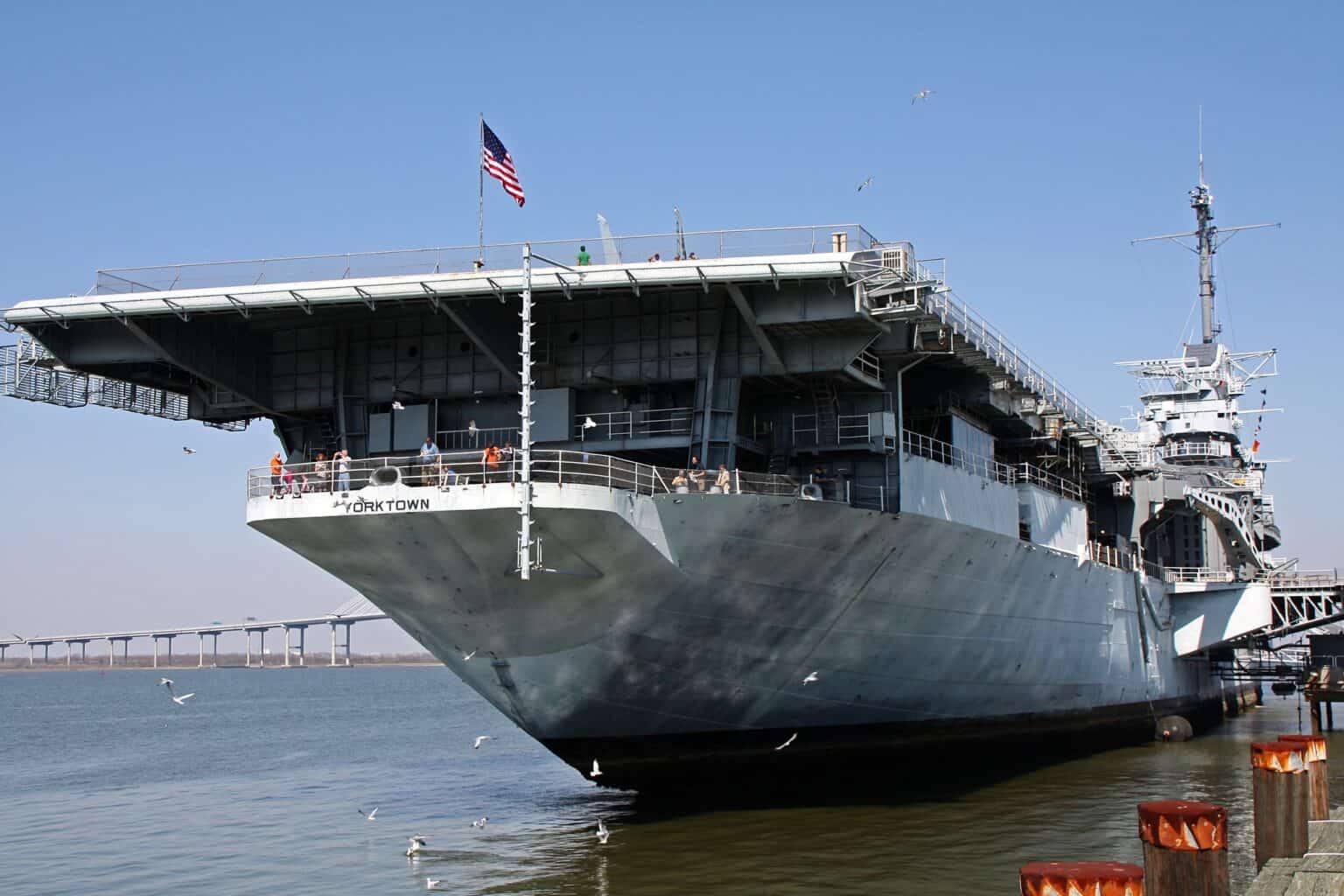
More than 300,000 people a year visit Patriots Point in South Carolina, where the centerpiece is the aircraft carrier USS Yorktown. It is easy to assume you are standing on the carrier that fought at Midway.
That ship is more than 16,600 feet (5,100 m) down in the Pacific. In April 2025, NOAA’s cameras went inside its hangar deck for the first time and found Dauntless dive bombers and what looks like a 1941 Ford station wagon.
There were two carriers named Yorktown, and their stories are tied together on purpose. Here is which is which, what each one did, and why the name has no ship today.
Which USS Yorktown Sank, and Which Is in Charleston?
USS Yorktown (CV-5) is the one that sank. She was commissioned in 1937, fought in the first six months of the Pacific War, and went down on June 7, 1942, three days after Japanese aircraft crippled her at the Battle of Midway.
USS Yorktown (CV-10) is the museum ship. She was being built as Bon Homme Richard when the Navy renamed her Yorktown on September 26, 1942, in honor of the carrier lost at Midway. She fought from 1943 to 1945, served until 1970, and has been a museum at Patriots Point in Mount Pleasant, near Charleston, since 1975.
The two carriers at a glance
CV-5: Yorktown class, commissioned 1937, sunk June 7, 1942 after Midway. CV-10: Essex class, renamed in CV-5’s honor in 1942, commissioned 1943, decommissioned 1970, museum ship since 1975. No ship named Yorktown is in service today.
| Yorktown (CV-5) | Yorktown (CV-10) | |
|---|---|---|
| Class | Yorktown | Essex |
| Commissioned | September 30, 1937 | April 15, 1943 |
| Length | 809 ft 6 in (246.7 m) | 872 ft (265.8 m) |
| Displacement | 19,800 tons | 27,100 tons |
| Aircraft | 81 to 85 | 80+ |
| Fate | Sunk June 7, 1942, Battle of Midway | Museum ship, Patriots Point, since 1975 |
The First Yorktown Fought Three Campaigns in Six Months
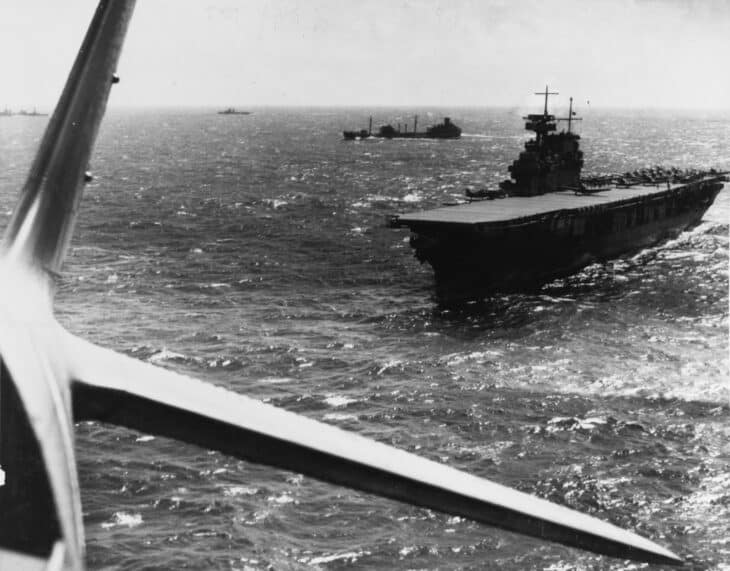
CV-5 was the lead ship of the Yorktown class, built at Newport News, Virginia. In the first weeks of 1942 her planes raided Japanese bases in the Marshall and Gilbert Islands, and on March 10 they flew across New Guinea’s Owen Stanley mountains to attack Japanese forces at Lae and Salamaua.
_during_the_Battle_of_the_Coral_Sea,_April_1942.jpg)
In May came the Battle of the Coral Sea. Aircraft from Yorktown and USS Lexington sank the Japanese light carrier Shoho, the victory one Lexington pilot announced by radio as “Scratch one flattop.”
The next day, Japanese aircraft found the American carriers. Yorktown dodged eight torpedoes, but one bomb went through her flight deck and exploded below, killing or seriously injuring 66 men.
One sponsor, both ships
Eleanor Roosevelt sponsored both carriers. She christened CV-5 at her launch in April 1936 and CV-10 in January 1943, a few months after the first Yorktown sank.
The 72-Hour Repair Was a Patch, Not a Fix
Yorktown reached Pearl Harbor on May 27, 1942. The Navy’s own history says experts estimated she needed at least three months in a shipyard, and Rear Adm. Aubrey Fitch, who was aboard, put it at 90 days.
Adm. Chester Nimitz knew from codebreakers that Japan was about to strike Midway. His answer was “We must have this ship back in three days.”
More than 1,400 shipyard workers went at her around the clock in Dry Dock No. 1. Honolulu had rolling blackouts so the yard had enough power, and on the morning of May 30 Yorktown sailed with workers still aboard finishing the job.
Myth: Pearl Harbor fixed Yorktown in 72 hours
The yard made her fit to fight, not whole. The Navy’s War Damage Report calls the work temporary repairs, and instead of mending the ruptured hull seams one by one, workers welded a large steel plate over the damaged section. Her air group was topped up with planes and aircrew from USS Saratoga.
What the Yorktown Did at Midway
On the morning of June 4, Yorktown’s air group was the only one at the Battle of Midway to launch a coordinated strike, with torpedo planes, dive bombers and fighters arriving almost together.
Seventeen SBD Dauntless dive bombers of Bombing Squadron 3, led by Lt. Cmdr. Max Leslie, went after the carrier Soryu. Leslie and three others had accidentally jettisoned their bombs on the way, but they pressed on anyway to draw fire, and Soryu took three direct hits from 1,000-pound (450 kg) bombs.
The cost fell on the torpedo squadron. Torpedo Squadron 3 lost 10 of its 12 Devastators without scoring a hit. Above them, Lt. Cmdr. John Thach, flying a Grumman F4F Wildcat, improvised the beam defense that became the Thach Weave and shot down three Zeros.
Around noon, the one Japanese carrier still able to fight, Hiryu, struck back. Yorktown’s Wildcats shot down most of the incoming dive bombers, but the seven that got through scored three direct hits and two near misses.
Her crew put out the fires and got her moving again. When Hiryu’s torpedo planes arrived that afternoon, Yorktown looked undamaged, and their leader attacked her as if she were a fresh carrier. Two torpedoes hit her port side.
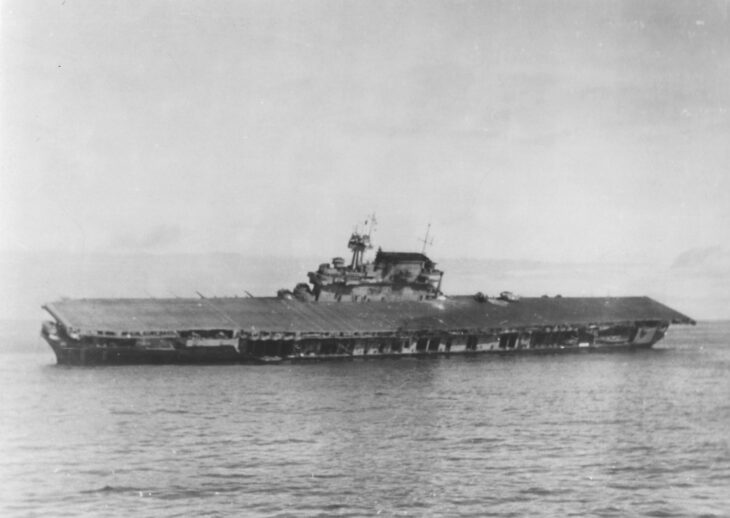
Thirty-five of her crew had been killed in the two attacks. When her list reached 26 degrees, Capt. Elliott Buckmaster ordered the crew off the ship.
_listing_and_abandoned_on_4_June_1942.jpg)
One carrier, reported sunk twice
Because Yorktown was back under way when the second wave found her, Japanese aviators believed they had knocked out two different American carriers, and the reports lifted morale in Japan’s fleet. Yorktown was the only U.S. carrier lost at Midway.
She did not sink that night. A salvage party of 29 officers and 141 men went back aboard on June 6, with the destroyer Hammann alongside.
That afternoon the Japanese submarine I-168 fired four torpedoes. One broke Hammann in half, killing 81 of her 251 crew, and two hit Yorktown. At 7:01 a.m. on June 7, 1942, she rolled over onto her port side and sank, her battle flags still flying.
The Wreck Is More Than 3 Miles Down
Robert Ballard’s expedition, run with the U.S. Navy and National Geographic, found the wreck on May 19, 1998. It sits more than 16,600 feet (5,100 m) down, with many of its anti-aircraft guns still pointing up.
Ocean Exploration Trust’s ship Nautilus filmed it in detail in September 2023, the first close look in 25 years. That same year, the Navy designated the wreck a Site of Extraordinary Character.
On April 19 and 20, 2025, NOAA Ship Okeanos Explorer sent its vehicle into the hangar deck for the first time. It found at least three Dauntless dive bombers, which NOAA called the first aircraft ever found on the Midway battlefield that fought in the battle.
One lies upside down with a 500-pound (227 kg) bomb still attached. Another carries Bureau Number 4581, an SBD-3 from Bombing Squadron 6 on USS Enterprise, not Yorktown.
The team also found a mural about 42 by 12 feet (13 by 3.7 m) charting Yorktown’s cruises and a car that NOAA tentatively identified as a 1941 Ford Super Deluxe “Woody” station wagon. Part of its front plate reads “SHIP SERVICE,” followed by a gap, then “NAVY.”
The Second Yorktown: The Fighting Lady
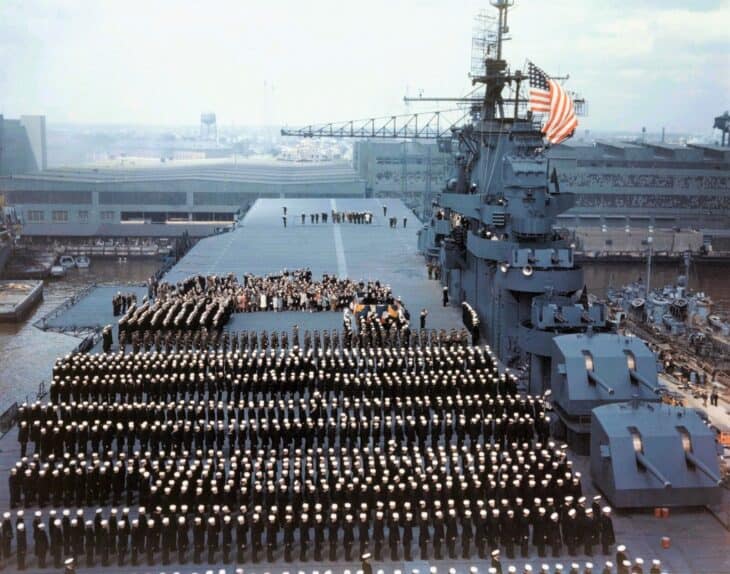
CV-10 was the second Essex-class carrier laid down, on December 1, 1941, six days before Pearl Harbor. Patriots Point says Newport News built her in a record 16 and a half months, and she was commissioned on April 15, 1943, under Capt. Joseph “Jocko” Clark.
_on_15_April_1943.jpg)
Her air group fought across the central Pacific. She earned 11 battle stars and a Presidential Unit Citation in World War II, and the nickname “The Fighting Lady.”
That nickname came from a Navy documentary filmed mostly aboard her. The Fighting Lady won the Academy Award for best documentary feature of 1944.
Aug. 1943
First combat. Strikes on Marcus Island.
Feb. 1944
Truk. Raids on Japan’s main fleet anchorage in the central Pacific.
June 1944
Philippine Sea. Strikes on Guam, then a 40-plane strike on Admiral Ozawa’s fleet.
April 7, 1945
Yamato. Her pilots claimed several torpedo hits on the battleship just before it exploded and sank.
July 1945
Japan. Air strikes on the Tokyo area until the end of the war.
1955 to 1957
Sub hunter. Rebuilt with an angled flight deck in 1955, then reclassified CVS-10, an antisubmarine carrier, in 1957. Five more battle stars followed off Vietnam.
Dec. 27, 1968
Apollo 8. The first crew to orbit the Moon splashed down about 5,100 yards (4,700 m) from Yorktown, the recovery ship.
June 27, 1970
Decommissioned at Philadelphia.
A few weeks before Apollo 8, she spent late November and early December 1968 as a film set for Tora! Tora! Tora!, the Pearl Harbor epic.
Where Is the USS Yorktown Now?
CV-10 was towed to Charleston in June 1975 and dedicated as a memorial on October 13, 1975, the Navy’s 200th birthday. Patriots Point opened to visitors on January 3, 1976, and she became a National Historic Landmark in 1986.
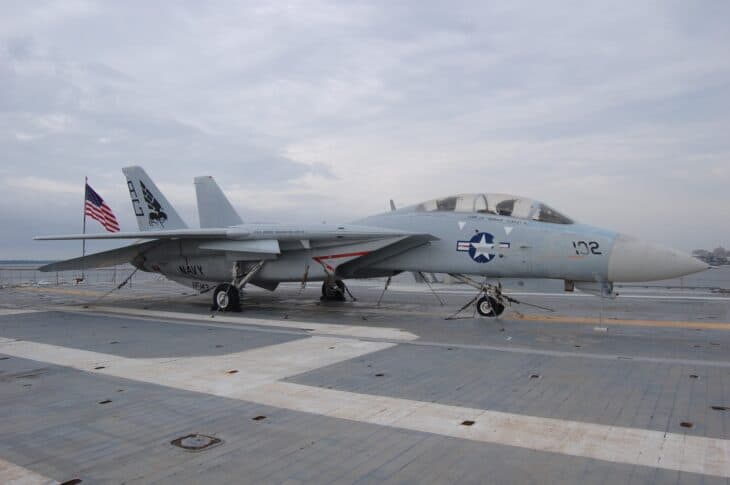
Patriots Point lists 27 aircraft across the museum, and most sit on Yorktown’s flight deck or in her hangar bays. They run from World War II types like the F6F Hellcat, SBD Dauntless and TBM Avenger to the F-14 Tomcat. The Medal of Honor Museum is also aboard.
.jpg)
Keeping an 83-year-old steel hull afloat is the hard part. A clean-up that finished in November 2025 took two years and about $31 million, pumping out roughly two million gallons (7.6 million liters) of toxic waste and nearly 20,000 pounds (9 tonnes) of asbestos.
Patriots Point also shows the destroyer USS Laffey. Its next plan is a $5 million renovation that moves the ship’s entrance and redesigns all three hangar bays.
Five Ships Named Yorktown, and None in Service Today
The name honors the 1781 siege at Yorktown, Virginia, the climactic battle of the American Revolution. Five Navy ships have carried it, and the two carriers are only the third and fourth.
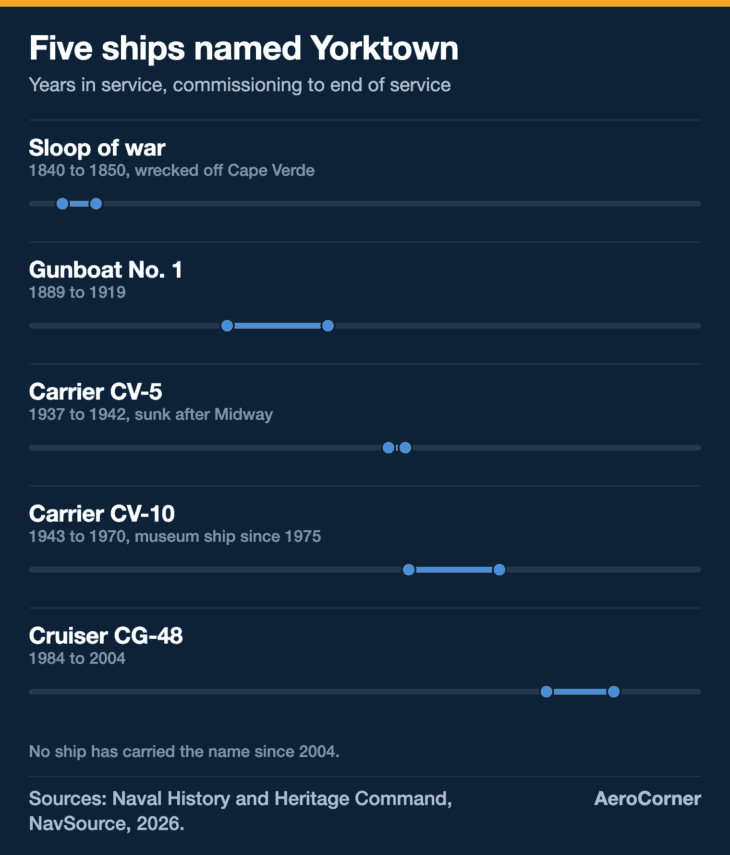
The first was a sloop of war commissioned in 1840, wrecked on an uncharted reef in the Cape Verde Islands in 1850 without losing a man. The second was Gunboat No. 1, in service from 1889 to 1919.
The fifth was the Ticonderoga-class cruiser USS Yorktown (CG-48), commissioned on July 4, 1984. On February 12, 1988, she was in the Black Sea with the destroyer Caron, asserting the right of innocent passage 7 to 9 miles off the Soviet coast, when the Soviet frigate Bezzavetny shouldered her aside.
No one was hurt. After further talks, the two governments adopted a joint statement in September 1989 agreeing that warships may make innocent passage without notice or permission.
CG-48 made headlines again in September 1997 as a Navy “Smart Ship” test bed. A zero entered in a database field made her computers try to divide by zero, and she was dead in the water for about two hours and 45 minutes.
The cruiser was decommissioned in December 2004 and towed to Brownsville, Texas, for scrapping in 2022. Since then no ship has carried the name.
That could change. In March 2026, Rep. Rob Wittman of Virginia urged the Navy to name the future carrier CVN-84 USS Yorktown for the nation’s 250th anniversary. In April the Navy secretary replied that the idea would get “full and earnest consideration,” and as of October 2026 no name had been announced.
So the Yorktown you can visit is not the one that fought at Midway, but it was built to carry that ship’s name back into the war. The next time you stand on her hangar deck, the other one is 16,600 feet (5,100 m) under the Pacific with its own hangar deck and Dauntlesses still in it.
Sources and references used for research and fact-checking.
- Naval History and Heritage Command, DANFS, Yorktown III (CV-5)
- Naval History and Heritage Command, DANFS, Yorktown IV (CV-10)
- Naval History and Heritage Command, DANFS, Yorktown I
- Naval History and Heritage Command, DANFS, Yorktown II (Gunboat No. 1)
- Naval History and Heritage Command, H-Gram 006: The Battle of Midway
- Naval History and Heritage Command, H-Gram 006-1
- Naval History and Heritage Command, H-Gram 006-3
- Naval History and Heritage Command, H-Gram 006-4
- Bureau of Ships via HyperWar, USS Yorktown (CV-5) Bomb and Torpedo Damage, Midway, War Damage Report No. 25
- NAVSEA, Pearl Harbor Battle of Midway legacy continues
- Defense Media Network, You've Got Three Days: Repairing the Yorktown After Coral Sea
- NOAA Ocean Exploration, Exploring USS Yorktown
- Ocean Exploration Trust, Exploring Iconic Shipwrecks of the Battle of Midway
- CNN, Wreckage of USS Yorktown found
- Patriots Point Naval and Maritime Museum, USS Yorktown
- Patriots Point Naval and Maritime Museum, Aircraft
- Patriots Point Naval and Maritime Museum, Patriots Point 50th anniversary press release
- Patriots Point Naval and Maritime Museum, Yorktown and America 250: how USS Yorktown's name connects us to the nation's founding
- National Park Service, USS Yorktown National Historic Landmark
- National Park Service, USS Yorktown National Historic Landmark nomination
- NASA, Apollo 8 Mission Details
- Academy of Motion Picture Arts and Sciences, The 17th Academy Awards, 1945
- Naval History magazine, U.S. Naval Institute, Our Scope
- The Maritime Executive, Years-long pollutant cleanup completed for historic carrier USS Yorktown
- South Carolina Office of Resilience, Governor McMaster and SCOR announce start of final phase of USS Yorktown remediation
- The Post and Courier, USS Yorktown Foundation plans renovation at Patriots Point
- Los Angeles Times, Soviet Ships Bump 2 U.S. Warships in Black Sea
- NavSource, USS Yorktown (CG-48)
- Lawfare, Deja Vu: Russia's Illegal Restrictions on Innocent Passage in the Black Sea
- Centre for International Law, National University of Singapore, 1989 USA-USSR Joint Statement on the Uniform Interpretation of Rules of International Law Governing Innocent Passage
- Government Computer News, Software glitches leave Navy Smart Ship dead in the water
- Route Fifty (GCN), Smart ship inquiry a go
- ValleyCentral, Decommissioning USS Yorktown arrives for recycling in Rio Grande Valley
- WLOX, USS Yorktown decommissioned at Pascagoula homeport
- Office of Rep. Rob Wittman, Wittman urges naming of next US aircraft carrier USS Yorktown
- Office of Rep. Rob Wittman, Wittman's push gains momentum as Navy reviews USS Yorktown proposal for CVN-84
Get the Newsletter
The latest aviation news and stories sent to your inbox.
About the Author

Tim is the owner and lead editor of AeroCorner since 2019, overseeing aviation content covering aircraft, airlines, airports, and the broader aviation industry. Through years of researching, writing, editing, and publishing aviation-focused content, he has developed extensive practical knowledge of commercial aviation and air travel. Based in Asia and a frequent traveler himself, Tim also brings firsthand passenger experience to AeroCorner’s coverage. Outside of publishing, he has also explored aviation firsthand through hands-on flight training in New Zealand.