

Table of Contents
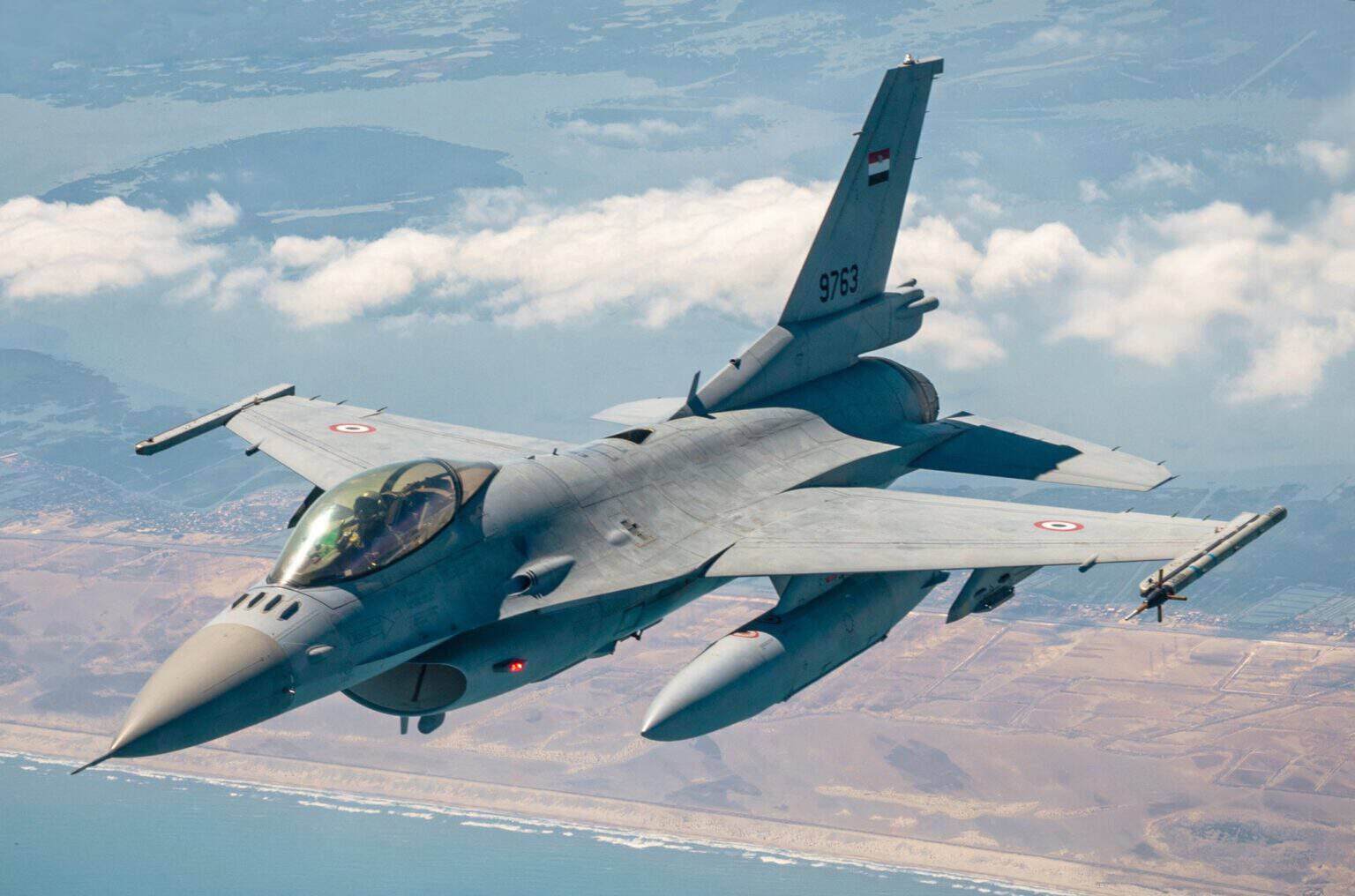
The Egyptian Air Force (EAF) flies 1,088 aircraft, the ninth-largest military fleet in the world and the largest in Africa, according to FlightGlobal’s World Air Forces 2026 directory. Its best fighter is the Dassault Rafale, and its backbone is a fleet of 218 F-16s.
Few air forces mix rival suppliers like this one. Egypt flies American F-16s, French Rafales and Russian MiG-29s side by side, and in August 2026 its pilots trained against Chinese J-16s over Egyptian bases.
This list ranks every combat jet type the EAF flies by one measure: the fighting value it adds as of October 2026, weighing what the aircraft can do against how many Egypt has. The helicopters, the support fleet and the jets Egypt tried and failed to buy follow the ranking.
| Rank | Aircraft | Role | In service | On order |
|---|---|---|---|---|
| 1 | Rafale DM/EM | Multirole fighter | 28 (32 delivered by May 2026) | 26 |
| 2 | F-16 Fighting Falcon | Multirole fighter | 218 (168 A/C, 50 B/D) | None |
| 3 | MiG-29M/M2 | Multirole fighter | 43 (31 M, 12 M2) | None |
| 4 | Mirage 2000EM/BM | Air defense fighter | 19 (15 EM, 4 BM) | None |
| 5 | Mirage 5 | Attack and reconnaissance | 81 (75 combat, 6 trainers) | None |
| 6 | Alpha Jet | Light attack and trainer | 40 (13 attack, 27 trainers) | None |
How this ranking works
Each type is ranked by its fighting value in October 2026: its radar, weapons and age, multiplied by how many the EAF flies. Counts come from FlightGlobal’s World Air Forces 2026 directory, which lists only aircraft in day-to-day use, and count two-seat trainer versions of each fighter. Navy-operated and army-operated aircraft are covered in the helicopter section, not the ranking.
1. Dassault Rafale: The Jet Egypt Keeps Ordering
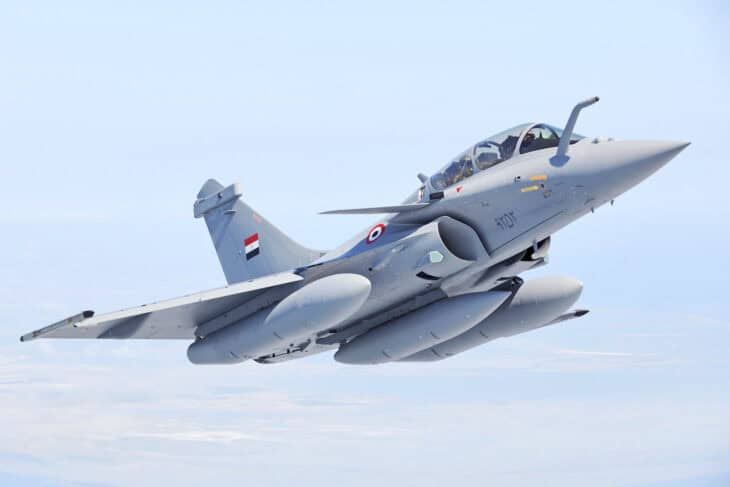
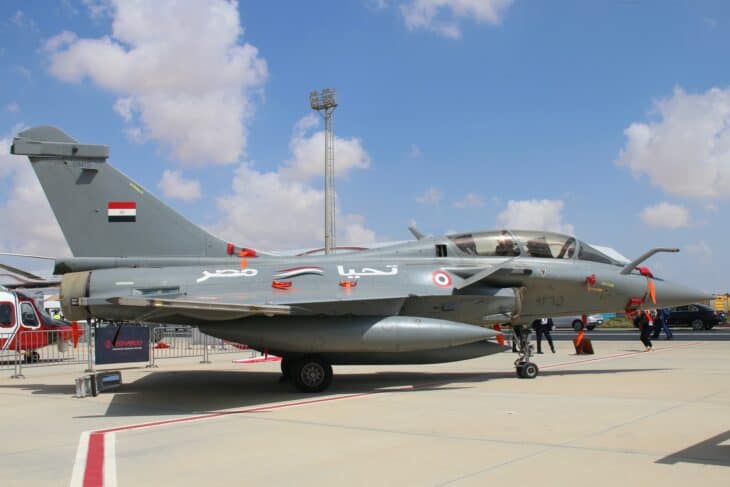
Egypt was the Dassault Rafale‘s first export customer. It ordered 24 on February 16, 2015, eight single-seat and 16 two-seat jets, as part of a $5.9 billion package that also included a FREMM frigate and missiles.
The first three were accepted at Istres in July 2015. A second order for 30 more followed in May 2021, and deliveries from it were still arriving in 2026: three two-seaters were photographed at Dassault’s Bordeaux-Mérignac airfield on May 12, 2026.
FlightGlobal’s directory, compiled in late 2025, counted 28 Rafales in service and 26 on order. By May 2026 the Ukrainian outlet Militarnyi put the total at 32 delivered of 55 ordered, one more than the 54 the two contracts are usually said to cover.
.jpg)
It ranks first on quality, not numbers: Defence24 calls it the most capable combat aircraft the EAF has. Specialist sources now list Egypt as a customer for the long-range Meteor air-to-air missile, though neither Cairo nor Paris has said how many.
Egypt wants more. La Tribune reported on September 2, 2026, that Cairo had sent Dassault a formal request for proposals for 24 more Rafales, which would take the fleet to 78. It is a request, not a contract.
Ties with the French Air Force run deep: the joint fighter exercise Amon-2026 began at bases across Egypt on October 11, 2026.
2. F-16 Fighting Falcon: The Backbone Without Long-Range Missiles
.jpg)
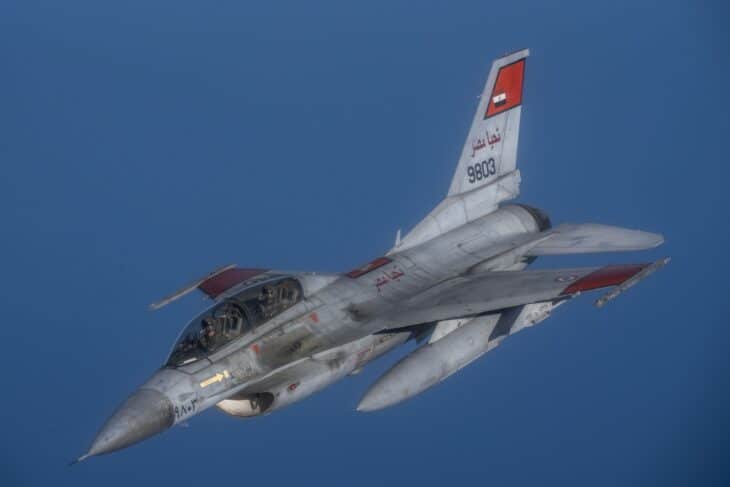
FlightGlobal counts 218 F-16 Fighting Falcons in Egyptian service: 168 single-seat F-16A and F-16C jets and 50 two-seat F-16B and F-16D trainers. The 168 single-seat jets alone are half of the 332 combat aircraft FlightGlobal counts for Egypt.
The first 12 arrived in March 1982, and 220 had been delivered by 2002 under six separate Peace Vector programs. A final batch of 20 Block 52 jets, ordered in 2010, was held up when Washington paused deliveries in July 2013 and finally finished in October 2015.
By numbers alone the F-16 would be first. It ranks second because of what it carries.
218 F-16s, zero AMRAAMs
For decades Washington refused to sell Egypt AIM-120 AMRAAM missiles for its F-16s, and as of September 2026 no approval to arm them with it had been announced, Defence24 reports. The US did clear AMRAAMs for Egypt’s NASAMS ground-based air defense system, not for the jets. That leaves what was once the world’s fourth-largest F-16 fleet without the AMRAAM, the standard beyond-visual-range missile of the US-built fighter.
Some of the airframes date to the early 1980s. Defence24 counts more than 200 still in service from roughly 240 ordered.
3. MiG-29M/M2: The Russian Fighters Lost in Sudan
.jpg)
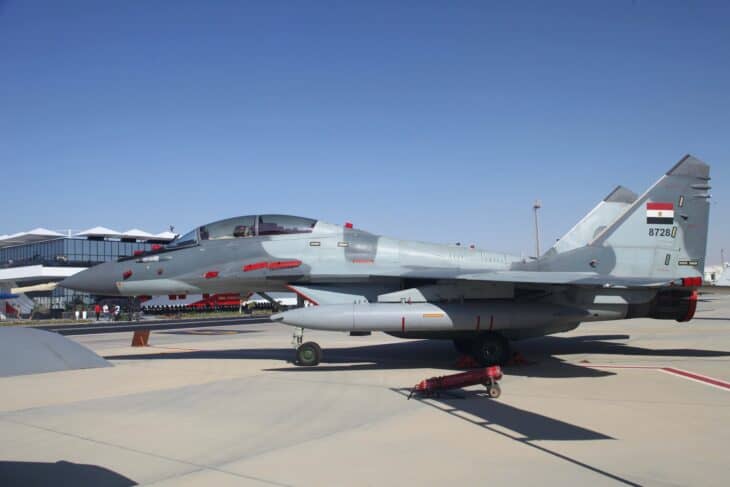
Egypt signed for 46 MiG-29M and MiG-29M2 fighters in April 2015, a deal reported at about $2 billion. The first batch arrived in April 2017, and these are new-build jets with a targeting pod for precision-guided weapons, not old Fulcrums.
FlightGlobal now counts 43: 31 single-seat M models and 12 two-seat M2s. One crashed on a training flight on November 3, 2018, and the pilot ejected safely.
Others were caught in someone else’s war. In April 2023, Sudan’s Rapid Support Forces seized Merowe Air Base, about 186 miles (300 km) north of Khartoum, where Egyptian MiG-29M/M2s had reportedly deployed for exercises, and filmed its fighters posing beside at least five of them.
The RSF also claimed to have captured Egyptian personnel, reportedly including several MiG-29 pilots. The War Zone later reported at least one of the jets destroyed and possibly all of them damaged or destroyed.
4. Mirage 2000EM: The Small, Old Interceptor Force
.jpg)
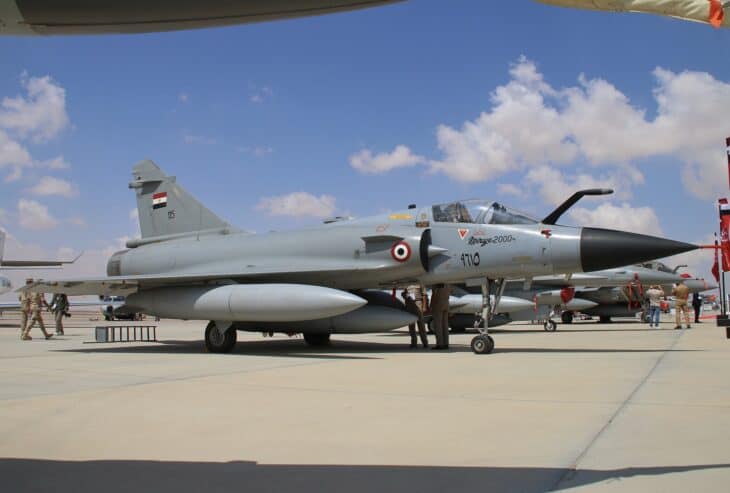
Egypt bought 20 Mirage 2000s, 16 single-seat 2000EM fighters and four two-seat 2000BM trainers. The EM is close to the French Air Force’s Mirage 2000C air defense fighter.
FlightGlobal counts 15 EMs and four BMs still flying. They rank fourth because the fleet is small and the Rafale, built by the same company, now does the same job far better.
5. Mirage 5: The Jets That May Exist Mostly on Paper
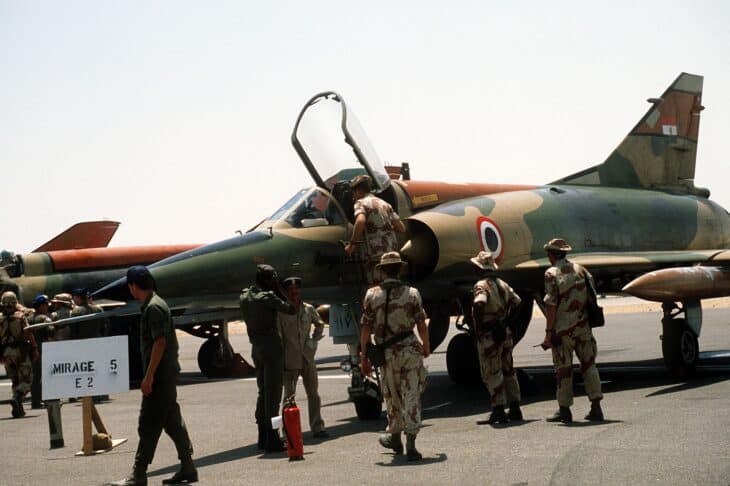

Egypt flew about 101 Mirage 5s over the years, in four versions: the radar-equipped 5SDE fighter-bomber, the radarless 5E2 attack jet, the 5SDR reconnaissance jet and the two-seat 5SDD trainer.
On paper they are still a big force. FlightGlobal’s 2026 directory lists 75 Mirage 5E2, 5SDE and 5SDR jets as combat aircraft, plus six 5SDD trainers.
Treat that number with care. Wikipedia’s Mirage 5 article already lists Egypt as a former operator, and in 2019 there was talk of selling old airframes to Pakistan. They rank fifth because even the jets that do fly are the oldest fighter design in the fleet.
The Libyan Mirages Egypt kept
In April 1973, 19 Libyan Mirage 5Ds and two Mirage 5Rs formed an Egyptian squadron at Tanta, flown by Egyptian pilots. When Libya tried to negotiate their return during the October 1973 war, Egypt refused. The jets went back only in 1974, after new Mirages had arrived from France.
6. Alpha Jet: Trainer First, Light Attack Second
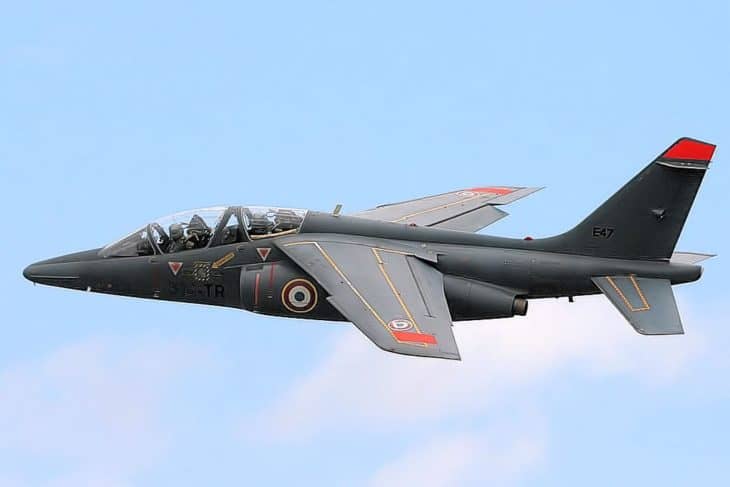
FlightGlobal counts 40 Alpha Jets: 13 in the light attack role and 27 as advanced trainers. It is a subsonic Franco-German jet built mainly for training, so it adds little to Egypt’s air combat power.
Two oddities round out the combat column: FlightGlobal also lists two AT-802U armed versions of the Air Tractor crop duster. Behind the Alpha Jet sits the biggest trainer fleet in Africa, led by 117 Chinese-Pakistani K-8 jet trainers.
Egyptian Air Force Helicopters: Apaches, Alligators and New Chinooks
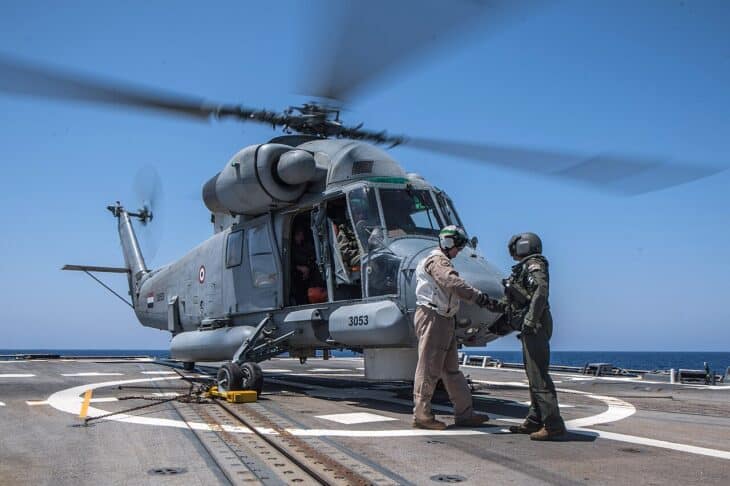
Egypt’s helicopter force is slightly larger than its combat jet force. FlightGlobal counts 348 combat helicopters, the ninth-largest fleet in the world, tied with Italy.
| Helicopter | Role | In service | On order |
|---|---|---|---|
| AH-64D Apache | Attack | 46 | None |
| Ka-52 Alligator | Attack and reconnaissance | 46 | None |
| SA342 Gazelle | Scout and light attack | 89 | None |
| Mi-8 and Mi-17 | Transport | 62 | None |
| AW149, AW189, AW139, AW109 | Transport, search and rescue | 25, 8, 4, 3 | None |
| CH-47D/F Chinook | Heavy lift | 19 | 12 |
| Sea King, SH-2G Super Seasprite | Maritime | 23, 10 | None |
| Mi-24, S-70, H125M/AS350 | Attack, utility | 8, 2, 3 | None |
Egypt flies American and Russian attack helicopters side by side: 46 AH-64D Apaches and 46 Ka-52 Alligators.
The heavy-lift fleet is being renewed. Egypt took its first five CH-47F Chinooks at the El Alamein air show in September 2026, the start of a 12-helicopter, $426 million order that replaces its aging CH-47Ds.
The Support Fleet: Hawkeyes, Hercules and Trainers
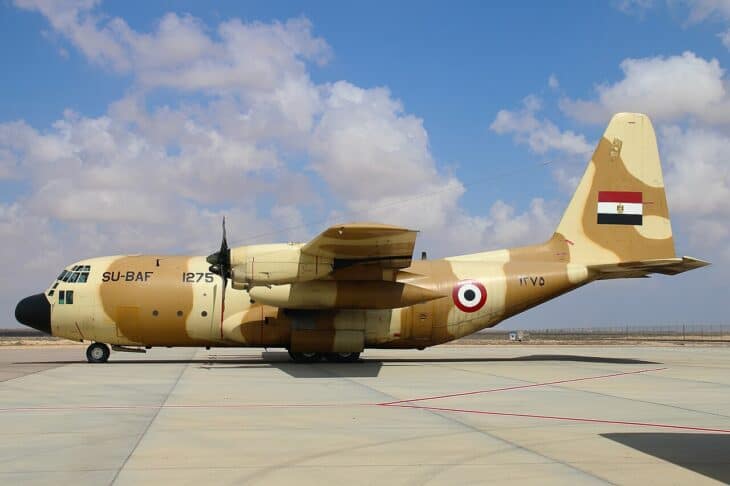
Behind the fighters sits a modest support fleet. Egypt has no aerial refueling tankers in FlightGlobal’s 2026 count, which limits how far its jets can reach, though the US has approved the sale of four retired KC-10A tankers.
| Aircraft | Role | In service |
|---|---|---|
| E-2C Hawkeye | Airborne early warning | 7 |
| Beech 1900 | Electronic warfare, transport | 4 and 4 |
| C-130H Hercules | Transport | 22 |
| C-130J Super Hercules | Transport | 2 |
| C295 | Transport | 22 |
| An-74 and Il-76 | Transport | 3 and 2 |
| K-8 | Jet trainer | 117 |
| G115 | Primary trainer | 74 |
| EMB-312 Tucano | Basic trainer | 54 |
The training fleet is the sixth-largest in the world at 344 aircraft and helicopters, FlightGlobal says. That is more than India’s or Turkey’s.
A Short History: From the 1967 Disaster to Air Force Day
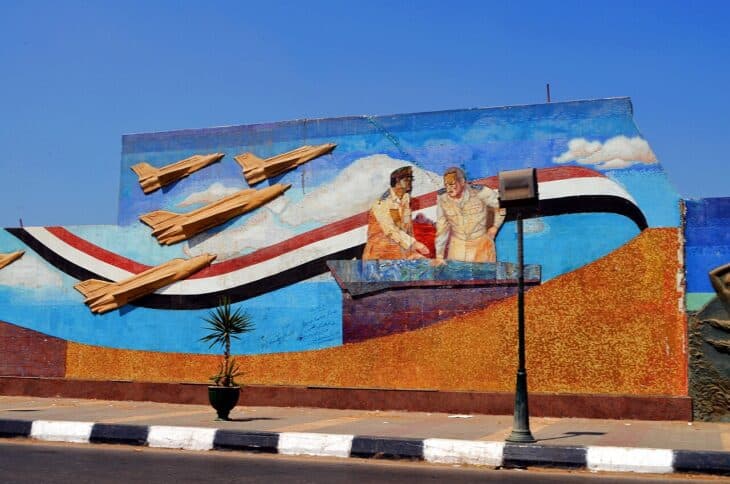
Egypt formed an Army Air Service in 1932, and it became an independent air force in 1937. Its defining moment came 30 years later, and it was a catastrophe.
1932
Army Air Service formed. It becomes an independent air force in 1937.
June 5, 1967
Operation Focus. Israel’s opening strike of the Six-Day War destroys most of the Egyptian Air Force on the ground within about three hours.
October 14, 1973
The air battle of El Mansoura. Egypt marks the fight with its annual Air Force Day, moved from November 2 to October 14.
March 1982
First F-16s arrive. The start of six Peace Vector programs that deliver 220 jets by 2002.
2015
The big diversification. Egypt becomes the Rafale’s first export customer in February and orders 46 MiG-29M/M2s in April.
2018
The Su-35 deal. Egypt pays a reported $2 billion for Russia’s Su-35, then abandons it under threat of US sanctions.
April 2023
Merowe. Sudan’s Rapid Support Forces seize an air base holding Egyptian MiG-29s and claim to capture Egyptian personnel.
2025 and 2026
China’s turn. Chinese J-10s train in Egypt in 2025, and J-16s, tankers and radar planes follow in August 2026.
That is why Egypt’s Air Force Day falls on October 14. Egypt’s first reports from El Mansoura claimed 15 Israeli aircraft destroyed, six years after the air force had been wiped out on the ground.
The Jets Egypt Tried to Buy: Su-35, F-35, J-10C and KAAN
Egypt’s shopping list is longer than its fleet. The clearest failure is the Sukhoi Su-35: Egypt paid a reported $2 billion for it in October 2018, and the first six jets were ready when US Secretary of State Mike Pompeo warned that buying them would trigger sanctions under the CAATSA law.
Egypt walked away, and in 2022 the commander of the Iranian Air Force said on television that 24 of the Su-35s Iran was buying came from Egypt’s undelivered order. Washington, for its part, offered Egypt the F-15E Strike Eagle in March 2022, with no number or price set.
Washington has never agreed to sell Egypt the F-35. Analysts trace that refusal to US policy protecting the qualitative military edge of Israel, whose air force already flies the F-35.
Does Egypt fly the J-10C? No.
Reports that Egypt had bought or received China’s J-10C have circulated for years, and in February 2025 an Egyptian outlet said the jets had arrived. China’s defense ministry called that total fake news, in a denial reported on March 1, 2025, and as of August 2026 no order had been confirmed. Chinese J-10s have flown in Egypt, but as visiting PLA Air Force jets in the 2025 Eagles of Civilization exercise, not in Egyptian markings.
China is still pitching. In August 2026 it sent J-16 fighters, YY-20 tankers, Y-20 transports and KJ-200 and KJ-500 radar planes for Eagles of Civilization 2026, where the J-16s flew simulated combat against Egyptian Rafales and MiG-29s, the first known training encounter between the J-16 and the Rafale. Weeks later much the same lineup headlined the El Alamein airshow.
Egypt’s air force commander has also reportedly shown interest in China’s J-35A stealth fighter, but no talks have been confirmed by Cairo or Beijing. The same goes for the Turkish KAAN: Turkey reportedly approved Egyptian participation in July 2025, with no official detail on what Egypt would build or buy.
How Egypt Compares
Egypt is the only African or Arab country in FlightGlobal’s top 10 for total military aircraft, ranking ninth with 1,088, ahead of France. Only nine countries in the directory field more than 1,000 aircraft.
By combat aircraft it is also ninth, with 332, but Saudi Arabia’s air force has more at 364. For the full world table, see our ranking of the largest air forces in the world.
Size is not the same as strength. Egypt’s numbers lean on F-16s without modern missiles and Mirages from the 1970s, which is why the Rafale, not the F-16, tops this list.
FAQ
Sources and references used for research and fact-checking.
- FlightGlobal, World Air Forces 2026 directory (PDF)
- Militarnyi, Dassault Delivers New Rafale Fighter Jets to Egypt
- Defence24, Egypt wants more Rafales
- Wikipedia, Dassault Rafale
- Wikipedia, Egyptian Air Force
- Wikipedia, General Dynamics F-16 Fighting Falcon operators
- Wikipedia, Mikoyan MiG-29M
- The War Zone, Egyptian MiG-29s Captured By Militia In Sudan
- Wikipedia, Dassault Mirage 2000
- Wikipedia, Dassault Mirage 5
- Wikipedia, Operation Focus
- Military Africa, Egypt's Sukhoi Su-35Es sold to Iran due to US pressure
- Military Africa, China denies sale of J-10 fighter jets to Egypt
- AirData News, China deploys J-16, tankers and AEW aircraft to Egypt in expanded air exercise
- Ahram Online, Egypt-China 'Eagles of Civilization 2026' air exercise concludes
- Ahram Online, Egypt-France joint air exercise Amon-2026 kicks off
- Defence Security Asia, Egypt Eyes Chinese J-35A Stealth Fighter as U.S. Blocks F-35 Sales to Preserve Israel's Edge
- The New Arab, Diversifying from West, Egypt to join Turkey's Kaan fighter jet development
Get the Newsletter
The latest aviation news and stories sent to your inbox.
About the Author

Tim is the owner and lead editor of AeroCorner since 2019, overseeing aviation content covering aircraft, airlines, airports, and the broader aviation industry. Through years of researching, writing, editing, and publishing aviation-focused content, he has developed extensive practical knowledge of commercial aviation and air travel. Based in Asia and a frequent traveler himself, Tim also brings firsthand passenger experience to AeroCorner’s coverage. Outside of publishing, he has also explored aviation firsthand through hands-on flight training in New Zealand.