

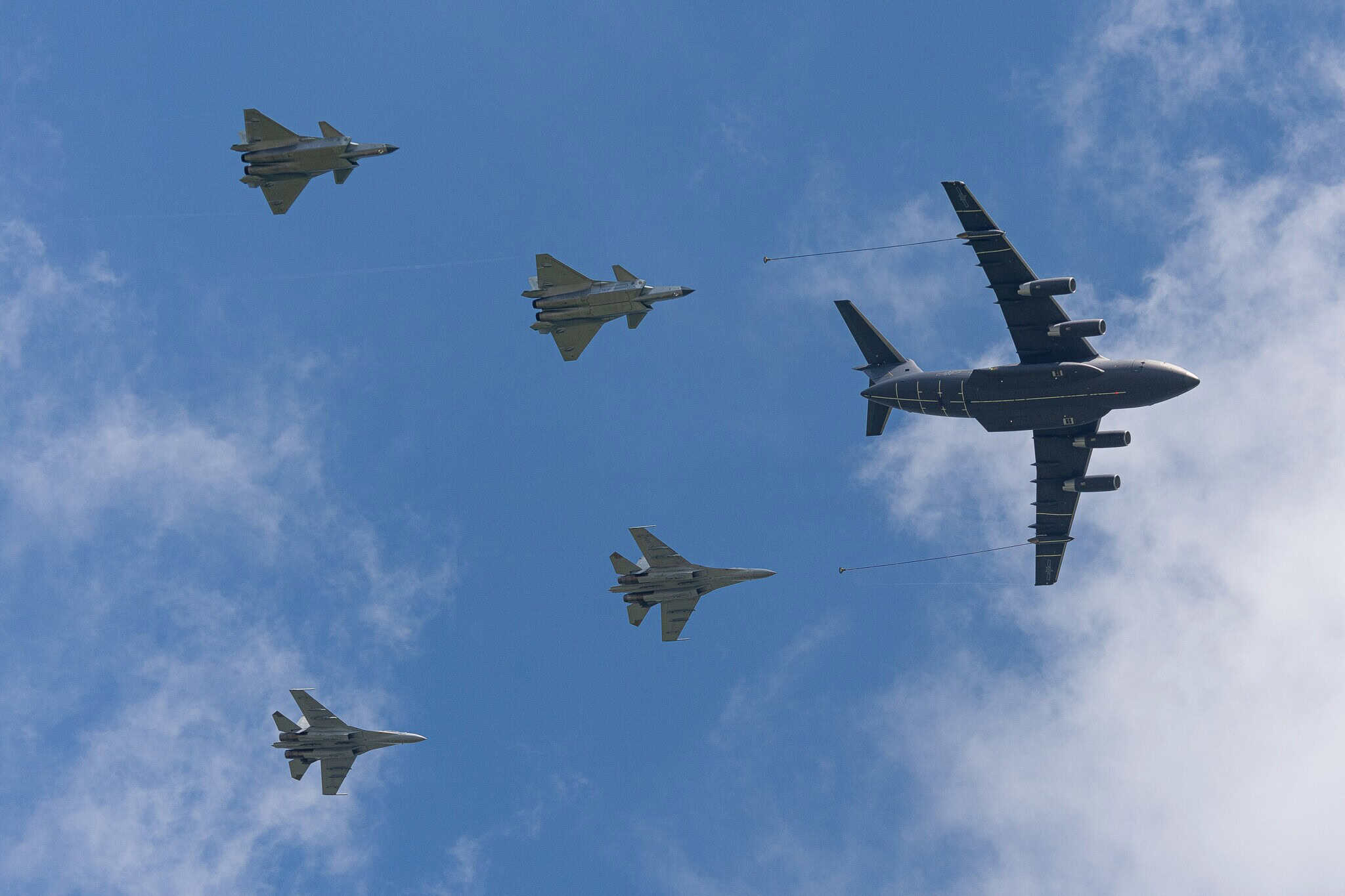
The El Alamein International Airshow opened on Egypt’s Mediterranean coast on September 8, 2026, with China’s People’s Liberation Army fielding the biggest package of military aircraft it has ever sent to an exhibition outside its borders. The three-day show runs through September 10.
China sent six J-16 multirole fighters, two YY-20A aerial-refueling tankers, two Y-20 heavy transports, one KJ-500 airborne early-warning aircraft, and two Z-20K helicopters, according to the South China Morning Post. Four of the types are making their first appearance at an airshow abroad.
The Same Kit China Just Flew to Egypt for a Drill
The lineup closely matches the contingent China deployed weeks earlier for Eagles of Civilization 2026, the second joint air exercise between the two air forces. During that deployment a YY-20A tanker was photographed refueling Egyptian Dassault Rafale fighters in flight, an unusually visible sign of how closely the two militaries are now working.
Chinese state media framed the El Alamein display as a demonstration of the PLA Air Force’s “system-of-systems” combat capability. Military commentator Song Zhongping told the Global Times the showing was “a breakthrough” and said the tanker, transport, early-warning and helicopter types all carry real export potential because China can build them beyond its own needs.
Why China Is Showing, Not Just Flying
Egypt has spent a decade widening its list of arms suppliers. It bought 30 Rafales from France in 2021, flies aging F-16s from the United States, and operates Russian MiG-29s, and reports of an order for the Chinese Chengdu J-10C have circulated for years without a confirmed deal.
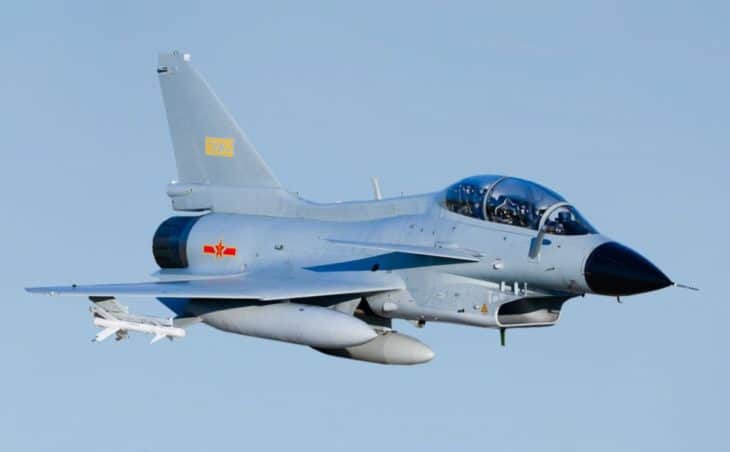
The pitch on display is not a single jet but the surrounding fleet that lets an air force fight at range: a tanker to extend it, an early-warning aircraft to see, a transport to move the support tail, and a helicopter for the rest. Selling that package as a set is how China distinguishes its offer from a straight fighter sale.
The economics help. The J-10C is a 4.5-generation fighter reported to cost $40 million to $50 million, well below a Rafale or a new F-16, and it carries an AESA radar and the long-range PL-15 air-to-air missile. That matters to Cairo because the United States and Israel pressed France to withhold the 100-kilometer Meteor missile from Egypt’s Rafales, which fly instead with the shorter-range MICA.
A display is not a contract
Rumors of an Egyptian J-10C or J-35 purchase have run for years with no signed order. A large airshow presence is a sales campaign, not a deal, and past Chinese showings in the region have not always converted.
The Y-20 family, among the largest military airlifters in service, anchors that argument: a country that can build its own heavy transport and tanker fleet is offering buyers a path away from Western logistics support. Russia and the United States also brought aircraft to El Alamein, turning the show into a three-way contest for one of the region’s larger fighter markets, a competition that echoes the Rafale export campaign playing out elsewhere.
Get the Newsletter
The latest aviation news and stories sent to your inbox.
About the Author

Tim is the owner and lead editor of AeroCorner since 2019, overseeing aviation content covering aircraft, airlines, airports, and the broader aviation industry. Through years of researching, writing, editing, and publishing aviation-focused content, he has developed extensive practical knowledge of commercial aviation and air travel. Based in Asia and a frequent traveler himself, Tim also brings firsthand passenger experience to AeroCorner’s coverage. Outside of publishing, he has also explored aviation firsthand through hands-on flight training in New Zealand.