

Table of Contents
The biggest military airplane ever flown was the Antonov An-225 Mriya, at a maximum takeoff weight of 1,410,958 pounds (640,000 kg). It was destroyed on the ground at Hostomel, Ukraine, in February 2022, and it has not been replaced.
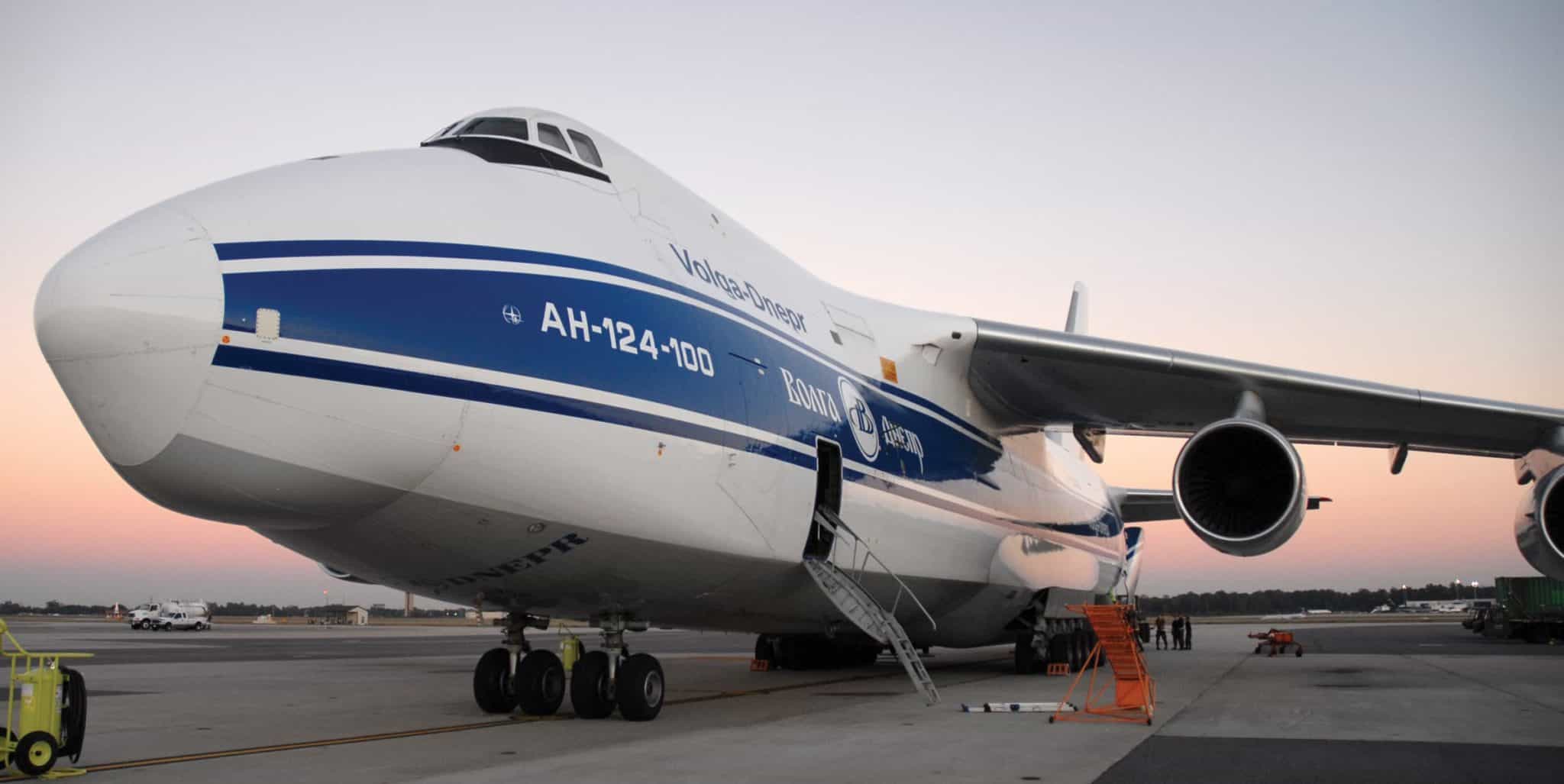
The biggest military airplane still flying is the Antonov An-124 Ruslan, at 886,258 pounds (402,000 kg). The largest aircraft the United States operates is the Lockheed C-5M Super Galaxy, at 840,000 pounds (381,024 kg).
We rank by maximum takeoff weight, because that is the number that decides what an airlifter can actually pick up and where it can operate from. Length and wingspan give a different order, and we list both so you can see where they disagree.
How this ranking works
Aircraft are ordered by maximum takeoff weight, the heaviest the type is certified to leave the ground at. Every figure comes from an official air force fact sheet or the manufacturer where one exists, and specs are current as of September 2026. Aircraft that are retired or destroyed are ranked on their record and clearly labeled, because a list of the biggest military planes ever built is not the same list as the biggest ones flying today.
| # | Aircraft | Max takeoff weight | Length | Wingspan | Status |
|---|---|---|---|---|---|
| 1 | Antonov An-225 Mriya | 1,410,958 lb (640,000 kg) | 275 ft 7 in | 290 ft | Destroyed 2022 |
| 2 | Antonov An-124 Ruslan | 886,258 lb (402,000 kg) | 226 ft 8 in | 240 ft 6 in | In service |
| 3 | Lockheed C-5M Super Galaxy | 840,000 lb (381,024 kg) | 247 ft 10 in | 222 ft 9 in | In service |
| 4 | Boeing VC-25A (Air Force One) | 833,000 lb (377,800 kg) | 231 ft 10 in | 195 ft 8 in | In service |
| 5 | Boeing E-4B Nightwatch | 800,000 lb (362,900 kg) | 231 ft 4 in | 195 ft 8 in | In service |
| 6 | Tupolev Tu-160 Blackjack | 606,271 lb (275,000 kg) | 177 ft 6 in | 182 ft 9 in | In service |
| 7 | Boeing C-17 Globemaster III | 585,000 lb (265,352 kg) | 174 ft | 169 ft 10 in | In service |
| 8 | Antonov An-22 Antei | 551,156 lb (250,000 kg) | 190 ft | 211 ft 3 in | Retired 2025 |
| 9 | Airbus A330 MRTT | 513,677 lb (233,000 kg) | 193 ft | 197 ft 10 in | In service |
| 10 | Boeing B-52H Stratofortress | 488,000 lb (221,400 kg) | 159 ft 4 in | 185 ft | In service |
| 11 | Xian Y-20B | 485,017 lb (220,000 kg) | 154 ft 2 in | 164 ft 1 in | In service |
| 12 | Ilyushin Il-76 | 462,971 lb (210,000 kg) | 152 ft 11 in | 165 ft 8 in | In service |
1. Antonov An-225 Mriya
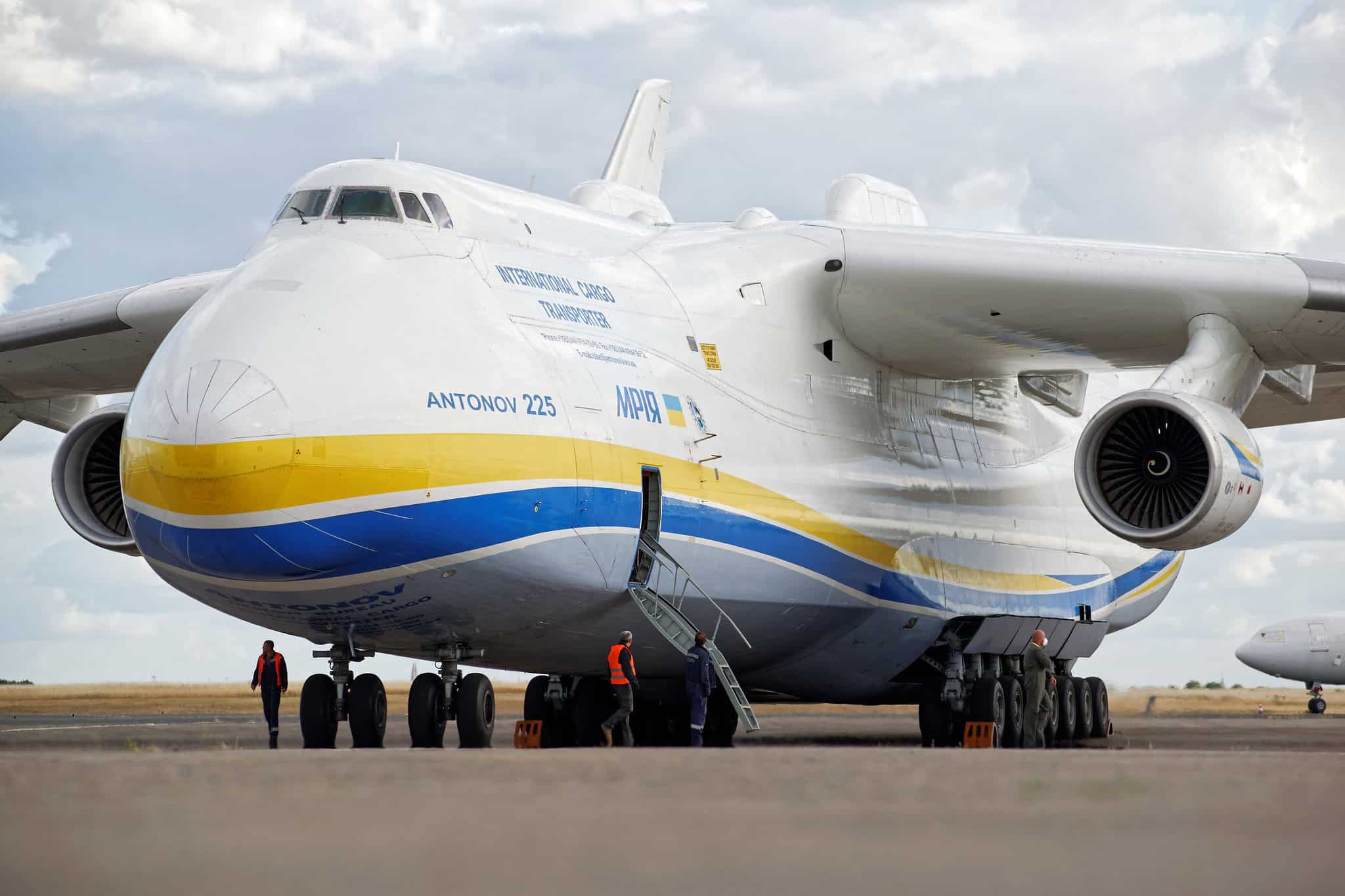
Maximum takeoff weight: 1,410,958 pounds (640,000 kg). Payload: 551,156 pounds (250,000 kg). Six Progress D-18T turbofans.
The An-225 was built to carry the Soviet Buran space shuttle on its back, which is why it is a stretched An-124 with two extra engines and a twin tail. It first flew in December 1988, and exactly one was ever finished.
Nothing else has come close since. At 640 tonnes it outweighed the An-124 by more than half again, and its 290-foot wingspan was wider than any aircraft in service anywhere.
Russian forces destroyed it in its hangar at Hostomel airport near Kyiv during the opening days of the 2022 invasion. Antonov has said it intends to rebuild the aircraft around the partly completed second airframe, at an estimated cost near $500 million, but no completion date has been set.
The fuselage was longer than the first flight
The Wright brothers’ first powered flight on 17 December 1903 covered 120 feet. The An-225 was 275 feet 7 inches long, so the aircraft’s fuselage alone was more than twice the distance of the flight that started all of it.
2. Antonov An-124 Ruslan

Maximum takeoff weight: 886,258 pounds (402,000 kg). Payload: 264,555 pounds (120,000 kg). Four Progress D-18T turbofans.
With the An-225 gone, the An-124 Ruslan is the heaviest military transport aircraft in the world. It first flew in December 1982 and entered Soviet service in 1986, NATO reporting name Condor.
It loads through the nose and the tail, kneels on its landing gear to lower the cargo floor, and can carry loads no Western airlifter can take. The upgraded An-124-100M-150 raises the payload to 150 tonnes and the maximum takeoff weight to 420 tonnes.
Only around 57 were built, and the type is now split awkwardly across a war: Ukraine’s Antonov Airlines flies a handful, Russia’s Volga-Dnepr held the largest civil fleet, and the Russian Aerospace Forces operate the military examples. Nobody is building new ones.
3. Lockheed C-5M Super Galaxy

Maximum takeoff weight: 840,000 pounds (381,024 kg). Maximum cargo: 281,001 pounds (127,460 kg). Four General Electric F138-GE-100 turbofans.
The C-5M Super Galaxy is the largest aircraft in the US Air Force inventory and the heaviest military aircraft the West has ever operated. It is also the longest aircraft on this list apart from the An-225, at 247 feet 10 inches.
Here is where the measure matters. The An-124 outweighs it, but the C-5M is 21 feet longer, and its cargo hold runs 143 feet 9 inches from the nose visor to the tail ramp.
The M is a rebuild rather than a new aircraft. Existing C-5 airframes, in service since 1969, received new engines, new avionics and a structural overhaul, and the Air Force expects them to fly past 2040.
Unrefueled, a C-5M covers roughly 5,524 statute miles (4,800 nautical miles) carrying 120,000 pounds of cargo, and about 7,000 nautical miles empty.
4. Boeing VC-25A (Air Force One)

Maximum takeoff weight: 833,000 pounds (377,800 kg). Four General Electric CF6-80C2B1 turbofans. Two in the inventory.
The two heavily modified Boeing 747-200Bs that carry the president are the fourth-heaviest military aircraft in the world, which is not how most people picture Air Force One. They are heavier than any bomber and any tanker.
Both entered service in 1990 and are operated by the Presidential Airlift Group at Joint Base Andrews. They cruise at 630 mph (1,014 km/h) and carry a crew of 30 plus 71 passengers.
Their replacement, the 747-8-based VC-25B, has slipped repeatedly. Until it arrives, two airframes built in the 1980s remain among the biggest military planes flying.
5. Boeing E-4B Nightwatch
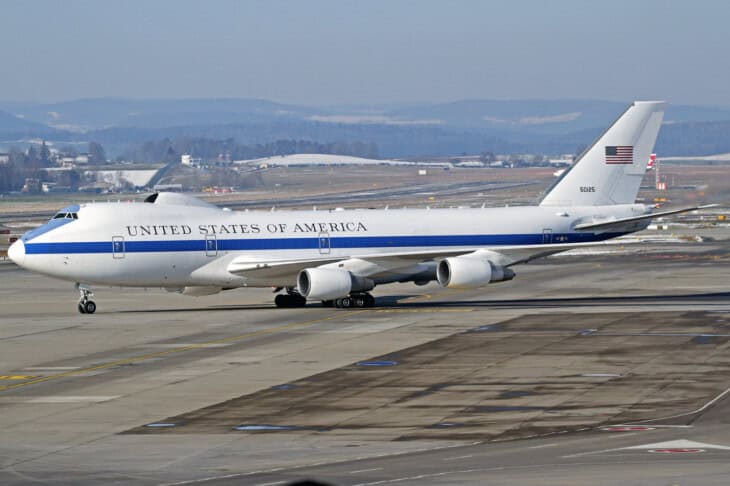
Maximum takeoff weight: 800,000 pounds (362,900 kg). Four General Electric CF6-50E2 turbofans. Four in the inventory.
The E-4B is the National Airborne Operations Center, a 747-200 rebuilt as a flying command post for the president and the secretary of defense in a nuclear crisis. It is hardened against electromagnetic pulse and carries a crew of up to 111.
Its notable number is not weight but endurance: 12 hours unrefueled, and far longer with tanker support, limited mainly by engine oil.
All four have been flying since the 1970s and 1980s. Their replacement is under way: Sierra Nevada Corporation is converting five used Boeing 747-8s into the E-4C under a contract worth about $13 billion, awarded in April 2024. The first conversion began flight testing on 7 August 2025, with service entry expected around 2028.
6. Tupolev Tu-160 Blackjack

Maximum takeoff weight: 606,271 pounds (275,000 kg). Top speed: Mach 2.05. Four Kuznetsov NK-32 afterburning turbofans.
The Tu-160 is the heaviest combat aircraft ever built and the heaviest supersonic aircraft of any type. Russian crews call it Belyi Lebed, the White Swan; NATO calls it Blackjack.
Its variable-sweep wings spread to 182 feet 9 inches for takeoff and fold back to 116 feet for supersonic dash, which is why its wingspan beats the C-17’s despite a much smaller aircraft underneath.
It first flew in 1981 and entered service in 1987. Fewer than 20 remain in Russian service, and production restarted in modernized Tu-160M form rather than as a new design.
The Tu-160 is frequently compared to the American B-1B Lancer, and the resemblance is real, but the Tu-160 is substantially larger and notably faster.
7. Boeing C-17 Globemaster III
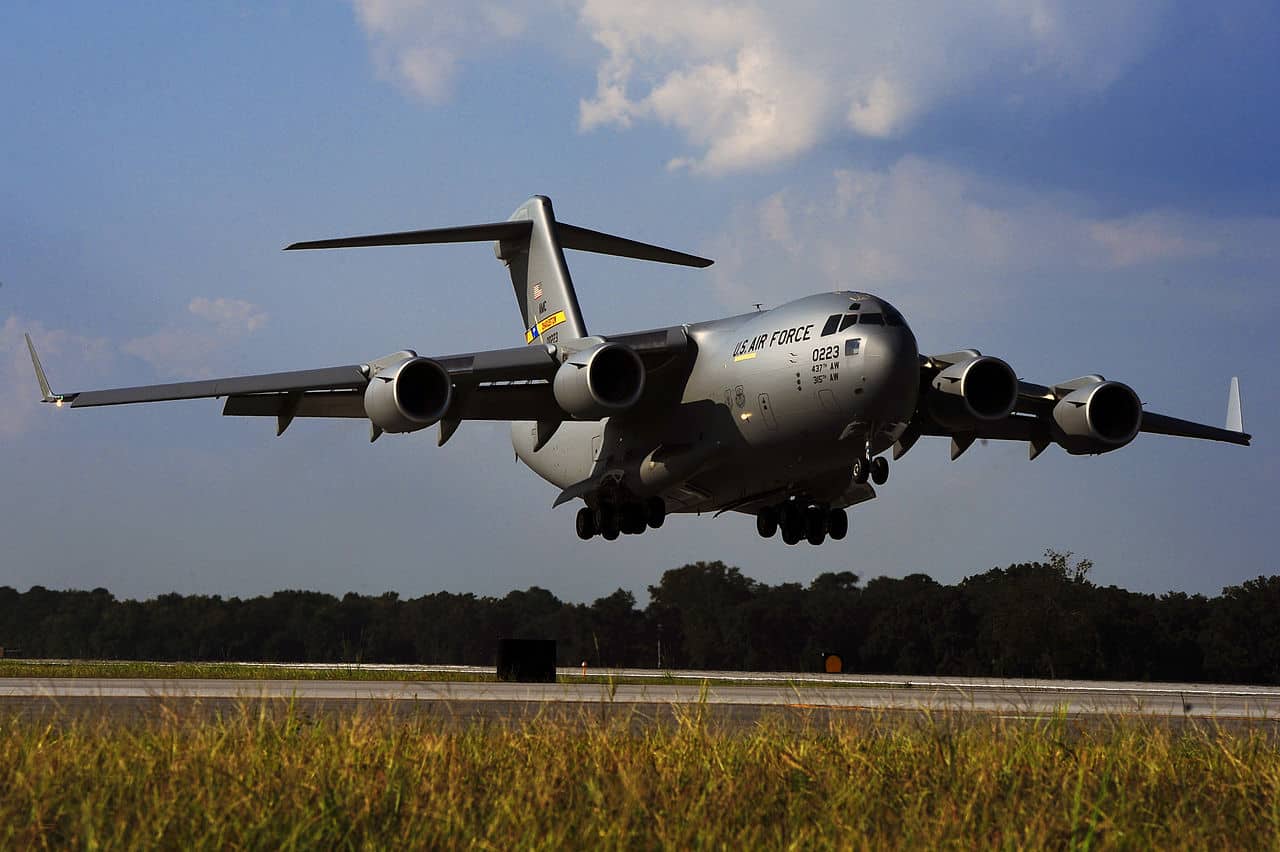

Maximum takeoff weight: 585,000 pounds (265,352 kg). Cargo: 170,900 pounds (77,519 kg) or 102 troops. Four Pratt & Whitney F117-PW-100 turbofans.
The C-17 Globemaster III is the most useful aircraft on this list, and that is a different thing from being the biggest. It carries two thirds of the C-5M’s payload into airfields the C-5M cannot use.
It is designed for runways as short as 3,500 feet (1,067 m), works from unpaved strips, and backs itself up on a narrow taxiway using its thrust reversers. That combination is why 222 serve with the US Air Force and why the UK, Australia, Canada, India, Qatar, the UAE and NATO’s shared fleet all bought it.
A single C-17 takes an M1 Abrams tank, three Apache helicopters, or three Stryker vehicles. Production ended in 2015 after 279 aircraft.
8. Antonov An-22 Antei

Maximum takeoff weight: 551,156 pounds (250,000 kg). Payload: 176,370 pounds (80,000 kg). Four Kuznetsov NK-12MA turboprops driving eight contra-rotating propellers.
The An-22 Antei is the largest turboprop-powered aircraft ever built, a record it has held since 1965 and is unlikely ever to lose. NATO named it Cock.
Its eight contra-rotating propellers made it famously loud and gave it the short-field performance of a much smaller aircraft, which is how a 250-tonne airlifter operated from soft, unprepared strips.
Its service life ended in December 2025. The last airworthy An-22 broke up in flight during a post-repair test near Ivanovo, Russia, killing everyone aboard. Russia had already been retiring the handful that remained, and no return to service is expected.
9. Airbus A330 MRTT

Maximum takeoff weight: 513,677 pounds (233,000 kg). Fuel: 111 tonnes, about 245,000 pounds. Two turbofans.
The A330 Multi Role Tanker Transport is the heaviest military aircraft with only two engines, and the heaviest non-American, non-Soviet design in service. It entered service in 2011.
It carries its entire 111-tonne fuel load in the standard wing and fuselage tanks, with no auxiliary tanks eating into the hold. That leaves up to 45 tonnes (99,000 lb) of payload, of which 37 tonnes (82,000 lb) can be cargo, or a cabin seating up to 300. Most tankers trade one for the other.
Twenty nations have chosen it, among them Australia, the UK, France, Spain, Italy, Singapore, South Korea, Saudi Arabia and NATO’s multinational fleet. The uprated A330 MRTT+ lifts the maximum takeoff weight to 242 tonnes.
10. Boeing B-52H Stratofortress
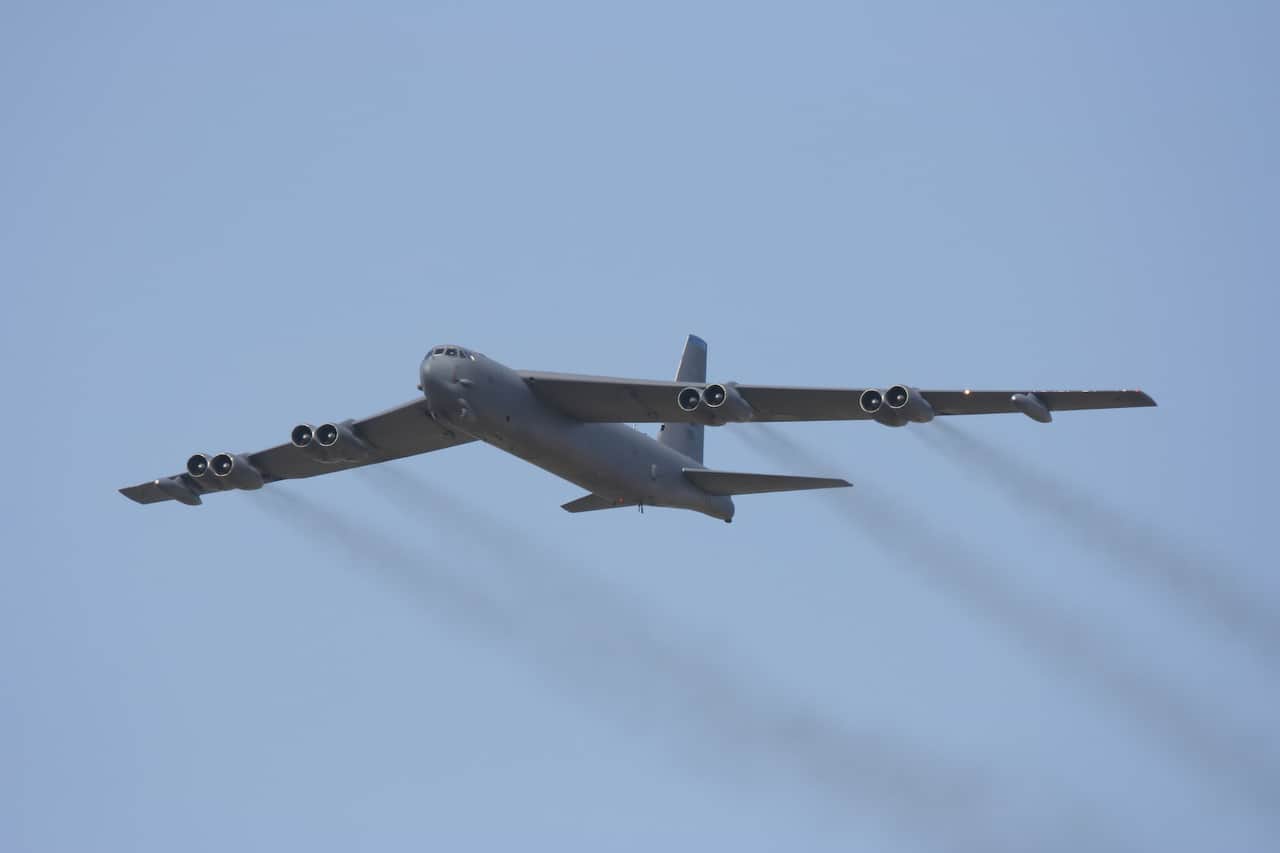
Maximum takeoff weight: 488,000 pounds (221,400 kg). Payload: 70,000 pounds (31,500 kg) of ordnance. Eight Pratt & Whitney TF33 turbofans.
The B-52H Stratofortress is the largest American bomber and, at a 185-foot wingspan, wider than the C-17 that dwarfs it in every other dimension.
It is also the oldest design still in front-line service anywhere on this list. The H model entered service in 1961, and the Air Force intends to keep it flying into the 2050s, which would give the type a century in uniform.
Its unrefueled range is 8,800 miles (14,160 km), the longest of any aircraft here.
It is being re-engined once more. The Commercial Engine Replacement Program swaps the eight TF33s for eight Rolls-Royce F130s and redesignates the aircraft B-52J. The program passed its critical design review in May 2026, with initial operational capability planned for 2033.
11. Xian Y-20B

Maximum takeoff weight: 485,017 pounds (220,000 kg). Payload: 145,505 pounds (66,000 kg). Four Shenyang WS-20 turbofans.
The Y-20 is the newest aircraft on this list and the only one whose numbers are still climbing. It first flew on 26 January 2013 and entered service on 6 July 2016.
It sits neatly between the C-17 and the Il-76 in capability, which is unsurprising: it borrows from both. The Y-20B swaps the original Russian D-30KP-2 engines for Chinese WS-20 turbofans, adding thrust, range and altitude.
Roughly 100 are now in People’s Liberation Army Air Force service, including about 40 configured as YY-20 tankers. No other country has added a new strategic airlifter this century.
12. Ilyushin Il-76

Maximum takeoff weight: 462,971 pounds (210,000 kg). Four turbofans. 981 built.
The Il-76 is the smallest aircraft on this list and by far the most numerous. It has been in production since 1971, and 981 have been built, more than any other heavy military jet transport in history. NATO calls it Candid.
It was designed to work from rough, frozen strips in Siberia, which is why it has a high wing, a glazed navigator’s nose and multi-wheel landing gear that spreads its weight over soft ground.
The current production version is the Il-76MD-90A, with a new one-piece carbon-fibre wing, a glass cockpit and Aviadvigatel PS-90A-76 engines. The stretched Il-76MF lifts 60 tonnes, the most of any Il-76 variant.
Older Il-76s serve with dozens of air forces and do heavy work in disaster relief and aerial firefighting.
Two things most lists of biggest military planes get wrong
First, the An-225 is still widely listed as the biggest military plane flying. It was destroyed in February 2022 and no rebuilt aircraft has flown. Second, the Boeing Dreamlifter appears on many of these lists, and it is not a military aircraft at all: it is a civil 747-400 conversion Boeing owns and uses to move its own 787 parts between factories.
Biggest by wingspan, length and payload
Change the measure and the order changes with it. The An-225 leads under every one, but below it the list rearranges.
| Measure | Winner (excluding the An-225) | Figure |
|---|---|---|
| Maximum takeoff weight | Antonov An-124 Ruslan | 886,258 lb (402,000 kg) |
| Length | Lockheed C-5M Super Galaxy | 247 ft 10 in (75.3 m) |
| Wingspan | Antonov An-124 Ruslan | 240 ft 6 in (73.3 m) |
| Payload | Antonov An-124-100M-150 | 330,693 lb (150,000 kg) |
| Range | Boeing B-52H Stratofortress | 8,800 miles (14,160 km) |
The widest wingspan of any aircraft ever built belongs to neither. That record is held by the Hughes H-4 Hercules, the wooden flying boat nicknamed the Spruce Goose, at 319 feet 11 inches.
It was built to a 1942 US War Department requirement for an aircraft that could cross the Atlantic above the U-boats. It flew exactly once, on 2 November 1947, covering about a mile at 70 feet.
The near misses
Five aircraft sit just below the cut, and each is the biggest of something.
Boeing KC-46A Pegasus, 415,000 pounds (188,240 kg). The newest American tanker, based on the 767, and the aircraft slowly replacing the KC-135 fleet.
Tupolev Tu-95MS Bear, 414,469 pounds (188,000 kg). The largest and fastest turboprop-powered combat aircraft ever built, and a contemporary of the B-52 that is also still flying.
Kawasaki C-2, 311,734 pounds (141,400 kg). Japan’s own jet airlifter, in service since 2016, carrying 37 tonnes or 120 troops.
Airbus A400M Atlas, 310,852 pounds (141,000 kg). Europe’s tactical airlifter, with 81,600 pounds (37,000 kg) of payload and the most powerful turboprops ever built in the West.
Lockheed C-130J Super Hercules, at 97 feet 9 inches long, is not remotely in this weight class, but it is the aircraft most people picture when they think of military airlift, and it outnumbers everything on this list combined.
Where these aircraft sit in the wider picture
Military aircraft dominate the heavy end of aviation, but they do not own it. Set against every aircraft ever flown, the An-225 still leads, while the largest commercial airplanes such as the Airbus A380 and Boeing 747-8 outweigh every military aircraft flying today except the An-124.
Our ranking of the biggest aircraft in the world puts civil and military types on one list, and the largest cargo planes covers the freighters that do the same work for money.
Rotary wing is a separate contest with a clear Soviet winner: see the biggest military helicopters. And among combat aircraft, the biggest fighter jets are a fraction of the size of anything ranked here.
FAQ
Sources and references used for research and fact-checking.
- U.S. Air Force, C-5M Super Galaxy Fact Sheet
- U.S. Air Force, C-17 Globemaster III Fact Sheet
- U.S. Air Force, B-52H Stratofortress Fact Sheet
- U.S. Air Force, E-4B Fact Sheet
- U.S. Air Force, VC-25 Air Force One Fact Sheet
- U.S. Air Force, C-130 Hercules Fact Sheet
- Wikipedia, Antonov An-124 Ruslan
- Wikipedia, Antonov An-225 Mriya
- CNN Travel, AN-225: Plans to rebuild world's largest plane confirmed
- The War Zone, There's Likely No Way Back For Russia's An-22 Turboprop Heavy Transports After Fatal Crash
- Wikipedia, Antonov An-22
- Wikipedia, Tupolev Tu-160
- Wikipedia, Xian Y-20
- Wikipedia, Ilyushin Il-76
- Airbus, A330 MRTT
- Airbus, A400M
- Wikipedia, Boeing C-17 Globemaster III
- Wikipedia, SNC E-4C Survivable Airborne Operations Center
- The Aviationist, B-52J Commercial Engine Replacement Program Passes Critical Design Review
- Wikipedia, Hughes H-4 Hercules
Get the Newsletter
The latest aviation news and stories sent to your inbox.
About the Author

Tim is the owner and lead editor of AeroCorner since 2019, overseeing aviation content covering aircraft, airlines, airports, and the broader aviation industry. Through years of researching, writing, editing, and publishing aviation-focused content, he has developed extensive practical knowledge of commercial aviation and air travel. Based in Asia and a frequent traveler himself, Tim also brings firsthand passenger experience to AeroCorner’s coverage. Outside of publishing, he has also explored aviation firsthand through hands-on flight training in New Zealand.