Cargo Airplanes
Antonov An-70
ICAO: AN70
The one-off six-engine giant that set a 253.8-tonne payload record, destroyed in 2022.
Updated: by Tim de Vries

The latest aviation news and stories sent to your inbox.
The Antonov An-225 Mriya was the heaviest aircraft ever built, a six-engine freighter designed in Kyiv to carry the Soviet Buran space shuttle. Only one was completed. It first flew in 1988, hauled outsize cargo for Antonov Airlines from 2002, and was destroyed at Hostomel in February 2022.
Live Fleet Activity (A225)
Fetching live data…
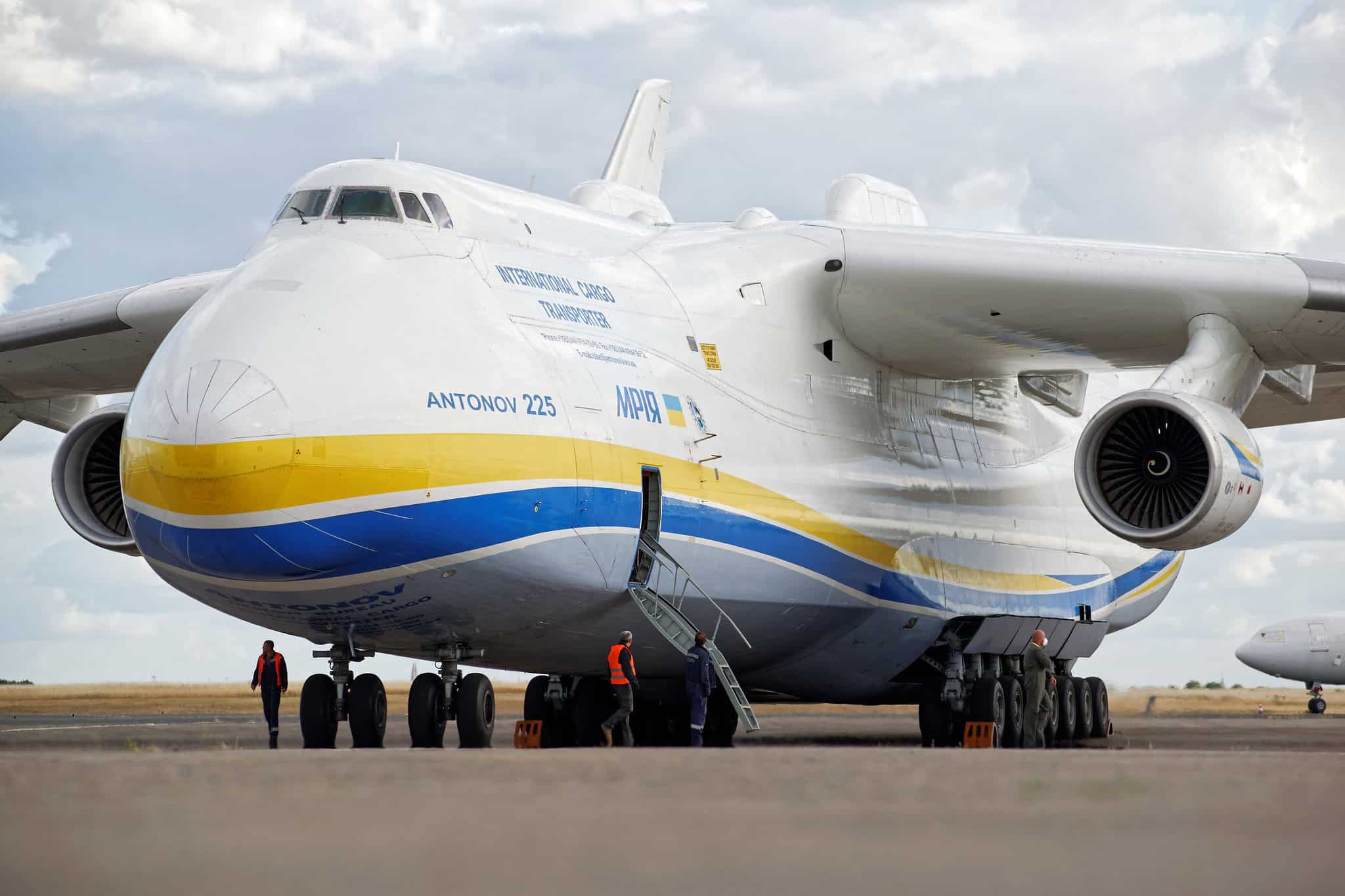


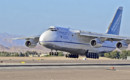
The Antonov An-225 Mriya was a six-engine strategic cargo aircraft and the heaviest aircraft ever built, with a maximum takeoff weight of 1,411,000 lb (640,000 kg). Only one was ever completed, registered UR-82060.
It was designed in Kyiv by the Antonov Design Bureau to carry the Soviet Buran space shuttle, then spent two decades hauling outsize freight for Antonov Airlines. Russian forces destroyed it in its hangar at Antonov Airport in Hostomel, near Kyiv, during the opening days of the 2022 invasion of Ukraine.
Mriya means “dream” in Ukrainian. NATO gave the type the reporting name Cossack.
Work on the An-225 began in 1984, when the Soviet government asked for an airlifter to replace the Myasishchev VM-T. The job was the same one NASA gave its Shuttle Carrier Aircraft: fly the Buran orbiter and the Energia rocket’s boosters between factories and launch sites.
The brief called for a payload of 511,116 pounds (231,840 kg), carried inside or on top, from any runway of at least 11,500 feet (3,505 m). The timetable was short, so Antonov stretched an aircraft it already had rather than start from a blank sheet.
The An-225 made its maiden flight on December 21, 1988. Its lead designer was Viktor Tolmachev, who had also led the An-124.
The aircraft’s first public appearance outside the Soviet Union came at the 1989 Paris Air Show, where it arrived with a Buran orbiter riding on its back. It flew a display at Farnborough the following year.
The Mriya is a stretched Antonov An-124 Ruslan. Antonov added fuselage barrel sections ahead of and behind the wing, and a new, wider wing center section carried a third engine under each wing, taking the total from four to six Progress D-18T turbofans.
Those changes lengthened the aircraft from 226 feet 8 inches (69.1 m) to 275 ft 7 in (84.00 m). The wingspan grew from 240 feet 6 inches (73.3 m) to 290 feet (88.4 m), and maximum takeoff weight rose from 402 tonnes on the An-124 to 1,411,000 lb (640,000 kg) on the Mriya.

The tail changed most. The An-124’s single fin was replaced with a twin tail on a large swept horizontal stabilizer, because the single fin could not cope with the wake turbulence from bulky loads such as Buran riding on the upper fuselage.
Flight controls were fly-by-wire with triple-redundant hydraulics. The landing gear grew to 32 wheels, some of them steerable, which let the aircraft turn around on a runway 197 feet (60 m) wide.
The Mriya also gave up something the An-124 has. It had no rear cargo door or ramp, which was deleted to save weight, because the An-225 was never meant for tactical airlift or short, rough fields.
With no rear door, everything went in through the nose. Like the An-124, the An-225 had a nose gear designed to “kneel”, lowering the front of the aircraft to make loading easier.

The pressurized hold was 142 feet 3 inches (43.35 m) long, 21 feet (6.4 m) wide and 14 feet 5 inches (4.4 m) high, for a volume of 45,909 cubic feet (1,300 cubic meters). That is longer than the Wright brothers’ first flight at Kitty Hawk.
The hold could take up to 80 cars, 16 standard shipping containers, or 250 tonnes of general cargo. Four overhead cranes ran the length of the hold, each able to lift 11,000 pounds (5,000 kg).

For loads too big for the hold, mounting points on the upper fuselage could carry up to 200 tonnes (440,900 pounds), with external cargo up to 230 feet (70 m) long. This was how Buran traveled.
The flight deck sat on an upper deck reached by a ladder, with crew stations and rest areas with beds behind it. The standard crew was six: two pilots, two navigators and two flight engineers.
The full specification table for the An-225 is on this page. A few of its figures are often quoted against each other without the context that makes them agree.
The 640-tonne maximum takeoff weight is the second figure the aircraft carried. It was built at 600 tonnes, and a roughly $20 million modification program in 2000 and 2001, including a reinforced cargo floor, raised it to 640. Older sources that give 600 tonnes are describing the aircraft as first built, not getting it wrong.
The range in the panel is the maximum-fuel figure. With 200 tonnes in the hold, published range drops to about 2,500 miles (4,000 km), which is the number that mattered to customers.
The panel’s 250-tonne maximum payload is the design rating for the hold. The aircraft actually lifted more than that once, on a record flight covered below.
Fuel capacity was 99,100 gal (375,000 L), more than 300,000 kg of fuel. That outweighs the aircraft’s own empty weight of 628,317 lb (285,000 kg).
The An-225 flew in the Soviet space program only from 1988 to 1991. After the Soviet Union collapsed and Buran was canceled, the aircraft had no job, and in 1994 it went into long-term storage with its six engines removed for use on An-124s.
By the late 1990s, Antonov Airlines needed an aircraft bigger than its An-124s. The An-225 was restored, re-engined and modernized as the An-225-100, gaining a traffic collision avoidance system and new communications and navigation equipment.
It received its type certificate from the Interstate Aviation Committee on May 23, 2001. Its first commercial flight, on January 3, 2002, carried 216,000 prepared meals on 375 pallets from Stuttgart, Germany, to Thumrait, Oman, for American military personnel.
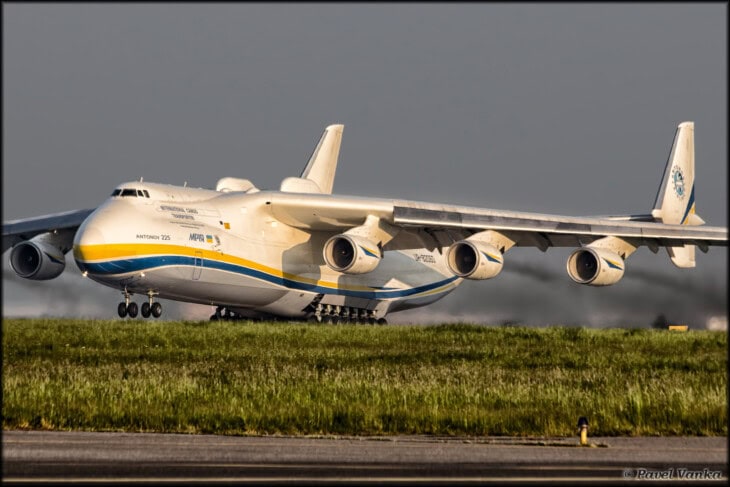
From then on it carried loads few other aircraft could, including 130-ton generators, wind turbine blades and diesel locomotives. The Canadian and US governments chartered it to move military supplies to the Middle East, and relief agencies used it after disasters.
During the COVID-19 pandemic in 2020 it flew medical supplies out of China. In 2017, hiring it cost about $30,000 per hour.
Wherever it landed, it drew crowds. Its blue and yellow scheme, added in 2009, matched the Ukrainian flag, and The New York Times called it “Ukraine’s winged ambassador to the world.”
For how it compared with the aircraft that carry outsize freight today, see our ranking of the largest cargo planes in the world.
On September 11, 2001, the An-225 carried a record 253.82 tonnes (559,580 pounds) of cargo, five main battle tanks, around a 621-mile (1,000 km) closed circuit at 474 mph (763.2 km/h) and up to 35,270 feet (10,750 m).
On August 11, 2009, it carried the heaviest single item ever sent by air: a generator for a gas power plant in Armenia. With its loading frame, the payload weighed 418,830 pounds (189,980 kg).
On June 11, 2010, it flew what was then the world’s longest piece of air cargo, two 138-foot (42.1 m) test wind turbine blades from Tianjin, China, to Skrydstrup, Denmark. Over its career the aircraft was credited with 240 world records.
The An-225’s last commercial mission ran from February 2 to 5, 2022, carrying almost 90 tons of COVID-19 test kits from Tianjin to Billund, Denmark. It then returned to its base at Antonov Airport in Hostomel, where it underwent an engine swap.
An evacuation had been planned for the morning of February 24, 2022. Russia invaded that morning, Antonov Airport was among its first targets, and Ukraine closed its airspace to civilian flights before the aircraft could leave.
On February 27, 2022, Ukraine’s state defense group Ukroboronprom said the aircraft had been destroyed in its hangar during the fighting for the airport. Later drone footage showed the forward fuselage burned out and a broken right wing held up by its engines resting on the ground.
The loss became a criminal case. In April 2023, Ukrainian prosecutors charged Antonov’s former head with negligence for not ordering the aircraft flown to Leipzig, Germany, before the invasion, although the Security Service of Ukraine said it had been in good enough technical condition to fly out.
Possibly, but not as the same aircraft. The realistic route is a second An-225, built around an unfinished airframe started in the late 1980s and never completed after the Soviet collapse, which was reported intact after Russian forces withdrew from northern Ukraine.
Earlier attempts to finish it came to nothing. A 2006 decision to complete it had stalled by 2009, and the aircraft was and priced at $300 million or more in 2011. Sources put it at 60 to 70 percent complete by 2016.
In May 2022, President Volodymyr Zelenskyy said Ukraine would complete the second aircraft. In November 2022, Antonov’s general director put the cost at about 500 million euros, and parts have since been removed from the wreck to be fitted to the unfinished fuselage.
Estimates vary widely. Ukroboronprom said in 2022 that restoration could exceed $3 billion and take more than five years, and many 1980s components are no longer made.
As of February 2026 coverage, Antonov had paused the work in September 2024 until the war ends, and no funding commitment or delivery date had been announced.
By weight, yes. At 1,411,000 lb (640,000 kg), the An-225 is the heaviest aircraft ever built, well above the Airbus A380.
By wingspan, no. The Stratolaunch carrier aircraft, first flown on April 13, 2019, spans 385 feet (117 m), and Howard Hughes’ H-4 Hercules “Spruce Goose” spanned 321 feet (98 m), both more than the Mriya’s 290 feet (88.4 m).
Both are lighter, though. The Stratolaunch’s maximum takeoff weight is 1.3 million pounds, and the wooden Spruce Goose was far lighter still.
It was caught at its home base, Antonov Airport in Hostomel near Kyiv, when Russia invaded Ukraine on February 24, 2022. The airport was one of the first targets, and the aircraft was destroyed in its hangar during the battle, which Ukroboronprom announced on February 27, 2022.
No. The only completed An-225 was destroyed in 2022. Antonov plans to build a second one around an unfinished airframe, but as of February 2026 that work had been paused since September 2024 until the end of the war.
By weight, the Antonov An-225 Mriya, with a maximum takeoff weight of 1,411,000 lb (640,000 kg). By wingspan, the Stratolaunch carrier aircraft, whose 385-foot (117 m) span beats the An-225’s 290 feet (88.4 m).
It was designed in the Soviet era by the Antonov Design Bureau in Kyiv, which is now in Ukraine, and first flew in 1988. After the Soviet Union dissolved, the aircraft and the company were Ukrainian, and it flew for Ukraine’s Antonov Airlines from 2002 until 2022.
One was completed and flown. A second airframe was partially built in the late 1980s and never finished, and it is the basis for Ukraine’s plans for a new Mriya.
No sale price was ever published, because the aircraft was never sold. The 2000 to 2001 upgrade cost about $20 million, hiring it cost about $30,000 per hour in 2017, and finishing a second aircraft is now estimated at 500 million euros or more.
The hold was rated for 250 tonnes (551,000 pounds) of general cargo, and up to 200 tonnes could ride on top of the fuselage. Its record flight in 2001 carried 253.82 tonnes.
Sources and references used for research and fact-checking.