Cargo Airplanes
Boeing 777 Freighter
ICAO: B77L
Four converted 747-400s that carry 787 wings and fuselage barrels for Boeing.
Updated: by Tim de Vries

The latest aviation news and stories sent to your inbox.
The Boeing 747-400 Large Cargo Freighter, better known as the Dreamlifter, is a 747-400 rebuilt around a cargo hold large enough to carry the major assemblies of another airliner. Four were converted from used passenger 747-400s between 2006 and 2010, and they remain the only examples ever built. Their job is to move 787 Dreamliner wings and fuselage barrels between Boeing’s global suppliers and its final assembly line, a task that cut delivery times from as long as 30 days by sea to about one day. Boeing owns the fleet, Atlas Air flies it, and the type certificate bars it from commercial freight work.
Live Fleet Activity (BLCF)
Fetching live data…


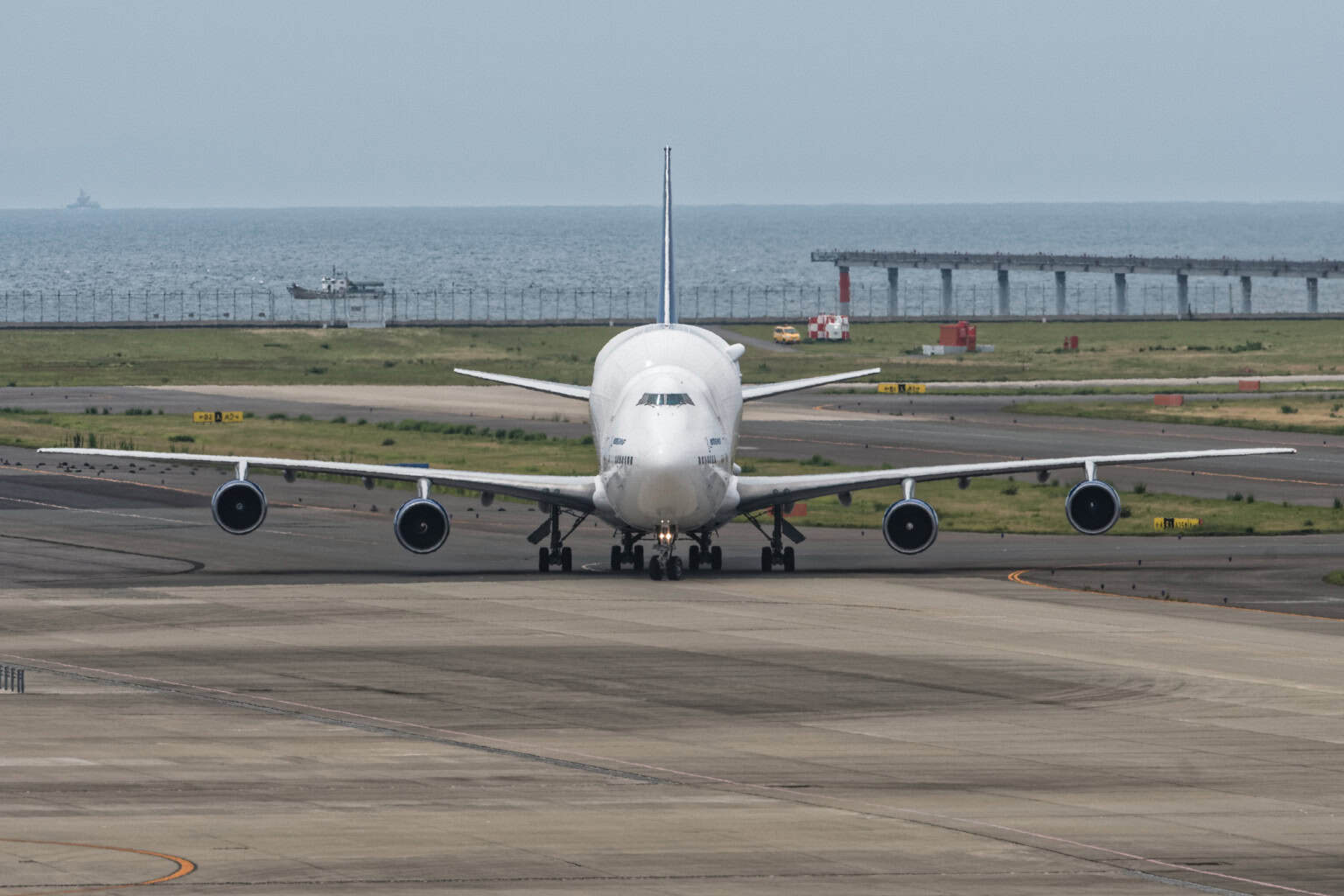


The Boeing Dreamlifter is a 747-400 that was rebuilt around a cargo hold big enough to swallow the parts of another airliner. Its formal name is the 747-400 Large Cargo Freighter, or LCF, and its ICAO type designator is BLCF.
Only four exist. They were converted from used Boeing 747-400 passenger jets between 2006 and 2010, and they remain the only aircraft of their kind.
The Dreamlifter was built for one job: moving major 787 Dreamliner assemblies between Boeing’s suppliers and its final assembly line. It is not a commercial freighter, and by the terms of its type certificate it cannot become one.
The 787 program was designed around a global supply chain. Wings come from Japan, fuselage barrels from Italy and the United States, and the sections meet at final assembly already largely complete.
Those sections are far too large for any conventional freighter. Shipping them by sea took as long as 30 days, which no production rate could absorb.
The Dreamlifter cut that to roughly a single day. That speed is what made distributed 787 production workable at all, and it is why Boeing built a bespoke aircraft rather than chartering existing lift.
Today the fleet works a circuit that takes in Charleston in South Carolina, Everett in Washington, Wichita in Kansas, Nagoya in Japan, and Taranto in Italy. Final assembly of the 787 has been consolidated at Charleston since 2021, when the last Everett-built Dreamliner left the line.
The conversion work was done by Evergreen Aviation Technologies Corporation in Taiwan, not by Boeing itself. Boeing reacquired four secondhand 747-400s to feed the program.
The type certificate lists them by serial number: two 747-409s that flew for China Airlines, one 747-4H6 from Malaysia Airlines, and one 747-4J6 from Air China. They now wear the registrations N249BA, N718BA, N747BC and N780BA.
The FAA’s change list for the modification is blunt about how deep it goes. Boeing installed a new crown structure to enlarge the fuselage cross section and added a new pressure bulkhead immediately aft of the flight deck.
It then fitted a swing tail cargo door together with a 10 foot fuselage extension, extended the vertical stabilizer by 5 feet, and strengthened the floor beams.
One change is easy to miss in photographs. The 747-400’s winglets were removed before certification to resolve excess vibration and other handling characteristics, so a Dreamlifter wingtip ends plain where a 747-400’s turns upward.
The first aircraft rolled out at Taipei Taoyuan in August 2006 and flew on September 9, 2006. FAA certification followed on June 2, 2007, the first two entered service that year, a third was working by June 2008, and the fourth became operational in February 2010.

A 747 freighter loads through a hinged nose. The Dreamlifter loads through its tail, which swings aside to open the entire rear fuselage.
The mechanism is deliberately low-tech. Unlike the hydraulically supported nose of a 747 Freighter, the tail is opened and closed by a modified shipping container handling truck, then locked to the rear fuselage with 21 electronic actuators.
Feeding the hold needs equipment of its own. The DBL-100 cargo loader, completed in June 2006 and described as the world’s longest cargo loader, lifts 787 sections straight in along the aircraft’s axis.
The hold measures 65,000 ft³ (1,840.6 m³). That is roughly three times the volume of a 747-400 freighter, which is the figure that matters for this aircraft’s mission.
Volume, not weight, is the binding constraint. A 787 wing is enormous and comparatively light, so the Dreamlifter runs out of space long before it runs out of payload.
That trade shows up in the rest of the design. Maximum payload is well below what the airframe’s structure could theoretically carry, and the aircraft is best understood as a flying volume rather than a heavy hauler. For aircraft that genuinely optimize for mass, see our roundup of the largest cargo planes.
The full specification table for the aircraft is on this page. A few of those figures deserve context, because they are the ones most often quoted against each other.
Range is the clearest example. The Dreamlifter is good for about 4,200 nautical miles fully loaded, against roughly 7,260 for the 747-400 it was built from. The enlarged fuselage costs aerodynamic efficiency, and the aircraft also carries less fuel, 52,600 gal (199,100 L), about 8% less than the standard 747-400.
Cruise speed is published two ways. Mach 0.82 is the figure Boeing and the safety databases quote, and it corresponds to the 474 knots true airspeed shown in the panel. A standard 747-400 cruises slightly faster at Mach 0.855.
Maximum takeoff weight is lower than the donor aircraft’s, at 803,000 pounds against about 875,000. That surprises people who assume a bigger aircraft must be heavier, but the Dreamlifter gave up weight capability in exchange for volume.
The 43,100 foot maximum operating altitude comes from the type certificate rather than from a brochure, which is worth noting because several references still publish a lower figure.
Boeing owns the four Dreamlifters. Boeing does not fly them.
Evergreen International Airlines operated the fleet first, running it to a 93% schedule performance until August 2010. Atlas Air won a nine-year operating contract in March 2010 and took over that August, and it still operates the aircraft today.
This split is the single most common misunderstanding about the type. The crews are Atlas Air crews, while Boeing controls scheduling and routing.
The type certificate closes off the obvious follow-up question. These aircraft are not approved for commercial freight operations, and only cargo that supports Boeing’s own lines of business may be carried. You cannot charter one.
The Dreamlifter’s best-known moment was an embarrassment rather than an accident. On November 20, 2013, N780BA landed at Colonel James Jabara Airport, a small general aviation field in Wichita, instead of McConnell Air Force Base 9 miles (14 km) further along the same heading.
The aircraft was undamaged, and it flew out the next day from Jabara’s 6,101 foot (1,860 m) runway. That departure, from a runway barely half the length the type normally uses, drew more attention than the arrival.
On October 11, 2022, N718BA lost a main landing gear wheel departing Taranto in Italy. The wheel landed in a vineyard outside the airport perimeter, and the aircraft continued to Charleston and landed safely.
No Dreamlifter has been written off, which for a four-aircraft fleet flown hard for nearly two decades is a reasonable record.
Airbus faced the same problem and solved it differently. The BelugaXL is based on the A330 and carries its outsize load in a bulged upper fuselage reached through a forward cargo door.
The Dreamlifter is the larger aircraft by cargo volume and the only one of the two able to carry complete 787 wings. The BelugaXL could in theory take a fuselage barrel one at a time, but not the wings or paired fuselage sections.
The loading philosophies differ as much as the numbers. Airbus loads from the front and above the flight deck, Boeing swings the whole tail open. Both are covered in our guide to the types of cargo planes.
Yes. As of September 2026 all four aircraft remain in service with Atlas Air on Boeing’s behalf.
Utilization is high for such a small fleet. N747BC alone flew 175 flights in 2025, and individual aircraft often make more than one flight in a day.
The fleet’s future is tied to the 787’s. As long as Boeing builds Dreamliners from sections made on three continents, something has to carry them, and Boeing has not announced a successor.
Four. All four were converted from used 747-400 passenger aircraft between 2006 and 2010, and no more were built.
They carry major 787 Dreamliner assemblies, including wings and fuselage barrels, between Boeing’s suppliers and its final assembly line. The FAA type certificate restricts them to cargo that supports Boeing’s own lines of business, so they cannot be used for commercial freight.
Very. With four airframes it is one of the rarest widebody types flying, and the only way to see one is at an airport on Boeing’s 787 supply route, such as Charleston, Everett, Wichita, Nagoya or Taranto.
Yes. As of September 2026 all four are active, operated by Atlas Air under contract to Boeing, and flying regularly enough that one aircraft logged 175 flights in 2025.
Boeing owns the aircraft and Atlas Air flies them with Atlas Air crews. Evergreen International Airlines held the contract first, until Atlas took over in August 2010.
No. The donor 747-400s had them, but they were removed before certification to resolve excess vibration and handling problems introduced by the enlarged fuselage.
Its hold is 65,000 ft³ (1,840.6 m³), about three times a 747-400 freighter’s volume, with a maximum payload of 250,000 lb (113,500 kg). In practice the aircraft is limited by space rather than weight, because 787 sections are bulky and relatively light.
No. The type certificate caps occupancy at four people including the flight crew, and the aircraft may only carry cargo supporting Boeing’s own business.
Sources and references used for research and fact-checking.