


Table of Contents
There are eight main types of aircraft engines: piston, turboprop, turbojet, turbofan, turboshaft, ramjet, scramjet and electric. The first five do nearly all of the real flying.
Two of them carry most of it. According to the FAA’s powerplant handbook, small general aviation planes mostly use horizontally opposed piston engines, and almost all airliners use turbofans.
The fastest way to tell them apart is to ask what the engine actually pushes on: a propeller, a helicopter rotor, or the air shot out of its own tailpipe. The table below sorts all eight that way, and each section explains how the engine works and what flies on it.
| Engine type | How it makes thrust | Where it works best | Example |
|---|---|---|---|
| Piston | Pistons turn a crankshaft and a propeller | Small, slow aircraft | Cessna 172 (Lycoming IO-360, 180 hp) |
| Turboprop | Gas turbine turns a propeller through a gearbox | Cruise of about 180 to 350 mph | Pilatus PC-12 (Pratt & Whitney Canada PT6A) |
| Turbojet | All the air goes through the core and leaves as a hot jet | Supersonic flight; now rare | Concorde (Rolls-Royce/Snecma Olympus 593) |
| Turbofan | A large fan pushes most of the air around the core | 350 mph to Mach 0.8-0.9; low-bypass versions in fighters | Boeing 777-9 (GE9X), F-35 (F135) |
| Turboshaft | Gas turbine turns a shaft instead of making jet thrust | Helicopters and auxiliary power units | MH-60R Seahawk (GE T700) |
| Ramjet | Forward speed compresses the air; no moving parts | Around Mach 3; needs a booster | Bloodhound and Meteor missiles |
| Scramjet | A ramjet that burns fuel in supersonic airflow | Mach 5 and up; experimental | NASA X-43A |
| Electric | Battery-powered motor turns a propeller | Short training flights | Pipistrel Velis Electro |
How Aircraft Engines Are Grouped
Every one of these engines works on the same idea: throw air backward and the aircraft goes forward. They differ in how much air they move and how fast.
A propeller or rotor accelerates a large mass of air at a relatively low speed. A pure jet does the opposite and fires a small mass of air out at very high speed, which is why jets are loud.
The FAA sorts the field into piston engines and gas turbines. It counts four types of gas turbine used to propel and power aircraft: the turbofan, turboprop, turboshaft and turbojet.
“Turbojet” used to be the word for any turbine engine, which is why older guides call every jet a turbojet. Ramjets and scramjets sit outside that family because they have no turbine at all, and electric motors burn nothing.
Speed decides which one an aircraft uses. The same handbook says turboprops perform very well at cruising speeds of 180 to 350 mph (290 to 560 km/h), and turbofans take over from 350 mph up to Mach 0.8-0.9 on airline routes.
Anything built for Mach 1 or more uses afterburning turbojets or low-bypass turbofans. That speed split is also why the different types of airplanes look the way they do.
1. Piston Engine (Reciprocating)
The piston engine is the oldest aircraft engine and still the most common one in small planes. The Wright Flyer flew on December 17, 1903, on a 12-horsepower, four-cylinder gasoline engine the brothers built with their bicycle shop mechanic, Charles Taylor.
It works like a car engine. Fuel and air burn inside a cylinder and push a piston down, and a crankshaft turns that back-and-forth motion into rotation that spins the propeller.
The FAA classifies piston engines by how the cylinders are arranged: inline, V-type, radial or opposed. Each arrangement had its era.
Horizontally opposed
Two rows of cylinders lie flat, facing each other across the crankshaft. This is the engine in most light aircraft today, and Lycoming and Continental build most of them.
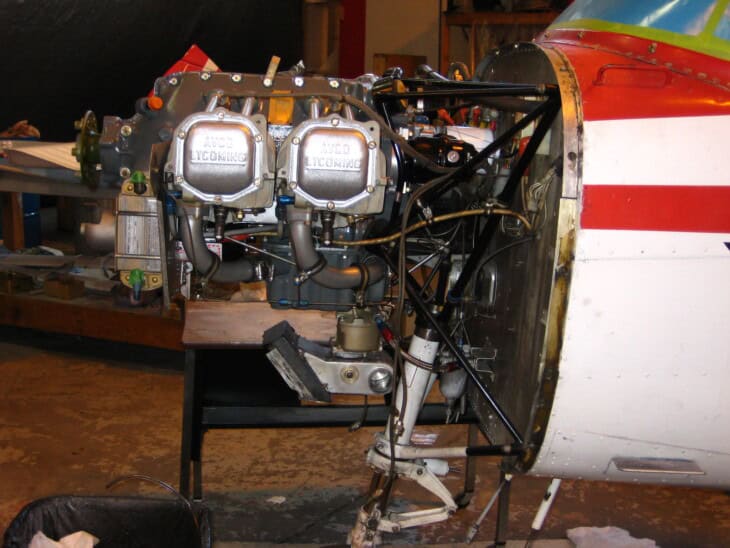
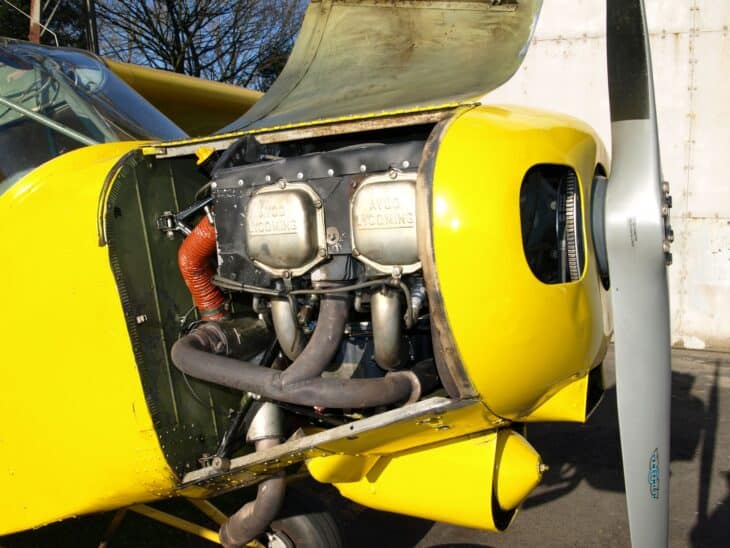

The current Cessna 172 Skyhawk uses a Lycoming IO-360-L2A rated at 180 horsepower (134 kW). More than 44,000 Cessna 172s have been built.
Inline and V-type
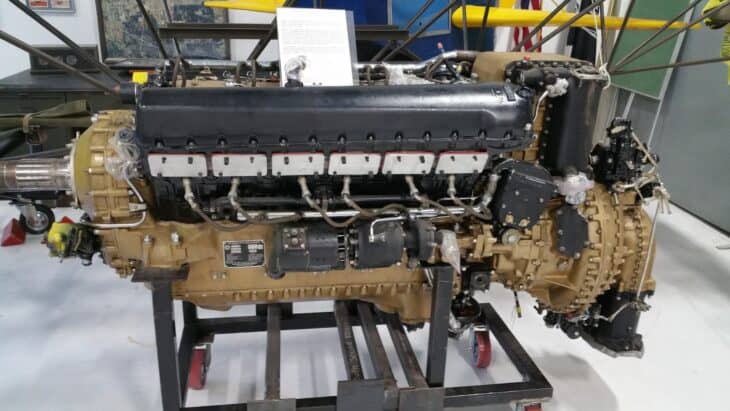
An inline engine puts its cylinders in a single row, which gives it a small frontal area that is easy to streamline. A V-type engine sets two inline banks in a V, generally 60 degrees apart.
The Rolls-Royce Merlin V-12 is the classic example. The FAA notes that V-type engines were used mostly during the Second World War and are now largely limited to older aircraft.

Radial
A radial arranges its cylinders in a star around a central crankcase, in rows of three, five, seven or nine. Double-row radials stack two rows, and one design ran four rows of seven for 28 cylinders.
The best-known example is the Pratt & Whitney R-2800 Double Wasp, an 18-cylinder twin-row radial built 125,334 times between 1939 and 1960. It powered the Republic P-47 Thunderbolt, the F4U Corsair, the F6F Hellcat and the Douglas DC-6 airliner.
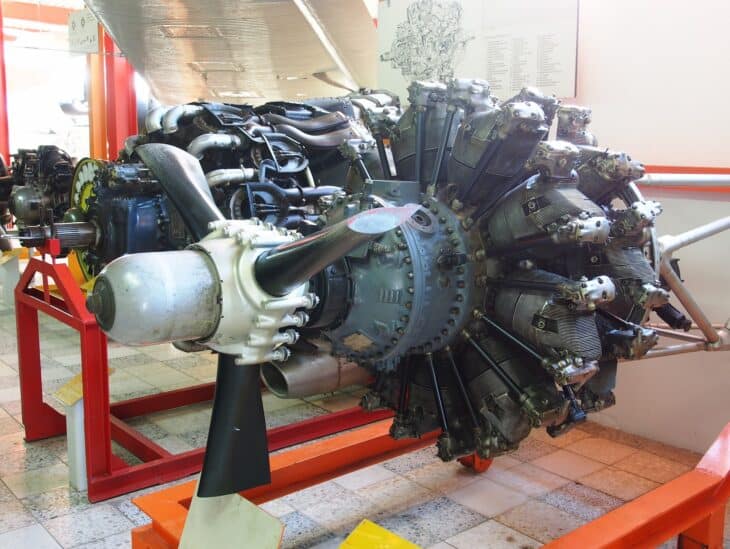

Radials are rugged and dependable, but the FAA says their use today is limited to some older cargo planes, warbirds and crop sprayers.
Rotary (the First World War oddity)
In a rotary engine, the crankshaft stayed bolted to the airframe while the cylinders and crankcase spun around it with the propeller. The Gnome Omega of 1908-1909 was the first production rotary, at 50 horsepower.
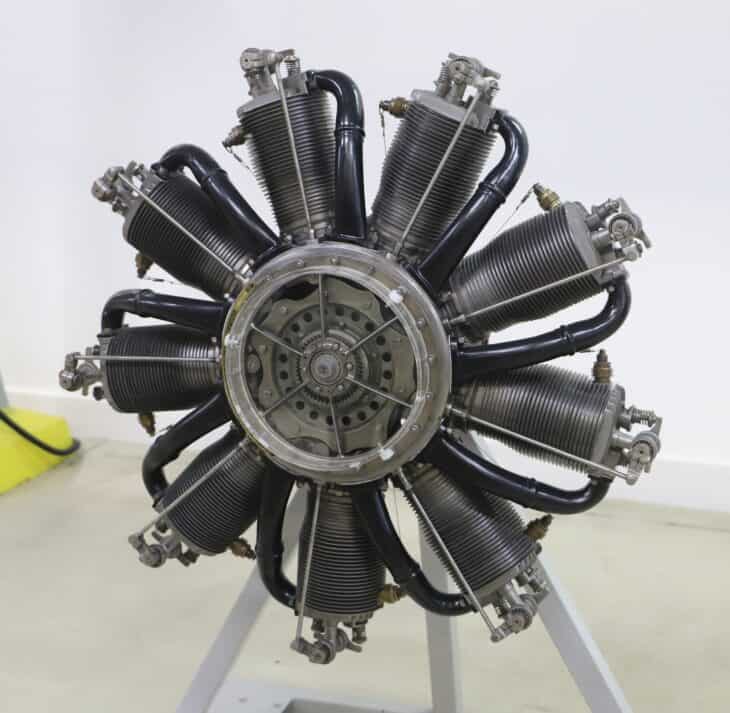

Rotaries powered the Sopwith Camel and the Fokker Dr.I, but the spinning mass made turns violently gyroscopic, and the engines drank fuel and castor oil. Stationary inline and radial engines had replaced them by the early 1920s.
Most piston aircraft engines burn gasoline, but certified diesels exist too: Thielert and Austro Engine developed them from Mercedes car engines. Our guide to diesel aircraft engines covers why they have not taken over.
Best at: cheap, efficient flying at low speed. The FAA notes that piston and turboprop engines have better economy than jets at low speed.
2. Turboprop Engine
A turboprop is a gas turbine engine that turns a propeller through a speed reduction gearbox. The turbine spins far too fast to drive a propeller directly, so the gearbox steps it down.

Roughly 80 to 85 percent of the energy the turbine develops goes into the propeller. The rest leaves through the exhaust as a little extra thrust, so turboprops are rated in equivalent shaft horsepower, which adds the two together.
There are two layouts. In a fixed-turbine engine, the gas generator is mechanically linked to the gearbox and propeller. In a free-turbine engine, the only link is the hot gas flowing onto a separate power turbine.
One of the most successful free-turbine turboprops is the Pratt & Whitney Canada PT6. It first flew in 1961, and 64,000 had been built by February 2023.
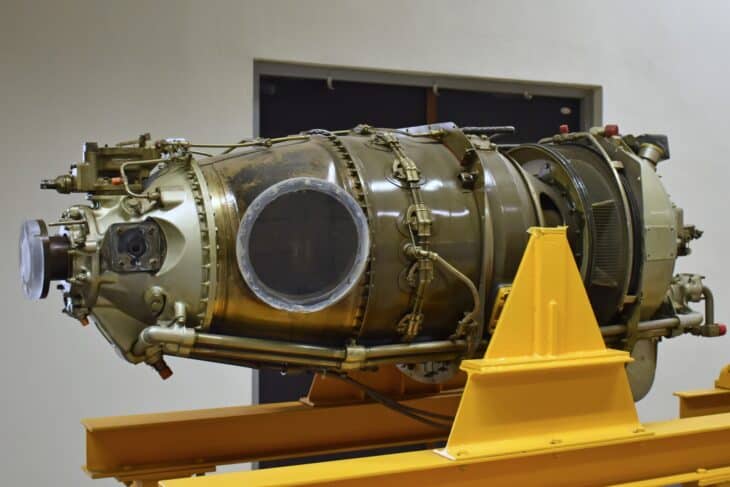
The PT6A turboprop covers 580 to 1,940 shaft horsepower and powers the Beechcraft King Air, the de Havilland Twin Otter, the Cessna Caravan and the Pilatus PC-12.
The limit is the propeller itself. As the blade tips approach the speed of sound, efficiency drops sharply, so turboprops are rarely used on aircraft faster than about Mach 0.6-0.7. The FAA puts the crossover at around 400 mph, above which a turbofan wins. Our guide to types of aircraft propellers covers the blade designs.
Hungarian engineer György Jendrassik built one of the earliest turboprops, the Cs-1, which first ran in Budapest in 1940. The first turboprop to fly was a Gloster Meteor test aircraft fitted with two Rolls-Royce Trent engines, on September 20, 1945.
Best at: regional airliners, business turboprops and utility aircraft that fly shorter routes from shorter runways.
3. Turbojet Engine
The turbojet is the original jet engine and the simplest gas turbine. Air enters at the front, a compressor squeezes it, fuel burns in the combustion chamber, and the hot gas spins a turbine on its way out.
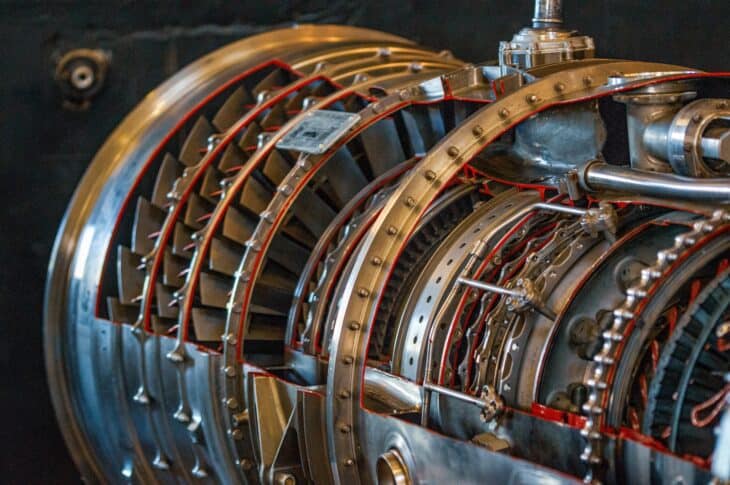
The turbine only takes enough energy to drive the compressor through a shaft. Everything left over blasts out of the nozzle as a fast jet, and that jet is the thrust.

What makes it a turbojet is that all of the air passes through the core. For the full intake-to-nozzle sequence, see how a jet engine works.
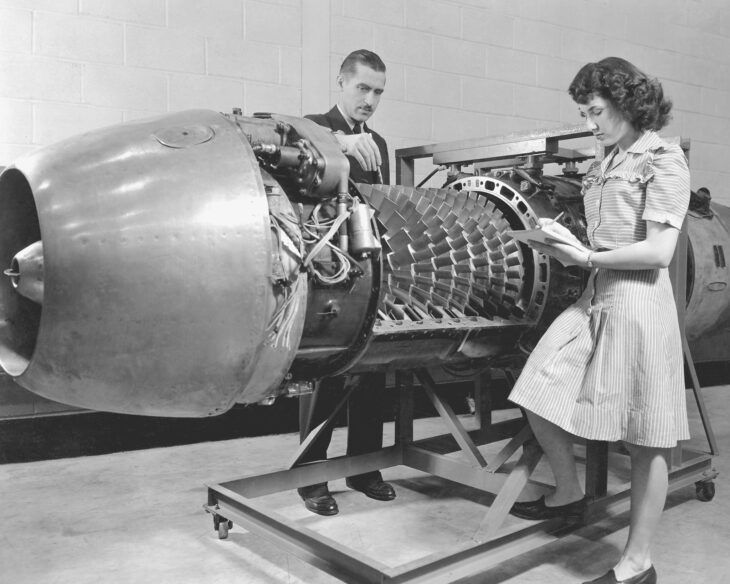
The Heinkel He 178 made the first turbojet-powered flight on August 27, 1939, on Hans von Ohain’s HeS 3 engine. The flight lasted six minutes.
The Messerschmitt Me 262 became the world’s first operational jet fighter in 1944, on two Junkers Jumo 004 turbojets.

An afterburner, or reheat, adds extra fuel nozzles and a flame holder in the exhaust. Burning fuel there gives a large burst of thrust for short periods, at a steep cost in fuel.
The turbojet’s most famous airliner was Concorde. Its Rolls-Royce/Snecma Olympus 593 produced 38,050 pounds of thrust (169 kN) with reheat in its final version.
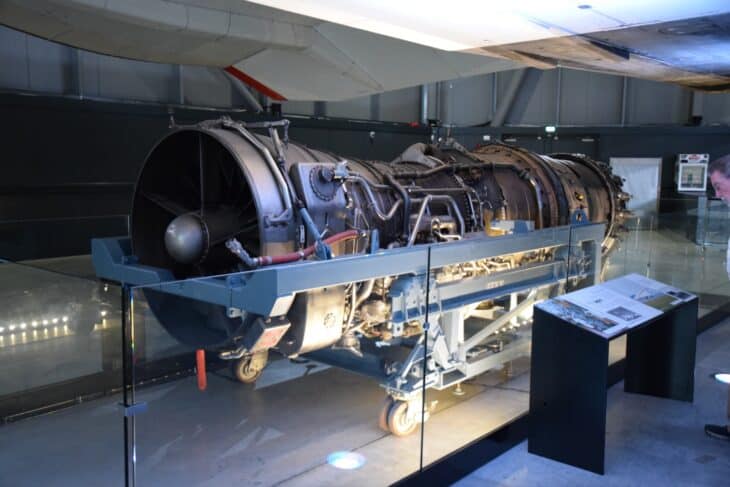

Concorde lit the reheat for takeoff and to push through the transonic range from Mach 0.95 to Mach 1.7, then cruised at Mach 2 without it. The Olympus was the only reheated turbojet to power a commercial aircraft, and it left service with Concorde in October 2003.
Why it faded: the FAA says pure turbojets are noisy and thirsty at the Mach 0.8 speeds airliners fly, so their use today is very limited.
4. Turbofan Engine
A turbofan is a turbojet core with a large fan bolted to the front. The fan pushes most of its air around the outside of the core, through a duct, instead of through it.
That bypass air is the whole trick. According to the FAA, the fan produces about 80 percent of a turbofan’s thrust, and the engine is quieter and more fuel-efficient than a turbojet at airliner speeds.
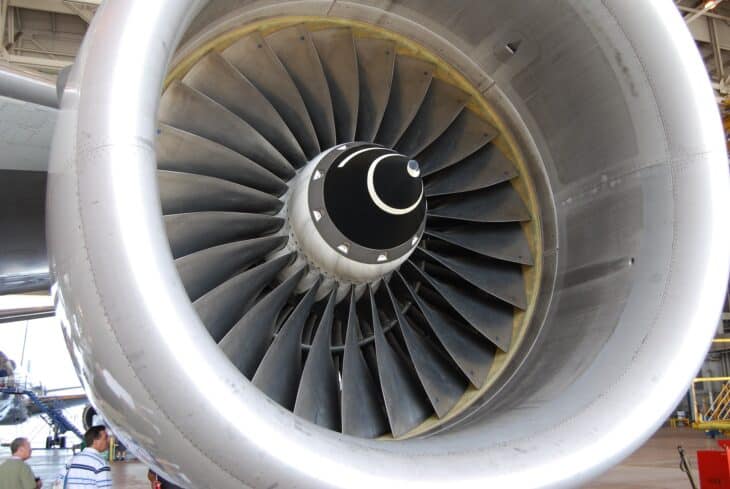
The key number is the bypass ratio: fan airflow that goes around the core divided by the airflow through it. The FAA’s example is 100 pounds per second through the fan and 20 through the core, a 5:1 ratio.
Most turbofans have two or more shafts, or spools. A low-pressure spool drives the fan, and a high-pressure spool forms the core.
High-bypass: the airliner engine
Airliners use high-bypass turbofans with huge fans. The GE Aerospace GE9X on the Boeing 777-9 has a 134-inch (3.4 m) fan and a bypass ratio of about 10:1.
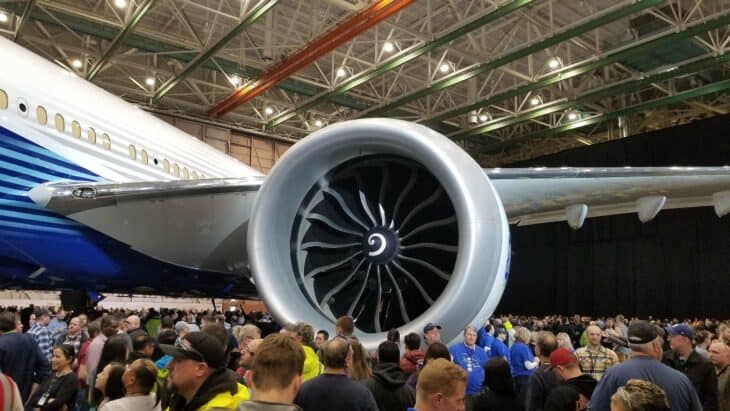
It also holds the Guinness World Record for the highest thrust of any commercial jet engine, at 134,300 pounds (597 kN). The largest commercial aircraft engines are all high-bypass turbofans.
Low-bypass: the fighter engine
Fighters need a slim engine that works above Mach 1, so they use low-bypass turbofans with afterburners. The Pratt & Whitney F135 in the F-35 Lightning II has a bypass ratio of just 0.57:1.
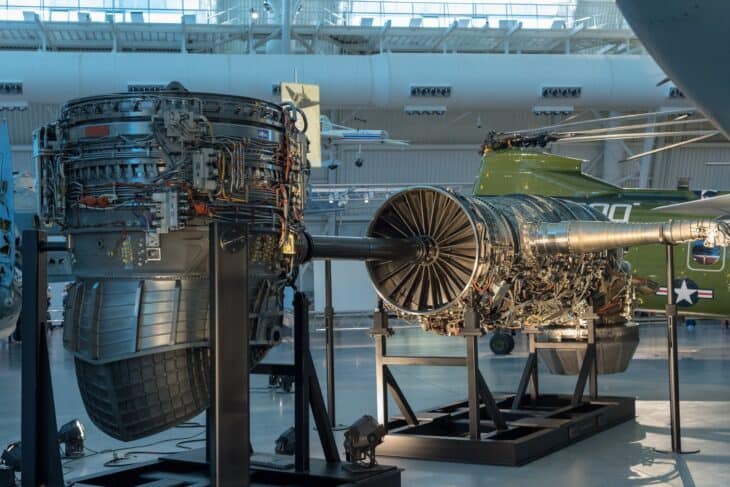

The F135 makes about 28,000 pounds of thrust (125 kN) dry and 43,000 pounds (191 kN) with the afterburner lit.
A jet airliner is mostly pushed by a fan
On a modern airliner, most of the thrust does not come from the hot jet at the back. The FAA puts the fan’s share at about 80 percent, which makes a high-bypass turbofan closer to a ducted propeller than to the roaring turbojets of the 1950s.
Best at: airliners between 350 mph and Mach 0.9, plus supersonic fighters in low-bypass form.
5. Turboshaft Engine
A turboshaft is a gas turbine built to deliver its power through a spinning shaft rather than through jet thrust. On aircraft, that shaft turns a helicopter’s transmission, or the engine serves as an onboard auxiliary power unit (APU).
Because the output is a turning shaft, it is rated in horsepower, not pounds of thrust. Most current turboshafts use a free power turbine that spins independently of the gas generator.

The turboshaft and the turboprop are close cousins. Pratt & Whitney Canada builds turboshaft versions of the PT6, and GE’s T700 turboshaft shares its family with the CT7 turboprop.
The T700 family covers 1,500 to 3,000 shaft horsepower, and more than 20,000 have been built since production began in 1978. It powers the UH-60 Black Hawk and AH-64 Apache, and the Navy’s MH-60R Seahawk uses two T700-GE-401C engines rated at 1,890 shp each for takeoff.
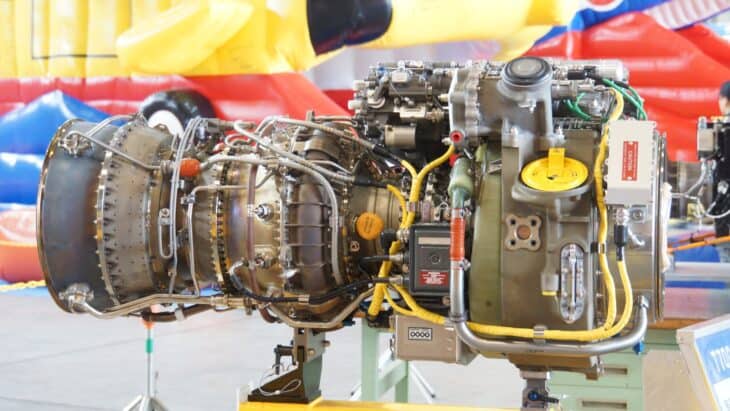

Civil helicopters use smaller ones. The Bell 206B JetRanger flies on a single 400-horsepower Allison 250-C20 turboshaft.
Airliners carry a turboshaft too. The APU supplies electrical power and bleed air on the ground and acts as a backup generator in flight. Our guide to how jet engines start explains where that air goes.
Best at: helicopters. See our breakdown of helicopter engine types for the rotorcraft side.
6. Ramjet Engine
A ramjet is a jet engine with no compressor and no turbine. The aircraft’s own forward speed rams air into the inlet and compresses it, then fuel burns in that air and exits through a nozzle.

The catch is that it produces no thrust standing still. Below about Mach 0.5 it gives little thrust at all, so a ramjet needs a booster rocket or a carrier aircraft to get up to speed.
Once there, it works best at around Mach 3 (2,300 mph, 3,700 km/h) and can run up to about Mach 6.
Ramjet examples include missiles such as Britain’s Bloodhound surface-to-air missile and the Meteor air-to-air missile, which uses a ducted-rocket design. The French Leduc 0.10 was one of the first ramjet-powered aircraft to fly, in 1949.
The SR-71 flew partly on ramjet power
The SR-71 Blackbird’s Pratt and Whitney J58 was an afterburning turbojet. At Mach 3.2, its engine pressure ratio fell to about 0.9, and the afterburner effectively ran as a ramburner.
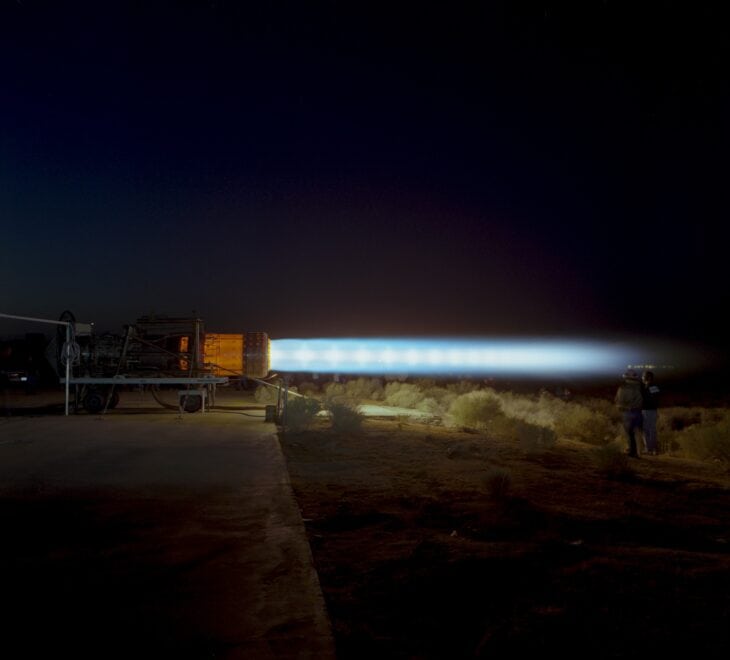

The SR-71 Blackbird still ranks among the fastest aircraft in the world.
7. Scramjet Engine
A scramjet, short for supersonic combustion ramjet, is a ramjet that keeps the air moving faster than sound all the way through the combustor. An ordinary ramjet slows the air to subsonic speed before burning fuel in it.
It only starts working at around Mach 4 to 5, so something else has to get it there first.
NASA’s X-43A proved the idea. A B-52 dropped it on a modified Pegasus booster rocket, and in November 2004 its scramjet ran for 10 to 12 seconds and reached Mach 9.68, about 6,755 mph (10,870 km/h).
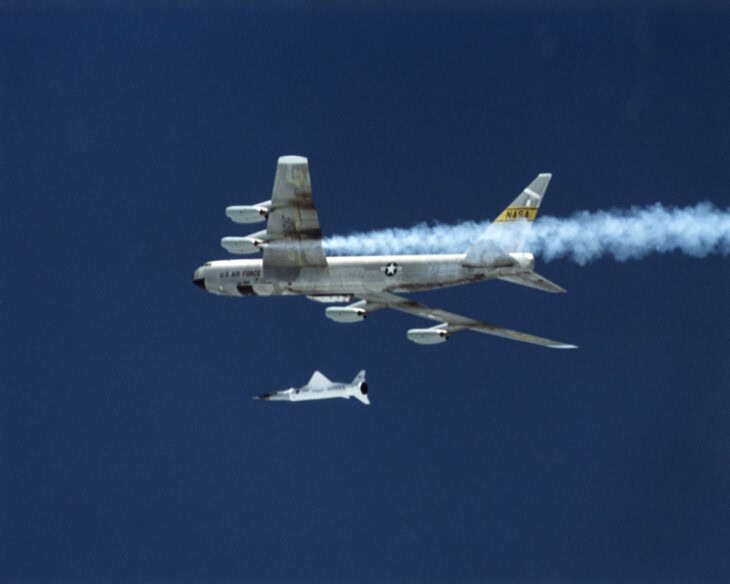
Guinness World Records recognizes it as the fastest air-breathing jet, at roughly Mach 9.6. The Air Force’s X-51A Waverider later reached Mach 5.1 under scramjet power in May 2013.
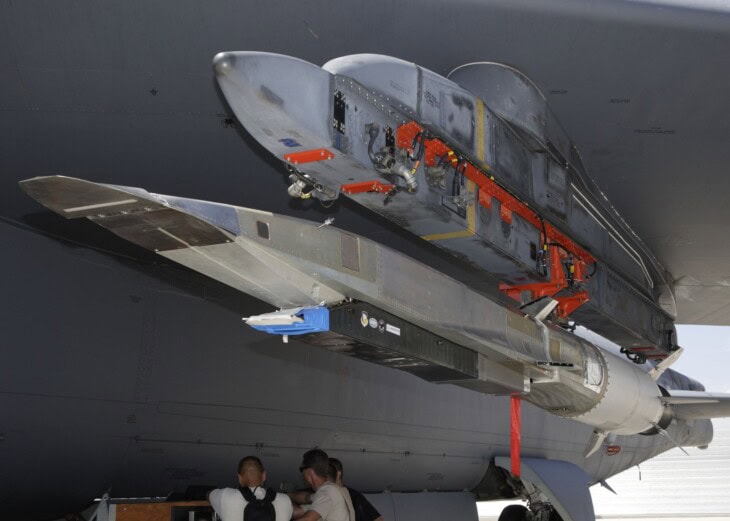
Both were uncrewed test vehicles, and the scramjet remains an experimental engine.
8. Electric Motor
An electric aircraft replaces the fuel-burning engine with a battery-powered motor that turns a propeller. It burns no fuel at all. The tradeoff, so far, is endurance.
The first type-certified electric aircraft is the Pipistrel Velis Electro, certified by the European Union Aviation Safety Agency (EASA) on June 10, 2020. Its E-811 motor delivers 77 horsepower (57.6 kW) for takeoff.
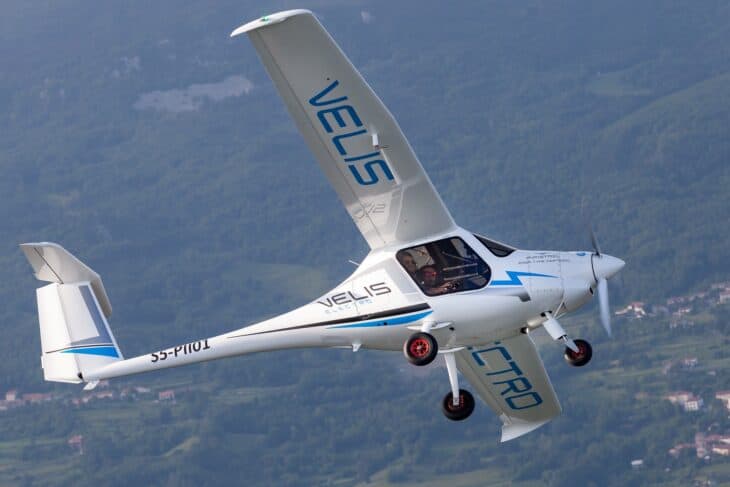

It can fly for up to 50 minutes plus a 10-minute reserve. The Velis was designed for exactly that job, repeated takeoffs and landings in pilot training.
In the United States, a May 2026 GAO report said the FAA had not yet issued a type certificate for a crewed electric aircraft as of March 2026. The agency was still evaluating electric designs for certification case by case.
The Rare Ones: Rockets and Pulsejets
Two more engine types have flown aircraft, but neither is in everyday use.
Rocket engines carry their own oxidizer, so they need no air at all. The North American X-15’s XLR99 rocket engine produced 57,000 pounds of thrust, and on October 3, 1967, it carried pilot William J. Knight to Mach 6.70 (4,520 mph).
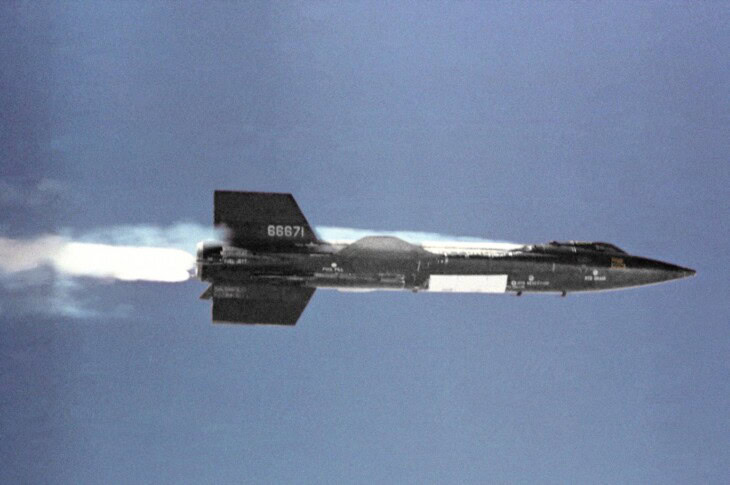
That remains the official record for the highest speed by a crewed, powered aircraft.
Pulsejets burn fuel in rapid bursts instead of continuously. The Argus As 014 on Germany’s V-1 flying bomb fired about 43 times per second and was the first pulsejet in mass production.
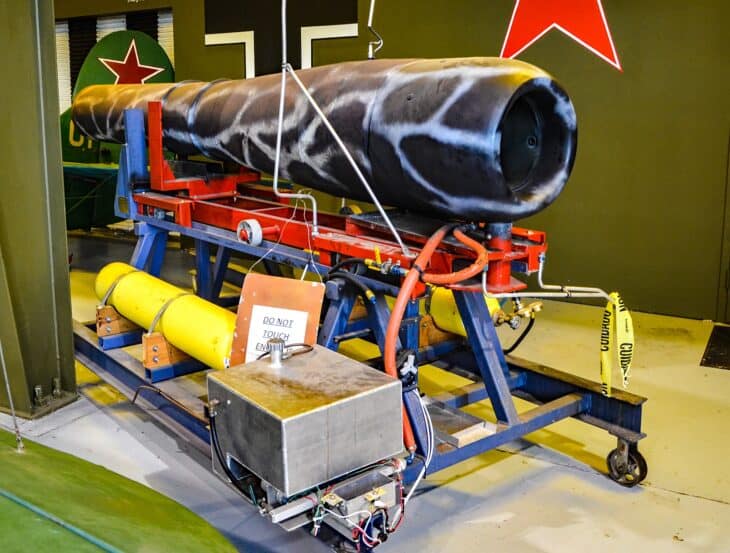

Noise, vibration and poor fuel economy keep pulsejets to drones, models and experiments today.
Which Type of Aircraft Engine Is Best?
None of them is best overall. Each wins in its own speed band, which is why the aircraft you see at an airport sort so neatly by engine.
For slow, cheap flying, the piston engine wins on cost and economy. From about 180 to 350 mph, the turboprop takes over, offering more power per pound than a piston engine.
From about 350 mph to Mach 0.9, the high-bypass turbofan wins, which is why it powers almost every airliner. The difference between the two jet types is covered in detail in turbojet vs turbofan.
Above Mach 1, the choice narrows to afterburning low-bypass turbofans and turbojets, and ramjets and scramjets only begin to make sense well beyond that.
Helicopters are the exception to the speed rule, because they need shaft power for a rotor, so turbine helicopters use turboshafts. The engines themselves come from a small group of companies, covered in our list of the largest aircraft engine manufacturers.
FAQ
Sources and references used for research and fact-checking.
- Federal Aviation Administration, Aviation Maintenance Technician Handbook, Powerplant, Chapter 1: Aircraft Engines
- Smithsonian National Air and Space Museum, 1903 Wright Flyer
- Wikipedia, Aircraft engine
- Wikipedia, Cessna 172
- Wikipedia, Pratt & Whitney R-2800 Double Wasp
- Wikipedia, Rotary engine
- Wikipedia, Turboprop
- Wikipedia, Pratt & Whitney Canada PT6
- Wikipedia, Heinkel He 178
- Wikipedia, Messerschmitt Me 262
- Wikipedia, Rolls-Royce/Snecma Olympus 593
- GE Aerospace, GE9X
- Wikipedia, Pratt & Whitney F135
- Wikipedia, General Electric T700
- Wikipedia, Sikorsky SH-60 Seahawk
- Wikipedia, Bell 206
- Wikipedia, Ramjet
- Wikipedia, Scramjet
- Wikipedia, NASA X-43
- Wikipedia, Pipistrel Velis Electro
- U.S. Government Accountability Office, Electric Aircraft: FAA Is Evaluating Designs for Certification and Considering Long-Term Regulatory Approaches (GAO-26-107816)
- Wikipedia, North American X-15
- Wikipedia, Pulsejet
Get the Newsletter
The latest aviation news and stories sent to your inbox.
About the Author

Tim is the owner and lead editor of AeroCorner since 2019, overseeing aviation content covering aircraft, airlines, airports, and the broader aviation industry. Through years of researching, writing, editing, and publishing aviation-focused content, he has developed extensive practical knowledge of commercial aviation and air travel. Based in Asia and a frequent traveler himself, Tim also brings firsthand passenger experience to AeroCorner’s coverage. Outside of publishing, he has also explored aviation firsthand through hands-on flight training in New Zealand.