Fighter Jets
Messerschmitt Me 163 Komet
ICAO: ME163
The world's first operational jet fighter
Updated: by Tim de Vries

The latest aviation news and stories sent to your inbox.
The Messerschmitt Me 262 Schwalbe was the world’s first operational jet fighter. It first flew on jet power on 18 July 1942, entered service in 1944, and at about 540 mph was 120 mph faster than the P-51 Mustang. More than 1,400 were built, but fewer than 300 saw combat. Nine originals survive and none flies; the Me 262s at air shows today are modern reproductions.
Live Fleet Activity (ME62)
Fetching live data…

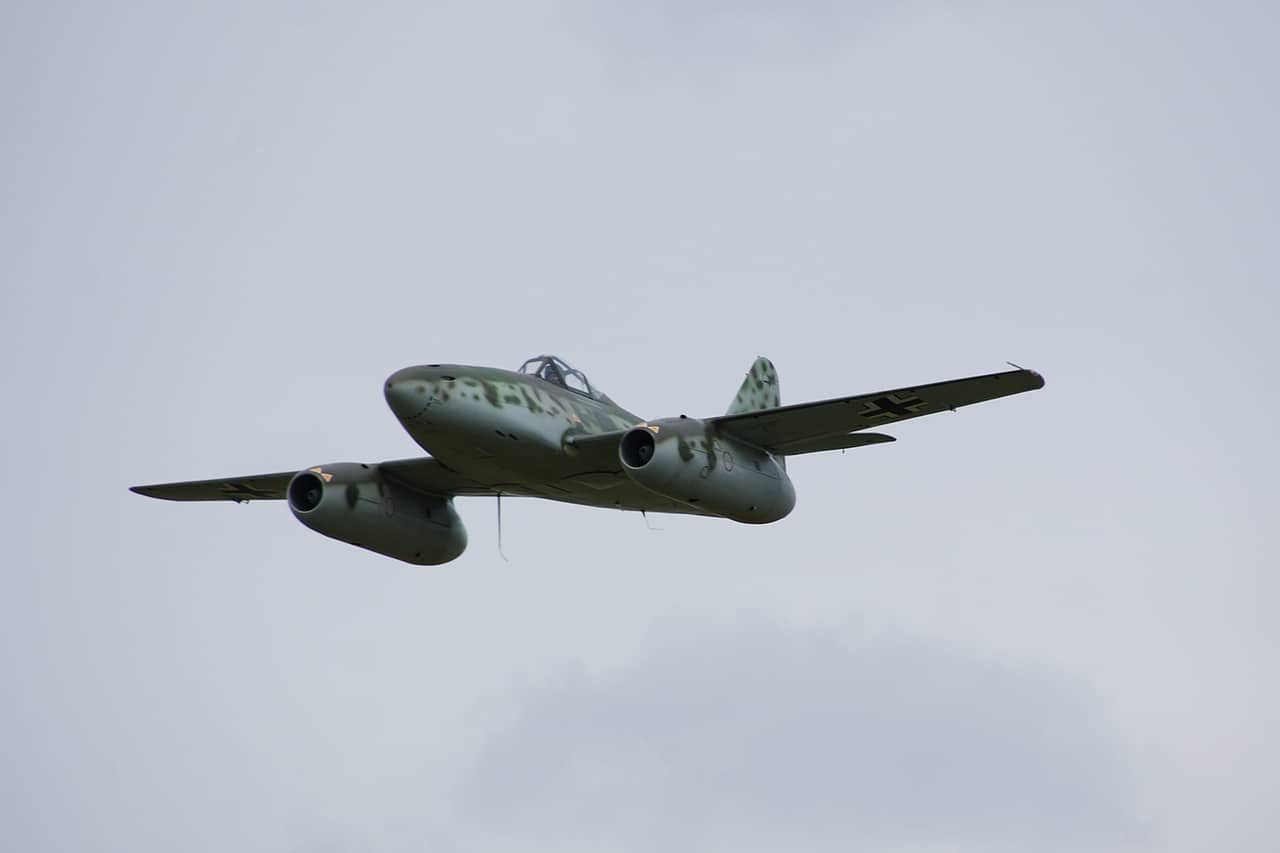
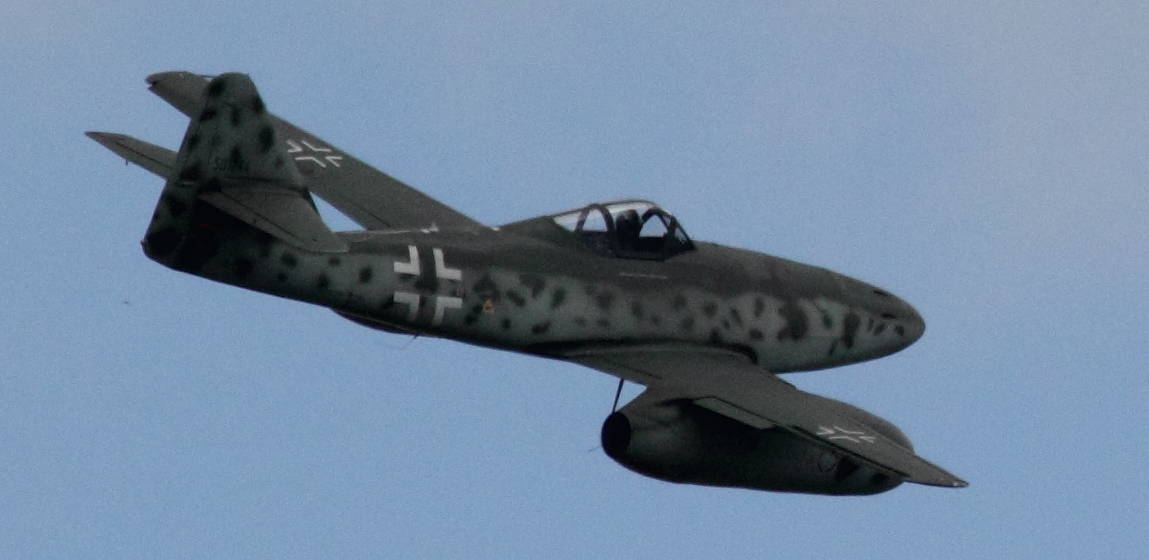
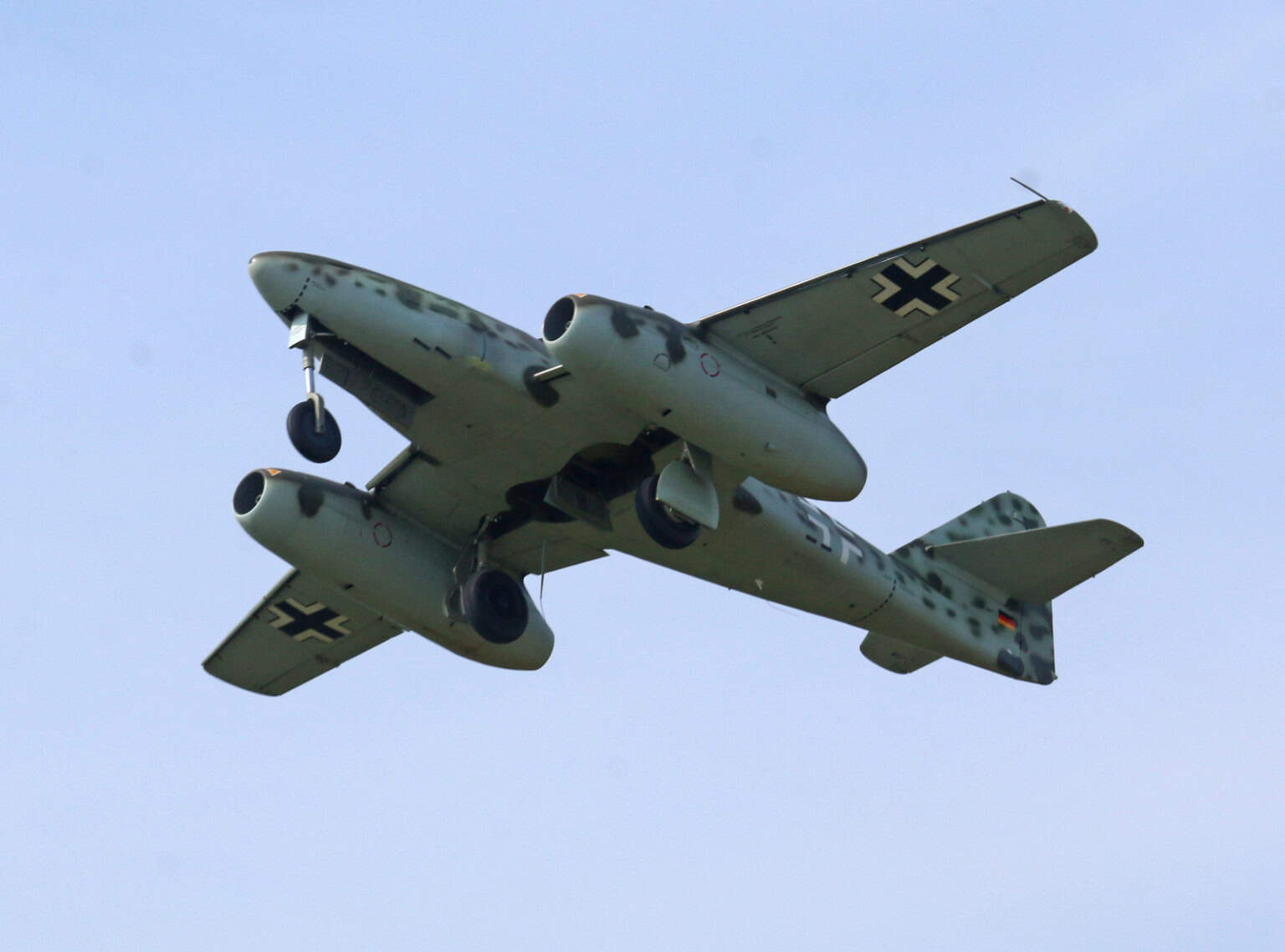
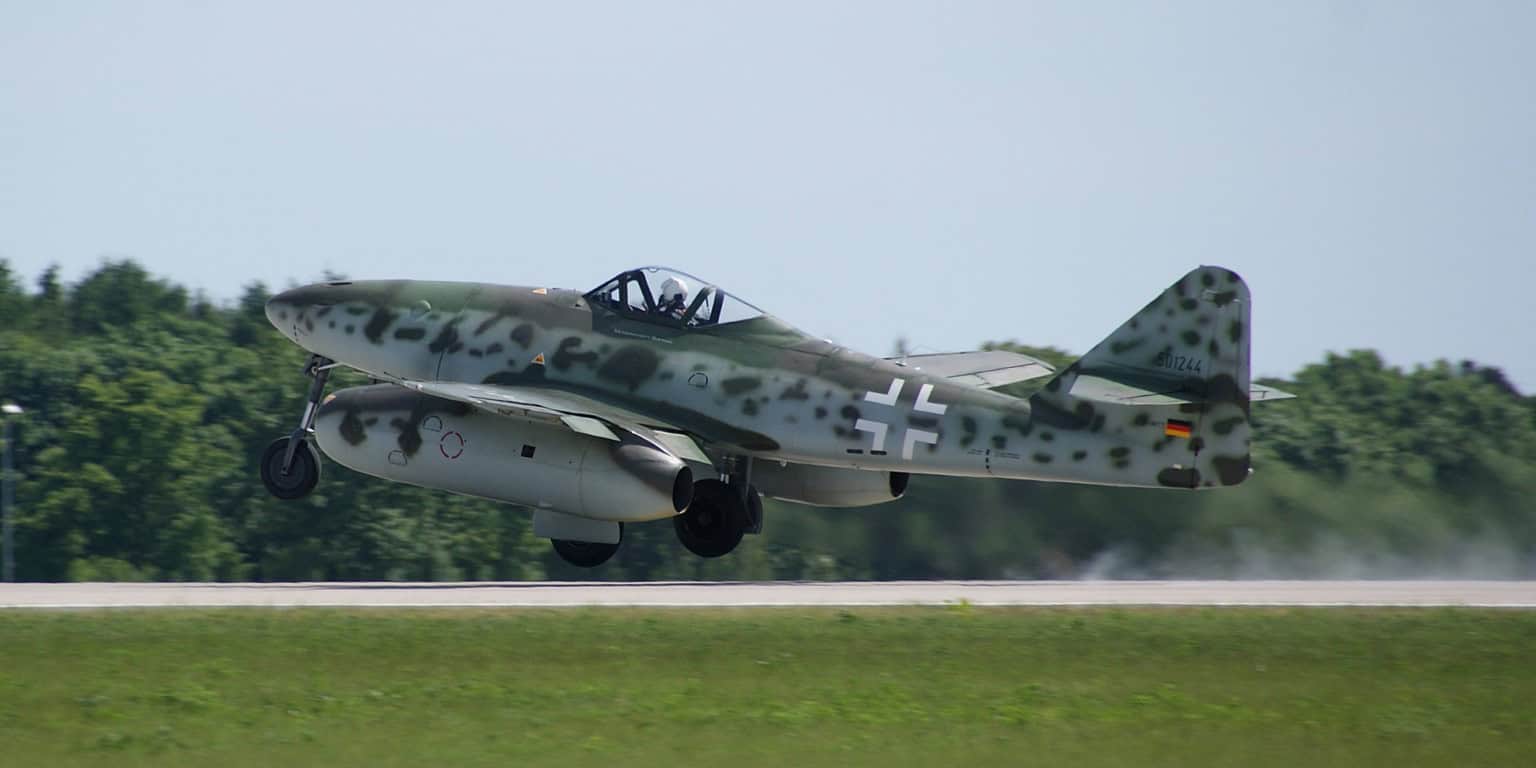


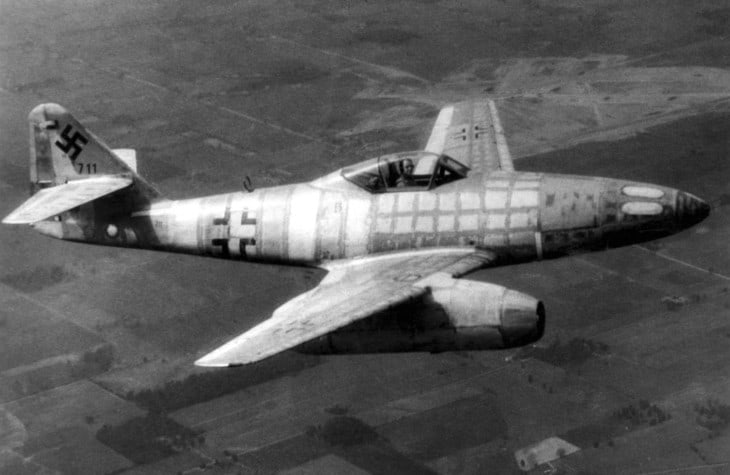
The Me 262 was conceived in 1938 by a Messerschmitt team led by Waldemar Voigt, and its first plans were drawn up in April 1939 as Projekt 1065. That was months before World War II began.
The original design had straight wings with the engines buried in the wing roots. When the BMW 003 jets turned out heavier than promised, Messerschmitt moved them into underwing pods and, on 1 March 1940, swept the outer wing back 18.5 degrees to keep the center of gravity in the right place.
That sweep was a balance fix, not a speed trick. A 35 degree sweep proposed by aerodynamicist Adolf Busemann was not adopted, although the shallow angle may have raised the wing’s critical Mach number slightly.
The jet engines were not ready, so the first prototype, the Me 262 V1, made its first flight on 18 April 1941 with a Junkers Jumo 210 piston engine and propeller in its nose.
When BMW 003 jets were added, the piston engine stayed on for safety, which proved wise. Both jets failed on the first flight, and the pilot landed on the propeller alone.
The first flight on jet power alone came on 18 July 1942, when test pilot Fritz Wendel flew the V3 prototype from Leipheim on two Junkers Jumo 004s. That was almost nine months before Britain’s Gloster Meteor first flew, on 5 March 1943.
The first four prototypes had a tailwheel, and on takeoff the jet exhaust and wing turbulence left the elevators with no effect. Wendel got airborne by tapping the brakes to lift the tail, and from the fifth prototype on the Me 262 used tricycle landing gear.
The airframe changes were finished in 1942, but serial production did not begin until 1944. The holdup was the Jumo 004, an axial-flow turbojet, and early engines were so short-lived that they often had to be replaced after a single flight.
The problem was metal. Germany was short of the nickel, cobalt and molybdenum that heat-resistant alloys need, so the production Jumo 004B used mild steel protected only by an aluminum coating in its hottest parts.
That engine needed an overhaul after 25 hours for a turbine inspection. If it passed, it could run another 10 hours, and 35 hours was the absolute limit for the turbine wheel.
Frank Whittle, the British jet pioneer, put it plainly: “it was in the quality of high temperature materials that the difference between German and British engines was most marked.”
Politics added to the delay. Hermann Göring cut the jet engine program to 35 engineers in February 1940, and in mid-1943 Adolf Hitler demanded that the Me 262 be developed as a fast bomber rather than a defensive interceptor.
How much that order mattered is disputed. The Smithsonian’s National Air and Space Museum says engine development, not Hitler, was the real cause of the delay, and that his order diverted about 30 percent of production airframes to the Me 262 A-2a Sturmvogel bomber.
Deliveries started slowly in 1944: 28 aircraft in June, 59 in July, and only 20 in August.
A test unit, Erprobungskommando 262, formed at Lechfeld near Augsburg on 19 April 1944 to bring the jet into service and train its pilots. Its commander, Werner Thierfelder, was killed on 18 July 1944 when his Me 262 caught fire.
The first jet air combat came in late July 1944, when an Me 262 attacked an unarmed RAF Mosquito reconnaissance aircraft over Munich. The Mosquito escaped; the National Museum of the U.S. Air Force dates the encounter to 25 July, while other accounts give 26 July.
On 8 August 1944, Leutnant Joachim Weber claimed the first kill by an Me 262, another reconnaissance Mosquito over Munich. Both of its crew were killed.
Walter Nowotny took over the unit on 25 September 1944, and Kommando Nowotny began jet fighter operations on 3 October. On 8 November, Nowotny claimed two P-51D Mustangs before an engine failed at high altitude; other Mustangs attacked him as he dove to restart it, and he died after bailing out.
It was a costly start. By 16 November 1944, 28 of the unit’s 30 jets had been damaged or destroyed, against 24 claimed kills.
By January 1945 the Luftwaffe had formed Jagdgeschwader 7 (JG 7) as a pure jet fighter wing. In February, Adolf Galland, recently dismissed as Inspector of Fighters, formed Jagdverband 44, a squadron-sized unit that drew in many of the Luftwaffe’s most decorated pilots.
On 18 March 1945, 37 Me 262s of JG 7 intercepted a raid of 1,221 bombers and 632 escorting fighters. They shot down 12 bombers and one fighter for the loss of three jets.
A 4:1 exchange was what the Luftwaffe needed. But the losses came to about 1 percent of the attacking force.
The standard armament was four 30 mm MK 108 cannon in the nose. The shells hit hard, but the short-barreled guns were inaccurate beyond about 650 yards (600 m), and at jet speed the pilot had to break away at about 220 yards (200 m) to avoid a collision.
British test pilot Eric Brown, who flew a captured Me 262, spelled out the result. “You only had two seconds firing time,” he said. “Now, in two seconds, you can’t sight.”
The answer was the R4M rocket. An Me 262 could carry 24 of them under its wings and fire a salvo from the side of a bomber formation, still out of range of the bombers’ guns.
One or two hits from their 1.1 lb (520 g) warheads could bring down even a B-17 Flying Fortress. Only small numbers of jets carried them, most of them JG 7’s Me 262 A-1a fighters.
A few two-seat Me 262 B-1a trainers were converted into night fighters with Neptun radar. Flying with 10./NJG 11 near Berlin, alongside several single-seaters, they accounted for most of the 13 Mosquitoes lost over Berlin in the first three months of 1945.
German pilots claimed 542 Allied aircraft shot down by Me 262s, according to the historian William Green. Estimates vary widely: other sources put the number actually destroyed at 300 to 450, while Morgan and Weal credit German jet fighters of all types with 745 victories.
The top Me 262 ace was probably Franz Schall, with 17 kills, including six four-engine bombers and ten P-51 Mustangs. Kurt Welter claimed more, 25 Mosquitoes and two four-engine bombers at night plus two Mosquitoes by day. Most of his night kills were made by eye rather than radar.
Heinrich Bär is credited with 16 victories in the Me 262, out of 240 in his whole career. Georg-Peter Eder scored 12, nine of them P-51s.
The Smithsonian’s Me 262 carries the tally of Oberfeldwebel Heinz Arnold: 42 victories over Soviet aircraft, scored in piston-engine fighters, and seven over American bombers and fighters, perhaps not all of them his.
The last Luftwaffe air victory of the war may have been an Me 262’s. On 8 May 1945, Oberleutnant Fritz Stehle of JG 7 claimed a Yak-9 over the Ore Mountains, although the aircraft he hit was probably a P-39 Airacobra.
Yes, and usually when it was slow. On 5 October 1944, a Supermarine Spitfire Mk IX of No. 401 Squadron, Royal Canadian Air Force, shot down Hans-Christoph Buttmann’s Me 262 near Overasselt, which Wikipedia records as the first aerial victory over a jet aircraft.
The weak point was the engines. The Jumo 004s gave little thrust at low airspeed and answered the throttle slowly, and moving the throttles too quickly could stall the compressor or flame out an engine, so an Me 262 taking off or landing could not accelerate out of trouble.
Allied pilots learned that the only reliable way to destroy the jets, as with the even faster Me 163 Komet rocket fighter, was on the ground or during takeoff and landing. Chuck Yeager of the 357th Fighter Group caught one on its landing approach, and on 7 October 1944 Urban Drew shot down two as they took off.
On 25 February 1945, Mustangs of the 55th Fighter Group surprised a whole Staffel of Me 262s at takeoff and destroyed six. The Luftwaffe answered with anti-aircraft “flak alleys” along the approaches and top cover from its most advanced piston fighters, the Focke-Wulf Fw 190D and Ta 152H.
RAF Hawker Tempest pilots flew a “Rat Scramble,” racing to the jet base at Rheine-Hopsten to catch Me 262s coming in to land. The Germans ringed it with more than 150 emplacements of quadruple 20 mm flak guns, and after seven Tempests were lost to flak in a week, the Rat Scramble was dropped.
In all, the Allies shot down about 100 Me 262s in the air. The National Museum of the U.S. Air Force says American bombers destroyed hundreds more on the ground.
On paper the jet won easily. The National Air and Space Museum puts the Me 262 at about 540 mph (869 km/h), 120 mph (193 km/h) faster than the North American P-51 Mustang at the same altitude, and says that although less maneuverable, it could join or leave a fight at will.
Brown said the same. With that speed, “you could conduct combat totally on your own terms. If you didn’t want to engage, you could go off and leave everyone standing.”
It also turned better than its high wing loading suggests. Full-span automatic leading-edge slats, a Messerschmitt feature dating back to the Bf 109, added as much as 35 percent more lift in tight turns and at low speed.
The Mustangs still had answers. They patrolled over the jet airfields and caught Me 262s at takeoff and landing, and in the air the Americans relied on numbers: the historian Mike Spick reckoned it could take eight Mustangs to neutralize one Me 262.
Skilled jet pilots did well against them, as Schall’s ten P-51s and Eder’s nine show. For a side-by-side look at the two aircraft, see our P-51 Mustang vs Me 262 comparison.
Totals differ by source. The English-language Wikipedia gives 1,430, the German-language Wikipedia 1,433, and the National Air and Space Museum 1,443.
Few reached combat. The National Museum of the U.S. Air Force says fewer than 300 of the more than 1,400 built saw combat, and at any one time fewer than 100 were ready to fight.
The rest were lost to bombing and training accidents, or grounded by shortages of fuel, spare parts and trained pilots. Between late February and late March 1945, about 60 Me 262s were destroyed in attacks on Obertraubling and 30 at Leipheim.
An Me 262 airframe, without engines, armament and electronics, cost 87,400 Reichsmarks. Each one took about 6,400 man-hours to build.
To escape the bombing, production moved into forest clearings and tunnels. In the B8 Bergkristall tunnels beneath St. Georgen an der Gusen in Austria, prisoners of the Gusen II concentration camp built complete Me 262 fuselages.
An estimated 35,000 to 50,000 people died on the forced labor details for the Me 262.
The Me 262 A-1a Schwalbe (Swallow) was the main production version, used as both an interceptor and a fighter-bomber. It followed 23 pre-production A-0s.
The A-2a Sturmvogel (Stormbird) was the dedicated bomber, keeping only the two lower cannon. The A-1a/U3 carried cameras in the nose for reconnaissance, and the A-1a/U4 tested a 50 mm anti-tank gun as a bomber destroyer.
The two-seat B-1a was a trainer, and the B-1a/U1 conversion became a stopgap night fighter with FuG 218 Neptun radar and “stag’s antlers” antennas. Trainers were so scarce that many pilots made their first jet flight alone, in a single-seater.
More radical versions were tested too. The Me 262 C-1a added a Walter rocket motor in the tail and first flew on combined jet and rocket power on 27 February 1945, while the HG high-speed series explored a low racing canopy and wings swept to 35 and 45 degrees.
After the war, Czechoslovakia built its own: nine single-seat Avia S-92s and three two-seat CS-92s, completed from August 1946 and powered by locally built Jumo 004 copies. They were the Czechoslovak Air Force’s first jet fighters and flew until 1951.
For the other jets and rocket planes Germany built during the war, see our guide to German jet aircraft of WWII.
The Allies raced to collect Me 262s. A U.S. Army Air Forces team led by Colonel Harold Watson, running Operation Lusty, seized jets at Lechfeld, including the one the Smithsonian owns today, and shipped them to the United States aboard the British carrier HMS Reaper.
The test results were flattering. In postwar testing the Me 262 was faster than the Gloster Meteor, had better visibility, and was the better gun platform, although it had a shorter range and less reliable engines.
Brown, who flew 487 types of aircraft, called it “the most formidable aircraft of WW2.” The USAAF found it superior to its own Lockheed P-80 Shooting Star in acceleration and speed, with similar climb performance.
The Smithsonian notes that the Me 262 introduced features found on many later aircraft: the swept wing, wing slots, underslung engine nacelles, and heavy cannon armament in the nose.
Captured jets were studied by all the major powers. The North American F-86 Sabre used a slat design based on the Me 262’s, and the type also influenced the MiG-15 and the Boeing B-47 Stratojet.
There is no evidence that it did. After Willy Messerschmitt’s death in 1978, former Me 262 pilot Hans Guido Mutke claimed he had passed Mach 1 in a vertical dive on 9 April 1945, but the claim rests only on his memory, and airspeed readings run falsely high at those speeds.
Messerschmitt’s dive tests found the Me 262 went out of control at Mach 0.86, and postwar tests at Britain’s Royal Aircraft Establishment reached Mach 0.84 and confirmed the result.
Mutke’s aircraft, White 3, is now in the Deutsches Museum in Munich. He landed it in Switzerland, out of fuel, on 25 April 1945.
As of September 2026, no original Me 262 is known to be flying. Nine German-built originals survive, and the only one restored to airworthy condition, W.Nr. 500453 at the Flying Heritage & Combat Armor Museum in Everett, Washington, ran its rebuilt Jumo 004 engines for the first time on 25 September 2019.
It had still not flown when Vintage Aviation News profiled it in March 2026, and the magazine said it was unclear when or if it ever would.
The Me 262s seen at air shows are reproductions built by the Me 262 Project at Paine Field in Everett. They use General Electric CJ610 turbojets, the engine of classic Learjets, hidden inside replica Jumo 004 nacelles, and their serial numbers pick up where wartime production stopped.
Three were completed to fly and one for static display, at the Evergreen Aviation & Space Museum in Oregon. The Collings Foundation’s two-seat W.Nr. 501241 (N262AZ) was the first to fly, on 20 December 2002, and FighterJets Inc said it would show the jet at select air shows from the 2026 season.
The Military Aviation Museum’s W.Nr. 501243 (N262MF), painted as Mutke’s White 3, first flew in 2011. After more than a decade on the ground it flew again on 28 March 2025, and it performed at EAA AirVenture Oshkosh that July.
In Germany, the Messerschmitt Foundation flies W.Nr. 501244 (D-IMTT) from Manching, and it was booked for Belgium’s Sanicole Airshow on 12 and 13 September 2026. Airworthy warbirds go in and out of maintenance, so this is the picture as of September 2026.
Originals are on display at the National Museum of the U.S. Air Force in Dayton, the RAF Museum Cosford, the Deutsches Museum and the Australian War Memorial in Canberra, whose aircraft Wikipedia describes as the only Me 262 left in its original colors. The Smithsonian’s JG 7 fighter is not on display at the museum.
The two postwar Czechoslovak copies, an Avia S-92 and a CS-92, are at the Prague Aviation Museum in Kbely.
The full specification table for the Me 262 is on this page, and it describes the Me 262 A-1a. A few of its figures need context.
The maximum speed row, 469 knots (540 mph), is the figure both the National Air and Space Museum and the National Museum of the U.S. Air Force publish. U.S. tests at Farnborough in October 1945 reached it at 20,000 feet with the engines at maximum rpm.
Other figures bracket it. The Pilot’s Handbook lists 515 mph (830 km/h) in level flight, and Wikipedia’s specification, based on original Messerschmitt data, gives 559 mph (900 km/h); see how that compares among the fastest planes of WWII.
The cruise speed row, 405 knots (466 mph), is the handbook’s 750 km/h. The National Museum of the U.S. Air Force gives 460 mph.
The 567 nautical miles (650 miles) in the range row is Wikipedia’s 1,050 km, the same 650 miles the Air Force museum lists. In practice endurance was the limit: the handbook gives 45 to 50 minutes of flight at low altitude and 60 to 90 minutes above 12,000 feet.
The fuel row, 660 US gallons (2,500 L), is the handbook’s four tanks added together: 240 and 204 gallon main tanks in front of and behind the pilot, plus 53 and 158 gallon auxiliaries. The engines burned fuel at about double the rate of a typical twin-engine fighter of the era, usually J2, a synthetic fuel made from brown coal.
The 1,980 lbf thrust is per Jumo 004B-1 engine, and the handbook limited full takeoff power, at 8,700 rpm, to five minutes. The 15,700 lb (7,150 kg) maximum takeoff weight compares with a normal takeoff weight of 14,272 lb (6,474 kg) in the handbook.
The approach speed row is the handbook’s 155 mph (250 km/h), or 135 knots. The payload row, 1,100 lb (500 kg), is two 250 kg bombs.
Yes. The Allies shot down about 100 Me 262s in the air, the first on 5 October 1944 by a Royal Canadian Air Force Spitfire. Allied pilots caught many while they were taking off or landing, and American bombers destroyed hundreds more on the ground.
No original is known to be flying as of September 2026. The only original restored to airworthy condition, at the Flying Heritage & Combat Armor Museum, had not flown as of March 2026. The Me 262s at today’s air shows are modern reproductions with GE CJ610 engines, based in Texas, Virginia and Germany.
German pilots claimed 542 Allied aircraft, according to the historian William Green, while other estimates put the number actually destroyed at 300 to 450. The top Me 262 ace was probably Franz Schall, with 17.
In performance, yes: it was about 120 mph faster at the same altitude and could choose when to fight. But its engines were fragile and slow to respond, few Me 262s were ever combat-ready at once, and Mustangs destroyed many of them at takeoff and landing.
About 540 mph (469 knots), according to the Smithsonian and the National Museum of the U.S. Air Force. Its pilot’s handbook lists 515 mph in level flight and a cruise speed of 750 km/h (466 mph).
Sources give between 1,430 and 1,443. Fewer than 300 saw combat, according to the National Museum of the U.S. Air Force.
Nine German-built originals survive, plus two postwar Czechoslovak Avia copies in Prague. None of the originals flies; the flying Me 262s are modern reproductions.
Two Junkers Jumo 004B axial-flow turbojets of 1,980 lbf thrust each. Built from low-grade steel, they needed an overhaul after about 25 hours.
Schwalbe is German for swallow, the name of the fighter versions. The fighter-bomber versions were called Sturmvogel, or storm bird.
There is no evidence that it did. Pilot Hans Guido Mutke claimed a supersonic dive in April 1945, but Messerschmitt’s own tests found the jet went out of control at Mach 0.86.
Sources and references used for research and fact-checking.