Military Propellor Planes
Messerschmitt Bf 110
ICAO: BF110
The Messerschmitt Bf 109 was the Luftwaffe's main fighter of the Second World War and the most produced fighter aircraft in history, flown by the three highest-scoring aces of all time.
Updated: by Tim de Vries

The latest aviation news and stories sent to your inbox.
The Messerschmitt Bf 109 is the German single-seat fighter designed by Willy Messerschmitt and Robert Lusser, first flown on 29 May 1935 and built until 1945. It is the most produced fighter in history, with roughly 34,000 built, and it flew in every Luftwaffe fighter unit and for a dozen other air forces. The panel on this page describes the Bf 109G-6, the most numerous version of the most numerous variant.
Live Fleet Activity (ME09)
Fetching live data…
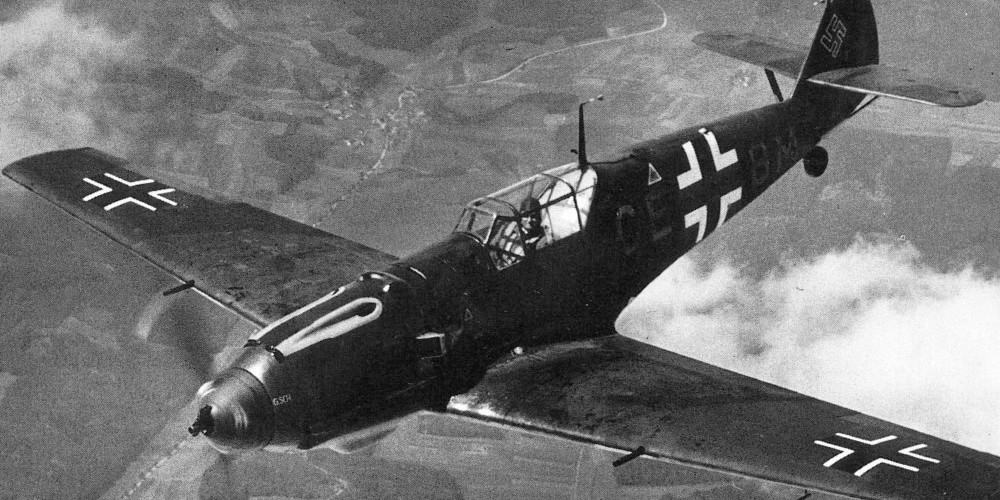

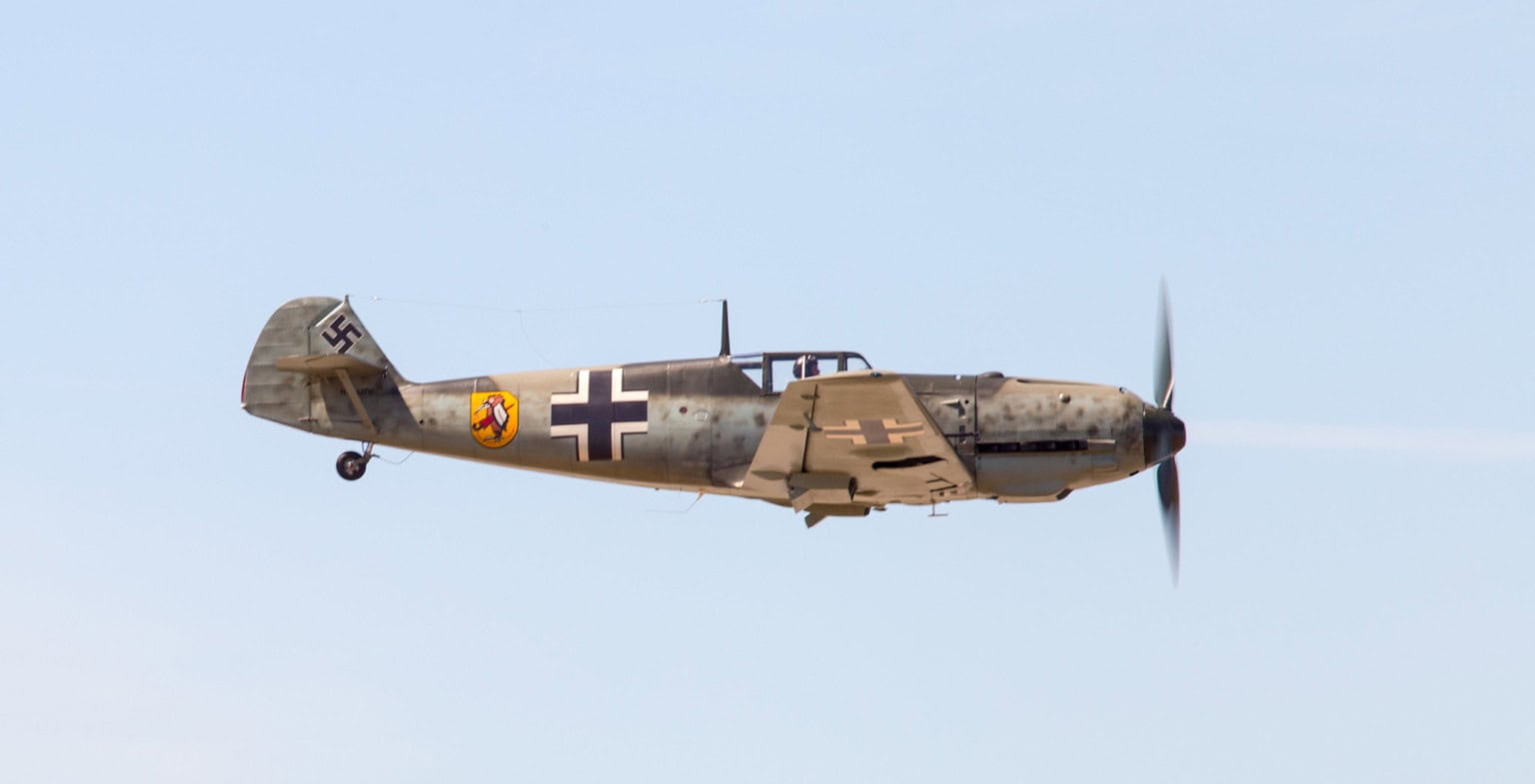
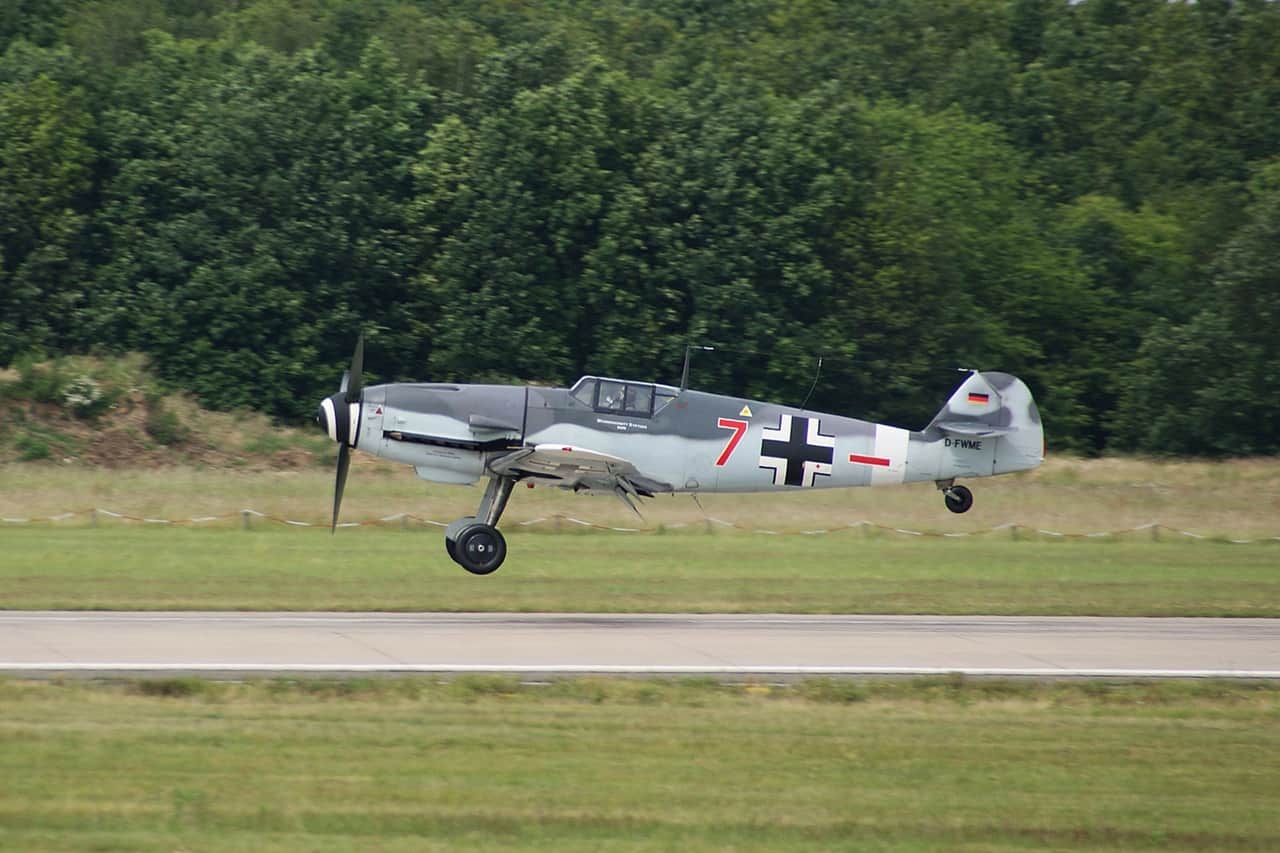


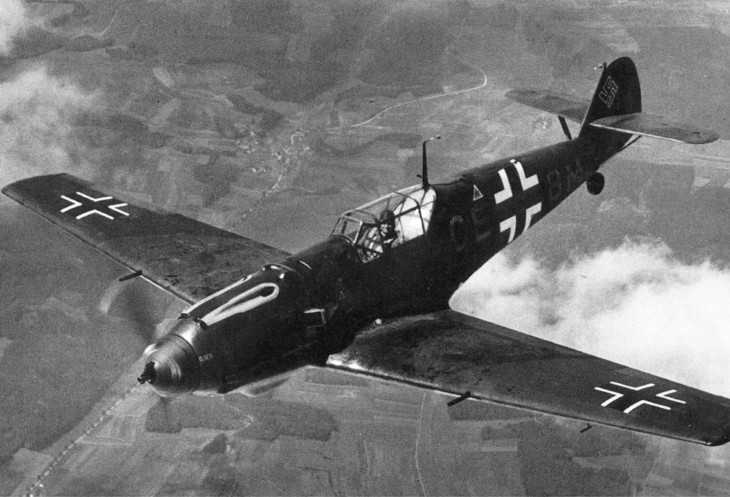
The Messerschmitt Bf 109 is the most produced fighter aircraft in history. Roughly 34,000 were built between 1936 and 1945, and it was still flying with several air forces in the 1950s and 1960s.
It fought in the Spanish Civil War, over Britain, across the Soviet Union and the Mediterranean, and in the defense of Germany. The page’s specification panel describes the Bf 109G-6, the single most numerous sub-variant.
In 1933 the German Air Ministry asked for a short-range, single-seat interceptor to replace the Arado Ar 64 and Heinkel He 51 biplanes. Bayerische Flugzeugwerke (BFW), led by Willy Messerschmitt and designer Robert Lusser, began work on its entry in March 1934.
The prototype first flew at the end of May 1935 with a British Rolls-Royce Kestrel engine, because the German engines were not ready. In the 1936 head-to-head trials it beat the Heinkel He 112, which was heavier and more complicated, and the order for production followed in March 1936.
For its day the Bf 109 was advanced. It had an all-metal stressed-skin structure, a closed cockpit, retractable landing gear and automatic leading-edge slats, and it was powered by a liquid-cooled inverted V-12 engine.
“Bf” stands for Bayerische Flugzeugwerke, the Bavarian Aircraft Works that submitted the design in 1935. The company became Messerschmitt AG in July 1938, so later Messerschmitt designs carry “Me”, such as the Me 210.
The fighter itself kept its Bf designation. Wartime documents mixed the two, and the Allies usually said “Me 109”, but every surviving airframe bears a “Bf 109” data plate.
Crews on both sides also called it the “Messer”, the German word for knife. Variants carried the spelling-alphabet names “Emil” for the E, “Friedrich” for the F, “Gustav” for the G and “Kurfürst” for the K.
The early A to D models used 670 to 700 PS Junkers Jumo 210 engines. The E, or Emil, switched to the Daimler-Benz DB 601 and was the main variant from the start of the war until mid-1941.
The F, or Friedrich, brought a cleaner airframe and is considered by many the high point of the design. It moved all the guns into the nose, with a cannon firing through the propeller hub.
The G, or Gustav, entered service in mid-1942 and was the most mass-produced variant. More than a third of all Bf 109s were G-6s, about 12,000 built from March 1943 to the end of the war.
The final production version was the K, or Kurfürst, introduced in late 1944 with the DB 605D engine rated up to 2,000 PS.
The full specification table for the aircraft is on this page. A few figures need context.
The G-6 panel lists one engine, the Daimler-Benz DB 605A-1. Its rating is quoted as 1,475 PS in German metric horsepower, which is the 1,455 hp the panel shows.
The panel range is the top of the standard range, published as 475 to 618 nautical miles. The ferry range runs from 618 to 1,077 nautical miles, and the longer figure needs a 79 US gallon (300 liter) drop tank.
The G-6’s top speed of 347 kt (399 mph, 643 km/h) comes at 20,700 feet (6,300 m), not at sea level. The climb rate on the panel is also the G-6 figure.
The panel does not hold the armament. A typical G-6 had two 13 mm MG 131 machine guns above the engine and a 20 mm MG 151/20 cannon firing through the propeller hub.
Some carried a 30 mm MK 108 cannon instead, and a field kit added two underwing 20 mm cannon pods. Those pods made it a better bomber destroyer but hurt its handling in fighter-versus-fighter combat.

The Bf 109 was small, light and fast, with a strong rate of climb. Its engine and radiators could be reached quickly, and a cut-off system on later models let a pilot keep flying with a damaged radiator.
The landing gear was its great weakness. The narrow track and strong propeller torque made takeoff swings dangerous, and at least 10 percent of all Bf 109s were lost in takeoff and landing accidents.
Range was the other problem. In the Battle of Britain the short-legged Bf 109E could not escort bombers beyond London, which the U.S. Air Force museum calls a significant contribution to the Luftwaffe’s defeat. Read the Battle of Britain story for the wider picture.
The Bf 109E met its equal in the Supermarine Spitfire over the English Channel. The U.S. Air Force museum says the E series exposed its short range there, and the Spitfire matched it in the air.
Against the P-51 Mustang the picture changed by variant. The U.S. Air Force museum says G-series pilots found it increasingly difficult to fly against more capable fighters such as the P-51D.
The late K series climbed better than the P-51D, the Spitfire Mk XIV and the Hawker Tempest V, according to Wikipedia. The Luftwaffe’s other mainstay, the Focke-Wulf Fw 190, began replacing it in some units from 1941, but the Bf 109 stayed in production to the end.
More aerial kills were made with the Bf 109 than any other aircraft of the Second World War. The three top-scoring fighter aces of all time flew it, claiming 928 victories among them, mainly on the Eastern Front.
The highest scorer, Erich Hartmann, was credited with 352 victories. Hans-Joachim Marseille, the top ace of the North African campaign, shot down 158 aircraft.
Many of those victories came against poorly trained and badly organized Soviet forces in 1941, and later against Allied bomber raids over Germany. No official ace status existed in the Luftwaffe, and the totals are credited claims.
Counts differ slightly by source. Wikipedia gives 33,984 built to April 1945 in its production section and 34,248 in its summary, and the Military Aviation Museum says more than 33,900.
Part of that output came from forced labor. From 1943 the SS supplied concentration camp prisoners to build Bf 109 parts at Flossenbürg and Gusen, and Buchenwald prisoners made roughly 300 fuselages, tail sections and wings.
The most produced aircraft of the war carries that history with it.
The Bf 109 did not end with the war. Czechoslovakia kept building it as the Avia S-99 and S-199, and the new state of Israel bought 25 S-199s, of which 23 were delivered.
Spain built the Hispano HA-1109 and HA-1112 “Buchon” after the war and flew them until late 1967. The Swiss flew Bf 109Gs into the 1950s, and Finland retired its last in March 1954.
In 1967 the film Battle of Britain used Spanish Buchons, repainted as Bf 109Es, because few real ones remained.
Between 1945 and 1948 most Bf 109s were scrapped or destroyed, and the first generation of survivors was kept as war trophies or technical examples. Wikipedia keeps a list of museum and private examples.
The Military Aviation Museum says its Bf 109G-4 is one of just a handful of original examples that remain airworthy. Most Bf 109s seen flying at air shows are Spanish-built Buchons, often powered by Rolls-Royce Merlin engines.
The National Museum of the U.S. Air Force displays a Bf 109G-10.
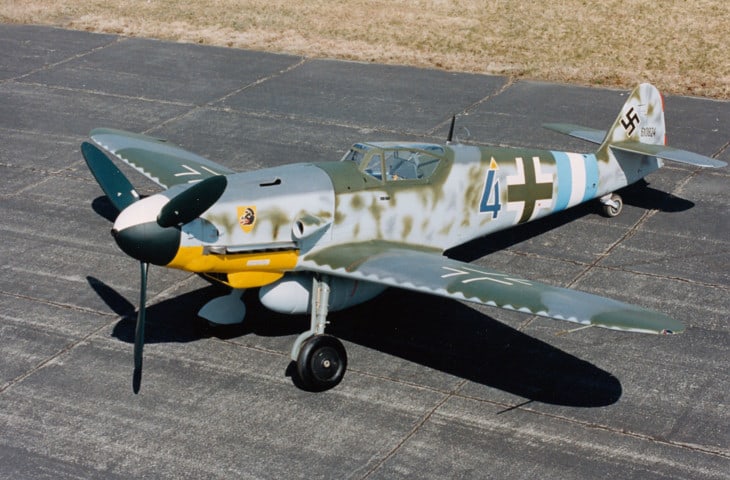

No source we consulted gives a verified count of all survivors. Wikipedia maintains a list of surviving examples, and the Military Aviation Museum says only a handful of original examples are airworthy.
Neither was clearly better. The Spitfire turned tighter and the Bf 109 had the edge in a dive and, in later versions, in climb, while the Bf 109E’s short range limited it over Britain.
Bf stands for Bayerische Flugzeugwerke, the company that designed it. The firm became Messerschmitt AG in 1938, which is why the Allies and many pilots said “Me 109”, though the official designation stayed Bf 109.
We found no verified wartime unit price or current market price. Original airframes rarely trade publicly, and most flying Bf 109s are Spanish-built Buchons.
Early models used Junkers Jumo 210 engines, then the Daimler-Benz DB 601 on the E and F. The G-6 on this page used the DB 605A-1, a liquid-cooled inverted V-12.
The Luftwaffe was the main operator. Allied and neutral users included Bulgaria, Croatia, Finland, Hungary, Italy, Romania, Slovakia, Spain and Switzerland, and Israel flew the Czechoslovak Avia S-199.
Sources and references used for research and fact-checking.