Fighter Jets
Messerschmitt Me 262
ICAO: ME62
The Messerschmitt Me 163 Komet is the only rocket-powered fighter that ever flew in combat, but it shot down only about nine bombers, and its volatile fuel made it dangerous for its own pilots.
Updated: by Tim de Vries
The latest aviation news and stories sent to your inbox.
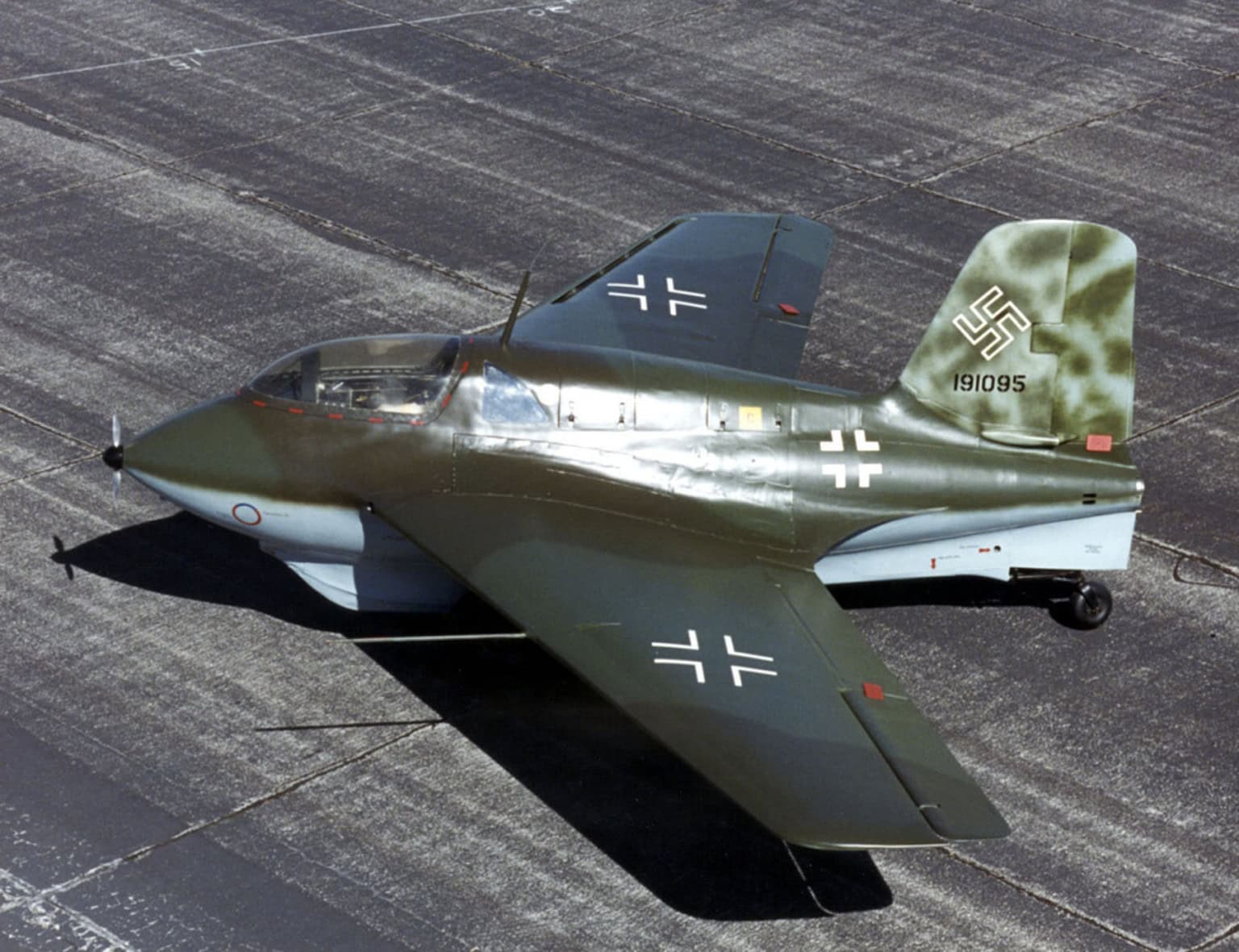
The Messerschmitt Me 163 Komet was designed by Alexander Lippisch and manufactured by Messerschmitt as a German interceptor aircraft intended for point-defence and the sole rocket-powered fighter aircraft ever operated. It first flew in September 1941 and entered service in 1944. A total of around 370 aircraft were built.
Live Fleet Activity (ME163)
Fetching live data…


The Messerschmitt Me 163 Komet is the only rocket-powered fighter that ever flew in combat. It was also the first piloted aircraft to pass 1,000 km/h (620 mph) in level flight.
It still failed as a weapon. The Komet shot down only about nine bombers, and its volatile fuel and violent landings made it dangerous for its own pilots.
The full specification table for the aircraft is on this page. The sections below explain the numbers and the story behind them.
The Komet grew out of glider research led by Alexander Lippisch at the German gliding institute DFS. Lippisch moved to Messerschmitt in January 1939, and the tailless rocket design was renamed the Me 163.
The first prototype flew in 1941. On October 2, 1941, test pilot Heini Dittmar reached 1,004.5 km/h (623.8 mph) in an Me 163A, a world speed record.
The production Me 163B was almost a complete redesign. It took off from a jettisonable wheeled dolly and landed on a retractable skid, a feature inherited from its glider ancestors.

The Komet was powered by the Walter HWK 109-509A-2, a liquid-fuel rocket burning two fluids that ignited on contact. The oxidizer was T-Stoff, a concentrated hydrogen peroxide mix, and the fuel was C-Stoff, a blend of hydrazine hydrate, methanol and water.
Maximum thrust was 3,307 lbf, and the throttle ran down to a minimum of 220 lbf, according to the figures in Wikipedia’s specification block.
The motor also had a design flaw. Vacuum pockets could form as fuel passed through the pumps, and the resulting cavitation sometimes caused a catastrophic explosion at start-up.
The Komet could climb to its 39,700 ft · 12,100 m service ceiling in just under three and a half minutes. Its rate of climb is listed at 16,000 ft/min · 81 m/s.
The top speed needs a caveat. The commonly quoted 596 mph (959 km/h) corresponds to a speed above Mach 0.89 at altitude, yet the aircraft hit severe compressibility problems above about Mach 0.82.
The Smithsonian notes that the Komet’s safe dive speed was limited to below Mach 0.82. Treat the headline figure as a record-book number, not an operating limit.

The Komet carried enough propellant for about 7.5 minutes of powered flight. After one or two firing passes, the pilot had to glide home.
That is why the listed range is so short. Walker (1983) gives a flight radius of about 25 miles, and the panel’s range figure is a distance, not an endurance.
The plan was a chain of overlapping bases that never materialized. In practice the Komet defended single targets such as the synthetic fuel plant at Leuna.
The Me 163B carried two 30 mm Rheinmetall Borsig MK 108 cannon with 60 rounds per gun. A few hits could bring down a four-engine bomber.
The problem was closing speed. The Komet overtook its targets so quickly that pilots had very little time to aim, and the slow-firing, short-ranged cannon made accurate shooting hard.
Yes. Major Wolfgang Späte flew the first Me 163B combat sortie on May 13, 1944. The first regular operational actions came on July 28, 1944, from Brandis with Jagdgeschwader 400.
Wikipedia counts nine confirmed kills against ten Komets lost from May 1944 to spring 1945. The Smithsonian also records nine kills. Other sources credit more, and the best-known pilot, Feldwebel Siegfried Schubert, is credited with three bombers.
By the end of 1944, 91 aircraft had been delivered to JG 400, but a lack of fuel kept most of them grounded. Operations stopped at the start of May 1945.

Not literally, but the propellants were savagely dangerous. Both fluids were toxic, and they were hypergolic, so Komets sometimes exploded on the ground.
T-Stoff reacted violently with organic matter. Ace Josef Pöhs died in 1943 from T-Stoff exposure combined with injuries from a failed takeoff that ruptured a fuel line.
Landings were hazardous too. A skid that failed to extend, or a hard touchdown, caused back injuries, and a rough landing could rupture the tanks.
Captured Komets were tested by the Allies, including by Royal Navy test pilot Captain Eric Brown. Germany also sent plans and one example to Japan, which led to the Mitsubishi J8M Shusui.
The Smithsonian’s Me 163B-1a, serial 191301, was towed behind a B-29 in 1946 for glide tests. Powered tests were dropped after the wooden wings were found to be delaminating. It is now at the Udvar-Hazy Center in Chantilly, Virginia.
The point-defense role passed to surface-to-air missiles. For other German designs, see our guide to German jet aircraft of WW2, and for context on speed see the fastest planes of WW2.

No, but its propellants could cause fatal chemical injuries. T-Stoff reacted violently with organic matter, and a ruptured fuel line killed ace Josef Pöhs in 1943.
Yes. The first combat sortie of the Me 163B was flown on May 13, 1944, and JG 400 flew operational missions from mid-1944 until early May 1945.
Wikipedia and the Smithsonian both give nine confirmed kills, with ten Komets lost in that period. Some sources credit more, up to 16 aircraft.
Yes, by the Luftwaffe from 1944. Roughly 370 were built, but a shortage of fuel kept most of them on the ground. No other country used it operationally.
The commonly quoted figure is 596 mph (959 km/h). Heini Dittmar reportedly reached 1,130 km/h (702 mph) in a test flight in July 1944, an unofficial record.
Sources and references used for research and fact-checking.