

Table of Contents
Yes, diesel aircraft engines exist, and you can buy a new airplane with one today. Continental, Austro Engine, DeltaHawk and SMA all build certified diesel piston engines that run on Jet A, the same kerosene fuel airliners burn.
Their appeal is simple. A diesel burns far less fuel than a gasoline engine of similar power, and it avoids 100LL avgas, the last leaded fuel in everyday US use.
They still haven’t taken over. Diesels are heavier, cost more up front, and Cessna has dropped its diesel plans more than once. Here is how they work, who builds them, and what is holding them back.
| Engine | Power | Layout | Notable aircraft |
|---|---|---|---|
| Continental CD-135 / CD-155 | 135 / 155 hp | Turbocharged inline four | Piper Archer DX, Cessna 172 (STC), Diamond DA40 TDI |
| Continental CD-170 | 170 hp | Turbocharged inline four | Tecnam P2010 TDI |
| Continental CD-300 | 300 hp | Twin-turbo six-cylinder | Diamond DA50 RG |
| Austro AE300 | 168 hp | Turbocharged inline four | Diamond DA40 NG, DA42 NG |
| Austro AE330 | 180 hp | Turbocharged inline four | Diamond DA62 (two engines) |
| DeltaHawk DHK180 | 180 hp | Two-stroke inverted V4 | Certified 2023, no factory airframe yet |
| SMA SR305-230 | About 230 hp | Air/oil-cooled flat four | Cessna 182 (STC) |
What Is an Aircraft Diesel Engine?
An aircraft diesel, or “aero diesel,” is a piston engine that ignites its fuel by compression instead of a spark. It turns a propeller like the gasoline engines in most small planes, but it runs on Jet A or road diesel. It is one of several types of aircraft engines, and the least common in service.
The cycle is the same four strokes as a car diesel. On intake, the cylinder draws in air only, with no fuel mixed in.
On compression, the piston squeezes that air until it gets extremely hot. Fuel is then injected at high pressure, and it ignites on contact with the hot air, driving the piston down. Exhaust clears the cylinder for the next cycle.
Modern aero diesels add three things a car does not need. A turbocharger keeps power up as the air thins with altitude. A reduction gearbox slows the engine’s high crankshaft speed to one a propeller can use.
The third is FADEC, or full-authority digital engine control. The pilot moves a single power lever and a computer manages fuel injection, turbo boost and propeller pitch. It replaces the separate throttle, propeller and mixture controls of a traditional piston engine.

Why Diesel? The Problem With Leaded Avgas
Most piston airplanes burn 100LL, a 100-octane “low lead” avgas. Its tetraethyllead additive raises the octane rating, prevents engine knock and helps lubricate the engine. 100LL can carry up to 2.1 grams of lead per US gallon.
The EPA finished phasing leaded gasoline out of US cars by 1996, but avgas kept its lead. That made piston aircraft the main remaining source of airborne lead.
On October 18, 2023, the EPA ruled that lead emissions from these aircraft endanger public health. On July 30, 2026, the FAA released its final plan to move the piston fleet to unleaded avgas by 2030, working with industry through the EAGLE initiative, with a separate transition for Alaska.
Unleaded replacements are coming, but slowly. As of January 2026, AOPA reported that GAMI’s G100UL, approved through an STC in 2022, was sold at only a handful of airports. The FAA is still testing three candidate fuels, and airports must keep selling 100LL until unleaded fuel is widely available.
A diesel avoids the whole problem. It burns Jet A, which contains no lead and is sold at almost any airport that serves turbine aircraft. Our guide to kerosene vs avgas covers how the two fuels differ.
Jet fuel is almost diesel
Jet A is a kerosene fuel that is chemically very close to road diesel. That is why engines like the Continental CD-155 and CD-170 are approved to run on Jet A, road diesel to the EN 590 standard, or any mix of the two.
Advantages of Diesel Aircraft Engines
Much lower fuel burn
Fuel efficiency is the headline benefit. AOPA measured a Continental CD-135 burning 5.8 gallons per hour at 75% power, against 8 to 10 gallons per hour for typical 160 to 180 hp gasoline engines.
The same pattern shows up in new aircraft. Tecnam quotes about 5.2 gallons per hour in typical cruise for its 170 hp P2010 TDI. Diamond quotes 8.0 gallons per hour at maximum range for the 300 hp DA50 RG. For comparison with other types, see how much fuel aircraft use.
Longer range
Lower fuel burn turns directly into range. The Tecnam P2010 TDI holds 63 US gallons (240 liters), and Tecnam quotes 1,300 nautical miles at 60% power with a 90-minute reserve. It can stay airborne for more than 14 hours.
Fuel you can find anywhere
Jet A is sold wherever jets and turboprops refuel, including remote parts of the world where avgas is scarce or expensive. That matters most to flight schools and operators outside North America.
Safer fuel, simpler cockpit
Jet A has a flash point of 100°F (38°C), so it does not ignite as readily as gasoline in a crash. And with FADEC, the pilot flies with a single power lever.
Why Aren’t Diesel Engines Used More in Aircraft?
Weight
Weight is the core problem. A diesel has to be built strong enough to handle very high compression, so it produces less power per pound. Engine maker UL Power notes that diesels of about 100 hp weigh about 220 pounds (100 kg) or more.
The fuel is heavier too. Jet A weighs about 6.84 pounds per US gallon (0.82 kg/L), against about 6.01 pounds (0.72 kg/L) for avgas. Fifty gallons of Jet A weighs roughly 41 pounds (19 kg) more than the same volume of avgas.
Together, these cut into payload. AOPA’s diesel-converted test aircraft could carry only 332 pounds (151 kg) with full fuel, 100 to 120 pounds (45 to 54 kg) less than comparable gasoline models.
Cost
Diesels are expensive to buy. AOPA priced a complete CD-135 retrofit kit, including propeller and engine computers, at $65,000 before labor.
Maintenance works differently too. Many Continental diesels have a “time before replacement” rather than an overhaul interval, so the whole engine is swapped at the limit. The CD-155’s limit is 2,100 hours. AOPA also reported a gearbox inspection at 600 hours that usually ends in a $3,500 to $4,500 replacement.
Technical trade-offs
Jet fuel lubricates poorly compared with road diesel, which adds wear to the high-pressure injection system. Diesels also need heavier starters and batteries to turn over against high compression, and can need extra help in cold weather.
UL Power also points to strong torque pulses that can damage propellers and parts designed for gasoline engines. That is part of why aero diesels need purpose-built gearboxes and propellers.
Cessna's diesel false starts
Cessna announced a diesel Skylane, the 182 JT-A, in 2012, but the SMA-powered model never reached production. Its diesel Turbo Skyhawk JT-A was certified in 2017 and discontinued less than a year later, in May 2018. The CD-155 engine is still available for the 172, but only as an aftermarket STC from Continental.
Diesel Aircraft Engine Manufacturers
Continental (formerly Thielert)
Continental has the largest diesel lineup of any maker here. Its line grew out of Thielert’s Centurion engines, which were based on heavily modified Mercedes-Benz car diesels. After Thielert went insolvent in 2008, the business passed to Technify Motors, owned by AVIC, and is sold under the Continental name.
The CD-135 and CD-155 are turbocharged four-cylinder engines with a 2,100-hour replacement interval. The CD-135 has been certified by EASA and the FAA since 2006, and its weight matches the older 1.7-liter Centurion, so it drops straight into existing installations.
The 170 hp CD-170 has a 1,800-hour interval and a helicopter version, the CD-170R. The 300 hp CD-300 is a twin-turbocharged, liquid-cooled six-cylinder engine with common-rail direct injection and a 2,000-hour interval.
Austro Engine
Austro Engine is Diamond Aircraft’s in-house engine maker, based in Wiener Neustadt, Austria, where its plant was built in 2007. When Thielert’s 2008 insolvency halted DA42 production, Austro’s engines became Diamond’s way forward.
Its AE300 four-cylinder diesel was certified by EASA and the FAA in 2009 and makes about 168 hp in the DA42 NG. The AE330 raises that to 180 hp and powers the twin-engine Diamond DA62.

DeltaHawk
DeltaHawk, based in Racine, Wisconsin, took a clean-sheet approach. The DHK180 is a liquid-cooled, two-stroke inverted V4 with both a turbocharger and a supercharger. DeltaHawk announced its FAA type certification in May 2023 after developing it since 2007.
The company says the 180 hp engine has 40% fewer moving parts than others in its class and is 40% more fuel efficient than avgas engines. It runs on Jet A or sustainable aviation fuel. At certification, DeltaHawk put the target price at $60,000 for the engine alone.
SMA (Safran)
SMA’s SR305-230 is unusual among modern aero diesels because it is an air- and oil-cooled flat four, the same layout as a traditional Lycoming or Continental gasoline engine. It was certified in Europe in 2001 and by the FAA in 2002. Its main use is as an STC conversion for the Cessna 182.
Diesel Aircraft You Can Fly Today
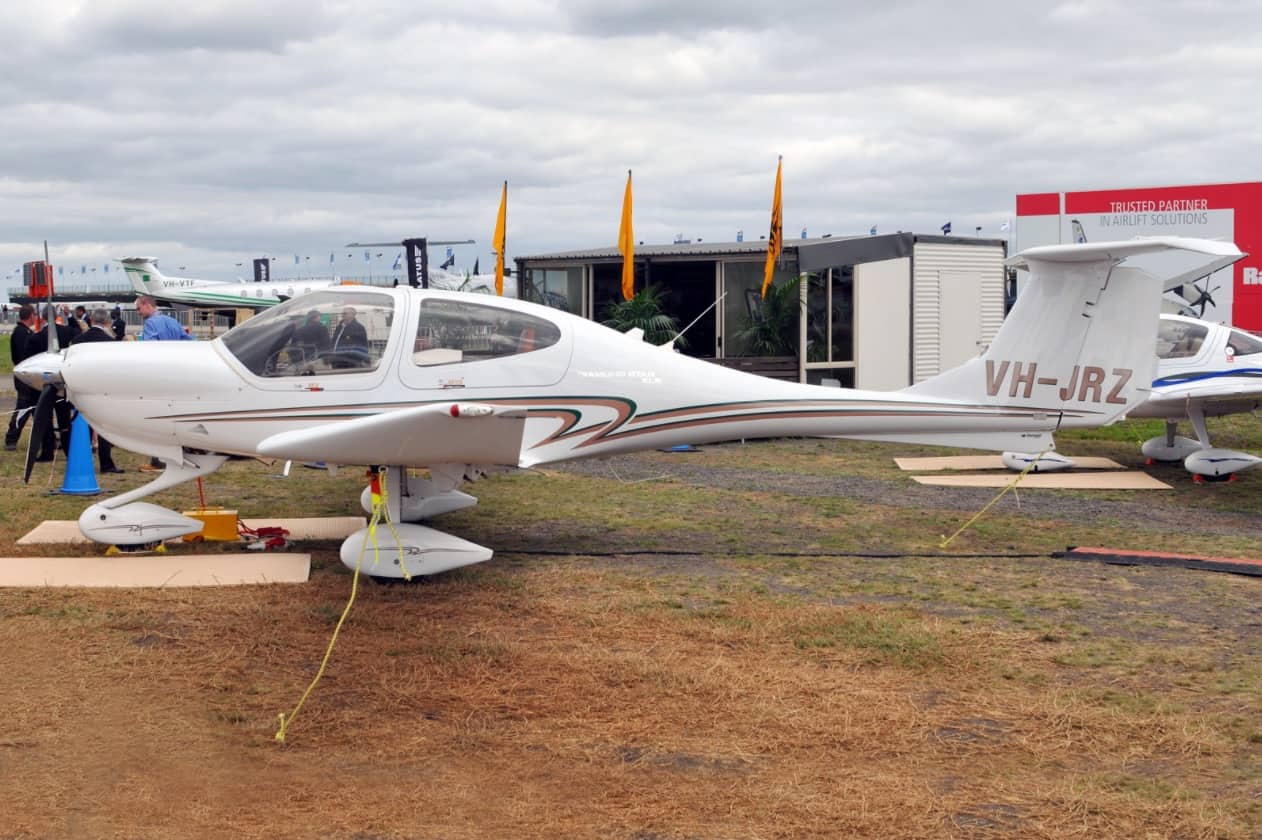
Diamond DA40 NG and DA42. Diamond offers more diesel models than any other planemaker on this list. The Diamond DA40 NG uses an Austro AE300 and earned European certification in 2010.
The twin-engine Diamond DA42 Twin Star first flew in December 2002 on Thielert engines. In August 2004, a DA42 flew non-stop across the North Atlantic in 12.5 hours, the first diesel-powered airplane credited with that crossing.
Diamond DA62 and DA50 RG. The seven-seat DA62 flies on two Austro AE330s. The five-seat DA50 RG, powered by the Continental CD-300, earned FAA certification on July 25, 2023.
Piper Archer DX. Piper’s diesel trainer pairs the classic Archer airframe with a Continental CD-155 and Garmin G1000 NXi avionics. Piper quotes a 123-knot cruise and an 845-nautical-mile range.


Tecnam P2010 TDI. Tecnam’s four-seat high-wing runs the Continental CD-170 on Jet A, Jet A-1 or road diesel. Tecnam calls it the longest-range, lowest-consumption aircraft in its fleet.
Cessna 172 and 182 conversions. Owners can still convert a Cessna 172 Skyhawk with Continental’s CD-155 STC, or a Cessna 182 with the SMA engine.
Military drones. The US Army’s General Atomics MQ-1C Gray Eagle uses a Centurion 1.7 heavy-fuel engine, a diesel that burns jet fuel.
A Brief History of Diesel Engines in Aircraft
Diesel flight is nearly a century old. On September 18, 1928, a Stinson SM-1DX Detroiter, registered X7654, made the first successful flight of a diesel-powered aircraft. Its engine was the 225 hp Packard DR-980, the first successful diesel designed specifically for aircraft.
Germany’s Junkers built the most successful early aero diesels. The Jumo 205 was a two-stroke with 12 opposed pistons in six cylinders and two crankshafts geared together. About 900 were built, for the Ju 86 bomber, the Blohm and Voss BV 138 and BV 222 flying boats, and Dornier’s Do 18 and Do 26.
The Jumo 205 was efficient at cruise but proved too unresponsive for combat and liable to fail at maximum power. That flaw kept diesels out of fighters.
Airships used diesels too. The Hindenburg and Graf Zeppelin II flew on reversible diesel engines, and Britain’s ill-fated R101 airship used the Beardmore Tornado, a diesel developed from a railcar engine. The Soviet Petlyakov Pe-8 bomber was built with Charomskiy ACh-30 diesels, which were replaced after the war.
After World War II, better gasoline engines and turbines pushed diesels aside for decades. The modern revival came in the early 2000s, led by Thielert’s car-based Centurion engines and SMA’s SR305.
1928
First diesel flight. A Packard DR-980 powers a Stinson SM-1DX Detroiter on September 18.
1930s
Junkers Jumo 205. The opposed-piston two-stroke enters service in German flying boats and bombers.
2001-2002
Modern revival. SMA’s SR305 is certified in Europe, then by the FAA, and Diamond flies the Thielert-powered DA40 TDI and DA42.
2008
Thielert collapses. The insolvency halts DA42 production, and Diamond turns to its own Austro engines.
2018
Cessna retreats. The diesel Turbo Skyhawk JT-A is discontinued less than a year after certification.
2023
New entrants. The EPA issues its avgas lead finding, DeltaHawk’s DHK180 is certified, and the CD-300-powered DA50 RG earns FAA approval.
Diesel Aircraft Engines: Future or Fad?
Diesels are no longer an experiment. Certified engines from four makers are flying in new Diamond, Piper and Tecnam aircraft, in retrofitted Cessnas and in military drones.
They are also not about to replace gasoline. Weight, purchase price and a thin US market have held them back, and Cessna’s retreat shows how hard the sale is in North America.
The deciding factor may be avgas itself. If unleaded 100-octane fuel spreads smoothly before 2030, gasoline engines keep their edge. If it does not, a diesel that already burns lead-free, widely available Jet A becomes a much easier case to make. For a wider look at the fuels involved, see our guide to sustainable aviation fuel.
FAQ
Sources and references used for research and fact-checking.
- Wikipedia, Aircraft diesel engine
- Continental Aerospace Technologies, Certified Jet-A Engines
- Wikipedia, Thielert Centurion
- Wikipedia, Austro Engine
- Wikipedia, Diamond DA42 Twin Star
- Wikipedia, Diamond DA40 Diamond Star
- Diamond Aircraft, Diamond Aircraft celebrates DA50 RG FAA certification
- Kitplanes, DeltaHawk Receives FAA Certification
- AOPA, DeltaHawk jet-fueled piston engine gets FAA certification
- Wikipedia, SMA SR305-230
- AOPA, Cessna discontinues Turbo Skyhawk JT-A
- AOPA, Little diesel, big fuel savings
- Piper Aircraft, Archer DX
- Tecnam, P2010 170 TDI
- UL Power, Why develop a gasoline aircraft engine and not a diesel?
- Wikipedia, Avgas
- Wikipedia, Jet fuel
- US EPA, EPA Determines that Lead Emissions from Aircraft Engines Cause or Contribute to Air Pollution
- AOPA, Another 100-octane unleaded fuel advances
- FAA, FAA Releases Plan for Transitioning General Aviation Aircraft to Unleaded Gas
- Wikipedia, Junkers Jumo 205
- Wikipedia, Stinson Detroiter
Get the Newsletter
The latest aviation news and stories sent to your inbox.
About the Author
Matt Claiborne is an FAA Airline Transport Pilot and Certified Flight Instructor with more than two decades of experience in flight training. He has served as an assistant professor and FAA Part 141 Assistant Chief Instructor for a university aeronautics program in Florida. His background in professional flying, flight instruction, and aviation education gives him firsthand expertise in aircraft operations, pilot training, flight procedures, and aviation safety.