

Table of Contents
The best stealth fighter jet in the world is still the Lockheed Martin F-22 Raptor. Twenty years after it entered service, no other fighter combines the same radar signature, supercruise speed and air-to-air record, and no air force has publicly claimed a better one.
The F-35 Lightning II is the more useful aircraft, and by a wide margin the more common one. But “stealthiest” and “most useful” are different questions, and this list answers the first one first.
Below are the stealth fighters that actually exist as of 2026, ranked by how much low-observable capability each one has genuinely fielded. Five are in squadron service. Two are flying and entering production. The rest are still drawings and funding lines, and they are marked as such.
| Rank | Aircraft | Country | First flight | Status in 2026 |
|---|---|---|---|---|
| 1 | Lockheed Martin F-22 Raptor | United States | 1997 | In service, 185 in USAF inventory |
| 2 | Lockheed Martin F-35 Lightning II | United States | 2006 | In service, 1,340+ delivered worldwide |
| 3 | Chengdu J-20 Mighty Dragon | China | 2011 | In service, 300 to 500 estimated |
| 4 | Shenyang J-35 and J-35A | China | 2012 (as FC-31) | Entered service late 2025, ramping up |
| 5 | Sukhoi Su-57 Felon | Russia | 2010 | In service, roughly 30 delivered |
| 6 | KAI KF-21 Boramae | South Korea | 2022 | First production jet rolled out March 2026 |
| 7 | TAI Kaan | Turkey | 2024 | In flight test, 20 on contract |
| 8 | HAL AMCA | India | Not yet flown | In development, first flight late this decade |
How this ranking works
This list covers fighters only, meaning aircraft built to fight other aircraft. Stealth bombers like the B-2 Spirit and B-21 Raider, and the F-117 Nighthawk, which was an attack aircraft with a fighter designation, are ranked separately in our guide to the best stealth aircraft in the world. Ranking is by how much low-observable capability each type has actually fielded, not by paper claims: in-service aircraft outrank prototypes, and prototypes outrank programs that have never left the drawing board.
1. Lockheed Martin F-22 Raptor
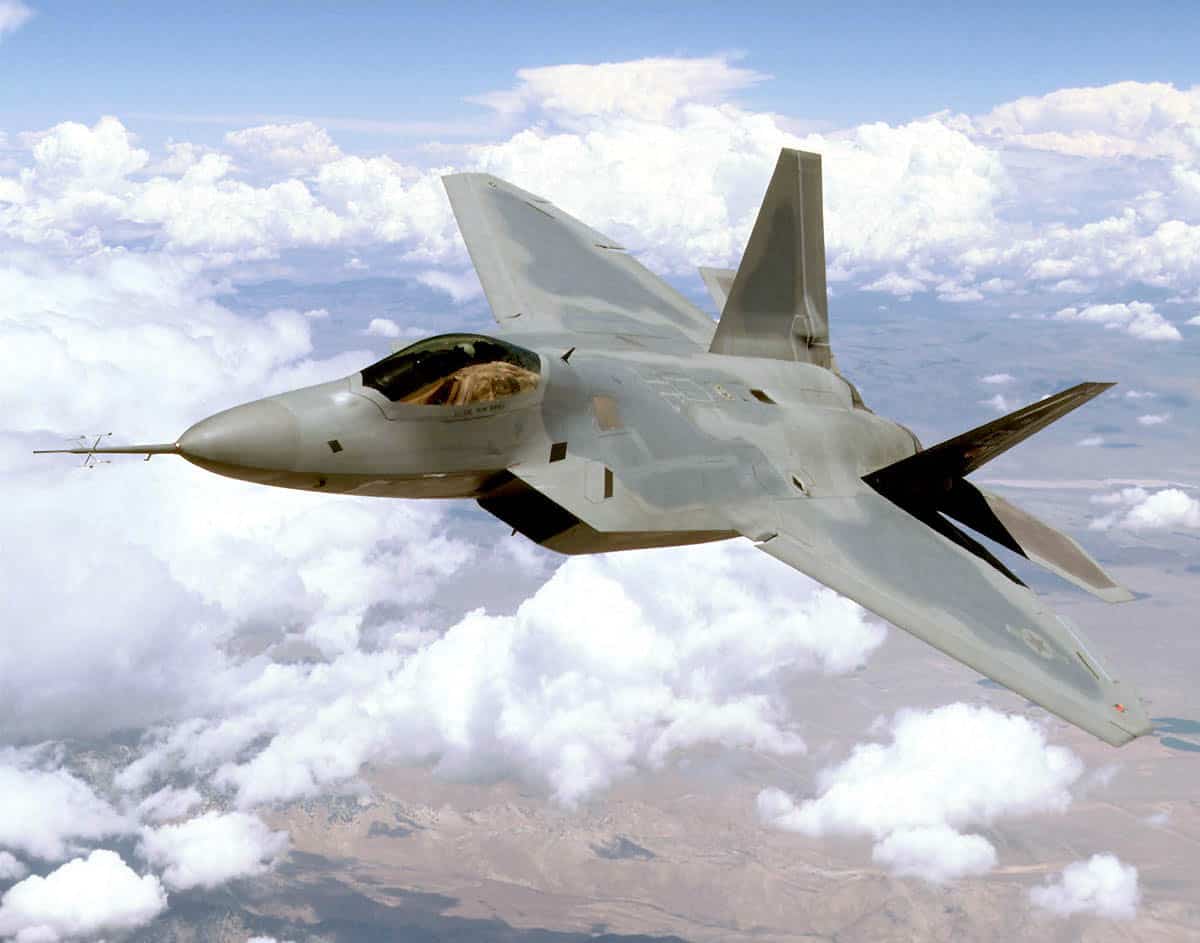
The F-22 Raptor entered US Air Force service in December 2005 and has never been beaten in the role it was built for. It is 62 feet 1 inch (18.9 m) long, tops Mach 2.25 on two Pratt & Whitney F119 engines, and cruises above the speed of sound without afterburner.
That last point is what separates it from everything below. Supercruise at roughly Mach 1.8 lets the Raptor arrive, shoot and leave at speeds other fighters can only reach by burning fuel they cannot spare.
Only 195 were built before production ended in 2011, and 185 remain in the inventory. Just 143 of those are combat-coded, because 32 early Block 20 jets were built to a training standard the Air Force has repeatedly tried to retire.
Congress has blocked those retirements, and in 2026 the Air Force is instead weighing a modernization that would cost at least $3.3 billion and take around fifteen years. The Raptor is now expected to serve into the 2050s, well past the arrival of its supposed replacement.
The Raptor was never allowed to be exported
A 1998 US law, the Obey Amendment, banned foreign sales of the F-22 outright. Japan and Australia both asked and both were refused, which is why the world’s best stealth fighter is flown by exactly one air force, and why the F-35 exists in the form it does.
2. Lockheed Martin F-35 Lightning II
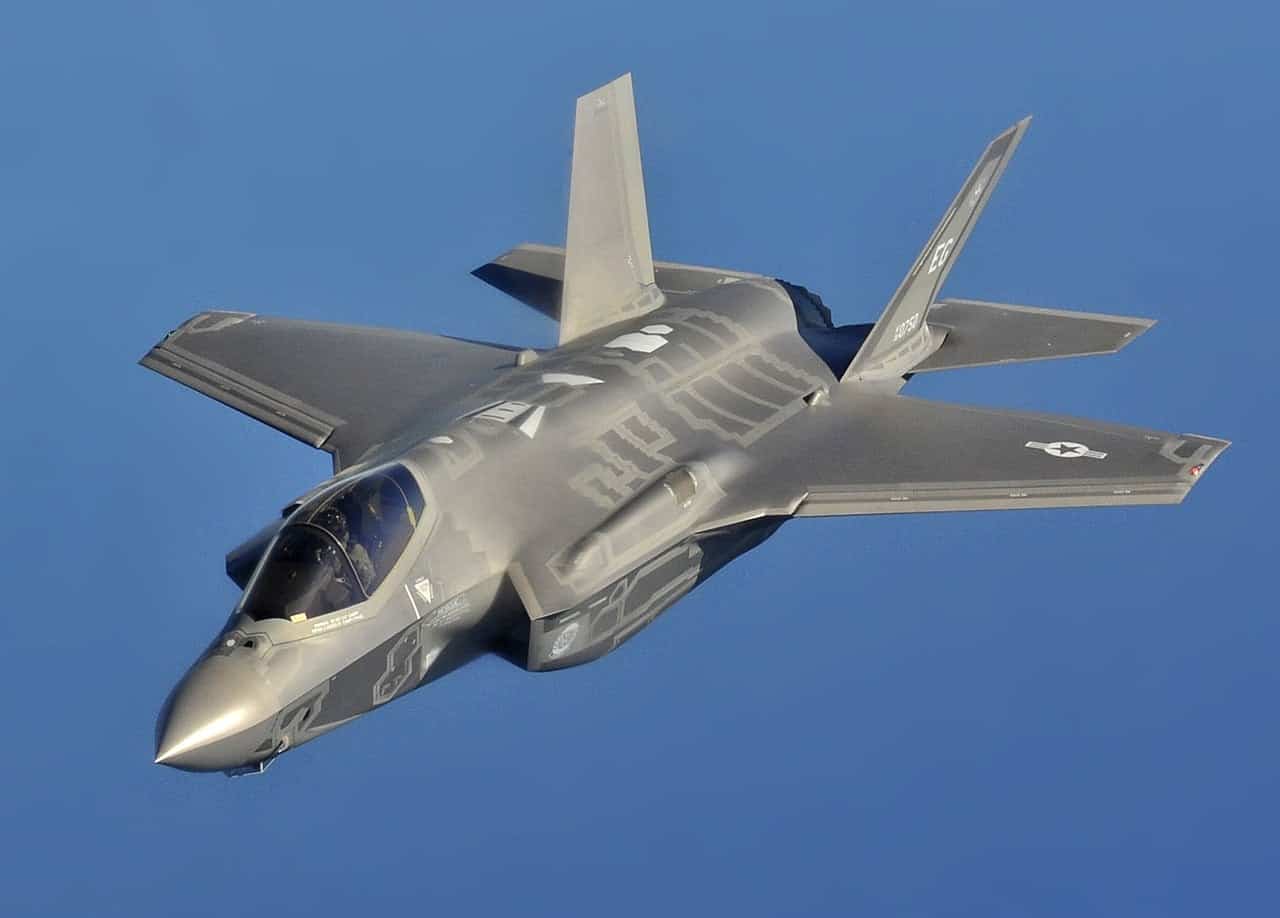
The F-35 is less stealthy than the F-22 and far more important. Lockheed Martin had delivered more than 1,340 aircraft by mid-2026, including 191 in 2025 alone, the highest annual total in the program’s history.
Three variants share one airframe family: the conventional F-35A, the short-takeoff F-35B, and the carrier-capable F-35C. Twenty countries fly or have ordered it, which makes it the default stealth fighter of the Western world.
The F-35A is 51.4 feet (15.7 m) long, spans 35 feet (10.7 m), and reaches Mach 1.6. It gives up the Raptor’s speed and its two-engine thrust for sensor fusion, an electronic warfare suite, and the ability to hand a target picture to every other aircraft in the formation.
It is also the only stealth fighter with a serious combat record. Israel’s F-35I Adir struck targets in Syria in 2018 in the type’s combat debut, then led the June 2025 opening strikes on Iran, the largest operational use of stealth fighters ever flown.
Stealth is a setting, not a state
F-35s routinely fly with Luneburg lenses bolted to the fuselage, small reflectors that make the jet look far bigger on radar than it is. Pilots use them in peacetime so that nobody gets a free look at the real signature, and remove them before anything serious.
3. Chengdu J-20 Mighty Dragon
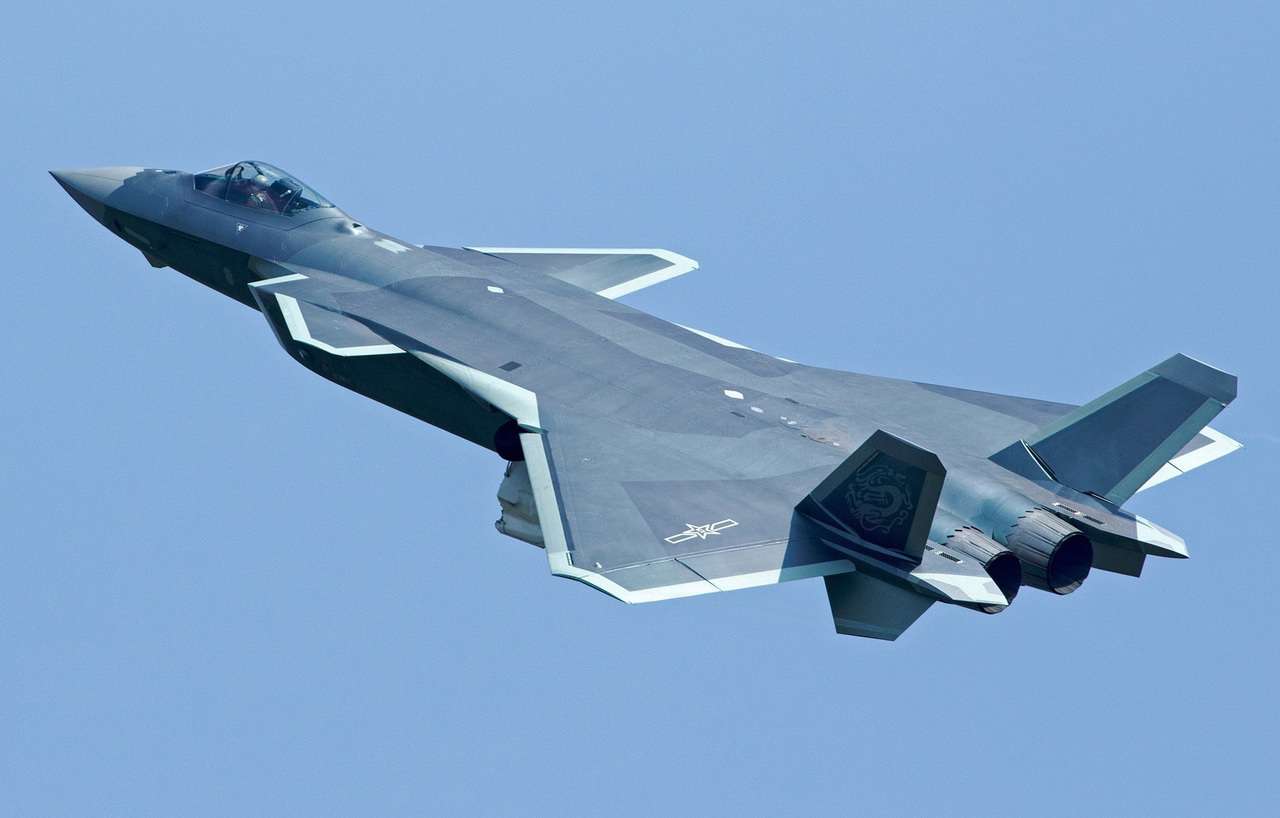
The J-20 first flew in 2011 and entered People’s Liberation Army Air Force service in 2017. It was the third stealth fighter in the world and the first not built for the United States.
Fleet estimates for 2026 range from around 300 to more than 500 airframes, with analysts putting annual output near 100 to 120 aircraft. The spread is wide because China publishes nothing, but every credible estimate now has the J-20 as the second most numerous stealth fighter flying.
At 66.8 feet (20.4 m) it is noticeably longer than the F-22, built around long-range missiles and internal fuel rather than a turning fight. Later production aircraft carry the domestic WS-15 engine that the early jets lacked.
China has also fielded the J-20S, a two-seat variant unveiled in 2025 and the first twin-seat stealth fighter anywhere. The second crew member is there to manage drones and sensors, not to instruct. Our guide to the best Chinese fighter jets covers the wider PLAAF fleet.
4. Shenyang J-35 and J-35A
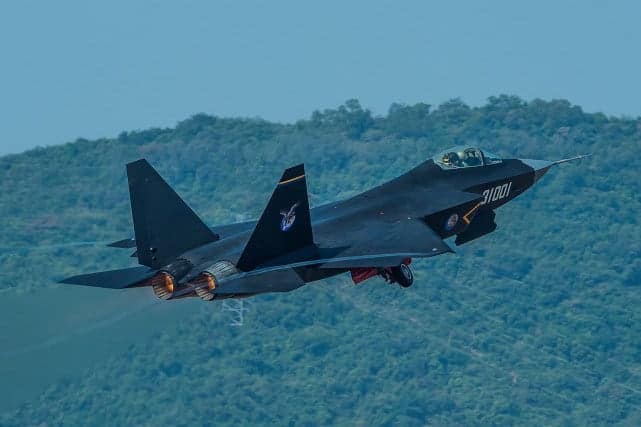
The aircraft that used to be listed everywhere as the FC-31 or J-31 is now real, in service, and has two forms. The land-based J-35A was revealed publicly at Zhuhai in November 2024 and entered PLAAF service in late 2025.
The naval J-35 is the more consequential half. It completed electromagnetic catapult trials aboard the carrier Fujian in September 2025, which gives China a carrier-borne stealth fighter that only the United States had before.
Two factory-fresh J-35As were photographed flying in formation in January 2026, a fairly reliable sign that serial production has started. Full initial operating capability is expected around the end of 2026.
It sits below the J-20 here because it is years behind on numbers and hours, not because it is a lesser design. If you want the wider strategic picture, we compare the two fleets directly in US vs China fighter jets.
5. Sukhoi Su-57 Felon
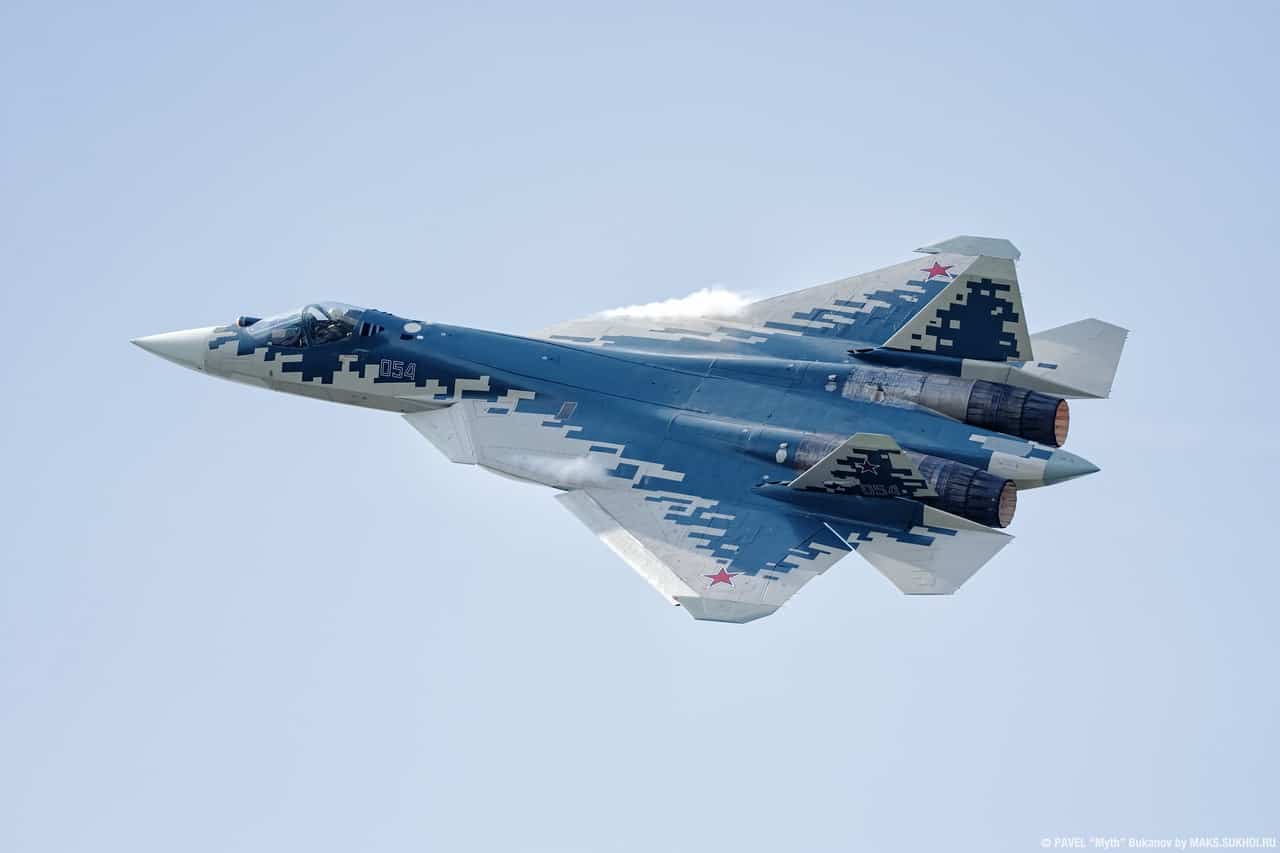
The Su-57 is the most capable Russian fighter ever built and the least successful fifth-generation program in the world. First flown in 2010, it did not reach the Russian Aerospace Forces in numbers until the 2020s.
Total construction had passed roughly 44 airframes by mid-2026, of which about ten are test aircraft. Serving strength is estimated at somewhere between 20 and 32 jets, against a J-20 fleet more than ten times that size.
It is 65 feet 11 inches (20.1 m) long and reaches around Mach 2, and it carries a genuinely impressive missile set. Its weakness is the airframe itself: exposed engine faces, visible fasteners and riveting that Western analysts read as a much larger radar return than the F-22 or J-20.
Algeria became the first export customer, taking delivery of its first Su-57E in November 2025 against a reported order for twelve. Russia announced further export agreements in 2026 without naming a buyer.
Russia is still waiting on the engine
Every Su-57 delivered so far flies on the AL-41F1, an interim engine derived from the Su-35’s. The purpose-built second-stage engine that the design was drawn around has been in testing since 2017 and is still not in squadron aircraft.
6. KAI KF-21 Boramae
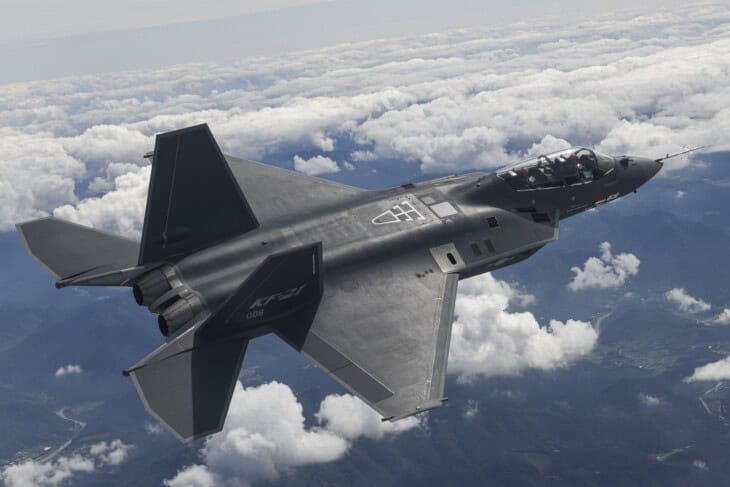
South Korea’s KF-21 is the most honest entry on this list, because Korea Aerospace Industries has never claimed it is a full fifth-generation fighter. It is a stealth-shaped 4.5-generation aircraft that carries its weapons externally today, with an internal bay planned for a later production block.
That still puts it ahead of every paper program. It first flew in July 2022, completed its planned flight-test campaign in January 2026, and the first production aircraft, tail number 26-001, rolled out at Sacheon on 25 March 2026.
The first jets reach the Republic of Korea Air Force in the second half of 2026. The initial batch is 20 aircraft for around $1.4 billion, with 120 planned by 2032.
Indonesia is a junior partner in the program, though its share has been repeatedly renegotiated. The old “KF-X” designation used across most older articles has not been current since 2021.
7. TAI Kaan
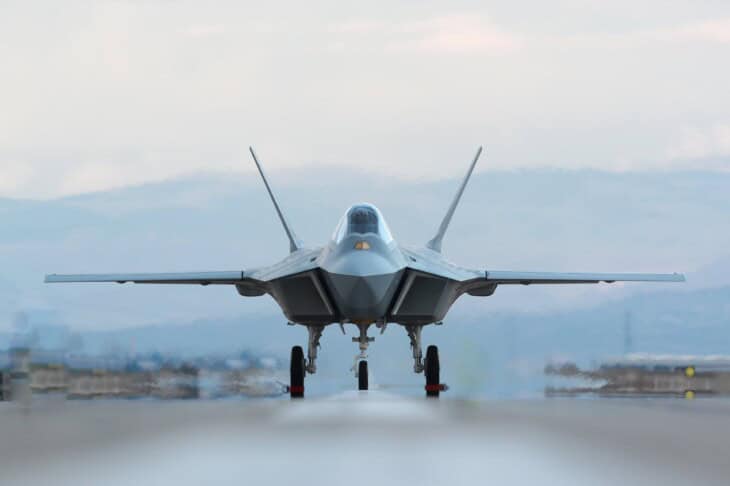
Turkey’s Kaan is a twin-engine fifth-generation design that made its first flight in February 2024, and it moved faster than most observers expected. A second prototype joined the test campaign in 2026, with a third due in early 2027.
Turkey signed its first production contract in May 2026 for 20 aircraft, to be delivered to the Turkish Air Force between 2028 and 2030. The program exists in large part because Turkey was removed from the F-35 program in 2019 over its purchase of Russian S-400 air defences.
Indonesia signed for 48 Kaans in June 2025 in a deal reported at around $10 billion, making it the launch export customer before Turkey had ordered any itself. Indonesia has since asked for a version stripped of US-origin components.
8. HAL AMCA
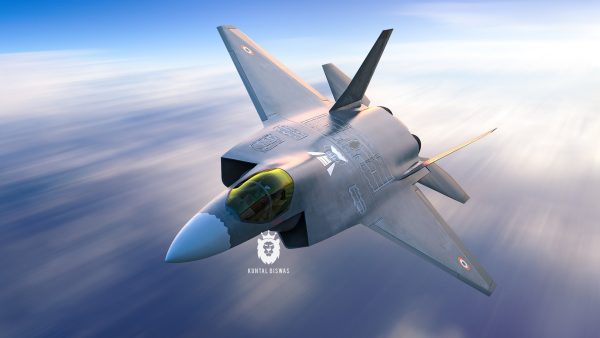

India’s Advanced Medium Combat Aircraft is a genuine national program with real money behind it, and it has not yet flown. Full-scale engineering development was approved in March 2024 at around 15,000 crore rupees.
In a significant break with precedent, the Defence Ministry shortlisted three private firms in early 2026 to lead prototype development, with Hindustan Aeronautics eliminated from that competition. Official rollout targets range from late 2026 to 2031 depending on which timeline you read.
A realistic reading puts first flight late this decade and squadron service in the mid-2030s. It is on this list because it is funded and designed, not because it is close.
Which countries have stealth fighter jets?
Only three countries have designed and fielded a stealth fighter: the United States, China and Russia. That is the entire list as of 2026.
A much larger group operates one without building it. Around twenty countries fly or have ordered the F-35, including the United Kingdom, Israel, Japan, Australia, Italy, Norway, South Korea, Poland and Finland.
South Korea, Turkey and India are the three most credible additions to the builders’ club, in that order. Algeria became the first country outside the three original builders to operate a non-American stealth fighter when its Su-57E arrived in late 2025.
Only two air forces have ever taken a stealth fighter into combat: the United States and Israel. Every other operator’s aircraft has so far flown nothing harder than an exercise.
What happened to the stealth fighters that never arrived
Lists of stealth fighters have carried the same three ghosts for a decade, and none of them exist. It is worth saying plainly which ones to stop expecting.
The Mikoyan MiG-41 has been “in development” since 2018 with no prototype, no airframe and no confirmed funding line. The Mach 4.9 figure attached to it in older articles came from Russian press speculation, not from Mikoyan.
Iran’s HESA Shafaq never progressed past mock-ups, and Japan’s Mitsubishi F-X no longer exists as a national program. Japan folded it into GCAP in 2022, a joint sixth-generation aircraft with the United Kingdom and Italy targeting service entry in 2035.
What about the B-2, the B-21 and the F-117?
None of them are fighters. The B-2 Spirit and B-21 Raider are strategic bombers, and the F-117 Nighthawk was a subsonic attack aircraft that carried a fighter designation for secrecy reasons and never had an air-to-air weapon. They are outstanding stealth aircraft and they belong in a different ranking, which is why we cover them in our guide to the best stealth aircraft in the world rather than here.
The sixth generation has already started flying
Everything above is fifth generation or below, and that era is closing. China flew two sixth-generation prototypes on the same day in December 2024, the tailless J-36 and the smaller J-50, and both have been in visible flight testing since.
The United States answered with the Boeing F-47, awarded in March 2025 and targeting a first flight in 2028. GCAP, the British, Italian and Japanese program, is aiming at 2035.
None of these will change this ranking before the 2030s. We track all of them in our guide to sixth-generation fighter jets.
How stealth fighters actually stay hidden
Stealth is not invisibility, and every air force involved is careful to say so. It is a set of design choices that shrink how far away a radar can usefully detect and track an aircraft.
The biggest factor is shape. Flat, angled surfaces bounce radar energy away from the transmitter instead of back at it, which is why stealth fighters have canted tails, sawtooth panel edges and serpentine intake ducts that hide the engine face.
Second is what the aircraft is coated and made of. Radar-absorbent materials convert a portion of the incoming energy into heat rather than reflecting it, and they are the reason stealth fighters cost so much per flight hour to maintain.
Third is carrying weapons internally. A missile hung under a wing is a corner reflector, and it undoes the airframe work instantly, which is exactly why the KF-21’s external carriage matters to its ranking.
Ignore any exact radar cross-section figure you read
You will see the F-22 quoted at 0.0001 square metres and the F-35 at 0.005, usually with no source. No air force has ever published a radar cross-section for an aircraft in service, because the figure changes with radar frequency, aspect angle and the jet’s configuration on the day. Every number in circulation is an estimate or a guess, including the ones repeated confidently.
The verdict
If you are asking which stealth fighter you would want pointed at you least, the answer is the F-22. If you are asking which one will decide the next twenty years of air combat, the answer is the F-35, on numbers alone.
The real story of 2026 is the second column of the table. China is now the only country producing two stealth fighters at scale simultaneously, and it flew a sixth-generation prototype before anyone else.
For how these aircraft rank against non-stealth fighters on overall combat capability, see our ranking of the best fighter jets in the world. For raw speed, where several of these jets do badly, see the fastest fighter jets. And for stealth aircraft of every type, including bombers and drones, start with the best stealth aircraft in the world.
Sources and references used for research and fact-checking.
- U.S. Air Force, F-22 Raptor Fact Sheet
- Lockheed Martin, F-35 Breaks Delivery Record, Continues Combat Success in 2025
- Lockheed Martin, F-35 Lightning II Program Fast Facts
- The Aviationist, First Production KF-21 Boramae Rolled Out
- The Aviationist, Algeria's First Su-57E Reportedly Captured in Flight
- Breaking Defense, Turkish air force contracts its first batch of indigenous KAAN jets
Get the Newsletter
The latest aviation news and stories sent to your inbox.
About the Author

Articles credited to the AeroCorner Editorial Team are created or maintained by multiple aviation contributors working under a shared editorial framework. Content is researched using authoritative aviation sources and reviewed to ensure clarity, technical accuracy, and consistency across AeroCorner.