

Table of Contents
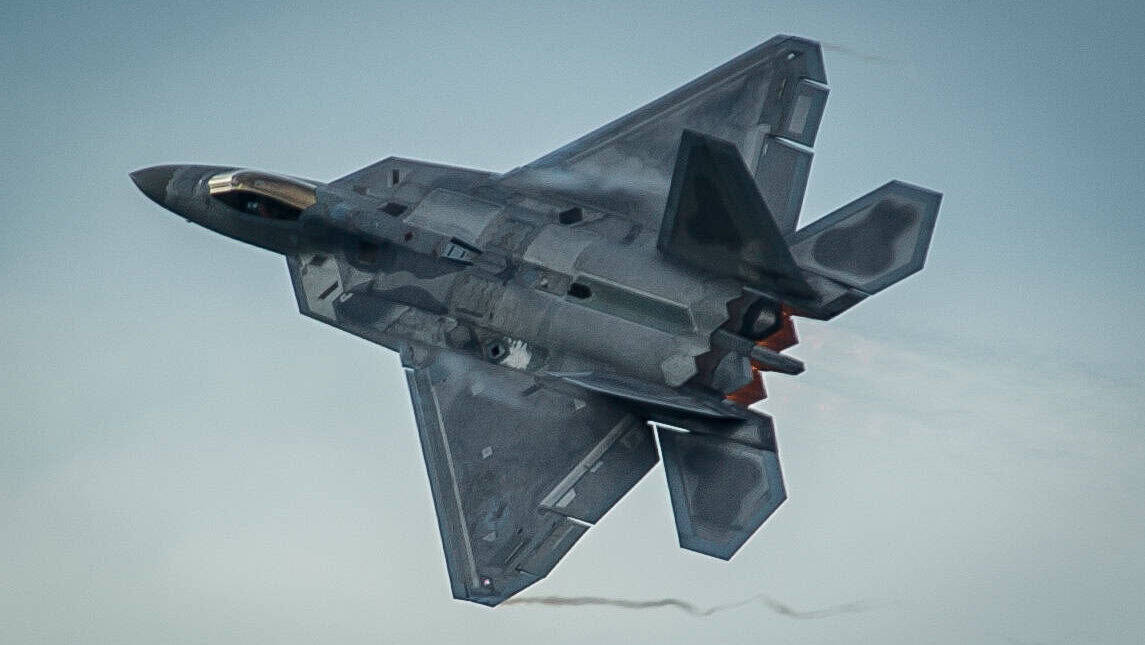
The best Lockheed Martin fighter jet is the F-22 Raptor, the stealth air-superiority fighter the US Air Force says can outmaneuver all current and projected aircraft. The F-35 Lightning II and the F-16 Fighting Falcon follow it, and those two are the only Lockheed fighters still in production in 2026.
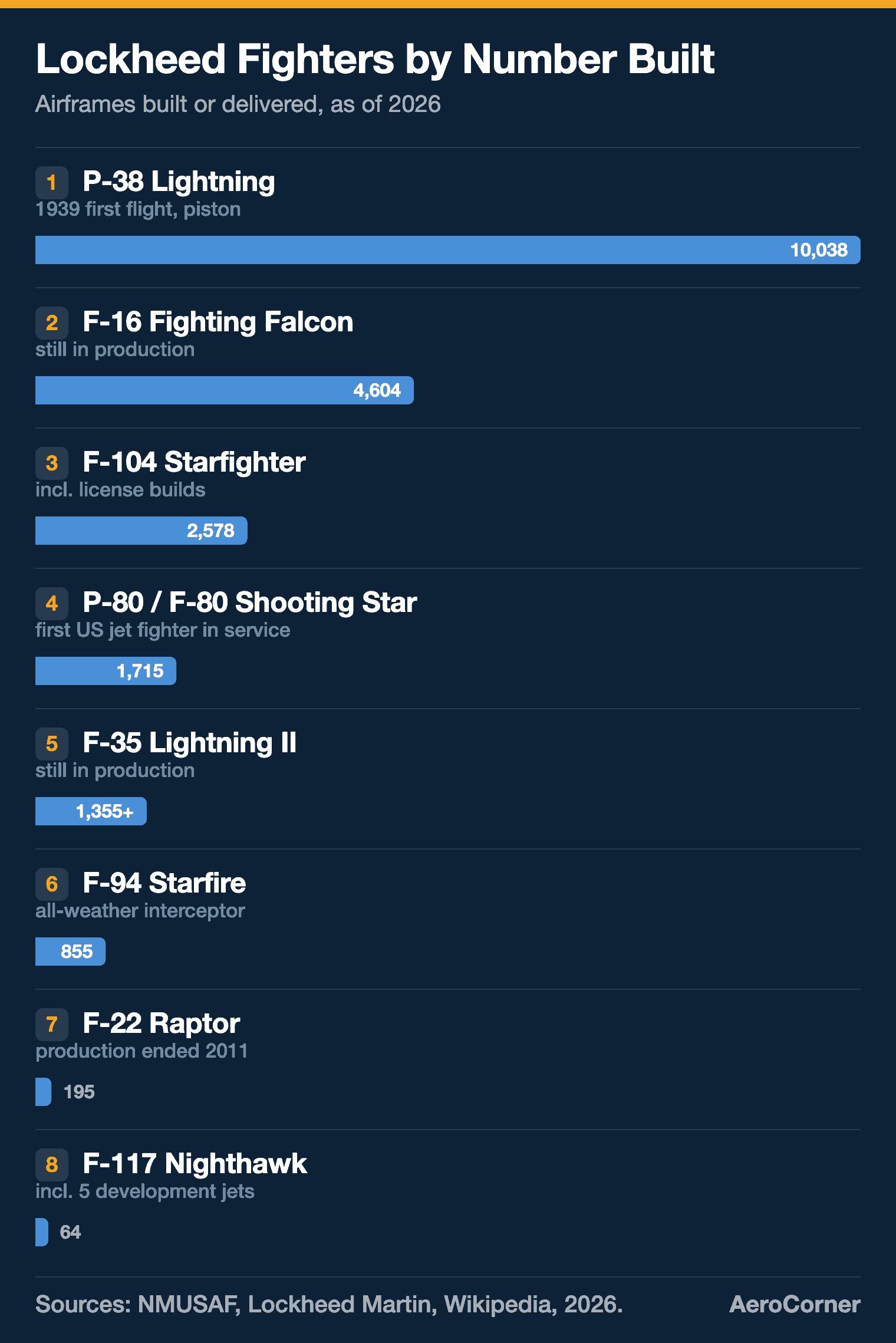
This list ranks eight fighters built by Lockheed or, since the March 1995 merger with Martin Marietta, Lockheed Martin. Each one is judged on what it did against the aircraft of its own day: capability, combat record, numbers built and influence on later fighters.
Two entries are not jets at all in the strict sense: the propeller-driven P-38 and the F-117, a stealth attack aircraft carrying a fighter designation. Both stay, because nobody searching for Lockheed’s fighters expects them to be missing.
| Rank | Aircraft | First flight | Top speed | Built | Status (2026) |
|---|---|---|---|---|---|
| 1 | F-22 Raptor | 1997 | Mach 2 class | 195 | In service |
| 2 | F-35 Lightning II | 2006 | Mach 1.6 (~1,200 mph) | 1,355+ | In production |
| 3 | F-16 Fighting Falcon | 1974 | 1,500 mph (2,414 km/h) | 4,604 | In production |
| 4 | P-38 Lightning | 1939 | 414 mph (666 km/h) | 10,038 | Retired |
| 5 | F-104 Starfighter | 1954 | 1,320 mph (2,124 km/h) | 2,578 | Retired 2004 |
| 6 | P-80 / F-80 Shooting Star | 1944 | 580 mph (933 km/h) | 1,715 | Retired |
| 7 | F-117 Nighthawk | 1981 | 684 mph (1,101 km/h) max cruise | 64 | Retired 2008, still flies in training roles |
| 8 | F-94 Starfire | 1949 | 640 mph (1,030 km/h) | 855 | Retired 1959 |
How this ranking works
Every aircraft here was designed and built by Lockheed or Lockheed Martin and served as a fighter or carried a fighter designation. Modern jets rank on capability today; older ones rank on how far ahead of their rivals they were when new. Prototypes that never entered service, such as the YF-12, and upgrades of other companies’ airframes are covered at the end.
1. F-22 Raptor
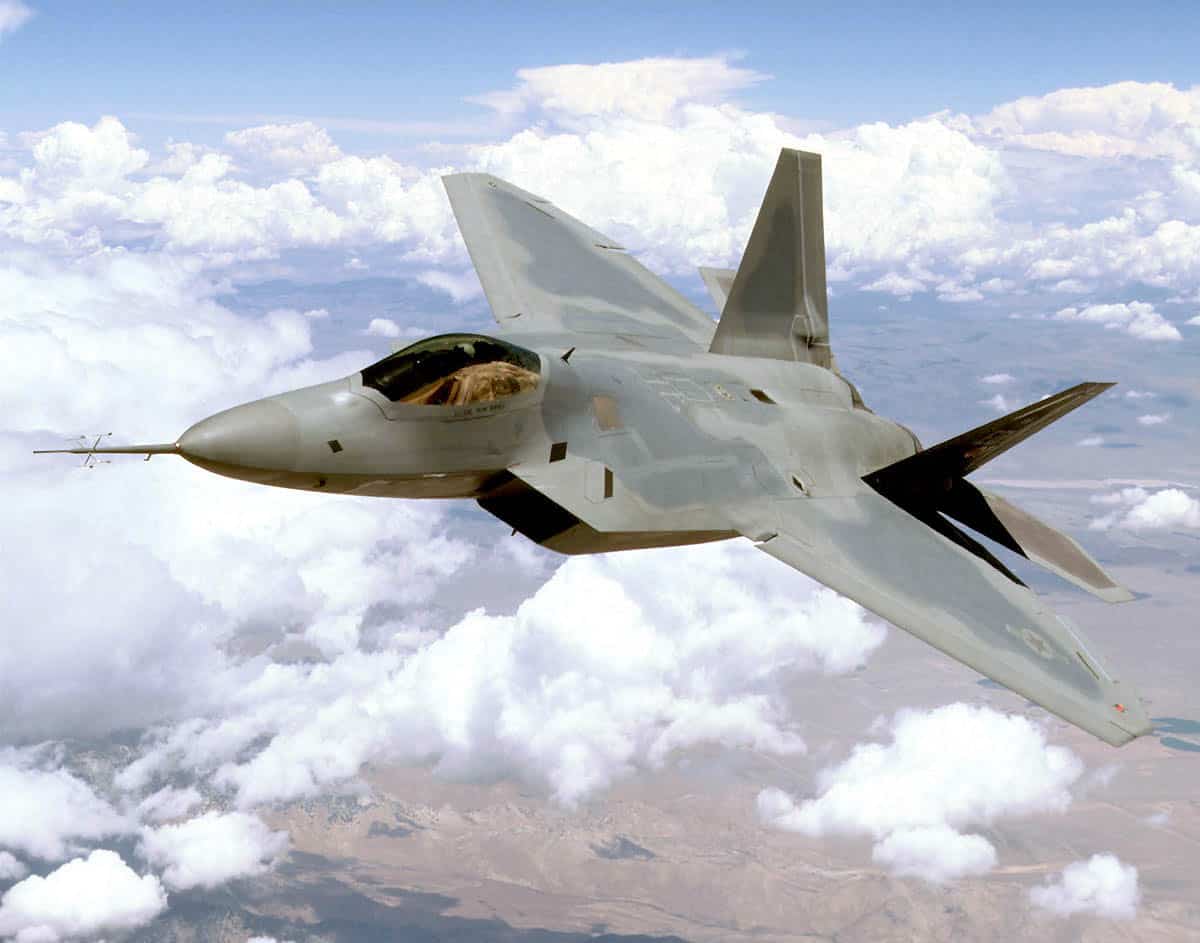
The F-22 Raptor takes the top spot because it was built to do one thing better than anything else in the air: win the fight for air superiority. It reached initial operating capability in December 2005 and combines stealth, thrust vectoring and a sensor suite built to find and shoot first.
Its two Pratt & Whitney F119 engines, each in the 35,000-pound thrust class, let it cruise above Mach 1.5 without afterburner, a trick called supercruise. Top speed is listed as Mach 2 class, the ceiling is above 50,000 feet (15,240 m), and ferry range is more than 1,850 miles (2,977 km) with two external tanks.
Lockheed Martin delivered the 195th and last Raptor on May 2, 2012: 8 test jets and 187 operational aircraft. Congress has barred export sales in every defense appropriations act since fiscal 1998, and the program worked out to about $360 million per production jet once development was counted.
Its first air-to-air kill was a balloon
On February 4, 2023, an F-22 fired a single AIM-9X Sidewinder from 58,000 feet and brought down the Chinese surveillance balloon off South Carolina. It is believed to be the Raptor’s first air-to-air kill, 17 years after the jet entered service.
The Raptor’s replacement will not be a Lockheed design. On March 21, 2025, the Pentagon picked Boeing’s F-47 for the Next Generation Air Dominance program, beating Lockheed Martin; our guide to sixth-generation fighter jets covers what comes next.
2. F-35 Lightning II
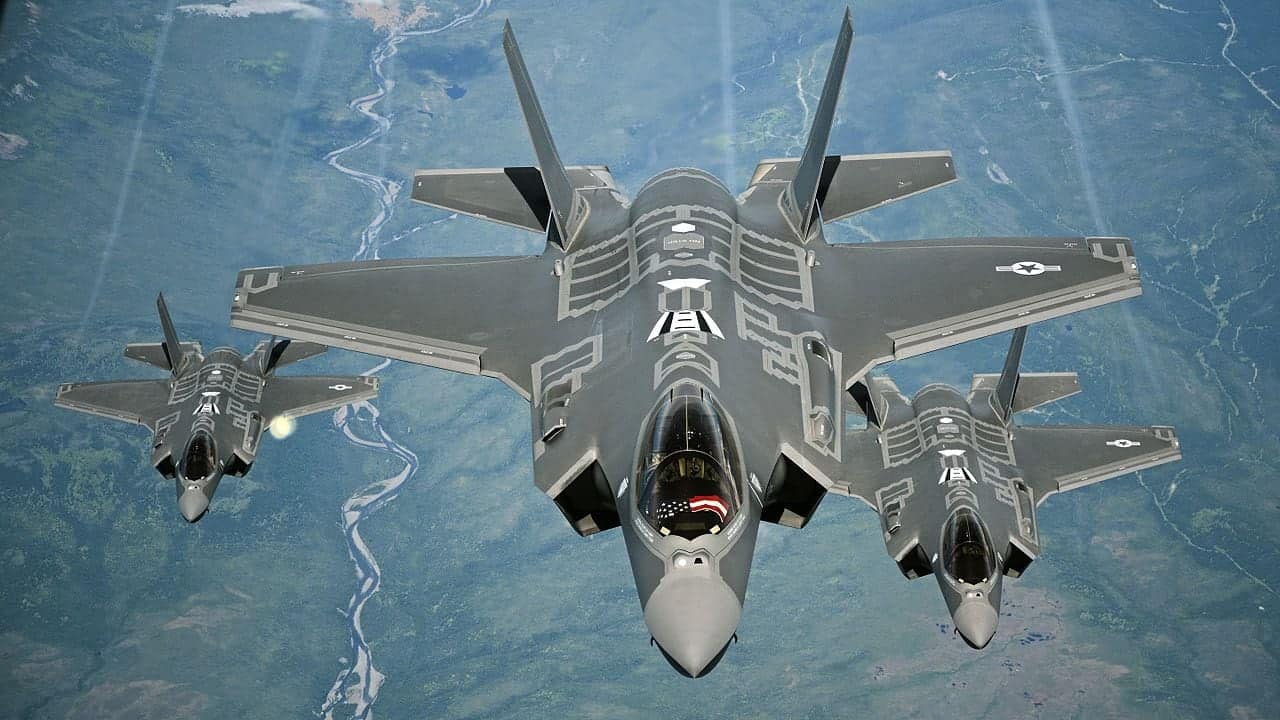
The F-35 Lightning II is second only because it was designed as a stealthy multirole jet rather than a pure dogfighter. By numbers, reach and budget, it is the program that now defines Lockheed Martin.
The first F-35A flew on December 15, 2006, and the type comes in three variants: the F-35A for runways, the short-takeoff F-35B and the carrier-based F-35C. The Air Force lists the F-35A at Mach 1.6 (about 1,200 mph), with a range of more than 1,350 miles (2,173 km) on internal fuel and an 18,000-pound (8,160 kg) payload.
Lockheed Martin had delivered more than 1,355 F-35s by August 27, 2026, including a record 191 in 2025, and the fleet passed one million flight hours in 2025. Israel was the first country to fly it in combat, in 2018.
Price is the other headline. For aircraft delivered from 2026, the flyaway cost is about $92 million for an F-35A, $121.4 million for an F-35B and $110.8 million for an F-35C.
3. F-16 Fighting Falcon

The F-16 is the most-produced jet on this list, but Lockheed did not design it. General Dynamics flew the first official YF-16 flight on February 2, 1974, and sold its aircraft business to Lockheed in 1993.
Its design set the pattern for the light fighters that followed: a bubble canopy, a seat reclined to 30 degrees instead of the usual 13, a side-stick controller and a fly-by-wire control system. It tops out at 1,500 mph (2,414 km/h), Mach 2 at altitude, and can pull nine g with full internal fuel.
4,604 have been built, and Lockheed Martin counted about 3,100 still flying in 29 countries at the end of 2025. Israel scored the type’s first air-to-air kill on April 28, 1981, and its F-16s were credited with 44 kills in the 1982 Lebanon War.
Production now runs at Greenville, South Carolina, on the Block 70/72, which carries an AESA radar and a 12,000-hour structural life. In December 2025 Lockheed Martin reported 104 jets in the backlog and 36 delivered.
4. P-38 Lightning

The P-38 Lightning is a piston fighter, not a jet, but its wartime record earns it a place above most of Lockheed’s jets. Ben Kelsey first flew the XP-38 on January 27, 1939, and on February 11 of that year he set a coast-to-coast record of 7 hours and 48 minutes in it.
Its twin booms and long range made it a natural escort and long-range hunter. Seven of the top eight scoring US Army Air Forces aces in the Pacific flew the P-38, led by Richard Bong with 40 victories and Thomas McGuire with 38.
On April 18, 1943, P-38s flew far enough to ambush and shoot down the aircraft carrying Admiral Isoroku Yamamoto, the planner of the Pearl Harbor attack. The P-38L topped out at 414 mph (666 km/h), and 10,038 Lightnings were built, more than any other Lockheed fighter.
The “Fork-Tailed Devil” nickname is usually credited to German pilots in North Africa, though the story first appeared in a 1943 Life magazine piece and no German source has confirmed it. It sits alongside the other types in our ranking of the best American fighter jets.
5. F-104 Starfighter

The F-104 Starfighter was built for raw speed and climb, and it collected world records to prove it. Tony LeVier flew the XF-104 for the first time on March 4, 1954.
An F-104A set a world speed record of 1,404.19 mph (2,260 km/h) on May 18, 1958, and an F-104C reached 103,395 feet (31,515 m) on December 14, 1959. It was the first aircraft to hold the official speed, altitude and time-to-climb records at the same time.
The Widowmaker
The Starfighter’s record is not clean. West Germany lost 292 of its 916 F-104s between 1961 and 1989, and 116 pilots were killed, a toll that earned the jet its grim nickname there.
The US Air Force bought only about 300, but 2,578 were built in total, most of them for allied air forces, many built under license abroad. Italy retired the last military Starfighters on October 31, 2004.
6. P-80 / F-80 Shooting Star

The P-80 Shooting Star put the United States into the jet age. Kelly Johnson’s team delivered the first airframe 143 days after design work began, and it first flew on January 8, 1944.
It was the first American aircraft to exceed 500 mph (805 km/h) in level flight and the first US Air Force jet used in combat. The F-80C was rated at 580 mph (933 km/h), and 1,715 were built, plus 6,557 of the T-33 trainer derived from it.
On November 8, 1950, 1st Lt. Russell J. Brown was credited with downing a MiG-15 in the first all-jet air battle, though Soviet records show no MiG lost that day. Our list of Korean War fighter jets covers the jets that replaced it over Korea.
7. F-117 Nighthawk

The F-117 Nighthawk ranks here on influence rather than dogfighting, because it was built to drop bombs, not fight other aircraft. It was the world’s first operational stealth aircraft, and it first flew on June 18, 1981.
It first saw combat over Panama on December 19, 1989. In Desert Storm the F-117 fleet flew 1,271 sorties with no losses or battle damage, and the type won the 1989 Collier Trophy.
One was shot down over Serbia on March 27, 1999, by an SA-3 missile, and the pilot was rescued. Lockheed built 64 in all (5 development jets and 59 production F-117As), and the Air Force retired them in 2008, though some still fly in training roles in 2026.
Why a bomber got an F
The F-117 was an attack aircraft, so an A prefix would have been the normal choice. A program manager later said Tactical Air Command’s chief believed top fighter pilots would be more drawn to a jet with an F designation.
Our guide to stealth fighter jets traces how its faceted shape led to the F-22 and F-35.
8. F-94 Starfire

The F-94 Starfire was Lockheed’s answer to a Cold War problem: intercepting bombers at night and in bad weather. It was developed from the P-80 and first flew in 1949.
It was the first US production jet with an afterburner. The final F-94C carried no guns at all, only 24 rockets in the nose plus 24 more in optional wing pods, and reached 640 mph (1,030 km/h).
855 were built in A, B and C models. The last active-duty F-94C left service in 1957, and the Air National Guard retired its final Starfires in 1959.
What About the A-4AR, the YF-12 and the F-21?

The A-4AR Fightinghawk often appears on lists like this one, but it is a Douglas A-4 Skyhawk that Lockheed Martin rebuilt for Argentina. Lockheed Martin Aircraft Argentina converted 36 ex-US airframes (32 single-seat and 4 two-seat) with an APG-66V2 radar, and the first group arrived in December 1997.
Argentina announced the type’s retirement on May 14, 2026, after the first of its ex-Danish F-16s arrived in December 2025.
The YF-12 is the fastest fighter-type aircraft Lockheed ever flew. One of the three prototypes set a speed record of 2,070.101 mph (3,331 km/h) on May 1, 1965, but the F-12B production program was ended in January 1968, so it never entered service.
The F-21 is not a new aircraft either: unveiled at Aero India 2019, it is an enhanced F-16 Block 70 that Lockheed Martin offered to India. For how the company compares with its biggest rival across every program, see Boeing vs Lockheed Martin.
FAQ
Sources and references used for research and fact-checking.
- US Air Force, F-22 Raptor fact sheet
- US Air Force, F-16 Fighting Falcon fact sheet
- US Air Force, F-35A Lightning II fact sheet
- National Museum of the US Air Force, Lockheed P-38L Lightning
- National Museum of the US Air Force, Lockheed F-80C Shooting Star
- National Museum of the US Air Force, Lockheed F-94C Starfire
- National Museum of the US Air Force, Lockheed F-104C Starfighter
- National Museum of the US Air Force, Lockheed F-117A Nighthawk
- Lockheed Martin, F-35 Lightning II Fast Facts, September 2026
- Lockheed Martin, F-35 Breaks Delivery Record, Continues Combat Success in 2025
- Lockheed Martin, F-16 Fighting Falcon Fast Facts, December 2025
- Lockheed Martin, F-16 Block 70/72
- Lockheed Martin, Lockheed Martin Delivers Final Historic F-22 Raptor to U.S. Air Force
- Defense One, F-22 shoots down Chinese balloon off South Carolina coast
- Defense News, Boeing wins contract for NGAD fighter jet, dubbed F-47
- The Aviationist, Argentina retires its A-4 Skyhawks
- Wikipedia, Lockheed Martin F-22 Raptor
- Wikipedia, Lockheed Martin F-35 Lightning II
- Wikipedia, General Dynamics F-16 Fighting Falcon
- Wikipedia, Lockheed P-38 Lightning
- Wikipedia, Lockheed F-104 Starfighter
- Wikipedia, Lockheed P-80 Shooting Star
- Wikipedia, Lockheed F-117 Nighthawk
- Wikipedia, Lockheed F-94 Starfire
- Wikipedia, A-4AR Fightinghawk
- Wikipedia, Lockheed YF-12
- Wikipedia, Lockheed Martin
- The Aviationist, Lockheed Martin offers India enhanced F-16 Block 70 dubbed F-21
Get the Newsletter
The latest aviation news and stories sent to your inbox.
About the Author

Tim is the owner and lead editor of AeroCorner since 2019, overseeing aviation content covering aircraft, airlines, airports, and the broader aviation industry. Through years of researching, writing, editing, and publishing aviation-focused content, he has developed extensive practical knowledge of commercial aviation and air travel. Based in Asia and a frequent traveler himself, Tim also brings firsthand passenger experience to AeroCorner’s coverage. Outside of publishing, he has also explored aviation firsthand through hands-on flight training in New Zealand.