Private Single Engine
Cessna 350 Corvalis
ICAO: COL3
The Cessna 172 Skyhawk is a four-seat, single-engine light aircraft that first flew in 1955 and has been built in greater numbers than any other aircraft.
Updated: by Tim de Vries

The latest aviation news and stories sent to your inbox.
The Cessna 172 Skyhawk is a four-seat, single-engine, high-wing light aircraft and the most-produced aircraft in history, with more than 45,000 delivered since 1956. It first flew on June 12, 1955, and Textron Aviation still builds it today. The specifications on this page describe the current 172S, powered by a 180 hp Lycoming IO-360-L2A.
Live Fleet Activity (C172)
Fetching live data…


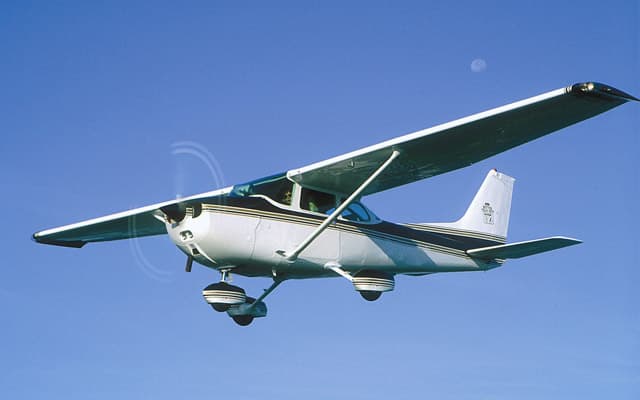
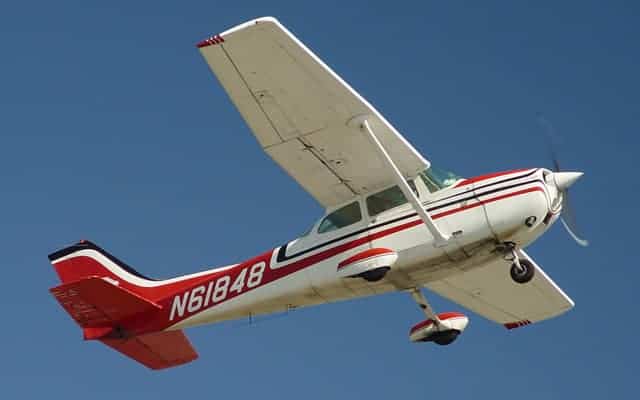


The Cessna 172 Skyhawk is a four-seat, single-engine, high-wing light aircraft with fixed tricycle landing gear. More 172s have been built than any other aircraft, and Textron Aviation says more than 45,000 have been delivered to customers in over 40 countries.
It first flew on June 12, 1955, and the first production aircraft were delivered in 1956. Apart from a ten-year pause between 1986 and 1996, it has been in production ever since.
Most pilots meet the 172 as a trainer, but it also works as a personal airplane, a patrol platform and a military primary trainer. The specifications on this page describe the current production model, the 180 hp 172S.
The 172 started as a nosewheel version of the Cessna 170, a taildragger Cessna had built since 1948. In January 1955 Cessna flew an improved 170C with larger elevators and a more angular tailfin, then fitted it with tricycle landing gear and flew it again on June 12, 1955.
To save time and money, Cessna certified the new airplane as the Model 172 on the Cessna 170’s type certificate. It later received its own certificate.
The 172 sold immediately. Cessna built 1,178 for the 1956 model year, when the airplane listed at $8,700, and more than 1,400 in calendar 1956, its first full year of production.
Cessna marked successive changes with a suffix letter, and its model years ran ahead of the calendar the way car model years do. These are the changes that matter when you are looking at a 172 today.

Licence production ran in France too. Reims Aviation built 172s from the 172D onward under an F172 prefix, including the F172P that later became famous in Moscow.
Some airplanes sold under the 172 name are not 172s on paper. The R172 series shares a type certificate with the Cessna 175 Skylark, not with the original 172.
The best known is the R172K Hawk XP, built from 1977 to 1981 with a derated 195 hp Continental IO-360-K or -KB. Cessna built 1,456 of them, and Reims built another 85 as the FR172K.
The 172RG Cutlass RG, first flown in 1978, added retractable landing gear and a constant-speed propeller behind a 180 hp Lycoming O-360-F1A6. Only 1,191 had been built when production ended in 1985, but it found a niche as an inexpensive flight-school trainer for complex aircraft.
In July 2014 Cessna announced the Turbo Skyhawk JT-A, a factory 172 with a 155 hp Continental CD-155 diesel burning Jet-A. It was priced at $435,000 at launch.
The diesel burned about 3 gal (11 L) per hour less than the standard 172 and stretched range to 885 nautical miles. Sales were poor at twice the price of a diesel conversion, and Cessna discontinued it in May 2018.
Cessna halted 172 production in 1986 because of product liability costs. The last 172Ps were built that year, and no new Skyhawk left the factory for a decade.
Production resumed in 1996 at Cessna’s new factory in Independence, Kansas, with the 172R. The 180 hp 172S Skyhawk SP joined it in 1998, and its engine and weights match the Skyhawk Textron builds today.
New Skyhawks come with the Garmin G1000 NXi integrated flight deck as standard. Textron lists the GFC 700 autopilot, Electronic Stability Protection and Underspeed Protection as options.

In July 2025 Textron made a dual electronic ignition system standard on all new Skyhawks, replacing the dual magneto system. Textron says the solid-state system has fewer moving parts, longer maintenance intervals and lower operating costs.
An April 2026 update added G1000 NXi System Release 7, with Garmin Smart Glide for engine-out guidance. Textron expects aircraft with these upgrades to enter service from late 2026 into early 2027.
The 172’s formula is simple: a high wing that keeps the view of the runway clear, fixed gear, a fixed-pitch propeller, and forgiving low-speed handling. With flaps down and power off, the 172S stalls at 48 knots calibrated airspeed.
That simplicity shows up in the safety data. In an AOPA Air Safety Foundation review of more than 1,600 172 accidents from 1982 through 1988, the aircraft itself was the problem source less than 7 percent of the time.
For much of its history its main rivals were the Beechcraft Musketeer and the Grumman American AA-5, neither still in production. Today it competes with the Piper PA-28 Cherokee, the Diamond DA40 and the Cirrus SR20. Our guide to the best training aircraft and the Cessna 152 vs 172 comparison cover where it fits.
Textron still sells it into the training market. Its Top Hawk program had placed nearly 50 Skyhawks with U.S. and U.K. flight schools and universities by June 2025.
The full specification table for the current 172S is on this page. A few of its figures get quoted against each other, and they only agree once you know the conditions behind them.
Range depends on power setting. The 640 nautical miles (740 miles, 1,190 km) in the panel is Textron’s maximum range. The handbook’s matching figure, 638 nautical miles, is flown at 45% power at 10,000 ft with a 45-minute reserve, and at 75% power at 8,500 ft range falls to 518 nautical miles (596 miles, 959 km).
The 696 nautical mile figure also in circulation is Cessna’s number for the lighter 172R, flown at 55% power at 12,000 ft.
Top speed and cruise speed are 2 knots apart. The handbook gives a maximum speed of 126 knots (145 mph) at sea level. Its cruise speed is 124 knots (143 mph) at 75% power at 8,500 ft, and both assume wheel speed fairings, which Cessna says add about 2 knots.
Fuel burn follows the throttle. The 172S cruise table shows about 10.4 US gal (39 L) per hour at 2,700 rpm and 8,000 ft, and 7.8 gal (30 L) per hour at 2,400 rpm, when leaned as recommended at standard temperature. The panel’s fuel capacity is the total the tanks hold, and 53 gal (201 L) of it is usable.
Four seats is not four adults and full fuel. The panel’s maximum payload is Textron’s useful load, and it has to cover fuel as well as people. Full usable fuel weighs 318 lb (144 kg), which leaves about 560 lb (254 kg) for people and bags.
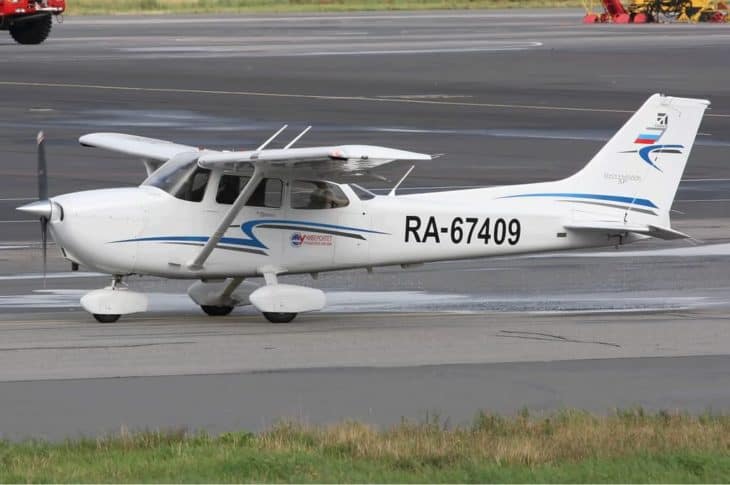
Takeoff and landing distances include the climb-out. The panel shows the distance over a 50 ft obstacle, so the takeoff distance is 1,630 ft (500 m). The landing distance is 1,340 ft (410 m). The ground rolls alone are 960 ft (293 m) and 575 ft (175 m).
From December 4, 1958, to February 7, 1959, Robert Timm and John Cook kept 172 N9172B airborne for 64 days, 22 hours, 19 minutes and 5 seconds. Flying from and back to McCarran Field in Las Vegas, they covered an estimated 150,000 miles (241,000 km) and set the world record for refueled flight endurance.
On May 28, 1987, German teenager Mathias Rust flew a rented Reims F172P from Helsinki through Soviet airspace and landed near Red Square in Moscow without being intercepted. The airplane is now at the German Museum of Technology in Berlin.
In a delivery flight reported in August 2022, ferry pilot Tom Lopes flew a new Skyhawk nonstop from Merced, California, to Honolulu. The 2,190 nautical mile (2,520 miles, 4,056 km) flight took just over 18 hours.
For how the 172’s production total compares with other types, see our list of the most-produced aircraft.
Textron does not publish a list price. The last factory price we can source is $307,500 for a 2012 172S, the figure in this page’s panel, while a 2026 buyer’s guide puts a new Skyhawk above $400,000 and past $500,000 with options. Used 172s cost far less: the same guide puts typical 1970s and 1980s examples at $60,000 to $100,000.
Not on its standard fuel. The 172S carries 53 gal (201 L) of usable fuel and has a maximum range of 640 nautical miles, while Merced, California, to Honolulu is 2,190 nautical miles. Ferry pilot Tom Lopes did make that flight, with a temporary 157 gal (594 L) tank in the rear seat area bringing the total to about 210 gal (795 L).
AOPA’s published summary of its Air Safety Foundation review, which covered more than 1,600 Cessna 172 accidents from 1982 through 1988, gives an overall accident rate of 6.17 per 100,000 flight hours and no separate fatal-accident rate. It found the 172 had a very slight edge over comparable four-seat singles and fewer serious accidents, which AOPA said may reflect its near-universal use as a trainer. The pilot was the primary cause about 85 percent of the time.
The 172S handbook gives 638 nautical miles (734 miles, 1,182 km) in about 6.7 hours at 45% power at 10,000 ft, with a 45-minute reserve. At a faster 75% power setting at 8,500 ft, range drops to 518 nautical miles (596 miles, 959 km) in about 4.3 hours.
A 172S cruises at about 124 knots (143 mph, 230 km/h) at 75% power at 8,500 ft, and its top speed at sea level is 126 knots (145 mph). Its never-exceed speed is 163 knots (188 mph) indicated airspeed.
Textron said in July 2025 that more than 45,000 Cessna 172s had been delivered to customers in over 40 countries. That makes it the most-produced aircraft in history.
The current 172S uses a fuel-injected Lycoming IO-360-L2A producing 180 hp at 2,700 rpm. The 172R used the same engine limited to 160 hp at 2,400 rpm, while most older 172s used the 145 hp Continental O-300 or a 150 hp or 160 hp Lycoming O-320.
Both use the Lycoming IO-360-L2A, but the 172S may run it at 2,700 rpm instead of 2,400 rpm, which raises power from 160 hp to 180 hp. The extra power let Cessna raise maximum takeoff weight from 2,450 lb (1,111 kg) to 2,550 lb (1,150 kg) and the service ceiling from 13,500 ft to 14,000 ft.
The R172K is the Hawk XP, a more powerful 172 variant built from 1977 to 1981 with a 195 hp Continental IO-360-K or -KB engine. It is certified under the Cessna 175’s type certificate rather than the 172’s, and Cessna built 1,456.
Yes. Textron Aviation builds the 172S Skyhawk today and announced avionics and ignition upgrades for new aircraft in 2025 and 2026.
Sources and references used for research and fact-checking.