


Table of Contents
Helicopters fly on two kinds of engine today. Small and training helicopters generally use piston engines, such as the flat, air-cooled Lycoming in the Robinson R22, while everything from the Robinson R66 to the Black Hawk and the Mi-26 uses turboshafts, gas turbines that turn a shaft instead of making thrust.
Five other engine types have lifted helicopters along the way. Radials powered the first practical helicopters, in-line and rotary engines flew in the earliest experiments, tip jets spun rotors with no gearbox at all, and battery-electric drives are still experimental.
Here are all seven, how each one turns a rotor, and which helicopters used them, with the figures checked against the FAA, the manufacturers and the type histories.
| Engine type | How it turns the rotor | Where you find it | Example (engine) |
|---|---|---|---|
| 1. Turboshaft | A gas turbine drives an output shaft | A wide variety of helicopters, light singles to heavy-lifters | UH-60M Black Hawk (2 × GE T700-GE-701D) |
| 2. Horizontally opposed piston | Flat rows of cylinders on a crankshaft | Smaller and training helicopters | Robinson R22 (Lycoming O-360) |
| 3. Radial piston | Cylinders in a star around the crankshaft | From the 1930s until turbines replaced them | Sikorsky S-58 (Wright R-1820) |
| 4. In-line and V piston | Cylinders in straight rows | The earliest experiments | Cornu helicopter, 1907 (Antoinette) |
| 5. Rotary piston | Cylinders spin around a fixed crankshaft | 1920s and 1930s experiments | TsAGI 1-EA (two M-2 rotaries) |
| 6. Tip jet | Jets at the blade tips push the rotor around | 1950s, few built | Sud-Ouest Djinn (178 built) |
| 7. Electric | Battery-powered electric motors | Experiments | Tier 1 Engineering electric R44 |
How a Helicopter Engine Is Different From an Airplane Engine
An airplane engine turns a propeller or makes thrust. A helicopter engine turns a transmission, which sends power to the main rotor, the tail rotor and the accessories, according to the FAA Helicopter Flying Handbook.
Between the engine and the rotor sits a freewheeling unit, a one-way clutch. If the engine fails, it disengages the engine so the main and tail rotors keep turning, which is what makes an engine-out autorotation landing possible.
That job, steady shaft power to a gearbox, is why the engine families below look the way they do. For the airplane side of the story, see our guide to the types of aircraft engines.
1. Turboshaft Engines
A turboshaft is a gas turbine built to make shaft power. Air is compressed, mixed with fuel and burned continuously, and the hot gas spins turbine wheels instead of blasting out the back as thrust.
Most helicopter turboshafts use a free turbine. The first turbine, the gas producer or N1, drives the compressor and keeps the engine running, and a second turbine, the power turbine or N2, sits on its own shaft inside the first and drives the rotors.
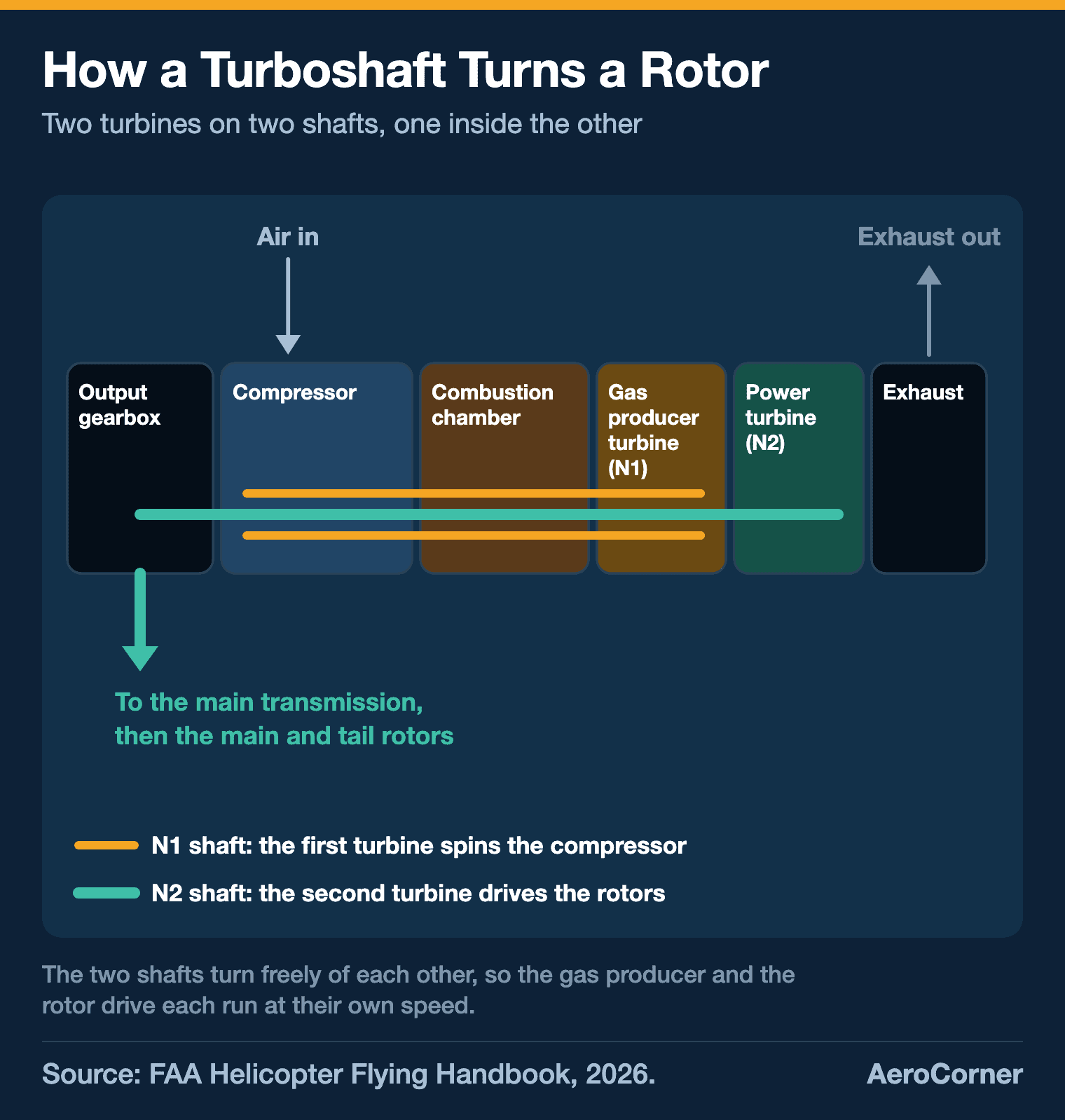
Turbines produce a tremendous amount of power for their size, the FAA says, but are generally more expensive to operate than piston engines. That cost gap is a big part of why helicopters are so expensive to run.
Most of the air is not burned
About 75 percent of the air a helicopter turbine swallows is used to cool the engine, not to burn fuel, according to the FAA Helicopter Flying Handbook.
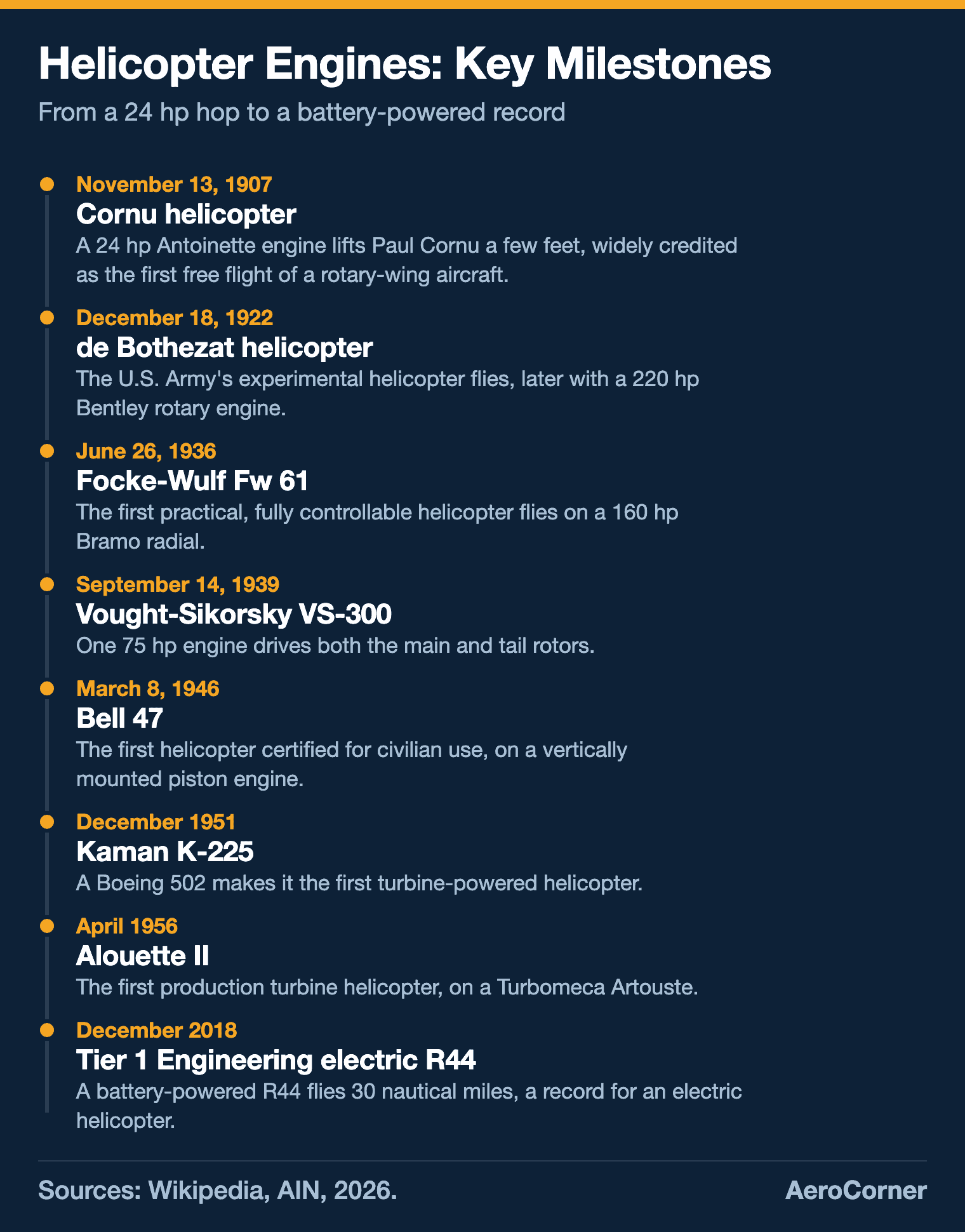
The Kaman K-225 became the first turbine-powered helicopter in December 1951, flying on a Boeing 502. The French Alouette II, on a Turbomeca Artouste, was the first production turbine helicopter in April 1956, and more than 1,300 were built.
Big helicopters stack engines. The UH-60M Black Hawk uses two GE T700-GE-701D engines, each rated at 1,994 shp for 10 minutes and 2,000 shp for 2.5 minutes if the other engine fails. The CH-53K King Stallion carries three GE T408s of 7,500 shp each.
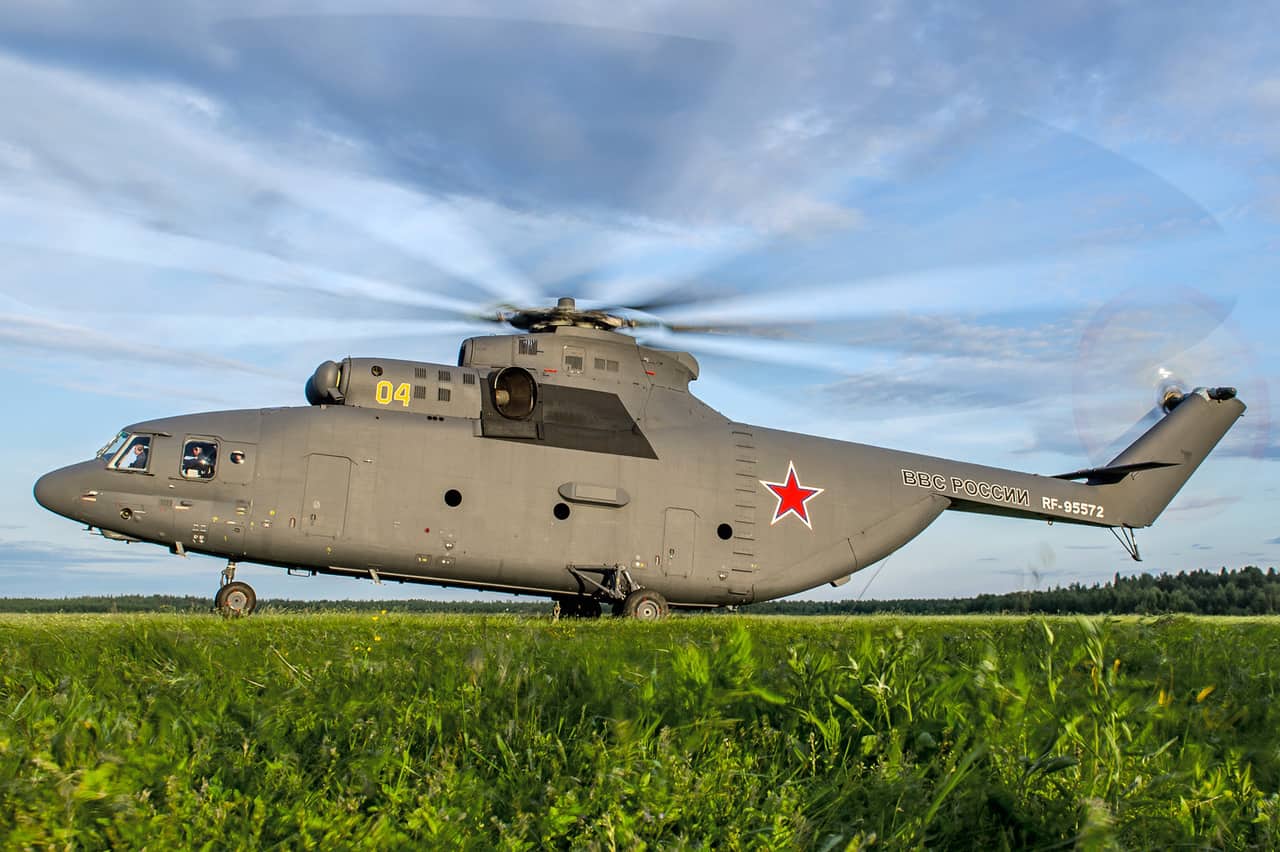
The Mil Mi-26, the largest helicopter ever built in series, lifts on two Lotarev D-136 turboshafts rated at 11,400 hp each at their contingency rating. It also holds the FAI record for the heaviest load lifted to 6,562 feet (2,000 m): 125,154 pounds (56,768.8 kg), set in 1982.

Turbines reach light helicopters too. The Robinson R66 flies on a single Rolls-Royce RR300 turboshaft.
The Helicopter Training Videos channel has a short clip devoted to the sound of helicopter turbines. Watch the “Helicopter Turbine Engines – One of the Best Sounds in the World!” video on YouTube.
2. Horizontally Opposed Piston Engines
A horizontally opposed engine, also called a flat or boxer engine, lays its cylinders in two rows on opposite sides of the crankshaft. Pistons move back and forth to turn the crankshaft, and air flowing over finned cylinders does the cooling.
It is the layout in today’s Robinson piston helicopters. The FAA says most training helicopters use piston engines because they are relatively simple and inexpensive to operate.
The Robinson R22 trainer runs a four-cylinder, carbureted Lycoming O-360 derated to 131 hp for takeoff and 124 hp continuous. Robinson derates it to keep reserve power and to perform better at high altitude and in hot weather.
The four-seat Robinson R44 uses six cylinders. The Raven I has a carbureted Lycoming O-540 derated to 225 hp for takeoff, while the Raven II has a fuel-injected IO-540 derated to 245 hp, both at 205 hp continuous.

Fuel injection matters because carburetors ice. The FAA warns that carburetor ice can stop a piston engine, and that a governor holding rpm steady can mask it forming; Robinson says the injected IO-540 removes the need for carburetor heat.
The layout goes back to the helicopter’s first decade in service. The Bell 47, the first helicopter certified for civilian use on March 8, 1946, flew on Franklin and Lycoming engines of 175 to 305 hp, mounted vertically.


The 47G-3B’s Lycoming TVO-435 is a turbocharged, six-cylinder, horizontally opposed engine of 280 hp. The 47G-2A used the 240 hp VO-435, and the 47G-3 a supercharged 225 hp Franklin.


Igor Sikorsky’s VS-300, which first flew tethered on September 14, 1939, was originally powered by a single 75 hp engine and later by a Franklin. Sikorsky is credited with being the first to power both the main and tail rotors from a single engine. Our article on who invented the helicopter covers the VS-300 and its rivals.
How Much Power Helicopter Engines Make
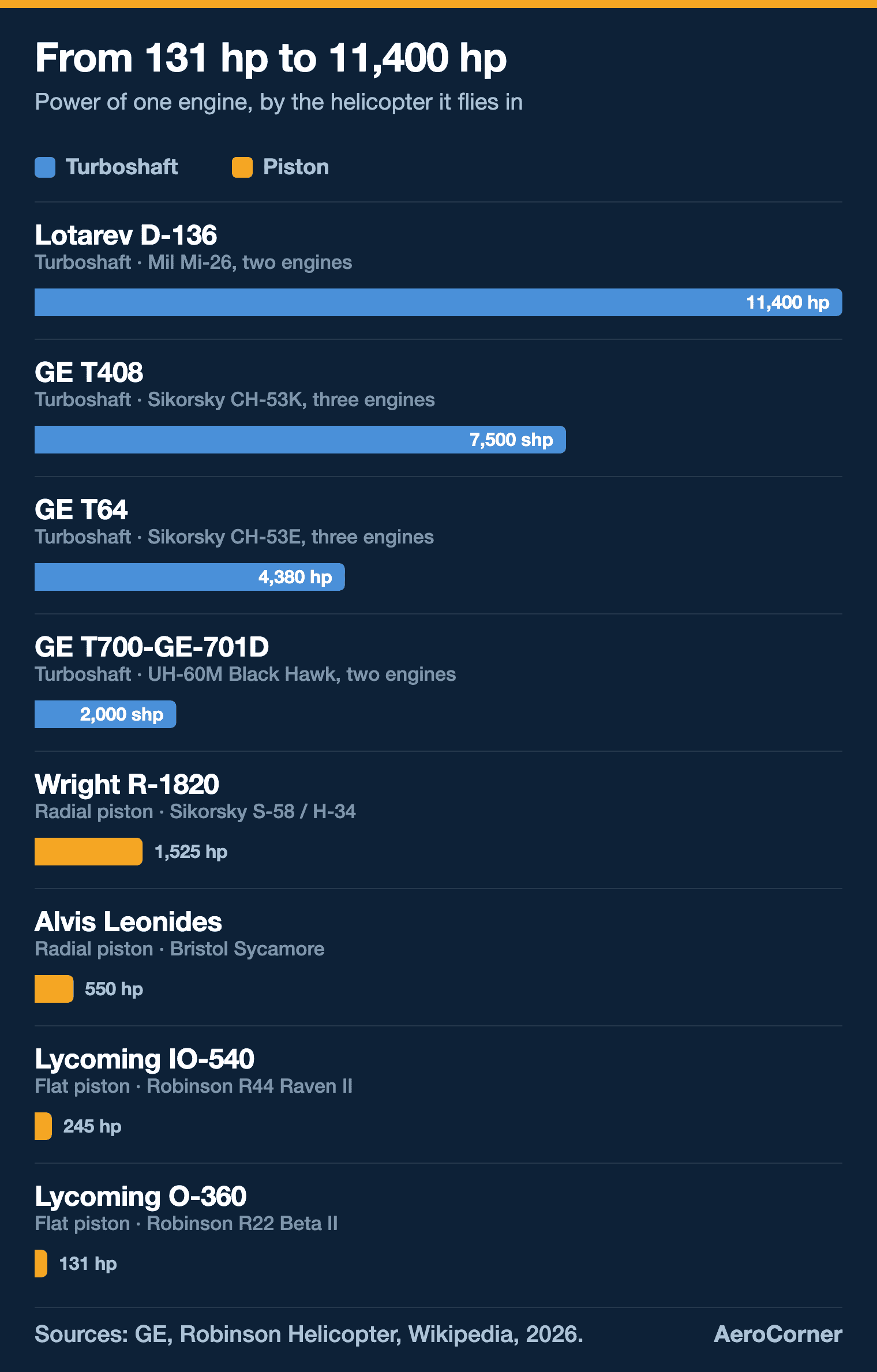
Engine power across the two main families spans almost two orders of magnitude, from a trainer’s 131 hp to a heavy-lifter’s 11,400 hp. The table shows the highest published rating for one engine in each helicopter.
| Engine | Type | Helicopter | Power per engine |
|---|---|---|---|
| Lotarev D-136 | Turboshaft | Mil Mi-26 (two engines) | 11,400 hp |
| GE T408 | Turboshaft | Sikorsky CH-53K (three engines) | 7,500 shp |
| GE T64 | Turboshaft | Sikorsky CH-53E (three engines) | 4,380 hp |
| GE T700-GE-701D | Turboshaft | UH-60M Black Hawk (two engines) | 2,000 shp |
| Wright R-1820 | Radial piston | Sikorsky S-58 / H-34 | 1,525 hp |
| Alvis Leonides | Radial piston | Bristol Sycamore | 550 hp |
| Lycoming IO-540 | Flat piston | Robinson R44 Raven II | 245 hp |
| Lycoming O-360 | Flat piston | Robinson R22 Beta II | 131 hp |
Reading a horsepower figure
Helicopter engines carry several ratings. The T700-GE-701D is rated at 2,000 shp for 2.5 minutes with one engine out, 1,994 shp for 10 minutes and 1,716 shp continuous, and Robinson derates its Lycomings below what they could make. Compare like with like before calling one engine more powerful.
3. Radial Piston Engines
A radial arranges its cylinders in a star around a central crankshaft, and the crankshaft turns while the cylinders stay put. Radials powered the first practical helicopters and the big piston helicopters of the 1950s.
The Focke-Wulf Fw 61, the first successful, practical and fully controllable helicopter, first flew freely on June 26, 1936. It used a 160 hp Bramo Sh.14A, a seven-cylinder, air-cooled radial.
The Sikorsky H-19 (S-55) of 1949 put its radial in the nose, below the crew and ahead of the cabin: a 600 hp Pratt and Whitney R-1340 in early versions and a 700 hp Wright R-1300 later. Sikorsky and its licensees built 1,728.
Britain’s Bristol Sycamore flew in July 1947 on a 550 hp Alvis Leonides radial. On April 25, 1949, it became the first British helicopter to receive a certificate of airworthiness.

The Sikorsky S-58, the U.S. military’s H-34, used a 1,525 hp Wright R-1820 Cyclone, and 2,340 were built between 1953 and 1970. In 1970, Sikorsky began converting S-58s to a pair of Pratt and Whitney Canada PT6T turboshafts, a neat summary of how turbines replaced radials.
4. In-Line and V Piston Engines
In-line engines set their cylinders in one or more straight rows, as in most car engines, and a V engine is two such rows set at an angle. In the helicopter story they appear mostly at the very beginning.
Paul Cornu’s helicopter, widely credited with the first free flight of a rotary-wing aircraft on November 13, 1907, rose perhaps 5 to 7 feet (1.5 to 2 m) for less than a minute. It used a 24 hp engine from Antoinette, the French firm whose engine designer, Léon Levavasseur, patented the V8 layout in 1902.
The practical helicopters that followed used radials, flat engines and then turbines. The Bell 47 photo above shows why the “in-line” label that circulates online is wrong: its cylinders are horizontally opposed, just mounted on end.
5. Rotary Engines
A rotary engine looks like a radial but works the other way around. The crankshaft stays still and the whole crankcase, cylinders included, spins around it, a design widely used in World War I fighters.
Several early helicopter experiments flew on rotaries. The U.S. Army’s de Bothezat helicopter, first flown on December 18, 1922, ended up with a 220 hp Bentley rotary, and the Soviet TsAGI 1-EA used two M-2 rotaries to set an unofficial altitude record in 1932.
Two different engines called rotary
The World War I rotary has pistons and a spinning cylinder block. The Wankel engine is also called a rotary, but it has no pistons: a roughly triangular rotor turns inside a housing shaped like a fat figure eight. Neither has anything to do with the helicopter’s rotor.

6. Tip Jets
A tip-jet helicopter does away with the gearbox. Jets at the ends of the rotor blades push the rotor around, so no engine twists the fuselage against the rotor and no tail rotor is needed.
The French Sud-Ouest Djinn used a “cold” tip jet: a Turbomeca Palouste engine drove a pump to make compressed air, which was blown out through nozzles at the blade tips with no burning there. It was the first tip-jet rotorcraft to enter production, and 178 were built.
The Hiller YH-32 Hornet went further, with a ramjet weighing 13 pounds (5.9 kg) on each blade tip. It suffered from high fuel consumption and poor range, and the ramjets were extremely noisy, a problem we cover in why helicopters are so loud.
7. Electric Motors
The battery-electric helicopters built so far have been experiments, and endurance is the obstacle.
Sikorsky’s Firefly, announced in July 2010, was an S-300C with its 190 hp Lycoming swapped for an electric motor and two lithium-ion battery packs. Sikorsky expected 12 to 15 minutes of operating time, and the helicopter was never flown.
AVweb’s video covers the Firefly demonstrator. Watch the “Sikorsky Firefly: An Electric Helicopter” video on YouTube.
An electric helicopter did fly in 2018. A Robinson R44 modified by Tier 1 Engineering flew 30 nautical miles at 800 feet and 80 knots in December 2018, a record for an electric helicopter.
Piston or Turbine: Which Engine Does a Helicopter Need?
The choice comes down to size and budget. A piston engine is relatively simple and inexpensive to operate, the FAA says, which is why most training helicopters use one.
A turbine makes far more power for its size, which is what heavier helicopters need. The same Robinson airframe family shows the trade: the R44 on a piston engine, the R66 on a turbine.
Twin and triple turbines add a margin when an engine quits: the T700’s contingency rating exists for flight with one engine inoperative. Our guide to heavy-lift helicopters shows where those multi-engine designs end up.
FAQ
Sources and references used for research and fact-checking.
- Federal Aviation Administration, Helicopter Flying Handbook, Chapter 4: Helicopter Components, Sections, and Systems
- GE Aerospace, T700-701D turboshaft engine datasheet
- Robinson Helicopter Company, R22 Beta II
- Robinson Helicopter Company, R44 Raven I / Clipper I
- Robinson Helicopter Company, R44 Raven II / Clipper II
- Robinson Helicopter Company, R66 NXG Palo Verde
- AIN, All-electric R44 sets flight record
- Wikipedia, Turboshaft
- Wikipedia, Mil Mi-26
- Wikipedia, Progress D-136
- Wikipedia, General Electric GE38
- Wikipedia, Kaman K-225
- Wikipedia, Aérospatiale Alouette II
- Wikipedia, Vought-Sikorsky VS-300
- Wikipedia, Bell 47
- Wikipedia, Focke-Wulf Fw 61
- Wikipedia, Sikorsky H-19 Chickasaw
- Wikipedia, Bristol Sycamore
- Wikipedia, Sikorsky S-58
- Wikipedia, Cornu helicopter
- Wikipedia, Antoinette (manufacturer)
- Wikipedia, De Bothezat helicopter
- Wikipedia, Rotary engine
- Wikipedia, Wankel engine
- Wikipedia, Sud-Ouest Djinn
- Wikipedia, Hiller YH-32 Hornet
- Wikipedia, Sikorsky Firefly
Get the Newsletter
The latest aviation news and stories sent to your inbox.
About the Author

Tim is the owner and lead editor of AeroCorner since 2019, overseeing aviation content covering aircraft, airlines, airports, and the broader aviation industry. Through years of researching, writing, editing, and publishing aviation-focused content, he has developed extensive practical knowledge of commercial aviation and air travel. Based in Asia and a frequent traveler himself, Tim also brings firsthand passenger experience to AeroCorner’s coverage. Outside of publishing, he has also explored aviation firsthand through hands-on flight training in New Zealand.