

Table of Contents
No single person invented the helicopter. Frenchman Paul Cornu is usually credited with the first free, piloted helicopter flight, on November 13, 1907, though modern engineering analysis says his machine could only have hopped.
The first practical, fully controllable helicopter was Germany’s Focke-Wulf Fw 61, which first flew freely on June 26, 1936. Igor Sikorsky’s VS-300 followed in 1939 and set the single main rotor and tail rotor layout almost every helicopter still uses.
Sikorsky’s R-4 then became the first helicopter built in large numbers, in 1942. That is why Google’s answer box says “Sikorsky.” The honest answer depends on which “first” you mean, so here is every one of them.
| The “first” | Who | Year | Machine |
|---|---|---|---|
| Coined the word “helicopter” | Gustave de Ponton d’Amécourt | 1861 | Steam-powered model |
| First rotorcraft to lift a pilot (held steady by men) | Louis and Jacques Breguet, Charles Richet | 1907 | Gyroplane No. 1 |
| First claimed free piloted flight | Paul Cornu | 1907 | Cornu helicopter |
| First 1 km (0.62 mile) closed-circuit flight | Étienne Oehmichen | 1924 | Oehmichen No. 2 |
| First practical, fully controllable helicopter | Henrich Focke | 1936 | Focke-Wulf Fw 61 |
| Main rotor plus tail rotor layout proven | Igor Sikorsky | 1939 | Vought-Sikorsky VS-300 |
| First large-scale mass production | Igor Sikorsky | 1942 | Sikorsky R-4 |
| First civil type certificate | Arthur M. Young, Bell | 1946 | Bell 47 |
| First gas turbine-powered helicopter | Charles Kaman | 1951 | Kaman K-225 |
Why the answer is “Sikorsky,” and why that is only half right
Igor Sikorsky did not make the first helicopter to fly. Two French teams had left the ground in 1907, and Germany had a fully controllable helicopter setting records three years before his VS-300 flew.
What Sikorsky did was turn the helicopter into a product. His VS-300 proved the configuration that won, and his R-4 was the first helicopter a military could actually order in quantity. That is a bigger legacy than “first to fly,” which is why his name sticks.
So the fair one-line answer is: the helicopter was invented in stages between 1907 and 1942, by Cornu, Focke and Sikorsky above all, on top of centuries of models and sketches.
Timeline: when was the helicopter invented?
The idea is more than 2,000 years old. A machine that could carry a pilot and be steered took until the 1930s.
c. 400 BC
The Chinese flying top. Children in China play with bamboo toys that spin up and fly, the basic principle of a rotor.
1480's
Leonardo da Vinci’s aerial screw. A design on paper for a machine lifted by a spiral rotor. It was never built.
1754
Lomonosov’s spring-powered model. Russian scientist Mikhail Lomonosov builds a small coaxial model driven by a wound spring.
1784
Feathers for rotor blades. Launoy and Bienvenu demonstrate a contra-rotating model to the French Academy of Sciences.
1861
The word is born. Gustave de Ponton d’Amécourt coins “helicopter” and demonstrates a small steam-powered model.
1877
Forlanini’s steam helicopter. An unmanned model rises 43 feet (13 m) over a park in Milan and stays up for 20 seconds.
Sept. 29, 1907
Breguet-Richet Gyroplane No. 1. The first rotorcraft to lift a pilot, about 2 feet (0.6 m), but four men steady it.
Nov. 13, 1907
Paul Cornu’s free flight. Cornu reports rising about 1 foot (0.3 m) for 20 seconds with no one holding the machine.
May 4, 1924
Oehmichen’s closed circuit. The first 1 km (0.62 mile) closed-circuit helicopter flight, in 7 minutes 40 seconds.
June 26, 1936
Focke-Wulf Fw 61 flies. The first practical, fully controllable helicopter makes its first free flight.
Sept. 14, 1939
Sikorsky VS-300. First (tethered) flight of the design that fixed the main rotor and tail rotor layout.
Jan. 14, 1942
Sikorsky XR-4. First flight of the helicopter that becomes the first mass-produced type.
April 1944
First combat rescue. U.S. Army Lt. Carter Harman flies an R-4 into the Burma jungle to rescue downed airmen.
March 8, 1946
Bell 47 certified. The first helicopter certified for civilian use.
Dec. 1951
Kaman K-225 goes turbine. A modified K-225 becomes the first gas turbine-powered helicopter.
Before engines: toys, sketches and steam models
Every early helicopter idea traces back to the Chinese flying top, a stick with feathered or bamboo blades that climbs when spun. Children were playing with them from around 400 BC.
Leonardo da Vinci drew his “aerial screw” in the 1480s. It is the most famous early design, but it stayed on paper, so da Vinci did not invent the helicopter in any practical sense.
Models came next. Mikhail Lomonosov built a spring-driven coaxial model in 1754, and in 1784 Launoy and Bienvenu showed the French Academy of Sciences a model with turkey feathers for blades.
In 1861 French inventor Gustave de Ponton d’Amécourt gave the machine its name. He built “helicopter” from the Greek helix (spiral) and pteron (wing), and demonstrated a small steam-powered model.
The best of the unmanned steam machines was Enrico Forlanini’s. In 1877 it took off vertically from a park in Milan, climbed to 43 feet (13 m) and hovered for 20 seconds.
Even Thomas Edison tried. In 1885 he was given $1,000 to experiment with flight and built a helicopter, but the experiments ended after one of his workers was badly burned.
1907: the year two French teams left the ground
The first rotorcraft to lift a person was the Breguet-Richet Gyroplane No. 1, built by brothers Louis and Jacques Breguet with Professor Charles Richet. On September 29, 1907, it rose about 2 feet (0.6 m) with its pilot aboard and stayed up for around a minute.
It was not a free flight. The machine was so unstable that four men stood at its corners to hold it steady, and it had no way to be steered.
Six weeks later, on November 13, 1907, Paul Cornu tried in Normandy. Cornu, a bicycle maker, reported that his twin-rotor machine, driven by a 24 hp Antoinette engine, lifted him about 1 foot (0.3 m) for 20 seconds with nobody holding it.

That is the flight most histories call the first helicopter flight, and it is why Cornu is the usual answer to “who invented the helicopter in 1907.”
Did Cornu really fly?
Probably not in any controlled sense. A 2008 engineering analysis by University of Maryland helicopter professor J. Gordon Leishman concluded that with less than 24 hp, it is highly unlikely the Cornu machine ever made a sustained free flight. At best, he wrote, it made brief, uncontrolled hops, and the press exaggerated them. He still credits Cornu as a genuine pioneer.
The 1920s: records, prizes and a detour
After the First World War, inventors in Europe and the United States chased prizes and records with machines that could fly, but only just.
French engineer Étienne Oehmichen set the first helicopter world record recognized by the FAI on April 14, 1924. On May 4, 1924, he flew the first 1 km (0.62 mile) closed-circuit helicopter flight, taking 7 minutes 40 seconds and winning a prize of 90,000 francs.

Raúl Pateras Pescara beat Oehmichen’s first record days later, flying 2,415 feet (736 m) at about 6 feet (1.8 m) off the ground. In Italy, Corradino D’Ascanio’s coaxial helicopter set records in 1930, including 8 minutes 45 seconds in the air.
America had tried too. George de Bothezat built a four-rotor machine for the U.S. Army Air Service, and its best test stayed up for 2 minutes 45 seconds at about 15 feet.
The autogiro is not a helicopter
Spain’s Juan de la Cierva flew his C.4 autogiro in January 1923, and it is often confused with an early helicopter. The difference: an autogiro’s rotor spins freely in the airflow and a separate propeller drives it forward, so it cannot hover. A helicopter powers its rotor. Cierva’s hinged rotor blades fixed the rolling problem that wrecked his earlier designs.
Focke-Wulf Fw 61: the first practical helicopter (1936)
If “invented” means the first helicopter that actually worked, the answer is German engineer Henrich Focke. His Focke-Wulf Fw 61 made its first free flight on June 26, 1936, with Ewald Rohlfs at the controls.
It used two rotors side by side on outriggers, not the layout we know today. But it was stable, fully controllable and could fly for real distances.
On May 10, 1937, it made the first autorotation landing with the engine off, the maneuver every helicopter pilot still trains for. It went on to set records, including an altitude of 11,243 feet (3,427 m) and a straight-line distance of 143 miles (230 km).
In February 1938 test pilot Hanna Reitsch flew it indoors inside Berlin’s Deutschlandhalle sports arena. Only two Fw 61s were built.
Igor Sikorsky and the VS-300: why he gets the credit
Sikorsky was born in Kiev in 1889 and tried to build a helicopter there in 1909 and 1910. His second machine could lift its own 400 pounds (180 kg) but not a pilot, and he concluded the engines and materials of the day were not up to it.
He moved to the United States in 1919 and became a citizen in 1928. He filed a patent for a “direct lift aircraft” on June 27, 1931.
The VS-300 first flew, tethered, on September 14, 1939. Its first untethered flight came in May 1940, and on May 6, 1941, Sikorsky flew it for 1 hour 32 minutes 26 seconds, a world helicopter endurance record.
The layout that won
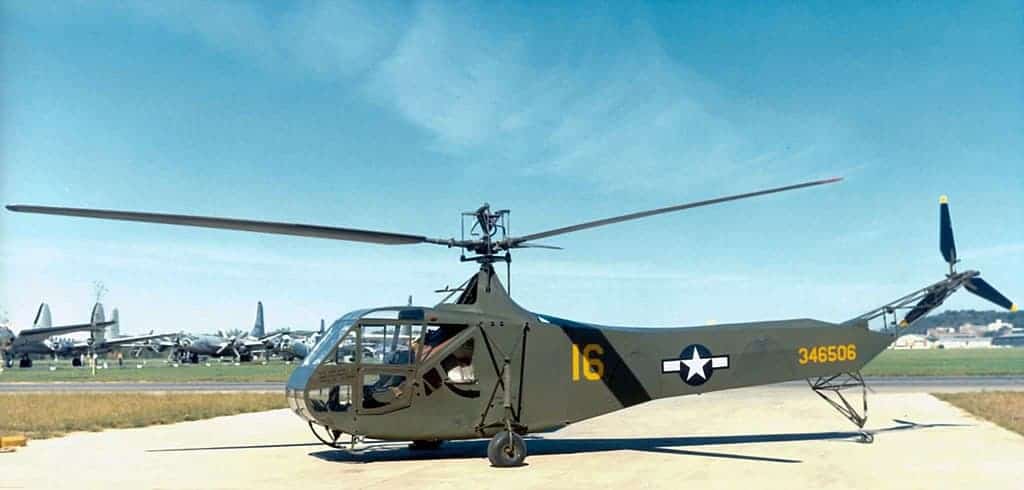
The VS-300 went through four iterations between 1939 and 1943. What came out was one main rotor for lift and one small tail rotor to stop the fuselage spinning. It became the basis for the modern single-rotor helicopter, from a news helicopter to the Black Hawk.
The XR-4, a direct development of the VS-300, first flew on January 14, 1942. Sikorsky built 131 R-4s between 1942 and 1944, making it the world’s first large-scale mass-produced helicopter.
Germany’s Flettner Fl 282 Kolibri is sometimes called the first series-production helicopter. It flew in 1941 and a contract for 1,000 was placed in 1944, but only 24 were ever completed.
The R-4 is also the helicopter that went to war. In January 1944, U.S. Coast Guard Commander Frank Erickson flew blood plasma to survivors of the USS Turner explosion, the first U.S. helicopter rescue. The full wartime story is in our guide to helicopters in World War 2.
On April 22 and 23, 1944, U.S. Army Lt. Carter Harman of the 1st Air Commando Group flew an R-4 into the jungle of Burma and pulled out downed airmen. It was the first combat rescue by helicopter.
After the war: the Bell 47, turbines and the modern helicopter
The helicopter became a civilian machine through Arthur M. Young, who developed the Bell 30 prototypes for Bell Aircraft. The third Bell 30 became the basis for the Bell 47.

The Bell 47 first flew on December 8, 1945, and on March 8, 1946, it became the first helicopter certified for civilian use. More than 5,600 were built between 1946 and 1974, and its military version, the H-13 Sioux, flew medevac missions in the Korean War.

The last big step was the engine. In December 1951 a modified Kaman K-225 fitted with a Boeing 502 turboshaft became the first gas turbine-powered helicopter. That aircraft is now held by the Smithsonian.

France’s Sud Aviation Alouette II turned the idea into a product. The first production Alouette II was completed in April 1956, making it the world’s first production turbine-powered helicopter, and more than 1,300 were built.
Our guide to types of helicopter engines explains how a turboshaft differs from a piston engine, and our breakdown of how far helicopters can fly shows what modern machines can do.
Two decades after the R-4, helicopters were flying troops and casualties in huge numbers, the story we trace in our guide to helicopters in the Vietnam War.
FAQ
Sources and references used for research and fact-checking.
- Wikipedia, History of the helicopter
- J. Gordon Leishman and Bradley Johnson, University of Maryland (AHS 64th Annual Forum, 2008), Engineering Analysis of the 1907 Cornu Helicopter
- Wikipedia, Cornu helicopter
- Wikipedia, Paul Cornu
- Wikipedia, Breguet-Richet Gyroplane
- Wikipedia, Étienne Oehmichen
- Wikipedia, Cierva C.4
- Wikipedia, Focke-Wulf Fw 61
- Igor I. Sikorsky Historical Archives, VS-300: The First Practical Helicopter
- Wikipedia, Igor Sikorsky
- Wikipedia, Sikorsky R-4
- Wikipedia, Flettner Fl 282 Kolibri
- Wikipedia, Bell 47
- Wikipedia, Bell H-13 Sioux
- Wikipedia, Kaman K-225
- Wikipedia, Sud Aviation Alouette II
Get the Newsletter
The latest aviation news and stories sent to your inbox.
About the Author

Tim is the owner and lead editor of AeroCorner since 2019, overseeing aviation content covering aircraft, airlines, airports, and the broader aviation industry. Through years of researching, writing, editing, and publishing aviation-focused content, he has developed extensive practical knowledge of commercial aviation and air travel. Based in Asia and a frequent traveler himself, Tim also brings firsthand passenger experience to AeroCorner’s coverage. Outside of publishing, he has also explored aviation firsthand through hands-on flight training in New Zealand.